

A Monday morning settlement review can expose a problem no demand package will fix. A paralegal opens the settlement statement for a policy-limits case and finds an unpaid emergency-room lien, plus a Medicaid reimbursement claim that nobody logged during intake. The gross recovery hasn't changed, but the client's net has dropped sharply, the disbursement date is uncertain, and the attorney now has to explain why two third parties appeared at the finish line.
That failure isn't really a billing failure. It's a settlement-allocation failure. A medical lien gives a hospital, provider, insurer, or public payer a claim against personal-injury proceeds, so the firm must know who can claim money, how much the claim is worth, whether the claim is legally enforceable, and who owns the next action. Medical lien management works when those questions are answered before settlement pressure peaks.
The risk has also changed. Emerging tort-reform rules in markets including Georgia, Louisiana, and Arkansas increasingly emphasize payer-first billing and medical amounts paid rather than gross amounts billed, according to Aspirion's analysis of new tort-reform laws and hospital liens. The firm that focuses only on reducing liens may miss the earlier problem, overstating recoverable specials before the lien pool is even calculated.
The Settlement Moment That Changes Everything
The settlement moment exposes every unresolved assumption in the file. A provider that treated the client on a letter of protection, a health plan that paid accident-related care, and a government program that issued a reimbursement demand all may look like separate administrative issues. They're not separate once funds arrive. Each claim competes for the same recovery and can delay distribution until the firm reconciles it.
The first operational rule is simple:
Practical rule: By the time a case settles, every potential lien should have an inventory entry, a current balance, a legal basis, and a named owner.
That inventory starts with treatment, not with the demand letter. The case manager should compare the medical chronology, provider list, itemized statements, explanation-of-benefits records, insurance cards, and correspondence. A treatment ledger that lists only the facility name isn't enough. It should show who rendered care, who billed, who paid, the dates involved, and whether the treatment appears connected to the claimed injury.
The federal baseline makes this review more than a matter of professional neatness. Under 42 U.S.C. § 1396p, states generally can't impose liens against a living Medicaid recipient's property before death, subject to limited statutory circumstances. Personal-injury recovery still requires careful reimbursement analysis, because Medicaid, Medicare, private insurers, hospitals, and providers may assert different rights under different authorities.
The new upstream risk
Payer-first billing rules create a second settlement problem. If a provider should have billed available health coverage before asserting a lien, or if a jurisdiction limits medical damages to amounts paid, a gross bill may no longer represent the amount the case can reasonably support. The firm may spend time negotiating a demand that should first have been corrected at the specials stage.
That changes the order of operations. Validate causation and payment data, then assess lien rights, then negotiate reductions. A clean settlement statement is the final output of that process, not the place where the process begins.
What a Medical Lien Actually Is
A medical lien is a legal or contractual claim against money recovered for an injury. It differs from an ordinary medical bill because the claimant asserts a right to reach settlement proceeds, often through a statute, payer agreement, plan language, provider contract, or written notice. The practical consequence is that a valid claim may need resolution before the client receives unrestricted funds, as explained in this overview of how medical liens work in personal-injury cases.
A new case manager can classify most incoming notices by asking two questions: Who paid or provided the care, and what document creates the recovery right?
| Lien Category | Source of Right | Who Asserts | Negotiability |
|---|---|---|---|
| Public payer recovery | Federal or state reimbursement authority | Medicare, Medicaid, TRICARE, or another public program | Often constrained by statute, though unrelated charges, allocation, hardship, and other permitted issues may matter |
| Hospital or provider lien | State lien statute, provider agreement, or letter of protection | Hospital, physician, ambulance company, clinic, or facility | Often negotiable, especially when charges, notice, perfection, causation, or statutory limits are disputed |
| Insurer subrogation | Insurance policy, plan document, or statutory reimbursement right | Health insurer, auto MedPay carrier, or workers' compensation carrier | Depends heavily on funding status, plan language, state law, and payment proof |
| Attorney or case-cost claim | Engagement agreement, charging lien, or advance agreement | Counsel or litigation-cost provider | Governed by the engagement terms and applicable professional or procedural rules |
Four plain-English classifications
Public payer recovery resembles a tax authority's claim on a refund. The program may have paid first and seek repayment after the injury case resolves, but the firm must confirm the statutory authority and the charges tied to the recovery.
A hospital or provider lien resembles a tab secured against a future payment. The provider may accept delayed payment while the case is pending, but the notice and filing requirements can determine whether the tab has enforceable priority.
Insurer subrogation resembles an insurance company stepping into the client's position. It seeks reimbursement for covered care, but the firm should test the plan or policy, payment history, relatedness, and any applicable reduction rules.
An attorney lien or case-cost claim isn't medical in substance, but it affects the same settlement allocation. Keep it visible in the disbursement model so the client sees the full path from gross recovery to net funds.
Federal and State Lien Rules
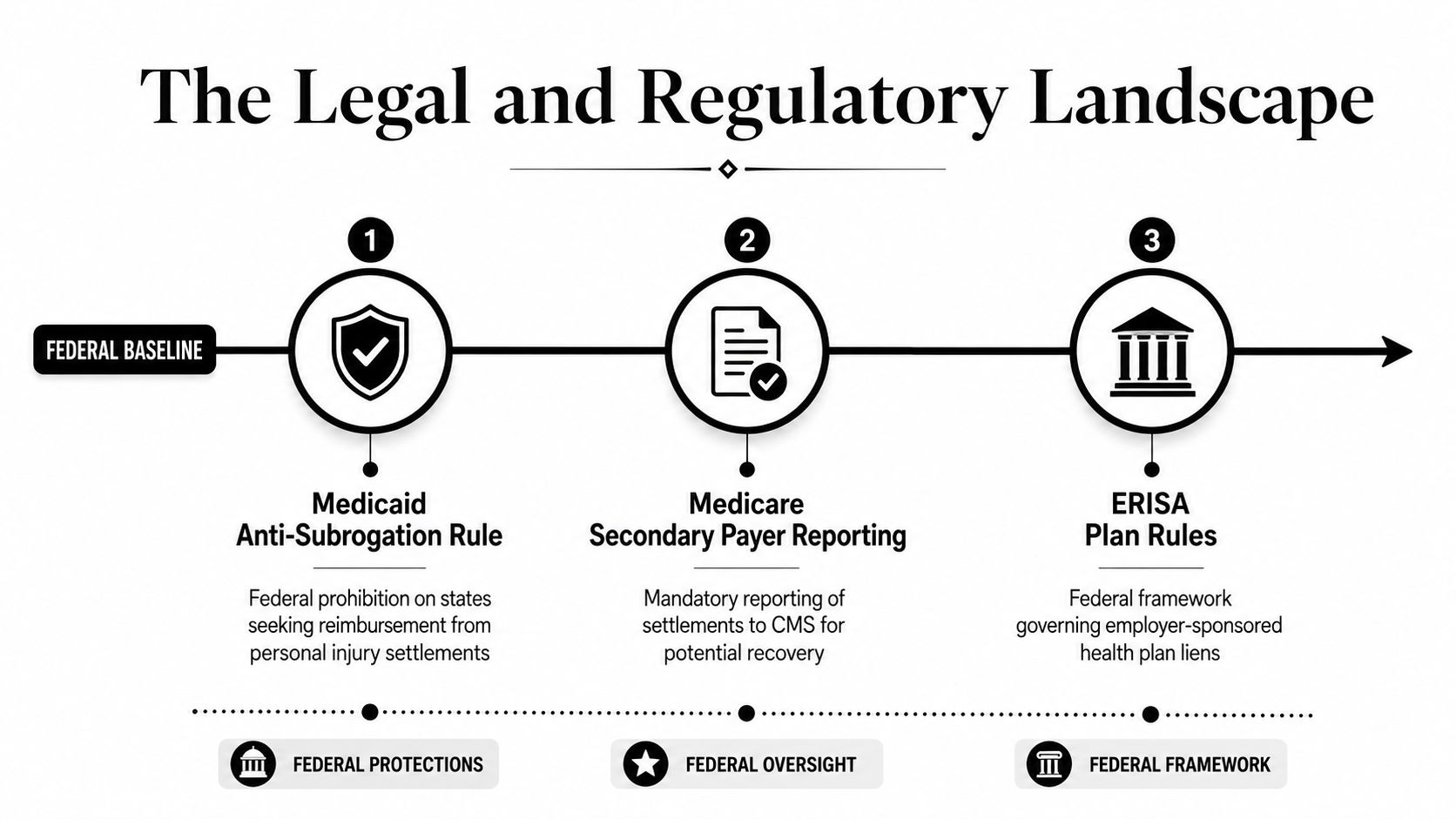
Lien management is a settlement-allocation control problem. A federal rule may restrict one recovery, a state hospital-lien statute may control notice and perfection, and an employer health plan may rely on federal plan language. If a case manager treats every demand letter as an ordinary invoice, the firm can miss the legal basis for the claimant's authority and overstate what the settlement must fund.
Medicaid requires careful classification. Federal law generally restricts liens against a living Medicaid recipient's property before death, subject to limited exceptions, as noted earlier under 42 U.S.C. § 1396p. State rules can still establish recovery procedures involving benefits and settlements. Virginia, for example, gives the Commonwealth a lien for amounts paid under specified public medical programs. Washington's statute addresses how provider liens interact with settlement payment and discharge.
Record Medicare, Medicaid, private insurer, and provider claims as separate entries. They do not follow one universal priority formula. A provider's use of the word “lien” does not, by itself, establish an enforceable claim or determine what the client must pay.
State procedure changes the settlement math
State law may determine whether a hospital claim attaches, what notice is required, how the lien must be perfected, and whether the settlement documents must provide for payment and discharge. Washington's lien statute illustrates the practical effect: a settlement does not discharge a hospital or provider lien unless the settlement itself provides for payment and discharge. California maintains a formal Medi-Cal personal-injury recovery process through its Department of Health Care Services, showing why government recovery should be handled through an established workflow rather than informal billing correspondence.
The 2025 to 2026 tort-reform shift adds a front-end valuation issue. In states identified in the supplied reform analysis, providers may need to bill health insurance before filing liens, while recoverable medical damages may be tied to amounts paid instead of amounts billed. The defensible specials can therefore be lower before negotiations begin. The file must capture EOBs, payment evidence, adjustments, and payer status, not only provider invoices.
HIPAA-compliant document management supports controlled movement of sensitive records among intake, case management, negotiation, accounting, and counsel. The operating objective is an auditable chain from treatment to payment to settlement allocation, so the demand reflects recoverable specials and the disbursement reflects verified obligations.
The Lien Lifecycle From Intake to Disbursement
Lien work should follow the matter timeline, with a gate review at every phase. The firm needs a defined output before the case advances, otherwise unresolved claims get pushed forward until settlement creates artificial urgency.
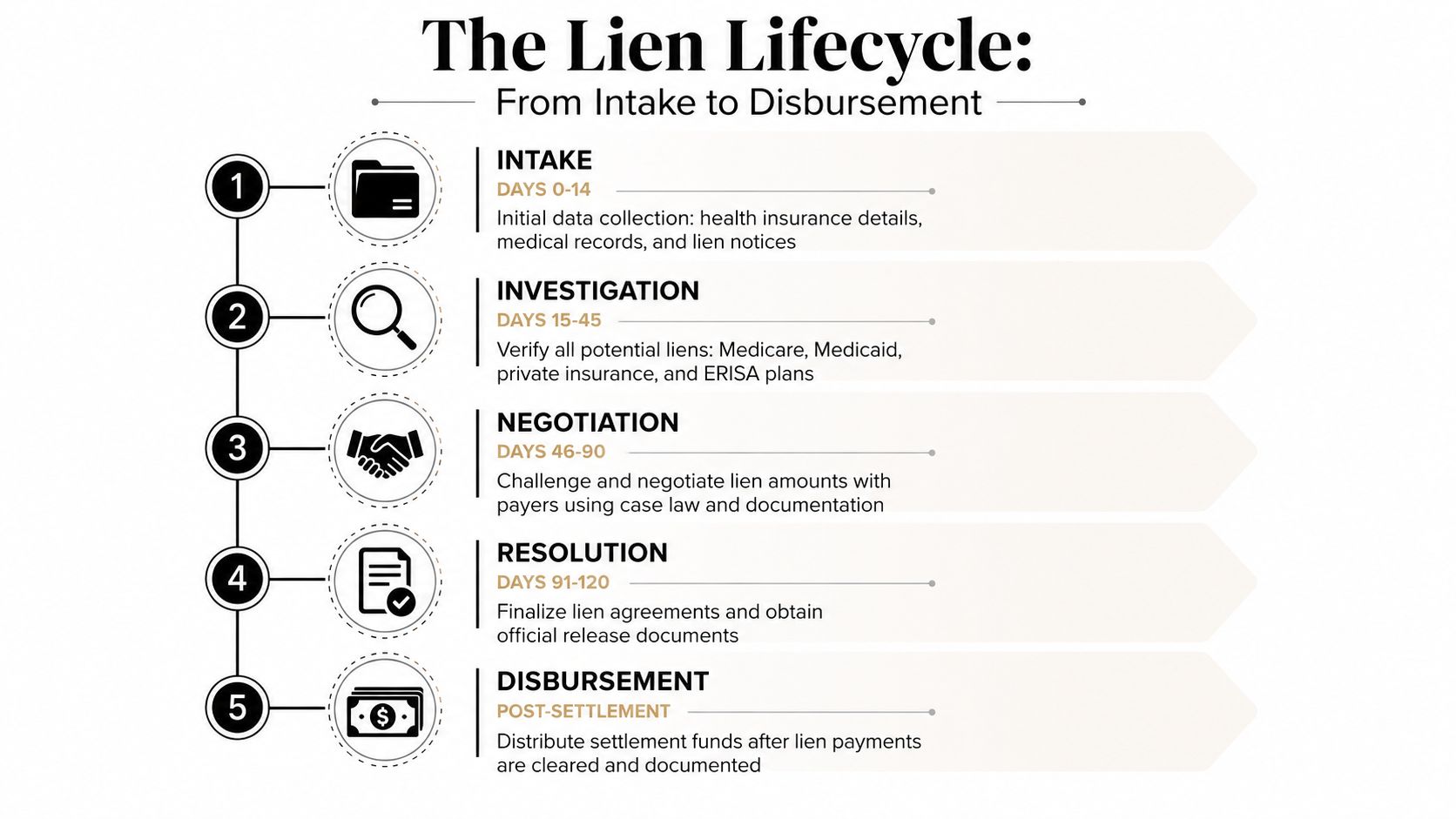
Five phases with a required output
Intake. Capture health-plan information, Medicare and Medicaid indicators, provider names, insurance cards, accident details, and signed authorizations. Flag every treating provider that may assert a lien. The gate is a complete payer and provider map, not merely a signed representation agreement.
Treatment. Reconcile the treatment ledger against bills, EOBs, records, and provider correspondence. Save each lien notice as a date-stamped PDF and record the claimant, account number, asserted amount, statutory or contractual basis, and response deadline. The gate is a current register with no unexplained provider or payer gap.
Demand preparation. Before the demand goes out, request final balances, itemized charges, payment records, and payoff terms from every known claimant. Match charges to dates and causation, then separate billed amounts from amounts paid or contractually allowed. The gate is a specials package that can withstand both liability scrutiny and lien review.
Negotiation and settlement. Once the recovery range becomes realistic, prioritize the claims, calculate available funds, apply applicable caps or pro rata rules, and document every concession. The gate is a signed allocation memo supported by written lien responses.
Disbursement. Pay approved amounts from the trust account, obtain satisfactions or conditional release language, and reconcile the trust ledger to the settlement statement. The gate is documentary closure, not just a cleared check.
Firms can align these gates with their existing claim life cycle. A case should never move from settlement approval to distribution merely because the carrier has funded the account.
Operating Workflow for PI Firms
A workable system assigns one person to each action and gives the matter-management system a status field that another person can audit. Shared responsibility sounds collaborative, but it often means nobody owns the deadline.
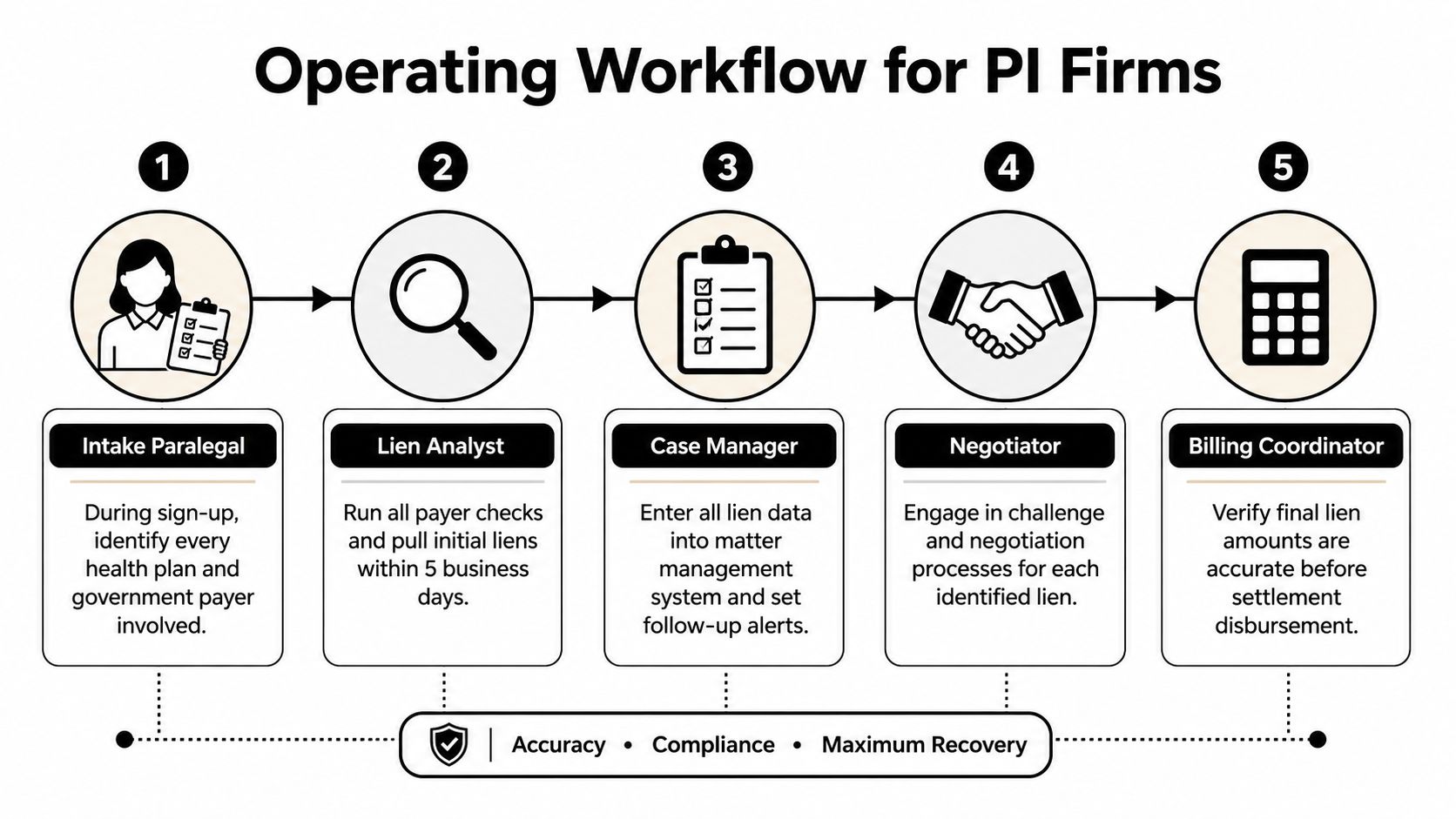
Ownership by stage
| Role | Responsible Action | Approval or Review |
|---|---|---|
| Intake paralegal | Identify health plans and government-payer indicators, upload cards, obtain authorizations, and trigger lien exposure flags | Case manager reviews missing intake fields |
| Lien analyst or case manager | Run payer checks, reconcile treatment and EOB data, and maintain the lien register | Supervising paralegal reviews unresolved entries |
| Pre-demand paralegal | Request final balances, itemized codes, plan documents, payment proof, and reduction packages | Attorney reviews specials and legal exposure |
| Negotiating attorney | Select the negotiation order, challenge unsupported claims, approve reductions, and sign the allocation memo | Managing attorney or assigned reviewer handles exceptions |
| Billing coordinator or disbursement accountant | Issue payments, obtain releases, and reconcile the trust ledger | Attorney confirms distribution authorization |
The intake file should include insurance cards, government-program indicators, provider names, authorizations, accident information, and any letter of protection or provider agreement. Before demand, add itemized statements, EOBs, payment ledgers, lien notices, plan documents, filing or service proof, and current payoff requests. After settlement, preserve written reductions, payment confirmations, satisfactions, release language, and the final allocation memo.
Automate the handoffs, not the judgment
A case-management system can create alerts for missing payer data, stale balances, unanswered requests, and unsigned reduction letters. It can't decide whether a charge relates to the accident or whether a state statute was properly perfected. That decision remains with trained staff and counsel.
Lead intake deserves the same discipline. Firms evaluating using SkipCalls for injury intake should make sure the intake process captures payer information and treatment-provider details, rather than collecting only contact and incident data. A fast sign-up that creates a blind lien file isn't operational efficiency.
Negotiation and Reduction Strategies
Negotiation works better as an algorithm than as a sequence of hopeful phone calls. Start with the claim's legal strength, then test the amount, then calculate what the limited recovery can support. A reduction request without evidence is a discount appeal. A reduction request tied to defects, payment records, causation, and client hardship gives the claimant a reason to change its position.
The decision order
Private health-plan subrogation and contracted claims often deserve early review because plan language, waiver provisions, funding status, and common-fund arguments can determine the available influence. Hospital and provider claims come next, with attention to notice, perfection, treatment relatedness, reasonableness, statutory limitations, and duplicate billing. Public payer claims require authority and exhaustion review before counsel treats the demand as final.
Ask for the plan document, assignment or agreement, itemized charges, procedure codes, EOBs, proof of payment, lien filing, service evidence, and payoff terms. Don't negotiate against a rounded balance when the claimant hasn't shown what it paid or why every line belongs in the injury case.
| Lien Type | Priority Order | Primary Reduction Lever | Documentation to Request |
|---|---|---|---|
| Private health-plan subrogation | First review | Plan language, funding status, relatedness, common-fund or contractual defenses | Full plan, summary documents, EOBs, payment ledger |
| Hospital or provider lien | Second review | Perfection, statutory limits, reasonableness, causation, duplicate charges | Filed notice, service proof, itemized bill, treatment records |
| Public payer recovery | Counsel-directed review | Statutory authority, unrelated charges, allocation, approved waiver or compromise options | Conditional or final demand, payment history, allocation records |
| Workers' compensation or MedPay claim | Parallel review | Policy terms, statutory coordination, payment proof, fee contribution | Policy, payment ledger, lien notice, carrier calculation |
A disciplined settlement model
Suppose a policy-limits recovery is $100,000, client specials are $45,000, asserted liens total $60,000, and attorney fees are $33,333. Those figures come from the supplied worked example, not a universal formula. If the firm verifies the claims, applies available legal limits, and reaches a combined lien figure of $40,000, the client's net improves by $20,000 compared with paying the full asserted liens, before considering case costs and any other permitted deductions.
That model also reveals the danger of using gross bills as settlement value. If only paid amounts support recoverable damages in the applicable jurisdiction, the firm must correct the specials analysis before arguing that a large lien should be reduced.
A counter-offer should state the verified balance, the disputed charges, the legal or procedural defect, the settlement constraints, the proposed payment, and the deadline for written acceptance. Attach the itemized comparison, EOB or payment evidence, relevant filing records, settlement statement, and any hardship or pro rata support. Every agreement should specify whether it is a final satisfaction or only a conditional release.
Two Cases Side by Side
The clean file and the messy file can have the same operational destination, a settlement check, but very different client experiences. The difference is usually visible long before the check arrives.
In Case A, the firm identified Medicaid during intake, tracked the claim, and built a negotiation package around hardship, statutory limits, and pro rata treatment. The lien was asserted at $24,000 and resolved for $8,600 on a $185,000 policy-limits recovery, leaving $76,000 net to the client under the supplied case facts. The file moved because the firm had evidence ready before the settlement became urgent.
Case B involved a $310,000 commercial-truck settlement. A hospital lien appeared late with imperfect service, a workers' compensation carrier asserted reimbursement against the recovery, and a Medicare conditional payment survived the initial review. The scramble reduced what should have been a six-figure net by roughly $42,000, according to the supplied scenario. The problem wasn't merely that the claims were large. The file lacked a timely, negotiation-ready record.
| Case | Gross Settlement | Liens Identified | Lien Asserted | Lien Paid | Net to Client | Time to Disbursement |
|---|---|---|---|---|---|---|
| Clean file | $185,000 | Medicaid identified at intake | $24,000 | $8,600 | $76,000 | Controlled by early resolution |
| Messy file | $310,000 | Hospital, workers' compensation, and Medicare claims surfaced during closing | Not fully consolidated before settlement | Not fully consolidated before settlement | Net reduced by roughly $42,000 | Delayed by scramble and unresolved claims |
These examples aren't a promise that every Medicaid claim can be reduced to the same figure or that every late lien fails. They show why the firm should separate asserted amount, legally collectible amount, negotiated payoff, and amount paid. A settlement statement that collapses those fields hides risk.
Building a Repeatable Lien System
A repeatable system measures the work that changes client recovery, not the number of letters sent. Four useful indicators are the average reduction on the firm's major lien types, the time from intake to lien identification, the time from demand to final resolution, and the share of settlements that close within the firm's chosen service standard. Management should review those measures by lien category and responsible owner, because one strong average can conceal a recurring hospital or ERISA failure.
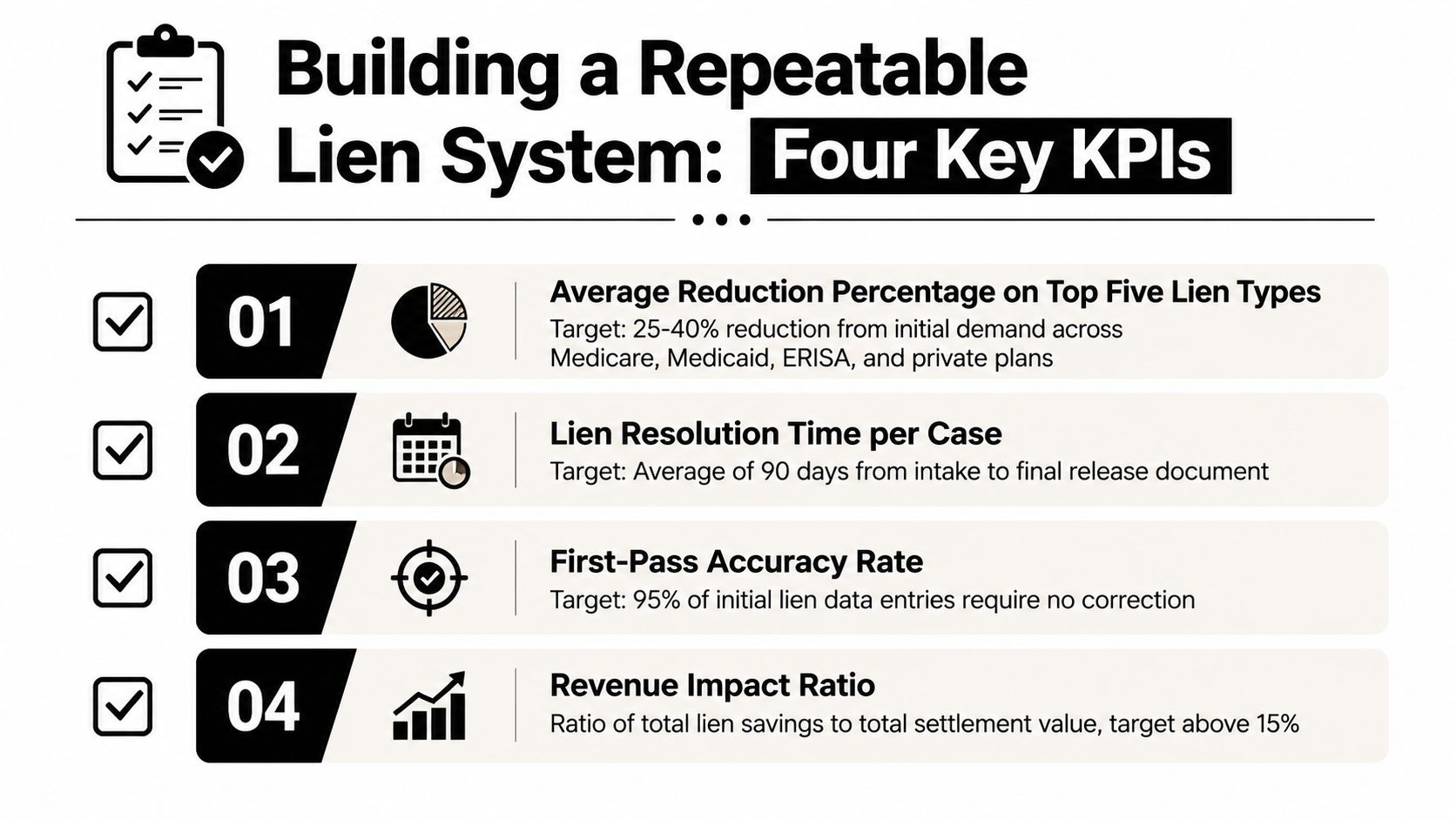
Find the failure before it reaches accounting
Late hospital discovery usually points to an incomplete provider map or an unreviewed EOB. An unreduced ERISA claim often means nobody obtained the governing plan document. A stale Medicare balance indicates that the file lacked a refresh trigger. An unsigned reduction letter is a closing-control failure, not a negotiation failure.
Build artifacts that survive turnover:
- Intake checklist: Require payer indicators, cards, authorizations, provider names, and EOB or EOR review triggers.
- Lien register: Track claimant, source of right, asserted amount, verified amount, owner, status, next deadline, and supporting documents.
- Allocation template: Force the attorney to list every lien, proposed payoff, disputed amount, fees, costs, and client net before distribution.
- Decision tree: Route public payer, provider, ERISA, MedPay, and workers' compensation claims to the right reviewer with deadlines.
- Quarterly review: Compare reductions, aging, missing documents, and disbursement delays against prior internal performance.
The strongest system doesn't depend on one experienced paralegal remembering every payer. It creates an auditable path from intake to release and makes exceptions visible while the firm still has influence.
The objective isn't to negotiate every demand downward. It's to distribute only the amount the file, the law, and the settlement actually support.
Ares can support this process by organizing medical records into summaries that identify dates, diagnoses, treatments, providers, and symptom chronology, while its drafting feature can produce letters of representation with lien notifications. To strengthen your firm's settlement-allocation controls, visit Ares and evaluate how it fits into your records and demand workflow.