
A structured settlement is a negotiated personal injury or tort resolution that pays the claimant in scheduled periodic payments rather than one lump sum, usually funded through a single-premium fixed annuity bought by the defendant or insurer, and in qualifying physical-injury cases the payments are generally tax-free to the recipient. In 2022, the U.S. structured settlement industry paid out more than $6.2 billion in annual annuity payments to about 350,000 recipients, so this isn't a niche settlement device, it's a mainstream compensation tool.
If you're reviewing a draft, the central question isn't whether a structure sounds safe in the abstract. It's whether the payment schedule, tax treatment, and post-settlement transfer rules fit the client's life, because a bad structure can be harder to unwind than a bad lump-sum choice.
What a Structured Settlement Means for Personal Injury Cases
A structured settlement is the cleanest way to describe a settlement that replaces part or all of a tort recovery with a stream of future payments. In practice, that means the client does not receive one check for the full settlement value. Instead, the client receives a series of payments that can be designed to start immediately, arrive monthly or annually, or kick in later when a child reaches adulthood or retirement age.
The working definition PI lawyers should use
For a personal injury lawyer, the key point is not the textbook definition alone. It's that the defendant or carrier usually funds the obligation through an annuity, which shifts the payment promise into a form that can be priced, scheduled, and administered over time. That matters because the negotiation dynamic changes once the parties start talking about future cash flow instead of a single number.
The appeal is straightforward. A structure can provide predictable income, help protect against rapid dissipation, and fit long-term needs like wage replacement or future care costs. It can also preserve the tax advantage that applies in qualifying physical-injury cases, which is often the feature clients remember least until the draft is on the table.
Practical rule: If the client's biggest risk is not under-settlement but poor long-term money management, a structure deserves serious consideration.
Why this matters in real cases
A junior associate should think about a structure as a settlement design choice, not a boilerplate add-on. The payment schedule affects negotiation, the release language affects tax treatment, and the client's later options are constrained by whatever is signed now. That's why the case file needs to answer basic questions before anyone starts drafting, like whether the case is likely to resolve through periodic payments, whether the client needs immediate liquidity, and whether a deferred schedule would better match the injury horizon.
A useful frame is this, the structure is doing three jobs at once, paying over time, protecting tax treatment, and imposing discipline. If it does all three well, it can be a strong result. If it only solves one problem while creating a liquidity problem, it can be the wrong answer even in a strong case.
How a Structured Settlement Actually Works
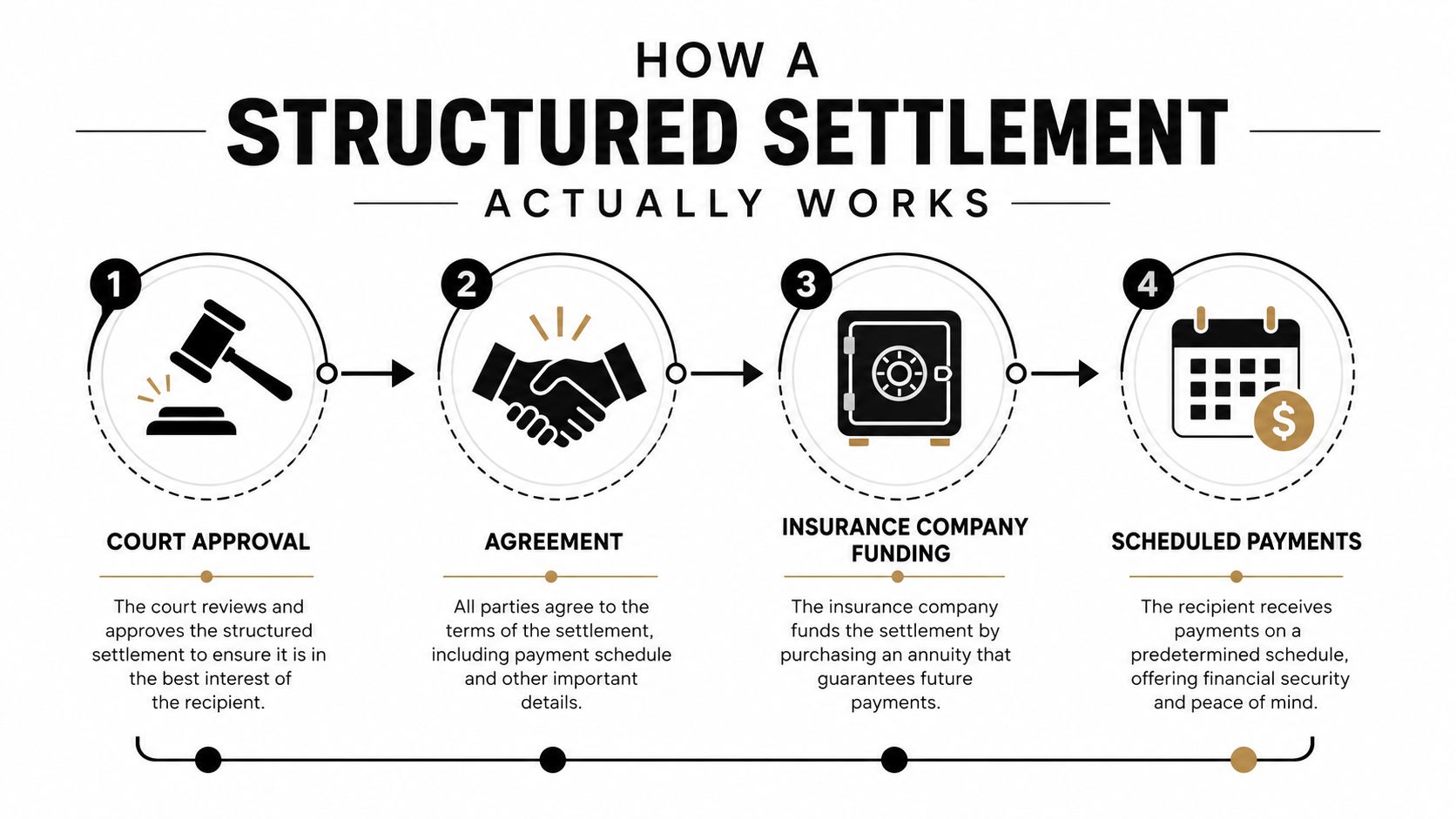
The transaction is a triangle, not a straight line. The claimant settles the tort claim, the defendant or insurer agrees to fund a payment stream, and a life insurer usually issues the annuity that makes the future payments possible.
The parties and their roles
The claimant is the person receiving the compensation. The defendant or obligor is the party responsible for settling the claim. The annuity issuer is the life insurer that takes over the funding side by issuing the policy that pays according to the agreed schedule.
That division of labor matters because the settlement obligation and the annuity contract are related, but they are not the same thing. The legal release resolves the claim. The annuity then performs the funding function in the background, which is why the draft has to be precise about who promises what and what happens if the issuer fails to perform.
How the payment schedule gets built
The schedule can be customized to the client's needs. A claimant might receive monthly payments right away, one larger payment later for college or retirement, or a series of stepped payments that change over time. The structure can also include survivor benefits, deferred start dates, or a balloon payment, depending on the economics of the case and the carrier's pricing.
The practitioner's job is to match the payment pattern to the actual loss pattern. Wage replacement wants regularity. Future medical needs may justify different timing. Family protection may call for survivor language. A generic schedule is usually a mistake because the whole point of the structure is customization.
The best structures are built backwards from the client's future expenses, not forwards from whatever payment stream the carrier first offers.
The industry scale shows why this workflow matters. In 2022, U.S. structured settlement annuity payments exceeded $6.2 billion to roughly 350,000 recipients industry data. That volume reflects ordinary case administration, not exotic planning, so every PI team should know how the mechanism works before the settlement conference starts.
Tax Treatment and the Legal Framework That Protects It
The tax result is the main reason many clients and lawyers still prefer structures in physical-injury cases. A properly structured recovery is designed so the recipient receives periodic payments that are generally excluded from income tax when the underlying claim fits the physical-injury rules, and the modern market expanded after the federal tax changes that encouraged their use, as described in the historical review.
Why the tax benefit is not automatic
The tax result depends on the claim and the drafting. The injury has to fit the qualifying framework, and the structure has to be set up the right way. If the underlying case is not a qualifying physical-injury matter, or if the payment stream is handled poorly, the expected tax treatment can change.
Clients hear “tax-free” and assume the label follows the money everywhere. It does not. The protection comes from the legal structure of the settlement, not from the simple fact that payments are spread out over time.
The legal documents carry the tax result
The settlement agreement, release, and funding documents should all reflect the intended structure. If those documents are vague, the carrier may still fund the annuity, but the tax and assignment consequences can become harder to defend later. Precision in the paperwork preserves the result.
The market keeps growing, which is one reason the drafting discipline matters. An industry review estimated 2022 production at about $5.44 billion, while NSSTA later described 2023 as a record year at $8.623 billion in premium volume, and the same historical review explains that expansion. That growth shows practitioners are using these structures more often, not that the documents can be treated casually.
Drafting rule: The release should identify the structure clearly, tie it to the qualifying settlement, and avoid loose language that makes the payment character harder to preserve.
Structured Settlement vs Lump Sum
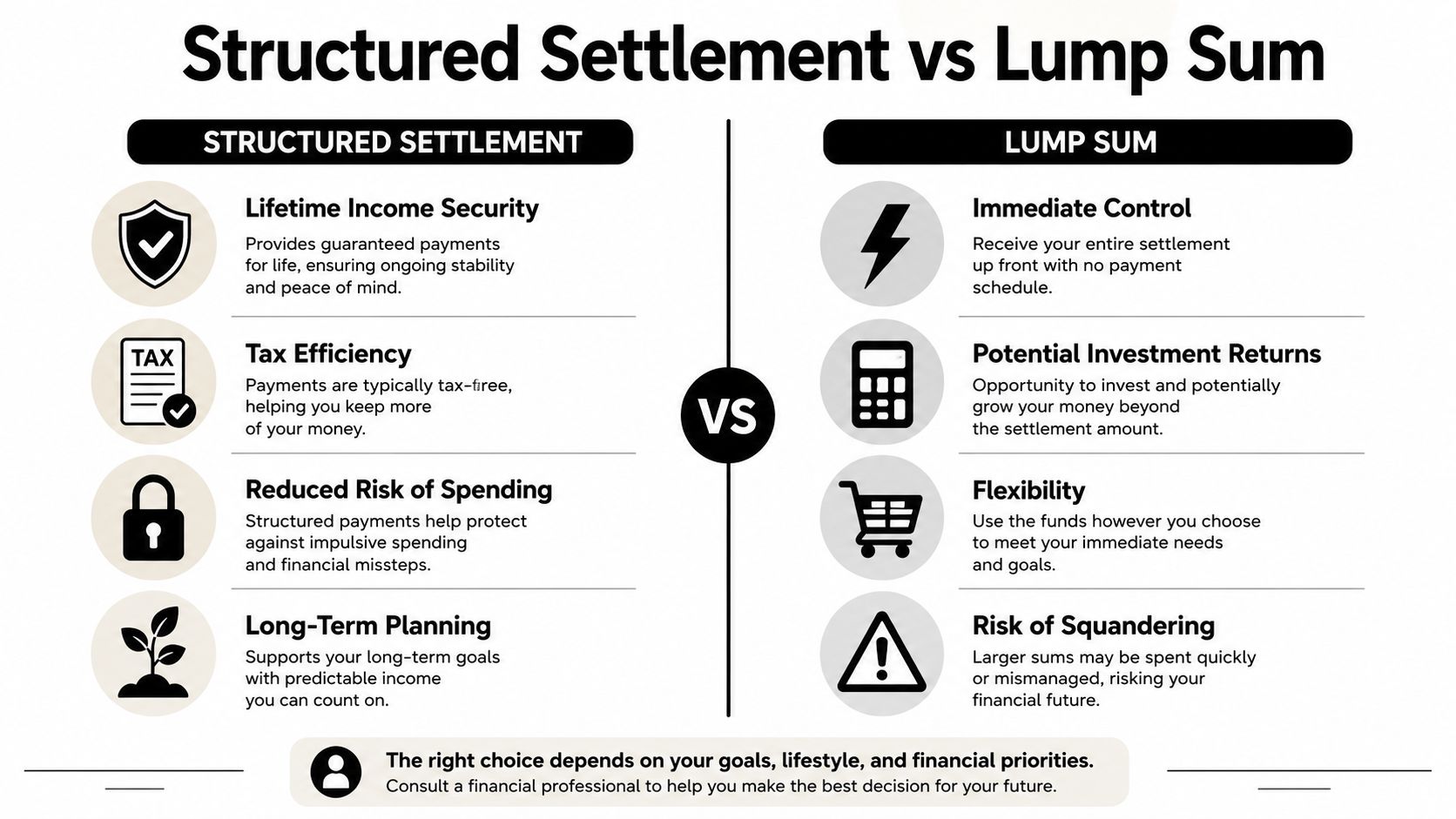
The right choice usually comes down to four things, security, tax efficiency, liquidity, and discipline. A structure tends to win when the client needs long-term income and protection from fast spending. A lump sum tends to win when the client needs flexibility, immediate control, or a different investment plan.
Where the structure is usually stronger
A structure is usually stronger when the client wants predictable income over time. That can be especially useful for people replacing wages, managing future care costs, or trying to avoid the common problem of exhausting a recovery too quickly. It's also a better fit when the client values certainty more than control.
The Washington state legislative study gives a useful reality check. It found that typical structured settlement payouts clustered around a median of $90,000 and a mean of $96,207, with 50% of settlements falling between $60,000 and $120,000 Washington legislative study. That's the range where disciplined payment design often matters more than flashy economics.
Where the lump sum still makes sense
A lump sum wins when the client has concrete uses for immediate capital. That can include paying down debt, buying accessible housing, funding business needs, or handling needs the structure can't match cleanly. It also gives the client direct control over investment timing and spending decisions.
The core issue is not which option is “better” in the abstract. It's whether the client can handle the responsibility that comes with a large immediate payment. If the answer is yes, a lump sum may be the right tool. If the answer is no, a structure can be a practical safeguard, not just a tax play.
For a deeper negotiation lens on settlement value and bargaining power, it can help to review how to increase settlement value before you decide whether a structure or cash should anchor the deal.
Present Value, Discount Rates, and Why the Same Payout Is Worth Different Money
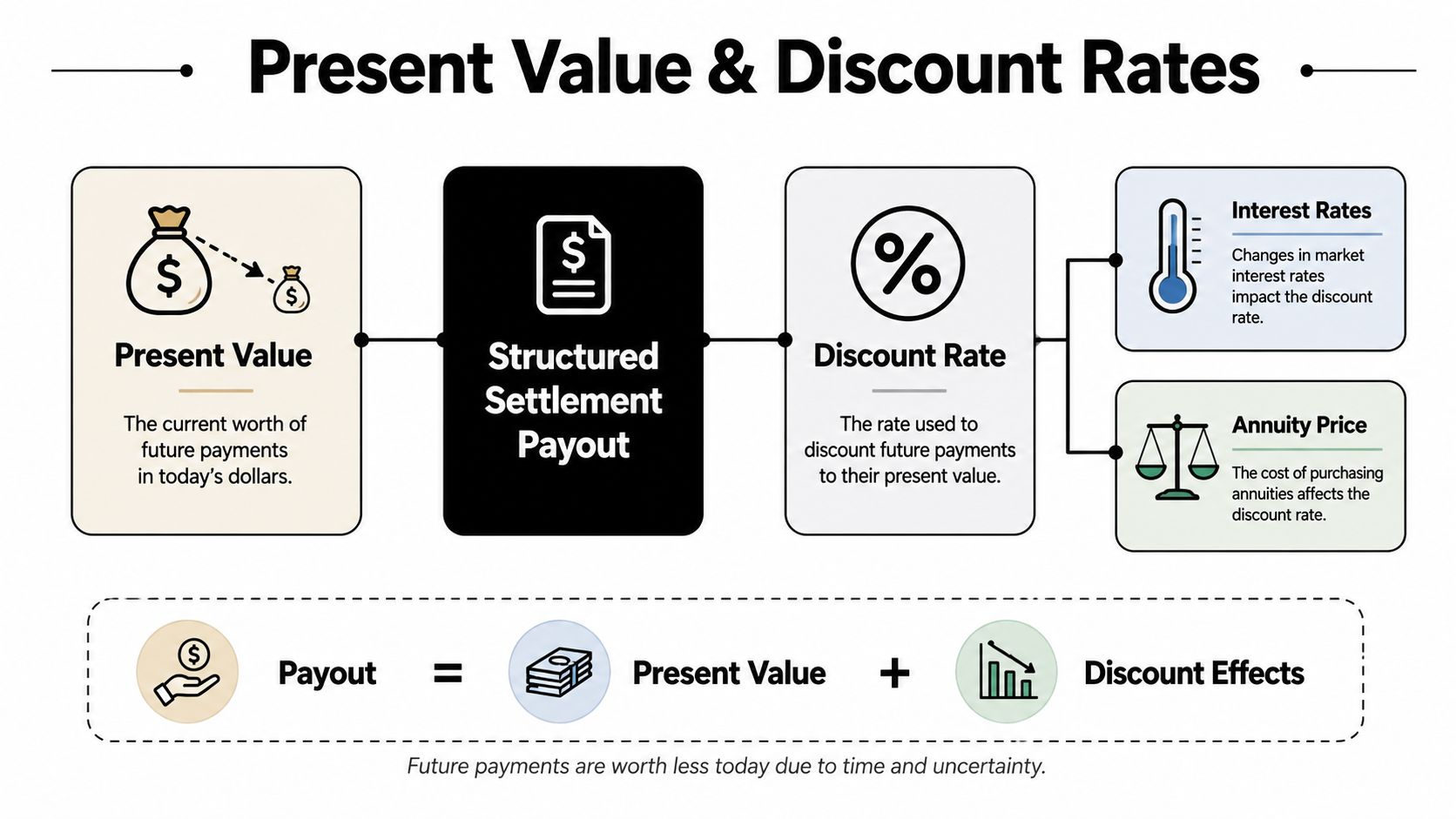
The same nominal payout can carry very different economic value depending on when the money arrives. That's why structured settlement valuation starts with present value, not the face amount on the schedule.
The math behind the settlement quote
A deferred payment is worth less today than a payment made now, because the recipient gives up the use of the money in the meantime. The insurer prices that delay using its discount assumptions, along with mortality assumptions, expenses, and the timing pattern built into the schedule. In the market, pricing discount rates for top-rated carriers are often described in the high single digits, which is why future dollars are not treated as if they were cash in hand.
That's the hidden point of difference. Two structures with the same face value can cost very different amounts depending on timing. A payment stream that starts soon is more expensive than one pushed far out. A schedule with larger late payments may also price differently from a smoother stream.
Why timing choices can make or break value
A client does not always need the highest nominal payout. A lawyer needs the payment pattern that best fits the loss, then needs to understand how the insurer will price it. If the deferred portion is too aggressive, the economics can deteriorate because the annuity is being asked to support payments far in the future under assumptions that may not line up with the client's needs.
Practical rule: Compare offers on present value, not on the sticker price of the schedule.
A simple way to keep the analysis grounded is to ask what the client needs now, what can be deferred, and what should never be deferred. For future medical planning, the numbers need to reflect the actual care timeline, which is why calculating future medical expenses belongs in the settlement discussion long before the final draft.
The practical takeaway is blunt. A structure is not a pile of equal dollars spread across time. It's a priced stream, and the price changes as the timing changes.
Selling Future Payments Through Factoring
A structure only stays valuable if the claimant keeps the payment stream. Once future payments are sold, the claimant is in the secondary market, and the economics change fast.

How factoring works in practice
A factoring company buys the right to receive future payments for a lump sum today. The company pays less than the face value of the stream because it is taking on the wait, the collection risk, and the time value of money. The longer the stream and the farther out the payments, the more expensive the cash-out typically becomes for the recipient.
That discount is the entire story. A client who needs quick cash may focus on the upfront payment and ignore how much value disappears in the spread. Once the sale closes, the headline tax benefit may still exist on paper, but the client has converted future protected income into discounted cash.
Court approval is not a formality
Most states require court approval for the transfer of structured settlement payment rights. The judge typically reviews whether the deal is fair, whether the claimant understands the transaction, and whether the discount makes sense in light of the claimant's situation. Independent counsel is often part of the process, especially when the court needs assurance that the transfer is informed, not just expedient.
The best way to think about factoring is that it's a second settlement decision, not a side transaction. If the client is considering it because of emergency expenses, the transfer may be understandable. If the client is doing it because the original structure was never explained, the issue is counseling, not liquidity.
Cashing out future payments should trigger the same level of review as the original settlement, because the economic loss is real even when the paperwork looks simple.
For additional context on the broader after-settlement transfer issues, see this discussion of structured settlement transfers and payment-right rules.
Negotiation Levers and Drafting Language for the Settlement Agreement
The key factors are the ones that change the shape of the stream. That means timing, duration, deferred starts, survivor benefits, and the ability to specify or substitute the annuity issuer if the deal allows it.
The levers that matter most
If the client needs near-term relief, push for earlier payments or a hybrid structure. If the loss is long-tail, consider extending the stream rather than concentrating too much value up front. If family protection matters, add survivor language instead of assuming the remaining payments will do the job automatically.
The draft should make the structure unmistakable. A settlement agreement should identify that part of the consideration is to be satisfied through periodic payments, name the qualified assignee or funding mechanism if one is being used, require the obligor's cooperation in procuring the annuity, and preserve the obligor's responsibility if funding fails. Loose wording creates later disputes, especially when the client or carrier believes the payment promise was broader than the final paper says.
A quick drafting checklist
- Define the payment stream clearly: State the amount, start date, frequency, and duration in plain terms.
- Name the funding party correctly: Identify the assignee, obligor, and annuity issuer role so the paperwork matches the economics.
- Protect the fallback: Make sure the obligor's obligation does not vanish if the annuity issuer does not perform.
- Match the release to the structure: The release should track the settlement economics, not just the liability compromise.
- Check for beneficiary language: If death benefits or survivor payments matter, the draft needs to say so.
| Common Drafting and Negotiation Pitfalls | Why It Matters | Fix |
|---|---|---|
| Vague payment dates | Ambiguity makes administration and enforcement messy | State exact start dates and intervals |
| Missing survivor terms | Family protection may disappear by default | Spell out guaranteed or survivor payments |
| Loose funding language | The obligor can argue the structure was only aspirational | Tie the funding duty to the settlement terms |
| No issuer flexibility | The client may be stuck with a suboptimal carrier setup | Negotiate replacement or substitution language where appropriate |
| Draft doesn't match the settlement memo | Internal inconsistencies create execution disputes | Reconcile memo, release, and funding documents before signing |
If you want a broader negotiation checklist for settlement terms, this personal injury settlement negotiation guide is a useful companion while you draft.
Frequently Asked Questions From PI Practitioners
A few issues come up again and again once the mechanics are clear. The first is what happens if the annuity issuer fails. The practical answer is that the settlement documents should be drafted so the obligor's funding responsibility is clear, because the client should not be left chasing the wrong party if servicing problems arise.
Another common question is whether a claimant can partially commute a structure or partially sell future payments. The answer depends on the contract terms and the court-approved transfer process, so the lawyer needs to check the payment schedule, the transfer rules, and the client's reason for needing cash before recommending anything.
Practical rule: Don't assume a structure is permanent, and don't assume it's liquid. The payment contract controls both questions.
Minor cases and special needs situations need even more care, especially where public benefits or trust planning are involved. The structured settlement may need to work with a trust, a guardianship order, or beneficiary designations that match the client's long-term support plan. In those files, the settlement document is only one piece of a broader estate and benefits strategy.
For workflow discipline around the paper trail, many firms also benefit from streamlining contract workflows with these best practices, because structured settlements live or die on document control, not theory.
If you need deeper authority, start with the National Structured Settlements Trade Association, the relevant federal tax rules, and the state protection statutes that govern transfer approvals. Those sources, plus the insurer's own verification documents, are the right places to verify the exact payment rights before you advise the client.
If your team is drafting, reviewing, or negotiating settlement structures right now, use Ares at Ares to turn medical records into clean case summaries faster, spot future-care issues earlier, and keep the settlement file organized enough to support the right payment design.