
The road to maximizing a personal injury settlement starts the second an incident happens. If you want to systematically increase settlement value, your team needs to get aggressive from day one about preserving evidence, documenting every last detail of the damages, and setting up a rock-solid communication plan with your client.
This early work is what separates a routine claim from a high-value case that an insurance adjuster simply can't ignore.
Building Your Case Value from Day One
The fight for a better settlement doesn't begin when you're on the phone with an adjuster—it starts the moment a new client walks through your door. Too many firms treat these initial stages as a simple fact-finding mission, a box to be checked. That’s a huge mistake.
The sharpest PI teams know that every single action taken right after an incident is a strategic play to build leverage. This proactive mindset flips the script, shifting you from a defensive position to one of offensive strength. You're not just collecting data; you're building an unshakeable case brick by brick.
The idea is to construct a demand package so thoroughly supported by undeniable proof that it preemptively dismantles the adjuster's arguments. You want them to look at your valuation and see it as the only logical conclusion.
To get there, you need a strategy built on three core pillars: irrefutable evidence, quantified damages, and a compelling narrative.
Let's break down how to put that strategy into action.
| Pillar | Objective | Key Action Items |
|---|---|---|
| Irrefutable Evidence | To establish clear, undeniable liability and causation. | Secure scene photos/videos, gather witness statements, obtain official reports immediately, and issue spoliation letters. |
| Quantified Damages | To document the full financial, physical, and emotional impact on the client. | Track all medical bills, project future costs, log lost wages, and guide the client in keeping a detailed pain and suffering journal. |
| Compelling Narrative | To tell a persuasive human story that an adjuster can't ignore. | Weave together the evidence to show a "before and after" picture of the client's life, connecting the negligence directly to their suffering. |
By focusing on these three areas from the very beginning, you create a foundation that can support a much higher settlement value down the line. It's about moving from reacting to the insurance company's narrative to creating your own.
Preserve Every Piece of Evidence
Evidence has a shelf life. The moment an accident occurs, the clock starts ticking. Your absolute first priority has to be locking down all physical and digital proof before it vanishes, gets repaired, or is intentionally deleted.
This initial scramble is often what decides the fight over liability.
Here’s what you need to do immediately:
- Photo and Video Documentation: Tell your clients to go overboard. They need to capture extensive photos and videos of the scene, vehicle damage from all angles, and any visible injuries as soon as possible. Encourage them to think beyond the obvious—get pictures of traffic signals, road conditions, skid marks, and even the weather.
- Witness Information: Get names and phone numbers for everyone who saw what happened. A neutral, third-party account can completely shut down any attempt by the defense to muddy the waters or shift blame.
- Official Reports: Pull the police report, incident report, or any other official documentation right away. These documents create an early, authoritative record of what happened.
A single, clear photograph of a faded crosswalk or a broken streetlight can be worth more than ten pages of legal argument. It crafts a visual story that provides a powerful, undeniable anchor for your liability claim.
Establish Clear Client Communication
Your client is your most valuable asset. They are your primary source of information and a crucial partner in building the case. You have to establish a clear, structured communication rhythm from the very beginning to capture the full scope of their damages.
This isn't just about sending updates; it's about guiding them. A disciplined process prevents the kinds of gaps that insurance carriers love to exploit, like a delay in seeking treatment or inconsistent reports of their symptoms.
Effective communication means setting expectations. Your client needs to understand their role in documenting their own recovery. This includes keeping a detailed pain journal, tracking every out-of-pocket expense, and understanding why they cannot miss a single doctor's appointment. A client who is well-informed and engaged provides the steady stream of evidence you need to justify top dollar, especially for those all-important non-economic damages.
Turning Medical Records into Your Strongest Asset
In any personal injury claim, the medical records are the bedrock. But let's be honest—just piling up a thick stack of documents from every provider isn't what moves the needle on settlement value. The real leverage comes from turning that chaotic paper trail into a clear, persuasive story of your client's journey.
This isn't just about putting pages in chronological order. It's a strategic deep dive to find the specific entries that truly drive value. Think of it like a treasure hunt. While most of the record is supportive context, the gold nuggets are the surgical reports, specialist consults, and physical therapy notes that detail the daily, human struggle. Those are what justify higher damages.
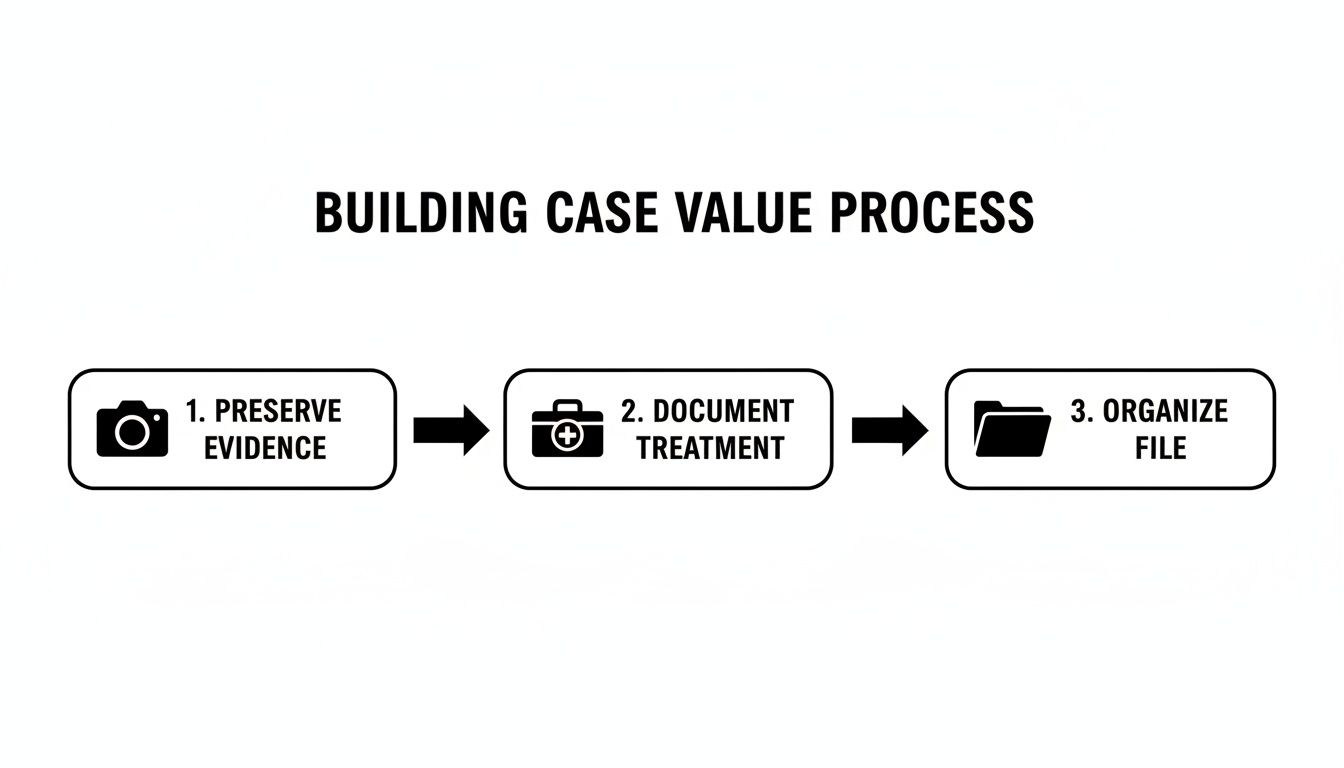
The entire initial case-building process boils down to a few fundamental steps. You preserve the evidence, meticulously document the treatment, and then organize it all into an airtight file.
Getting this part right is everything. A disorganized medical file can sink a strong case before you even get to the negotiating table.
Weaving Data into a Powerful Damage Narrative
An insurance adjuster has seen thousands of medical bills and routine chart notes. They’re numb to it. To make your claim stand out, you have to connect the dots for them and paint a vivid "before and after" picture of your client's life.
This is where you zero in on specific records. For instance, a single entry from a physical therapist noting the client can no longer lift their own child is infinitely more powerful than a dozen pages of billing codes. You’re looking for entries that show:
- Objective Medical Findings: MRI or CT scan reports that name the specific disc herniations or fractures.
- Expert Medical Opinions: A specialist’s report that draws a direct, causal line from the accident to a long-term prognosis.
- Functional Limitations: Notes from an OT or PT detailing struggles with daily activities—things like getting dressed, walking to the mailbox, or concentrating at work.
- Pain and Suffering: Mentions of anxiety, depression, or insomnia in a primary care physician’s notes, which gives you solid proof for non-economic damages.
When you pull these key details to the forefront of your medical summary, you build an evidence-backed story that an adjuster simply can’t ignore.
Highlighting High-Value Medical Events
Certain medical events have a massive impact on case value. Surgery is the most obvious one. We see it all the time—cases requiring surgery average 3.2 times higher settlements than non-surgical claims for the same injury type. A slip-and-fall that might have settled in the $15,000-$75,000 range can easily jump to $100,000-$250,000 once surgery is on the table.
The data backs this up. In one analysis, spinal injury cases with immediate MRI documentation settled for 60% more than those where the diagnosis was delayed. This is where firms are getting smarter, using AI tools like Ares to automate the medical records review. It can extract key dates and summaries in minutes, cutting out 10+ hours of manual work on every single case.
A surgical report is more than just a document; it's a turning point in the narrative. It represents an undeniable, invasive procedure that permanently changed the client's life, giving you a concrete anchor for significant pain and suffering damages.
Spotting and Addressing Gaps Before the Defense Does
A proactive review of medical records isn't just about finding your strengths; it’s about finding your weaknesses before the other side does. Gaps in treatment, inconsistent symptom reporting, or contradictory notes from different doctors can seriously poison a claim.
Keep an eye out for these common red flags:
- Treatment Gaps: Any unexplained break in medical care is an open invitation for an adjuster to argue the injury wasn't that serious.
- Inconsistent Complaints: The client tells their orthopedist the back pain is a "10/10" but tells their family doctor it’s a "mild ache." Adjusters live for these contradictions.
- Missing Records: You absolutely have to get the records from every key treating physician and facility.
- Prior Injuries: An undisclosed pre-existing condition affecting the same body part is a gift to the defense.
Ensuring your records are not only complete but also accurate is critical. Many top firms rely on professional medical transcription services to make sure every note is captured perfectly.
When you spot these issues early, you have time to fix them. You can get a narrative from a doctor explaining a treatment gap or prepare your client to discuss a prior injury honestly during a deposition. For more practical tips on building a flawless file, check out our guide on https://areslegal.ai/blog/how-to-organize-medical-records.
Building an Ironclad Liability Argument
Even the most catastrophic injuries won’t move the needle on settlement value if you can’t prove fault. Liability is the engine that drives the case. A well-documented injury without clear negligence is just a tragedy in the eyes of an adjuster; a well-documented injury caused by undeniable negligence is a high-value claim. Your job is to build a liability argument so solid that the defense has nowhere to go.
The aim here is to get way beyond just quoting the police report. A truly powerful argument weaves together witness accounts, expert analysis, and hard visual evidence into a single, cohesive story. This story should paint a picture of the defendant’s fault that is simply unavoidable. When you do this, you control the narrative from day one.
Look Beyond the Official Report
Think of the police report as a starting point, not the final word. They’re often rushed and can contain inaccuracies or leave out crucial details that witnesses saw. The best PI teams I know treat the report as just one piece of a much larger puzzle, and they start working immediately to find evidence that either backs it up or fills in the gaps.
This means getting to witnesses while the event is still fresh in their minds. A clean, third-party statement that supports your client's story can be the single most important piece of evidence you have, especially in a contested liability case. Spending a little on an investigator to canvass the area for Ring cameras or witnesses the police missed is an investment that almost always pays for itself.
The Power of Visuals and Expert Testimony
In a liability fight, showing is always better than telling. Your team has to be relentless in digging up visual proof that makes the incident real for an adjuster, and eventually, a jury.
Key assets to hunt down include:
- Scene Photography: Don't just rely on what the police took. Go back to the scene at the same time of day, in the same weather, to document sightlines, traffic flow, and any hazards that played a role.
- Surveillance Footage: Map out every nearby business, traffic camera, or home that might have caught the incident. Get a spoliation letter out the door immediately to make sure that footage doesn't get erased.
- Accident Reconstruction Experts: For any complex case, an expert is a game-changer. They use physics and engineering to create a scientific, step-by-step explanation of how the accident happened, turning a confusing situation into a clear case of fault.
When an adjuster sees the defendant's car blow through a red light on video, or when they watch an expert’s simulation showing their insured had more than enough time to stop, the argument is over. It’s no longer a "he said, she said" situation; it’s a matter of fact.
This is exactly how you drive up settlement value. It shows the carrier you're ready and able to prove your case at trial, and that’s a prospect that makes them far more willing to negotiate fairly.
Shut Down Defense Arguments Before They Start
A truly great liability case doesn't just prove you're right; it anticipates and dismantles the defense's strategy from the get-go. The oldest trick in their book is to argue comparative negligence—trying to pin a percentage of the blame on your client to slash the payout.
You can tear this argument apart before they even make it. If you suspect they’ll claim your client was speeding, have your accident reconstructionist provide data showing their speed was reasonable for the conditions. If they're going to allege an improper lane change, have a witness statement ready that confirms your client signaled and had plenty of room.
Building this fortress of proof is what separates average settlements from exceptional ones. In my experience, cases with bulletproof liability often settle 2-3 times faster and for significantly more money. A moderate injury claim that might normally be in the $25,000-$100,000 range can easily jump into the millions when there's undeniable proof of gross negligence. It completely changes the financial reality for your client. You can see more on how liability influences average personal injury settlement amounts from Gainservicing.com.
Quantifying Damages Beyond the Medical Bills
A winning settlement is about capturing the full story of a client's losses, not just handing over a stack of hospital invoices. If you really want to drive up settlement value, your team needs to stop tallying expenses and start meticulously quantifying every single economic and non-economic damage your client has endured. This detailed, evidence-backed calculation is what turns an average claim into a high-value case that adjusters simply can't ignore.
The bedrock of any claim is what we call special damages—the tangible, calculable financial hits. Medical bills are the most obvious part, but they're just the starting point. A truly comprehensive valuation digs much, much deeper to capture every cent this incident has cost your client, both now and for the rest of their life.
Projecting Future Economic Losses
One of the biggest levers you can pull to increase settlement value is to accurately project long-term costs. A serious injury doesn't just stop when the client leaves the hospital; its financial shockwave can ripple through their entire life. Your valuation has to account for these future expenses with concrete, defensible evidence.
This is where you bring in the heavy hitters—the experts who can provide credible forecasts:
- Future Medical Needs: A life care planner can be your best friend here. They'll create a detailed report that outlines every anticipated medical treatment, from future surgeries and physical therapy to prescription medications, medical equipment, and even in-home care.
- Lost Earning Capacity: To show how the injuries have permanently derailed your client's career, a vocational expert is essential. Their analysis can project lost wages, benefits, and even retirement contributions over what would have been the client's full working life.
An expert's report takes a vague claim about "future losses" and turns it into a hard, data-driven projection. For an adjuster, a life care plan projecting $1.2 million in future medical care is infinitely more persuasive than a fuzzy, unsupported request.
This level of detail signals to the insurance carrier that you've done your homework and are ready to prove every penny of these damages at trial. That alone gives them a powerful reason to offer a much higher settlement.
Don't Forget the "Small" Out-of-Pocket Expenses
Beyond the big-ticket items like medical bills and lost wages, countless smaller expenses can quietly add up to a significant amount. This is why you must instruct your clients from day one to keep a detailed log and save every single receipt for these often-overlooked costs.
We're talking about things like:
- Mileage and parking fees for the dozens of doctor and therapy appointments.
- The cost of over-the-counter medications, braces, or bandages.
- Hiring help for tasks the client can no longer handle themselves, like lawn care or housekeeping.
- Modifications needed for their home or car to accommodate a new disability.
A single $15 parking receipt might seem trivial, but when you compile hundreds of these small expenses over months, they can easily add thousands of dollars to your special damages. Presenting this as a neat, itemized list in your demand letter showcases your meticulous preparation and adds undeniable weight to your final number.
The Art of Valuing Pain and Suffering
Putting a number on non-economic damages, or "pain and suffering," feels more like an art than a science, but it absolutely must be grounded in evidence. This is where you connect the dots between the documented medical journey and the client's very human experience of trauma, pain, and a diminished quality of life. The goal is to justify your valuation so it never feels like a random number pulled out of thin air.
A common starting point is the multiplier method, where you multiply the total special damages by a factor (usually between 1.5 and 5) based on the severity of the injury and its life-altering impact. A severe, permanent injury with a long and agonizing recovery obviously justifies a much higher multiplier.
To back that number up, you have to use the evidence you've gathered—the client’s pain journal, notes from a therapist detailing emotional distress, and photos of the injuries—to weave a powerful narrative. Our team has put together a detailed guide if you want to learn more about how to calculate pain and suffering damages for your cases.
When you present a comprehensive and itemized breakdown of every loss, you force the adjuster to negotiate on your terms, anchored by a valuation that is both methodical and deeply human.
Drafting a Demand Letter That Forces a Response
Think of your demand letter as the opening move in a high-stakes chess match. A flimsy, cookie-cutter letter tells the insurance adjuster you're not a serious player, inviting them to make a lowball offer. On the other hand, a meticulously crafted, evidence-packed demand sets the tone immediately, forcing them to sit up, take notice, and treat your valuation with the respect it deserves.
This is your first—and best—chance to frame the entire case. You're not just sending a bill; you're delivering a compelling legal argument that tells your client's story. The letter needs to lay out your liability theory, walk the adjuster through the client's painful medical journey, and justify every dollar you're demanding. It should be so buttoned-up that the adjuster has everything they need to go to their supervisor and justify paying your number.
A great demand anticipates the defense arguments and neutralizes them before they're even made. You're not just playing the game; you're controlling the board from day one.
Structuring a Persuasive Narrative
The best demand letters I've seen always start with a short, punchy summary of what happened and who's at fault. Don't dance around it. State the facts of liability with confidence, referencing the police report, a key witness statement, or the photo that shows the other driver clearly ran the red light.
Then, you pivot from the facts to the human cost. This is where you connect the defendant's carelessness to your client's real-world suffering. Pull powerful quotes directly from a doctor’s report or use a line from your client’s pain journal to show, not just tell, what their life has been like. For a deep dive into crafting these arguments, it's worth learning how to write a powerful insurance demand letter.
The goal is to build a story that’s both logically airtight and emotionally resonant. You want to make it impossible for the adjuster to see your client as just another file number.
The Anatomy of a High-Impact Demand Letter
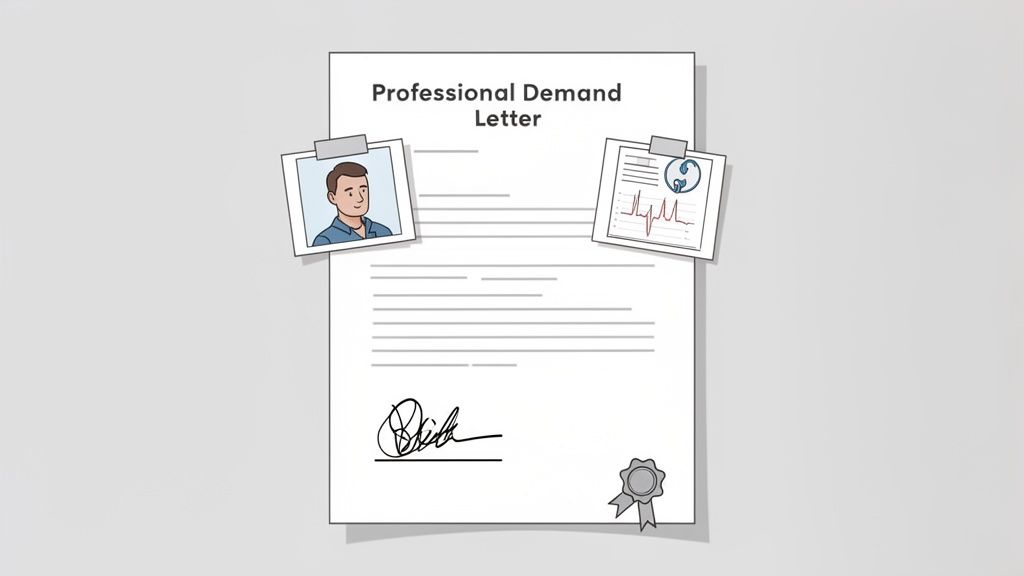
A demand that gets top dollar is more than a letter; it's a full package. It has to be organized, look professional, and make the adjuster's job easy. If they have to hunt for information, you’re giving them an excuse to put your file at the bottom of the pile and lowball you later.
Make sure you include these key components:
- A Detailed Breakdown of Damages: Never just list a total. Itemize everything—every medical bill, every hour of lost work, and every out-of-pocket receipt. Crucially, show your math for the pain and suffering calculation.
- A Comprehensive Medical Summary: This is a chronological narrative of your client’s treatment. Highlight the big-ticket items: the key diagnoses, the surgeries, and the specialist's long-term prognosis.
- Key Supporting Exhibits: Attach and label everything. The police report, photos of the injuries, the ER records, the MRI report—make it a complete, organized appendix.
I tell my team to assemble every demand package as if it were a trial binder. It sends a powerful, unspoken message to the adjuster: "We are organized, we are serious, and we are ready for court." That posture alone can significantly drive up your settlement offers.
Setting the Right Tone and Demand Amount
The tone should be firm and professional, but not angry. You are presenting a business proposition based on facts, not an emotional appeal. Use clear, direct language. The adjuster isn't a judge, so drop the overly formal legalese.
When it comes to the number, be ambitious but credible. Your initial demand should anchor the negotiation at the high end of a reasonable settlement range for this type of case, backed by the mountain of evidence you've just presented. Go too low, and you've left money on the table. Go outrageously high, and the adjuster will write you off as an amateur. A strategic, well-supported opening number is the key to starting the negotiation on your terms.
Mastering the Art of Negotiation and Finalizing Your Settlement
Once you’ve sent out that meticulously crafted demand package, you’ve arrived at the most critical stage of the entire process: the negotiation. This is where all your hard work preparing the case pays off. The first offer you get back from the adjuster? It’s almost never their best. Think of it as an opening chess move, designed to test your preparation and your resolve.
A great negotiator knows this dance well. They blend timeless principles of leverage with the modern advantage of having every single fact about the case ready to go at a moment's notice. When an adjuster tries to poke a hole in your case—questioning a treatment date or the necessity of a procedure—you need to be able to fire back instantly with the exact answer, pulled from a perfectly organized file. This isn’t about being argumentative; it’s about showing an unshakeable command of the facts.
Decoding the Adjuster's Playbook
To win any game, you have to understand your opponent. Insurance adjusters are professionals trained with one primary goal: to minimize how much the insurance company pays out. They see hundreds of claims and have a standard set of tactics they use to wear you down and chip away at the settlement value.
Just being able to spot these tactics is half the battle. You can almost guarantee that the initial offer will be so low it feels insulting. This is a classic move, not an honest assessment of your client's claim.
The secret is to never let a lowball offer get an emotional reaction out of you. Instead, use it as a teaching moment. Calmly ask the adjuster to justify their number in writing, addressing each point of evidence you presented. This simple request forces them to stop playing games and start engaging with the facts of your case.
This one move completely flips the script. You’re no longer just reacting to their number; you're making them defend their position against the mountain of evidence you’ve already built. It’s a subtle but incredibly powerful way to seize control of the negotiation.
How to Build and Use Real Leverage
In any personal injury negotiation, real leverage comes from one thing: your readiness to go to trial. The biggest fear for any insurance carrier is the enormous cost and total uncertainty of a jury verdict. Every move you make from day one should quietly signal that you are not only willing but completely prepared to file a lawsuit if they refuse to make a fair offer.
This doesn't mean you need to be loud or aggressive. It's about demonstrating a level of professionalism and organization that speaks for itself.
Here’s how to put that into practice:
- Impose Firm Deadlines: When you send a counteroffer, give the adjuster a reasonable but firm deadline to respond. This creates a sense of urgency and stops them from just letting your file gather dust on their desk.
- Drop Specific Evidence: In your conversations, casually mention specific, powerful details from the file. Saying something like, "As Dr. Smith's May 15th MRI report confirms..." shows you have total command of the medical records.
- Know Your Walk-Away Point: You must always know your Best Alternative to a Negotiated Agreement (BATNA). In this context, that means filing the lawsuit. Having a clear number in your head where you will walk away from the table gives you the confidence to stand your ground.
This quiet, confident posture is far more intimidating to an adjuster than blustering threats. It tells them you're a serious professional with a case that can and will win in court. For a more detailed look at the language and specific tactics for these conversations, check out our guide on how to negotiate a personal injury settlement.
The Final Push: Getting It in Writing
Once you've gone back and forth and finally landed on a number you and your client can agree on, the work isn't done. These last steps are absolutely essential to protect both your client and your firm. As soon as you have a verbal agreement, you must confirm it in writing. Immediately.
Send a quick email or letter to the adjuster that very same day, clearly outlining the agreed-upon settlement amount. This simple act prevents any "misunderstandings" or attempts by the adjuster to backtrack on their offer later.
With the confirmation sent, you can move on to the formal settlement and release agreement. This is the final legal document standing between your client and their money, and it needs a careful eye. Scrutinize the language, especially the scope of the release, to make sure you're only settling the current claim and not accidentally signing away any of your client's future rights.