A confidentiality clause is a contract provision that restricts a party from disclosing non-public information. In personal injury settlements, it matters because the clause often sits right on the money line, and the wrong wording can cost bargaining power, create HIPAA problems, or leave the client boxed into a bad post-settlement process.
You see the same pattern all the time. Defense counsel offers a cleaner number if the plaintiff signs broad confidentiality, and the draft arrives with language that is wider than the actual deal needs. That is where junior lawyers get tripped up, because the clause is not just about secrecy, it is about what information moves, who can see it, how long the duty lasts, and what happens if someone breaks it.
Why a Confidentiality Clause Matters in a PI Settlement
A personal injury settlement rarely lands on your desk as a simple exchange of payment for a release. More often, the defense wants an extra layer of protection around the amount, the medical facts, the negotiation history, or the existence of the deal itself. That is why a confidentiality clause shows up so often in PI work, even though the clause is a standard commercial tool across contracts, either as a standalone NDA or as a clause inside a larger agreement (Thomson Reuters drafting guidance).
The practical point is simple. If the plaintiff signs confidentiality, the firm is trading away future disclosure rights, sometimes for a higher payment, sometimes for faster resolution, sometimes for both. If the clause is drafted badly, the cost is not abstract. It can interfere with routine intake discussions, lien resolution, medical-record handling, and later case development.
What the clause really does in settlement practice
A confidentiality clause is the contract mechanism that restricts a party from disclosing non-public information. In PI settlements, that means the defense is trying to control the spread of settlement terms and case details after the file closes. The clause usually isn't there because the information is mysterious. It's there because once a number or a medical fact gets out, the defense loses control of the narrative.
Practical rule: treat confidentiality as a negotiated deal term, not a housekeeping paragraph. If the defense wants silence, that silence has a price.
That is why plaintiff-side lawyers should read the clause as part of the economics of the settlement, not as a stylistic choice. A broad clause can be worth accepting if the trade is real and the exceptions are sane. A broad clause with weak carve-outs is just a future problem wearing a nicer font.
Anatomy of a Confidentiality Clause
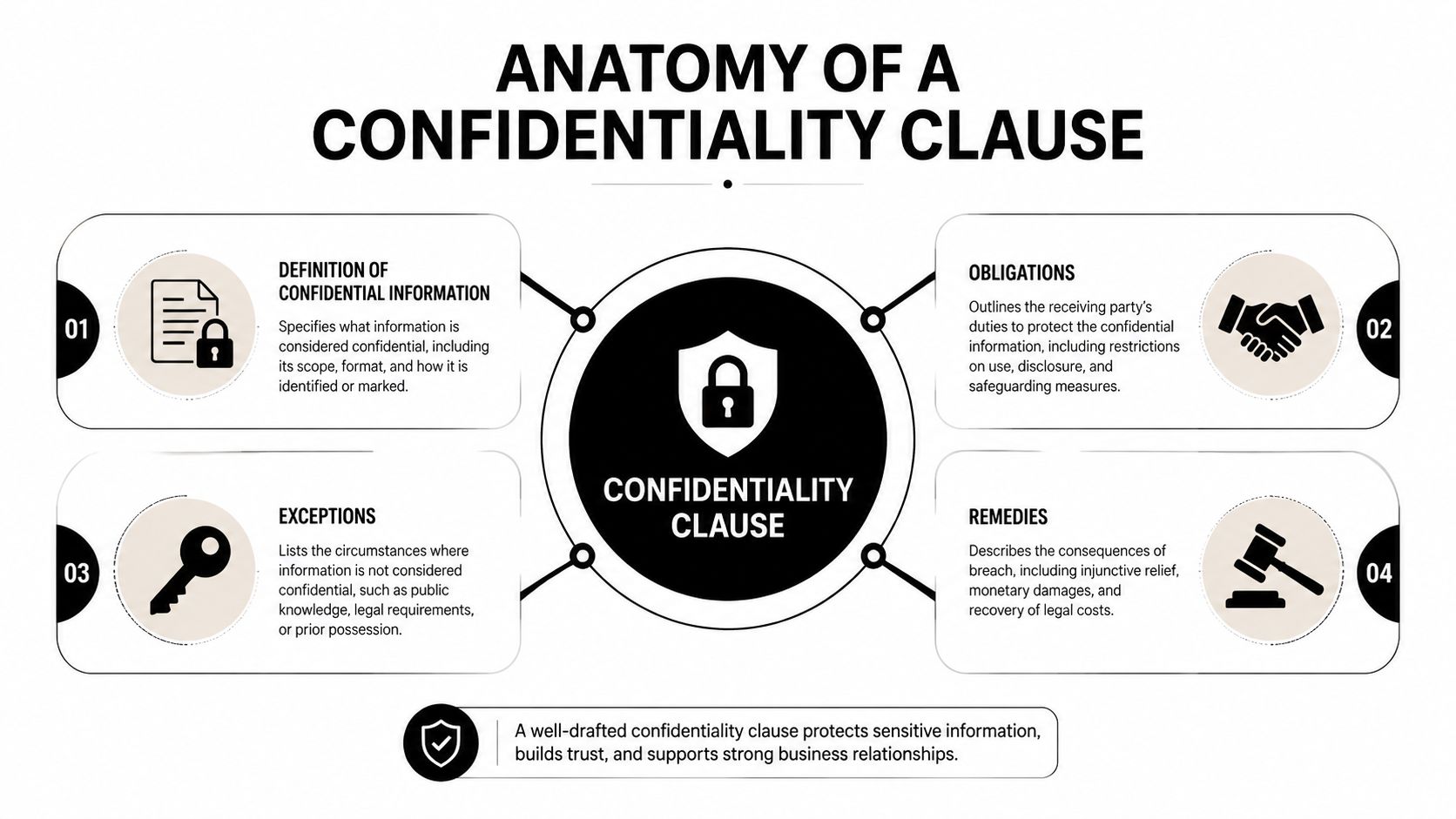
The fastest way to read any draft is to split it into five moving parts. First, what counts as confidential. Second, what the recipient must do with it. Third, who still gets access. Fourth, how long the duty lasts. Fifth, what happens if someone violates it.
Definition, obligation, exceptions, survival, remedies
The definition does the heavy lifting. Good drafting specifies what qualifies as Confidential Information, and good counsel also watches for exclusions like public information or material developed independently. Drafting guidance from contract-focused sources recommends narrowing the definition enough to make enforcement workable and limiting access on a need-to-know basis, because overbroad language creates compliance noise while underinclusive language leaves gaps (ContractKen glossary).
The obligation is usually a non-disclosure and non-use promise. The recipient can't just refrain from forwarding the document. The recipient also has to avoid using the information for a purpose the agreement doesn't allow. That matters in PI because a settlement amount, a lien concession, or a medical chronology can be valuable in more than one setting.
The standard of care is the internal-control yardstick. Major legal guidance notes that recipients are typically bound to use the same degree of care they use for their own information, but not less than a reasonable degree of care (Thomson Reuters drafting guidance). That phrasing gives you a contractual floor you can audit against.
A clause without a clean exceptions section usually causes more trouble than it prevents.
Permitted disclosures are the safety valves. The clause should still allow disclosure to lawyers, tax advisors, carriers, courts, and other parties when the law requires it. Survival is the duration piece, and commercial guidance says 1 to 5 years is typical, while trade secrets may be protected indefinitely (Thomson Reuters drafting guidance). Remedies are the enforcement piece, and well-drafted clauses often include injunctive relief because disclosure harms can't always be fixed with money alone (Fynk confidentiality clause guidance).
For related health-information concepts, Ares has a useful overview of what counts as protected health information, which helps when settlement language brushes up against medical privacy issues.
Unilateral, Mutual, and Multilateral Variants
The structure matters as much as the wording. In PI settlements, a unilateral clause is usually the default because only the plaintiff is being bound to keep settlement terms quiet, while the defense already controls its own claims file and internal communications. That doesn't mean unilateral is always fair, only that it matches the way most settlement information flows.
A mutual clause makes more sense when both sides are exchanging sensitive material. Structured settlements, lien negotiations, and co-defendant matters often fit that model because each side is handing over information it doesn't want the other side to repurpose elsewhere. If only one side is giving up confidentiality, the mutual label can hide a one-way restriction.
A multilateral clause shows up when multiple insurers, lienholders, or lawyers are in the room. Those drafts get messy quickly because the question is no longer just who promised secrecy, but which entities are covered, which are merely recipients, and which are excluded from the obligation. In a high-volume practice, that's where ambiguity creeps in.
The clean test is operational, not theoretical. Ask who is disclosing sensitive material, who is receiving it, and who might accidentally use it later. If the answer changes from one paragraph to the next, the draft needs surgery. In PI work, that check is often more useful than arguing over labels.
Enforceability, HIPAA, and the Exceptions That Save You
A confidentiality clause is only enforceable if the exceptions let the parties comply with the law and do ordinary professional work. The clause should not try to gag disclosure to counsel, accountants, courts, or regulators. It also needs a survival period and a clear remedy structure, because the point is to protect information after the file closes, not just while everyone is still polite.
The carve-outs that keep the clause usable
The practical carve-outs are the ones that keep a settlement from turning into a trap. Required disclosures to legal and tax advisors are routine. Disclosures under court order or government investigation are routine too. If those exceptions aren't in the text, someone will spend time later arguing about an issue that should've been obvious on first read.
HIPAA is the carve-out that gets overlooked most often in PI settlement drafting. If the clause is broad enough to interfere with lawful handling of medical records, the agreement becomes a compliance problem instead of a protection. That's why the permission language should allow disclosures and uses consistent with medical-privacy obligations, not just generic “as required by law” boilerplate. A plain-language HIPAA carve-out keeps the settlement from trapping the plaintiff or the firm in a bad contradiction.
For a deeper operational lens on medical-document controls, Ares has a practical guide to HIPAA-compliant document management. If your file handling system can't support the carve-outs you're promising in the contract, the drafting is ahead of the operations.
Do not draft confidentiality in a way that blocks lawful medical or litigation activity. That's how a settlement clause turns into a follow-on dispute.
Litigation carve-outs matter too. The client still needs room to pursue later claims, enforce the settlement, respond to subpoenas, and work with counsel on issues that survive the case. Whistleblower protections belong in the same category. If the clause tries to silence protected reporting, it's asking for a problem.
A real-world issue also comes up in lien work. Confidentiality sometimes needs to protect repayment terms or negotiated reductions. That can be sensible, but it should be drafted carefully so the clause hides the concession without obscuring obligations that must still be performed. The difference is subtle until someone needs the paper trail.
When medical records are moving through the office, a secure transmission process matters too. If you need a practical reference point for sending PHI, a useful discussion of secure fax for PHI helps frame why the workflow matters as much as the clause.
Sample Language for a PI Settlement Clause
A clean PI confidentiality provision does three things at once. It limits the scope, preserves lawful disclosures, and keeps the file workable after execution. If you want something that survives negotiation, it helps to draft it as a working paragraph rather than a slogan.
Sample clause and how to read it
“Plaintiff and Plaintiff's counsel shall keep confidential the settlement amount and the material terms of this agreement, except that disclosure may be made to counsel, tax advisors, insurers, lienholders, treating providers as necessary for billing or lien resolution, and as otherwise required by law, court order, subpoena, or applicable medical-privacy obligations. Nothing in this agreement prohibits Plaintiff from disclosing information necessary to pursue future claims, enforce this agreement, or comply with legal obligations. Confidential materials shall be returned or destroyed upon request, except that counsel may retain one archival copy for file maintenance and compliance purposes.”
That language is not magical, but it gives you the right bones. The first sentence defines the scope. The second protects the working channels that a PI file needs. The third preserves future litigation and compliance rights. The fourth handles records.
Here's a quick way to think about the moving parts.
| Provision | Function | Negotiation Lever |
|---|---|---|
| Settlement amount and material terms | Defines what stays private | Narrow to the real economic terms, not the whole file |
| Permitted disclosures | Keeps counsel, advisors, and lien work moving | Add HIPAA, court order, and lawful-compliance language |
| Future claims and enforcement | Avoids trapping the client | Keep explicit, not implied |
| Return or destruction | Limits retention of sensitive copies | Preserve one archival file copy for counsel |
| Counsel retention exception | Protects the firm's recordkeeping | Clarify it's for compliance and defense only |
The negotiation patterns are predictable. Defense often pushes for the broadest definition and the fewest exceptions. Plaintiff counsel should push back on any phrase that swallows lawful disclosures, and on any return-or-destroy language that ignores the firm's need to keep a defensible archival record.
If your office builds forms from approved text, document automation can help keep the approved carve-outs from disappearing in the rush. A useful overview of legal document automation for law firms shows why templated drafting can reduce the odds of a last-minute clause drifting off-model.
Negotiation Pressure Points You Should Not Miss
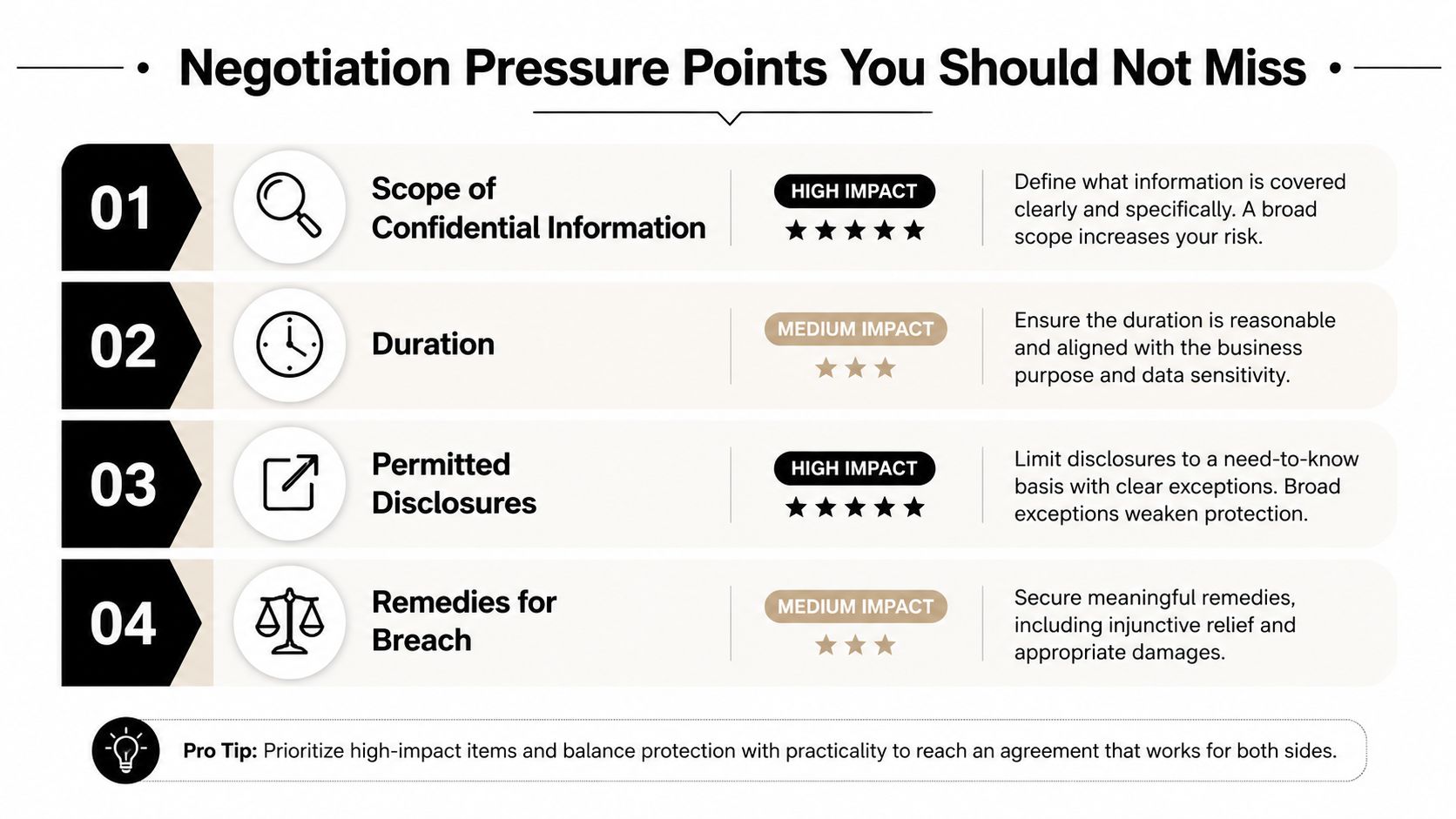
The pressure points are usually the same, but they don't all carry the same weight. Scope comes first, because if the definition of confidential information is too wide, the rest of the clause is just decoration. Duration comes next, then permitted disclosures, then remedies.
What to flag the minute the draft arrives
- Scope of Confidential Information. Watch for language that tries to cover the entire existence of the claim, the injury, the client relationship, and every document in the file. Tighten it to what needs protection.
- Duration. Commercial guidance says 1 to 5 years is typical, while trade secrets may be protected indefinitely (Thomson Reuters drafting guidance). In PI, a longer term may be fine, but only if the exceptions are solid.
- Permitted disclosures. If the clause doesn't expressly cover counsel, tax, lien, court, and lawful medical-privacy disclosures, it is underbuilt.
- Remedies for breach. Clauses that preserve injunctive relief are stronger than clauses that rely on damages alone, because dissemination can't always be un-rung (Fynk confidentiality clause guidance).
Defense counsel sometimes tries to bind the firm and its staff, not just the client. That's not automatically wrong, but it needs to match the actual information flow. If paralegals, case managers, and supervising lawyers all touch the settlement, the draft should say who is covered and for what purpose. Otherwise, the firm ends up with obligations it never intended to accept.
The same caution applies to lienholders and insurers. If they're expected to keep terms confidential, they need to be named cleanly, not buried in a catch-all. Bad naming creates bad enforcement.
How Confidentiality Clauses Connect to Your Document Workflow
A confidentiality clause is only as strong as the systems behind it. If settlement drafts live in random inboxes, shared drives, and desktop folders, the firm is promising control it can't always prove. That is why the clause and the workflow have to be designed together.
What defensible handling looks like
Start with access control. Only the people who need the file should see it, and that should be true for both medical records and settlement terms. Then add auditability. If you can't trace who handled the document, you can't confidently show that the office protected it with the same degree of care it uses for its own information, which is the standard framing common in commercial confidentiality drafting (Thomson Reuters drafting guidance).
That's where AI-assisted file review can fit. Ares is one example of a HIPAA-compliant platform that organizes medical records, extracts key facts, and helps teams draft demand letters from case documents while keeping sensitive material inside a controlled environment. Used properly, a tool like that supports the clause because it keeps PHI and settlement material inside a system built for privacy instead of a generic cloud folder. For document-heavy PI firms, that operational fit matters as much as the wording on page three.
For a related workflow discussion, Ares also has a useful guide on discovery document management, which maps well to the same access-control problem you face with settlement materials.
If your software stack can't support controlled access, retention discipline, and audit trails, the confidentiality clause is carrying too much weight on its own.
The firm's IT and ops teams should think in terms of repeatable handling, not heroic cleanup. When the clause says records must be returned or destroyed, the workflow needs a designated place for archival counsel copies and a standard process for limiting who can export, forward, or print sensitive material. That's how the contract becomes real.
Best Practices for Drafting and Managing Confidentiality
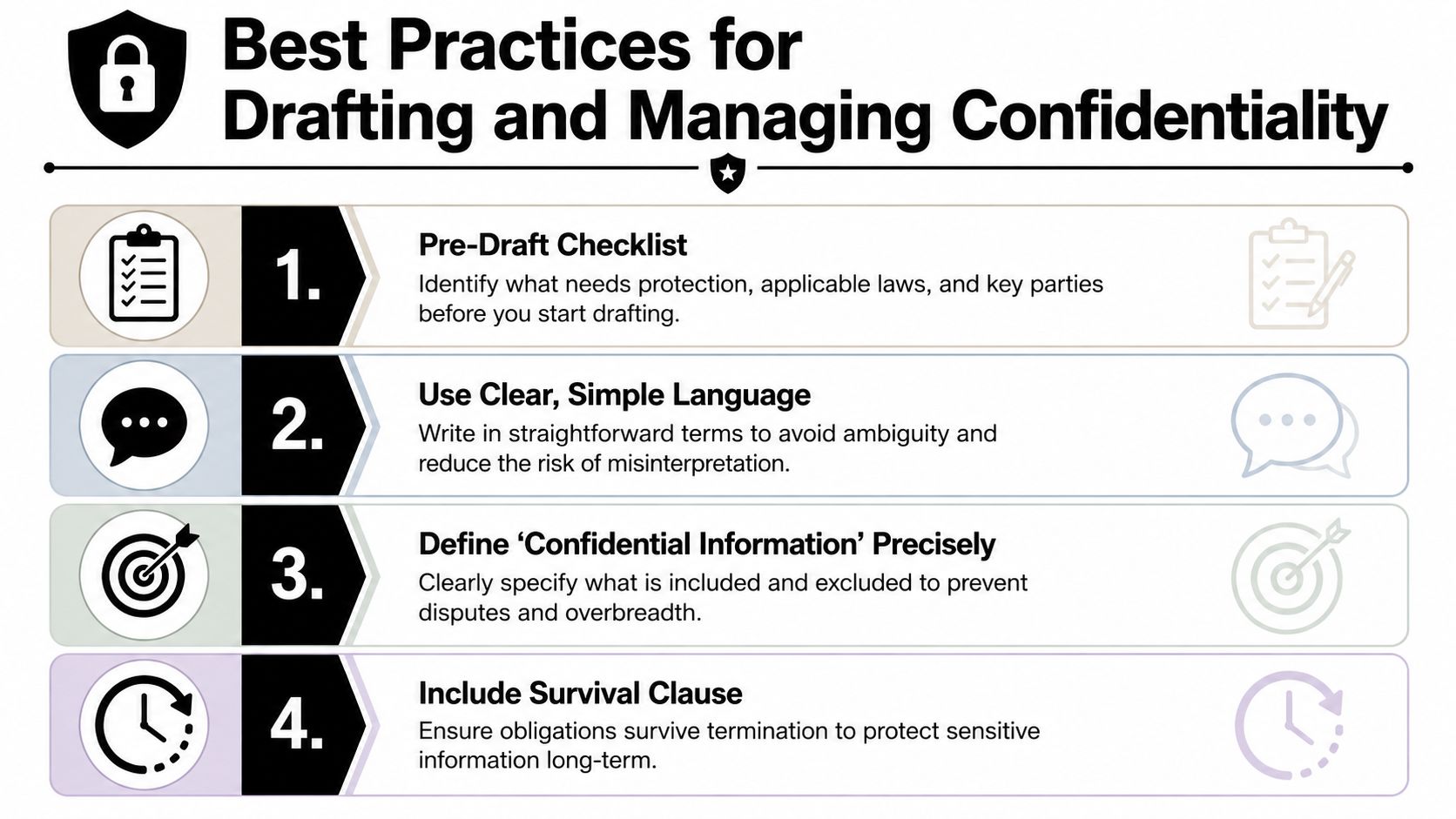
The cleanest drafts are usually the ones that start with a checklist and end with a named owner. Before the next settlement goes out, verify the protected information, the permitted disclosures, the survival period, and who on your side is signing up to the obligation.
A short working checklist
- Check the signatories. Make sure the clause binds only the people who need to be bound.
- Keep the carve-outs explicit. Counsel, taxes, court orders, HIPAA, and future claims should not rely on implication.
- Store the executed version centrally. A lost agreement is a future argument waiting to happen.
- Train intake and paralegal staff. They are the first line between a clean workflow and an accidental disclosure.
The best drafts are also the ones that don't try to be clever. Keep the language simple, define Confidential Information precisely, and include a survival clause that matches the actual business need. That's the difference between a clause that helps close the case and one that creates avoidable cleanup later.
Ares helps PI teams manage medical records, organize case facts, and draft demand materials in a HIPAA-compliant workflow that lines up with the confidentiality issues in settlement practice. If you want a system that supports controlled document handling instead of fighting it, visit Ares and see how the platform fits into your file review and settlement process.