

In 2024, the average third-party bodily-injury auto claim payout reached $27,373, an 8% increase from the prior year, according to CCC Intelligent Solutions claim payout data. That number doesn't reward the longest file. It rewards the file an adjuster can verify without guessing which bill belongs to which injury, why care stopped, or whether the demand total adds up.
Treat a personal injury demand package as an audit trail, not a stack of attachments. Every claimed diagnosis, dollar, and lost workday should point to a record, and every adverse fact should have a short, sourced explanation before the adjuster finds it first.
Why Most Injury Claims Are Won on Paper
An Australian legal research review reports that "few injury compensation claims are litigated" and even fewer reach a judge. Most resolve directly between the parties through negotiation or alternative dispute resolution, according to the Australian review of injury compensation settlement.
That changes what a personal injury demand package is. It's not a narrative letter with records attached. It's the structured evidentiary presentation an experienced insurer evaluates in the forum where the claim will probably end.
The same review notes that settlement data can reveal claim types, average damages, use of legal services, claim duration, settlement timing, and litigation behavior. Track those markers in your own files. They show whether weak packages correlate with long evaluations, repeated record requests, or avoidable litigation in your practice.
Read your next demand as the adjuster will. List the three questions it can't answer yet, such as when treatment began, which bill supports which injury, or what proof ties future care to a treating provider.
Fix those gaps before you polish the prose. The adjuster's first read, not a courtroom presentation months later, usually sets the path for the file.
Essential Documents in a Demand Package
A complete personal injury demand package gives the adjuster ten answers in a predictable order. The inventory below shows what each component proves, where it comes from, and where files most often break.
| Component | What It Proves | Typical Source Documents | Common Weak Point |
|---|---|---|---|
| Demand letter | Liability, injuries, damages total and the specific demand | Attorney draft built from the file | Demand figures not tied to exhibits |
| Medical chronology | Injury onset and the treatment sequence over time | Provider records, EMS and emergency notes | Service dates that do not match billing dates |
| Provider records | Original diagnosis, findings and treatment | Hospital, clinic, imaging and therapy files | Missing pages or unsigned notes |
| Itemized medical bills | Amounts billed, paid and owed | Provider billing forms and account ledgers | Billed amounts confused with amounts paid |
| Pharmacy records | Medications, dosages and costs | Pharmacy printouts and receipts | Prescriptions with no matching charge |
| Wage loss proof | Lost income and paid time off | Employer letter, pay stubs, tax returns | Estimates with no employer verification |
| Out-of-pocket and mileage log | Travel and incidental costs tied to treatment | Receipts and dated mileage log | Small expenses left undocumented |
| Future care and prognosis | Basis for ongoing treatment costs | Treating physician letter, care plan or cost estimate | Opinion given without a stated basis |
| Liability evidence | Fault and how the accident happened | Police report, photos, witness statements | Accident facts that conflict across documents |
| Exhibit index | Map from each claim to its document and page | Numbered index with page references | Unnumbered attachments |
How to Check the Inventory Against a Live File
Start with the demand letter and medical chronology together. The letter makes the argument, and the chronology shows injury onset and treatment in date order. If a service date in the chronology doesn't match the billing record, don't hide the mismatch. Flag it, resolve it, or explain it.
Provider records are the original evidence behind the summary. Check for missing pages, unsigned notes, unnamed facilities, and encounters mentioned in one record but absent from your requests. A referral note often identifies the provider nobody followed up with.
Next, reconcile money to medicine. Itemized bills should distinguish billed, paid, and owed, while pharmacy printouts should connect each medication to a prescription and charge. Wage loss needs employer verification, not an estimate built from the client's memory. Mileage and small out-of-pocket costs look minor until they're the only undocumented lines in an otherwise clean schedule.
What Belongs and What Does Not
Future care requires more than a doctor's conclusion. Ask what examination findings, imaging, treatment response, or clinical history support the recommendation. An opinion without a stated basis invites the adjuster to discount the entire category.
Liability evidence has to tell one consistent story. Compare the police report, photographs, witness statements, and first medical history before drafting. Conflicting accident mechanics create credibility problems that stronger medical records won't cure.
The exhibit index is not clerical decoration. It's the map from every assertion to its source page, and it's what lets an adjuster verify the claim quickly. Apply one inclusion rule. A document belongs in the package only if a sentence in the demand cites it.
Building a Medical Chronology Adjusters Can Verify
The chronology below should let a reviewer trace any treatment statement back to its original page without rebuilding the timeline.
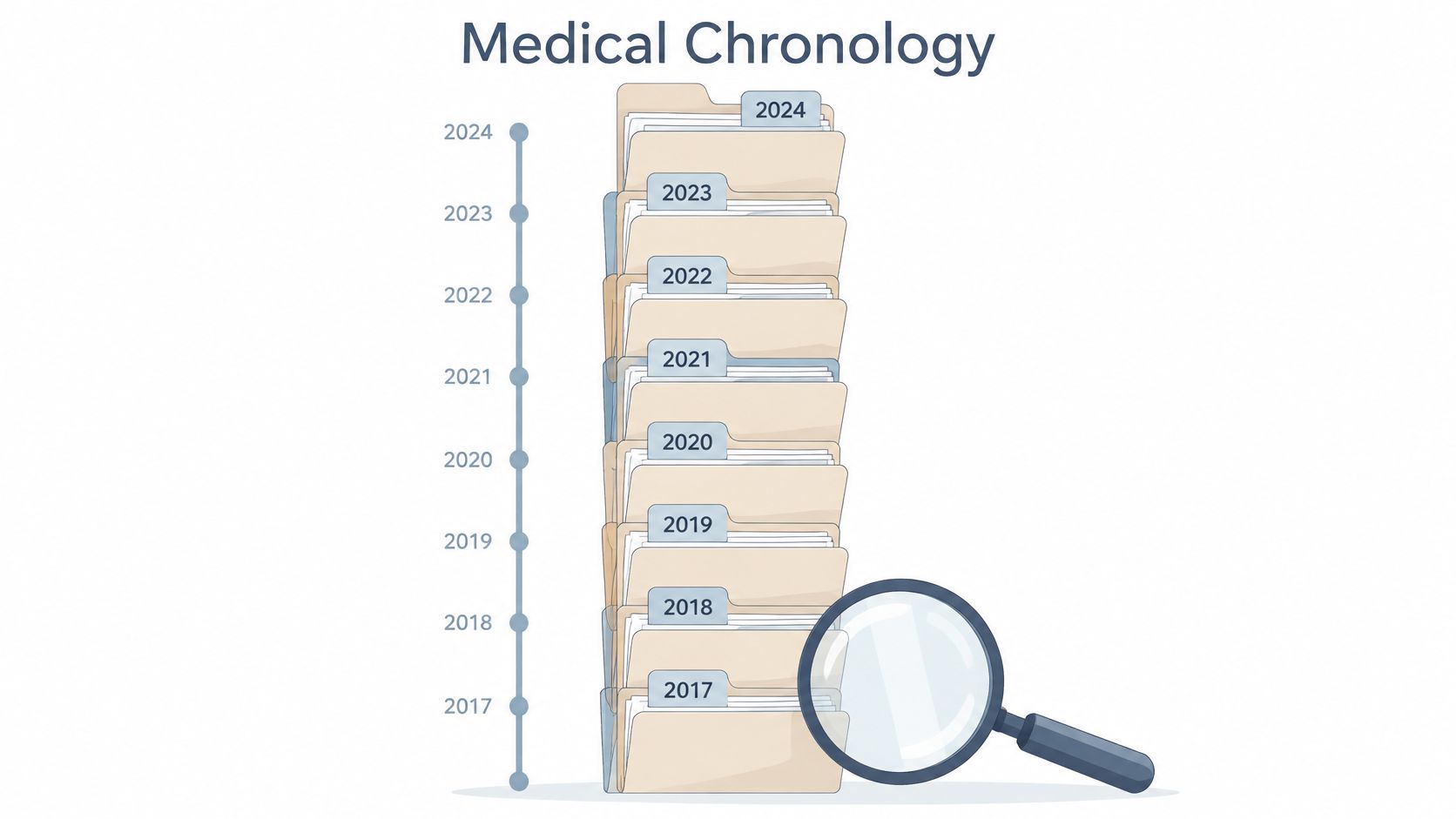
A personal injury demand package needs a medical chronology that summarizes records without replacing them. Build it as a verification tool, not a narrative rewrite.
The Six-Step Build
- Inventory every provider. List each record set, date range, date received, page count, and outstanding request. You can't reconcile a file you haven't inventoried.
- Create one row per encounter. Include date, provider, facility, complaint, key finding, treatment, and source page. One encounter per row keeps later cross-checks manageable.
- Mark injury onset. Use the first EMS or emergency note to establish what was reported closest to the event. Later symptom changes should be measured against that starting point.
- Add treatment milestones. Show imaging, referrals, injections, procedures, surgery, discharge, and changes in restrictions. Milestones reveal whether care progressed logically or stalled.
- Cross-check service and billing dates. Flag every mismatch between the clinical record and the bill. An unresolved date conflict can damage both causation and credibility.
- Cite the source page beside every entry. Each diagnosis, procedure, and expense should map to the underlying record. If a statement can't be traced, it isn't ready for the demand.
A deeper walkthrough of building a medical record chronology is useful when a paralegal is learning the format, but the standard stays the same. Date order beats provider order because adjusters evaluate recovery over time.
The video below is best used as a training companion while a team member compares a draft chronology against the original records.
Preserve the Evidentiary Chain
Under Federal Rule of Evidence 803(6), medical records may qualify as regularly conducted business records when they were made at or near the time by someone with knowledge, kept in the ordinary course of business, and supported by custodian testimony or certification. Authentication also requires evidence sufficient to support a finding that an item is what its proponent claims it is, as explained in AHIMA guidance on legally sound health records.
Preserve source-document identifiers, provider and facility names, service dates, and author or signature information. Keep attorney-generated summaries physically and conceptually separate from original provider records. Blending them lets opposing counsel characterize the package as an unauthenticated compilation.
Verification standard: another person in the office should be able to pick any chronology row, turn to the cited page, and confirm the date, complaint, finding, and provider without asking the drafter what it means.
Software can handle the first extraction pass. Ares can extract dates, diagnoses, treatments, and providers from uploaded files in minutes, leaving the attorney or case manager to verify the output and resolve flagged discrepancies. Don't treat extraction as review. The human check is where duplicate encounters, unrelated care, and billing mismatches get caught.
A finished opening page should show the accident, first treatment, diagnostic turning points, current status, and any unresolved gap at a glance. The detail follows, but the treatment arc is visible immediately.
Quantifying Damages Line by Line
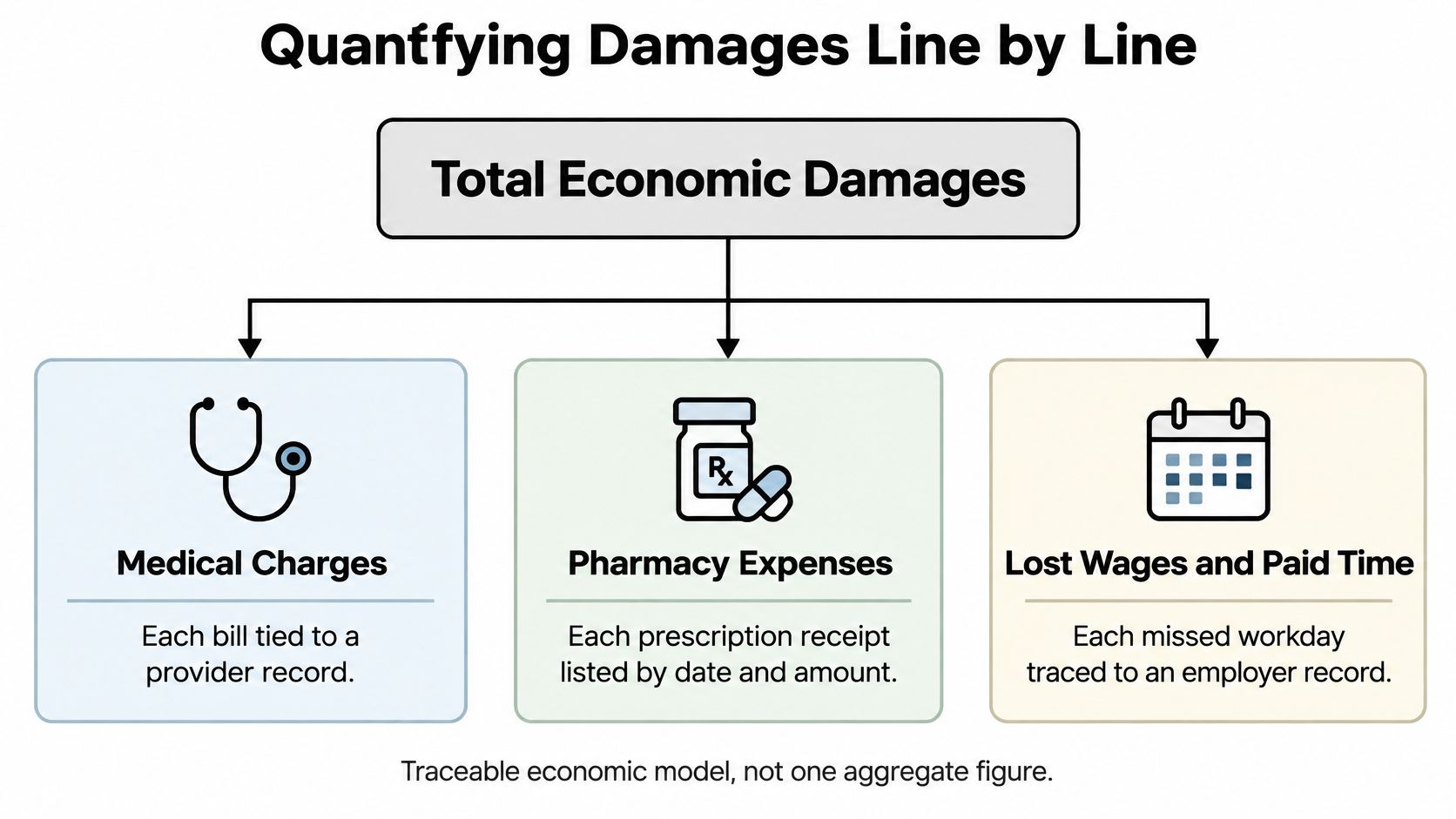
Don't ask an adjuster to trust one aggregate number. Build the damages section as a traceable economic model in which each line has a provider, service date, amount, accident relationship, and exhibit. A fuller explanation of what economic damages include can help newer staff separate documented losses from general harm.
Economic Categories and Their Proof
Itemize medical charges, pharmacy expenses, wage loss, out-of-pocket costs, and documented future care. Nolo identifies medical bills, lost wages, and pharmacy charges as common economic damages, advises totaling them individually, and recommends employer documentation for missed work or paid time off, as set out in Nolo guidance on writing a demand letter.
Use this schedule structure for a claimant with an emergency visit, six months of physical therapy, two weeks of unpaid leave, and a planned injection.
| Line | Provider | Date of Service | Billed / Paid or Owed | Relationship to Accident | Exhibit |
|---|---|---|---|---|---|
| Emergency visit | Hospital named in the record | Date shown on the encounter record | Billed amount and balance from the ledger | First evaluation after the collision | Numbered exhibit with page reference |
| Physical therapy, six months | Treating therapy clinic | Each service date or stated date range | Billed amount and balance from the ledger | Rehabilitation ordered for the documented injury | Numbered therapy and billing exhibits |
| Unpaid leave, two weeks | Employer | Dates verified by the employer | Lost wages confirmed in employer records | Work missed during documented treatment restrictions | Employer verification exhibit |
| Planned injection | Treating physician or facility | Planned date if scheduled | Estimated charge from the supporting care document | Future treatment recommended for the injury | Prognosis or care plan exhibit |
| Mileage and out-of-pocket costs | Claimant log with receipts | Date of each trip or purchase | Amount supported by the log or receipt | Travel and incidental costs tied to treatment | Mileage and receipt exhibit |
| Total (must equal demand figure) | All listed sources | Full schedule period | Sum of the documented lines | Combined accident-related economic loss | Damages schedule exhibit |
This format has strategic value beyond arithmetic. If the carrier disputes one therapy charge or one workday, the disagreement stays confined to that line. An unsupported total gives the carrier a reason to question the entire calculation.
Non-Economic Harm Needs Dates Too
Keep non-economic harm separate from the economic schedule. Describe pain, functional limitations, sleep disruption, missed family activities, and changes in daily routines through concrete, time-linked examples. Saying the client couldn't lift a child for six weeks is more useful than calling the pain severe.
Tie those examples to treatment dates, work restrictions, medication changes, or provider findings when the record supports the connection. Don't overstate a limitation after the records show it resolved. Accuracy protects the parts of the claim that are harder to measure.
Finish with a totals check. Every schedule line must add to the figure in the personal injury demand package, and every difference between billed, paid, and owed amounts must be labeled. If you can't explain the math in one pass, the adjuster won't do it for you.
Explaining Gaps, Pre-Existing Conditions and Delayed Care
Missing bills hurt a file. Unexplained contradictions hurt it more. Most generic guidance tells you to collect records, bills, prognosis evidence, and a specific demand, but it doesn't tell you how to handle delayed care, inconsistent symptoms, missed appointments, prior conditions, or records with no causation opinion, a weakness identified in Observed guidance on personal injury demand letters.
Build a Gap-and-Explanation Section
Place this section directly after the chronology. For each adverse fact, state it plainly, give the documented reason, and cite the evidence. Don't bury the explanation in a long treatment narrative and don't use defensive language.
| Adverse Fact | How to Address It | Evidence to Attach |
|---|---|---|
| Pre-existing condition | Separate unrelated history from any aggravation and state the difference | Prior records and a treating opinion on aggravation |
| Delayed treatment | Explain the reason in the chronology before the adjuster asks | Work notes, referral dates or a short sworn explanation |
| Missed appointments | Tie each gap to a documented cause and show when care resumed | Cancellation records and the next visit note |
| Inconsistent symptom reports | Quote the earliest and latest descriptions side by side and explain the change | Triage notes and any symptom journal |
| Bills that differ from clinical notes | Reconcile line by line before sending and state the correction | Provider ledger and billing statement |
| No causation opinion | Request a narrative causation letter that states its basis | Treating physician letter |
Distinguish an unrelated prior condition from an aggravated one with records, not adjectives. Show the baseline, the post-accident change, and the treating provider's reasoning. If the prior condition is unrelated, say so clearly and keep its charges out of the schedule.
Delayed treatment needs a factual reason tied to dates. Work constraints, referral timing, authorization problems, transportation limits, or provider availability may explain the interval, but only claim the reason the file supports. The same rule applies to missed appointments. Show when care resumed and whether symptoms or restrictions changed during the break.
Volume Is Not Credibility
Adding pages doesn't answer a contradiction. Unexplained volume makes a personal injury demand package harder to evaluate, while a concise account of an adverse fact signals that the firm has reviewed its own evidence.
An explained gap gives the adjuster context. An unexplained gap gives the adjuster an argument.
Run the same quality-control routine before every submission. Complete a provider-by-provider inventory, date-based chronology, unresolved-gap log, causation check, and exhibit cross-reference. Close each item or explain in the file why it remains open. That routine turns gap handling from last-minute drafting into repeatable case management.
Timing the Demand Around Settlement Routes
Ireland's Central Bank reported average settlement times of 1.8 years for direct insurer settlements, 2.7 years for Personal Injuries Assessment Board resolutions, and 5.2 years for litigation in private motor claims settled in the first half of 2023. Those figures come from National Claims Information Database data covering approximately €358 million across 73,400 claims representing 90% of the market, according to Ireland's Central Bank private motor claims report.
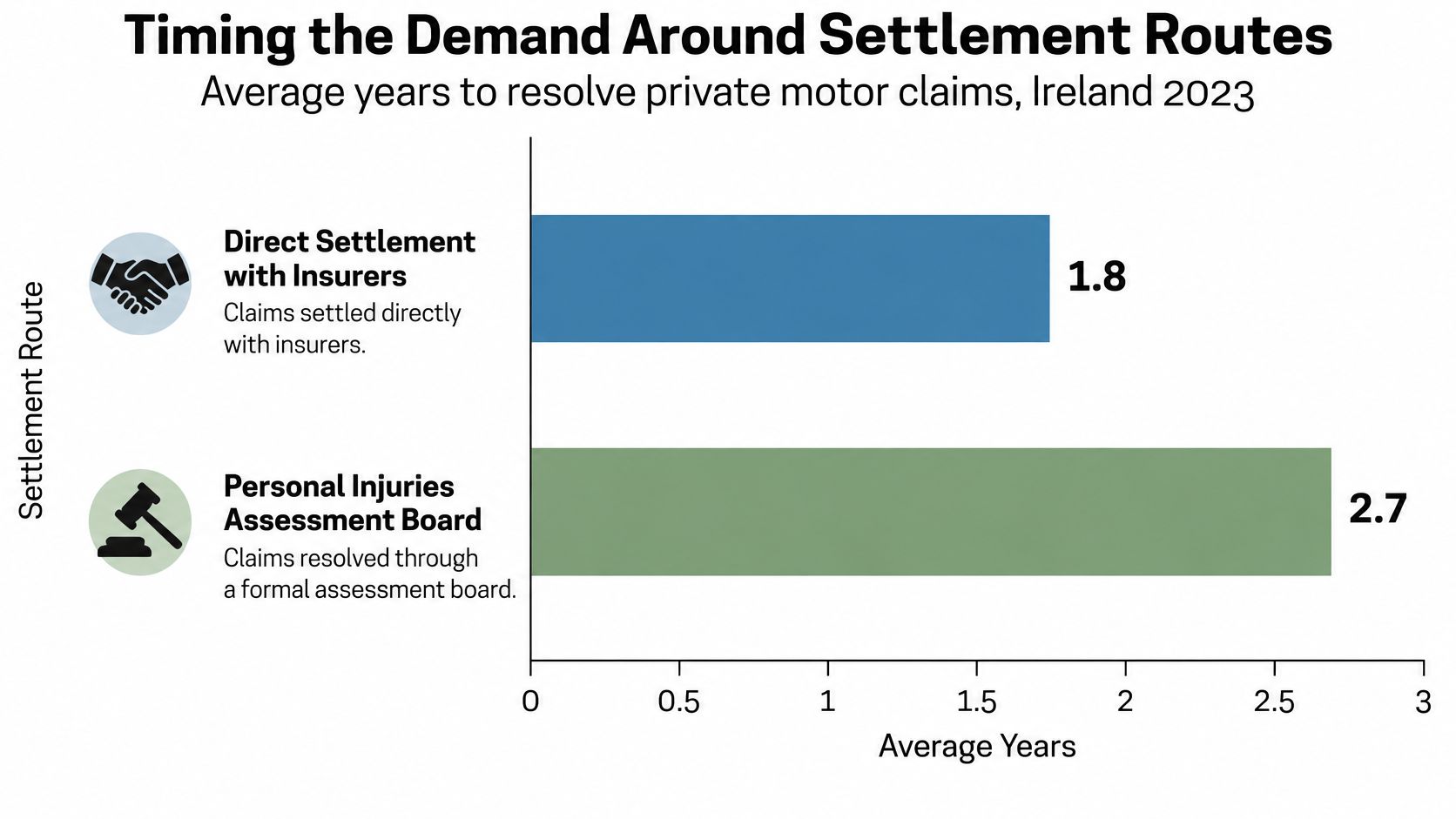
These aren't U.S. figures, and they don't prove that documentation quality causes a particular time saving. They do show the operational cost of moving into slower formal routes, with litigation adding approximately 3.4 years compared with direct settlement in that dataset.
| Resolution Route | Average Time to Settlement | What the Package Must Do |
|---|---|---|
| Direct settlement with the insurer | 1.8 years | Arrive complete at first contact so no information request is needed |
| Personal Injuries Assessment Board | 2.7 years | Give the assessor a verified chronology and a damages schedule with exhibits |
| Litigation | 5.2 years | Hold up under records requests, authentication challenges and expert review |
The Send-or-Wait Rule
Send when the chronology, bills, causation support, and prognosis let the adjuster evaluate the claim without sending a request list. Waiting is better when treatment remains active and future care is unsettled, unless the demand identifies the expected care and the provider basis for it.
That judgment matters in policy limits settlement decisions, where an incomplete damages presentation can weaken the reason to tender available coverage. Timing isn't about sending as early as possible. It's about sending when the evidence is reviewable and the losses aren't materially understated.
Review your active inventory by route. Mark where each file stalls, which records remain outstanding, and whether the next task belongs to the firm, a provider, or the carrier. A personal injury demand package submitted before that audit often creates the delay it was meant to prevent.
Assembling the Demand Letter and Pre-Send Check
The demand letter should read in the order an adjuster evaluates risk. Lead with identification and liability, prove treatment and impact, confront weaknesses, present the math, and only then state the number.
The Nine-Part Letter
- Claim summary. Identify the parties, date of loss, policy number, and claim number. End with the exhibits that establish those basic facts.
- Liability facts. Explain how the accident happened and why the insured is responsible. Cite the police report, photographs, and witness material rather than asking the adjuster to infer fault.
- Treatment summary. Present care in date order and cite the chronology exhibit. Keep this tighter than the chronology itself. The letter argues significance, while the exhibit supplies verification.
- Injury impact on daily life. Use dated examples involving work, household tasks, family activities, sleep, mobility, and recreation. Connect major limitations to provider restrictions or findings where available.
- Gaps and explanations. Address delayed care, prior conditions, missed visits, inconsistent descriptions, and billing corrections before the adjuster raises them. This placement matters because it comes after the treatment story and before valuation.
- Economic damages. Summarize each category and state the total that matches the damages schedule exhibit. Don't introduce a charge in the letter that doesn't appear in the schedule.
- Future care. Identify the recommended treatment, the provider recommending it, its clinical basis, and the supporting cost document. Separate scheduled care from care that's merely possible.
- Specific demand. State the amount, its factual basis, and a response deadline. The reader should reach this paragraph after seeing liability, injury, impact, weaknesses, and documented loss.
- Enclosure list and exhibit index. List every exhibit by number and title. Confirm that the index matches the citations in the letter and the files actually enclosed.
Write claim-to-exhibit sentences throughout the letter. For example, a sentence might read, "Following a lumbar MRI on March 4, Dr. Lee documented an L4-L5 disc herniation (Exhibit 6, p. 14)." That sentence tells the adjuster what happened, who documented it, and exactly where to verify it.
Don't repeat the records at length. A readable letter with precise citations beats a longer letter that forces the adjuster to compare two versions of the same facts. When the letter and a record differ, the adjuster will trust the record and discount the letter.
Assign the Pre-Send Check to One Person
Give one named reviewer responsibility for the final audit. Shared responsibility usually means nobody checks the exhibit numbers against the enclosed pages.
- Provider completeness. Every treating provider has records in the file, with custodian certification or another authenticating statement where needed.
- Chronology traceability. Every entry cites its source page and uses the provider and facility names shown in the original record.
- Bill-to-record match. Every billed service matches a documented encounter date, and every major documented procedure has a corresponding charge or an explanation.
- Damages support. Every line in the schedule has an exhibit, and billed, paid, and owed amounts are labeled consistently.
- Adverse-fact review. Every gap, prior condition, inconsistency, and missing causation point has a written explanation or an open-item note.
- Prognosis basis. Future-care opinions identify the findings or treatment history supporting the recommendation.
- Arithmetic check. The schedule total equals the amount used to support the specific demand.
- Exhibit check. Exhibit numbers, titles, page references, enclosures, and the index all match.
- Deadline check. The letter states a clear response deadline and identifies where the response should be sent.
Send only when no item remains open or each open item has a written explanation in the file. "We'll send it later if they ask" isn't an explanation. It's a forecast of another evaluation cycle.
Final test: remove the demand letter and hand the chronology, schedule, gap log, and index to someone unfamiliar with the case. If that person can't reconstruct the claim, the package isn't audit-ready.
This week, run the checklist on one active personal injury demand package and record how long the review takes. Note which category produces the most corrections. That category is your firm's first process fix, whether it's provider follow-up, billing reconciliation, causation requests, or exhibit control. Improve that step before you redesign the whole letter template.
Turn scattered medical records into a cited chronology, damages support, and a demand draft your team can audit before it goes to the carrier. Visit Ares to see how the platform helps personal injury firms organize case files, surface gaps, and prepare stronger demand packages with less manual assembly.