In the world of personal injury law, sometimes the clearest path to a resolution is when the numbers speak for themselves. This is often the case with a policy limits settlement, a specific type of agreement where an insurance company pays the absolute maximum amount available under the at-fault party's insurance policy.
This typically happens in serious personal injury cases where the client's damages—from staggering medical bills to significant lost wages—dwarf the defendant's available coverage. Essentially, it’s the insurance carrier agreeing to pay out every last dollar they are contractually obligated to, in order to close the claim for good.
Defining the Policy Limits Settlement
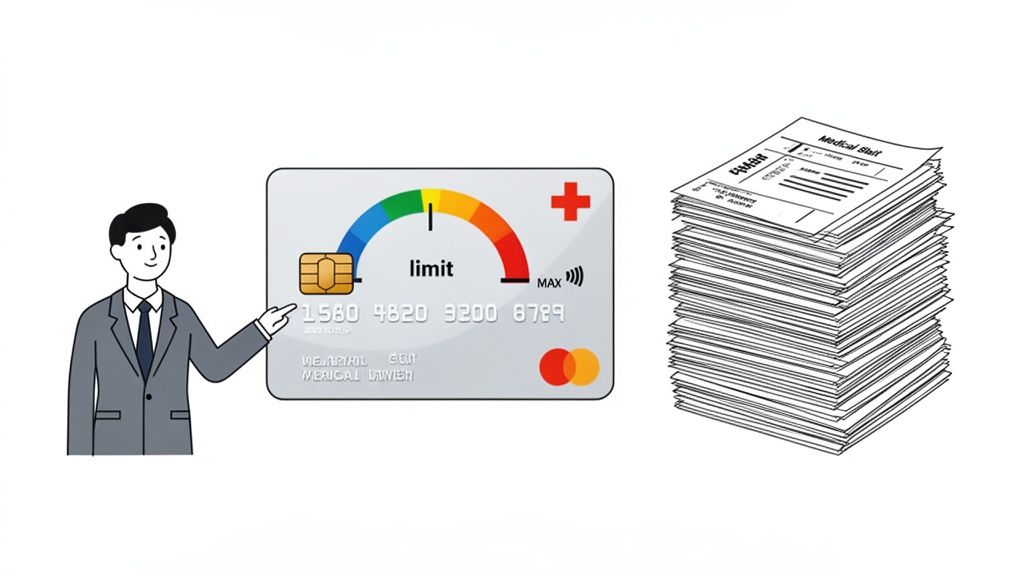
Think of the at-fault party's insurance policy like a credit card with a strict spending cap. No matter how much damage is done or how high the bills stack up, the card issuer will only cover charges up to that predefined ceiling. A policy limits settlement is simply the insurer agreeing to max out that card to settle the debt.
For a seasoned personal injury attorney, pushing for this kind of settlement is a critical strategic decision, particularly when your client has suffered catastrophic injuries and the defendant is underinsured. It often represents the quickest, most efficient way to get the maximum available funds into your client's hands without the cost and uncertainty of a lengthy court battle.
The Anatomy of the Settlement
A policy limits settlement is triggered when an insurance company offers to pay the full, maximum dollar amount of the at-fault driver's policy. In exchange, the injured party agrees to release the insured from further liability. This effectively caps the insurer's financial exposure at that exact figure.
You see this frequently in car accident cases where the damages far exceed state-mandated minimums, like Missouri's required $25,000 per person for bodily injury. You can find more practical examples and insights about auto accident policy limits on the Brown & Crouppen blog.
This isn't just about cutting a check. It’s a calculated business decision by the insurance carrier to manage its own risk. By tendering the policy limits, the company sidesteps the threat of a much larger jury verdict and, just as importantly, a potential "bad faith" lawsuit for failing to reasonably settle a clear claim.
At its core, a policy limits settlement is an acknowledgment by the insurer that the value of the claim reasonably exceeds the coverage available. It is both a financial conclusion and a strategic risk-management tool for all parties involved.
Key Components of a Policy Limits Settlement at a Glance
For any PI firm looking to maximize a client's recovery, understanding the moving parts of this settlement type is non-negotiable. It's a delicate dance between clear liability, overwhelming damages, and the available insurance coverage.
This table breaks down the core elements you'll be working with.
| Component | Description | Implication for PI Firms |
|---|---|---|
| Maximum Payout | The insurer pays the full, maximum dollar amount stipulated in the defendant's insurance contract. | This represents the absolute ceiling for recovery from that specific insurer, giving you a clear financial target. |
| Final Release | The plaintiff agrees to release the insured defendant from all future liability related to the incident. | Secures closure for the client but requires careful consideration of any underinsured motorist (UIM) claims or other potential defendants. |
| Risk Mitigation | For the insurer, it eliminates the risk of a bad faith lawsuit and a verdict exceeding policy limits. | This is the primary leverage for a plaintiff's attorney; the threat of a bad faith claim is what compels the insurer to pay. |
| Damage Evaluation | A settlement is pursued when documented damages clearly and substantially exceed the policy coverage. | Requires meticulous, undeniable documentation of all medical costs, lost income, and non-economic damages to justify the demand. |
In short, each component plays a critical role in the strategy. Mastering how they interact is key to forcing the insurer's hand and achieving the best possible outcome for your client under the circumstances.
Identifying When to Pursue a Policy Limits Demand
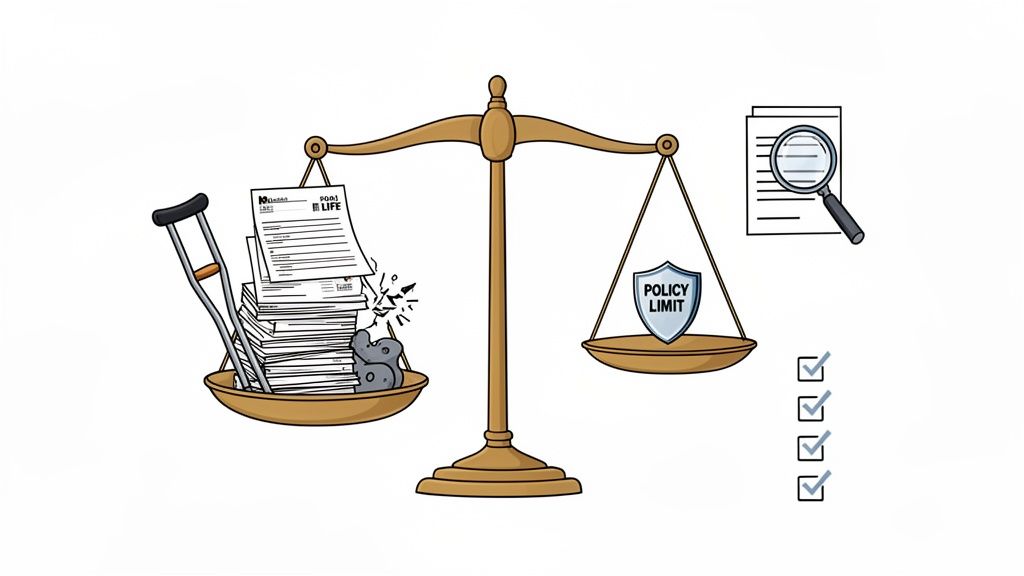
Knowing the right moment to make a policy limits demand isn't about guesswork; it's a strategic calculation. The decision really boils down to one critical question: are your client’s documented damages so severe that they obviously and substantially dwarf the defendant's available insurance coverage? When the answer is a resounding "yes," it's time to make your move.
This isn't a tool for every personal injury case. It’s reserved for those situations where the harm is undeniable, and the claim's value objectively rockets past the policy cap. Think of it as having a royal flush in poker—the evidence of your client's loss is so overwhelming that you can confidently push all-in.
The Clear-Cut Scenarios for a Demand
Some cases are just built for a policy limits demand. These are almost always the ones involving catastrophic injuries, where the financial fallout and human suffering are simply immense. Your job is to paint a picture of damages so clear and compelling that the insurer has no reasonable alternative but to pay out.
These are the most common triggers:
- Severe and Catastrophic Injuries: Cases involving traumatic brain injuries (TBIs), spinal cord damage, amputations, or third-degree burns will almost always have damages that blow past minimum or even moderate policy limits.
- Wrongful Death Claims: The combined economic and non-economic losses in a wrongful death case—from lost future income to the profound loss of companionship—can easily push a claim's value into the millions.
- Permanent Impairment or Disfigurement: When an injury leaves someone with a lifelong disability, scarring, or a need for round-the-clock medical care, the projected future costs alone can justify tendering the limits.
- Multiple Claimants: In a multi-vehicle pile-up or any incident with several injured parties, the total damages often overwhelm a single policy. A limits demand from each claimant becomes almost inevitable.
The math in these situations is hard to argue with. If the at-fault driver has a $100,000 policy, but your client has $350,000 in medical bills and can never work again, you have a textbook candidate.
Building an Irrefutable Argument
A successful policy limits demand isn't built on threats; it's built on a mountain of irrefutable evidence. The goal is to leave the insurance adjuster with zero doubt that a jury would award damages far beyond what their policy covers. This takes more than just forwarding a stack of bills—it requires weaving a powerful, fact-based narrative of loss.
The strength of a policy limits demand lies not in its threat, but in its evidence. It must demonstrate that the value of the claim is not just a matter of opinion, but a matter of fact, making any refusal to settle an unreasonable gamble for the insurer.
To construct this airtight case, you need to gather and present a truly comprehensive damages package. This means detailing not just the costs already incurred, but also providing a clear, expert-backed projection of what your client will need for the rest of their life.
Your evidence package should include:
- Complete Medical Records and Bills: This is the bedrock of your economic damages, itemizing every single procedure, treatment, and associated cost.
- Life Care Plans: For truly catastrophic injuries, a life care plan from a certified expert is non-negotiable. It meticulously outlines all future medical needs—surgeries, therapies, assistive devices, in-home care—and puts a precise dollar figure on them.
- Expert Economic Reports: An economist’s report is vital for calculating lost earning capacity. They can project, with authority, the income your client has lost and will continue to lose over their lifetime because of the injury.
- Compelling Non-Economic Evidence: This is where you show the human cost. Photographs of the injuries, victim impact statements, and reports from psychologists can vividly illustrate the client’s daily pain, suffering, and fundamentally altered quality of life.
By assembling all of this before you send the demand, you show the carrier that your valuation isn't a negotiation tactic; it's based on cold, hard data. This puts immense pressure on them, framing your demand not as an opening offer but as a final, reasonable chance to protect their insured and close the file.
Using Policy Limits as a Strategic Negotiation Tool
A policy limits demand isn't just another settlement offer. It’s a calculated, strategic move meant to completely reframe the negotiation. When you execute it correctly, you shift the entire financial risk of a massive verdict from your client directly onto the insurance carrier. This forces them into a corner where they have to make a very tough call.
Essentially, you're turning a routine negotiation into a high-stakes bet for the insurer. The premise is simple: if you present a clear, well-supported demand to settle for the full policy limits, and the insurer unreasonably refuses, they're rolling the dice.
Should you then take the case to trial and win a verdict that blows past the policy limit, the insurance company could be on the hook for the entire judgment, not just their policy maximum. This is the power of an insurance "bad faith" claim—a legal doctrine that holds carriers accountable for not protecting their own insured when they had a reasonable chance to do so.
The Power of Bad Faith Exposure
The threat of a bad faith lawsuit is what gives a policy limits demand its teeth. Insurers have a legal duty to act in good faith to shield their policyholders from judgments that exceed their coverage. When they break that promise by turning down a reasonable settlement offer within the policy limits, they open themselves up to catastrophic financial exposure.
This is where your leverage comes from. You’re no longer just asking for the policy amount. You're giving the carrier a choice: pay the contractual limit now, or risk paying an uncapped, potentially multi-million-dollar verdict later.
A well-crafted policy limits demand effectively tells the insurer, "The risk of an excess verdict is now your problem, not my client's." This strategic shift is what compels even the most stubborn adjusters to re-evaluate their position and protect their company's assets.
Knowing a bit about how insurers operate internally can give you a real edge. For instance, understanding the rise of automated claims processing helps you frame your demand in a way that flags it as a high-risk file within their own systems, making it much harder for an adjuster to justify a rejection.
From Small Policies to Major Recoveries
The real magic of this strategy shines through in the results. A rejected $100,000 policy demand can absolutely transform into a seven-figure recovery for a deserving client. When an insurer gambles and loses, the fallout can be massive, forcing them to cover the full scope of your client’s damages, no matter how small the original policy was. The key is proving that their decision to say "no" was unreasonable based on the facts you presented.
While a policy limits settlement caps the insurer's initial payment, the data shows these agreements are the bedrock of personal injury resolutions. In fact, pre-trial settlement rates have climbed to 95%, up from 90% just a decade ago, largely because case valuation has become much more precise.
In catastrophic injury or wrongful death cases, the risk of an excess verdict skyrockets. In one Arkansas highway fatality case, for example, a carrier rejected a $100,000 policy demand. The jury came back with an $800,000 verdict, which was ultimately collected in full from the insurer through a bad faith action.
To make this strategy work, you have to nail the valuation of your client's losses. If you need a refresher, you can check out our guide on how to calculate pain and suffering damages to build the strongest possible case.
Insurer Response Scenarios to a Policy Limits Demand
When you send a policy limits demand, you put the ball squarely in the insurer's court. Their response will dictate your next move and can dramatically shape the outcome of the case. Here’s a breakdown of how it typically plays out.
| Insurer Action | Plaintiff's Next Steps | Potential Outcome |
|---|---|---|
| Accept the Demand | Finalize the settlement, negotiate liens, and execute the release. | The client receives the maximum available policy funds quickly, avoiding the stress and uncertainty of litigation. |
| Reject the Demand | File the lawsuit and begin preparing for trial. | The insurer is now exposed to a potential excess verdict and a subsequent bad faith claim for the entire judgment amount. |
| Counteroffer/Delay | Reiterate the demand and the deadline, carefully documenting the insurer's failure to accept a reasonable offer. | This strengthens the foundation for a future bad faith claim if the case proceeds and results in an excess verdict. |
As you can see, each path has distinct strategic implications. A rejection isn't always a loss; often, it's the first step toward a much larger recovery.
Ultimately, a policy limits demand is about creating a situation where settling is the insurer’s only logical and prudent choice. By meticulously documenting your client's damages and clearly articulating the risk of an excess verdict, you can turn a limited insurance policy into the key that unlocks a full and fair recovery.
Navigating Complexities and Common Pitfalls
Getting the insurance company to tender its policy limits is a huge win, but it’s rarely a simple, straight-line process. Real-world injury cases are messy. You'll run into everything from multiple people hurt in a single crash to a mountain of medical liens that threaten to swallow the entire settlement. Knowing how to navigate these minefields is what truly protects your client.
Anticipating these challenges and having a plan is what separates a decent outcome from a great one. It’s about playing chess, not checkers.
When Multiple Claimants Compete for Limited Funds
One of the most common headaches is dealing with multiple victims and not enough insurance money to go around. Picture this: a multi-car pile-up caused by a single driver who carries the state minimum of $50,000 per accident. If you have three people with serious injuries, that $50,000 will be gone in a flash.
In these situations, the insurance company isn't just going to cut a check to the first person who sends a demand letter. They’re terrified of being sued for "bad faith" by paying one claimant and leaving the others with nothing. So, they often file what’s called an “interpleader.” Essentially, they hand the $50,000 policy over to a court and say, "You figure it out." This gets the insurer off the hook, but it can drag out the process and leave the final decision in a judge's hands, not yours.
A much better way forward, if possible, is to get proactive. Reach out to the lawyers for the other injured parties and try to hammer out a global settlement agreement. This lets all the victims collectively decide how to split the limited funds, giving everyone a sense of control and avoiding a drawn-out court battle.
The Challenge of Liens and Subrogation
Even after the insurer agrees to pay the policy limits, the fight for your client's money is far from over. Medical liens and subrogation claims are often the biggest post-settlement hurdle, and they can dramatically shrink your client’s net recovery. These are legal claims against the settlement funds from parties that paid your client's medical bills.
You'll almost always be dealing with one or more of these:
- Medicare and Medicaid: These government programs have a powerful, statutory right to be paid back from any settlement for injury-related medical treatment they covered.
- Private Health Insurers: Think Blue Cross or UnitedHealthcare. Their policies are packed with subrogation clauses that give them the right to claw back what they paid out.
- ERISA Plans: These federally-regulated, employer-funded health plans are notoriously aggressive and have very strong reimbursement rights that can be tough to negotiate down.
The gross settlement amount is just a number on a piece of paper until every lien is resolved. Aggressively negotiating these liens isn't just a good idea—it's a fundamental duty. It directly impacts the amount of cash your client actually puts in their pocket.
Ignoring or mishandling these liens can have disastrous consequences, potentially exposing both your client and your firm to lawsuits. The key is to get out in front of them. Identify every potential lien early, demand itemized ledgers to verify every charge, and then negotiate hard. It's not uncommon to get these liens reduced by 30-40%, sometimes more, which is a direct and substantial financial benefit for your client.
Securing a Final and Comprehensive Release
The final piece of the puzzle is the settlement release. This is the legal document the insurance company is paying for—it’s the contract that ends their insured’s liability for good. But a poorly worded release can be a trap, creating new problems for your client down the road.
The release must be unconditional and final, but it also needs to be surgical in its scope. It should only release the at-fault party and their specific insurance carrier. It's absolutely critical that you preserve your client's right to pursue other sources of recovery. For instance, the release language must not accidentally let your client’s own Underinsured Motorist (UIM) carrier off the hook, as that’s often the next stop for compensation.
Always scrutinize the insurer's draft release with a fine-tooth comb. Look for overly broad "all other persons, firms, or corporations" language that could unintentionally waive claims against other potential defendants. This last document is what closes the door on this chapter for your client, and its precision is paramount.
How to Draft an Ironclad Policy Limits Demand Letter
Think of a policy limits demand letter not just as a request for money, but as a strategic legal tool. It’s your opening salvo, carefully engineered to corner the insurance adjuster into one reasonable conclusion: paying the full policy. The goal is to build such an airtight case for liability and damages that refusing to pay would be an act of bad faith.
This isn't a negotiation opener; it's a closing argument delivered on paper. Every assertion must be backed by solid proof, leaving zero wiggle room for the adjuster to question the claim's value or your readiness to go to trial.
Core Components of a Winning Demand
To get an insurer to part with the entire policy, your demand letter needs to be a complete, self-contained universe of proof. It has to tell the full story—the crash, the injuries, the pain, and the economic devastation—so compellingly that the adjuster sees a trial as a guaranteed loss for their side.
A truly effective demand letter must include:
- A Clear and Unconditional Offer: You have to state, without any ambiguity, that your client will sign a full and final release of all claims against the insured in exchange for the policy limits.
- A Firm Deadline: Give the insurer a reasonable but non-negotiable deadline to accept, usually 30 days. This injects a sense of urgency and prevents them from dragging their feet.
- A Powerful Narrative: Don't just list facts. Tell the story of what happened. Detail the defendant's negligence, then walk the adjuster through your client's ordeal—the medical journey, the suffering, and the permanent changes to their life.
- Exhaustive Documentation: Attach everything. The police report, every medical record and bill, photos of the scene and injuries, expert reports, and verification of lost wages.
When you hand them this complete package, you’re sending a clear message: "Here is everything you need to know. This is your one chance to protect your insured and close this file."
Structuring the Letter for Maximum Impact
A disorganized letter is an invitation for denial. You need to structure your argument logically, guiding the adjuster from point A to point B until paying the policy becomes the only rational choice.
Part of this process, especially after securing the settlement, involves navigating liens to ensure your client gets the most money possible. The workflow is fairly straightforward.
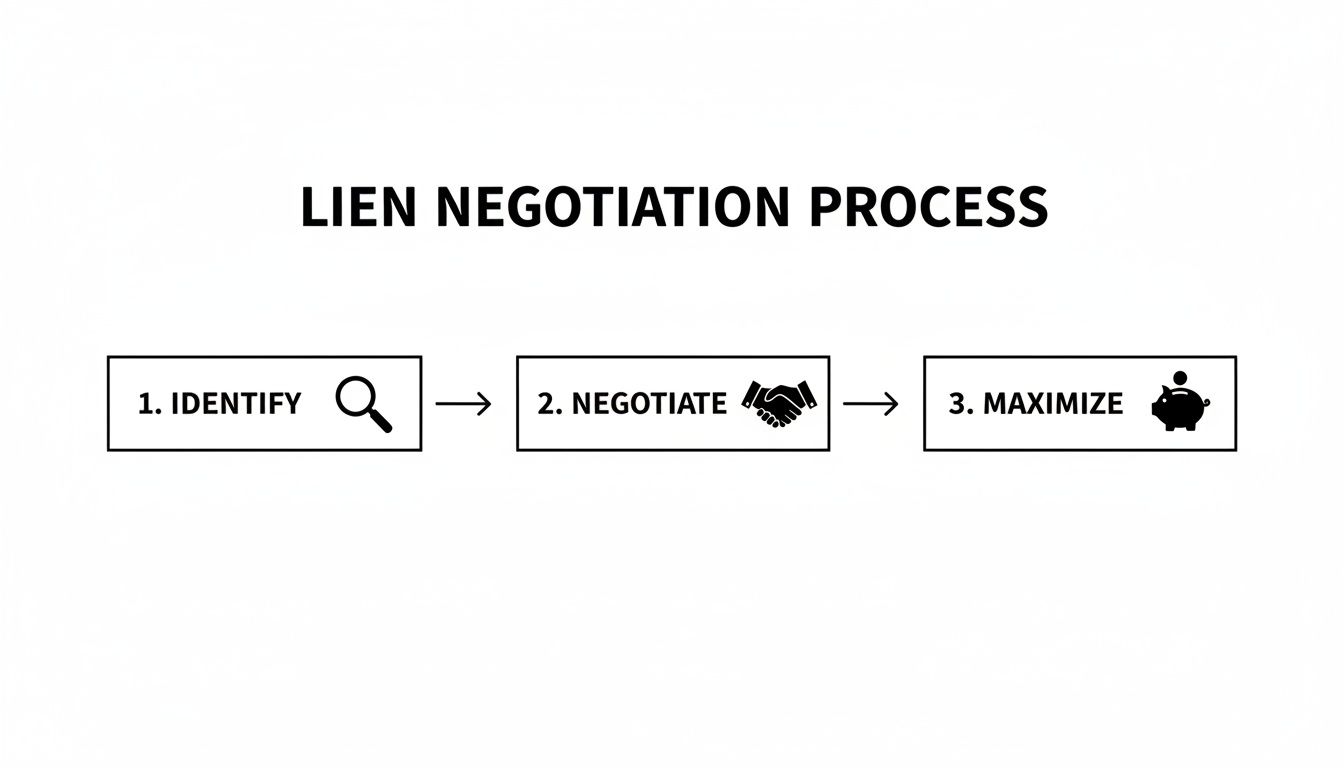
This visual is a good reminder that identifying all claims against the settlement, negotiating them down, and maximizing your client's net recovery is a critical final step.
A battle-tested structure for the demand letter itself looks like this:
- Introduction: Get straight to the point. Identify your client, their insured, the date of the incident, and the claim number.
- Liability: Lay out exactly how the insured was at fault. Keep it concise but powerful, referencing the police report and any other slam-dunk evidence.
- Damages: This is the heart of the letter. Detail the injuries, the treatments, the diagnoses, and the long-term prognosis. Itemize every dollar of economic loss (medical costs, lost income) and then vividly describe the non-economic damages like pain and suffering.
- The Demand: State your formal demand for the full policy limits within the deadline you've set.
- Conclusion: Reiterate that you're offering a full release and make it clear that your next step, should they refuse, is filing a lawsuit.
Checklist of Crucial Language to Include
There are certain phrases—legal "magic words," if you will—that are essential for setting up a potential bad faith claim down the road. They put the insurer on formal notice of their duty to their insured.
A policy limits demand is your opportunity to control the narrative. By presenting an organized, data-driven case that leaves no question unanswered, you significantly increase the odds that an adjuster will tender the policy limits without a fight.
Make sure your letter always includes language that:
- Explicitly states that the value of the claim "clearly exceeds" the available policy limits.
- Confirms your client will "execute a full and final release of your insured."
- Includes the phrase, "This offer will remain open for 30 days and will be automatically withdrawn if not accepted in writing by that time."
- Warns that a failure to settle may "expose your insured to a judgment in excess of their policy limits."
For a solid framework, using a well-vetted personal injury demand letter template can be a huge help. Including this specific language creates the paper trail you need, satisfying the legal requirements to hold an insurer accountable if they unreasonably refuse to settle. To go even deeper on this topic, check out our guide on what is a demand letter.
Securing Maximum Recovery in the Modern PI Firm
When it comes down to it, a masterfully executed policy limits demand is one of the most powerful tools a personal injury lawyer has. Getting it right is a delicate dance—a mix of deep preparation, perfect timing, and confident negotiation. It's about turning a standard claim into a critical decision point for the insurer, pushing them to settle or risk a massive bad faith judgment.
This is where today’s legal technology offers a real strategic advantage. Think about the hours spent poring over medical records and drafting demand letters. Platforms that automate that heavy lifting are a game-changer, helping firms build ironclad cases in a fraction of the time.
When you can streamline the foundational work, you free up your team to handle more cases, slash the risk of human error, and pour that reclaimed time into the high-level strategy that actually wins claims. The end result is simple: better, faster policy limits settlements for your clients.
This technological leap lets attorneys get back to what they do best: thinking strategically, negotiating hard, and fighting for their clients. Firms that embrace these tools aren't just staying current; they're defining the new benchmark for client recovery. They are solidifying their reputation as leaders in a tough, competitive field.
To continue exploring how to maximize client outcomes, see our guide on how reaching Maximum Medical Improvement impacts a payout. By integrating modern efficiencies, your firm can consistently deliver the kind of results that secure justice for the people you represent.
Frequently Asked Questions About Policy Limits Settlements
Even with a solid grasp of the strategy, settling at policy limits always seems to generate a few tricky questions. Let's break down some of the most common ones that pop up for personal injury attorneys in the thick of a case.
What Is the First Step When Damages Exceed Policy Limits?
When you realize your client's damages dwarf the defendant's insurance coverage, your first move is to build an ironclad case file. Before you even think about writing a demand letter, you need to gather every shred of evidence.
This means compiling all medical records, itemized bills, expert witness reports, and definitive proof of lost income. This comprehensive package is the bedrock of your demand; it shows the adjuster that your client's damages aren't just a number you picked out of thin air, but a hard reality they would be foolish to ignore.
Is a Policy Limits Demand the Same as a Bad Faith Lawsuit?
No, but they are closely related. Think of them as two separate chapters in the same story.
A policy limits demand is the formal offer you send to the insurer, agreeing to settle the entire claim for the maximum payout under the policy. It’s a strategic move you make before a lawsuit to try and resolve the case efficiently.
A bad faith lawsuit is a brand-new legal action you can file after the primary case is over. It only becomes an option if the insurer unreasonably rejects your policy limits demand and a jury later awards your client a verdict far exceeding that policy. The initial demand is the critical prerequisite; it gives the insurance company a fair chance to protect their insured, and their failure to do so is what opens the door to a bad faith claim.
The demand is you giving the insurer an off-ramp. The bad faith suit is what happens when they speed right past it and crash.
How Do You Handle Multiple Claimants and Limited Funds?
This is where things can get messy. When a single accident injures multiple people and their combined damages blow past the "per accident" policy limit, insurers get nervous. To protect themselves, they often file what’s called an "interpleader action."
Essentially, they hand over a check for the full policy amount to the court and ask a judge to figure out how to slice up the pie among all the victims. To sidestep this time-consuming process, the best approach is for all the plaintiffs' attorneys to get on the phone. By working together to negotiate a global settlement, you and the other lawyers can agree on a fair allocation yourselves, which is almost always faster and gives your clients more control than leaving it in a judge’s hands.
Accelerate your case resolution and maximize client recovery with Ares. Our AI platform automates the tedious work of medical record review and demand letter drafting, empowering your firm to build stronger cases faster. Discover how you can save over 10 hours per case by visiting https://areslegal.ai.