

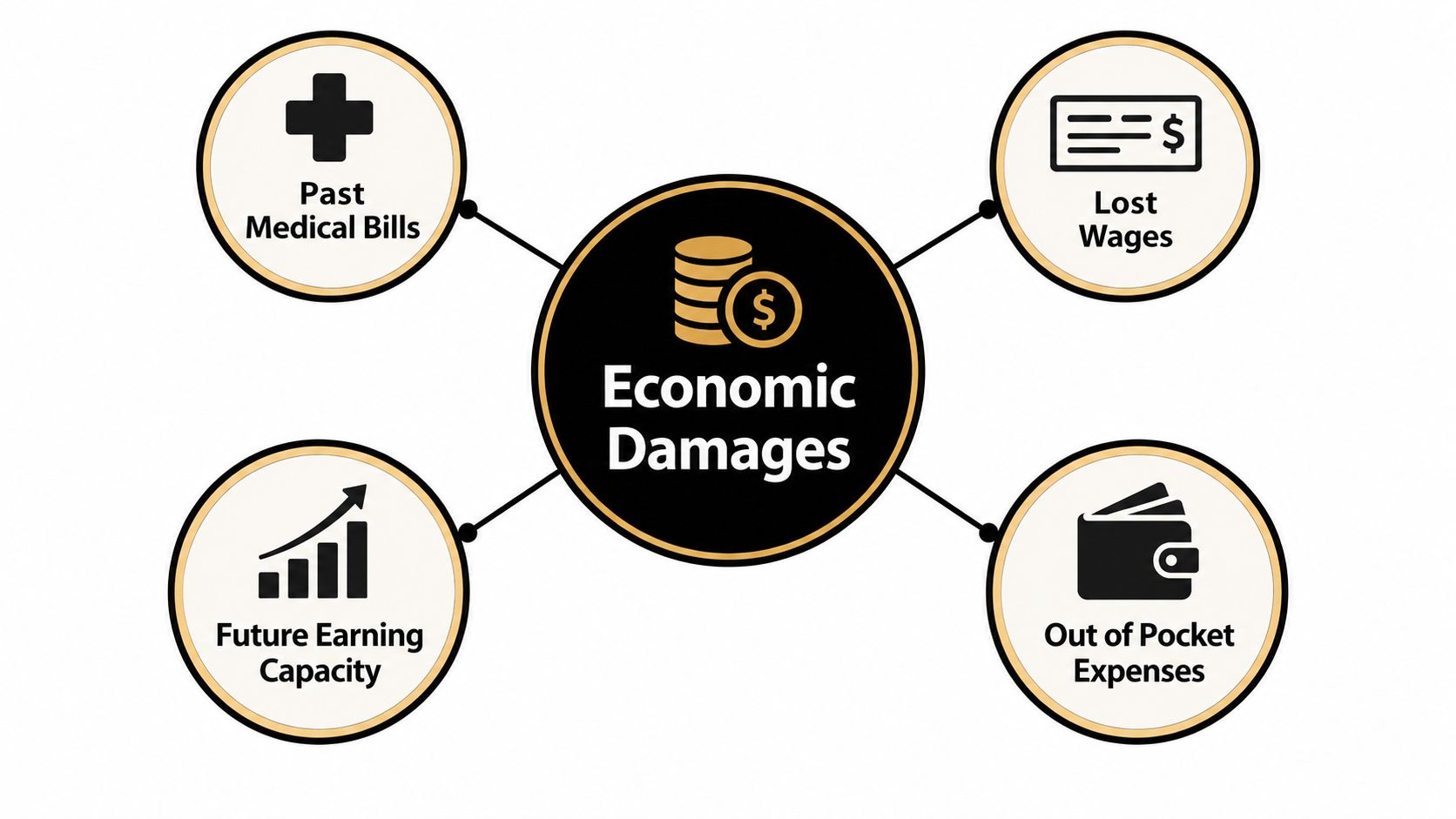
Economic damages are the objectively verifiable monetary losses tied to an injury, including past and future medical costs, lost earnings, and measurable out-of-pocket expenses. Their provability comes from the records that connect each loss to the harm, establish its amount, and show whether it belongs in the past-loss or future-loss calculation.
A client may arrive with a stack of medical bills, an employer's wage statement, receipts for transportation, and a doctor's recommendation for continuing care. The documents look substantial, but a stack of records isn't yet a damages model. The claim becomes persuasive when every line item has a source, a causal explanation, a calculation method, and a witness or record capable of surviving cross-examination.
Defining Economic Damages and Why They Matter
Economic damages are the objectively verifiable monetary losses a plaintiff suffers because of an injury or wrongful act. The legal aim is to restore the financial position the plaintiff would have occupied but for the harm, not to provide a round-number estimate untethered to evidence. Authoritative legal references describe the concept through losses such as medical bills, lost wages, future earning capacity, property repair or replacement, and substitute domestic services. The NIH reference guide on economic damages also addresses the need to project future losses and convert them to present value.
That “but for” framing does important work. A medical bill may be genuine, but the claimant still has to show that the treatment was caused by the incident, was reasonably necessary, and belongs in the damages calculation. A wage claim may be easy to quantify, but it still requires proof that the missed work resulted from the injury rather than an unrelated absence. The number matters only after the evidence establishes liability, causation, and continuity.
Objective proof distinguishes economic damages from noneconomic damages such as pain and suffering. Pain has real value, but it doesn't arrive with an invoice that states the amount owed. Economic losses generally do. Receipts, invoices, wage records, tax documents, repair estimates, and expert analysis let an adjuster, mediator, judge, or jury trace the claimed amount back to a source.
The practitioner's working model
Treat economic damages as a buildable, auditable model, not a single figure copied from a billing summary. Each component should answer four questions:
- What was lost? Identify the service, income, property, or expense.
- Why is it recoverable? Connect the loss to the injury and the applicable damages theory.
- How much is claimed? State the calculation without burying assumptions.
- What proves it? Assign the supporting record or testimony.
That structure strengthens settlement positions because the opposing side can challenge a specific assumption instead of dismissing the entire demand as inflated. At trial, it gives counsel a clean exhibit path from incident, to injury, to financial consequence, to requested recovery.
Practical rule: If a line item cannot be traced to a document, a competent witness, or a transparent calculation, it isn't ready for mediation.
The Core Categories of Economic Damages
A personal injury damages package usually contains several distinct categories. They overlap in the client's real life, but they shouldn't overlap in the spreadsheet. Past medical expenses are usually anchored by itemized bills and billing records. Future medical expenses require competent medical proof of anticipated treatment and a defensible method for valuing it.
Past lost wages are concrete and time-bound. Pay stubs, payroll records, tax documents, and an employer verification letter can establish what the client earned and when the client missed work. Lost earning capacity is different. It asks what the injury will prevent the client from earning in the future, so the analysis may require vocational evidence, work restrictions, education and employment history, and an economist's calculation.
Out-of-pocket expenses often appear modest individually but become credible when the file contains a consistent receipt and mileage trail. Property damage follows a similar proof methodology, with photographs, repair estimates, invoices, and replacement records. Depending on the jurisdiction and pleading, property damage may be treated separately, but it belongs in the same economic evidence package because the claim still depends on measurable financial loss.
| Category | Primary Documentation | Secondary Documentation |
|---|---|---|
| Past medical expenses | Itemized provider bills, CMS-1500 or UB-04 billing records | EOBs, medical records, payment ledgers |
| Future medical expenses | Treating-physician projection, life-care plan | Medical literature, provider estimates, care-cost evidence |
| Past lost wages | Pay stubs, payroll records, employer verification | W-2s, tax returns, attendance records |
| Lost earning capacity | Vocational assessment, economist's report | Employment history, restrictions, education records |
| Out-of-pocket expenses | Receipts, mileage logs, payment records | Calendars, declarations, appointment records |
| Property damage | Repair estimates, invoices, replacement records | Photographs, ownership records, valuation evidence |
The distinction between past and future loss controls the level of proof. A paid bill may establish the amount of a past expense, but it doesn't automatically prove that additional treatment will be required. A physician must explain the anticipated care, and the valuation must account for duration, frequency, and cost. A helpful companion resource for separating measurable personal injury losses from broader damages categories is this guide to special damages in personal injury.
The same discipline applies to wages. A payroll record can establish a missed shift. It can't, by itself, establish permanent impairment of earning capacity. That forward-looking claim needs a reasoned connection between the restrictions, the plaintiff's occupation, available work, and projected income.
How to Calculate Past and Future Losses
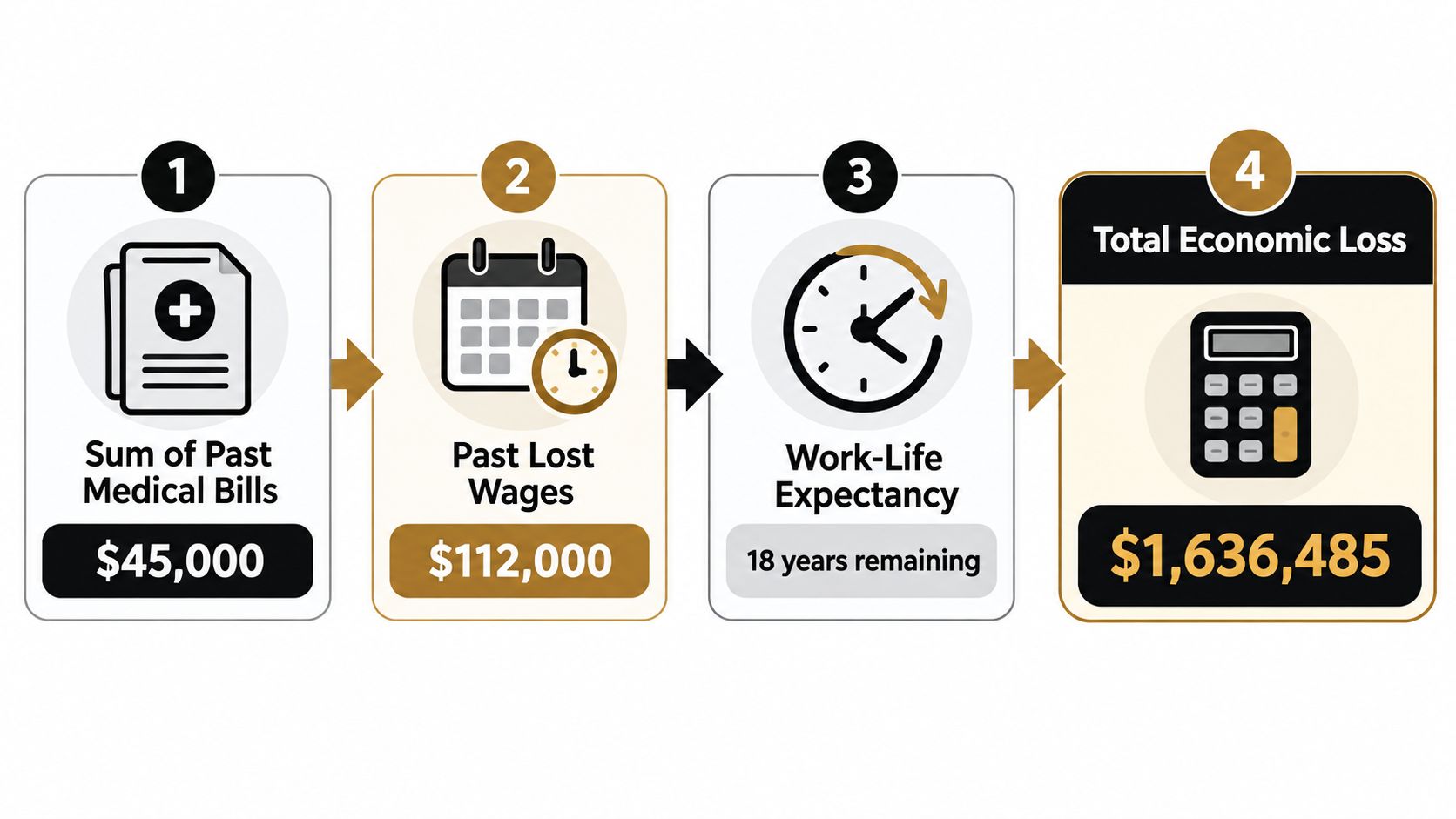
The calculation starts with the easiest figures and moves toward the assumptions that require expert support. First, identify the documented past medical expenses that are causally related to the injury. Then add verified past wage loss, approved out-of-pocket expenses, and supported property loss, keeping each category separate so the defense can audit the calculation.
Future losses require a different process. A basic present-value model can be expressed conceptually as:
Present value = future loss ÷ (1 + discount rate) raised to the relevant period
The future loss may be an anticipated medical expense or an annual earnings loss. The relevant period may be the time until the anticipated care occurs or the remaining work-life period used by the expert. The discount rate accounts for the fact that money received now can be invested or otherwise used before the future expense or loss would have occurred. Federal guidance recognizes discounting future economic losses to present value, a point discussed in the NIH damages reference.
A defensible calculation sequence
- Freeze the past-loss record. Reconcile every bill, payment ledger, wage statement, and receipt. Remove duplicates and identify balances that are still disputed.
- Define the future event. State the anticipated treatment, work restriction, or earnings consequence. The medical or vocational witness must explain why it is related to the injury.
- Set the duration. Use the treatment timeline, life-care plan, work-life analysis, or other competent evidence supporting how long the loss will continue.
- Select and explain the discount rate. The rate should have a reasoned basis, such as an accepted economic measure or testimony from the damages expert.
- Show the calculation. Give the fact finder the inputs, formula, timing, and result. A black-box total invites an attack.
The total-offset method treats future wage growth and the discount rate as offsetting assumptions, while a more detailed model can address wage growth, inflation, taxes, fringe benefits, work-life expectancy, and mitigation separately. Neither method wins just because it produces the larger result. The appropriate method depends on the jurisdiction, the evidence, and the expert's ability to explain the assumptions without overstating certainty.
A future-medical model deserves special care because treatment recommendations often change. The analysis should distinguish care already delivered from care still projected, state whether the estimate is nominal or discounted, and identify the provider or life-care planner supporting the assumption. The discussion in this resource on calculating future medical expenses can help organize that portion of the file.
Building the Documentation and Exhibit Package
The strongest demand package lets a reviewer move from a summary total to the underlying record without searching through an unindexed file. Build the damages spreadsheet before drafting the demand narrative. The spreadsheet should contain one row for each loss, a short description, the date, the amount, the causation note, the source document, and the exhibit label.
Start with the source file
For past medical expenses, collect itemized bills, payment ledgers, EOBs, and corresponding medical records. CMS-1500 forms can help identify professional services, while UB-04 records may support facility charges. A billing record without clinical context can establish that a charge exists, but it may not establish why the service was necessary or how it relates to the accident.
Future medical expenses need a separate folder. Include the treating physician's recommendation, a life-care plan where appropriate, cost support for the proposed care, and a clear explanation of frequency and duration. For lost wages, preserve pay stubs, W-2s, employer letters, attendance records, and any documentation showing the dates and reason for missed work. A vocational or economic report should support a capacity claim rather than merely repeat the client's estimate.
| Category | Source Document | Exhibit Label | Verified Amount |
|---|---|---|---|
| Past medical expenses | Itemized bills and related records | Exhibit A | To be reconciled |
| Future medical expenses | Physician projection or life-care plan | Exhibit B | To be supported |
| Past lost wages | Payroll records and employer verification | Exhibit C | To be verified |
| Lost earning capacity | Vocational and economic analysis | Exhibit D | To be calculated |
| Out-of-pocket expenses | Receipts and mileage log | Exhibit E | To be reconciled |
| Property damage | Repair estimate and photographs | Exhibit F | To be verified |
Assign exhibits consistently, such as medical bills and records first, wage materials next, and expert reports after the underlying documents. A master index should show whether each amount is billed, paid, estimated, disputed, or projected. That classification prevents a future estimate from appearing as a liquidated past expense.
Paralegals can use a structured legal document generator to standardize demand-language templates, but automation shouldn't replace source review. The person preparing the package still has to confirm dates, remove duplicate charges, check calculations, and make sure the narrative doesn't claim more than the records establish. Record organization also improves when the team follows a consistent medical-record organization process.
Before transmitting records, review every page for unnecessary protected health information. Redact unrelated medical history, personal identifiers that aren't needed for the claim, and third-party information, while preserving the entries required to prove treatment, causation, prognosis, and cost. Keep an unredacted working copy in the secure case file and document what was produced.
A Worked Example From Intake to Demand
A representative delivery-driver claim shows how the model should develop. At intake, the file contains the collision report, emergency-room records, photographs, employment information, and the client's account of missed work. The first task isn't to assign a settlement value. It is to establish a timeline and identify which future questions require medical, vocational, or economic testimony.
The emergency records establish the initial complaints and treatment. Later imaging confirms a disc injury, and the treating physician recommends possible surgery. A gap in treatment then appears in the chronology. That gap doesn't automatically defeat the claim, but it needs an explanation supported by the client, providers, and employment or insurance records. The spreadsheet should show the gap rather than conceal it.
| Item | Source | Calculation | Amount |
|---|---|---|---|
| Emergency treatment | Facility bill and emergency records | Causally related charges reconciled to records | To be verified |
| Diagnostic imaging | Imaging bill and radiology report | One charge matched to one study | To be verified |
| Follow-up care | Provider bills and treatment notes | Related visits and procedures totaled | To be verified |
| Missed shifts | Payroll records and employer letter | Verified missed work multiplied by supported wage basis | To be calculated |
| Future surgery | Treating physician recommendation | Projected cost timed and discounted as appropriate | To be supported |
| Other expenses | Receipts and mileage log | Each expense matched to a treatment event | To be reconciled |
The missed shifts should be calculated from payroll evidence, not a general statement that the client “couldn't work.” If the client returned to modified work, the model should show the difference between pre-injury earnings and actual post-injury earnings, along with the restrictions that caused the difference.
The projected surgery needs its own line and its own support. The treating physician should explain medical necessity, timing, and expected relationship to the injury. If the procedure is uncertain, the demand should describe the uncertainty accurately and avoid presenting a recommendation as a guaranteed expense. An economist can then apply the appropriate present-value treatment based on when the cost is expected to occur.
The demand letter should lead with a short damages summary, followed by the line-item schedule and indexed exhibits. It should state which amounts are historical, which are ongoing, and which are future projections. That presentation gives the defense a defensible number to evaluate and gives counsel a clear response when an adjuster challenges a particular component.
A demand anchored to a documented model is more useful than a round figure chosen for negotiation theater. The model doesn't eliminate disagreement, but it narrows the dispute to causation, necessity, duration, wage basis, or valuation.
Common Mistakes That Undermine Economic Damage Claims
A large medical file can still support a weak damages claim. The recurring problems aren't usually hidden in complex economics. They arise when the team treats documentation as a pile of records rather than a controlled evidentiary system.
The errors that surface at mediation
Double counting happens when the same treatment appears in past medical expenses and again inside a future-care projection. The fix is a treatment ledger that marks each service as incurred, ongoing, or projected. Cross-reference the physician's recommendation against the ledger before finalizing the demand.
Failure to discount makes a future loss look like a current cash expense. Future care and future earnings should be timed and converted to present value when the governing law and evidence require it. The economist should identify the discount rate and explain why the selected approach fits the assumptions.
Treatment gaps create an opening for the defense to argue that the injury resolved, that a later event caused the symptoms, or that the proposed care is unrelated. The file should identify the reason for the gap, preserve communications with providers, and obtain a medical explanation when the gap affects causation.
Unsupported earning-capacity claims often rely on the client's belief that the injury will limit future work. That belief may be sincere, but it doesn't replace vocational analysis. Match the work restrictions to the job's actual demands, then have qualified economic testimony address the resulting earning impact.
Unexamined collateral sources can create avoidable disputes over billed charges, paid amounts, admissibility, and the applicable state rule. Counsel should analyze the governing collateral-source doctrine rather than assume that an insurer payment automatically controls the recoverable medical-loss figure.
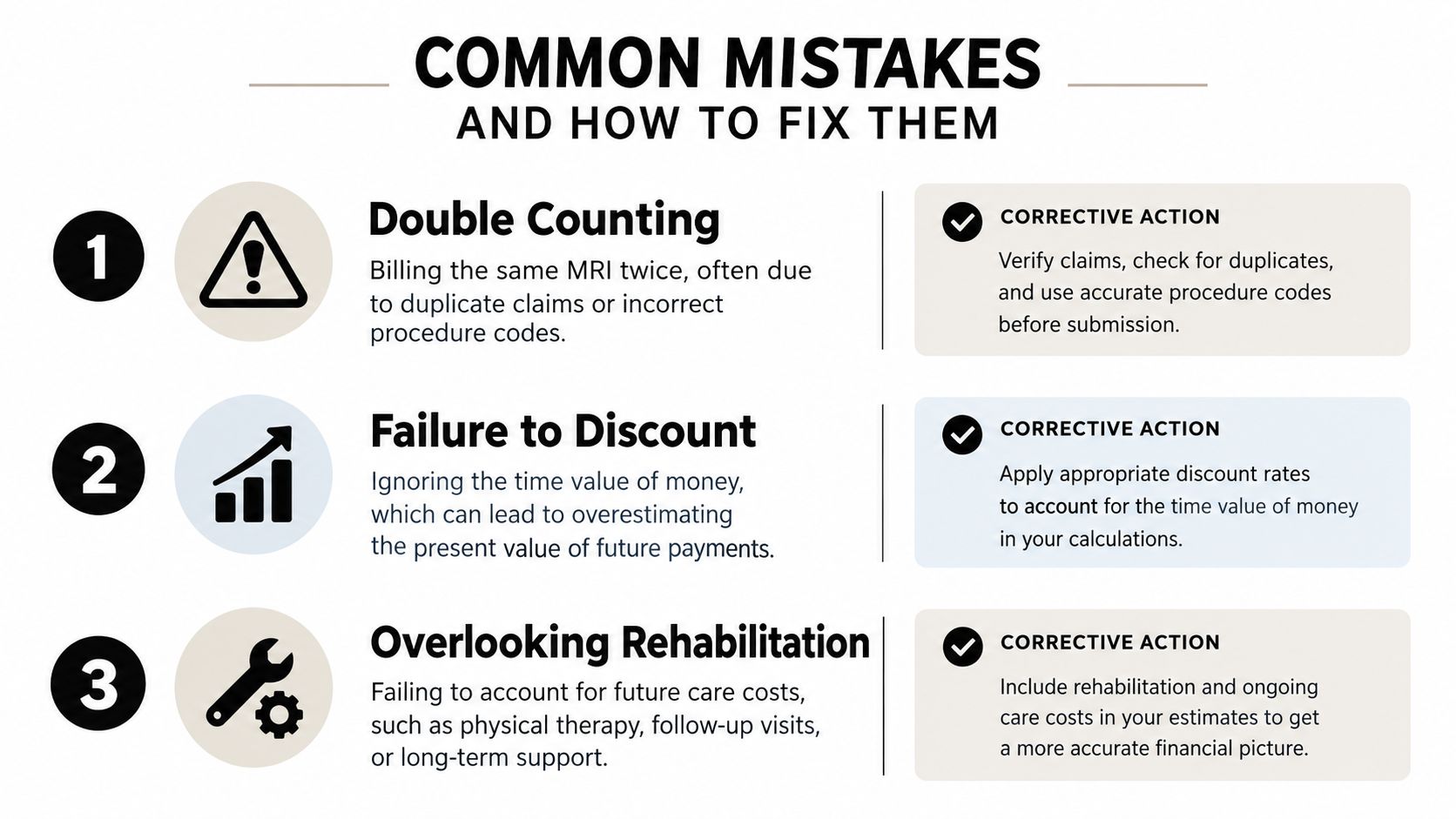
Before mediation: Run a duplicate check, a causation check, and a future-loss check. Those three reviews catch a substantial portion of the attacks that otherwise appear for the first time in negotiation.
The most effective remediation is specific. Don't write “medical records reviewed” in the spreadsheet. Identify the provider, service date, diagnosis connection, charge status, and exhibit page. Don't write “lost income supported.” Identify the employer record, wage basis, missed period, and calculation.
Putting It All Together for Settlement and Trial
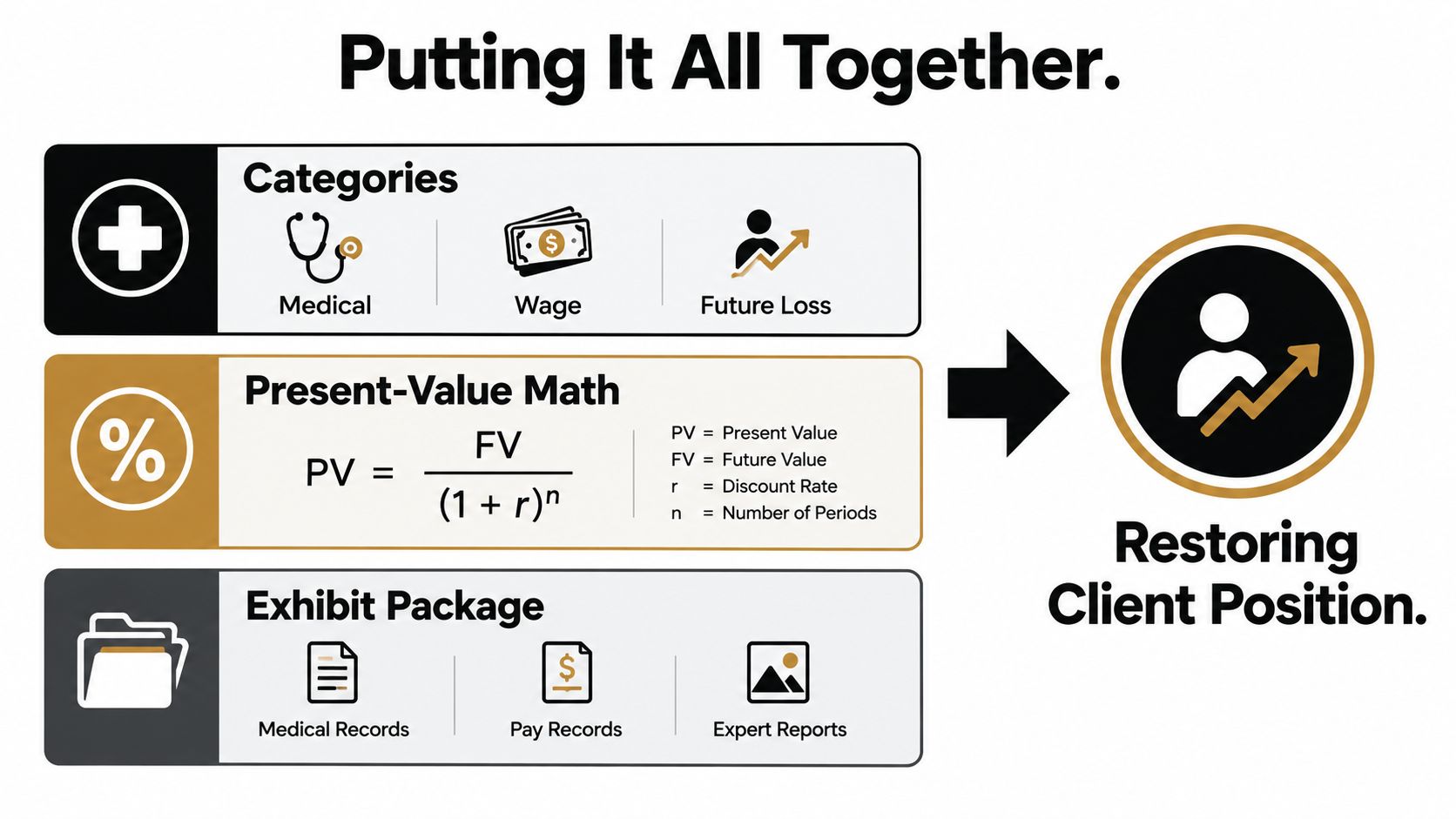
Economic damages work best as a repeatable chain. The categories identify what was lost. The records establish that the loss occurred. Medical, vocational, and economic testimony explain causation, duration, and future value. The final spreadsheet gives the mediator or jury a way to test the result.
At mediation, provide a line-item schedule, a narrative cover letter, and indexed exhibits. Separate documented historical losses from projections. Tie every future item to the witness or report that supports it, and make the assumptions visible instead of hiding them inside a total.
At trial, introduce the records that establish the loss, then use the appropriate witness to explain disputed issues. A life-care planner can address anticipated care, while an economist can explain work-life assumptions and present-value treatment. Opposing counsel will look for gaps, duplicate charges, unsupported projections, and inconsistencies between testimony and the spreadsheet.
Use this final checklist before sending the demand or assembling the trial binder:
- Confirm causation: Every claimed item has a medical, employment, or property connection to the incident.
- Reconcile amounts: The spreadsheet matches the source records and contains no duplicates.
- Separate time periods: Past, ongoing, and future losses are clearly identified.
- Explain assumptions: The model states its duration, wage basis, cost basis, and present-value method.
- Prepare witnesses: Each expert or records custodian can explain the exact portion of the model they support.
A documented damages model won't guarantee settlement. It does give the case a number that can be tested, defended, and adjusted without losing credibility. For broader process context on payment disputes and enforcement, practitioners may also review this discussion of Prompt Payment Act enforcement gaps.
Ares helps personal injury firms turn medical records into organized case insights, including damages-ready totals, provider breakdowns, treatment costs, and demand-letter materials. Visit Ares to see how your team can build a more consistent documentation pipeline for settlement and trial.