
You're scrolling job boards after 11 p.m., half-excited and half-fed up, because the listings look blurry. One posting says paralegal, another says legal assistant, a third wants plaintiff injury experience you don't have, and every salary range seems to mean something different. If you're trying to break into paralegal jobs in Nashville, Tennessee, or move up without wasting six months on the wrong applications, you need the market reality, not the recycled brochure version.
Nashville is a real paralegal market, and it's the one Tennessee candidates should bet on first. The city has the deepest concentration of openings, the broadest mix of practice areas, and enough salary variation that a careful applicant can position upward instead of taking the first lowball offer. If you want a bigger-picture career lens before you go further, start with the paralegal career outlook and then come back to the Nashville specifics.
Why Nashville Is the Right Paralegal Market to Bet On in 2026
Nashville isn't a fantasy market where a few firms post stale openings and call it a day. It's the place where Tennessee paralegal candidates have the best shot at finding volume, variety, and a path that fits their background.
The reason I'd take Nashville seriously is simple. The market isn't just law firms. It's law firms, plaintiff shops, healthcare-adjacent operations, insurance work, court-side support, and legal departments that all pull from the same talent pool. That matters because one candidate may fit a litigation desk perfectly while another is better suited for document-heavy support, intake coordination, or a more structured in-house role.
The real question is fit, not just volume
A lot of job seekers make the same mistake. They treat every paralegal opening as interchangeable, then wonder why they keep hearing nothing back. Nashville rewards people who match the lane, not just the title.
If you're newer to the field, don't assume the “best” job is the one with the fanciest title. The better move is to target the role family where your current experience already makes sense, then stack the missing credential later. That's especially true in a city where some employers want direct plaintiff injury experience, while others care more about software fluency, organization, and legal support judgment.
Practical rule: apply where your background already tells a believable story. Nashville hiring managers can spot a random application instantly.
There's also a hidden advantage in Nashville that gets missed in generic career guides. Because the market spans so many practice types, you can pivot without leaving the city. That's useful if you want to start in one lane, then move into a better-paying specialization once you've built the right file experience.
For job seekers comparing markets, that flexibility is the whole game. A smaller city might offer fewer choices but less confusion. Nashville gives you both opportunity and noise, which means the candidate who searches with intent usually beats the one who just sprays resumes.
Nashville Paralegal Pay, From BLS to Real Listings
The cleanest public baseline comes from the U.S. Bureau of Labor Statistics. In May 2023, the Nashville-Davidson–Murfreesboro–Franklin metro had 2,300 paralegals and legal assistants employed, with an annual mean wage of $59,960 and a median hourly wage of $27.51 according to the BLS occupational data for the Nashville metro. That's the anchor, but it's not the whole story.
What matters more for a job seeker is how current listings cluster around that number. Recent Nashville salary trackers put the market in the mid-range, not the bargain bin and not the high-end boutique ceiling. ZipRecruiter reported an average annual pay of $57,694 for paralegals in Nashville in May–June 2026, with most workers between $46,400 and $66,200 and the top 10% at $77,271. Its separate “law paralegal” listing showed the same citywide average and an hourly equivalent of $27.74.
What the spread says about real offers
The entry-level picture is still competitive. Robert Half's 2026 Nashville entry-level paralegal range was $48,760 to $61,215, while Salary.com placed the broader Nashville range at $58,169 to $118,164 as of November 2024. That gap tells you two things. First, employers are willing to pay for experienced people. Second, a polished resume with the right specialization can move you beyond the middle of the pack.
Here's the way I'd read offers in this market. If a posting is near the lower band, that's normal for a true entry role or a lighter-support desk. If you're already experienced in litigation, medical records, or a named practice area, an offer above $65K can be perfectly ordinary rather than aggressive. Don't undersell yourself just because a broad job-board average looks modest.
| Source | Year | Average/Mean | Entry Range | Top of Range |
|---|---|---|---|---|
| BLS | 2023 | $59,960 annual mean | Not stated | Not stated |
| ZipRecruiter | 2026 | $57,694 average annual pay | $46,400 to $66,200 | $77,271 top 10% |
| Robert Half | 2026 | Not stated | $48,760 to $61,215 | Not stated |
| Salary.com | 2024 | Not stated | $58,169 to $118,164 broad range | $118,164 top end |
For a candidate trying to negotiate, the best line on an application is usually a realistic range tied to your actual specialty. Don't quote a fantasy number, and don't anchor yourself to statewide averages that flatten Nashville's upside. If you want a second opinion on how the numbers stack up, the Nashville paralegal pay guide is useful for sanity-checking your target.
Read percentile ranges like a recruiter
ZipRecruiter's roughly $46.4K 25th percentile and $66.2K 75th percentile, plus Salary.com's $58.2K to $74.0K band for Paralegal I roles, show why the average can mislead you. The upper quartile is where specialized candidates live. If you've got litigation support, medical chronology, or certified training, you should assume you're competing for the stronger side of the range, not the floor.
Don't let one flat salary figure talk you into a weak offer. In Nashville, the right experience changes your bargaining position fast.
Which Practice Areas Are Hiring in Nashville
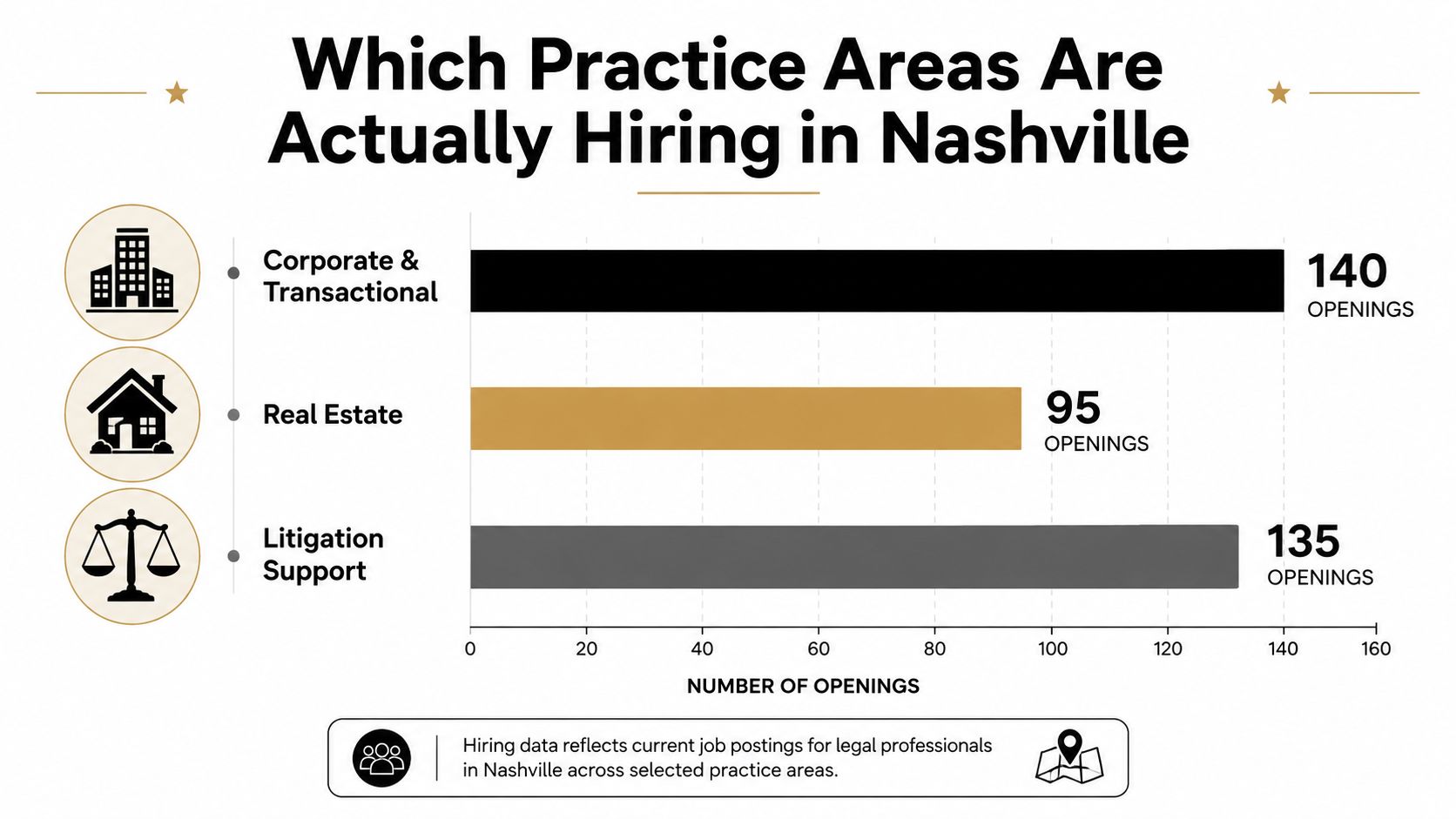
The hire pattern is wider than the title suggests. Current listings show about 370 paralegal jobs in the Nashville metro on LinkedIn, while Indeed, CareerBuilder, and ZipRecruiter keep surfacing openings across several legal support lanes. If you only search for “paralegal,” you miss half the market. You need a target practice area.
The four buckets that matter
Personal injury plaintiff work is the cleanest entry path for a lot of candidates, and it is the lane I would watch first if you want volume plus upward mobility. Nashville postings in this area often sit around $25 to $31 per hour, and the day-to-day work leans hard on medical records, deadlines, chronology building, and client contact. The catch is simple. Some firms want recent plaintiff PI experience, which makes cold entry tougher than the job title suggests. If you want to prepare for that track, the personal injury paralegal guide gives you the right skill map before you start applying.
Corporate and transactional support pays for precision. These desks care about document control, version tracking, and comfort with structured workflow, and they usually prefer candidates who can slot into a process without much hand-holding. The work is calmer than plaintiff litigation, but the screening is stricter on organization and polish.
Healthcare and insurance legal operations sit in the middle. These roles may be posted as paralegal, legal assistant, or legal support, and they fit candidates who can stay responsive, keep files clean, and move information without dropping details. Employers in this bucket want steady execution more than flair.
Government and court-side roles are the best bridge for candidates who have formal training but thin law-firm experience. A Nashville term law clerk role can run from $74,678 to $106,437, which shows how specialized legal support can pay well when the job carries heavier responsibility. If you are willing to take adjacent support work first, these openings can be a smart way into the market.
The mistake I see over and over is sending the same resume to all four buckets. That approach wastes time. A plaintiff firm wants proof that you can handle records and timeline pressure. A corporate desk wants disciplined process work. A government role wants training alignment and reliability.
Use the role title as a clue
If a posting says legal assistant, paralegal, or legal support, read the duties before you react to the label. Nashville employers mix titles constantly. The best opening for your background may not use the word you expected.
For a live-market check on how these titles show up, browse job listings and compare the wording across firms. The title shifts. The requirements stay stubborn.
The strongest candidates do not ask, “Which paralegal jobs are open?” They ask, “Which role family matches my file experience right now?”
For legal support teams that need a sharper intake front end, Recepta.ai legal receptionist is a useful example of how Nashville firms think about workflow around the paralegal seat, especially where first-touch responsiveness shapes the rest of the case load.
Credentials and Skills Nashville Employers Actually Screen For

Nashville employers don't hire on vibes. They scan for formal training, role-specific proof, and whether you can already function in their systems.
What actually moves the needle
A paralegal certificate is a good entry point if you need structure fast, especially if you're changing careers. A stronger academic path is a bachelor's degree or a paralegal studies program tied to an approved training route. If you're early-career and need to get employable, that foundation matters more than a fancy résumé bullet.
The Certified Paralegal credential from NALA is worth serious attention once you're ready to signal professional commitment. I'd call it “worth it later” for absolute beginners and “worth it now” for candidates who already have experience and want to separate themselves from the pack. The CRP designation can also help, but only if you're ready to pair it with real work history, not use it as a substitute for it.
Specialty credentials matter even more in plaintiff work. If you're trying to get into personal injury, the PICC from the National Federation of Paralegal Associations is one of the few credentials that tells a hiring manager you've thought beyond general legal support. That matters in a market where firms want people who can hit the ground running.
The software stack is not optional
Nashville postings frequently mention Clio, MyCase, Needles, NetDocuments, and iManage. If you know one of those, put it near the top of your resume. If you know several, even better. This isn't the place to be humble.
Skip the idea that software fluency is a “nice to have.” It's a screening tool. Hiring managers are looking for evidence that you can move files, not just talk about legal work in the abstract.
A strong first-pass resume for a Nashville PI firm usually shows four things:
- Training: certificate, degree, or paralegal program that makes your legal foundation believable.
- Role-relevant experience: medical records, chronology, demand letters, docketing, or client communication.
- Software fluency: the tools the firm uses, not just general “computer skills.”
- Certification signal: NALA, CRP, or specialty credentials that show commitment.
- Practice-area fit: plaintiff injury, litigation support, or another lane that matches the posting.
If your resume doesn't say what kind of legal work you've done, a recruiter has to guess. Guessing kills interviews.
The smartest sequencing is simple. Get the education piece solid first. Add certification when you can support it with experience. Use specialty credentials when you're aiming at a lane where they'll get noticed.
Where to Find Nashville Paralegal Openings Every Week
The best search routine is boring on purpose. It uses the same channels every week, but it doesn't waste time on random scrolling.
Tiered sourcing beats panic searching
Tier 1, high signal: LinkedIn, the Tennessee Bar Association career center, the Nashville Bar Association, and the direct career pages of high-volume plaintiff firms. These are the places where serious openings show up first, and where you can sometimes catch a posting before it gets flooded.
Tier 2, high volume: Indeed, ZipRecruiter, and CareerBuilder. These are useful for breadth, but you have to search smarter. Don't stop at “paralegal.” Use litigation support, case manager, legal assistant, and law clerk as search terms too.
Tier 3, relationship driven: Robert Half Legal, Special Counsel, local Nashville staffing agencies, and alumni networks from schools like MTSU, Belmont, and Nashville State. These channels are slower, but they can turn into the best-fit placements because someone has already screened the mismatch out.
A good weekly rhythm looks like this:
- Tuesday morning: scan LinkedIn and the bar association boards.
- Wednesday: submit the strongest applications, not the most applications.
- Thursday: check staffing firms and direct firm career pages.
- Friday: send follow-ups and update your tracker.
- Weekend: clean up your resume, portfolio, and references.
That routine beats a midnight binge every time.
Search terms matter more than most candidates think
If you only search “paralegal,” you'll miss work that's labeled differently but pays and functions the same way. Nashville employers often split the title across legal assistant, support specialist, and case management roles. That's especially true in plaintiff shops and legal operations teams.
For candidates who want a cleaner weekly workflow, the list of openings on the Nashville jobs search page can be a practical cross-check against what you're seeing on the big boards. Use it as a pattern finder, not a replacement for direct applications.
The best search habit is consistency, not intensity. A few targeted touches every week will beat fifty rushed applications that all look the same.
Resume, Interview, and Follow-Up Tactics That Win Offers
A Nashville firm can tell in the first minute whether you wrote your resume for the job or for the internet. The winning version is sharp, narrow, and built around the exact type of file work the employer needs.
Tailor the resume to the file, not the fantasy title
If you're applying to a PI or litigation support role, lead with medical-records review, demand-letter support, chronology work, and the software you've used. If you've handled Clio, MyCase, or Needles, name it. Don't bury it in a generic skills section.
The cover note should be short and specific. Mention the case type or practice area the firm handles, and give one sentence showing that you understand the file pressure. That's enough. Hiring managers don't need a manifesto, they need confidence that you understand the desk.
For resume mechanics, the ATS-compliance guidance is useful if you've been sending out polished resumes that somehow never get seen. Keep the formatting clean, the headings obvious, and the file readable by software before a human ever opens it.
Prepare for the questions Nashville firms actually use
There are two interview prompts I've seen come up often in this market.
The first is a mock chronology walkthrough. They want to know whether you can organize facts from a messy record set without losing sequence or context. The second is a HIPAA or PHI handling scenario. They want to know whether you understand privacy discipline and whether you'll make a careless mistake with sensitive records.
Your follow-up should be disciplined too. Send a thank-you within 24 hours, follow with a value-add note at day 7, and do a polite check-in at day 14 if you haven't heard back. Don't pester. Stay visible.
If you're trying to fit certifications and CLEs onto a one-page resume, make them compact and relevant. Put them near the top only if they help you win the exact role. Otherwise, let the experience section do the heavy lifting.
Employers remember the candidate who sounds ready on day one. They don't remember the one who sent a generic thank-you email and disappeared.
Your First 90 Days in a Nashville Paralegal Role
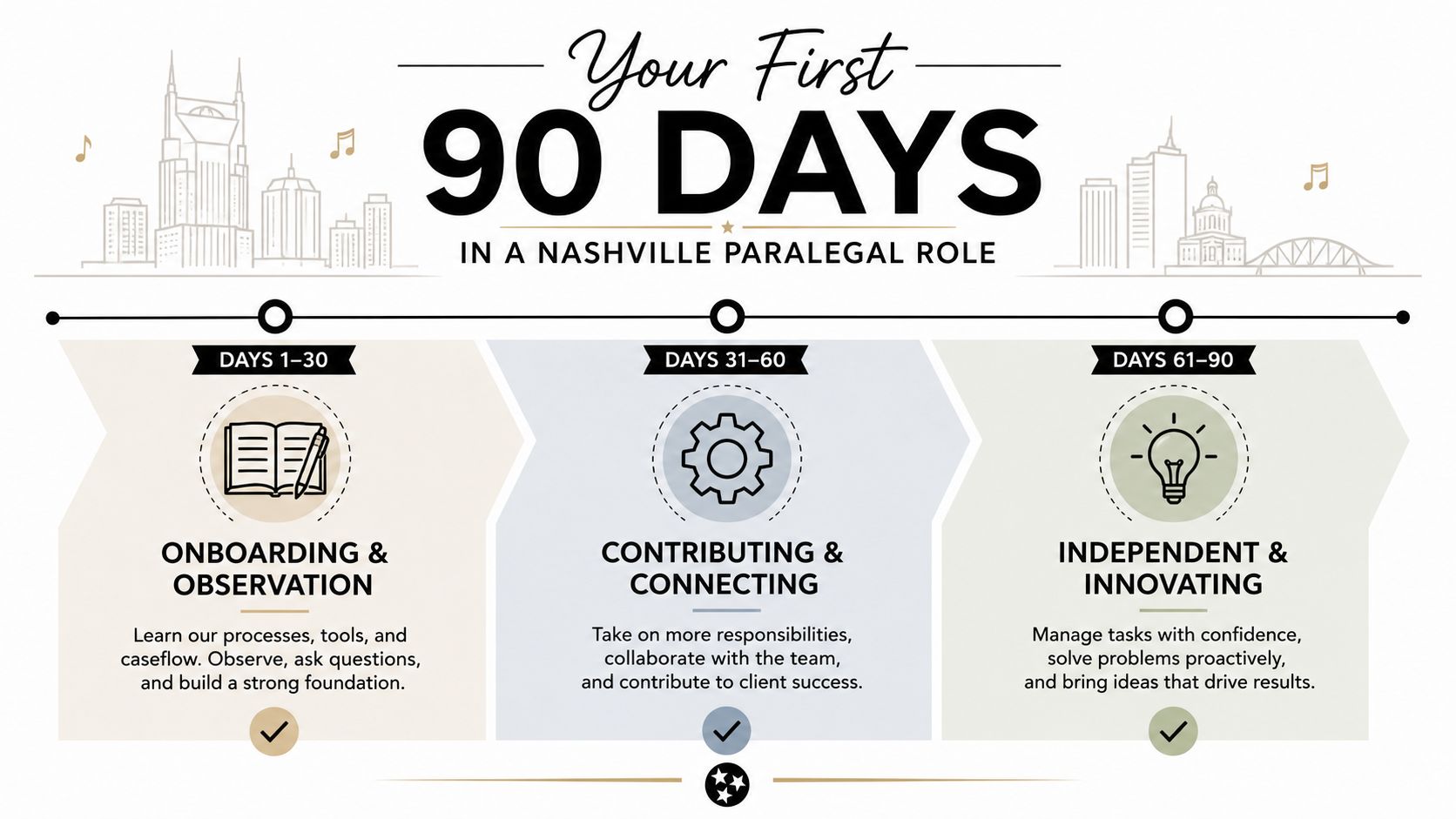
The first three months decide whether you become “the new hire” or the person they trust with real files. In Nashville, the candidates who settle in fastest are the ones who learn the system, learn the rhythm, and make the attorney's day easier without waiting to be asked.
The first month is about control
During days 1 to 30, master the case management system, the document naming conventions, and the internal calendar habits. If the firm uses Clio, MyCase, Needles, or another platform, your job is to stop being surprised by it. Shadow how demand letters are assembled, then learn the intake and document flow behind them.
The second month is about visible usefulness
During days 31 to 60, start owning pieces of the file instead of watching from the side. That means cleaning timelines, assembling record requests, organizing correspondence, and catching missing dates before anyone else does. It also means showing up to one networking event if the firm culture supports it, especially a NALA Tennessee affiliate meeting, an NFPA local chapter event, or a Nashville Bar Association mixer.
The third month is about leverage
During days 61 to 90, ask for one file or matter that you can handle end to end. If you've already earned trust, this is when your value becomes visible. Keep a short wins log so your 90-day review isn't built on memory alone. It's the right moment to revisit compensation if you've already made the job easier and faster.
Certification can also fit here if you're not already certified. If the timing works, the CP exam should move from “someday” to the first testing window that makes sense for your schedule.
Ares and other AI tools are changing PI workflows, especially in medical-records review and demand-letter drafting. The people who'll compound in value are the paralegals who can combine document judgment, file organization, and tool fluency. The old admin-only version of the job is shrinking. The high-trust workflow partner version is getting stronger.
If you want a faster way to compare Nashville paralegal pay, practice-area fit, and the skills employers are screening for, visit Ares and use it as a practical lens for PI workflow, record review, and demand drafting. If you're applying now, don't waste your next week on random boards, use the market data, sharpen your lane, and start targeting the Nashville firms that hire people who can already do the work.