
You've got records from three providers, a billing ledger that doesn't match the visit dates, and a demand deadline this week. The instinct is to write a smooth story and fill the gaps from memory. Don't. Opposing counsel won't attack your prose first. They'll check whether each sentence traces to a dated record, and they'll start with the sentence you can't source.
Medical Narrative Report Template Fields at a Glance
A medical narrative report template is a fixed set of labeled fields you complete for every encounter, not a free-form story you rebuild case by case. The U.S. Centers for Medicare and Medicaid Services documentation guidelines describe the history of present illness as a chronological account from the first sign or symptom through the current encounter, and they expect records to document progress, response to treatment, changes in condition, and revisions to diagnosis. Build your fields around that sequence, so a reviewer can audit the timeline against bills and later provider notes.
| Template Field | What to Record | Why It Matters in a Demand |
|---|---|---|
| Encounter date | Date the care happened, separate from signature date | Fixes the chronology |
| Provider | Name, credentials and facility | Tells reviewers which record to request |
| Complaint and history | Symptoms in the patient's words, with first-onset date | Links the injury to the first treatment |
| Objective findings | Exam results with measured values, such as range of motion | Separates observed findings from reported symptoms |
| Diagnostics | Imaging and lab tests with test dates and results | Supports the diagnosis with a dated result |
| Diagnosis | Diagnosis as the provider documented it | Sets the medical claim that must be verified |
| Treatment and restrictions | Procedures, medications, work or activity limits | Ties medical specials to documented care |
| Response and outcome | Progress, plateau or regression at each visit | Shows prognosis and permanency |
| Gaps and conflicts | Missed visits, delays, pre-existing conditions | Flags what opposing counsel will raise |
| Source and sign-off | Page reference and reviewer initials | Makes every statement auditable |
What a Weak Entry Looks Like
Pain since the accident, improving fails on three fields at once. It has no onset date, no measured finding, and no source page, so you can't tell whether the patient said it, a provider observed it, or a prior note carried it forward. Replace it with the patient's exact complaint, the exam value, and the page where both appear.
Paste this table into a blank Word or Excel document today, add your page references as you read, and reuse that file as the base for every new case. Consistency across facilities is what lets you spot a contradiction before negotiation does.
Build, Pilot and Lock Your Template
A template only helps if two reviewers fill it the same way on the same record. I would build it like an abstraction form, test it on real pages, and freeze it before it touches a live demand.
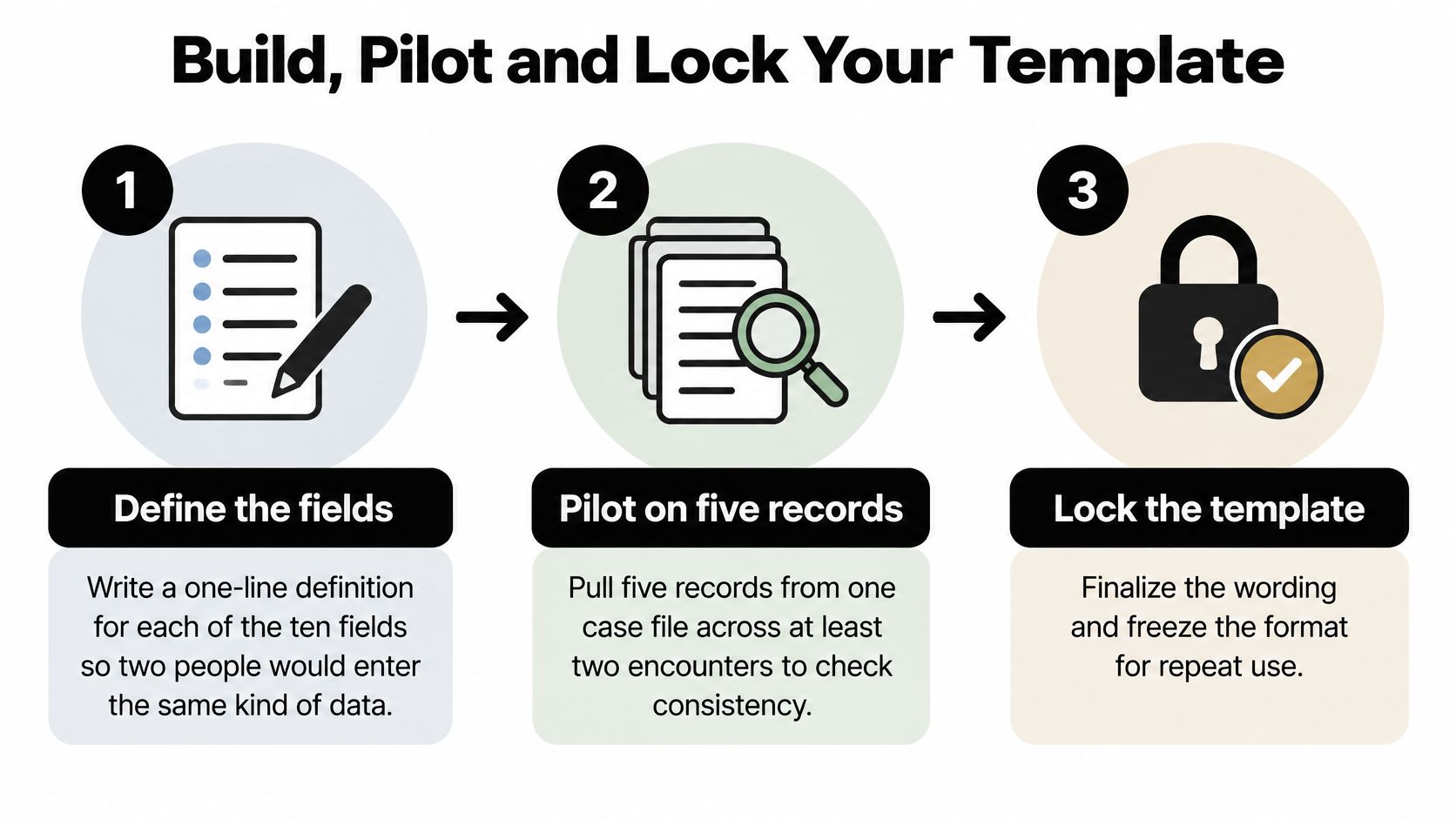
Steps 1 to 3 Define and Pilot
- Define the fields. Write a one-line definition for each of the ten fields. For example, define objective findings as measured or observed exam results only, not symptoms the patient reported. If a definition needs a second sentence to work, it's probably covering two fields.
- Pilot on five records. Pull five records from one closed or low-risk file, across at least two providers, and complete the template by hand. You'll quickly find where dates hide, where signatures postdate care, and where imaging results sit pages away from the order.
- Revise unclear fields. Where you hesitated, rewrite the definition. Decide in writing whether a nurse's intake note counts for complaint and history, and whether a billing diagnosis can ever populate the diagnosis field. My answer on billing codes is no. They support a charge, they don't prove a clinical finding.
If two reviewers can't agree where an entry belongs, fix the definition. Don't train around a bad field.
Steps 4 to 6 Add Provenance and Validate
- Add source and status columns. Record document type and page for every row, then label each statement as documented fact, provider opinion, or attorney assertion. Add an explicit not documented option. A blank invites inference. An explicit value tells the next reviewer you looked and didn't find it.
- Build check rules. Flag missing treatment visits, encounter dates that conflict with bills, repeated text under different dates, and conclusions with no supporting page. Flag laterality changes too. A left shoulder that becomes a right shoulder two visits later needs reconciliation, not silent correction.
- Validate on a second sample. Have a second person independently complete about a fifth of the entries, then compare field by field. An AHRQ-indexed medical-record study used a five-record pilot, assigned two reviewers to 200 randomly selected records, and achieved very high agreement at κ=0.966, P<.001, while preset fields were captured at a mean rate of 76.6% (SD 23.7%). You don't need to publish a statistic, but you do need disagreements counted and explained before you trust the form.
Steps 7 to 8 Lock and Choose the Tool
- Lock the version. Add a version number and date, freeze column order, and keep a short change log. Count how many pilot entries needed a source or date fix. A high count in one field usually means the definition is still loose, even if reviewers now agree with each other.
- Decide where it lives. A shared spreadsheet works if one person owns version control and nobody edits a local copy. If you use a platform, test it against your hand review first. Ares Demand Letters are built from the customer's case evidence and can use the customer's own template or Ares's Blueprints templates, and Ares Red Flags identify missing records, treatment gaps, and inconsistencies in a case. Compare those flags against the gaps you found manually. If the tool misses a conflict you caught, keep the manual check.
The template is ready for the next demand when a second reviewer can reproduce your chronology from the definitions alone, every material row carries a page, and unresolved items sit visibly in the gaps field instead of disappearing into polished prose.
Writing the Narrative Paragraph With Sample Language
Start from the completed rows, not from a blank page. The visual below shows the kind of dated care timeline your paragraph should follow, phase by phase.
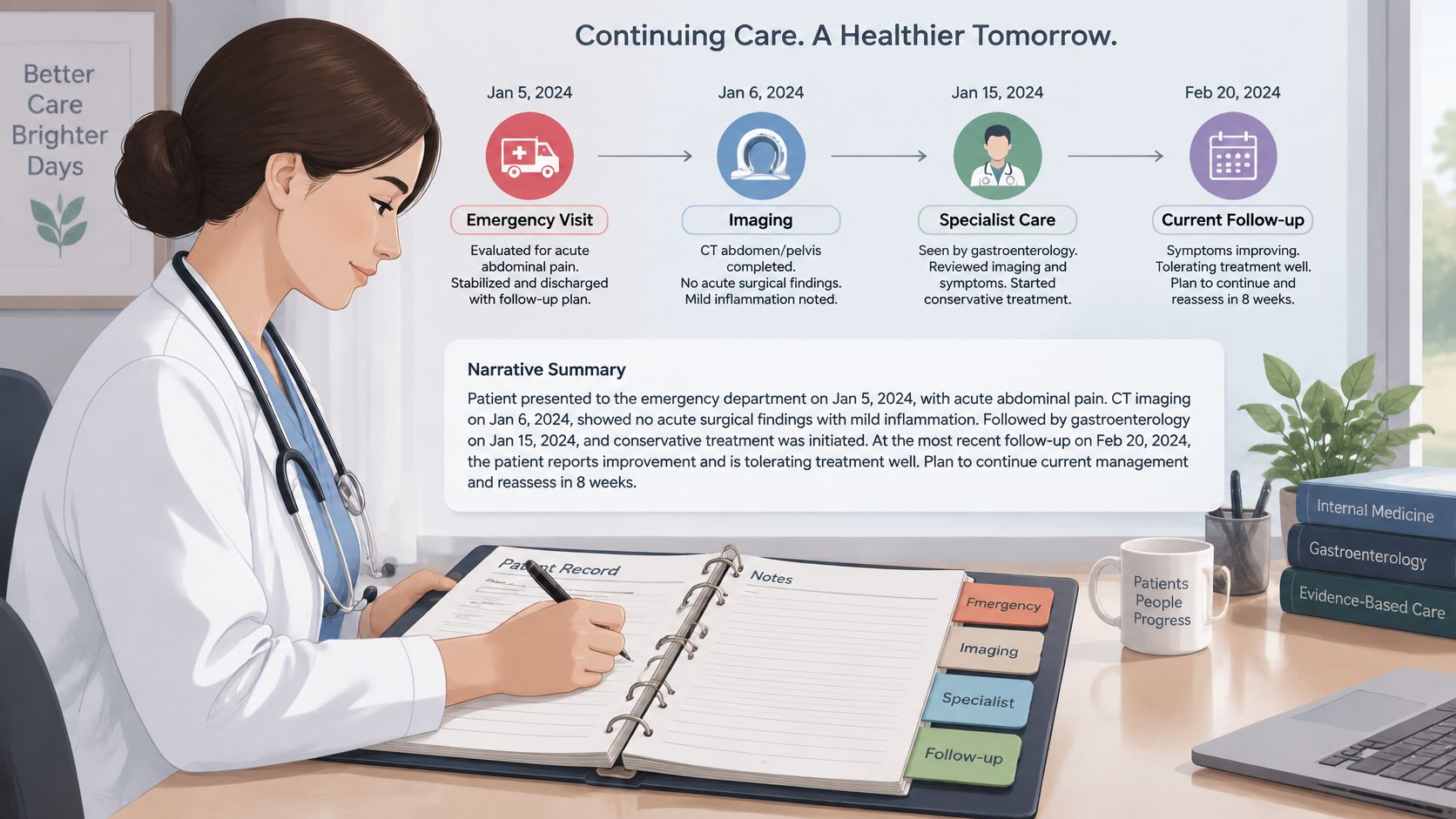
Write in date order, with one paragraph per phase of care, such as emergency visit, imaging, specialist treatment, and current status. Keep each paragraph to three or four sentences. If you need more, you've probably merged two phases or repeated a finding that belongs in a dated medical record chronology row rather than in prose.
Four Sentence Types to Copy
- Documented fact. Cervical range of motion measured 30 degrees of right rotation on the exam dated [date] (page 14).
- Attributed report. The patient reported pain rated 7 of 10 at night, as recorded in the intake note dated [date].
- Provider opinion. In the treating physician's assessment, the restriction is consistent with the collision mechanism. This is an opinion, not a recorded finding.
- Gap. No treatment is documented between [date] and [date]. The patient reported ongoing symptoms during that period.
Drafting rule: Every sentence in the narrative must trace back to a source row. If you can't point to the row, delete the sentence or move it to gaps.
Don't use words like severe unless a provider used them, and quote the provider when the wording carries weight. Never state causation inside a fact sentence. Causation belongs in an attributed opinion sentence, with the provider named, so the reader can weigh it.
Watch the sequence applied to a timeline before you adapt the sample paragraph below.
Say the emergency phase reads like this. On [date], the emergency department recorded cervical tenderness and measured right rotation at 30 degrees (page 14). The patient reported neck pain rated 7 of 10 that began the evening of the collision, as recorded in the intake note dated [date]. In the treating physician's assessment, the findings were consistent with the reported rear-end mechanism, and the physician restricted lifting pending imaging. No follow-up treatment is documented between [date] and [date], although the patient later reported continuing stiffness during that interval.
Tailoring the Template for Your Claim Type
Keep one core template and add fields by claim type. Building a new form for every case destroys comparability, and reviewers waste time relearning where basic facts live. I would keep the ten fields fixed and attach the claim-specific rows below.
| Claim Type | Fields to Emphasize | Extra Records to Add |
|---|---|---|
| Motor vehicle collision | Mechanism, seat position, delayed onset | Prior care to the same body region |
| Slip and fall or premises | Incident report timing, witness statements, hazard notes | Date of first treatment after the fall |
| Workers' compensation | Work restrictions, return-to-work dates, years of treatment | Employer injury report and light-duty status |
| Nursing home or facility | Care events, incident dates, staff notes | Care plan and medication administration records |
| Medical malpractice | Deviation points, expected care versus actual care | Expert-reviewed standard of care notes |
| Permanent injury | Impairment rating, future care plan, functional limits | Physician opinion on permanency with its source |
How the Add-Ons Change Your Review
For a collision, mechanism and delayed onset do the heavy lifting, because the defense will test whether symptoms fit the impact and when they first appeared. For premises cases, the distance between the incident report and first treatment often matters more than the emergency note itself. Workers' compensation files turn on restrictions and return-to-work dates, so a narrative without work status at each phase is incomplete.
Facility and malpractice matters need a different discipline. You're comparing what should have happened with what staff documented, sometimes across care plans, medication records, and incident logs that don't align. Permanent injury files need the impairment rating tied to its author and date, plus functional limits stated in observable terms. Reviewing worked medical report examples can help you see how those extra fields change the final paragraph.
Say a rear-end collision patient completes six months of cervical treatment, but she also had chiropractic visits for neck pain two years earlier. Put the prior care in its own dated row, in the open. State what was treated, when it resolved if that's documented, and what the current provider said about it. Don't delete it to protect the story. Opposing counsel will find it, and a narrative that disclosed it first keeps its credibility.
Common Pitfalls and How to Fix Them
An omitted visit is the most damaging error you'll carry into a demand. It shortens or lengthens an apparent treatment gap, changes the recovery curve, and gives the other side a clean credibility argument once their copy of the bills surfaces.
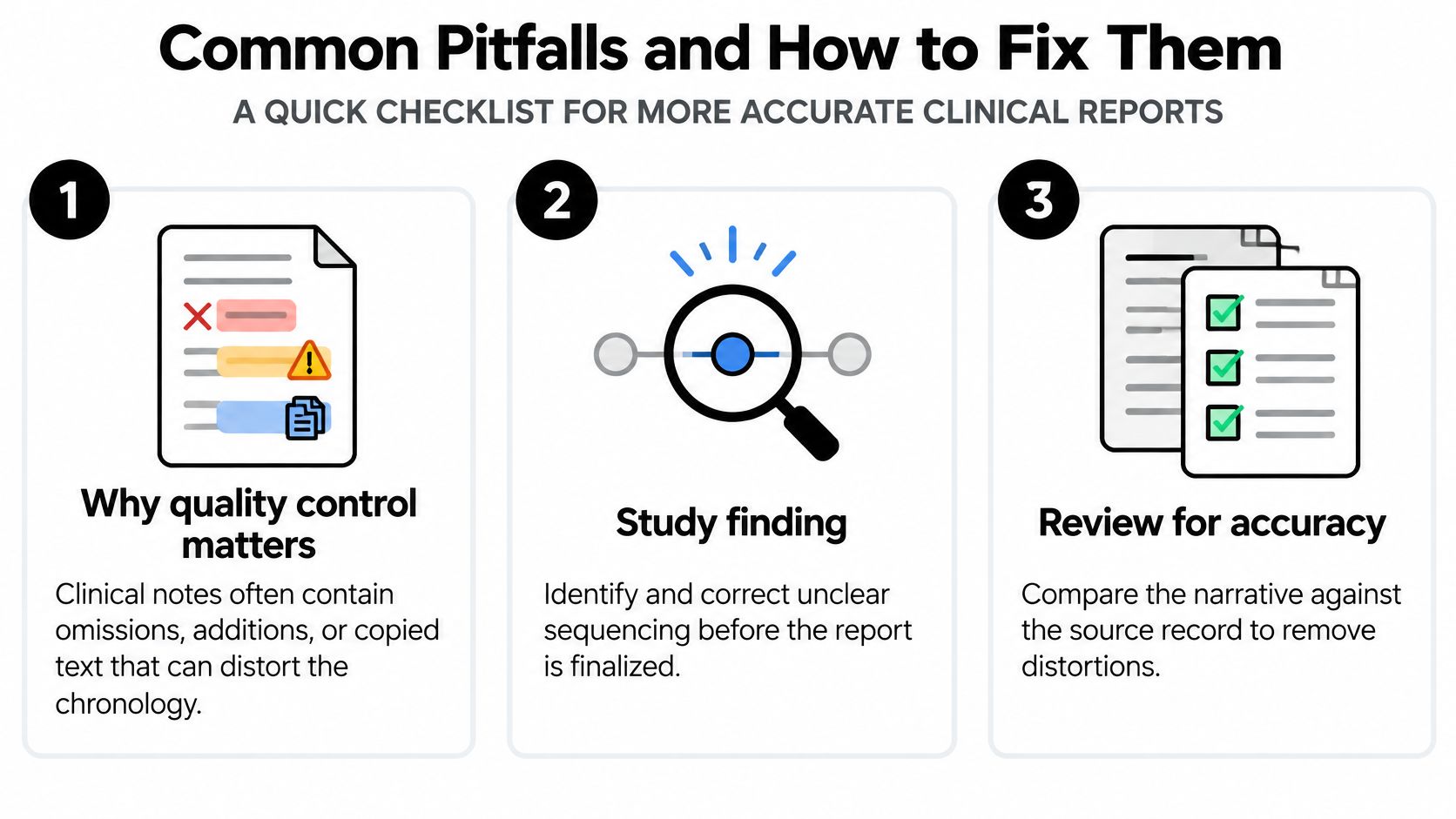
In a study comparing physicians' notes with concealed audio recordings from standardized patient encounters, researchers identified 636 documentation errors, with 181 findings recorded even though they did not occur and 455 findings that did occur omitted. Overall, 90% of notes contained at least one error, and 83% of the errors were judged clinically significant, while omissions accounted for 71.5% of all errors. That's why your job isn't to trust the note. It's to check it.
Copied text creates the opposite problem. A symptom copied forward visit after visit can make an injury look continuous after the patient stopped reporting it, or freeze a pain score that nobody remeasured. Treat identical language under different dates as a flag, not as confirmation.
A Ten-Minute Review Before Sign-Off
- Match bills to visits. Compare every billed encounter against the chronology and account for any visit that appears in one place but not the other.
- Search for duplicates. Find identical sentences under different dates and confirm whether the finding was reassessed that day.
- Trace each diagnosis. Link it to a clinical note with findings, not to a billing code standing alone.
- Check planned care. Mark every procedure as planned, completed, or cancelled, with the date that supports the status.
- Read causation sentences last. Confirm each one names the provider, carries an opinion label, and cites its page.
A structured template can't fix a bad source record. It can make the omission, addition, or copied paragraph visible while you still have time to request records, ask for clarification, or soften a claim you can't support.
Exporting and Using the Draft in a Demand Package
Exporting is where unverified material slips in, usually through a portal printout or a helpful summary nobody checked. A HealthIT.gov review of patient access reports that 77% of U.S. individuals were offered online access to health information in 2024, 65% accessed it, and 34% were frequent users who accessed it at least six times. Easy access doesn't make a portal message a clinical finding, so provenance has to survive the export.
Six Steps Before the Demand Leaves
- Freeze the version. Export only from the locked, dated template, so the demand matches the record your reviewer approved.
- Apply the minimum necessary. Remove identifiers and unrelated diagnoses the demand doesn't need, using a written redaction checklist rather than ad hoc judgment.
- Tag provenance. Confirm each material statement names its source type, whether clinical note, test result, billing record, portal message, or patient report.
- Obtain sign-off. Have a qualified reviewer approve every causation, prognosis, and impairment statement before export. No sign-off, no sentence.
- Assemble the package. Place the narrative, dated chronology, and specials total together, following your approach to writing a demand letter for personal injury, and keep source references visible in the working copy.
- Keep a correction log. When a later record contradicts the draft, update the entry, date the change, and recheck every sentence that depended on it.
That discipline protects you twice. It keeps patient-facing information from being asserted as medical fact, and it gives you a clean audit trail if the narrative is questioned months later in mediation or deposition.
Build your next medical narrative report template once, with sources on every line, then let Ares turn your uploaded records into page-cited chronologies and demand drafts that follow your format. You'll spend your review time on gaps, causation, and sign-off, where judgment matters, instead of retyping dates. Visit Ares to see how your firm's template would work on a live case file.