In personal injury litigation, the case is won or lost within the medical records. Raw physician notes, complex imaging results, and endless billing statements are often a chaotic collection of data. When properly organized, analyzed, and synthesized, they transform from a liability into the bedrock of a compelling settlement narrative that clearly demonstrates causation and damages. This guide is built for legal professionals who need to move beyond simply collecting records and start strategically deploying them.
This article provides a detailed breakdown of eight essential medical report examples, moving from raw data to a persuasive legal argument. We will dissect each report type with annotated samples and actionable tips for extracting critical facts. You will learn to identify causation links, spot treatment gaps or red flags before the defense does, and build a powerful case story that justifies a higher settlement offer. The goal is to equip you with the tools to turn a stack of documents into a clear, concise, and convincing asset.
For each example, we will explore specific tactics for converting dense medical information into powerful content for demand letters, case summaries, and trial preparation. Mastering these documents is not just an administrative task; it is a core litigation strategy. Ensuring the security and integrity of this sensitive data is equally critical. To truly unlock the value of these records, legal and healthcare organizations need robust IT systems. You can learn more by exploring practical IT strategies for healthcare and legal organizations to safeguard your client's information effectively. Let’s dive into the examples.
1. Medical Chronology Report
A Medical Chronology Report is the foundational document in any personal injury case. It organizes a plaintiff's entire medical journey into a clear, chronological timeline, transforming stacks of disorganized records into a powerful narrative tool. This report sequentially lists every medical event, from the initial incident and emergency room visit to ongoing physical therapy and specialist consultations.
Its primary purpose is to establish a direct and easily understandable link between the injury-causing event and the subsequent medical care. For litigators, this provides an at-a-glance roadmap of the case, highlighting key dates, diagnoses, providers, and treatment patterns. This structure is invaluable for drafting demand letters, preparing for depositions, and building a compelling case summary.
Strategic Analysis and Application
The true power of a medical chronology lies in its ability to tell a story of causation and damages. By mapping the treatment timeline, you can clearly demonstrate the progression of injuries and the necessity of each medical intervention.
For instance, in a motor vehicle accident case, a chronology might show an ER visit on the date of the accident, followed by a primary care physician referral to an orthopedist one week later, an MRI confirming a herniated disc two weeks after that, and a subsequent course of physical therapy and pain management injections. This linear presentation makes it difficult for opposing counsel to argue that the treatments were unrelated to the accident.
Key Takeaway: A well-prepared medical chronology is more than a list of dates; it's a strategic narrative that frames the entire case. It preemptively counters arguments about pre-existing conditions or gaps in treatment by presenting a logical, cause-and-effect sequence of events.
Actionable Tips for Implementation
To maximize the effectiveness of your medical chronology report, consider these tactics:
- Cross-Reference Billing Codes: Match the chronology with billing records (itemized ledgers) to verify that every listed service was actually performed and billed. This helps identify any discrepancies and strengthens the claim for damages.
- Highlight Key Events: Use color-coding or bold text to flag significant events like surgeries, new diagnoses, or specialist referrals. This creates a visual hierarchy that draws attention to the most critical aspects of the case.
- Note Treatment Gaps: Proactively identify and annotate any gaps in treatment. Include explanations from the records, such as waiting for an insurance authorization or a specialist appointment, to defuse potential defense arguments.
- Integrate with Case Strategy: A medical chronology is a living document. Continuously update it as new records arrive and use it to guide discovery, inform deposition questions, and structure your demand letter. You can learn more about building an effective timeline by exploring a detailed guide on medical record chronology.
2. Medical Summary/Narrative Report
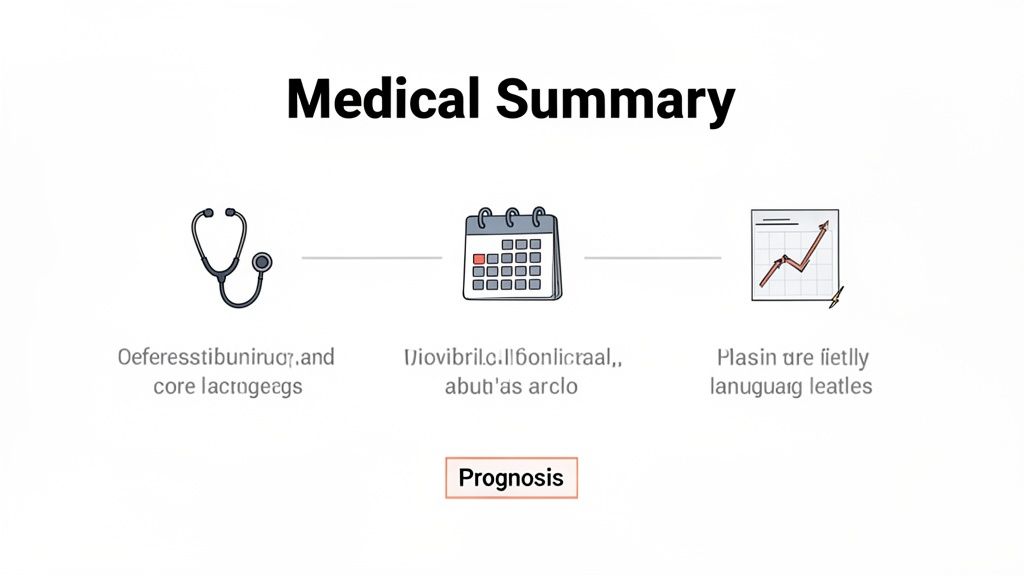
A Medical Summary or Narrative Report transforms dense, complex medical records into a cohesive and persuasive written story. It distills hundreds or even thousands of pages of technical jargon from multiple providers into a clear, readable account of the plaintiff's injuries, treatment, prognosis, and ongoing limitations. Unlike raw medical records, this report organizes key findings into a logical narrative that non-medical professionals like adjusters, judges, and juries can easily understand.
This report serves as the bridge between technical medical documentation and persuasive legal argument. Its primary purpose is to provide a comprehensive yet digestible overview that highlights the severity and impact of the injuries without requiring the reader to sift through the entire medical history. This makes it an indispensable tool for demand letters, mediation presentations, and settlement negotiations.
Strategic Analysis and Application
The strategic value of a narrative summary is its ability to shape the perception of the case from the very first reading. It allows you to frame the facts, control the narrative, and emphasize the most compelling evidence of pain, suffering, and causation.
For example, in a catastrophic injury case with records from a dozen providers, a narrative can synthesize the information to show a consistent pattern of debilitating pain and functional loss. In a soft tissue injury case, the narrative can connect a patient's initial subjective complaints of pain to objective findings and ongoing functional limitations, building a strong argument against defense claims that the injuries are minor or exaggerated. It effectively translates medical facts into a human story of struggle and resilience.
Key Takeaway: A compelling medical narrative is not just a summary; it's an advocacy document. It preemptively addresses potential weaknesses, connects the dots for the reader, and establishes the human cost of the injury in a way that raw records never can.
Actionable Tips for Implementation
To maximize the impact of your medical summary report, consider these tactics:
- Lead with Impactful Findings: Begin the summary with the most severe diagnoses, surgical procedures, or permanent impairments. This immediately establishes the gravity of the case and captures the reader's attention.
- Use Direct Quotes: Incorporate powerful, verbatim quotes from physicians' notes, such as "patient is in excruciating pain" or "prognosis for full recovery is poor." These add a layer of undeniable credibility and emotional weight.
- Separate Objective from Subjective: Clearly distinguish between objective evidence (e.g., MRI results, fracture diagnoses) and the plaintiff's subjective complaints. This structure helps neutralize defense arguments that the claim is based solely on self-reported symptoms.
- Create Layered Summaries: Develop multiple versions for different audiences. A one-page executive summary is perfect for an initial demand letter, while a comprehensive 8-10 page narrative can serve as a detailed exhibit for mediation or trial preparation.
3. Medical Billing and Treatment Cost Report
A Medical Billing and Treatment Cost Report serves as the financial backbone of a personal injury claim, meticulously cataloging every dollar spent on medical care. This report aggregates and organizes all related expenses, from initial emergency services to long-term physical therapy and prescriptions. It transforms complex billing statements, explanation of benefits (EOBs), and provider ledgers into a clear, consolidated financial summary.
Its primary purpose is to quantify the economic damages suffered by the plaintiff, providing irrefutable evidence of the financial impact of their injuries. For personal injury attorneys, this report is essential for calculating the special damages portion of a demand letter and substantiating the financial stakes of the case. It provides a comprehensive ledger of all costs, making it a critical tool for negotiations and trial preparation.
Strategic Analysis and Application
The strategic value of a comprehensive billing report extends beyond simple arithmetic; it contextualizes the plaintiff's suffering in concrete financial terms. By itemizing costs, you can construct a powerful narrative that demonstrates the extensive and often expensive road to recovery.
Consider a construction site injury case. The report might detail workers' compensation payments, separate billings to private insurance for non-covered specialists, and out-of-pocket expenses for durable medical equipment. This detailed breakdown clearly illustrates the financial burden and prevents the defense from downplaying the injury's overall impact by looking at just one payment source. It quantifies the disruption and supports claims for both past and future medical expenses.
Key Takeaway: A detailed Medical Billing and Treatment Cost Report anchors the abstract concept of "damages" in concrete, verifiable numbers. It moves the conversation from subjective pain to objective financial loss, strengthening your negotiating position and providing a solid foundation for your demand.
Actionable Tips for Implementation
To maximize the impact of your billing and cost report, consider these tactics:
- Request Itemized Bills Early: Do not wait for EOBs. Proactively request detailed, itemized bills from every provider to get a head start on cost aggregation and identify specific charges.
- Differentiate Billed vs. Paid: Clearly separate the total amount billed by providers from the amount actually paid by insurance or the client. The defense will challenge inflated "billed" charges, so be prepared to argue the reasonable value of the services.
- Flag High-Cost Outliers: Isolate unusually expensive procedures or treatments, such as surgeries or advanced imaging. Cross-verify these charges against the corresponding medical records to ensure they are directly related to the accident-induced injuries.
- Create a Cost Timeline: Visualize the expenses on a month-by-month basis. This can graphically demonstrate periods of intense treatment (like post-surgery) and the ongoing nature of recovery costs, reinforcing the severity and duration of the injury's impact.
4. Defendant's Medical Records Defense Report
A Defendant's Medical Records Defense Report is a structured analysis of a plaintiff's medical history from the defense's perspective. It systematically deconstructs the plaintiff's narrative by identifying pre-existing conditions, inconsistencies in subjective complaints, and potential alternative causes for the alleged injuries. While created by the defense, understanding this report's framework is crucial for plaintiff's attorneys to anticipate and neutralize opposing arguments.
The primary purpose of this report is to find and exploit weaknesses in the plaintiff's claim of causation and damages. Defense counsel uses it to pinpoint any information that could sever the link between the defendant's negligence and the plaintiff's medical condition. This proactive analysis forms the backbone of their litigation strategy, informing expert witness selection, deposition questions, and settlement negotiations.
Strategic Analysis and Application
This type of report weaponizes the plaintiff's own medical history against them. By meticulously combing through records, the defense can construct alternative narratives that cast doubt on the case's core claims. This is a critical defensive tool in many medical report examples where causation is the central dispute.
For instance, if a plaintiff claims a car accident caused a debilitating back injury, a defense report might highlight a decade of chiropractic records showing treatment for "chronic lumbar pain" and "degenerative disc disease." Similarly, a six-month gap between the incident and the first medical visit will be framed as evidence that the injury was not serious or was caused by an intervening event. These findings are then used to argue for a reduced damages award or a complete dismissal.
Key Takeaway: A Defendant's Medical Records Defense Report is designed to dismantle the plaintiff’s narrative. Proactively preparing for this analysis by identifying and addressing potential weaknesses in your own case is the most effective way to protect your client's claim.
Actionable Tips for Implementation
To preemptively counter a defense report and fortify your case, consider these tactics:
- Retain Experts Early: Engage a medical expert to review records and prepare a rebuttal before the defense even serves their report. This allows you to frame the narrative around pre-existing conditions in a favorable light.
- Document Explanations: Proactively document all reasonable explanations for treatment delays or apparent inconsistencies. An affidavit from the plaintiff or a note in your file explaining they were waiting for insurance approval can neutralize a key defense argument.
- Separate Subjective and Objective: In your own case summary, clearly distinguish between the plaintiff’s subjective pain complaints and objective medical findings like MRI results or EMG tests. This helps show that the injury is verifiable and not just an exaggeration.
- Address Inconsistencies Head-On: During depositions, have the plaintiff's treating physicians explain any confusing or inconsistent notes. A doctor can clarify that a "mild sprain" diagnosis on day one evolved into a more severe condition, which is a common and medically sound progression. This strategy is a core component of a thorough medical record review for attorneys.
5. Imaging Study Report (Imaging Findings Summary)
An Imaging Study Report, or Imaging Findings Summary, is a powerful compilation of objective medical evidence. It isolates and organizes all diagnostic imaging results, such as MRIs, X-rays, and CT scans, into a single, focused document. This report extracts the official interpretations from radiologists, presenting a clear picture of the physical injuries sustained.

Its primary purpose is to provide undeniable, visual proof of an injury. While a client's testimony is subjective, an MRI showing a disc herniation is objective fact. For litigators, this type of summary transforms complex radiological jargon into persuasive evidence that anchors the entire claim, making it a cornerstone among various medical report examples.
Strategic Analysis and Application
The strategic value of an Imaging Findings Summary lies in its ability to directly link the incident to a tangible, demonstrable injury. It provides the "smoking gun" that confirms the plaintiff's complaints and justifies the need for extensive medical treatment, like surgery or injections. This report effectively neutralizes defense arguments that attempt to portray injuries as subjective or exaggerated.
For example, in a cervical spine injury case, an initial X-ray at the emergency room might be normal. However, a subsequent MRI ordered due to persistent pain could reveal a significant disc herniation with nerve root impingement. Presenting these findings sequentially in a summary proves the injury was not immediately apparent and validates the plaintiff's ongoing symptoms, directly connecting them to the accident.
Key Takeaway: An Imaging Study Report translates complex medical science into compelling legal proof. It anchors subjective complaints to objective findings, making it one of the most persuasive tools for establishing the nature and extent of an injury in settlement negotiations and at trial.
Actionable Tips for Implementation
To maximize the impact of your imaging summary, consider these tactics:
- Quote Radiologists Directly: Extract the exact diagnostic language from the official report. Phrases like "full-thickness rotator cuff tear" or "acute displaced fracture" are far more powerful in a demand letter than paraphrased summaries.
- Create a Chronological Sequence: Organize the imaging findings chronologically alongside the plaintiff's reported symptoms. This alignment shows a clear cause-and-effect relationship, such as worsening neck pain followed by an MRI that confirms a herniated disc.
- Highlight "Jury-Friendly" Language: Identify and bold striking findings that are easily understood and remembered by a layperson. Terms like "impingement," "tear," and "herniation" carry significant weight and create a memorable picture of the injury.
- Address Normal or Negative Scans: Do not ignore imaging that comes back negative. Proactively flag these reports and use them to frame the diagnostic journey, showing that providers were diligent in ruling out other causes before arriving at the correct diagnosis.
6. Expert Medical Opinion Report
An Expert Medical Opinion Report is a formal, written analysis from a retained medical professional that provides a credentialed opinion on causation, the appropriateness of care, and the plaintiff's long-term prognosis. This report translates complex medical data into a clear, authoritative opinion that can substantiate a legal claim, moving beyond the simple recitation of facts found in treatment records. It is indispensable for proving elements of a case that require specialized knowledge, such as standard of care or the causal link between an event and a specific, complex injury.
The primary purpose of this report is to provide an objective, expert-level interpretation of the medical evidence. For litigators, this is the key to unlocking complex medical arguments and validating the plaintiff’s damages. Whether it's an orthopedic surgeon opining on a rotator cuff tear prognosis or a neuropsychologist assessing a traumatic brain injury, the expert's analysis provides the scientific foundation for the legal arguments.
Strategic Analysis and Application
The strategic value of an expert report lies in its ability to address and neutralize defense arguments before they are even made. It provides a credible, third-party validation of the plaintiff's injuries and their connection to the defendant's negligence, which is often necessary to overcome skepticism from adjusters or juries.
For example, in a case where a plaintiff develops cardiac symptoms after a high-stress motor vehicle accident, a cardiologist's expert report can establish a scientific link between the trauma-induced stress and the subsequent heart condition. This opinion transforms a contested causation argument into a medically supported fact. For specific injuries or conditions, an expert's detailed evaluation can be crucial. Understanding what a comprehensive detailed psychiatric assessment involves can shed light on how medical experts formulate their opinions.
Key Takeaway: An Expert Medical Opinion Report is not just evidence; it's a strategic weapon. It provides the medical authority needed to validate complex claims, quantify future damages, and compellingly argue for your client's case on scientifically grounded terms.
Actionable Tips for Implementation
To maximize the impact of your expert medical opinion report, consider these tactics:
- Provide Focused Questions: Instead of asking for a broad review, provide your expert with a list of specific, targeted questions. This focuses their analysis on the key legal issues and ensures the final report directly addresses the elements you need to prove.
- Select for Credibility: Choose experts with strong publication records, teaching appointments, and prior trial testimony experience. Their curriculum vitae (CV) is a critical component of their credibility and will be scrutinized by the defense.
- Prepare an Expert Packet: Streamline the expert's review process by providing a well-organized packet containing a medical chronology, a summary of key records, and specific films or reports. This reduces their billable hours and focuses their attention.
- Vet Past Testimony: Obtain and review the expert's prior testimony and publications. This helps you anticipate their positions and prepare for potential cross-examination on any inconsistencies or prior statements.
7. Functional Capacity Evaluation (FCE) Report
A Functional Capacity Evaluation (FCE) is a comprehensive assessment that bridges the gap between a plaintiff's medical diagnosis and their real-world functional limitations. Conducted by a physical or occupational therapist, this report quantifies a person's physical abilities, stamina, and tolerance for various activities, providing objective data on their capacity to perform work-related tasks and activities of daily living.
The primary purpose of an FCE is to translate medical impairments into tangible, measurable restrictions. It moves beyond diagnoses like "herniated disc" to define exactly what that injury means for the plaintiff's ability to lift, carry, sit, stand, and perform other job-critical functions. For litigators, the FCE is a critical tool for substantiating claims for lost earning capacity and future vocational damages.
Strategic Analysis and Application
The FCE's strategic value lies in its ability to provide objective evidence of disability that is directly relevant to a plaintiff's employment. It offers a standardized, data-driven assessment that is difficult for defense counsel to dismiss as purely subjective complaints of pain.
For example, an FCE for a construction worker with a back injury might document a maximum lifting capacity of 10 pounds, a stark contrast to the 50-plus pounds required by their job. This finding effectively proves they cannot return to their pre-injury role. Similarly, an FCE for an office worker with a repetitive strain injury could quantify a reduced ability to type or use a mouse, supporting a claim for necessary workplace accommodations or a transition to a different role.
Key Takeaway: An FCE report is a powerful instrument for proving damages. It converts a medical condition into a vocational and economic loss, providing a vocational expert with the concrete data needed to calculate lost earning capacity and future care needs.
Actionable Tips for Implementation
To maximize the impact of a Functional Capacity Evaluation report, consider these tactics:
- Schedule at MMI: Conduct the FCE after the plaintiff has reached Maximum Medical Improvement (MMI). This ensures the results reflect a stable, long-term baseline of their functional abilities rather than temporary limitations during acute recovery.
- Vet the Evaluator: Retain a therapist experienced in forensic or litigation-based FCEs. They will understand the importance of documenting causation, ensuring valid effort from the plaintiff, and presenting findings in a manner that will withstand legal scrutiny.
- Link to Medical Findings: Work with the evaluator to explicitly connect documented functional limitations to specific medical evidence. For instance, link reduced grip strength directly to nerve damage confirmed by an EMG, or diminished endurance to a documented cardiopulmonary injury.
- Prepare Your Client: Ensure the plaintiff understands the importance of giving a consistent and valid effort during the evaluation. Explain that the test's reliability depends on their genuine participation, which preempts defense arguments that the plaintiff was malingering.
8. Demand Letter with Integrated Medical Summary
A Demand Letter with an Integrated Medical Summary is a comprehensive settlement document that combines legal arguments, a detailed medical narrative, and a calculation of damages into one persuasive package. This report synthesizes all medical evidence, transforming it from a collection of records into a compelling story designed to justify a specific settlement figure to an insurance adjuster.
This approach moves beyond a simple request for payment by embedding a medical chronology and summary directly into the demand. It frames the client's injury, treatment, and ongoing struggles in a way that directly supports the legal claims for both economic and non-economic damages. For adjusters and defense counsel, it presents a well-substantiated case that is difficult to dismiss or undervalue.

Strategic Analysis and Application
The strategic advantage of this integrated format is its ability to control the narrative from the outset. Instead of allowing an adjuster to piece together the story from raw records, this report presents a curated, attorney-driven interpretation of the events. It connects the dots between the incident, the diagnosis, the cost of care, and the plaintiff's pain and suffering.
For example, a demand for a catastrophic injury claim might integrate excerpts from expert opinions and a life care plan directly into the narrative. It could show how a specific diagnosis led to a documented functional limitation, which in turn necessitates the future medical costs outlined in the plan. This method makes the settlement demand feel less like an opening bid and more like an inevitable conclusion based on the evidence.
Key Takeaway: An integrated demand letter is a strategic offensive tool. It preemptively shapes the adjuster’s understanding of the case by weaving the medical facts into a powerful story of loss, making the requested settlement figure a logical outcome of the presented evidence.
Actionable Tips for Implementation
To maximize the impact of your integrated demand letter, consider these tactics:
- Lead with Strength: Open the medical summary with the most compelling evidence, such as an objective MRI finding or a significant surgical procedure. Address any potential case weaknesses, like treatment gaps, in the middle sections after establishing a strong foundation.
- Use Visual Formatting: Employ headers, bullet points, and even small charts or timelines to make the document highly readable. This helps the adjuster quickly grasp key facts and prevents critical information from getting lost in dense text.
- Quantify Non-Economic Damages: Justify your demand for pain and suffering with specific examples from the records. Reference entries detailing high pain scores, psychological distress, or loss of daily function, connecting them to your damages calculation.
- Streamline with Appendices: Keep the main narrative focused and persuasive. Place detailed billing records, itemized ledgers, and full provider records in appendices, referencing them as needed to support your claims without overwhelming the reader. For a deeper dive into crafting these documents, explore best practices for writing a demand letter for personal injury.
Comparison of 8 Medical Report Types
| Report Type | Implementation complexity | Resource requirements | Expected outcomes | Ideal use cases | Key advantages |
|---|---|---|---|---|---|
| Medical Chronology Report | Moderate — aggregate and sequence records, some manual cleanup | Medical records, extraction tools or reviewer time | Clear timeline of events, causation links, gap identification | Demand drafting, trial prep, causation analysis | Reveals gaps/inconsistencies, streamlines review, supports chronology-based arguments |
| Medical Summary / Narrative Report | Moderate–High — skilled synthesis to avoid losing detail | Experienced medical-legal writer, records, optional AI draft | Readable medical story, persuasive explanation of injury and prognosis | Demand letters, juries, client communication, case valuation | Translates complex records into persuasive narrative, improves settlement leverage |
| Medical Billing & Treatment Cost Report | Moderate — itemization and reconciliation required | Itemized bills, EOBs, billing software or auditor | Quantified economic damages, lien tracking, cost trends | Damages quantification, settlement negotiations, lien resolution | Provides objective cost floor, supports damage calculations, highlights outliers |
| Defendant's Medical Records Defense Report | Moderate — adversarial analysis with medical expertise | Medical reviewers, defense-style analysis, expert consults | Identification of pre‑existing conditions, inconsistencies, causation challenges | Anticipating defense arguments, deposition prep, rebuttal planning | Exposes vulnerabilities, guides expert retention and mitigation strategy |
| Imaging Study Report | Low–Moderate — extract and summarize radiology findings | Radiology reports, clinician review, image comparisons | Objective imaging evidence, progression/healing timeline | Cases relying on imaging proof, trial exhibits, medical necessity arguments | Hard-to-dispute objective findings, strong persuasive value for judges/juries |
| Expert Medical Opinion Report | High — expert retention, detailed review, formal report | Paid medical expert(s), organized records, time for analysis | Admissible expert opinions on causation, prognosis, future care/costs | Complex/high-value cases, contested causation, future damages claims | Authoritative credibility, supports future cost claims, rebuts opposing experts |
| Functional Capacity Evaluation (FCE) Report | Moderate — standardized testing and interpretation | Certified evaluator, testing equipment, plaintiff effort | Objective functional limits, work-capacity classification | Lost earning capacity claims, vocational assessments, workers' comp | Quantifies real-world impairment, links to vocational damages |
| Demand Letter with Integrated Medical Summary | High — legal and medical synthesis into persuasive document | Attorney time, medical summaries/chronology, experts, visuals | Single persuasive demand with quantified damages and evidence | Initiating settlement, negotiation leverage, adjuster engagement | Consolidates case into one document, accelerates adjuster response, anchors negotiations |
Automate Your Analysis and Build Better Cases, Faster
The journey through the various medical report examples in this guide reveals a fundamental truth of personal injury litigation: the story of your client's case is written in their medical records. From the meticulous timeline established in a Medical Chronology to the persuasive damage valuation in a Billing and Treatment Cost Report, each document is a strategic asset. Mastering these reports is not just an administrative task; it is the core of effective advocacy.
We have dissected eight critical report types, each serving a distinct but interconnected purpose. You have learned how to transform a dense Imaging Study Report into a clear, compelling piece of evidence. You have seen how a Functional Capacity Evaluation (FCE) can objectively quantify a client's life-altering limitations, providing the hard data needed to justify significant damages. The common thread is the power of strategic extraction and presentation. The goal is to convert complex medical jargon and scattered data points into a coherent, persuasive narrative that adjusters and juries can easily understand.
The Strategic Value of Mastering Medical Reports
The true value of these medical report examples lies in their application. By understanding how to identify causation, pinpoint treatment gaps, highlight provider consistency, and flag potential red flags, you move from being a reactive practitioner to a proactive strategist.
- Proactive Case Management: A well-crafted Medical Summary Report doesn't just list injuries; it preemptively addresses potential defense arguments, like pre-existing conditions or gaps in care, turning weaknesses into points of clarification.
- Enhanced Negotiation Power: Presenting an adjuster with a Demand Letter that seamlessly integrates a detailed medical summary and itemized billing report demonstrates meticulous preparation and signals that you are ready for trial. This level of organization often leads to higher and faster settlement offers.
- Increased Firm Efficiency: When your team can consistently and quickly produce these high-quality reports, your entire case workflow accelerates. This frees up valuable attorney and paralegal time for higher-value activities like client communication, legal research, and strategic planning.
The challenge, however, has always been the immense manual effort required. The painstaking process of sifting through hundreds or thousands of pages of records to find the crucial details is a significant bottleneck for even the most efficient firms. It consumes billable hours, delays case progression, and introduces the risk of human error. This is where a fundamental shift in process becomes not just an advantage, but a necessity.
From Manual Review to Automated Insight
The principles and strategies discussed throughout this article are the building blocks of a winning case. But the execution can be radically optimized. Modern technology now offers a way to bypass the most time-consuming aspects of medical record review while amplifying your strategic capabilities. Instead of spending 10-20 hours manually constructing a chronology or summary, you can leverage AI-powered tools to accomplish the same task in minutes.
This automation is not about replacing legal expertise; it is about augmenting it. It allows your team to focus on the why instead of the what. When key facts, dates, diagnoses, and providers are automatically extracted and organized, your legal professionals can dedicate their time to building the case strategy, crafting the most powerful arguments, and ultimately, securing better outcomes for your clients. By embracing these tools, you transform a time-intensive administrative burden into a streamlined, strategic advantage, allowing you to build better cases, faster.
Ready to eliminate the manual work and turn medical record review from a bottleneck into your firm's competitive edge? Ares uses advanced AI to instantly analyze medical records, generate detailed chronologies, and draft powerful narrative summaries. Discover how you can build stronger demand letters and increase your case capacity by visiting Ares today.