Have you ever handed an adjuster a two-inch stack of records and gotten back an offer that reads like she never opened it? The records weren't the problem. The format was.
Most attorneys treat a medical narrative as one document with one job, which is to summarize treatment. That assumption costs money at every stage of a case. The same 600 pages can carry a demand, kill a causation defense, or undercut a claim, and the only variable is which structure holds them.
This list breaks down eight medical narrative examples and dissects each one the same way: what it's for, where it belongs in the case, the defense argument it preempts, and one tactic you can copy on the next file. Some are built for the adjuster's desk. Some are built for a jury. A few are internal working documents that never leave the office, and that's the point.
Choose by case stage, not by habit. A chronology that wins a demand can bury a mediation, and a functional impact story that moves a jury will draw an objection if it's attached to an early demand with no records behind it.
1. Chronological Medical Narrative
Every file gets one of these before anything else is drafted. The chronological narrative walks treatment in strict date order from the incident to the most recent visit, and each entry stands on its own: date, provider, setting, complaints, objective findings, diagnosis, and plan.
Its job is to prove the injury unfolded over time with a paper trail behind it, which is exactly what clinical readers look for. A review of 55 narrative medicine programs drawn from 1,569 original citations found that a usable narrative must preserve chronology, source attribution, symptoms, diagnoses, treatments, and changes over time, not retell events in persuasive language. Persuasion is the demand letter's job. Sequence is this document's job.
The rule that makes it hard to attack
Cite a page or Bates number for every entry, not for the record set as a whole. When defense counsel can flip to page 214 and read the exact sentence you quoted, the accuracy objection dies before anyone raises it.
Here's the format difference at a glance, because the two documents get confused constantly.
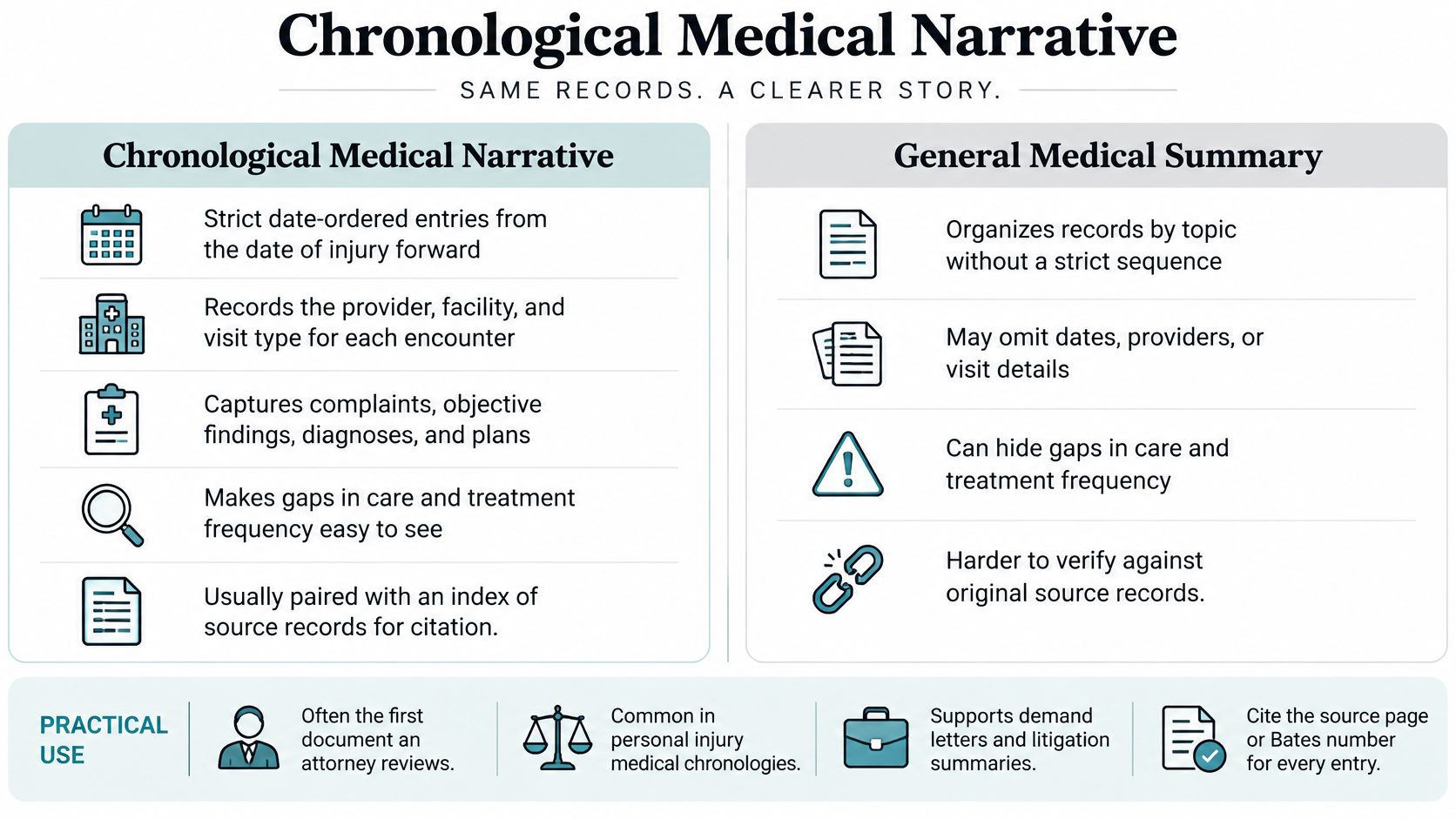
Three habits separate a chronology that survives deposition from one that collapses:
- Quote complaints instead of paraphrasing them. "Sharp pain radiating into the left hand" carries more weight than "reported arm pain," and it's harder to walk back.
- Front-load pre-accident records for the same body part. Address the 2019 chiropractic visit in your own document before the defense finds it and frames it as the cause.
- Build the spine, then annotate. An extraction pass over the full record set will pull dates, providers, and diagnoses quickly, but a human has to verify every entry against the source page before export.
The replicable tactic: build the spine with extraction, then read every line against the original note. Extraction gets you most of the way. The last pass is where credibility lives.
2. Problem-Oriented Medical Narrative
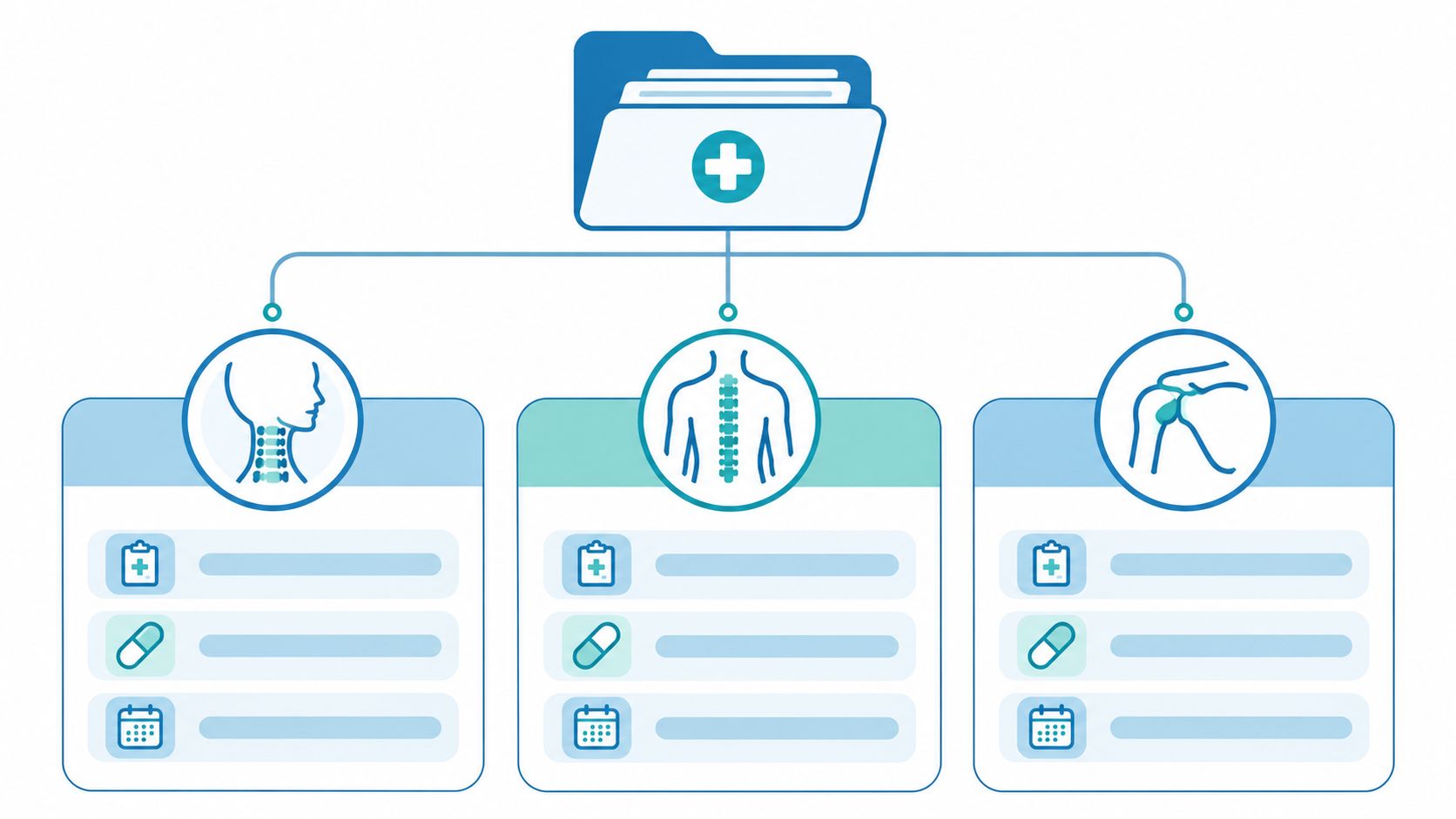
Which injury should the adjuster be able to assess without piecing together scattered notes? A problem-oriented narrative gives each claimed condition its own section, tracing symptoms, diagnosis, treatment, and response across providers.
Consider a client with a cervical herniation, a lumbar strain, and a right shoulder tear. A date-by-date account can bury the shoulder's early complaints among dozens of visits. Grouping records by condition makes the shoulder's treatment history easier to assess and keeps each injury's evidence together.
What this structure preempts
It counters the defense argument that complaints are scattered or inconsistent. When the neck records sit together, the reader can assess the pattern without searching across the entire file.
A cardiology study of 2,143 encounters found that documentation education and peer review increased the recorded capture of complications and major complications from 41% to 49%, while the mortality index fell from 1.40 to 0.97 (the cardiology documentation study). The study measured documentation outcomes; it does not establish that patient care stayed the same. For a legal narrative, the practical lesson is to distinguish what the record documents from what the evidence supports. Grouping records by problem helps the reader locate the relevant evidence, but the grouping itself does not prove the injury's severity.
Use these rules to keep each section accurate:
- Start with the full diagnosis list. Group related diagnoses under a body part or condition, not a billing category.
- Place relevant pre-existing records with the corresponding problem. Addressing a minor history entry in context lets the reader assess it alongside the later records.
- Check every claimed injury against the problem list. If an injury has no section, identify the gap before preparing the demand.
The replicable tactic: draft the condition headings first, then check that each one is supported by the relevant imaging, treatment, and documented functional consequences.
3. Causation Medical Narrative
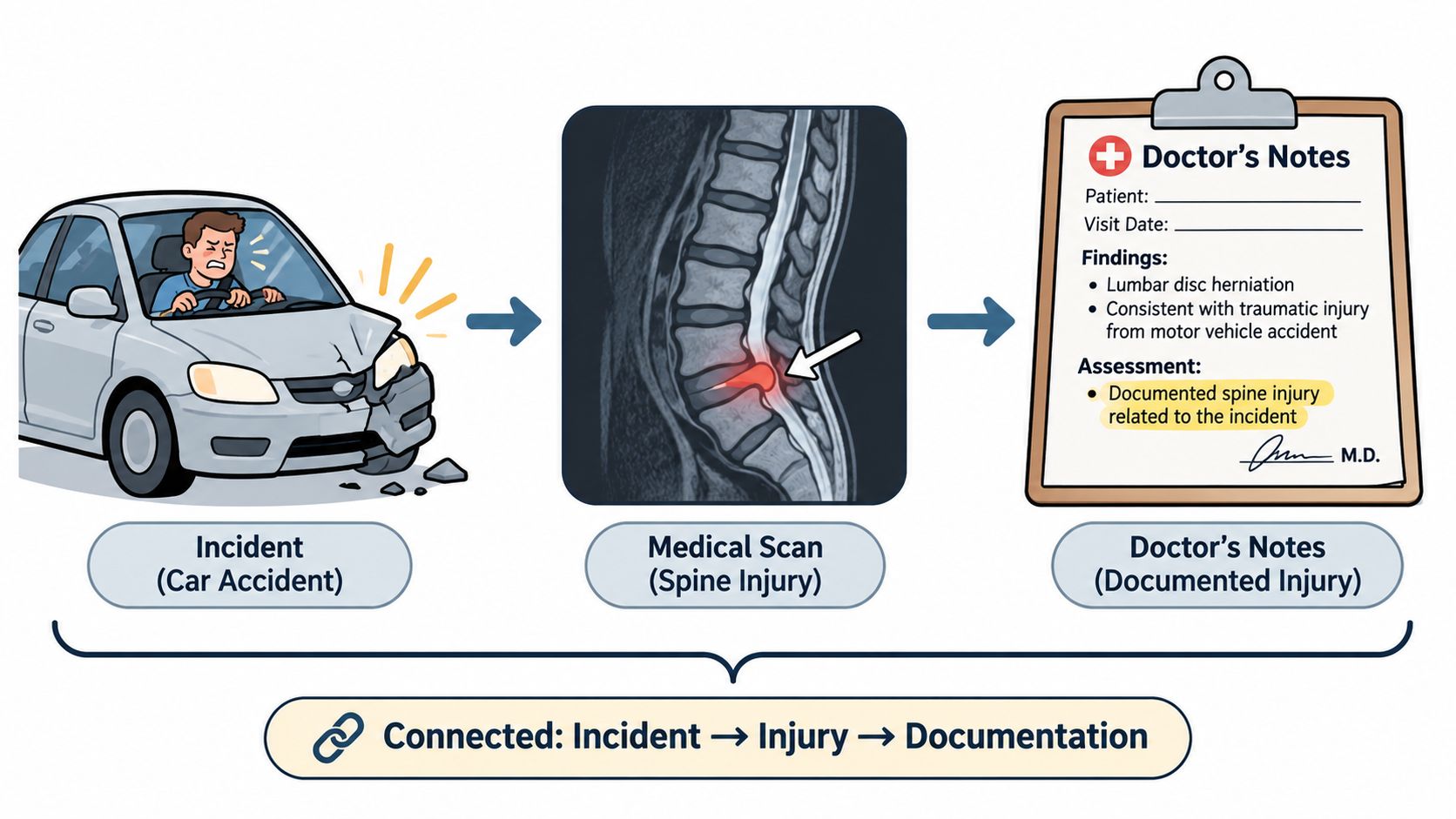
Causation is where strong records go to die. The narrative has to do four things in order: describe the mechanism, tie it to the specific injury, establish symptom onset, and explain why the competing explanations don't fit.
That last step is the one most firms skip. Defense counsel will run degeneration, prior injury, or delayed treatment at every deposition, and a causation narrative that doesn't address those three before they're raised reads as though you didn't know they existed.
Build the before picture
Pull every record for the same body part from before the incident, even when the folder is nearly empty. An absence of prior complaints is evidence. A single prior complaint with a clear resolution is also evidence, and it's better coming from you than from an IME report.
The line that matters: "to a reasonable degree of medical probability" belongs in the treating provider's chart note or letter, not in your prose.
The mechanism-to-injury link has to stay traceable, and documentation research shows why. In a hospital plastic surgery documentation-accuracy project, case-mix index, calculated severity of illness, and calculated risk of mortality all rose after systematic documentation improvement while length of stay fell (the documentation project). Read that carefully. Apparent severity can climb because the record captured more, not because the patient changed. Every causation conclusion you write should trace back to a contemporaneous note, provider, and date, and anything inferred should be labeled as inference.
The replicable tactic: ask the treating physician to state causation in the chart at the visit where the finding appears, in the physician's own words. A note written in real time outlasts any letter drafted two years later. Our guide to how to prove causation walks through the record sequencing that supports it.
4. Demand Letter Medical Narrative
This one gets read by a person with authority to write a check, usually in under ten minutes. Write for that reader. Two pages of plain language, defensible numbers, and exhibits for anyone who wants depth.
The order that works: incident, immediate care, diagnosis, treatment course, current status, specials, and why the number is the number. Skip the adjectives. A demand that describes a herniation and lists the injection dates does more than one that calls the injury devastating.
What kills a demand narrative
- Specials that don't reconcile. Total the billed charges from the bills themselves before you state a figure, and check that the treatment dates match the records.
- Unexplained gaps. A four-month hole in care with no explanation hands the adjuster a valuation discount you can't recover later.
- Attorney conclusions dressed as medicine. State what the records show, then let the treating provider's opinion carry the causal claim.
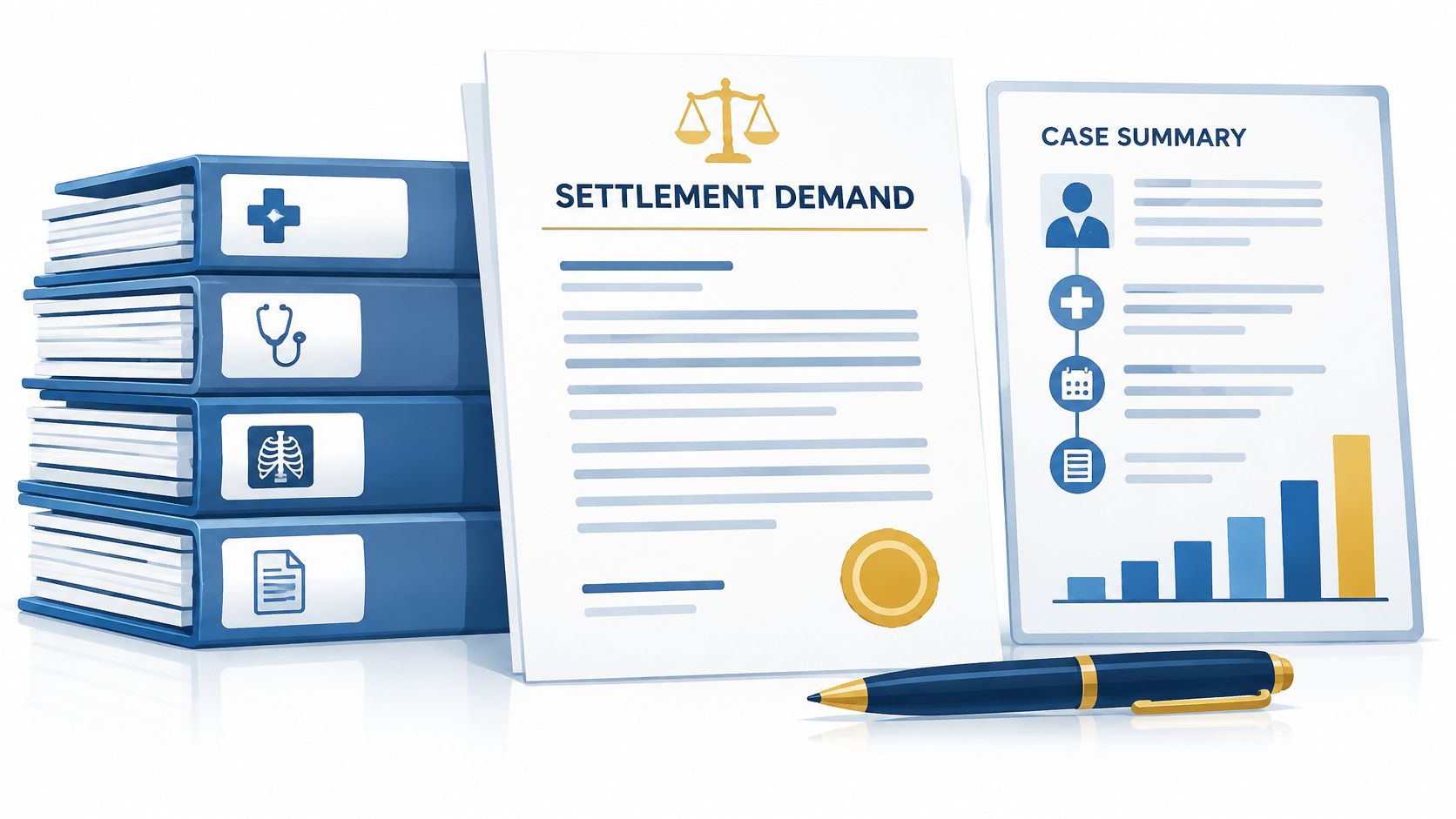
A worked version: a rear-end collision with cervical injections, eight months of physical therapy, and three providers. The medical section runs under two pages, cites the MRI by date, quotes the injection note, states total billed charges, and references the full chronology as Exhibit A. The adjuster never has to ask a question, which is the whole objective.
The replicable tactic: draft the medical section, then have someone who hasn't read the file read it cold and tell you what the injury is and what it cost. If they hesitate, the format failed. For the surrounding structure, this walkthrough of how to write a demand letter covers the packaging around the medical section.
5. SOAP-Based Clinical Summary Narrative
Where does a SOAP summary help most: in the case file, not in the demand? Its value is disciplined comparison. Each encounter separates the patient's account, the provider's observations, the assessment, and the plan, making it easier to see what changed and what remains unexplained.
Template-driven notes can make the patient's account harder to reconstruct when details are spread across standardized fields. Documind's medical documentation guide explains how medical documentation is organized. In litigation, keep reported symptoms distinct from examination findings and test results. That separation helps identify gaps without turning a chart summary into an argument.
A SOAP digest is an internal tool for review and deposition preparation. Translate it into plain language before sharing it with a carrier.
For a case approaching depositions, a paralegal can organize urgent care, orthopedic, and physical therapy notes by SOAP fields. The attorney can then spot a visit where the patient reported numbness but the note records no follow-up assessment. That may shape deposition questions about the symptom's persistence and clinical significance. The digest identifies the issue; the underlying note remains the evidence.
- Use the same fields and order across providers so encounters are easier to compare. Expand abbreviations that could be read more than one way.
- Flag mismatches for attorney review. A reported symptom and an examination finding may differ without either record being wrong.
- Keep the digest analytical. Preserve the source note's distinctions rather than smoothing them into a persuasive narrative.
A practical tactic is to maintain an inconsistency log beside the digest. Record the date, the conflicting statements, and the source for each one. Before a deposition, use that log to prepare focused questions about what the patient reported, what the provider observed, and whether the record explains the difference.
6. Treating Physician Narrative Report
A treating physician's report can support a demand, mediation statement, or expert disclosure with an opinion grounded in the care the physician provided. Its value depends on specificity: a short, supported opinion gives the adjuster or mediator something concrete to assess.
Request more than “a narrative.” Send a concise case summary, the relevant records, and numbered questions about diagnosis, prognosis, permanent restrictions, future care, and whether the injury was caused by the incident to a reasonable degree of medical probability. A medical narrative report template can help frame the questions.
Where these reports actually earn their fee
A treating orthopedic surgeon's report can sharpen a demand when surgery has been recommended by connecting the recommendation to the diagnosis, findings, and treatment history. A neurologist's opinion on post-concussive symptoms can serve a similar role in mediation, where the mediator needs a clear basis for each side's position.
Review the draft against the chart before it goes out. A wrong date or misstated mechanism gives the defense a reason to challenge the physician's credibility. Check that each opinion matches the record and that the physician will stand behind it at deposition.
- Send relevant records. Include the imaging, operative report, and recent visits needed to answer the questions.
- Ask for functional restrictions. “No lifting over ten pounds” gives the reader more to evaluate than “continue to monitor.”
- Confirm the physician will defend the opinion. A report the provider will not support at deposition can weaken the case.
The replicable tactic: number each question and request a direct answer, especially on causation. That makes the physician's reasoning easier to assess and gives the defense fewer openings to argue that the opinion is vague.
7. Treatment Gap and Compliance Narrative
Every file has gaps. The only question is whether you explain them or the adjuster explains them for you, and her explanation will be cheaper than yours.
The method is arithmetic before it's prose. Calculate gaps in days across all providers, not just the primary treating specialty, and flag anything over thirty days. Then, for each flagged gap, document the reason from the chart or the client interview, and show that symptoms persisted or recurred when care resumed. A gap that ends in a documented flare-up reads very differently from a gap that ends in a new complaint.
The gap you can't explain
Sometimes there's no reason in the record, because the client never told anyone why. Don't manufacture one. Show continuity through what does exist: pharmacy fills, work notes, a spouse's testimony, an urgent care visit for the same symptom at a different facility.
Never write a reason into a narrative that the chart and the client's own account don't support.
A worked version: a client changes jobs, loses coverage, and stops physical therapy for four months. The demand narrative states the dates, states the reason as the client gives it, and then shows the first visit back documenting increased pain and a reduced range of motion. The gap becomes a fact about insurance, not a fact about injury severity.
- Check the reason twice. Once against the chart and once against the client interview, because memory and records drift apart.
- Look across specialties. A patient may stop seeing orthopedics while continuing chiropractic care, which changes the gap math entirely.
- Address it early. Raising a gap in your own demand is cheaper than conceding it in a mediation brief.
The replicable tactic: build a single timeline of every provider and flag the empty stretches before drafting anything else. This breakdown of why gap analysis matters shows how the flagged periods feed directly into demand language.
8. Functional Impact and Daily Living Narrative
How does an injury change a person's ordinary day? A functional-impact narrative answers that question by connecting documented restrictions to specific tasks at work and at home. A chart may say “no lifting above shoulder height.” The narrative shows what that means for placing a box on a top shelf, doing someone's hair, or sleeping comfortably.
This format belongs in settlement negotiations, where the adjuster needs to assess non-economic damages alongside the medical evidence. Specific, supported examples also give a jury a clear way to understand the injury's effect without overstating it.
Anchor every claim to a record
Tie each limitation to a therapy goal, provider restriction, occupational therapy assessment, or documented observation. Use the client's own words when the record supports them, and identify the task affected. Patient narratives can also support emotional connection and participation in healthcare, but in a legal narrative, specificity and evidentiary support do the work.
- Replace absolutes with particulars. “Cannot do anything” invites a challenge from a single activity that appears inconsistent with the claim. Describe what the client can do, what causes difficulty, and what has changed.
- Organize by daily-life domain. Address work, household tasks, recreation, relationships, sleep, and self-care, with supporting citations for each.
- Keep the claim proportional to the proof. A few documented restrictions are more persuasive than a long list of unsupported limitations.
The replicable tactic: take each documented restriction to the client interview and ask which specific tasks it affects. Then connect each answer to the supporting record, and leave out claims the evidence cannot carry.
Comparing the 8 Medical Narrative Formats
| Item | Primary Use | Best Case Stage | Key Strength |
|---|---|---|---|
| Chronological Medical Narrative | Present treatment in date order | Initial case review and demand preparation | Makes care progression and gaps easy to verify |
| Problem-Oriented Medical Narrative | Organize evidence by injury or condition | Demand preparation and trial presentation | Connects diagnoses, treatment, and providers for each injury |
| Causation Medical Narrative | Link the incident to specific injuries | Medical expert review and litigation | Directly addresses accident-related causation |
| Demand Letter Medical Narrative | Present medical damages persuasively to an insurer | Settlement demand | Turns treatment records into a clear settlement narrative |
| SOAP-Based Clinical Summary Narrative | Summarize encounters using clinical note sections | Discovery review and deposition preparation | Separates reported symptoms from clinical findings |
| Treating Physician Narrative Report | Document the treating provider's opinions and prognosis | Settlement negotiations and litigation | Provides medical opinions in the treating clinician's own voice |
| Treatment Gap and Compliance Narrative | Explain gaps or inconsistencies in care | Demand preparation and deposition preparation | Addresses insurer concerns with a credible account |
| Functional Impact and Daily Living Narrative | Show how injuries affect everyday life | Settlement negotiations and trial | Connects medical evidence to lived experience |
Building Case-Ready Narratives Without the Grind
No single format wins a case. The firms that settle consistently layer them, in a specific order:
- Chronology as the backbone. One dated, cited spine that every other document references.
- Problem sections for each claimed injury. The version an adjuster can read in three minutes.
- Causation and gap work as preemptive strikes. Written before the defense raises either issue, not after.
- Functional impact to anchor the number. The only section that speaks to what the injury cost the client's actual life.
The layering is what does the work. A chronology with no problem sections reads as data. A problem narrative with no causation section invites the degeneration argument. A demand with specials and no functional impact gets valued as a bill instead of an injury. Each format covers a weakness the others leave open.
There's a practical constraint nobody mentions in CLE: the extraction and citation work behind good narratives is hours of reading, and it's the first thing that gets rushed when a firm takes on volume. That's the part where automation has changed the math. Ares builds chronologies, billing ledgers, treatment timelines, and red flags from uploaded records, with every clinical event cited to its source page, and its Medical Summaries product turns thousands of pages into an organized record set that a human then reviews. The output is a draft, not a final product, and it should be treated that way. The judgment about which format a case needs, and what the record proves, stays with the attorney.
The pattern that separates good outcomes from great ones is boring. Pick the format that fits the stage of the case. Anchor every assertion to a page, a provider, and a date. Label what's inferred instead of dressing it as fact. Address the weaknesses before the other side finds them. That discipline is also what makes a settlement conversation short, which is why the same preparation feeds directly into negotiating injury settlement terms when the carrier finally engages.
Do the layering once, correctly, and you'll use the same file for the demand, the mediation, and the trial.
Ares takes the records your team already has and returns a cited chronology, a billing ledger with treatment timelines, and the causation and gap analysis those documents depend on, so the drafting starts from structure instead of a blank page. Upload a case file and the platform generates the summaries and red flags you'd otherwise spend days assembling, with HIPAA-compliant handling of the underlying PHI. Visit Ares to run a live file and see the difference on your own records.