You're at mediation, the demand has gone out, and the adjuster asks a simple question: “Why did treatment stop for several weeks?” The file contains hundreds of pages, but no one has built a reliable chronology. Your client's injury is genuine. The treatment interruption may have a reasonable explanation. Yet the answer isn't immediately available, and the defense now has control of the conversation.
That's where the importance of gap analysis becomes practical. A gap analysis doesn't replace legal judgment or medical expertise. It forces the team to compare the evidence currently in the file with the evidence needed to support liability, causation, treatment, and damages, before the opposing side identifies the weakness for you.
Why Missing Details Cost Cases

A treatment gap rarely hurts a case because the calendar itself proves recovery. It hurts because an unexplained period gives defense counsel room to propose an alternative story. Perhaps the client improved. Perhaps the accident wasn't the source of the ongoing symptoms. Perhaps the client failed to follow medical advice. Those arguments may be wrong, but an incomplete file makes them easier to present.
Medical-record review guidance for attorneys specifically recommends marking the intervals between the event, initial treatment, referrals, follow-up visits, and recommended care, then investigating whether each interval resulted from access barriers, insurance problems, improvement, or noncompliance. That approach reflects the practical importance of gap analysis in a PI file, because a missing interval can affect both the causation narrative and the damages assessment. Expert Institute's medical-record review guidance provides a useful framework for those checkpoints.
The defense works from the unanswered question
A strong demand package doesn't merely collect records. It explains what happened between records. If the client couldn't obtain an appointment, document that. If a provider recommended conservative care but the client changed facilities, identify the transition. If symptoms continued but the client used home treatment, preserve the testimony and supporting evidence.
Practical rule: An unexplained gap is not neutral. It becomes an argument available to the other side.
The risk extends beyond settlement. At deposition, a witness who can't explain a missing interval may appear evasive even when the underlying facts are sound. At trial, opposing counsel can place two dates beside each other and let the jury draw its own inference. A gap analysis gives the attorney the explanation before that happens.
The file doesn't need to be perfect. It needs to be honest, chronological, and prepared for the questions a skeptical adjuster, defense lawyer, or juror will ask.
Defining Gap Analysis in Legal Terms
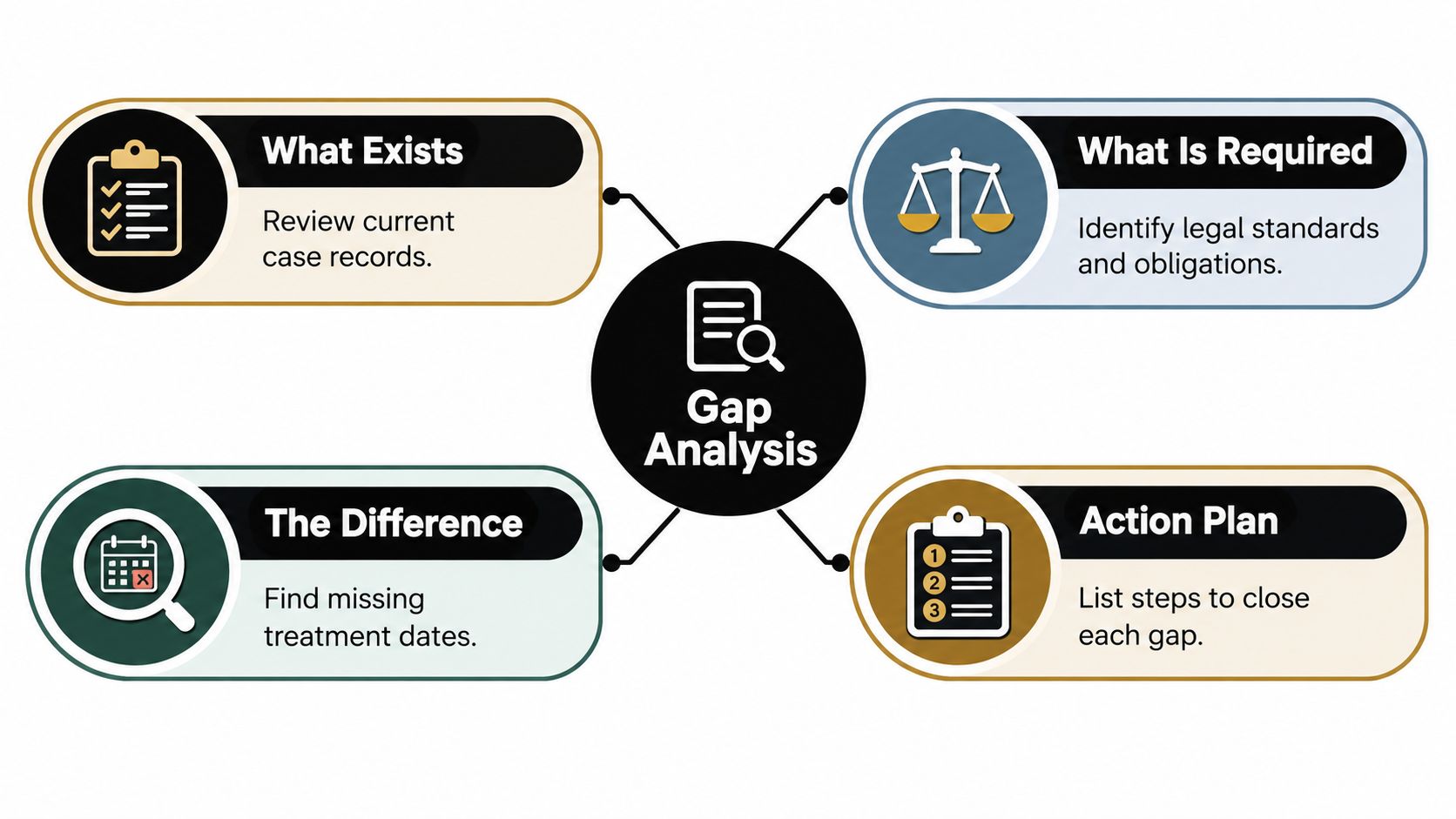
In legal practice, gap analysis is the structured comparison between what the file currently establishes and what the case must establish to support the client's position. The current state is the evidence in hand. The required state is the evidence, explanation, or expert support needed for the next decision, whether that decision is sending a demand, accepting an offer, filing suit, designating experts, or trying the case.
The general business definition is similar. Gap analysis compares actual outcomes with target or optimal performance, identifies the causes of the shortfall, and supports an action plan. TechTarget's definition of gap analysis captures the technical distinction: the exercise is not merely finding something absent, but connecting the difference between actual and required states to corrective action.
Think of a case file as a jigsaw puzzle. The records, bills, photographs, testimony, employment evidence, and expert opinions are pieces. A missing edge piece may prevent the entire picture from making sense. A missing middle piece may conceal how the accident led to treatment, how treatment led to restrictions, or how restrictions affected the client's life.
Four questions expose the weakness
- What exists? List the accident facts, initial complaints, diagnoses, treatment dates, provider opinions, bills, wage evidence, and client testimony supported by the file.
- What's required? Define the proposition you need to prove, such as immediate onset, continuous symptoms, reasonable treatment, future care, or a specific impairment.
- What's different? Identify absent records, conflicting histories, unexplained intervals, delayed diagnoses, inconsistent body-part descriptions, and unsupported damages assertions.
- What closes the gap? Assign a concrete action, such as requesting a missing chart, interviewing the client, obtaining a provider clarification, locating billing records, or retaining an expert.
This method separates a real evidentiary gap from a mere administrative inconvenience. A duplicate bill may be annoying. A missing first report of injury or an undocumented referral may affect the theory of the case.
A useful gap analysis also names ownership and timing. The paralegal may request records, the case manager may contact the client, and the attorney may decide whether the issue requires an affidavit, deposition testimony, or expert review. Without an owner and a deadline, the analysis becomes another memo that sits in the file.
How Gaps Affect Case Outcomes
A gap changes the weight of surrounding evidence. It can weaken causation, complicate the calculation of damages, and reduce settlement bargaining power even when the client's underlying account is credible.
Consider an accident followed by an emergency visit, several therapy notes, and then an unexplained interruption. The defense may argue that the client's condition improved during the interruption and worsened only later. That doesn't establish the defense theory, but it creates a competing explanation. Your job is to test that explanation before relying on a clean causal chain.
The same issue appears in damages. A treatment record may document pain but not functional restrictions. A billing record may show charges without explaining the medical necessity of the care. A physician may recommend follow-up treatment that never appears in the file. Each omission leaves the opposing side room to challenge the scope, duration, or reasonableness of the claimed losses.
Separate the kinds of gaps
Not every gap requires the same response. Sort the problem before assigning the solution.
| Gap type | What it may affect | Appropriate response |
|---|---|---|
| Chronology gap | Onset, progression, and treatment continuity | Build a date-by-date timeline and obtain missing records |
| Causation gap | Connection between the incident and the condition | Compare histories, prior records, diagnostic findings, and provider opinions |
| Damages gap | Treatment necessity, impairment, wage loss, or future care | Collect bills, restrictions, employment evidence, and supporting opinions |
| Narrative gap | Credibility and persuasiveness | Interview the client and reconcile inconsistent descriptions |
| Documentation gap | Ability to prove an otherwise valid event | Request source records, authorizations, metadata, or witness evidence |
A common mistake is to treat every missing record as a reason to delay the case indefinitely. That can waste time and increase costs. Another is to ignore the gap because the attorney believes the client. The better approach is to rank each gap by litigation risk and address the issues most likely to change valuation or credibility.
The purpose isn't to create a flawless file. It's to know which facts are established, which are disputed, and which still need proof.
Gap analysis also improves negotiation discipline. If the defense raises a treatment interruption, counsel can answer with documented access problems, a provider transition, continuing symptoms, or another supported explanation. If no explanation exists, the attorney can value the case with that weakness in mind rather than discovering it during mediation.
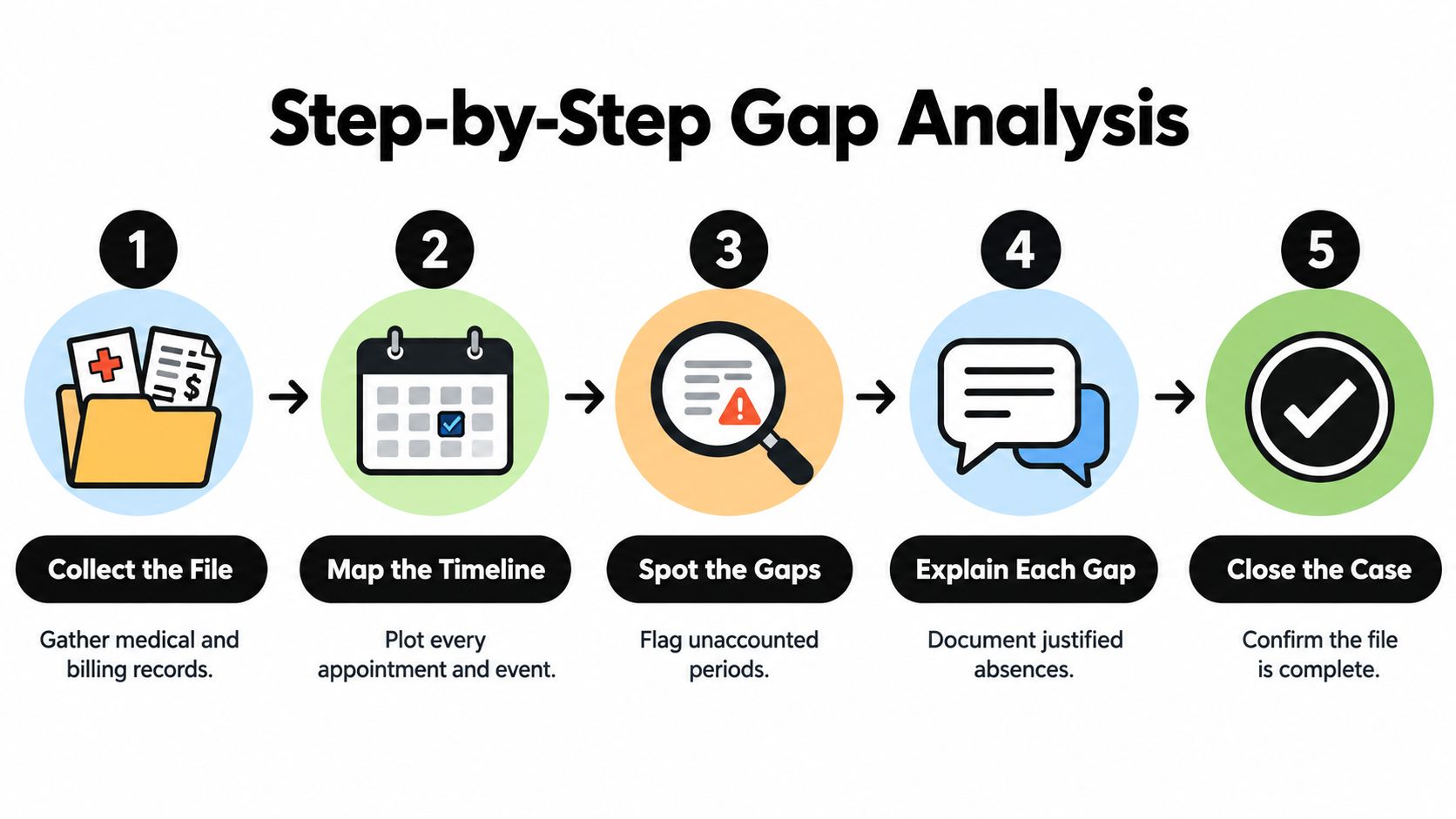
The Step-by-Step Review Process
A file can contain hundreds of pages and still fail at mediation because one unanswered question controls the story. Start with the accident, then test whether the records support the client's account from injury through claimed loss.
1. Collect the complete file
Obtain the incident report, photographs, insurance materials, client questionnaire, medical and billing records, diagnostic images or reports, employment documents, correspondence, and relevant prior medical history. Keep records separate from bills. Bills show charges and payments. Clinical records explain diagnoses, treatment decisions, restrictions, and changes in condition.
2. Define what the case must prove
Write the required narrative in terms another lawyer can challenge. It may need to establish the absence of comparable pre-incident symptoms, prompt reporting, consistent care, functional limitations, and a supported future consequence. Each proposition should point to the evidence that proves it and identify the witness or document that could undermine it.
3. Build a litigation timeline
Begin with the accident and continue through the latest known treatment. Record complaints, emergency care, referrals, imaging, specialist evaluations, therapy, medication changes, missed visits, discharge decisions, work restrictions, and relevant client communications.
A spreadsheet is usually enough. Create fields for date, provider, complaint, objective finding, treatment, recommendation, next appointment, and supporting document. Mark unknown dates as unknown. Guessing creates a credibility problem later.
4. Investigate every interruption
For each treatment gap, identify what happened and why it matters. The client may have lost insurance, lacked transportation, waited for a referral, moved, returned to work, improved, misunderstood instructions, or treated elsewhere. Record the explanation and classify its support: document, witness, client testimony, or provider evidence.
Use the PatientNotes audit checklist to check missing documentation and consistency issues without relying on memory. A gap without an explanation can become a defense theme, even when the underlying injury is legitimate.
5. Close material gaps and price the rest
Prioritize omissions that affect causation, credibility, liability, or damages. Request the missing chart, obtain provider clarification, re-interview the client, or seek medical interpretation when necessary. The medical record review workflow for attorneys provides a useful framework for organizing chronology, diagnoses, providers, and treatment patterns.
The review ends when every material gap has an explanation, a documented action, or a defined effect on settlement value and trial preparation. That final step protects the client from avoidable surprises and prevents the team from spending the fee on evidence that cannot change the case.
Real-World Pitfalls and Lessons
A missed follow-up can look minor inside a large production file. It becomes significant when the defense uses it to rewrite the client's recovery.
Suppose the records show an emergency evaluation after a collision, a specialist referral, and several therapy visits. The specialist recommends a follow-up appointment, but the next available record appears much later. No one asks the client why. The demand letter describes persistent pain but doesn't explain the missing visit. During negotiation, the adjuster points to the interruption and argues that the later treatment reflects a new or unrelated problem.
The weakness isn't necessarily the missed appointment. The weakness is that the file offers no prepared explanation. Perhaps the client's insurer denied authorization. Perhaps the referral went to a provider who stopped accepting new patients. Perhaps the client called several offices, returned to work, and continued prescribed home exercises. Each fact could matter, but none can help if the team never asks.
Another failure starts with a delayed diagnosis
A client may initially report neck pain, later develop radiating symptoms, and eventually receive imaging that identifies a more specific condition. If the attorney treats the later diagnosis as self-explanatory, the defense may characterize it as a new injury or a consequence of unrelated degeneration.
The file needs a bridge. That bridge may come from symptom progression, consistent complaints, examination findings, imaging, or a qualified provider's opinion. Gap analysis identifies the missing link before counsel builds the demand around a conclusion the records don't yet support.

The lesson for associates is simple: never write “ongoing treatment” merely because treatment appears on both sides of an interval. Confirm what occurred inside the interval, then state the limits of what the evidence proves. Accurate restraint protects credibility more effectively than an aggressive narrative that collapses under questioning.
Automating the Analysis with AI
A lawyer reviewing a large medical file can miss a date in a scanned page, overlook a provider transition, or describe the chronology differently from another team member. Manual judgment remains necessary for credibility, causation, privilege, admissibility, and medical meaning. The risk lies in spending that judgment on locating repeated facts instead of testing the case narrative.
AI-assisted review can handle the first pass. It can extract dates, providers, diagnoses, procedures, symptoms, and recommendations, then organize those details into a chronology for human validation. The output is a working record, not a legal conclusion. Counsel must still determine whether the evidence supports the theory of liability, explains a treatment interruption, or leaves a gap the defense can exploit.
Manual review and assisted review
| Manual-first approach | AI-assisted approach |
|---|---|
| Reviewer searches records page by page | Software extracts recurring dates and medical entities |
| Chronology depends heavily on individual note-taking | The team receives a structured starting chronology |
| Gaps are found as the reviewer encounters them | Treatment interruptions can be surfaced for confirmation |
| Drafting begins after extensive organization | Organized case facts can support earlier strategic review |
| Quality varies with workload and reviewer consistency | The same review pattern can be applied across matters |
The practical division of labor is straightforward. Let software organize the raw records, then assign a trained attorney or case manager to verify the chronology, investigate flagged gaps, and separate missing care from missing documentation. That distinction matters in settlement discussions. A treatment gap may reflect an access problem, a provider change, or an unrecorded event. It should not become a damaging inference before someone checks the file.
Ares offers an AI-powered platform for personal injury firms that automates medical-record review and demand-letter drafting. It converts uploaded documents into organized case insights, while the firm remains responsible for checking accuracy, context, and the limits of the evidence. Teams comparing this workflow with broader document processing for finance teams can apply the same principle: structure unorganized documents before making decisions.
Use the AI document review workflow as a model for assigning machine and human tasks. The attorney should review every material finding, confirm source documents, and record unresolved questions. Automation earns its place when it exposes evidentiary and narrative gaps early enough to strengthen discovery, negotiation, or trial preparation.
Building a Culture of Thoroughness
A gap analysis works only when the firm treats it as case strategy rather than clerical cleanup. The intake team should identify obvious missing facts. Case managers should maintain the chronology as records arrive. Paralegals should flag interruptions and conflicting histories. Attorneys should decide which gaps affect valuation, discovery, experts, or trial presentation.
That responsibility needs a defined place in the workflow. Add a gap review when the initial records arrive, before the demand is drafted, after significant new treatment, before filing, and during trial preparation. The precise checkpoints can vary by practice, but the principle should remain fixed: no major case decision without a current view of what the file proves and what it doesn't.
Assign ownership, not vague responsibility
A useful internal review identifies:
- The missing fact, stated in plain language.
- The risk, such as causation, credibility, damages, or compliance.
- The assigned person, not merely “the team.”
- The next action, with a due date.
- The decision point, explaining when the issue must be resolved.
Quality assurance matters here. A second reviewer can test whether the chronology matches the records, whether the demand makes claims the evidence supports, and whether the team has documented explanations for material interruptions. Firms building that discipline can use quality assurance processes for legal workflows as a reference when formalizing review standards.
The financial logic is straightforward. In a large-scale review of more than 21,000 strategic plans, 78% of strategic goals had no assigned owner, while owned goals were nearly three times more likely to be marked on track, with 42% of owned goals hitting green. ClearPoint Strategy's gap analysis discussion uses that historical evidence to show why identifying a gap without assigning ownership rarely produces execution.
A PI firm should apply the same discipline to its files. A flagged treatment interruption without a named owner is not a completed review. It's an unresolved litigation risk.
Final Thoughts on Case Strategy
The importance of gap analysis in personal injury practice lies in what it does to the case narrative. It turns a stack of records into a sequence of tested propositions: what happened, when symptoms began, how care progressed, why interruptions occurred, what the providers found, and how the injury affected the client's life.
The process also exposes uncomfortable facts early. You may discover that a diagnosis is poorly connected to the accident, that wage-loss support is incomplete, or that a client's recollection conflicts with a prior history. Finding that problem before the demand or deposition gives you options. You can investigate, obtain clarification, adjust the theory, or value the claim with appropriate caution.
Use analysis to protect judgment
Automation can help organize records and surface patterns. It can't decide whether a gap is innocent, damaging, or explainable without further proof. Attorneys still need to test the facts, speak with clients, read critical notes, and make decisions that protect both the client's recovery and the firm's credibility.
Structured intake supports the same objective. Firms exploring personal injury legal intake automation can use technology to capture better facts earlier, but intake data still needs to be verified against records as the case develops.
Run the next review on one active file. Build the chronology, mark every interruption, assign each material gap to a person, and record the action required to close it. That exercise will show whether your current process protects the case narrative or merely stores documents.
Ares automates medical-record review and demand-letter drafting, organizing dates, diagnoses, providers, treatment patterns, and potential gaps into case-ready insights. Visit Ares to see how your firm can make gap analysis a repeatable part of personal injury case preparation.