You're already seeing the problem in the file. The client can tell you what hurts, but they can't cleanly explain why the case feels bigger than medical bills and missed work. The issue is usually not pain alone, it's that their life got smaller, quieter, and less theirs.
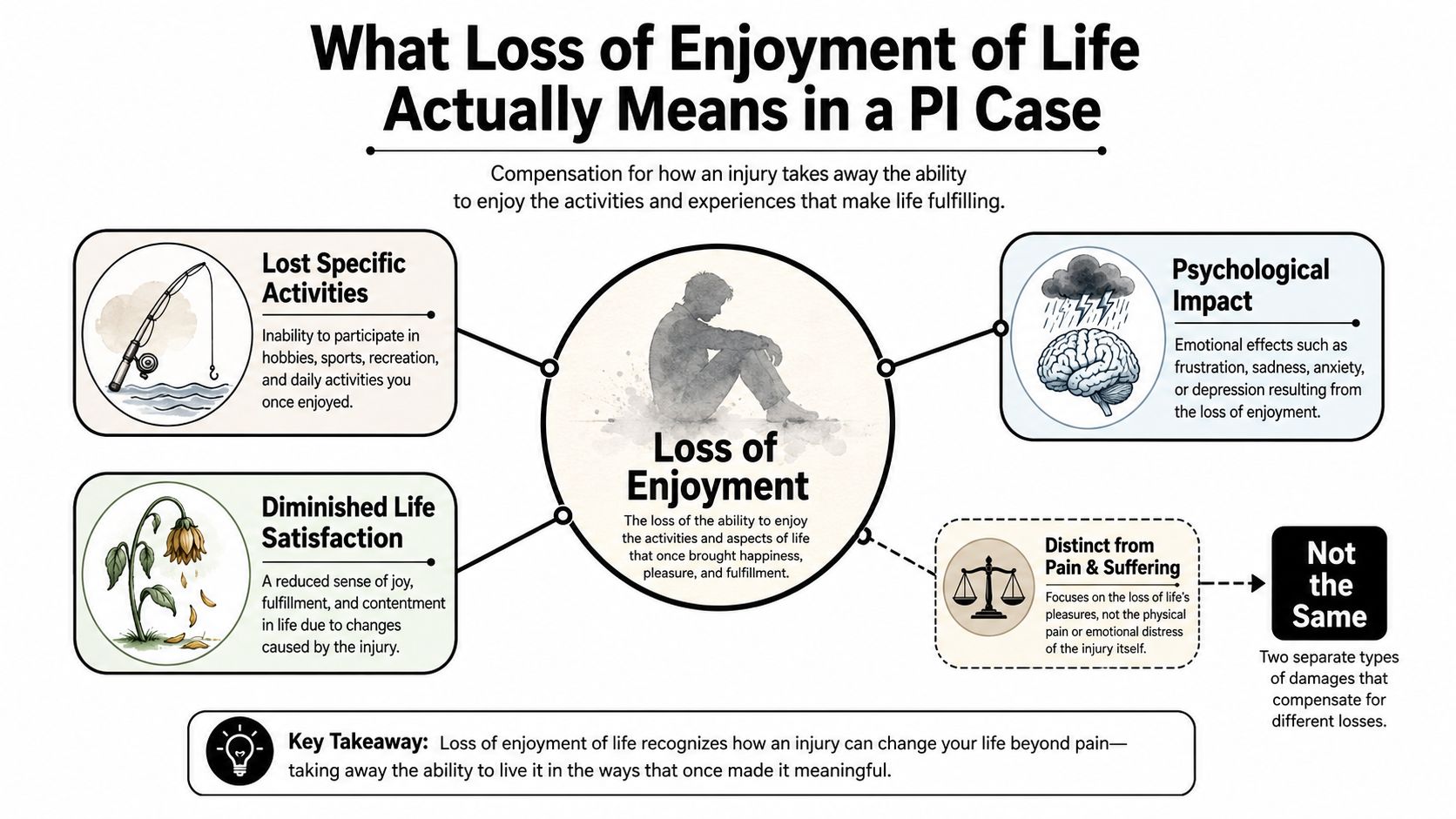
What Loss of Enjoyment of Life Actually Means in a PI Case
A 58-year-old delivery driver tears a rotator cuff, and suddenly the Saturday fishing trips stop, the grandson's baseball practices stop, and even carrying groceries becomes a production. That's the kind of fact pattern where loss of enjoyment of life belongs in its own damages paragraph, because the harm is not just discomfort. It's the loss of positive capacities the person used to live with every day.
The cleanest working definition
In a PI case, loss of enjoyment of life compensates the plaintiff for the functional loss of previously enjoyed activities and roles, not just for pain. Cornell's discussion of pain and suffering draws the line clearly, pain and suffering addresses new negative harms like discomfort and emotional distress, while loss of enjoyment of life covers the loss of positive activities, routines, and capacities the injury took away (Cornell Law School). That distinction matters because jurors can understand it.
If you want one sentence for intake notes or a demand draft, use this: the injury didn't just hurt the client, it took away the parts of daily life that made the client feel like themselves. That phrasing is cleaner than piling up adjectives about sadness or frustration.
Practical rule: frame the claim around what the client can no longer do, not around how upset the client feels about it.
A useful resource for the mechanics of valuing loss of enjoyment damages is a good reminder that the claim should be drafted as a separate harm, not an echo of the pain and suffering paragraph. If you're also building the broader non-economic case, the structure used in how to prove pain and suffering helps keep the damages buckets from collapsing into each other.
Why it needs its own paragraph
Pain and suffering covers the injury's unpleasantness. Loss of enjoyment of life covers the stolen parts of ordinary living, hobbies, family participation, identity, and future plans. That is why a demand that only says “my client experienced severe pain” usually undersells the file.
The better habit is to write two separate narratives. One describes the discomfort and emotional distress. The other describes the lost ability to fish, garden, coach, travel, lift a child, sleep through the night, or move through the day without planning around the injury.
If you can say, in a single clean sentence, that the injury reduced the client's ability to participate in normal life, you're already closer to a jury-ready theme.
The Legal Standard and How Juries Are Instructed
Courts treat loss of enjoyment of life as a non-economic, subjective harm with no fixed market price, so the proof has to be disciplined. The plaintiff is not asking the jury to reimburse a bill. The plaintiff is asking the jury to measure the change from the pre-injury baseline to the post-injury restriction.
What the jury is really comparing
The legal analysis is concrete. It is a before-and-after comparison built from testimony, records, and common sense. UsLegalForms summarizes the working framing well, loss of enjoyment of life reflects the limits the injury places on the person's life, and it is commonly supported by evidence of reduced participation in normal activities, special interests, and future expectations (USLegalForms overview). That is the lens jurors should be given.
Defense counsel usually takes one of two positions. It argues that the claim is just pain and suffering under a different label, or it says the plaintiff never had much of a hobby life, so there was little to lose. Both arguments gain traction only when the proof is loose and the injury story is not tied to daily function.
The instruction fight is won before the charging conference. If the evidence cleanly separates functional loss from physical pain, the defense argument gets much thinner.
What the pattern language should capture
The instruction should direct jurors to consider the plaintiff's inability to participate in ordinary life activities, including but not limited to recreation, family routines, work-adjacent tasks, and ordinary home life. The Arizona Attorney PDF is useful because it emphasizes normal activities of daily life and not only sports or leisure routines (Arizona Attorney PDF). That framing matters for older adults, caregivers, and clients with quiet routines that never produced trophy-case hobbies.
A clean instruction theme usually includes three ideas:
- Baseline first: what the client could do before the injury.
- Restriction next: what changed after the injury.
- Value last: why that lost participation matters as a human loss, even without a market price.
That structure gives the jury a usable path without forcing it to rank one person's life against another's. A client who gardened in the yard, drove to see family, handled household chores, or got through the day without planning around symptoms can still present a real functional loss. The point is not whether the life was flashy. The point is whether the injury took away ordinary parts of living that gave the client a sense of normalcy and control.
The trial theme should stay grounded in that comparison. Jurors can evaluate a stolen routine, a missed family role, or a lost sense of bodily freedom if counsel gives them clean facts and a direct instruction.
Evidence That Proves Loss of Enjoyment of Life
The file wins or loses on whether the plaintiff's life changed in ways a juror can see. Medical records matter, but they rarely carry the whole claim by themselves. The strongest files build a chain of proof from treatment notes to daily-life disruption to corroborating witnesses.
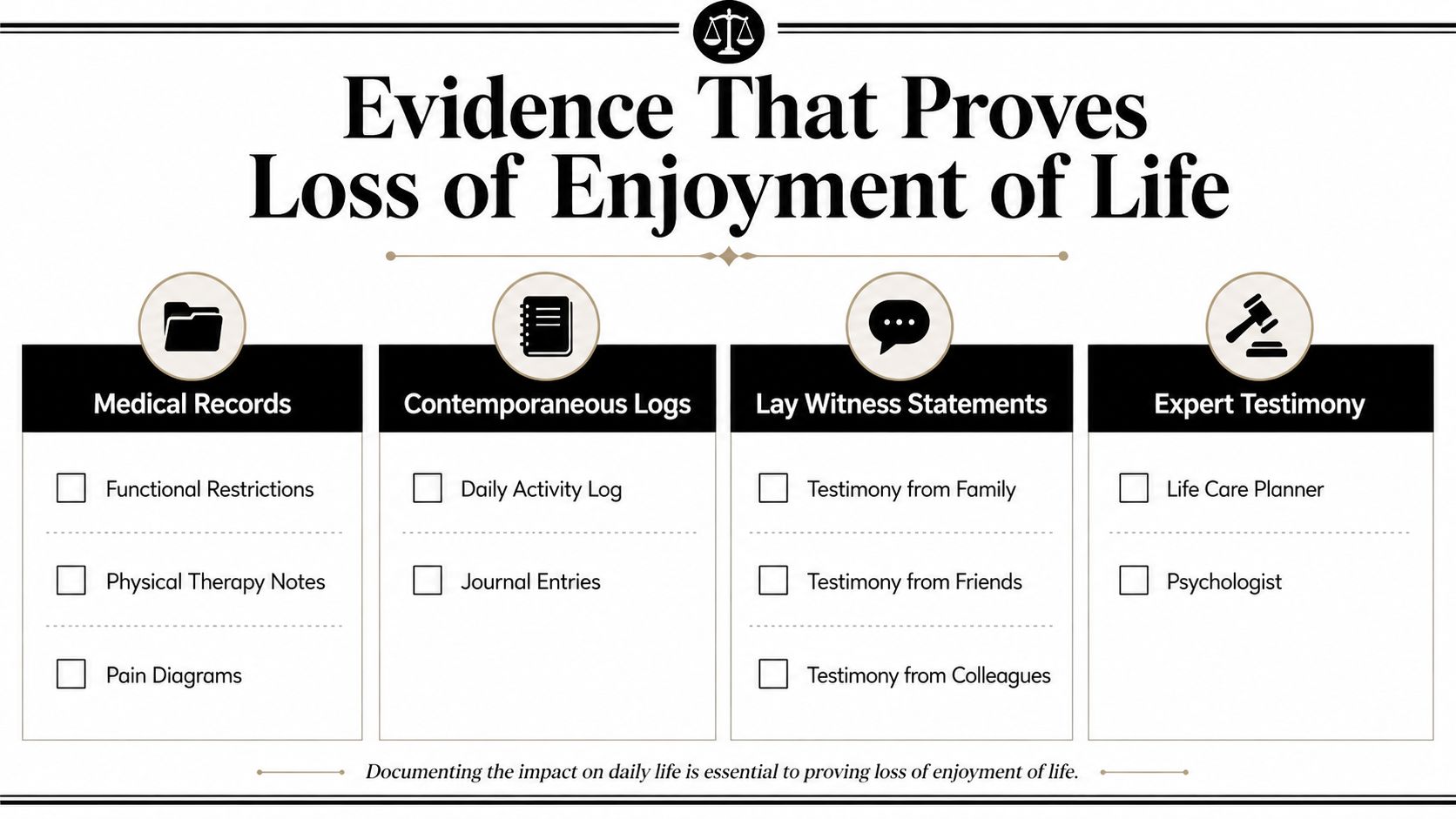
Build the file in four lanes
A clean evidence map helps paralegals and case managers keep the claim from becoming anecdotal. The best working bundle is usually:
- Medical records: functional restrictions, physical therapy notes, pain diagrams.
- Contemporaneous logs: daily activity logs, journal entries.
- Lay witness statements: family, friends, colleagues who saw the before-and-after.
- Expert testimony: treating doctors, life care planners, psychologists, or vocational experts where the case justifies it.
The point of the medical records is not to prove “sadness.” They prove capacity limits. If the chart reflects restricted lifting, limited range of motion, sleep disruption, or other documented limitations, those notes anchor the claim in actual functioning rather than post-loss rhetoric. A structured summary process like the one described in medical record summaries can help isolate those capacity issues early.
The checklist a paralegal can use
Hand this off as a working intake tool:
- Before-injury baseline: activities, routines, family roles, social habits.
- Post-injury change: what stopped, what became harder, what became impossible.
- Frequency and duration: how often the client used to do it, and how often they can do it now.
- Corroboration: texts, photos, calendars, coaching schedules, church or community roles.
- Witnesses: people who saw the client before and after the injury.
- Treatment support: notes showing persistent functional limits.
- Future impact: evidence that the restriction isn't just temporary.
A contemporaneous log is often more persuasive than a polished affidavit because it reads like lived experience, not litigation copy. Short entries about missed walks, skipped family dinners, abandoned chores, or reduced sleep can do more damage to the defense than a long, polished declaration.
You can use a medical-record review tool, a treating provider summary, or a demand-drafting platform to organize the chronology, but the litigation value still comes from the same thing, a credible record of lost function. If the documentation is thin, even a strong plaintiff can sound exaggerated. If the documentation is steady, the claim feels grounded.
When the Plaintiff Had a Modest Pre-Injury Life
A claimant does not need a dramatic pre-injury lifestyle to have a strong loss of enjoyment of life claim. A lot of people lived through routines, caregiving, work schedules, and quiet habits that never showed up in a highlight reel, yet those routines gave structure to the day. Older adults, caregivers, shift workers, disabled clients, and socially isolated people are often the ones defense counsel underrate.
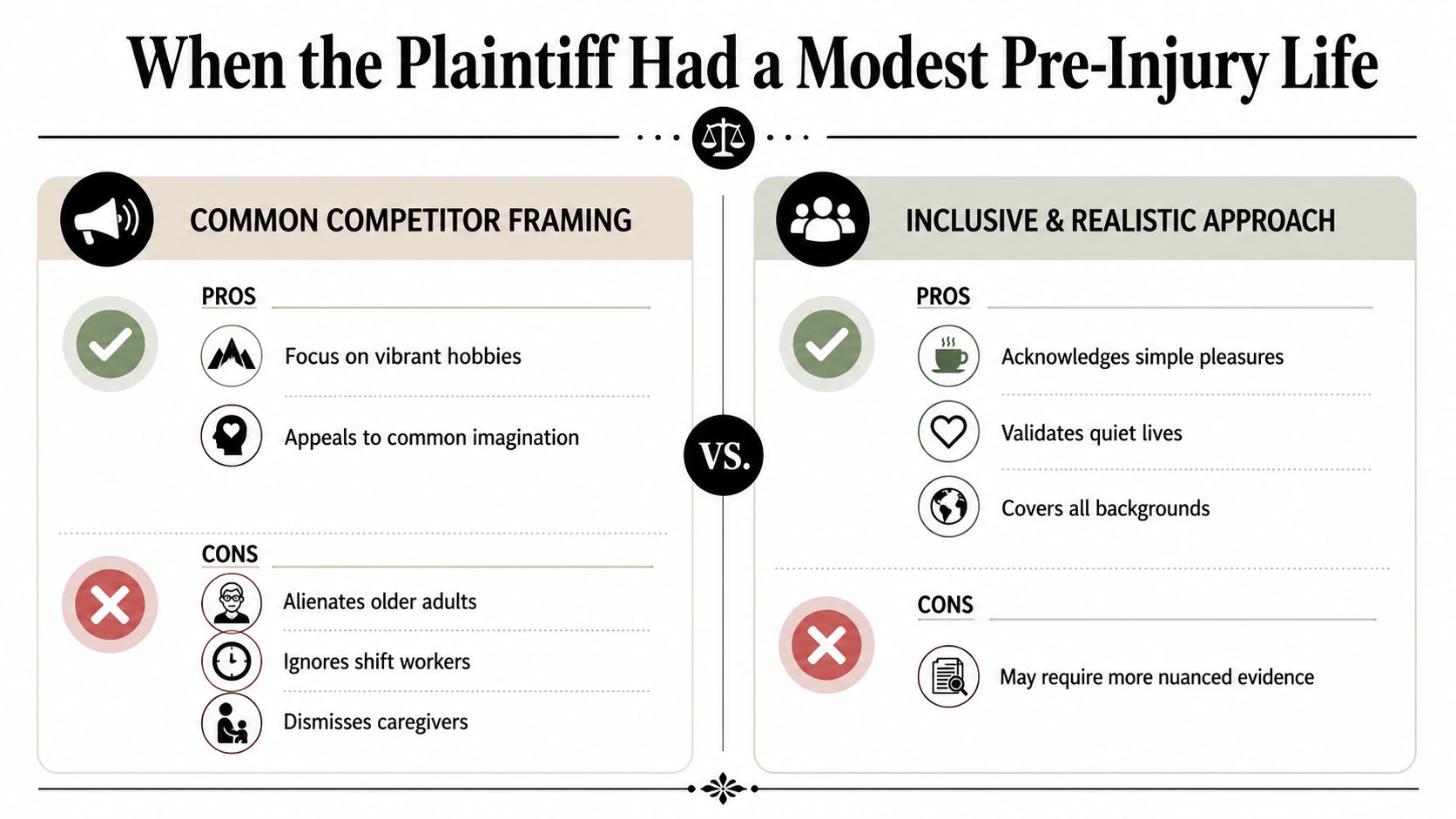
Replace the hobby story with the life story
The better case theme centers on everyday routines, sleeping through the night, driving without planning every stop, helping with grandchildren, cooking dinner, and keeping the household moving. Those are normal activities of daily life, and losing them can matter just as much as losing tennis, skiing, or hiking.
That framing matters because hobby-based storytelling can understate the harm for plaintiffs whose pre-injury lives were built around work, caregiving, faith communities, low-cost recreation, or quiet routines. The Arizona Attorney piece on hedonic damages points in that direction, because it emphasizes ordinary life participation, not just elite or visibly adventurous pastimes (Arizona Attorney PDF). That lens fits many clients defense counsel write off too quickly.
Baseline well-being can't be assumed
Recent large-scale mental-health and well-being research also makes one point harder to ignore, baseline well-being varies widely across adults, and middle-aged adults can be carrying more strain than jurors assume (Psychological Bulletin analysis). That does not weaken the claim. It sharpens the proof problem.
If a claimant already had caregiving stress, sleep disruption, or a modest pre-injury life, the task is to show the injury-caused loss on its own terms. Do not let the defense blur pre-existing strain into post-injury incapacity. The strongest proof usually looks functional and social, not sentimental.
Practical rule: do not sell the jury a lifestyle the client never had. Sell the one they lost.
For this client group, the evidence often comes from the smallest details. A missed church volunteer shift, a stopped bedtime routine with grandchildren, a lost morning walk, or an inability to sit through a family meal without pain can carry more weight than a flashy vacation story. The claim gets stronger when it sounds like real life.
Demand Letter and Pleading Language That Actually Lands
A demand letter should say what changed, why it matters, and how the loss affects the total value of the case. The complaint should plead the damage category cleanly enough that discovery can support it later. If you write either one like a generic emotional-distress paragraph, you leave money on the table.
Drop-in language that sounds like a real file
Use a paragraph like this in the demand:
As a direct result of the injury, the client's ability to participate in ordinary life has been materially reduced. The client can no longer engage in the daily routines, family roles, and personal activities that previously gave structure and meaning to life. This loss is separate from physical pain, and it reflects a lasting reduction in the client's quality of life, independence, and sense of self.
For the pleading, keep it simpler:
Plaintiff has suffered non-economic damages, including loss of enjoyment of life, diminished ability to participate in normal activities, and loss of the value of everyday life activities previously enjoyed.
The drafting lesson from writing a demand letter for personal injury applies here, the story has to be organized so the carrier can't dismiss it as vague emotional surplus.
Three valuation methods and their trade-offs
| Valuation Method | How It Works | Jury Appeal | Defense Attack Surface |
|---|---|---|---|
| Per-diem | Assigns a daily value to the loss over time | Easy to understand if the loss is concrete | Defense says it's arbitrary and mechanical |
| Multiplier | Applies a factor to specials to reflect broader harm | Familiar to adjusters and mediators | Can look detached from the lived loss if specials are low |
| Functional-unit or hedonic approach | Focuses on the value of lost activities and life functions | Strong when the plaintiff lost identity-level roles | Requires careful proof and can invite expert challenges |
Don't trap yourself inside a formula. The best number often comes from a narrative anchor, then a range supported by the seriousness of the restriction. If the client lost sleep, mobility, family participation, and spontaneity, the carrier should feel that loss in the opening demand, not after a spreadsheet debate.
One practical exception exists. If the case presents a severe lifestyle change, or the defendant is a policy-limits carrier that only respects hard structure, a more formal hedonic presentation can help create a stronger position. Otherwise, keep the math secondary to the human loss.
Settlement and Trial Strategy for This Damages Bucket
Develop the loss-of-enjoyment theme from intake, not after mediation. If the first time the file learns about the client's lost routines is in the final week before a settlement conference, the damages proof will feel improvised. That hurts credibility.
Sequence the proof early
Start with the daily-activity log and make it part of the file rhythm. Then corroborate it with records, witness statements, and treatment notes. Once the pattern is visible, build the demand around a consistent before-and-after story so the reserve conversation is forced to deal with the actual loss, not a soft summary.
The defense will often say the claim is duplicative of pain and suffering. Answer that in three moves. First, request instructions that keep the categories distinct. Second, narrow the theme to functional and social loss. Third, make witness order do some of the work, begin with the baseline witnesses, then move to treating providers, then to the plaintiff's own testimony about the change.
Reserve leverage and trial presentation
If the carrier's reserve is low, the file usually needs a cleaner, not noisier, presentation. A focused chronology, a few vivid routines, and a strong corroborating witness often beat a sprawling narrative. If the file is headed to trial, use the same exhibits repeatedly so jurors hear the same life-loss theme from different angles without getting lost in clutter.
Trial habit: don't ask jurors to abstractly value “loss of enjoyment.” Ask them to value the concrete parts of life the injury shut down.
There is a place for expert support, but not every case needs a retained hedonic expert. Severe permanent lifestyle change can justify one. Smaller files usually benefit more from disciplined lay proof and a clean story than from expensive layered testimony. The question is always whether the expert will add clarity or just add another target for cross-examination.
A Repeatable Workflow and the Principle That Ties It Together
The workflow is simple when the claim is built correctly. Intake captures the pre-injury baseline. Evidence build proves the change. The demand translates that change into damages language. Negotiation tests whether the carrier is paying attention. Trial puts the whole life story in front of the jury.
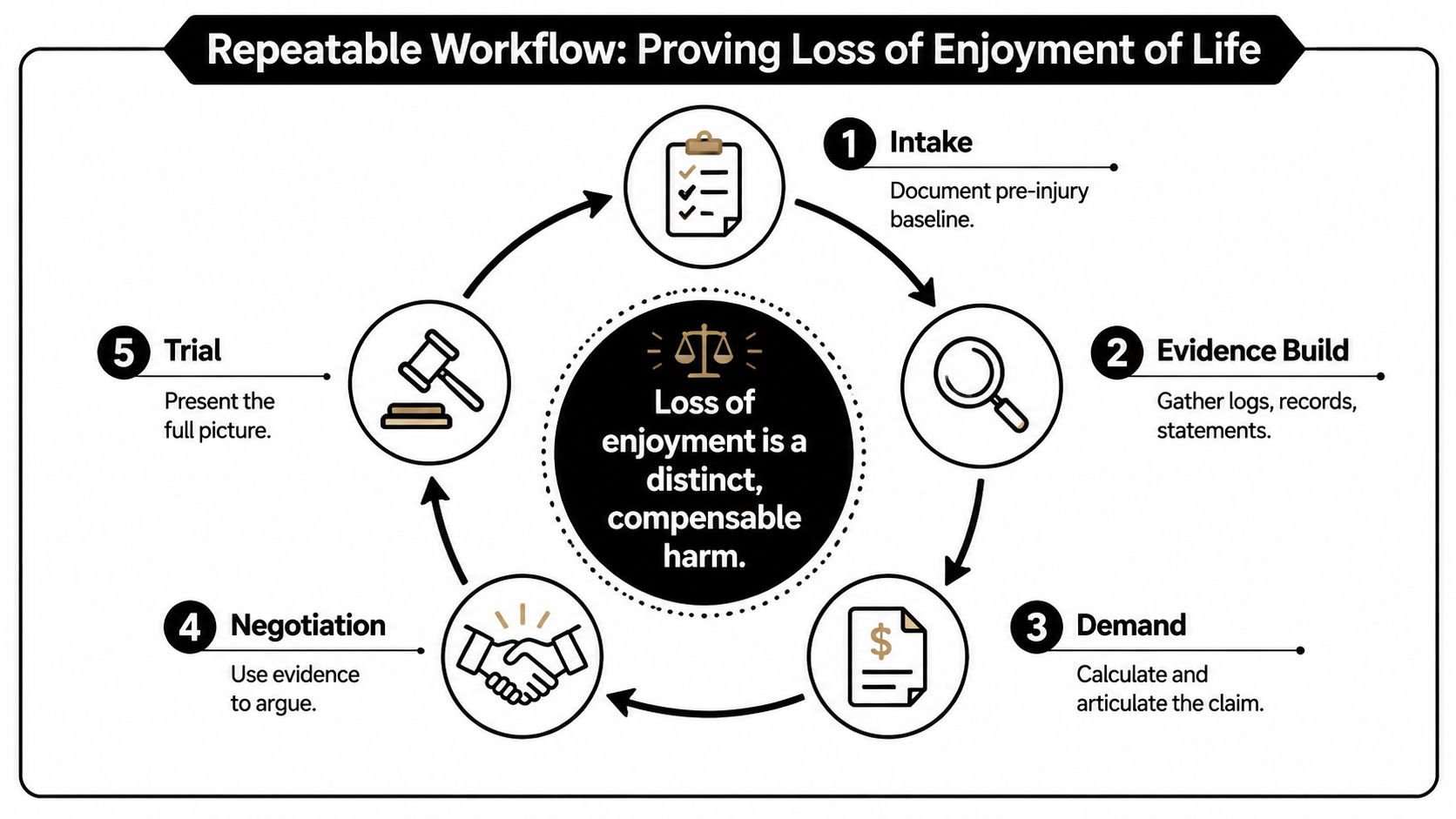
The principle that should control the file
The strongest claims are not built from emotional adjectives. They are built from specific, functional, identity-level losses. That is true whether the client was a marathon runner or a caregiver who took pride in cooking dinner every night and never missing a grandchild's game.
The verified life-satisfaction data supports the same practical lesson. Life satisfaction can decline in measurable, time-linked ways after major life shocks, and bereavement studies show that the drop can be large and long-lasting, with recovery taking years in some cases (older-adult longitudinal study, German panel study). For injury lawyers, that's the larger point, diminished enjoyment is not rhetorical, it's documentable.
A quick one-page mental model:
- Baseline: what life looked like before the injury.
- Loss: what routine, role, or activity disappeared.
- Proof: records, logs, witnesses, and treatment notes.
- Value: what that loss means to a jury.
- Delivery: demand, negotiation, and trial presentation.
If you keep that sequence intact, the claim stays separate from pain and suffering, and it stays believable even when the plaintiff's pre-injury life was modest.
Ares helps PI teams turn raw medical files into organized summaries and demand drafts, which is useful when you're trying to isolate functional losses and build a clean non-economic damages narrative. If you want a faster way to sort records, spot gaps, and draft around a loss-of-enjoyment theory, visit Ares and see how it fits into your next case file.