Medical record summaries are far more than just shortened versions of a client's chart. They're strategic documents, meticulously crafted to distill a mountain of complex medical jargon and data into a clear, compelling narrative for your personal injury case. This process turns thousands of pages of disorganized files into a powerful tool for building a winning argument, justifying damages, and ultimately, securing faster settlements.
The Strategic Power of Medical Record Summaries
Think about the last time you faced a case with thousands of pages of medical records from a dozen different providers. Illegible handwritten notes, buried lab results, a chaotic timeline of care—it's a familiar nightmare. Attorneys and paralegals can easily sink dozens of billable hours into just piecing the story together, time that should be spent on case strategy.
This administrative slog doesn't just slow things down; it actively weakens your position.
When crucial details get lost in the shuffle or the line connecting the incident to the injury becomes blurry, insurance adjusters gain the upper hand. A lowball offer that seemed like a mere annoyance suddenly becomes a real threat to a fair settlement. That's the expensive reality of handling medical records inefficiently.
From Administrative Burden to Strategic Weapon
A well-crafted medical record summary completely flips this dynamic. It changes the entire process from a tedious administrative chore into the creation of a powerful strategic weapon. It’s less of a "summary" and more of a "case intelligence briefing" that gives your firm a clear advantage.
This guide will show you how to stop just summarizing and start building documents that strengthen your claims from the very beginning. We'll walk through everything from the basic structure of a winning summary to advanced automation with tools like Ares. The goal is to give your firm the ability to:
- Save critical time: Stop wasting hours manually digging through disorganized files.
- Strengthen legal claims: Construct a clear, chronological story that undeniably proves causation and damages.
- Accelerate settlements: Present a cohesive, evidence-backed narrative that leaves insurance companies with little room to argue.
By transforming raw medical data into a focused narrative, you're not just organizing facts—you are building the foundation of your entire legal argument. Every detail, from treatment timelines to future care recommendations, becomes a tool for negotiation.
A methodical approach is what turns potential chaos into courtroom-ready clarity. You can dive deeper into this foundational process in our complete guide to medical record review services. This guide provides the blueprint for turning every summary into a strategic asset for your firm.
Your Case Intelligence Briefing: More Than Just a Summary
In the world of personal injury litigation, raw medical records are an avalanche. You're hit with a chaotic flood of data—often thousands of pages packed with dense medical jargon, disorganized scribbles from doctors, and endless duplicate entries. Just sifting through it all is a Herculean effort. This is precisely where a medical record summary stops being a simple document and becomes your central case intelligence briefing.
Think of it this way: sending a lawyer into a negotiation with a stack of raw medical files is like sending a general into battle with a pile of unsorted satellite photos. You wouldn't do that. You’d give them a concise, actionable intelligence report highlighting enemy weaknesses, key movements, and the strategic lay of the land.
That's exactly what a good medical record summary does. It takes the chaos and distills it into a clear, chronological narrative that focuses only on what's legally critical for your case.
From Raw Data to a Strategic Narrative
The real difference between a raw record and a summary is purpose. Raw records are an unfiltered, comprehensive account of a patient’s medical journey. A strategic summary, on the other hand, is built to tell one specific story: the story of your client's injury, their suffering, and the consequences that followed.
This story is built by zeroing in on three legal cornerstones:
- Causation: The summary draws a clear, unbroken line connecting the incident directly to the diagnosis, treatment, and ongoing pain.
- Damages: It meticulously documents every single medical expense, procedure, and therapy session, painting a vivid financial picture of the harm done.
- Prognosis: It shines a spotlight on expert opinions regarding future medical needs, potential long-term complications, and the impact on the client’s quality of life.
This targeted approach transforms a mountain of paper into a persuasive, powerful argument. In the high-stakes arena of personal injury, that kind of efficiency is everything. With global medical costs projected to jump by 10.3% in 2026, records are only getting more complex and expensive to handle. This growing pressure makes a smarter review process absolutely essential for a firm’s bottom line and, more importantly, for winning cases. You can find more on these global medical trends from the WTW survey.
A medical record summary isn't just about making the record shorter; it's about making it sharper. It’s the tool that turns a client’s medical history into a compelling narrative for proving liability and securing fair compensation.
Of course, a complete case intelligence briefing goes beyond just the medical files. You also need to understand the legal weight of other evidence, like the admissibility of digital evidence like text messages in court. Every piece of the puzzle must be curated and contextualized to build the strongest case possible.
Raw Medical Records vs. Strategic Summaries
The true value of a well-crafted summary becomes crystal clear when you put it side-by-side with the original records. For any busy legal professional, one is a roadblock, and the other is a direct path to understanding the heart of the case.
Here’s a look at how they stack up.
| Attribute | Raw Medical Records | Strategic Medical Record Summary |
|---|---|---|
| Organization | Disorganized and non-chronological, often sorted by provider. | Chronological and narrative-driven, telling a cohesive story. |
| Volume | Voluminous, often containing thousands of pages of unfiltered data. | Concise and focused, extracting only legally relevant information. |
| Language | Filled with complex medical jargon and technical abbreviations. | Written in clear, accessible language with jargon explained. |
| Legal Focus | Contains irrelevant details that can dilute the core argument. | Highlights causation, damages, and prognosis to support the claim. |
| Usability | Requires extensive time to analyze, increasing risk of missed details. | Delivers actionable insights quickly, enabling faster case strategy. |
Ultimately, one is a time-consuming chore that risks critical details being missed, while the other is a strategic asset designed to give you a competitive edge from day one.
The Anatomy of a Winning Summary
Think of crafting a powerful medical record summary less like filing paperwork and more like being a detective building a case. You can't just throw a jumble of facts at an insurance adjuster or opposing counsel and expect them to connect the dots. You need to build a logical, compelling story from the ground up, piece by piece.
Each component has a specific job, transforming a chaotic stack of medical records into a clear, persuasive narrative. A truly effective summary guides the reader—whether it's an adjuster, a mediator, or a jury—through your client's entire journey, from the moment of injury to their ongoing recovery. When every piece fits just right, you get an undeniable picture of causation and damages.
The goal isn't just to list what happened; it's to create a strategic tool that informs your entire case.
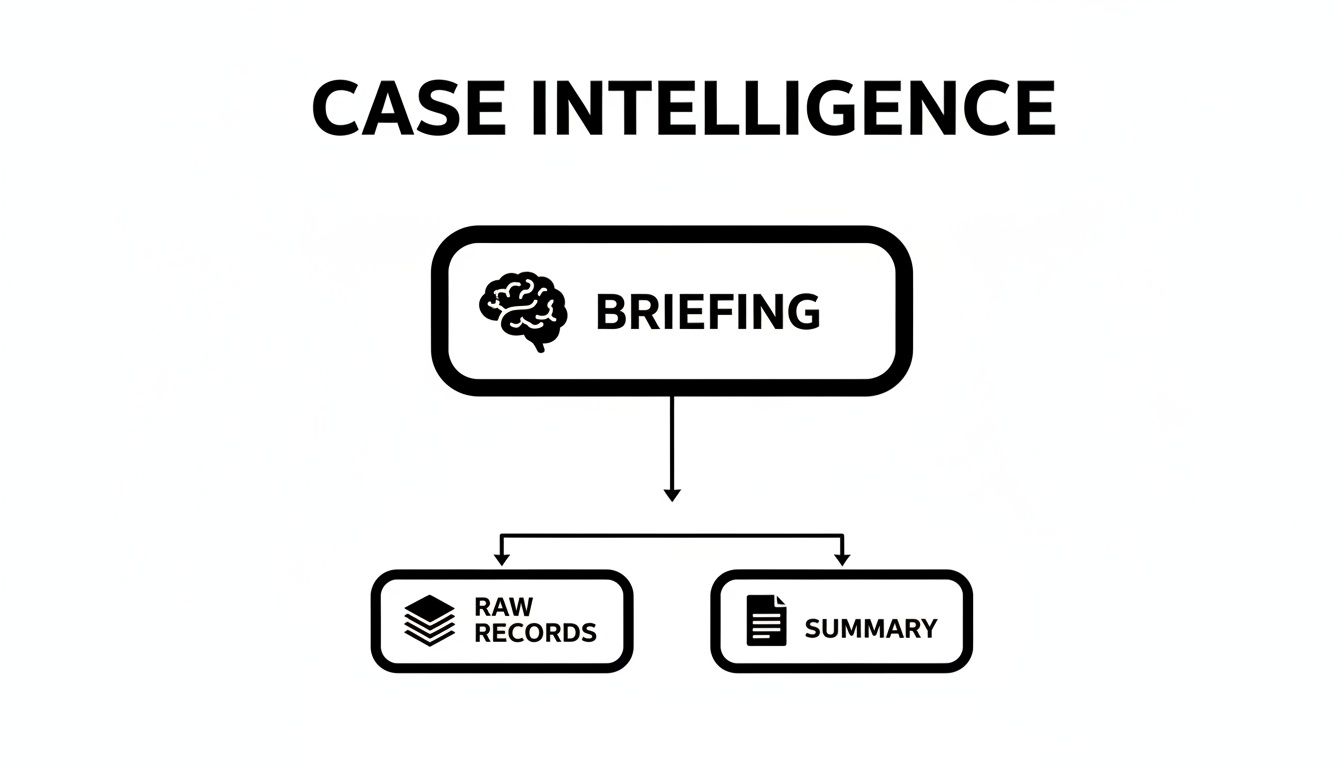
As you can see, a well-crafted summary isn't just a byproduct of the records. It's a refined piece of intelligence that directly shapes your briefing and overall strategy.
Foundational Case Details
Before you even get to the medical story, every summary needs to start with the "who, what, and where." These administrative details ground the entire document, providing immediate clarity for anyone picking up the file for the first time.
Case Caption and Patient Demographics: This is your anchor. It clearly identifies the plaintiff, defendant, and court information, along with your client's name, date of birth, and the date of the incident. Getting this right from the jump seems basic, but it prevents confusion and sets a professional, organized tone.
List of Providers and Facilities: Next, you need a complete roster of every single hospital, clinic, specialist, and therapy center the client has seen. This list acts as a quick-reference index, helping you track the flow of records and immediately spot any missing documents that could leave a hole in your timeline.
The Narrative Backbone of Your Summary
With the foundation laid, it's time to build the core story. This is where you draw the undeniable line connecting the incident to its long-term consequences, creating a powerful narrative of your client's experience.
The single most critical element here is a strong chronological flow.
"A case is only as strong as its evidence, and an unstructured summary can leave crucial gaps. Medical events should be organized chronologically, forming a cohesive, fact-based narrative that leaves no room for doubt."
This story is built on a few key pillars:
Chronological Timeline: This is the heart of your summary. It lays out every single medical event in the order it happened, from the initial ER visit to the most recent physical therapy session. This format makes it impossible to ignore the direct cause-and-effect relationship between the incident and the entire medical journey that followed.
Diagnosis and Injury Breakdown: Here, you isolate and define each diagnosis, linking it directly back to the incident. Instead of a messy list of medical codes, you present a clean, clear breakdown of injuries—like "Cervical Strain" or "Lumbar Disc Herniation"—and explain what they actually mean in plain English.
Comprehensive Treatment History: This section details every single treatment, procedure, and medication your client has undergone. You'll list surgeries, injections, therapies, and prescriptions, painting a vivid picture of the sheer scope of medical intervention required. This isn't just a list; it’s proof of the injury's severity and your client's diligence in trying to get better.
Quantifying Damages and Future Impact
Finally, you need to translate that medical story into dollars and cents. The last parts of your summary connect the narrative to quantifiable damages and future needs—the essential data for calculating a fair settlement.
Billing and Expenses: This is where you meticulously document every medical-related cost. A clean, itemized table of bills from each provider gives you a rock-solid financial basis for your economic damages claim.
Prognosis and Future Care: What does the future hold for your client? This section captures the long-term outlook, pulling in expert opinions on future medical needs, the potential for permanent impairments, and the projected costs of that ongoing care. This is absolutely crucial for justifying claims for future damages and showing the full, lifelong burden your client now carries.
Common Pitfalls and How to Avoid Them
Drafting a medical record summary is a high-stakes job. A single mistake can have major ripple effects, and a summary riddled with errors doesn't just look sloppy—it can actively sabotage your personal injury case. Think of it as leaving openings for opposing counsel to walk right through.
The best summaries are built defensively. They anticipate challenges and shut them down before they even start. This means being on high alert for common mistakes that can water down your argument, cloud the issue of causation, or twist the facts. By sidestepping these traps, you can build a summary that's a fortress of clarity, not a house of cards.
Pitfall One: Overloading with Irrelevant Information
One of the most common blunders is cramming the summary with every little detail from the medical records. The result is a bloated document full of noise—like a note about a minor cold the client had five years before the accident. This clutter makes it nearly impossible for an adjuster or opposing counsel to see the real story.
The Solution: Get surgical. Focus only on information directly tied to the personal injury claim. Every single entry should have a clear purpose: establishing the client's health before the incident, detailing the injury itself, or documenting the treatment that followed. If a piece of information doesn't strengthen the narrative of causation and damages, cut it.
A great medical record summary isn't defined by what it includes, but by what it strategically excludes. The goal is to build a clear, powerful narrative, not an exhaustive medical encyclopedia.
Pitfall Two: Failing to Establish a Clear Chronology
When you present medical events out of order, you muddy the waters. The critical line connecting the incident to the injury gets blurred, giving insurance companies the perfect opportunity to argue that something else caused your client’s pain. Without a clean, linear story, you’re basically handing them the ambiguity they need to fight your claim.
The Solution: Make the chronological timeline the unbreakable backbone of your summary. Every entry, from the first ER visit to the latest physical therapy appointment, must be organized by date. This step-by-step progression creates a cause-and-effect story that’s simple to follow and tough to argue against. A solid timeline is non-negotiable, and you can get a head start by reviewing a well-built medical chronology template.
Pitfall Three: Misinterpreting Medical Jargon
Medical records are packed with dense, specific terminology. A subtle misreading of a term or a botched translation of a doctor’s note can lead to huge inaccuracies about an injury's severity. For instance, confusing "radiculopathy" (nerve root pain) with general "back pain" dramatically understates the client's condition and hobbles your damages argument.
The Solution: Always verify and simplify the language. Define complex terms in plain English right there in the summary. If you’re ever unsure, bring in a medical expert or use trusted resources to confirm your understanding is spot on. This due diligence ensures your claims are grounded in medical fact, slamming the door on any attacks on your case's credibility. The summary should be clear enough for a jury, not just a doctor.
Automating Summaries with Modern AI
Even with the best manual processes, creating a medical record summary is a grind. Let's be honest: it’s time-consuming, expensive, and a prime spot for human error to creep in. A single complex case can spit out thousands of pages, chaining a paralegal or attorney to their desk for dozens of hours of painstaking review.
This isn't just an administrative headache. It's a bottleneck that slows down cases, limits how many clients your firm can take on, and pulls your best legal minds away from high-level strategy to play document wrangler.
This is where the right technology completely changes the equation. AI platforms like Ares were built to break these logjams, turning what was once a multi-day slog into a task that takes just minutes. The idea is simple but incredibly effective: instead of a human reading every single line, a sophisticated AI does the heavy lifting.
This shift introduces a level of speed and accuracy that manual review just can't touch. It frees up your team from the most tedious part of case prep, giving them back the time to focus on what really matters—strategy, client conversations, and negotiations.
How AI Transforms Record Summarization
The workflow itself is refreshingly straightforward. You securely upload the raw medical records—often just a jumbled mess of PDFs from different doctors and hospitals—straight into the platform. From there, the AI kicks in, scanning, analyzing, and organizing all that data at incredible speed.
The system's AI is trained to spot and pull out the most legally critical information, things like:
- Key dates of service and treatments
- Specific diagnoses and medical codes
- Prescribed medications and therapies
- Names of providers and medical facilities
Once it has all the key facts, the AI arranges everything into a clean, structured summary, complete with a chronological timeline. In essence, it turns a mountain of disorganized paper into a clear, actionable roadmap for your case. It happens in a fraction of the time it would take to do manually.

This intelligent analysis gives you a massive head start. Instead of digging for details, you can jump straight into building your case narrative. You can dive deeper into how this technology is reshaping legal work in our guide on the AI medical record review process.
By automating data extraction, firms can save 10+ hours of review time per case. That's time you can pour directly back into handling more cases, pushing for faster settlements, and focusing on winning legal strategy.
Ensuring Security and HIPAA Compliance
Of course, whenever you bring a new tool into your legal workflow—especially one handling Protected Health Information (PHI)—security and compliance have to be top of mind. The last thing any firm wants is a data breach or a HIPAA violation. It’s a non-negotiable.
Reputable AI platforms like Ares are designed from the ground up with this in mind. Security isn't just a feature; it's baked into the very foundation of the system. It's critical to look for solutions with robust privacy features, similar to those found in HIPAA-compliant AI automation in medical clinics.
Here are the key security pillars to look for:
- Enterprise-Grade Encryption: Your data should be encrypted both in transit (as it's being uploaded) and at rest (while stored on the servers). This makes it unreadable to anyone without authorization.
- Strict Access Controls: You need the ability to manage permissions, ensuring only the right people on your team can access sensitive case files.
- HIPAA Compliance: The platform must follow all the technical, physical, and administrative safeguards mandated by the Health Insurance Portability and Accountability Act.
This deep commitment to security means your firm can adopt powerful, efficient AI tools without compromising its ethical and legal duty to protect client data. It's how you get the best of both worlds: game-changing efficiency and institutional-level trust.
Building Stronger Cases with Smarter Summaries
Throughout this guide, we've aimed to shift your perspective on the medical record summary. It’s not just a tedious administrative chore; it's the strategic core of your entire personal injury case. This document is the narrative engine that transforms thousands of pages of raw medical data into a clear, persuasive argument for your client.
Think of the summary as an intelligence briefing. Its sole purpose is to spotlight causation, quantify damages, and clarify prognosis with razor-sharp precision. Real power comes from a solid structure—starting with the basic case details and building into a meticulously organized chronological timeline. Getting these components right is the first step toward building an undeniable claim.
From Manual Effort to Strategic Advantage
Of course, knowing what to do is only half the battle. Knowing what not to do is just as critical. A summary bogged down by irrelevant details or one that misinterprets complex medical terminology can seriously weaken your position, creating openings for opposing counsel to exploit.
By sticking to legally relevant facts and maintaining a strict chronological flow, you construct a case narrative that’s not just compelling, but also defensible under the toughest scrutiny.
But in today’s world, even the best manual practices have their limits. The traditional review process is a massive bottleneck, eating up hours that your team should be spending on high-level legal strategy. This is where technology offers a real, tangible advantage.
Embracing automation is no longer just about being more efficient. It's about elevating your firm's strategic capabilities. When you offload the low-value work of document review to AI, you free up your legal team to focus on what they do best—winning cases.
AI-powered tools like Ares are built specifically to remove this friction. They automate the heavy lifting of extracting and organizing critical data, producing a structured, actionable summary in a fraction of the time. This lets your team skip the administrative grind and get straight to building a winning strategy.
Take a hard look at your current workflow. Are you still sinking valuable hours into manual document review? By integrating intelligent automation, your firm can reclaim that time, build stronger claims, and gain the competitive edge needed to secure better outcomes for every single client.
Frequently Asked Questions
Even with a solid process, a few key questions always pop up when you're in the trenches creating and using medical record summaries. Let's tackle some of the most common ones we hear from legal professionals. Getting these details right can make a world of difference in your workflow and, ultimately, your case.
Think of this as a quick chat to clear up those nagging little uncertainties that can slow you down.
How Long Should a Medical Record Summary Be?
This is the classic "it depends" answer, but for a good reason. There's no magic page count; the length of the summary is dictated entirely by the complexity of the case. The real goal is to provide a complete and clear picture, not to hit an arbitrary number.
A straightforward whiplash claim with a handful of doctor's visits might only need a 3 to 5 page summary. That’s often plenty of space to lay out the timeline, diagnosis, and treatment plan without getting bogged down in fluff.
On the other hand, a complex case with multiple surgeries, long-term chronic pain, and a revolving door of specialists could easily demand a summary over 20 pages long. In these situations, every detail is a critical piece of a much larger puzzle. Cutting it short would mean leaving out the very evidence you need to justify a significant settlement.
How Should I Handle Missing Medical Records?
Finding a gap in your client's medical history can feel like hitting a brick wall, but it's a common hurdle. The trick is to get out in front of it before the other side can turn it into a weapon against you. If you leave a gap unexplained, opposing counsel will have a field day suggesting you're hiding something.
First, map out a clear timeline of every known treatment. This simple visual will instantly throw any missing periods into sharp relief.
Once you’ve pinpointed the gaps, here’s your game plan:
- Send Formal Requests: Immediately fire off formal record requests to every provider who might have treated your client during that time. Keep a meticulous record of every single attempt.
- Follow Up Persistently: Don't just send it and forget it. A friendly but firm follow-up call or a second letter can work wonders in getting your request to the top of the pile.
- Get an Affidavit: If a provider tells you the records are lost or have been destroyed, ask them for a signed affidavit. This sworn statement explains why the records are gone and serves as official proof that you did your due diligence.
This proactive approach shows you have nothing to hide and protects the integrity of your case.
Is AI Summary Software HIPAA Compliant?
Yes, but you have to choose wisely. For any personal injury firm, protecting a client’s Protected Health Information (PHI) is non-negotiable—it’s a legal and ethical bright line. So, any technology you bring into your practice must meet those exacting security standards.
Reputable, industry-specific platforms like Ares are built from the ground up with HIPAA compliance at their core. They understand the stakes and engineer their systems to provide institutional-level security for your most sensitive data.
When you're vetting an AI tool for medical records, HIPAA compliance isn't a feature; it's the foundation. Look for vendors who can point to enterprise-grade encryption, secure cloud infrastructure, and rigid data protocols that ensure PHI is handled exactly as federal law requires.
Always ask to see a vendor’s security credentials and compliance paperwork before you upload a single page. A trustworthy partner will be completely transparent about their security measures, from how they encrypt data (both in transit and at rest) to who can access it. This is the only way to get the speed and power of AI without risking a catastrophic data breach or compliance nightmare.
Ready to eliminate the administrative grind of manual review? With Ares, your firm can transform thousands of pages of raw medical records into clear, structured, and case-ready insights in just minutes. Save over 10 hours per case, build stronger arguments, and settle faster. Discover how our secure, HIPAA-compliant AI platform can give your team a strategic advantage by visiting https://areslegal.ai.