
Approximately 97% of tort-case dispositions ended without a trial, through settlement, dismissal, judgment without trial, or another non-trial resolution, according to the U.S. Bureau of Justice Statistics' Civil Justice Survey of State Courts, summarized by Settlement Insight. That doesn't mean every claim settled. It means the evidence usually has to do its work before a jury ever sees it.
An insurance company settlement offer is a valuation model, not a verdict on what an injury deserves. To challenge the number effectively, identify what the insurer assumed about fault, treatment, future losses, and proof, then test those assumptions against the file.
Why Most Insurance Claims Settle Before Trial
Settlement allows both sides to exchange an uncertain outcome for a defined result. A claimant avoids the expense, delay, and risk of litigation. An insurer closes an exposure it would otherwise have to investigate, defend, and potentially pay after judgment.
Neither side needs to agree completely about the incident or the injury. They need enough overlap between their acceptable outcomes to reach an agreement.
The practical distinction between settlement and trial is where the evidence must persuade.

Each side prices a different risk
Think of settlement as a sealed-bid negotiation, although the parties eventually exchange offers. Each side privately estimates what a judge or jury might do, how much proving the case will cost, and which weaknesses could change the result.
The claimant may see a straightforward collision followed by persistent pain. The adjuster may see disputed causation, incomplete treatment records, and uncertainty about whether the claimant can prove future impairment. Those are different models of the same claim.
A demand that repeats the claimant's experience won't necessarily close that gap. It must address the reasons the insurer discounts the case.
Practical rule: Don't save your strongest evidence for trial when you need it to obtain a defensible settlement offer.
The evidence must change the estimate
The inputs that matter are concrete:
- Liability proof: Scene photographs, witness accounts, incident reports, and evidence addressing competing explanations.
- Documented damages: Medical findings, treatment progression, income records, and supported future needs.
- A credible path to trial: Preserved evidence, available witnesses, and a litigation strategy counsel can execute.
Published awards from other cases can provide context, but they aren't a price list. Different injuries, legal rules, defendants, and evidentiary problems make direct comparisons unreliable.
The useful question isn't whether another claimant received more. It's which assumption keeps this insurer's estimate below the supported value of this claim.
How Insurers Build a Settlement Offer
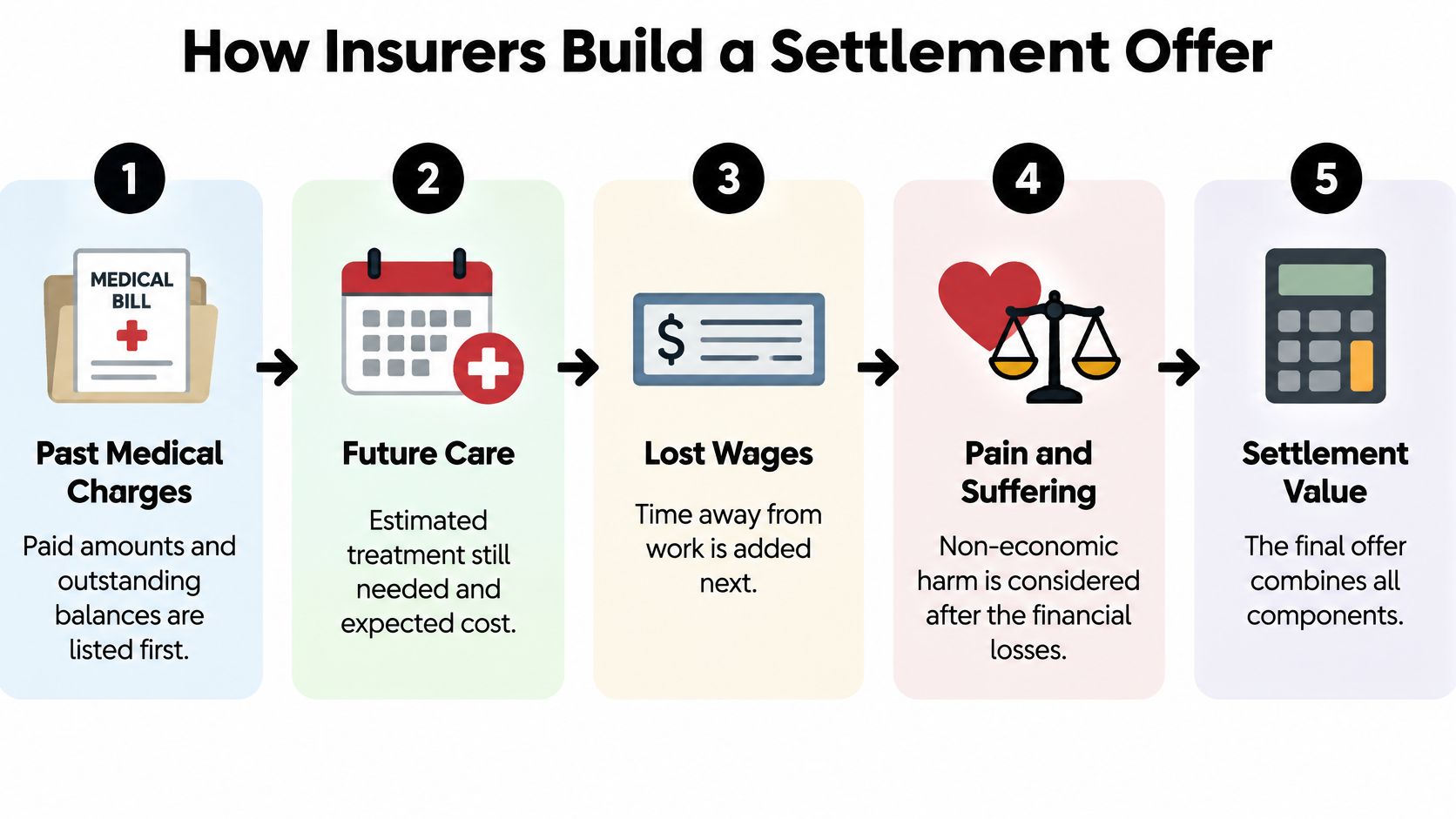
An offer combines assumptions about recoverable damages and the likelihood of proving them. A U.S. Department of Justice-sponsored study of litigated automobile-insurance claims found bargaining behavior consistent with divergent expectations, rather than a shared valuation.
That distinction matters. The adjuster may accept that treatment occurred while disputing whether the incident caused it, whether the charges are recoverable, or whether future care is sufficiently supported.
The graphic shows a simplified sequence, not a universal calculation formula.
Separate damages from adjustments
Start with past treatment. List charges, paid amounts, adjustments, and outstanding balances separately, rather than treating the face value of every bill as automatically recoverable. Applicable law determines how those amounts affect damages.
Next, document future care through the prognosis and treatment recommendations. Add supported wage loss and distinguish it from reduced future earning capacity. Non-economic damages require their own explanation, including activity restrictions, symptom persistence, and loss of enjoyment. There's no universal pain-and-suffering multiplier.
Components of a settlement offer
| Component | What It Covers | How It Moves the Offer | Proof the Insurer Looks For |
|---|---|---|---|
| Past medical bills | Treatment already received | Establishes a documented economic starting point, subject to recoverability | Itemized bills, paid amounts, outstanding balances |
| Future medical care | Anticipated treatment and prognosis | Adds supported future costs | Treating physician narrative and care plan |
| Lost wages | Income lost to date | Adds proven income loss | Pay stubs, employer letter, work restrictions |
| Loss of earning capacity | Reduced ability to earn over time | Can materially increase future economic damages | Functional limitations and vocational assessment |
| Non-economic damages | Pain, suffering, loss of enjoyment | Adds value for supported personal harm | Treatment history and daily-life impact |
| Liability discount | Fault attributed to the claimant | May reduce recovery under applicable fault rules | Police report, witnesses, scene evidence |
| Liens and reimbursement claims | Obligations payable from recovery | Reduces the client's net proceeds | Lien notices and plan documents |
| Policy limits | Available insurance coverage | Constrains payment under the applicable policy | Declarations, policy terms, other coverage |
Test the assumptions individually
Illustrative scenario: An adjuster accepts the past treatment but excludes recommended future care because the recommendation lacks a cost estimate. Counsel obtains a supported estimate and asks the adjuster to revise that component, rather than increasing the demand.
Fault requires separate analysis. An insurer's assigned share isn't automatically the legally correct reduction, and some jurisdictions apply rules more restrictive than proportional fault allocation.
Similarly, a policy limit constrains the carrier's contractual payment, not necessarily the defendant's total exposure. Check how insurance limits affect a claim and investigate other applicable coverage before treating the disclosed policy as the complete recovery picture.
This companion video provides another format for reviewing the settlement process.
Our personal injury work produces causation narratives, special damages, and liability arguments, with every claim substantiated and cited. The purpose is verification: counsel should be able to connect each requested component to evidence, not just a persuasive description.
Settlement Timelines by Resolution Path
In Ireland, injury claims settled in 2025 averaged 1.7 years through direct settlement, 2.6 years through the Injuries Resolution Board, and 4.7 years through litigation; the corresponding mid-year averages were 1.8, 2.5, and 4.7 years, according to the Central Bank of Ireland's National Claims Information Database report.
Those are Irish averages, not deadlines or U.S. benchmarks. More severe or contested claims may enter formal proceedings, so the difference reflects both the process and the kinds of cases using it.
Use the pathway to plan the work
Average injury claim duration by resolution path
| Resolution Path | Average Duration (2025) | When It Applies | What Adds Time |
|---|---|---|---|
| Direct settlement with insurer (Ireland) | 1.7 years; mid-year 1.8 years | Parties resolve the claim directly | Records requests and incomplete treatment |
| Injuries Resolution Board (Ireland) | 2.6 years; mid-year 2.5 years | Claim proceeds through the formal assessment process | Procedural steps and valuation disputes |
| Litigation (Ireland) | 4.7 years; mid-year 4.7 years | Proceedings follow an unresolved claim | Discovery, motions, trial scheduling |
| Direct settlement with insurer (U.S.) | Not established here; verify locally | Parties negotiate without suit | Records requests and incomplete treatment |
| Litigation (U.S.) | Not established here; verify state and court data | Suit is filed | Discovery, motions, trial scheduling |
A typical file moves through treatment, stabilization, demand preparation, insurer review, negotiation, and resolution. Those phases overlap: counsel can preserve liability evidence while treatment continues and obtain employment records before preparing the demand.
The important distinction is between productive waiting and inactivity. Waiting for a medically necessary assessment can improve valuation. Waiting because nobody followed up on a missing provider's records doesn't.
Don't confuse claim age with readiness
A rejected, well-supported demand and a persistent valuation gap suggest a different path from a file awaiting essential evidence. The filing criteria belong in the litigation decision, not in a generic promise that every claim should settle quickly.
For U.S. planning, build a personal injury settlement timeline around the relevant jurisdiction, treatment course, and actual court schedule. Track the date each requested item was delivered and the carrier's explanation for what remains unresolved.
Use the matching table row to allocate work and discuss expectations with the client. Don't describe an average duration as the time remaining after a demand or filing decision.
Common Insurer Tactics and How to Respond
Claims handling accounted for 65.2% of insurance complaints in 2024, while delays accounted for 22.2% and unsatisfactory offers or settlements for 12.2%, according to an analysis of NAIC closed-complaint data published by Claims Journal. These figures describe complaint patterns across insurance, not proof of misconduct in a particular injury claim.
A records request can be legitimate. So can an offer below the demand. The practical question is whether the insurer identifies a reasonable evidentiary problem and updates its evaluation when that problem is addressed.
Common insurer moves and the response that protects value
| Insurer Move | What It Usually Signals | Response That Protects Value |
|---|---|---|
| Early quick offer before treatment ends | Prognosis may not be reflected | Obtain a written prognosis before valuing the release |
| Repeated records requests | An incomplete file, processing problem, or possible delay | Log requests, delivery confirmations, and remaining items |
| Broad medical authorization | Request for history beyond the immediate treatment | Review relevance and scope with counsel; propose a tailored authorization |
| Recorded statement request | Investigation of fault, symptoms, or prior injuries | Clarify obligations and obtain counsel review before responding |
| Reserve-based low valuation | Possible incomplete exposure estimate, not a proven motive | Quantify future care, earnings effects, and impairment |
| Lowball on liens or specials | Disagreement over expenses or reimbursement assumptions | Verify itemized charges and actual reimbursement obligations |
Reserves aren't a settlement entitlement
Insurers distinguish known unpaid claims from losses that have occurred but haven't yet been reported, as illustrated by the Central Bank of Kosovo's technical-provisions framework. That accounting distinction doesn't establish what any particular claimant should receive or reveal a carrier's internal reserve.
An early estimate may omit future exposure because the carrier doesn't have the supporting information. You generally can't infer an internal reserve merely from a low offer.
Say an insurer offers payment shortly after a crash, before the specialist sets a treatment plan. The immediate task is to identify what the offer excludes and what the proposed release would surrender, not to assume either fairness or bad faith.
A low number is a reason to request the calculation. It isn't, by itself, an explanation of how the insurer reached it.
Document pressure deadlines, unexplained requests for unrelated history, and offers without a component-level explanation. Respond calmly, preserve the correspondence, and distinguish contractual cooperation duties from requests counsel can appropriately narrow.
Legal Strategies That Raise Settlement Value
A shorter demand deadline doesn't necessarily increase bargaining power. In a 2025 Ninth Circuit decision, the court found no bad faith where an insurer repeatedly sought corroborating medical documentation, including ten requests before the deadline, according to Sheppard's analysis of the decision.
That's a fact-specific outcome, not a nationwide safe harbor for insurers. It does illustrate the weakness of demanding an immediate decision while withholding information needed to evaluate the injury.
Leverage comes from removing defensible objections, not merely shortening the response window.
Strengthen the evidence before escalating
Record completeness starts with a provider inventory, not a large attachment count. Compare referral notes against the records received, confirm that imaging reports accompany references to imaging, and flag treatment periods that remain undocumented.
Treating-provider explanations should address the actual causation dispute. Ask the clinician to explain the relationship between the incident, findings, prior conditions, and current limitations. Don't substitute an attorney's medical conclusion for a supported clinical opinion.
Liability evidence deserves the same discipline. Identify what a witness observed, distinguish an officer's narrative from independent findings, and preserve photographs or recordings before they become unavailable. An unsupported allegation of claimant fault should receive an evidence-based response.
File for a reason, not because negotiations feel stale
Use a documented decision checklist:
- Treatment status: Treatment is complete or the prognosis is stable enough to evaluate future needs.
- Verified chronology: The material treatment sequence and outstanding gaps are understood.
- Quantified obligations: Medical specials and liens have been reconciled.
- Insurer conduct: Nonresponse or repeated failure to address a complete submission is documented.
- Valuation disagreement: The remaining difference is material and identifiable.
These are decision inputs, not prerequisites that justify missing a filing deadline. Counsel must protect limitation periods and preservation obligations even when the medical picture remains incomplete. Bad-faith standards and time-limited-demand rules require jurisdiction-specific review.
Keep marketing claims separate from this legal analysis. For practice managers reviewing how a firm presents its services online, AISEOGrow's resource to compare SEO specialists for law firms supports that separate vendor-selection task; it doesn't establish claim value.
The strongest escalation record makes the insurer's remaining objections visible, specific, and answerable.
How to Build a Demand Package Insurers Cannot Dismiss
No package guarantees acceptance. The practical objective is a submission the adjuster can evaluate without reconstructing the case or repeatedly asking where a proposition came from.
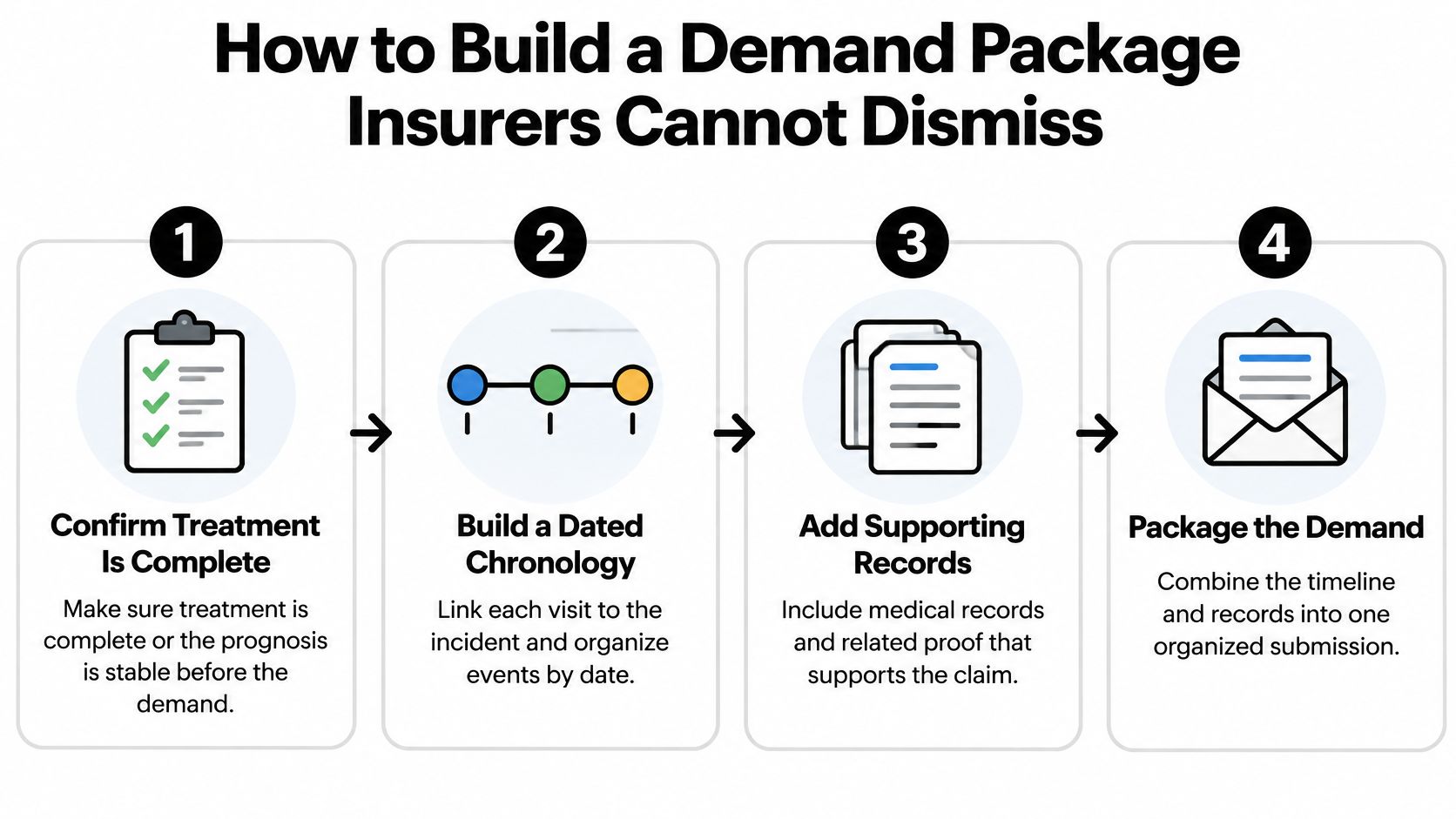
Build the package around traceability, with a readable narrative supported by an indexed record.
Assemble the evidence in a usable sequence
Confirm treatment status and prognosis. A written clinical assessment establishes what can reasonably be valued now and what remains uncertain. The common mistake is treating the last available visit as proof that treatment has ended.
Build a dated chronology. Link the incident, symptom onset, examinations, referrals, testing, and treatment progression, with a record reference for each material event. Don't omit inconvenient gaps; identify them and obtain an explanation when one is available.
Reconcile bills with diagnoses. Match charges to treatment dates and providers, then separate billed, paid, adjusted, and outstanding amounts. A stack of bills without corresponding clinical records invites disputes over what the treatment addressed.
Support work losses and restrictions. Combine payroll or business records with medically supported restrictions and a clear absence history. An employer's statement that someone missed work doesn't, by itself, establish why the injury required that absence.
Make the requested payment auditable
Obtain supported causation statements. Ask treating clinicians to address the connection between the incident and each disputed injury, including relevant prior conditions. Avoid blanket assertions that every later complaint resulted from the event.
Quantify reimbursement obligations. Identify the claimant, legal or contractual basis, asserted balance, and verification status for each lien or reimbursement demand. Don't calculate expected take-home proceeds using an unconfirmed balance.
State the demand transparently. Separate economic components, explain non-economic harm, and identify assumptions supporting future losses. Set a response window appropriate to the submission and governing law rather than copying an unrelated deadline.
Cite each material proposition. Use consistent filenames, provider labels, dates, and page references so the adjuster can verify the statement quickly. Narrative language that sounds authoritative but lacks a supporting record creates another review problem.
A practical guide to writing a personal injury demand letter can help organize the final presentation, but the underlying evidence still controls its reliability. Check that attachments open, page references match, and the carrier receives the complete submission.
At Ares, our Demand Letters are built from the customer's medical evidence and case records, including causation narratives, special damages, and liability arguments cited to source. We also produce settlement demands and hearing briefs with treatment narratives, medical specials, and impairment documentation; counsel should verify the draft against the file before sending it.
On the adjuster's desk, the finished submission should be straightforward: a demand, a dated chronology, a provider-by-provider record index, and a damages summary that reconciles with its attachments.
Confirm the Claim File Before You Negotiate
Complete a file audit this week before authorizing another negotiating position. The point is to know whether the disagreement concerns evidence, legal recoverability, or price.
- Confirm the medical position: Obtain treatment status and prognosis in writing.
- Verify coverage: Check policy limits, terms, and potentially applicable additional coverage.
- List reimbursement claims: Record each asserted lien and its verified or disputed balance.
- Calculate the client's net: Account for fees, costs, and reimbursement obligations.
- Resolve file gaps: Identify missing records and unexplained treatment intervals.
Choose a position the evidence supports
Accept when the risk-adjusted offer reasonably addresses recoverable economic and non-economic losses and the client understands the release and net proceeds. Complete reimbursement of every asserted expense isn't always achievable, and a settlement below the demand isn't necessarily unreasonable.
Counter when a specific evidentiary correction or clearly defined valuation disagreement supports a different number. Send the relevant proof and explain the requested adjustment instead of repeating the original demand unchanged.
File when the documented litigation criteria justify escalation, or when necessary to protect the claim. Don't postpone a required filing while waiting for negotiations to improve.
This is a decision framework, not a payout formula. State law, coverage, evidence, litigation risk, and the client's informed instructions control the result.
Finish the checklist, obtain authority for the next action, and send the supported counter or file promptly once the decision is documented. Calendar every carrier response deadline alongside the claim's independent legal deadlines.
Ares covers the document-heavy work of a personal injury case from intake to settlement, including medical record review and source-cited demand drafting. Visit Ares to explore how organized treatment histories, medical specials, and evidence-linked narratives can support your next settlement submission.