
You're reviewing a claim after a rear-end collision. The other driver's insurer has offered a quick settlement, and the number sounds substantial until you compare it with the medical treatment, lost income, and long-term impairment the claimant may face. The adjuster keeps referring to “the policy limits,” as though that phrase answers the question of what the injury is worth.
It doesn't. A limit in insurance determines how much coverage may be available, but it doesn't determine the value of the injury. The difference matters because coverage structure can change demand timing, settlement negotiation, and whether an unpaid balance ultimately falls on the injured person or the insured who caused the loss.
What a Limit in Insurance Actually Controls
A claimant has a herniated disc. An orthopedist recommends surgery. The liability carrier offers $25,000 within days. That offer may be the full bodily injury limit, or it may be an early attempt to resolve a claim before the insurer understands the medical picture. You can't evaluate it from the offer letter alone.
The policy limit is the insurer's contractual ceiling for a covered claim. It isn't a valuation of the claimant's pain, disability, medical care, or future losses. It also isn't a promise that the claimant will receive the full amount. Coverage, liability, damages, competing claims, and compliance with policy conditions still matter.
A useful explanation of the broader third-party claim process appears in this guide to what a third-party liability claim involves. The practical point is simple: before negotiating the injury, identify the money that can legally be recovered.
Separate the ceiling from other policy terms
Several terms get treated as though they mean the same thing, but they don't:
- Policy limit: The maximum amount the insurer pays for a covered category of loss.
- Deductible: The amount the insured absorbs before the insurer pays, subject to the policy wording.
- Sublimit: A lower cap that applies to a particular type of coverage or loss.
- Exclusion: A provision removing a risk from coverage altogether.
- Aggregate: The total available for covered claims during the policy period.
Suppose the claimant's medical bills are already substantial and surgery remains possible. A low liability limit creates a structural mismatch. The injury may justify a much larger recovery, but the primary carrier's payment obligation may still stop at the contractual cap. The file then turns toward uninsured assets, excess policies, additional defendants, and first-party coverage.
Practical rule: Never describe a claim as “a limits case” until you've confirmed which limit applies, whether it has been reduced by prior payments, and whether another policy can respond.
Historical liability markets show why this issue has always shaped litigation. Around 1910, standard U.S. liability limits were commonly $5,000 per person and $10,000 per accident, while employers' liability policies in the 1880s often used limits such as $1,500 per injured worker and $5,000 for all people injured in one accident. IRMI's history of early liability coverage also describes the later expansion of umbrella and excess limits from much smaller historical bases.
When damages exceed coverage, the unpaid balance becomes excess judgment exposure for the insured. That can affect demand timing, collection analysis, and the pressure placed on the insurer to evaluate a reasonable policy-limits resolution, as discussed in the Fordham Law Review analysis of excess judgments and insurer obligations.
The Four Limit Structures Every Policy Uses
The same collision can produce very different recoveries depending on how the declarations page organizes the coverage. A large number alone doesn't tell you how the carrier can allocate it.
Per-person and per-occurrence limits
A split limit such as 100/300 usually means $100,000 per person and $300,000 per occurrence. If Passenger 1 has the strongest injury, that claimant can't receive more than the per-person cap from that liability coverage. Two passengers may share the per-occurrence pool, but their combined recovery can't exceed the accident-wide ceiling.
The per-occurrence limit applies to one event. It matters when several people claim injuries from the same collision, premises incident, or commercial accident. Prior payments and competing claims can reduce what remains available.
Aggregate and combined single limits
An aggregate limit applies across covered claims during the policy period. A commercial policy may have a per-occurrence limit for one incident and a separate aggregate that restricts the insurer's total payments across multiple claims. A business can therefore have room under the individual-incident limit but little remaining capacity under the annual aggregate.
A combined single limit, or CSL, uses one pool for bodily injury and sometimes property damage, depending on the policy. Under a $300,000 CSL, the insurer can allocate the available money among claimants according to the claims' value and settlement posture, rather than applying separate per-person and per-accident bodily injury caps.
For commercial policyholders, an endorsement can change how an aggregate applies to a project. Lawyers and risk managers may find this discussion of a per-project aggregate endorsement from PIA Southern Alliance useful when checking whether coverage replenishes or remains shared across work.
| Limit Structure | Coverage Pool | Passenger 1 Recovery | Passenger 2 Recovery |
|---|---|---|---|
| $100,000/$300,000 split limit | $100,000 per person, $300,000 per accident | Up to $100,000 | Shares the remaining accident pool, subject to the per-person cap |
| $300,000 per occurrence | $300,000 for the incident | Draws from the shared $300,000 | Draws from the same shared $300,000 |
| $300,000 aggregate | Total policy-period pool, subject to the occurrence wording | Depends on remaining aggregate and occurrence limit | Depends on remaining aggregate and occurrence limit |
| $300,000 CSL | One $300,000 pool for the covered event | Allocated from the shared pool | Allocated from the shared pool |
The table illustrates why limit structure can matter as much as limit size. A single claimant may fare differently under a split limit and a CSL even when the headline coverage appears similar. Always read the declarations together with the definitions, conditions, endorsements, and prior-claim history.
How Liability UM and UIM Limits Interact
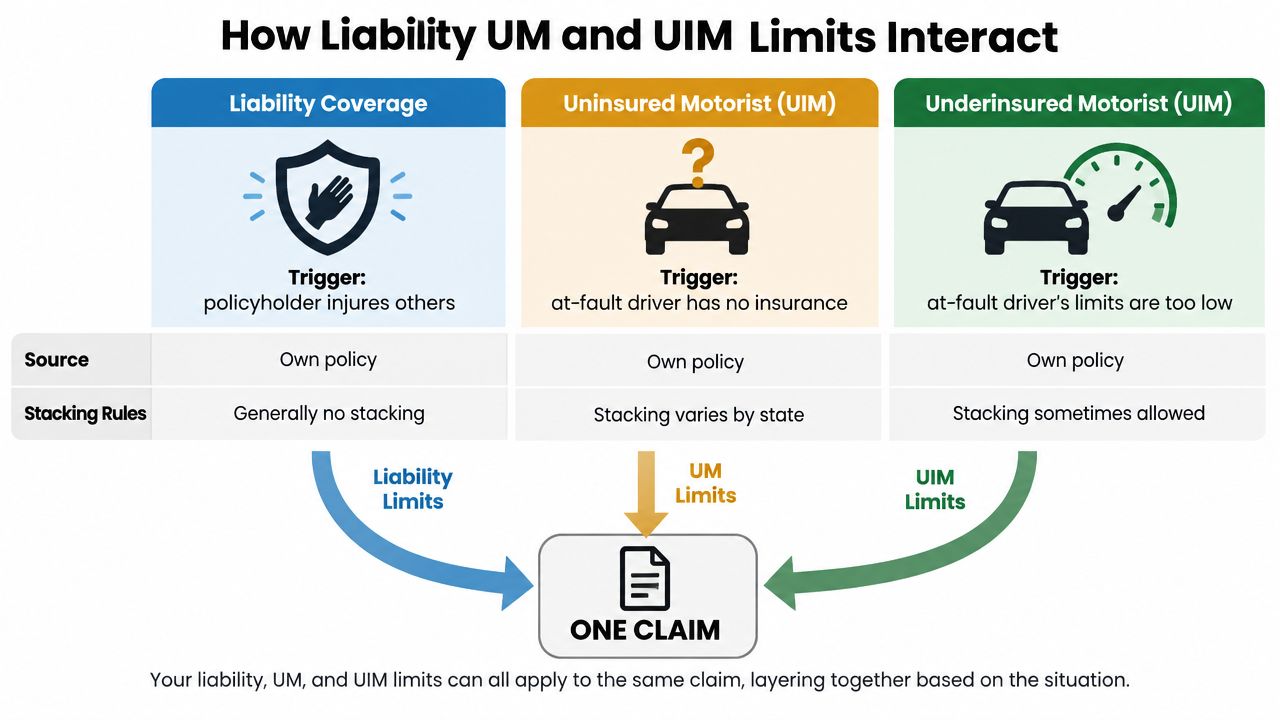
Liability coverage and first-party motorist coverage answer different questions. Liability coverage responds when the insured driver caused harm to someone else. Uninsured motorist coverage, or UM, may respond when the at-fault driver has no applicable insurance or cannot be identified. Underinsured motorist coverage, or UIM, addresses the gap when the at-fault driver has coverage, but that coverage is inadequate for the claimant's damages.
Consider a struck-from-behind collision. The at-fault carrier tenders $50,000, the injured person has $250,000 in UIM coverage, and total damages are $180,000. If the UIM policy applies an offset for the tortfeasor's available liability payment, the UIM carrier may pay the $130,000 difference after the $50,000 liability payment.
Compare the trigger before discussing the amount
| Coverage | Trigger | Typical source | Main issue |
|---|---|---|---|
| Liability | The policyholder injures another person | At-fault driver's policy | Available limit and competing claims |
| UM | The at-fault driver has no applicable insurance or leaves an unidentified vehicle | Injured person's policy | Eligibility, proof of the event, and stacking rules |
| UIM | The at-fault driver's limits are lower than the claimant's damages | Injured person's policy | Offset, consent, exhaustion, and available limit |
The mechanics vary by jurisdiction and policy language. Stacking may be allowed, restricted, or prohibited. Setoffs can reduce the amount payable, and a claimant may need the carrier's consent before accepting the tortfeasor's settlement. For readers comparing regional auto requirements and policy options, this resource to compare California auto coverage provides useful context, but the controlling answer remains the actual policy and applicable state law.
North Carolina illustrates why current rules deserve attention. For policies newly issued or renewed under the state's 2025 rule change, underinsured motorist coverage is included, and claim value is measured against total damages rather than only the liability limits. The North Carolina Department of Insurance explanation also addresses changes involving setoffs and stacking.
Stacking Policies to Multiply Available Coverage
Stacking asks whether a claimant can combine motorist limits from more than one vehicle or policy for the same injury. The answer can materially change the recovery pool, but it depends on state law, declarations, endorsements, household status, and anti-stacking language.
Intrapolicy stacking concerns multiple vehicles insured under one policy. Interpolicy stacking concerns separate policies, often involving household members or different insurers. Some policies define coverage broadly, while others restrict recovery to the vehicle listed for the accident or expressly prohibit combining limits.
Take a household with two vehicles, each carrying $100,000 in UM coverage. If stacking is permitted and the claimant qualifies under both vehicles' coverage, the available UM pool may reach $200,000. If the jurisdiction or policy bars stacking, the claimant may be limited to $100,000. In another case, a resident-relative exclusion or a narrow “covered auto” definition may eliminate the additional coverage altogether.
Check the documents in the right order
Start with the declarations pages. Identify every vehicle, named insured, resident relative, and UM or UIM selection. Then obtain the full policy, including endorsements and renewal forms. The declarations page may show the amount, but the endorsements often determine whether another limit can be combined.
| Scenario | Stacking Allowed | Resulting UM Pool |
|---|---|---|
| One vehicle, one applicable policy | Not applicable | $100,000 |
| Two vehicles on one policy, valid intrapolicy stacking | Yes | $200,000 |
| Two separate household policies, valid interpolicy stacking | Yes | $200,000 |
| Two vehicles, enforceable anti-stacking clause | No | $100,000 |
| Additional policy excluded by resident-relative or covered-auto language | No | No additional pool |
The analysis belongs at intake, not after the liability carrier sends a tender letter. Knowing whether another policy exists can change the demand amount, the order of settlements, the need for carrier consent, and the forum in which the dispute is litigated.
Using Limit Analysis to Drive Settlement Strategy
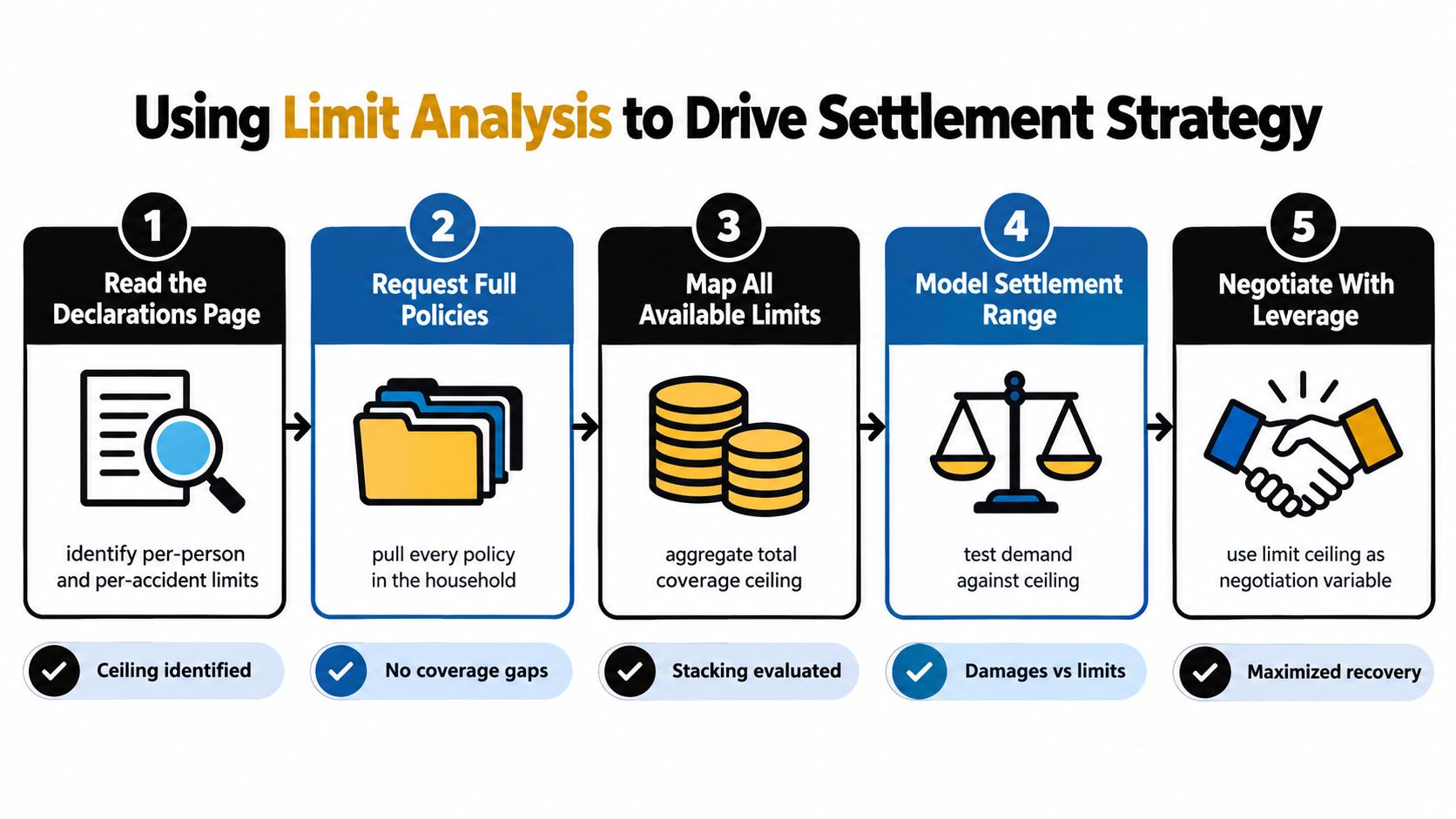
Limit analysis turns the coverage ceiling into a negotiation variable. The experienced team doesn't begin by drafting a demand from the medical chronology alone. It starts by identifying the available money and then tests whether the evidence supports a demand that uses that pool intelligently.
Read the coverage before writing the demand
A declarations page gives the first map. The full policy supplies the hazards. Look for offsets, exclusions involving household members, anti-stacking provisions, consent-to-settle clauses, exhaustion requirements, defense-cost treatment, and any umbrella or excess policy above the primary coverage.
A $250,000 demand against a $25,000/$50,000 policy communicates something different from the same demand against $250,000/$500,000 coverage with a $5,000,000 umbrella. The first may be designed to secure a prompt tender and preserve an excess claim. The second may require a fuller damages presentation because more coverage exists and the carrier has greater room to defend valuation.
Treat the carrier's ceiling as evidence, not as the whole case
Adjuster reserves can reveal how the carrier is classifying the exposure, although a reserve isn't a settlement promise. Compare the reserve posture with the medical records, liability evidence, wage documentation, permanency opinions, and the number of claimants competing for the same aggregate. If the reserve appears disconnected from the file, address the gap with organized proof rather than rhetoric.
The North America claims data gives a useful reason to take this review seriously. In the study period, 32% of paid claims exceeded 40% of the policy limit, 14% exceeded 80%, and 8% were paid at the full policy limit. Average payment size reached $10 million in 2022, and for policies incepted between 2021 and 2024, 23% of claims alleged losses greater than the policy's dollar limit, according to Aon's North America claims study.
A policy-limits settlement may protect the claimant from collection problems and protect the insured from an avoidable excess judgment. Pursuing excess exposure may be appropriate when liability is strong, damages are clear, coverage is larger than disclosed, or the carrier has mishandled a reasonable demand. Before recommending either path, document the proposed release, exhaustion letter, consent-to-settle requirements, and notice to every UM or UIM carrier.
A focused guide to attorneys asking for policy limits can help organize the demand process. The demand should identify the limit, explain the evidence supporting the claim, set a clear response framework, and avoid releasing rights that depend on another coverage layer.
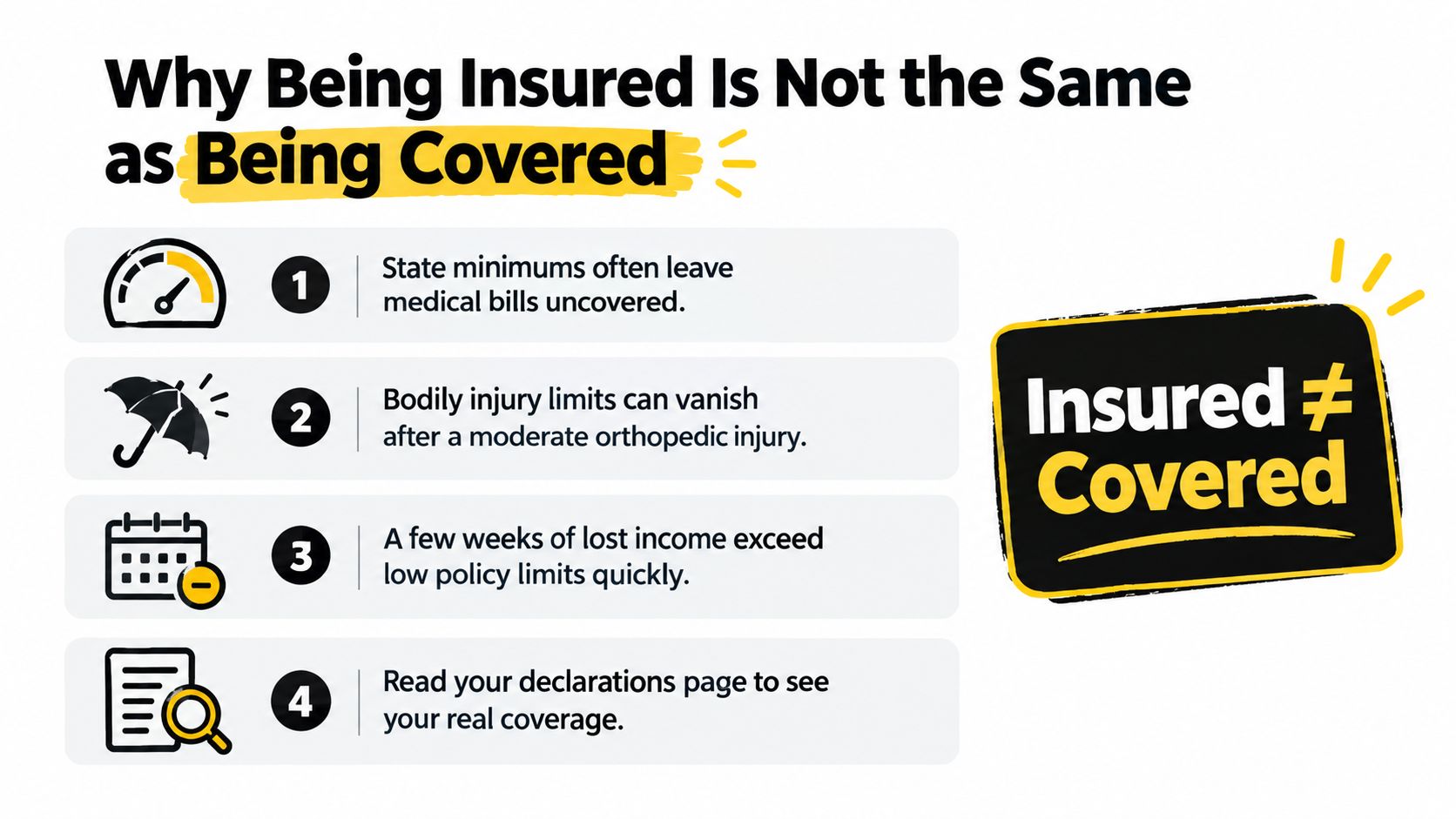
Why Being Insured Is Not the Same as Being Covered
A policy can satisfy a legal requirement and still leave a household functionally exposed. The relevant question isn't whether an insurance card exists. It's whether the available limits can respond to a realistic injury, defense cost, settlement demand, or judgment.
The protection gap is visible in both business and household coverage. Hiscox's 2025 global report states that 65% of surveyed businesses had less than £1 million in public liability cover and 60% had less than £1 million in professional indemnity cover. Separately, a 2026 housing report cites post-disaster research finding 7% of policyholders underinsured and 36% with coverage limits below 75% of replacement cost, as reported in the Hiscox global protection gap report.
Those figures don't mean every policyholder needs the highest available limit. They show why “insured” and “adequately insured” are different conclusions. Stale limits can lag rebuilding costs, inflation, business exposure, household assets, and litigation risk.
Signals that the policy needs another look
Check these warning signs before renewal:
- Low UM or UIM limits: The household may have strong liability coverage but little first-party protection for its own injuries.
- No umbrella or excess layer: A primary policy may stop where the household's assets and future earnings remain exposed.
- Unbalanced coverage: High medical-payments coverage can create comfort while bodily injury limits remain too low for a serious claim.
- Outdated declarations: A new driver, vehicle, residence, business activity, or household member may not be reflected.
- Driver exclusions: A named-driver exclusion can remove the coverage a family assumes follows every resident.
Review the limits against realistic medical and income exposure in your area, then ask an agent to price an umbrella or excess option before renewal. The objective isn't to buy a number for its own sake. It's to close the gap between the certificate in the glove box and the money available after a serious loss.
A Practical Limit Checklist for Your Next Case
A limit review should produce a written coverage map, not a vague note that “insurance is available.” Run the file in an order that reveals missing policies and restrictions before the first serious demand.
Build the coverage inventory
- Obtain every declarations page. Request the at-fault policy, every household auto policy, policies covering resident relatives, and any commercial, homeowners, umbrella, or excess coverage that could respond.
- Confirm the limit structure. Record per-person, per-occurrence, CSL, aggregate, UM, and UIM figures. Don't rely on an adjuster's verbal statement when the policy can be obtained.
- Pull the endorsements. Search for anti-stacking language, resident-relative exclusions, named-driver exclusions, covered-auto restrictions, offsets, and consent-to-settle provisions.
- Verify selection and rejection forms. UM and UIM elections may control the available coverage, especially where state law requires specific signatures or forms.
- Calculate the remaining pool. Account for prior payments, other claimants, deductibles, sublimits, aggregate erosion, and any defense or claim expenses treated as part of the limit.
The documentation step matters because a clean medical record supports the value side of the equation. Use a structured insurance claim documentation process to preserve bills, wage loss, treatment dates, diagnoses, restrictions, causation evidence, and communications with each carrier.
Match the demand to the available money
Compare the medical specials, projected care, lost wages, impairment, and liability proof with each coverage ceiling. Then document whether a limits settlement would resolve the known exposure or leave a viable excess claim against the insured.
For policyholders and claimants who need help reading declarations, exclusions, and endorsements, this guide to protect your rights while reading an insurance policy offers a practical starting point. It doesn't replace legal advice or the controlling policy language, but it reinforces the right habit: read the complete contract before relying on the headline limit.
Ares provides personal injury firms with AI-assisted medical-record organization and demand drafting, including materials built around policy-limits requests. It can extract dates, diagnoses, treatments, providers, and symptom chronology so the legal team can compare the documented injury against the available coverage before sending the demand.
The final recommendation should state the coverage map, damages assessment, settlement alternatives, and excess risk in plain language. Limit analysis isn't back-office paperwork. It's the framework that tells you what to demand, when to demand it, and what recovery remains possible if the primary policy is exhausted.
Ares helps personal injury teams organize medical records and draft demand materials, including policy-limits demands, so attorneys can connect documented damages with the available coverage before negotiating. Visit Ares to see how the platform can support a faster, more repeatable claim-review workflow.