You're staring at a medical file that has outgrown its folder. The emergency-room note uses one date, the orthopedic records use another, and the therapy notes describe symptoms that seem to change from visit to visit. A demand package can summarize all of it, but a court needs something more disciplined: a reasoned path from the governing law, through the admissible record, to the relief you're asking for.
What a Legal Brief Actually Is
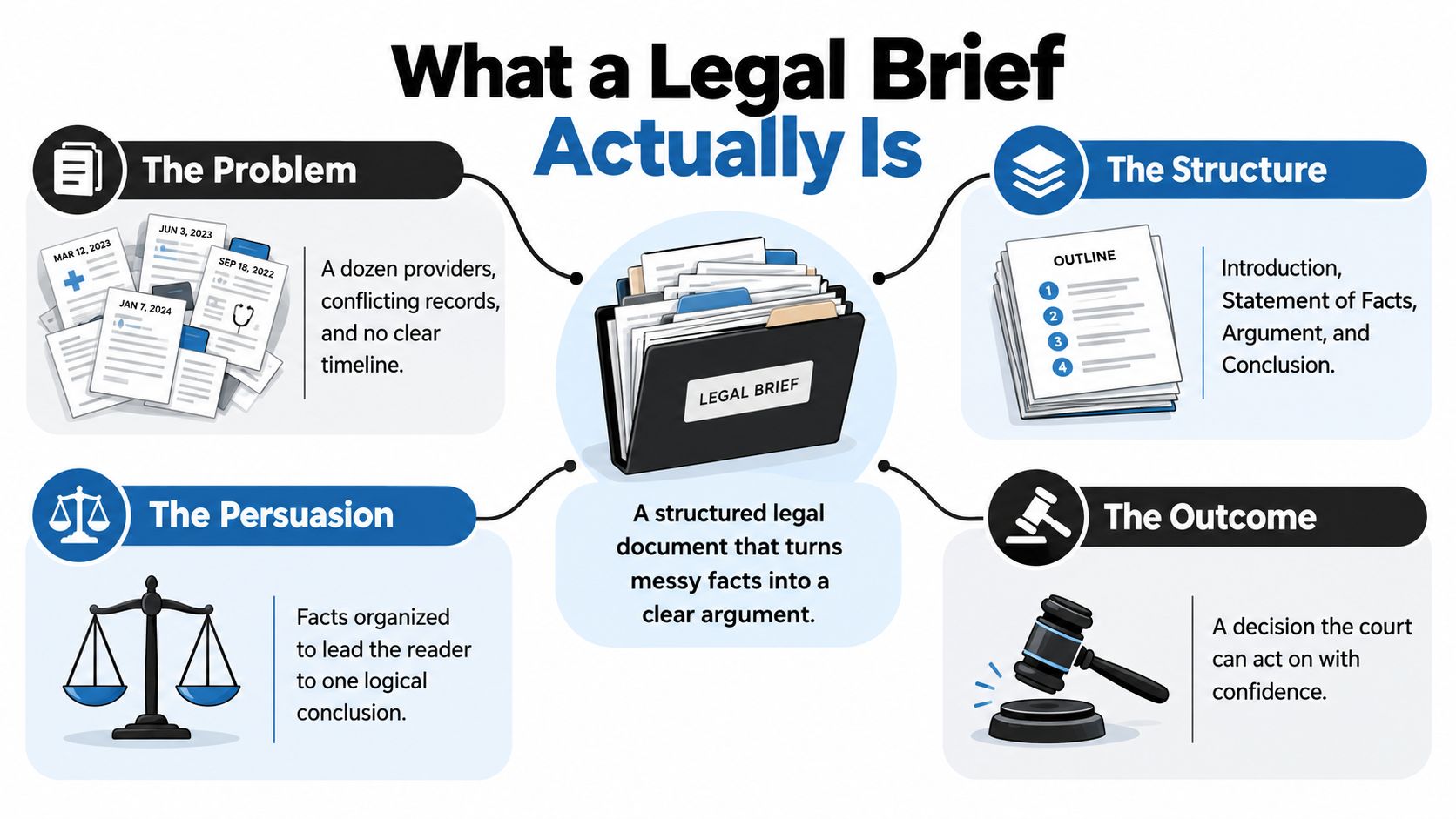
A legal brief is a structured written argument submitted to a court. It identifies the governing law, applies that law to relevant facts, and asks the court to grant a specific result. In federal appellate practice, Federal Rule of Appellate Procedure 28 reflects that function through required elements such as the issues presented, statement of the case, summary of the argument, supported argument, and conclusion.
That definition matters in a personal-injury case because a brief isn't a medical-record digest. Suppose the file contains emergency treatment, imaging, specialist opinions, injections, therapy, and a later work restriction. A weak brief reports each event in sequence. A useful brief selects the events that establish the elements of the claim, connects them to authority, addresses the defense theory, and explains why the court can grant the requested relief.
Organization is not advocacy
A chronology may show that a claimant visited several providers. It may even reveal an apparent progression from pain to diagnosis to treatment. But chronology alone doesn't answer the legal question. The brief must explain which facts matter, what each fact proves, and how the opposing argument fails.
The brief is directed to the judge or judges deciding the dispute, and to opposing counsel. A memorandum may advise the client about risk. A brief advances a position before an external decision-maker. Its purpose is therefore both informational and strategic.
Practical rule: Every important factual assertion should point the reader to the record, and every legal proposition should point the reader to authority.
The Ninth Circuit describes a brief as a document that explains a party's legal and factual arguments, states the facts, identifies the requested relief, supports the position with legal arguments, and cites the record through its briefing guidance. That is the working definition litigators need. A brief turns a complicated record into a theory of decision, not merely a cleaner file.
The Core Components of a Legal Brief
A brief works because its parts perform different jobs. Federal appellate practice provides a useful model. Under Rule 28, the required architecture isn't decorative. It gives the court a controlled route through the dispute.
Issues and factual setting
The statement of the issues presented frames the questions the court must answer. A vague issue invites a vague analysis. A precise issue identifies the ruling, legal standard, and consequence at stake.
The statement of the case supplies procedural and factual context. In a PI matter, that may include the incident, the disputed ruling, the relevant treatment history, and the record references that establish what happened. It shouldn't reproduce every visit. It should give the judge enough context to understand why the issue matters.
Roadmap and argument
The summary of the argument is the judge's roadmap. It should state the answer to each issue and preview the reasoning without becoming a second, compressed brief.
The argument does the substantive work. Strong argument sections generally:
- State the governing rule: Identify the controlling statute, regulation, precedent, or procedural standard.
- Explain the authority: Show why the cited authority governs this dispute, rather than merely listing cases.
- Apply the record: Connect material facts to the legal rule with accurate citations.
- Address the defense: Confront adverse facts and explain why they don't defeat the requested result.
- Build toward relief: Make the requested outcome appear to follow from the law and facts.
The requested result
The conclusion states the precise relief sought. “The court should rule for the plaintiff” may be too general in a procedural appeal. The conclusion should identify the order the court should enter, such as affirming, reversing, vacating, remanding, or granting a specified motion.
This structure also disciplines drafting. If a medical fact doesn't support an element, answer a defense, explain procedure, or establish the requested remedy, it may belong in the file but not in the brief. The court needs a coherent argument, not an inventory.
Briefs vs Memoranda and Other Legal Documents
The word “brief” often gets used loosely, but the document's function changes depending on its audience and stage of litigation.
| Document | Primary audience | Main function | What it should do |
|---|---|---|---|
| Legal brief | Court and opposing counsel | Persuade a decision-maker | Apply law to the record and request relief |
| Legal memorandum | Client, supervising lawyer, or internal team | Analyze risk and options | Explain likely outcomes, uncertainty, and strategy |
| Pleading | Court and opposing parties | Define claims or defenses | State allegations, denials, and required grounds |
| Demand letter | Opposing party or insurer | Seek resolution before judgment | Present liability, injuries, damages, and settlement position |
| Trial memorandum | Trial judge and litigation team | Support trial management or motions | Address evidentiary, procedural, and presentation issues |
A memorandum can candidly evaluate weaknesses because its job is advice. A brief must make the strongest supportable argument while acknowledging facts and authorities that the court is likely to consider. That difference affects tone, selection, and organization.
A pleading establishes the issues in the lawsuit. It may allege that a defendant breached a duty and caused injury, but it doesn't usually provide the fully developed legal analysis expected in a brief. A demand letter has a negotiation objective. It may use persuasive medical chronology, but it isn't constrained by the same court-directed architecture. A trial memorandum often focuses on evidentiary or procedural questions surrounding trial rather than the broader review of a lower-court ruling.
Why medical summaries aren't briefs
A medical summary answers, “What happened medically?” A legal brief must answer, “What legal conclusion should the court reach because of what happened medically?”
That distinction is especially important in PI litigation. A summary may list a diagnosis, treatment decision, symptom report, and work restriction. Advocacy selects the facts that prove causation or damages, identifies the source for each proposition, and places the facts under the governing legal standard.
The best record summaries remain useful because they preserve traceability. They become part of a brief only after counsel applies judgment. Summarization preserves information; advocacy assigns legal significance.
Formatting Rules and Jurisdictional Constraints
A legal brief is defined by form as well as purpose. Courts regulate headings, citations, record references, filing components, length, and formatting. Those rules differ by jurisdiction, so a sound argument can still fail as a filing if counsel ignores the applicable requirements.
Under the federal appellate rules, a standard principal brief may contain no more than 13,000 words or 1,300 lines, while a reply brief may contain no more than 6,500 words or 650 lines. The ordinary federal page limits are 30 pages for a principal brief and 15 pages for a reply brief, subject to the governing rules and exceptions. These requirements appear alongside prescribed content, citations, record references, and a conclusion identifying the relief sought. Rule 32 of the Federal Rules of Appellate Procedure sets out the relevant form and length framework.
Treat the limit as a strategy constraint
A word limit isn't an invitation to shrink every paragraph mechanically. It forces prioritization. Counsel should identify the dispositive issue, remove duplicative background, consolidate related facts, and use headings that communicate the argument before the judge reads the supporting text.
State rules show why counsel must check the forum rather than rely on federal habits. California permits a computer-produced appellate brief of up to 14,000 words, including footnotes, and requires a word-count certificate. Massachusetts permits a principal brief in applicable non-cross-appeal cases to use either a monospaced format of no more than 50 pages or proportional spacing of no more than 11,000 words. The different limits reflect the movement from typewritten page conventions toward digital word-count controls.
Complete a filing review
Before filing, confirm:
- Forum rules: Check the current appellate or trial-court rules, local rules, and any scheduling order.
- Required sections: Confirm that every mandatory component appears in the required order.
- Citations and record references: Verify that authorities support the propositions stated and that record citations lead to the correct material.
- Word or page count: Use the court's required method and prepare any certificate.
- Confidential material: Review redactions and filing restrictions, particularly where medical records contain protected information.
For matters involving multilingual records, translation accuracy can become part of filing reliability. A practical resource showing a court-ready translation can help counsel evaluate how translated material should be presented without losing the connection to the original document. For additional drafting and layout guidance, review this legal brief format guide.
Building Persuasive Arguments in PI Litigation
Personal-injury records rarely arrive as a ready-made narrative. One provider may document the initial complaint, another may interpret imaging, a third may change treatment, and a later note may describe functional limits. The brief must turn those fragments into an argument without overstating what any individual record proves.

Build the evidence-to-argument chain
Start with the legal elements, not the provider list. For each element, identify the record facts that support it, the authority that supplies the rule, and the defense position that must be answered.
A useful working matrix might connect:
- Liability: What conduct, duty, or breach does the record establish?
- Causation: What facts connect the event to the claimed condition, while addressing alternative explanations?
- Damages: What treatment, impairment, restrictions, or future consequences have support in the record?
- Procedure: What ruling or standard gives the court authority to grant the requested relief?
This approach prevents a common error: treating every medical fact as equally important. A preexisting condition may matter because the defense relies on it. A later therapy note may matter because it records persistent limitations. A normal finding may matter because it must be addressed rather than hidden. The advocate decides the significance, but the record controls the wording.
Select facts without distorting them
A persuasive chronology usually follows the legal theory rather than the order in which documents were scanned. It may begin with the incident, establish the early symptoms and treatment, explain the diagnostic development, then show how the condition affected function. It should also identify gaps, inconsistencies, and adverse evidence where those facts could affect the court's assessment.
The goal isn't to include everything. It's to include what proves an element, answers a likely objection, or explains the requested remedy. Counsel should distinguish a documented diagnosis from a patient's reported symptom, a provider's observation from an inference, and a treatment recommendation from proof that treatment occurred.
The guide to writing legal briefs is useful for translating that discipline into drafting steps. Technology can help sort dates and documents, but it can't decide which inference the law permits.
A short pause between the record and the argument often improves accuracy. Build the chronology first, attach each entry to its source, then write the legal analysis. Don't draft a confident causal sentence before checking whether the cited note supports it.
The narrative should lead somewhere concrete. If the brief proves liability but never explains why the court can grant the requested relief, the reader is left to complete the argument.
AI-Assisted Brief Drafting and Attorney Responsibility
AI can reduce the mechanical burden of organizing a case file, but it doesn't change who owns the brief. In 2025, a Law360 Pulse survey reported that 54% of surveyed private-firm attorneys used generative AI, while 79% remained concerned about AI's imperfect understanding of legal ethics and professional standards. The figures come from the Law360 report on attorneys' views of AI.
The practical lesson is not to reject assistance. It's to define the boundary between support and judgment. Software may identify dates, group records, propose headings, or produce a preliminary draft. Counsel remains responsible for the material facts, quotations, citations, procedural statements, confidential information, and conclusions.
A defensible review workflow
A reliable process separates machine assistance from attorney approval:
- Preserve the source set. Keep the original records and the version supplied to the tool.
- Mark generated text. Treat machine-produced language as draft material, not verified work product.
- Verify every material proposition. Compare medical chronology, quotations, citations, and procedural history with the original sources.
- Test the adverse record. Search for facts that undermine causation, damages, credibility, or requested relief.
- Protect sensitive information. Use controls appropriate for protected health information and follow firm confidentiality policies.
- Check local rules. Confirm filing, disclosure, citation, and certification requirements before submission.
The risk isn't limited to a fabricated citation. A polished draft may merge two providers, assign a symptom to the wrong date, convert a patient report into a medical conclusion, or omit a fact that the defense will emphasize. Faster drafting can therefore create more review work if the team treats fluent prose as proof.
For firms deciding which tasks to delegate, a virtual legal assistant can support administrative and document workflows, while counsel retains legal judgment. A related overview of AI legal document drafting can help teams define review checkpoints before introducing automated drafting into a litigation process.
Thomson Reuters reported that 95% of respondents expected GenAI to become central to organizational workflows within five years, as described in its 2025 survey reporting cited in the provided legal technology research. That projection makes governance more important, not less. A brief remains attorney-controlled advocacy even when a tool helps prepare its first draft.
Putting It All Together
The definition of a legal brief has two inseparable parts. It's a court-directed advocacy document, and it's a formally bounded filing whose structure, length, citations, and requested relief are controlled by the jurisdiction.
For a PI lawyer, the work begins with fragmented material, not a finished story. Medical records provide dates, diagnoses, treatment decisions, symptom reports, and functional observations. Connecting selected record evidence to governing authority, answering the defense, and explaining the precise action the court should take gives those facts legal significance.
Four habits keep that process sound:
- Structure: Give every section a job.
- Traceability: Make each important fact and legal proposition verifiable.
- Selectivity: Include facts because they advance the theory, not because they exist.
- Attorney control: Treat every automated output as unverified until counsel checks it.
A strong brief doesn't merely make a large file easier to read. It constructs a logical path from the legal issue, through the supported facts, to a remedy the court can confidently order. That's the practical meaning behind the definition of legal brief.
Ares helps personal-injury firms organize medical records and draft mediation briefs with case narratives, treatment histories, damages analyses, and citations to source evidence. If your team needs a repeatable way to turn fragmented records into case-ready material for attorney review, visit Ares.