You're probably in the middle of it right now. The deadline is close, the record is ugly, and your medical file looks less like a case narrative and more like a warehouse inventory. Orthopedics. PT. Pain management. Imaging. An IME. Maybe a prior accident buried in the chart. Somewhere in that stack is a clean theory of causation and damages, but the judge won't find it for you.
That's why legal brief format matters more than most lawyers admit. It isn't clerical polish. It's how you turn disorder into a sequence the court can trust. A good brief tells the judge where to look, what matters, and why your requested ruling follows from the law and the record.
Junior lawyers often treat format as a last-step cleanup job. Experienced litigators know better. The brief's structure controls what the judge sees first, what feels important, and whether your argument reads like a disciplined presentation or a rushed filing. If you need a broader foundation on drafting itself, this guide to writing legal briefs is a useful companion. But on a live case, especially in PI practice, the actual work is making the brief both compliant and persuasive.
The Anatomy of a Persuasive Legal Brief
The first major brief in a personal injury case usually creates the same problem. The law may be straightforward, but the facts aren't. You have treatment gaps that need explanation, overlapping complaints across providers, and records written by people who weren't thinking about litigation when they typed them. If you draft without a format strategy, that mess shows up on the page.
A persuasive brief does the opposite. It imposes order. It gives the court a map before asking for a ruling. That's why the best briefs feel easier to read than the record they came from. They aren't simpler because the case is simple. They're simpler because the lawyer made choices.
What format actually does
Legal brief format serves three jobs at once:
- It establishes credibility. A clean caption, disciplined headings, correct citations, and a coherent sequence tell the court you can be trusted with the details.
- It controls attention. Judges read under pressure. Your organization decides what stands out and what gets lost.
- It strengthens persuasion. The strongest legal theory usually fails if the facts arrive out of order or the argument wanders.
Practical rule: If a judge has to reorganize your brief mentally before deciding it, you've already made the ruling harder for your side.
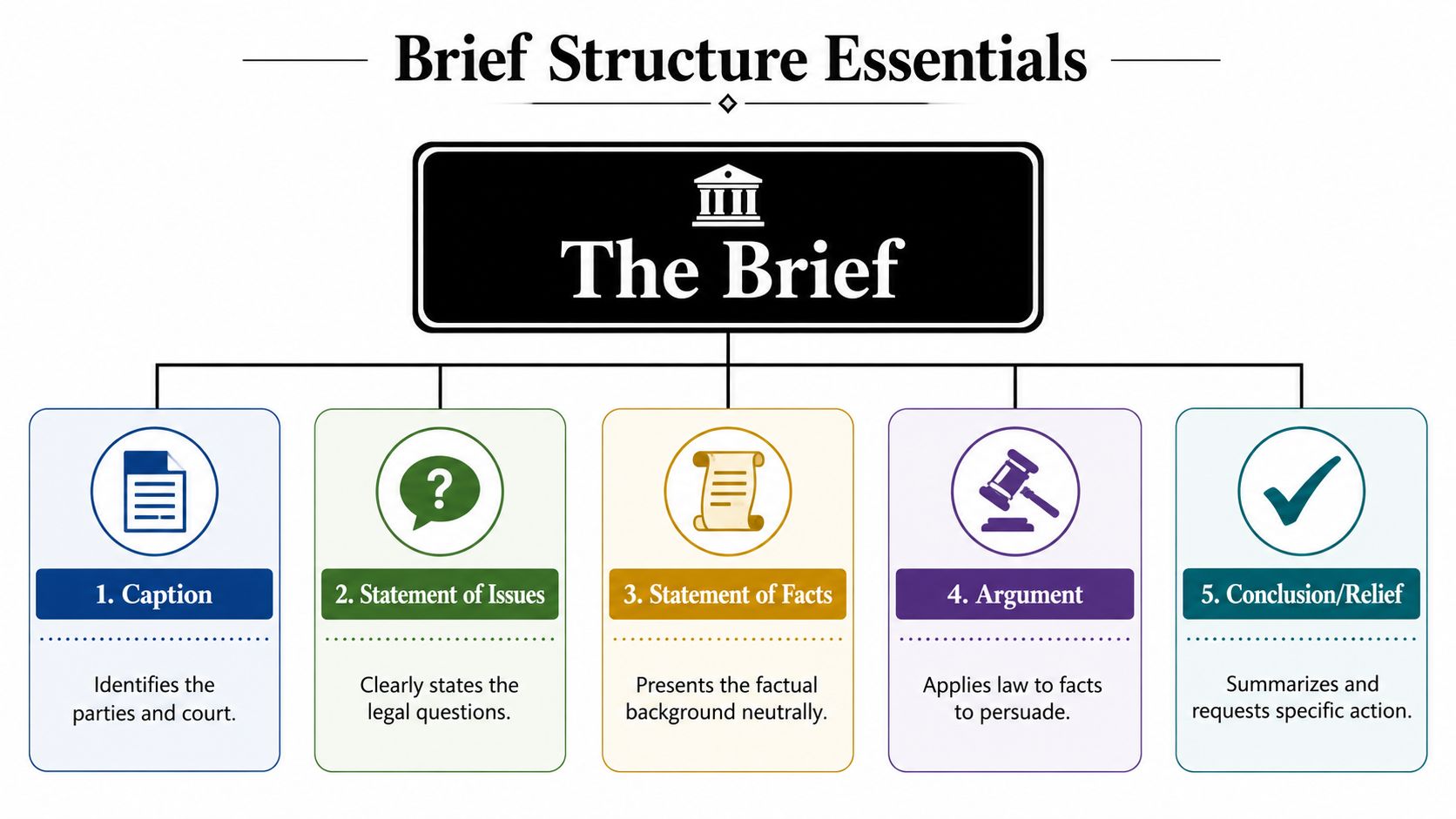
The core parts of most briefs are familiar. The caption identifies the filing. The issues frame the legal questions. The facts create the story of the dispute. The argument applies law to record. The conclusion tells the court exactly what order to enter. What separates a strong brief from an average one is not whether those parts exist. It's whether each part performs a distinct strategic function.
Why PI briefs need more than a template
Personal injury lawyers run into a formatting problem that generic appellate writing advice often ignores. Medical proof rarely arrives in a neat chronology. It comes in fragments, duplicated records, inconsistent terminology, and provider notes that mix symptoms, history, billing detail, and causation language on the same page.
That's where younger lawyers lose time. They summarize everything, include too much, and bury the point. The better approach is to treat the brief as a controlled narrative. You don't need every fact. You need the facts that let the court follow injury, treatment, causation, and consequence without friction.
A strong legal brief format gives you that control. It lets you sort chronology from commentary, separate background from contested facts, and reserve your heaviest persuasion for the places where persuasion belongs.
Mastering the Core Structural Components
A brief isn't just a required filing. It's a sequence of decisions. Each component should answer a different question in the judge's mind. If two sections are doing the same work, one of them is wasting space.
Caption and statement of issues
The caption is administrative, but it still signals competence. Get the court, parties, case number, and document title exactly right. Don't improvise naming conventions. Match the docket and the local rule.
The statement of issues is where persuasion starts. A weak issue sounds abstract. A strong issue frames the legal question in a way that makes your answer feel natural. Keep it tight. If the issue takes half a page to ask, it's probably hiding two or three issues that need to be broken apart.
A useful test is whether the issue statement previews the fight without arguing it. You want the judge oriented, not exhausted.
Statement of facts
Many briefs go off the rails. New lawyers either write a sterile chronology that proves nothing or a slanted narrative that reads like argument in disguise. That tension is real. A 2024 California Bar study found that 62% of first-year attorneys fear crossing the line between persuasive framing and misleading the court in this context, as noted in CUNY Law's guidance on drafting briefs to a court.
The answer isn't to become flat. It's to become disciplined.
Use this checklist when framing facts ethically:
- Lead with material facts, not dramatic facts. Start with the facts that bear on duty, causation, notice, standing, or damages.
- Order events to clarify consequence. In PI matters, that usually means incident, immediate symptoms, first treatment, diagnostic confirmation, progression, and current limitations.
- Use record-backed descriptors. “Reported,” “documented,” “diagnosed,” and “noted” are safer than argumentative adjectives.
- Acknowledge bad facts cleanly. If there's a treatment gap or prior condition, state it accurately and place it where the court can understand it in context.
- Save conclusions for the argument section. Facts should lead the judge toward your theory without announcing every inference.
The facts section should feel fair on first read and favorable on second read.
For firms trying to standardize this process, tools discussed in legal document automation workflows can help enforce consistent headings, styles, and chronology handling. The point isn't automation for its own sake. The point is reducing avoidable drift between draft one and filing.
Argument and conclusion
The argument is where you cash the check the facts section has been writing. Don't use it to repeat the chronology. Use it to tie legal standards to the specific record.
The conclusion should request relief in operative terms. Don't end with “for the foregoing reasons” and a vague ask. Tell the court what order you want entered, on what motion, and on whose behalf.
Here's the simplest working model:
| Component | What it must do |
|---|---|
| Caption | Identify the filing without error |
| Statement of Issues | Frame the legal questions efficiently |
| Statement of Facts | Build a credible and favorable record narrative |
| Argument | Apply law to the facts in a logical sequence |
| Conclusion or Relief | State the exact ruling requested |
Navigating Technical Formatting and Court Rules
A strong argument won't save a noncompliant brief. Courts can reject filings before anyone reaches the substance, and that's not a theoretical risk in appellate practice.
In Massachusetts, for example, Rule 20(a) requires 8.5 x 11-inch paper, 1-inch top and bottom margins, 1.5-inch side margins, 12-point mono-spaced font such as Courier or Pica with no more than 10.5 characters per inch, and double-spaced text. The same source notes that non-compliant submissions can be rejected or treated as non-conforming, and that 92% of courts in federal and state appellate systems reject briefs exceeding page limits without a waiver, with primary briefs capped at 50 pages and reply briefs at 20 pages under the cited rule discussion in Massachusetts Lawyers Weekly's review of technical brief requirements.
The rules you must verify every time
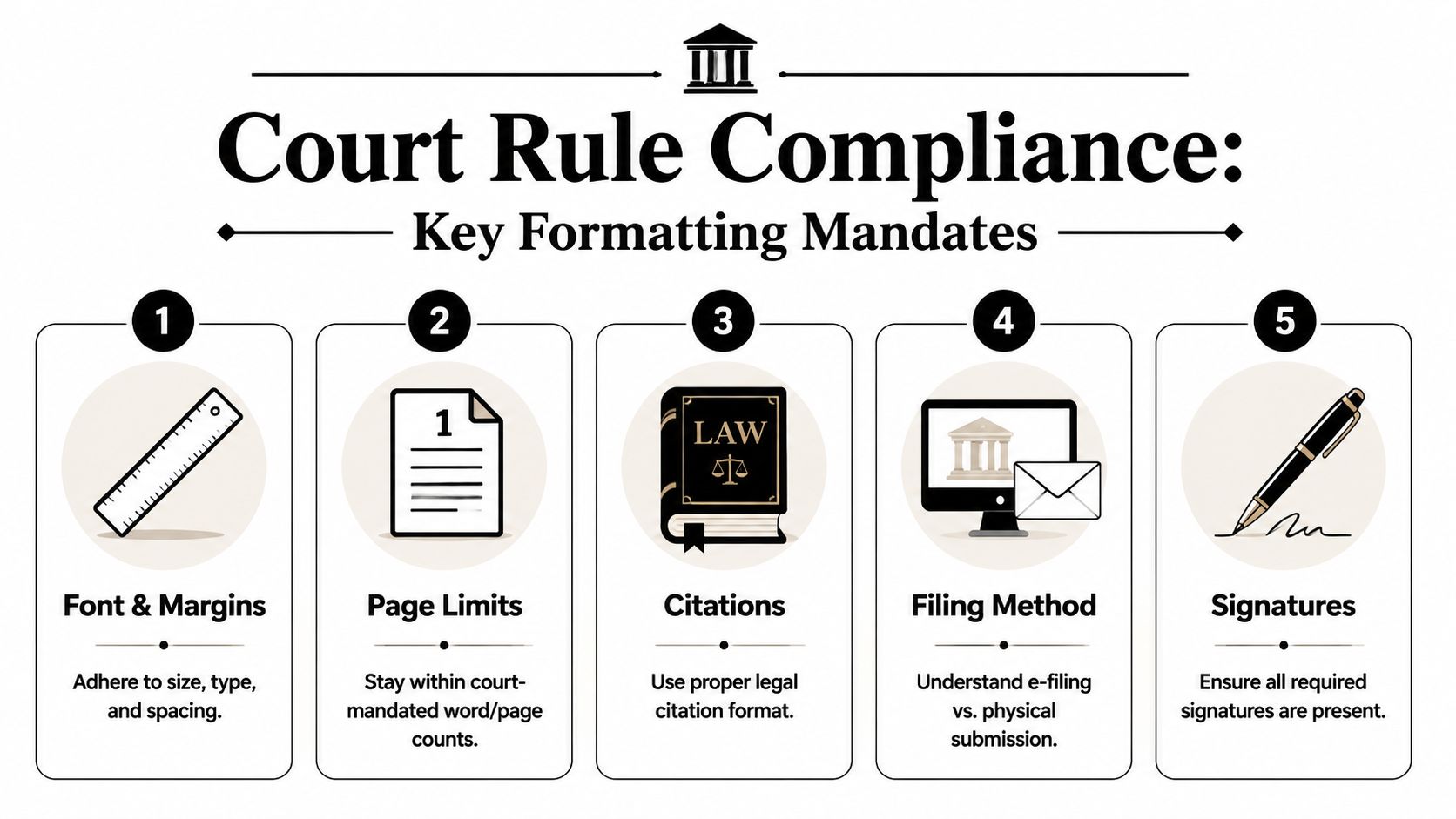
Don't rely on memory, old templates, or what the partner “usually files.” Check the current rule set for the specific court and motion. At minimum, verify these items:
Page or word limits
Some courts count differently. Some exclude certificates, appendices, or tables. Others don't.Typeface and spacing
Trial courts may allow proportional fonts where an appellate court won't. Even within one jurisdiction, local practice can differ.Margins and cover requirements
In some appellate courts, even the cover color is prescribed. The Massachusetts rule discussion identifies blue for appellant, red for appellee, gray for reply, and green for amicus.Filing method
E-filing rules can require searchable PDFs, bookmarks, or separate appendix handling.Signature blocks and certificates
A missing certificate of service or noncompliant signature line is the kind of avoidable mistake that annoys clerks and undermines confidence.
Citation discipline is part of formatting
Lawyers tend to separate citation from format. Courts don't. Citation form is part of the document's professionalism. A brief with uneven record cites, inconsistent case names, or half-finished parentheticals reads like it was assembled in fragments.
If you need a reliable refresher on proper Bluebook formatting, use it before the final cite-check, not after. By the time citations become a cleanup project, you're usually fixing problems created by poor drafting habits upstream.
A judge will forgive a hard case more readily than a careless brief.
For electronically filed matters, procedural requirements increasingly overlap with document design. Searchability, hyperlinks, appendix labeling, and PDF integrity all matter. Firms working through those operational changes should pay attention to how technology is changing court practice, because the technical side of filing is becoming inseparable from advocacy.
A practical compliance routine
Use a three-pass review before filing:
- Rule pass
Compare the draft against the current court rule line by line. - Document pass
Check page numbers, headings, caption consistency, tables, certificates, and exhibit references. - PDF pass
Open the final filed version, not just the Word file. Test bookmarks, links, text recognition, and page rendering.
That routine sounds unglamorous because it is. It also prevents some of the most embarrassing filing mistakes lawyers make.
Structuring a Persuasive and Logical Argument
The argument section is where many briefs become harder to follow than the law itself. Lawyers know the record too well. They skip steps, blend standards together, and assume the court will connect the dots. The court usually can. The better question is whether the court will want to.
The structure of the argument is persuasion. A judge reading quickly should know, from your headings and internal logic alone, where you're going and why each point matters.
Why structured arguments perform better
Briefs organized with strategically ordered major headings achieve 35% higher judge acceptance rates, and failure to follow IRAC or CRRAC is cited as a primary reason for weakened arguments in 68% of trial court cases, according to the discussion collected at Meegle's legal brief standards overview.
Those numbers match what experienced litigators see in practice. Judges don't want surprise architecture. They want a predictable path through the issue.
IRAC and CRRAC in real use
IRAC works well when the issue is narrow and the law is settled.
- Issue
Identify the legal question. - Rule
State the governing standard. - Application
Connect the record to the rule. - Conclusion
Give the answer.
CRRAC is often better for contested motions and appeals because it leads with your point and leaves room for authority and counterargument management.
| Framework | Best use |
|---|---|
| IRAC | Straightforward issues with clean legal standards |
| CRRAC | Contested issues where you need momentum and rebuttal built in |
Heading order matters more than lawyers think
Don't organize arguments chronologically just because the file developed that way. Organize them in the order the judge should decide them.
That usually means one of these sequences:
- Jurisdiction or threshold issue first if it controls everything else.
- Strongest merits argument first when early momentum helps the whole brief.
- Cleanest issue first when the case facts are messy and you need the court's confidence before reaching disputed territory.
A bad order can weaken even strong points. If your best argument sits behind two muddy ones, the judge reaches it tired and skeptical.
Write headings that could stand alone in an outline and still persuade.
What weak argument sections usually do
They combine rule explanation and factual recap until neither is clear. They hide the thesis in the middle of the paragraph. They acknowledge the opponent's best point only after the court has already noticed the omission.
A stronger method is to handle each major point like this:
- State the conclusion in the heading.
- Give the governing rule in the first paragraph.
- Cite the controlling authority before discussing secondary support.
- Apply the decisive facts, not every fact.
- Address the best counterargument before the court does it for you.
That kind of structure doesn't make the brief rigid. It makes it legible.
Advanced Techniques for Complex PI Medical Narratives
Generic legal brief format advice breaks down fast in personal injury cases with layered treatment histories. The problem isn't just volume. It's overlap. The same symptom appears in urgent care, primary care, PT, orthopedics, and pain management, but each provider records it differently. If you dump that chronology into a traditional facts section without design choices, the court gets repetition instead of clarity.
Data cited in a recent discussion of legal formatting for medical narratives states that 78% of rejected demand letters stem from poor chronology organization, and that many guides still don't explain how to structure complex multi-provider narratives or use bookmarks and hyperlinks in e-briefs, as described in this discussion of chronology organization and e-brief formatting.

Build by treatment phases, not by document pile
When the medical story is complicated, divide the factual presentation into phases the judge can understand.
A practical sequence often looks like this:
Immediate post-incident presentation
Initial complaints, first evaluations, emergency findings, early restrictions.Diagnostic clarification
Imaging, specialist referrals, differential diagnoses, objective findings.Conservative treatment
PT, medication management, injections, follow-up reports, documented response.Escalation or persistence
Ongoing symptoms, functional limits, surgery recommendations, future care issues.
That approach does two things. It reduces duplication, and it lets the court see progression. In PI litigation, progression often matters more than isolated treatment entries.
Use visual hierarchy inside the brief
Long factual sections need internal architecture. Don't rely on dense prose alone. Use:
- Section breaks to separate phases of treatment.
- Descriptive subheadings that identify provider type or treatment period.
- Consistent date formatting so the chronology can be scanned.
- Short record-cite clusters instead of citation dumps at paragraph ends.
If the judge can skim your headings and understand the treatment arc, you've already improved the odds that the detailed reading will go your way.
Make e-briefs easier to verify
Hyperlinked bookmarks are more than a tech flourish. They let the court test your accuracy quickly. In a medical-heavy brief, that matters. A factual assertion that links directly to the supporting appendix page feels controlled and transparent.
Use bookmarks for:
- Major factual sections
- Key provider records
- Imaging and operative reports
- Critical testimony excerpts
- Damages-related exhibits
Don't overlink every sentence. Link the propositions the court is most likely to verify or the points opposing counsel is most likely to contest.
When the record is dense, ease of verification becomes part of persuasion.
Handle difficult records without losing the thread
Complex provider histories often include prior complaints, inconsistent pain descriptions, or treatment gaps. Don't hide them in footnotes. Put them where they belong and frame them with context drawn from the record.
That's the practical difference between ethical persuasion and spin. Ethical persuasion selects and orders facts so the judge sees their significance. Spin tries to alter what the facts are. The first builds confidence. The second destroys it.
Your Pre-Filing Checklist and Downloadable Template
By the time you're ready to file, you shouldn't still be writing. You should be checking. Most bad filings don't fail because the lawyer missed the central legal issue. They fail because the last round of quality control never happened.
A solid pre-filing review catches structural drift, formatting errors, citation problems, and the subtle ways a brief can become less persuasive during revision.
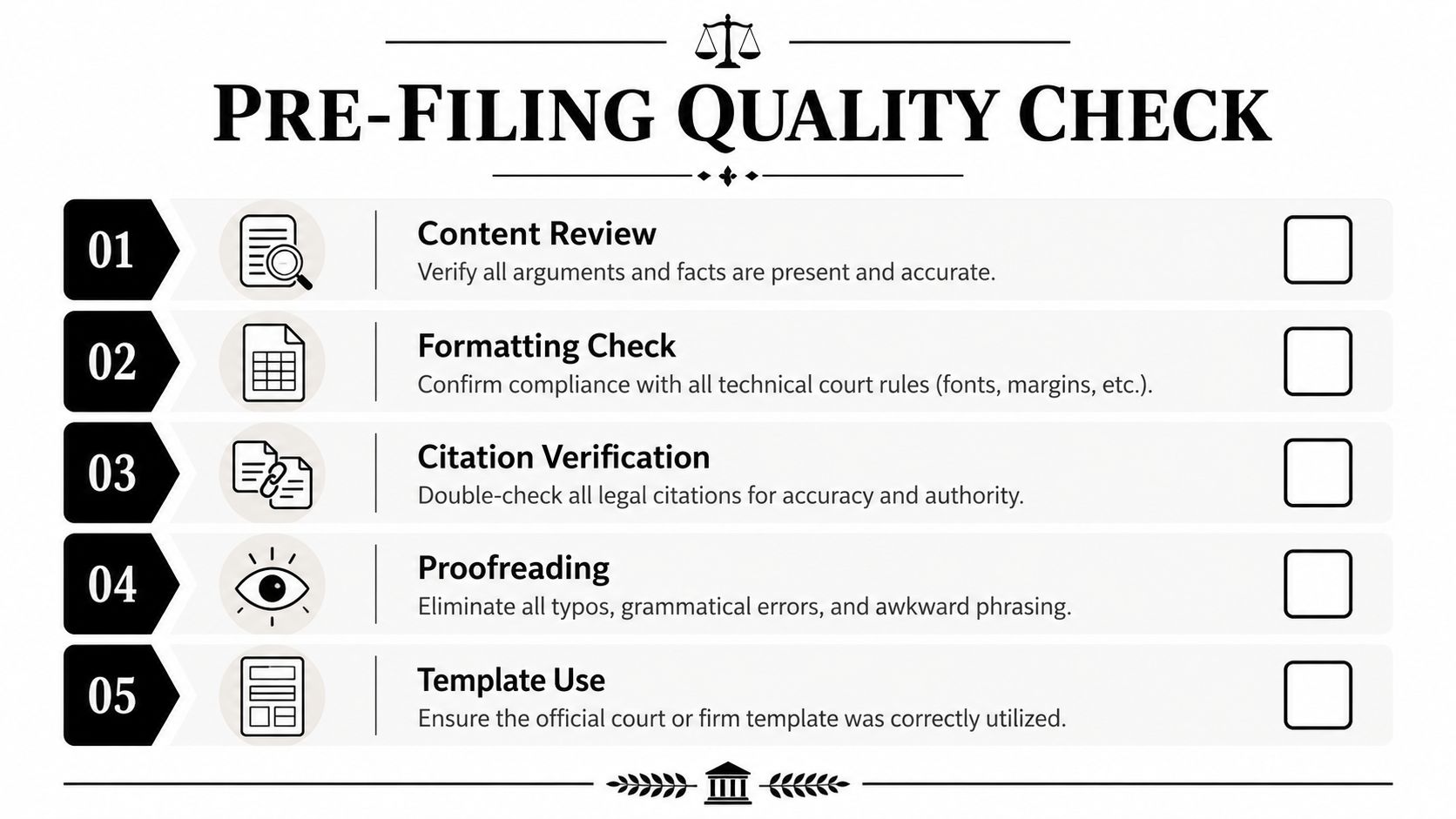
The final review sequence
Use this order. It works better than proofreading linearly from page one to the signature block.
Start with relief
Confirm the conclusion asks for the exact order you want. If the requested relief is vague, the rest of the brief can't rescue it.Read only the headings
If the heading outline doesn't tell a coherent story, the argument probably isn't ordered correctly.Audit the facts section for tone
Remove adjectives that sound like closing argument. Add context where bad facts appear without explanation.Check citations separately
Don't combine cite-checking with substantive editing. Those are different tasks and require different attention.Review the final PDF Test every bookmark, every hyperlink, every appendix reference, and every page number in the file you'll submit.
A working checklist for chambers-ready briefs
| Check | What to confirm |
|---|---|
| Caption and court info | Case number, party names, filing title, court designation |
| Structure | Issues are clean, facts are ordered, argument headings are decisive |
| Technical compliance | Margins, font, spacing, limits, signatures, certificates |
| Citations | Authorities, record cites, quotations, parentheticals |
| Readability | Paragraph length, heading clarity, defined acronyms, no clutter |
For internal workflows, it can help to borrow review discipline from adjacent legal processes. A concise example is Redline's contract analysis framework, which shows how a checklist can force consistency even when multiple reviewers touch the same document. Brief review benefits from the same habit. Someone should own the legal theory, someone should own the cite-check, and someone should own the filing package.
If your firm uses a downloadable Word template, build it so the formatting is already decided. Pre-apply styles for body text, block quotes, headings, record cites, and certificate sections. That prevents lawyers from manually styling each page under deadline pressure. It also makes tables, navigation panes, and export to PDF much cleaner.
The best legal brief format is the one you can repeat under stress without cutting corners.
Ares helps personal injury teams turn chaotic medical records into organized timelines, treatment summaries, and demand-ready narratives without spending hours doing it manually. If your firm wants a faster way to review records, spot gaps, and build stronger case stories, take a look at Ares.