
A claims adjuster opens a crowded production of emergency-room notes, imaging, therapy records, bills, and prior medical history. The attorney has only minutes to understand what happened, when symptoms began, whether treatment stalled, what the records establish, and which questions still need answers. A folder full of documents can't answer those questions on its own.
A strong personal injury case file makes the medical story legible, separates documented facts from assumptions, and puts the next useful action in view. The eight case file examples below are anonymized, instructional models, not substitutes for jurisdiction-specific legal, medical, privacy, or records-management guidance. Each answers a different preparation question, from what to capture at intake to how to organize a demand, resolve liens, and prepare for trial.
The organizing principle is simple: every summary should lead back to its source, and every identified weakness should lead to a next step. A case file isn't just a place to store documents. It's a review tool and a decision system that helps the team move from raw records to defensible work product.
1. Chronological Medical Summary
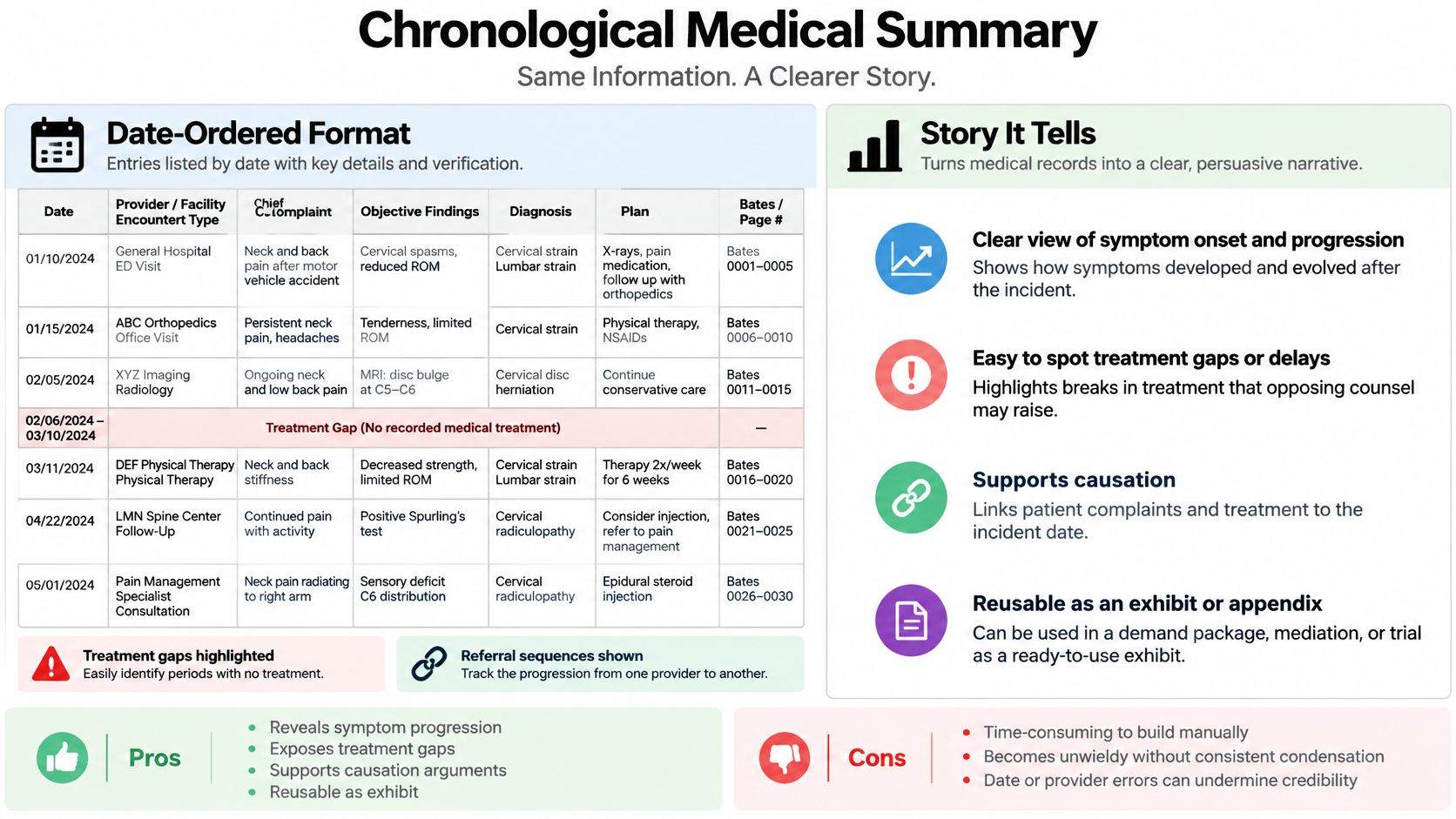
A chronology turns a disordered production into a sequence that a lawyer can follow. For a rear-end collision, for example, it might show an emergency-room visit, neck complaints documented the following day, a primary-care appointment, an orthopedic referral, and the start of physical therapy. The point isn't to make the treatment look smooth. It's to show what each record says, when it says it, and what happened next.
Use a consistent entry format: date, provider, facility, complaint, objective findings, diagnosis, treatment, and follow-up plan. Add a page or Bates reference for each entry. That source trail lets a reviewer check an important event without searching an entire production, and it makes errors easier to catch before they travel into a demand or deposition outline.
The chronology also needs to reveal absences. Flag missed follow-ups and periods without documented care, but don't decide what they mean inside the factual summary. A gap might reflect recovery, access barriers, a provider change, or missing records. Keep those possibilities for investigation and analysis rather than presenting an inference as a medical fact.
Practical rule: A chronology should make verification faster, not replace verification.
For a detailed model of how to build this work product, use this medical record chronology guide. The value of a chronology becomes clearer against the range of injury cases: a historical study of tort trials found substantial differences across automobile, malpractice, and product-liability matters, including differences in trial frequency and plaintiff success. That's a reminder to organize the evidence around the particular claim, not treat “personal injury” as one uniform case type. (Historical study of tort litigation)
2. Problem-Oriented Medical Summary
A date-ordered chronology answers, “What happened next?” A problem-oriented summary answers, “What does the record show about each injury?” That distinction matters when one incident produces several complaints handled by different specialists.
Consider a motorcycle collision involving a shoulder injury, a wrist fracture, and a concussion. A single timeline can show the sequence of appointments, but it may be difficult to see how each condition was evaluated and whether it remains active. Separate sections let the reviewer trace each problem from the first reported symptoms through testing, treatment, and documented status. The same structure helps in a fall case where the claimant had a pre-existing knee condition: the file can distinguish the pre-incident baseline from later complaints without claiming that every post-incident symptom has the same cause.
Keep the two views connected
Put a concise status line at the top of each problem section, such as ongoing, resolved, or status unclear, and support it with the underlying records. Cross-reference the chronology so a reader can move between the body-part view and the full sequence of care. If prior records for a body region remain outstanding, identify that gap in the relevant section rather than burying it in general correspondence.
This format has a trade-off: it can make a complex file easier to understand, but it can also obscure timing if the writer removes events from their context. Keep dates visible, preserve the source references, and avoid implying a causal conclusion the records don't establish. A problem summary works best as a second view of the evidence, not a substitute for the chronology.
3. Pre-Suit Demand Package
An adjuster shouldn't have to assemble the claimant's case from a pile of unrelated attachments. A well-organized pre-suit demand package brings the liability position, medical course, claimed expenses, wage support, and key exhibits together in a way that makes evaluation practical.
For a collision involving emergency care and follow-up treatment, the package might include a demand letter, a factual medical chronology, indexed bills, relevant imaging reports, and wage-loss documentation. The letter can explain how the evidence supports the claim, while the exhibits let the adjuster verify the supporting details. If the file includes a treatment gap or prior condition, address it directly and accurately rather than hoping it goes unnoticed.

Make every figure traceable
Before sending, compare each amount in the letter with the supporting bill or other source document. Separate the medical-specials summary from the narrative, and give each exhibit a clear label and page reference. Confirm the relevant coverage information and the intended demand terms with the supervising attorney. Record when the package was delivered and track the response date according to the applicable requirements and communications.
What doesn't work is a polished letter paired with an opaque exhibit dump. That forces the adjuster to reconstruct the presentation, and it makes it harder for the firm to see whether an important record is missing. A demand package should be persuasive, but persuasion depends on a clean evidence trail. Keep advocacy in the letter and let the exhibits show where the factual support comes from.
4. Time-Limited Policy-Limits Demand
A time-limited policy-limits demand isn't a standard demand with a shorter response date. Its wording, supporting materials, delivery, and deadline can carry legal consequences that depend on jurisdiction. The file should therefore show not only what was sent, but why the firm concluded the demand met applicable requirements.
Suppose an insurer has delayed its evaluation and the attorney is considering a limits demand. Before drafting, counsel needs to check current state law, confirm the required terms and supporting materials, review the release language and lien treatment, and establish how the deadline will be calculated. A demand that leaves the insurer uncertain about the claim being resolved or the conditions of acceptance may create avoidable disputes instead of a clear opportunity to evaluate the case.
Preserve proof of compliance
Keep the final signed demand, every enclosure, delivery confirmation, and a record of relevant communications together. Have a supervising attorney review the terms before sending, and calendar the deadline using the method required for that matter. If the insurer requests information or raises a question, preserve the exchange in the same section so a later reviewer can see what was asked, answered, and outstanding.
This is an area where a generic template can be dangerous. State rules change, and a clause that appears routine may not fit the governing law or the facts. Use a jurisdiction-specific review rather than relying on a form from another file. For background on the basic settlement concept, consult this explanation of a policy-limits settlement, then have counsel verify the requirements that apply to the case.
5. Medical Specials and Billed-vs-Paid Damages Schedule
A medical-specials schedule should let a reviewer see what each provider billed, what was paid, what was adjusted, and what remains outstanding. One total at the bottom isn't enough if the components use different measures or if a balance may still be claimed.
In a fall case with treatment from several providers, list each provider and the dates of service, then reconcile the itemized bills against payment records and explanations of benefits. Keep paid amounts, contractual adjustments, and outstanding balances in separate fields. This makes it easier to identify a missing bill, a duplicate charge, or a balance that needs follow-up before the firm presents a damages figure.
The right damages measure depends on the law that governs the case. A schedule that combines billed and paid amounts into one figure can create confusion, especially where state law affects what may be presented or recovered. Confirm the applicable rules before using totals in a demand, mediation statement, or trial exhibit.
Keep the accounting honest: A number is only useful if the file shows where it came from and what it represents.
Update the schedule when new bills or payment records arrive, and reconcile it again before any major valuation decision. Flag unresolved balances for the lien ledger rather than assuming they'll be handled automatically at settlement. This document is most useful when it functions as a working reconciliation, not a static summary prepared once and then copied forward.
6. Lien Resolution Ledger
A settlement figure isn't the same as the amount the client can receive. Health plans, public benefits programs, hospitals, and providers may assert repayment or lien claims, and the file needs to show who has a claim, what amount is asserted, what basis is given, and how the issue was resolved.
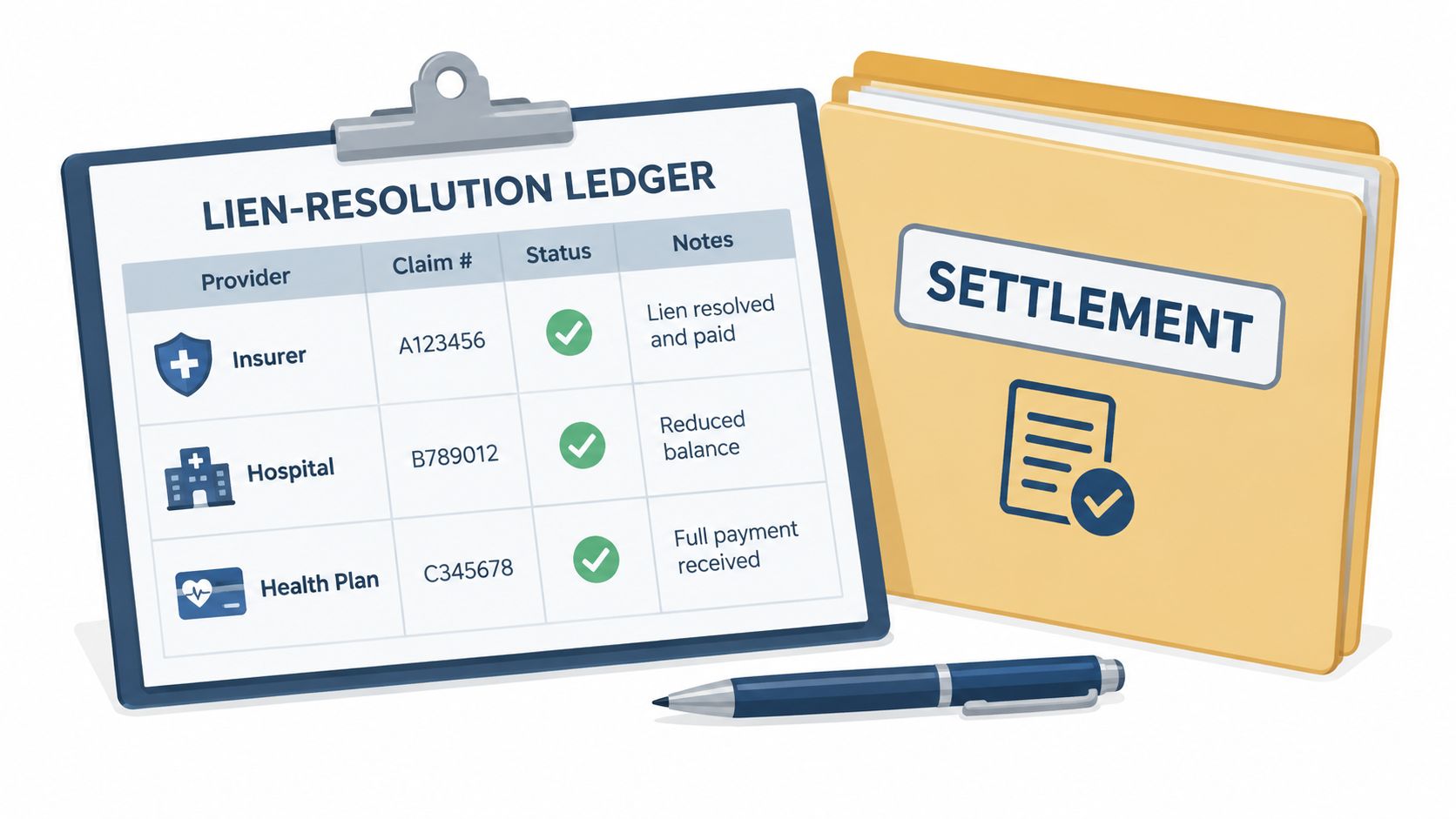
For example, a file may contain a health-plan claim, a hospital lien notice, and a separate public-benefits inquiry. Give each claim its own ledger entry. Record the notice or correspondence, the claimed amount, the legal basis identified by the claimant, the person responsible for follow-up, and the final payoff or written resolution. Update the ledger as the settlement develops, not only when the disbursement is being prepared.
Treat resolution as part of case preparation
Request lien information early enough to identify delays or disputes while the case is still active. Check the claimant's benefits and coverage information at intake, then follow the procedures relevant to the applicable programs and plans. If a claim is disputed, document the reason and the negotiation history. Don't treat an unconfirmed reduction or an unanswered inquiry as a final payoff.
Before funds are distributed, confirm the resolution in writing and keep satisfaction documents in the file. Where a portion of the proceeds remains disputed, follow the firm's trust-accounting procedures and applicable rules rather than improvising a holdback. A ledger that names an owner for each open issue is more useful than a list of lienholders alone, because it makes the next step, and who must take it, clear.
7. Case Intake and Evaluation File
A strong intake file captures what the prospective client reports while making clear what the firm has independently verified. That distinction protects the evaluation from turning an early account into an assumed fact.
For a reported intersection collision, the intake summary might record the client's description, claimed injuries, treatment providers, known insurance information, possible witnesses, and the existence of a police report that hasn't yet been obtained. The evaluation can identify comparative-fault questions, missing records, potential defendants, and the next steps needed to assess the matter. Keep the client's account separate from details confirmed by documents or other sources.
Protect the deadline and the decision trail
Calendar potentially important deadlines promptly, then verify them independently under the law and facts that apply. Record who completed the conflict check and document the basis for accepting or declining the matter. Gather provider names and dates of service early so the records team can begin targeted requests. Revisit the evaluation as reliable evidence arrives, rather than treating the initial screen as a final case assessment.
A useful intake file is direct about uncertainty. “Client reports ongoing pain” is different from “medical records document ongoing pain.” That distinction can feel small when the team is moving quickly, but it matters when the file later supports a demand, a discovery response, or a decision to decline further work. Record what is known, what is reported, and what needs verification in separate fields.
8. Records Gap Analysis and Trial-Readiness Memo
The chronology shows the treatment sequence. A gap analysis explains what the file still can't answer and assigns work to close those gaps. It may identify an uncollected provider file, an unexplained break in care, an imaging report that conflicts with a treating note, or a prior injury that hasn't been investigated.
Take a claimant who stopped attending therapy and later returned to an orthopedic provider. Don't label the interval as proof of recovery or as evidence of damages on its own. Identify the missing records, ask whether the provider documented a reason, and determine whether billing or pharmacy materials can add context. If the client offers an explanation, record it as the client's account and seek corroboration where appropriate.
Turn weaknesses into assigned work
Rank each issue by its potential effect on causation, damages, or trial presentation. Then name the next action, the person responsible, and when the team will revisit it. The memo can also shape deposition preparation: a disputed diagnosis may require a focused question for a treating provider, while an absent prior record may require a targeted authorization or subpoena. Update the analysis when new material arrives so the team doesn't keep relying on an obsolete gap list.
A gap isn't automatically a weakness in the claim. Its significance depends on the surrounding evidence, including contemporaneous notes and the reason for missing treatment. The memo should preserve competing interpretations rather than choosing the most favorable one. For a practical framework for identifying and acting on missing or inconsistent evidence, use this guide to medical-record gap analysis.
Comparison Guide to 8 Case File Examples
| Example | Implementation Complexity | Resource Requirements | Expected Outcome | Ideal Use Case | Key Advantage |
|---|---|---|---|---|---|
| Chronological Medical Summary | High for large records | Medical records; careful date and source verification | Clear view of symptom progression, referrals, and treatment gaps | Multi-provider cases where timing and causation matter | Makes the treatment timeline easy to verify and present |
| Problem-Oriented Medical Summary | Moderate to high | Records organized by injury; careful diagnosis classification | Injury-by-injury view of treatment, baseline, and current status | Multiple injuries, body regions, or pre-existing conditions | Helps distinguish new injuries from aggravations |
| Pre-Suit Demand Package | High | Medical summaries, bills, wage records, exhibits, and damages review | Documented settlement request for insurer evaluation | Initial settlement negotiations before filing suit | Presents liability and damages in one organized package |
| Time-Limited Policy-Limits Demand | High; jurisdiction-specific | Current legal review, supporting records, precise delivery and deadline tracking | Defined opportunity for the insurer to settle within policy limits | Damages plausibly exceed available policy limits | Creates a clear decision deadline and may increase insurer exposure |
| Medical Specials and Billed-vs-Paid Damages Schedule | Moderate to high | Itemized bills, EOBs, payment records, and reconciliation | Verifiable accounting of medical expenses claimed | Cases involving medical expenses or payer-based reductions | Clarifies billed, paid, adjusted, and outstanding amounts |
| Lien Resolution Ledger | Moderate; ongoing maintenance | Lien notices, payoff statements, payment records, and legal review | Documented lien status and settlement deductions | Planning settlement disbursement, especially with multiple lienholders | Helps prevent missed liens and disbursement errors |
| Case Intake and Evaluation File | Low to moderate | Client interview, insurance details, conflict check, deadline tracking | Consistent early screening and case-acceptance decision | High-volume intake and early case triage | Flags deadlines and supports faster, consistent screening |
| Records Gap Analysis and Trial-Readiness Memo | High; requires judgment | Complete records, experienced review, and follow-up resources | Prioritized list of weaknesses and recommended actions | Pre-demand or pre-trial review | Identifies case weaknesses before opposing counsel raises them |
Build the File Before You Need It
The best case file examples share one habit: they turn raw information into a structure that supports a decision. Start with an intake file that separates client reports from verified facts. Maintain a source-linked chronology, and create a problem-oriented view when multiple injuries or prior conditions make the timeline difficult to evaluate. Reconcile specials and liens before treating a gross settlement figure as a measure of the client's net recovery.
Use the demand package as the external presentation of the evidence, not as a replacement for the underlying file. Before sending it, confirm that each factual statement and amount can be traced to a record. Then use the gap analysis to identify missing proof, unexplained treatment, and deposition risks while there's still time to investigate. A file that records only what supports the claim may read smoothly, but it won't prepare the team for the questions an adjuster, opposing counsel, or jury will ask.
Technology can help organize a large production, but it doesn't remove the need for attorney review. A representative medical-records workflow described by NovaCIS reduced chronology preparation from approximately 15 hours to 1 hour per case, a 14-hour reduction. The same case study modeled approximately $1.4 million in annual capacity recovery for a stated volume of 1,000 matters and blended review cost of $100 per hour. (NovaCIS medical-record review case study) Those figures describe a specific workflow and model, not a guaranteed outcome for every firm. When evaluating a system, test its handling of page counts, provider and date extraction, diagnosis coding, treatment sequence, and attorney quality-control time.
Ares offers AI-assisted medical-record review that can organize dates, diagnoses, treatments, providers, symptom timelines, and source-linked references. The attorney remains responsible for checking the source material, making legal judgments, and ensuring that the work complies with jurisdiction-specific requirements.
Before a demand, deposition, or trial, audit the file: verify each number against its source, link each conclusion to supporting evidence, assign an owner and follow-up date to every open gap, and update the record after each new production. A file built this way helps the team see both the case it can present and the work it still needs to do.
Ares helps personal injury teams turn uploaded medical records into organized chronologies, treatment summaries, and source-linked case insights for review. If you're looking to make your case files easier to verify and act on, explore Ares.