
You're already handling PHI if a paralegal opens a provider's records dump, saves it to a shared drive, drops it into an AI summarizer, and sends the draft to co-counsel. In a personal injury firm, that workflow feels routine, but HIPAA sees each handoff as a custody decision that needs a legal wrapper. That wrapper is the business associate agreement, and if your firm receives, stores, transmits, or routes medical data through vendors, the business associate agreement requirements are part of your daily operations, not someone else's hospital paperwork.
The mistake I see most often is simple: firms think the BAA lives only on the provider side. It doesn't. Once your team is handling medical records, your firm is also choosing vendors, setting permissions, and deciding whether downstream tools can touch PHI at all. If you want a plain-English overview of the contract itself, Titanium Computing's guide to what a BAA requires is a useful reference point, but the key issue is how those requirements show up in a PI workflow.
Why Personal Injury Firms Cannot Ignore BAA Requirements
A PI file rarely enters the firm through a clean, controlled intake channel. It arrives as a CD, a PDF bundle, a portal download, or a fax dump, then gets split across case management software, cloud storage, e-signature tools, and drafting assistants. Once that happens, the firm isn't just reviewing medical records, it's operating a PHI pipeline.
Where PHI quietly enters your custody
The obvious source is the provider's records packet. The less obvious sources are the internal tools your staff uses after intake, because those tools can create, receive, maintain, or transmit PHI on your behalf. That's the line HIPAA cares about.
A PI firm also sits in a strange middle position. It may be a downstream recipient of PHI from providers, but it also becomes a procurer of vendors that can turn into business associates themselves. If your team uses an AI summary platform, a cloud repository, a document portal, or a medical chronology tool, each vendor needs to be tested against the same question, does it touch PHI for your firm's work?
Practical rule: if a vendor can see, store, route, or transform medical records for a case, assume the BAA question is live until you prove otherwise.
That's why BAA review is a front-end issue, not an after-the-fact cleanup. The legal relationship has to be documented before PHI moves, because informal access is exactly how firms drift into avoidable risk.
Why the dual role matters
PI firms also need to think like upstream vendors. When a provider, insurer, or co-counsel sends records to your team, your firm may be acting as a downstream recipient that has to maintain disciplined handling rules. When your firm hires a records summarization or hosting vendor, your firm becomes the entity that must insist on the BAA terms and monitor them.
That dual role changes the contract posture. You're not just buying software. You're creating a chain of custody around sensitive data, and the agreement is what keeps that chain defensible if a dispute, audit, or breach inquiry lands on your desk.
The Statutory and Regulatory Foundation
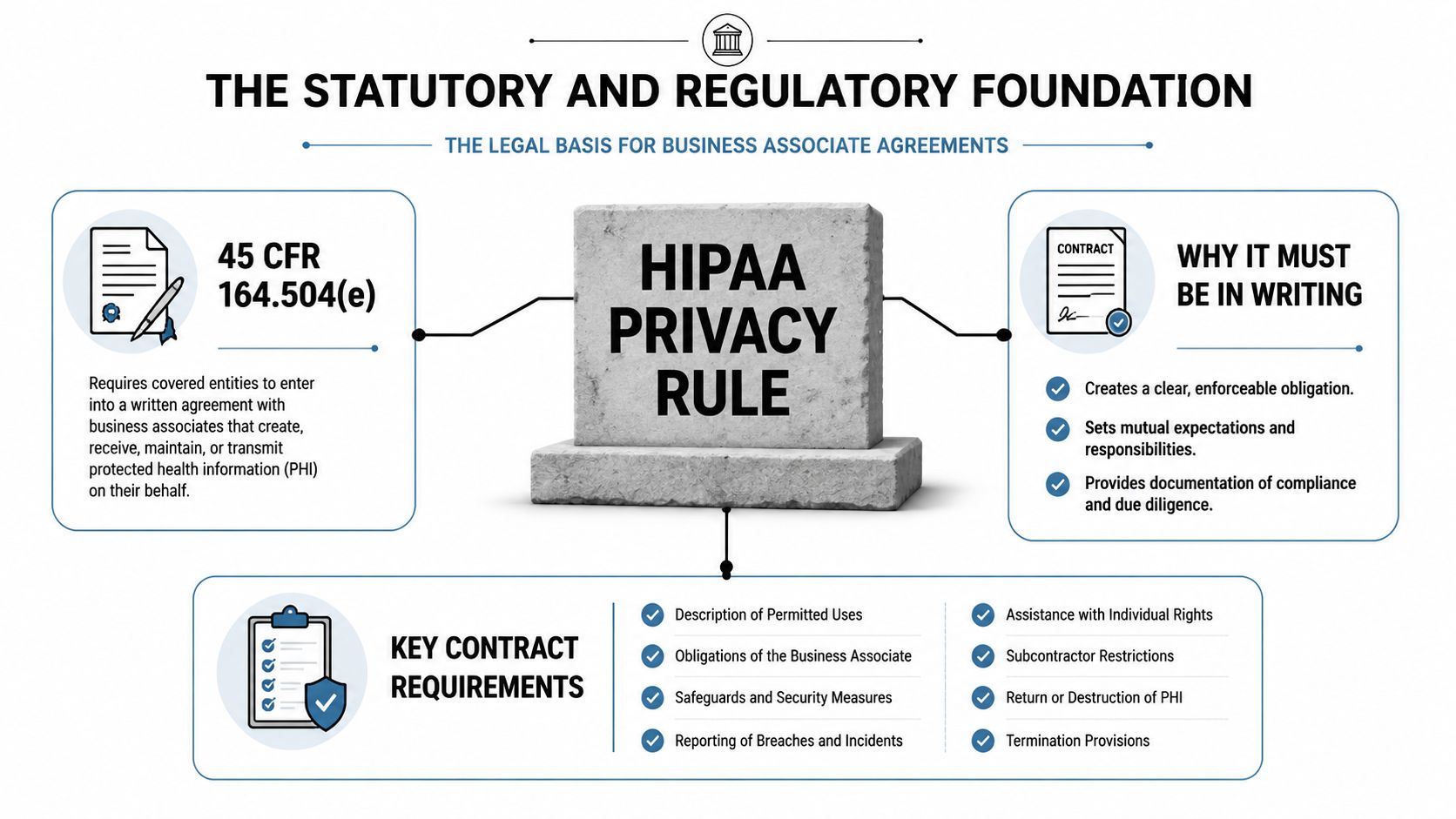
The legal floor is not fuzzy. A HIPAA business associate agreement must be in writing and must include specific terms under 45 CFR 164.504(e), because HHS requires satisfactory assurances that the vendor will safeguard PHI and use it only for the agreed purpose. HHS also makes clear that the covered entity can disclose PHI to a business associate only after those assurances are in place, so the agreement is the gateway, not decoration. HHS guidance on business associates is the controlling public framework here.
What changed after Omnibus
Before the HIPAA Final Omnibus Rule, a lot of vendors behaved as if the first contract hop was the end of the story. That approach is obsolete. The rule expanded business associate responsibilities and made clear that BAAs must reach relationships involving the creation, receipt, maintenance, or transmission of electronic PHI, including downstream subcontractors that handle PHI on the business associate's behalf. The practical result is a flow-down chain, not a single contract.
Old templates often stop at the first vendor. They may say the cloud host protects confidentiality, but they never address subcontractors, incident reporting, or what happens when the vendor changes infrastructure. Those omissions are where compliance programs break.
Who is a business associate, and who is a subcontractor
The classification step is where many firms get sideways. A business associate is not just a “vendor.” It's the entity performing a function or service for you that involves PHI. A subcontractor is the next link in the chain, the vendor your vendor uses to create, receive, maintain, or transmit PHI.
If you misclassify the relationship, every later clause starts from the wrong premise. That's why a records-retrieval company, an AI summarizer, a cloud host, or a transcription vendor can't be handled the same way as a generic office service provider. The first job is naming the role correctly. Everything else follows from that.
Mandatory Clauses Every BAA Must Contain
A compliant BAA isn't a signature page with privacy language sprinkled over it. It needs specific operational clauses that match the services being performed. In practice, I review these agreements as if I'm scoring a checklist, because vague language is usually the first sign that the contract won't hold up when the facts get messy.
Permitted uses and disclosures of PHI
The agreement has to say what the business associate may use or disclose PHI for, and it has to do that with enough precision to limit the vendor's conduct. A clause like “as necessary to perform services” is too loose for real review. Better language ties use to the specific function, the specific data set, and the specific purpose.
No unauthorized further disclosure
The BAA should say the vendor won't further disclose PHI except as allowed by the agreement or required by law. That phrasing matters because unauthorized onward sharing is what turns a routine workflow into a breach narrative. If your vendor can pass the data around without a clear boundary, you've lost the control point.
Safeguards and reporting
The agreement should require appropriate safeguards, and for ePHI that means operational security, not just a promise of confidentiality. It should also require breach reporting and describe what the vendor must report, how fast, and to whom. HHS expects breach reporting and return or destruction language at termination if feasible, and those obligations shouldn't be buried in a general services appendix. Holland & Hart's BAA discussion is a useful reminder that the enforcement stakes are real, and the contract language has to be specific enough to matter.
Drafting habit worth keeping: if a clause can't survive a vendor change, a new subprocessor, or a security incident, it's too vague.
Patient-rights support and end-of-term handling
The BAA should also support access and amendment rights, accounting obligations where applicable, and the return or destruction of PHI when the relationship ends. If return or destruction isn't feasible, the contract should keep the restrictions alive. That language sounds routine until a matter ends and the vendor still holds records, backups, or logs that no one planned for.
Safeguards and Subcontractor Flow-Down Obligations
The safeguards clause is where the BAA becomes more than a privacy promise. For ePHI workflows, it should operationalize the HIPAA Security Rule by requiring administrative, physical, and technical safeguards, and it should force the vendor to document risk review and incident reporting in a way you can verify. H.K. Law's summary of business associate agreement duties captures this practical point well, the contract has to translate security expectations into enforceable obligations.
Mapping safeguards to contract language
| Safeguard Category | What It Covers | Sample BAA Obligation | Common Drafting Gap |
|---|---|---|---|
| Administrative | Policies, training, access governance, risk review | Require documented risk assessment and security oversight | Generic promise to “maintain reasonable policies” |
| Physical | Facility, device, and media protection | Limit access to systems and media containing PHI | No mention of laptops, backups, or disposal |
| Technical | Access controls, logging, encryption, incident detection | Require technical controls for PHI access and reporting | No audit-log or incident-reporting detail |
The best contracts turn those categories into reviewable duties. The weak ones mention “HIPAA compliance” and stop there.
Flow-down language is not optional
A business associate must bind its subcontractors to the same restrictions when those subcontractors handle PHI. That's the downstream link many firms never verify. If your vendor uses a cloud host, transcription engine, analytics layer, or off-shore support team, the BAA should require the same restrictions to travel with the data.
For PI firms, vendor vetting often gets shallow. A firm may review the first contract, then assume the rest of the stack is covered. A better approach is to ask for a list of subprocessors, confirm the flow-down language, and check whether incident reporting reaches you fast enough to matter.
If you want a broader operational lens on documents and PHI workflows, Ares' HIPAA-compliant document management discussion is a practical internal reference point. For outside vendors, MD TECH TEAM's compliance audit services can also be helpful when a firm needs a structured review of control gaps.
Enforcement Exposure and Real Penalty Numbers
A PI firm that signs BAAs late, or skips them altogether, is not just leaving a contract gap. It is creating a record that can be used to show PHI moved without the controls HIPAA expects. That matters even more when the firm is acting in two roles at once, as a downstream recipient of medical records and as the entity hiring AI, cloud, or document vendors to touch those records.
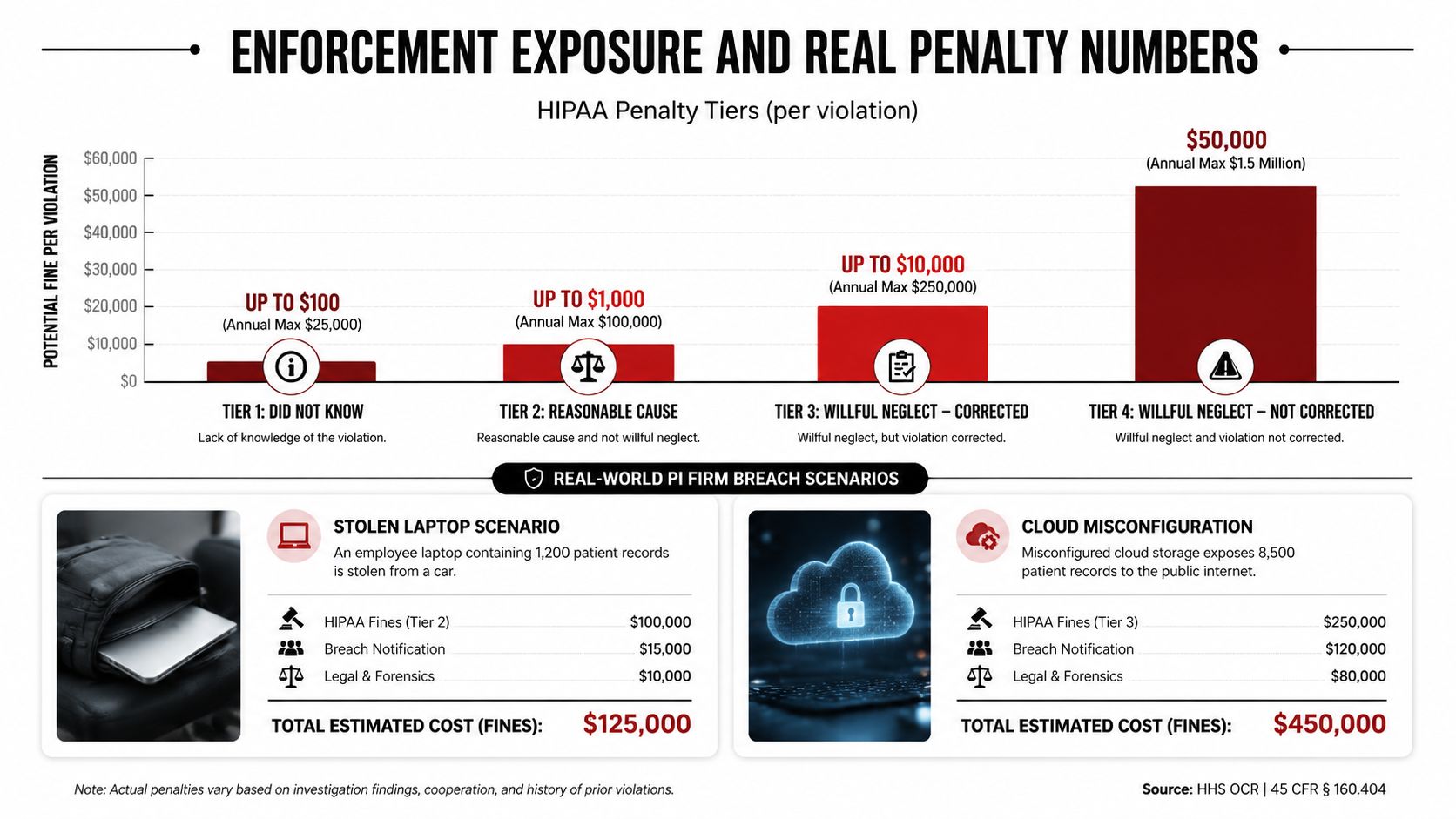
The penalty math is why I do not let firms treat BAAs like paperwork. HHS explains that civil monetary penalties are tied to the violation category and the level of culpability, and separate enforcement summaries show how quickly exposure can grow once the facts look sloppy or repeated. Holland & Hart's analysis makes the point plainly, outsourcing PHI handling does not outsource responsibility. HHS enforcement guidance on HIPAA penalty tiers confirms that the government looks at what the covered entity or business associate did, not just what the contract said.
Why the paperwork mindset is expensive
A missing BAA is not a harmless drafting miss. It shows that PHI was allowed to move without the legal structure HIPAA expects, and once a complaint or breach lands, that missing paper trail becomes part of the problem. Regulators, opposing counsel, and even your own carrier will ask why the vendor was engaged before the firm could prove the safeguards were in place.
PI firms feel that risk fast because medical records are not side documents, they are the core of the file. A paralegal sending charts to a records vendor, a claims platform, or an AI summarization tool without a signed BAA can create contract exposure, breach-response work, and a defensibility problem at the same time. The cleanup usually reaches beyond one email chain, because it often exposes weak vendor intake and poor PHI handling discipline. For a practical example of how records vendors fit into that chain, Ares' medical records retrieval companies discussion is a useful reference point.
Culpability still matters
HIPAA penalty tiers still turn on culpability, which means intent, knowledge, and the response after a problem all shape the enforcement story. A careless failure to paper a known PHI workflow looks worse than an isolated mistake that is found and corrected quickly. Even then, a low-culpability position does not erase the compliance failure, it just affects how hard the government may press on penalties.
That is why firms should fix BAA coverage before a vendor issue becomes visible. A clean inventory of vendors, signed agreements, and documented breach procedures costs far less than reconstructing the file after an incident. When firms also use outside tech or startup vendors, a structured review such as vendor risk for startups helps separate acceptable HIPAA language from contracts that leave gaps in real operations.
Mapping BAA Duties Across a PI Firm Vendor Stack
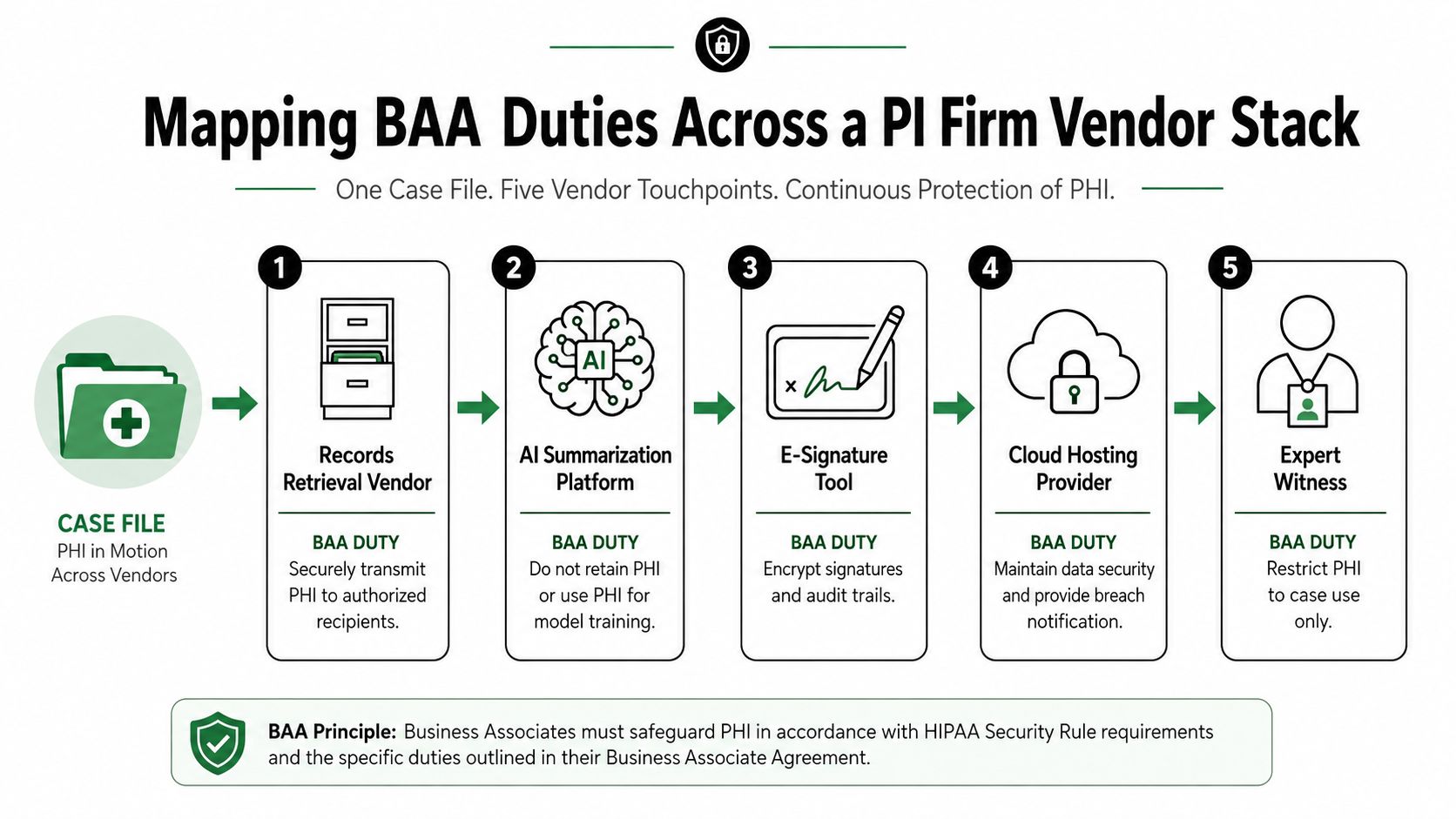
A single case file can move through five vendors before anyone drafts a demand letter. First, a records-retrieval company pulls the charts. Then an AI summarization platform structures the chronology. Next comes an e-signature tool, a cloud host, and sometimes an expert-witness coordinator. Each hop changes the contract question.
Stage by stage obligations
A records-retrieval vendor almost always needs a BAA if it is handling medical charts on your behalf. The contract should require secure transmission, limited access, and prompt breach notice. If the company also stores files, that storage function needs to be named, not assumed.
AI summarization platforms deserve extra scrutiny. If they receive PHI, the BAA should say whether the vendor can retain, analyze, or use that information for model training. Public consumer tools are a bad fit for this use case unless the product's HIPAA posture is documented and the agreement clearly addresses data handling.
Cloud hosts and e-signature tools sit in the same basic category, but their risks differ. Cloud contracts need service-specific coverage and a clear look at which services are HIPAA-eligible. E-signature tools should be checked for signature integrity, audit trails, and storage settings, because a compliant-looking workflow can still be a weak one if the platform's handling terms are thin.
For PI firms that use outside records vendors, Ares' medical records retrieval companies guide is a useful internal resource because it tracks the PHI-handling role at the point where many cases first become document-heavy. On the broader market side, vendor risk for startups is a good reminder that vendor review has to match the actual data exposure, not the sales pitch.
Vendors that usually require a BAA in PI practice
- Records-retrieval vendors, because they handle charts and transmissions.
- AI summarization and transcription tools, because they process PHI directly.
- Cloud storage and hosting providers, because they maintain case files.
- Secure client portals and e-signature tools, when they route or store PHI.
- Expert coordination platforms, when they centralize medical records or expert reports.
If a vendor touches the file and can see more than incidental PHI, the BAA question is almost always live.
Common Compliance Pitfalls and Vendor Vetting Mistakes
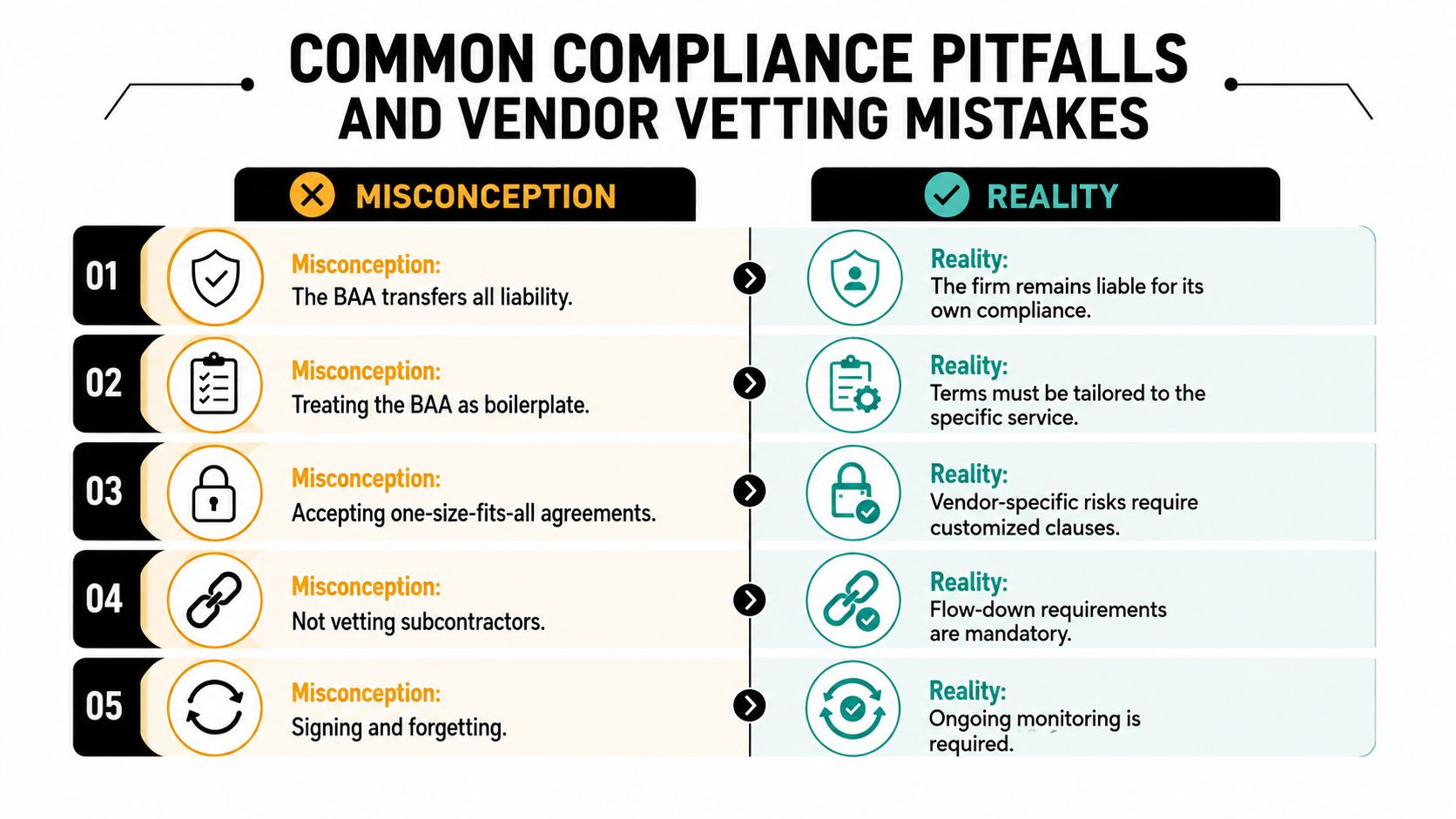
Signing a BAA does not transfer all liability to the vendor. HHS guidance is explicit that the covered entity still needs contractual assurances and still owns its own compliance posture, so the firm can't hide behind a signed attachment and call it done. Ares' vendor security assessment guide is a helpful lens for thinking about ongoing review, because the problem is usually not the first signature, it's what happens after the vendor relationship changes.
Boilerplate language
The symptom is a BAA that looks copied from a generic template. The root cause is usually speed, not malice. The fix is to tie the contract to the actual service, actual data type, and actual breach path.
One-size-fits-all templates
A vendor's standard paper may be acceptable as a starting point, but not as the final form if the service involves PHI, AI processing, or multiple subprocessors. The firm needs to redline for the actual workflow, especially if the vendor shifts infrastructure or adds new data-handling steps.
Stale agreements
A signed BAA can go stale when services change and nobody reopens the file. That's where a simple annual review cycle helps, because it catches new subprocessors, new modules, and new risk surfaces before the contract starts telling the wrong story.
Ignored state-law overlays
HIPAA is the floor, not the ceiling. A firm that only checks the federal box may still miss state privacy, confidentiality, or records-handling obligations that affect medical data in litigation. The fix is a jurisdiction check at onboarding, not after a dispute.
Signing and forgetting
The last common error is no monitoring after signature. That's the easiest one to correct, because it only requires ownership, reminders, and a rule that any material vendor change triggers a BAA review.
A Practical 30 Day BAA Compliance Plan
Start with a full inventory of every vendor and workflow that touches PHI. Pull the executed BAAs, separate the ones that are current from the ones that are stale, and flag any relationship where the paper trail is missing or unclear. That's week one.
Week two is clause review. Compare each agreement against the mandatory terms, then mark gaps in permitted uses, safeguards, breach reporting, return or destruction, and subcontractor flow-down language. Don't wait for a perfect redline before you identify the holes.
Week three is vendor outreach and re-papering. Send targeted revisions to the highest-risk vendors first, especially the ones handling cloud storage, AI processing, or dense medical archives. If a vendor won't sign a workable BAA, that's a product decision disguised as a legal one.
Week four is the control rhythm. Set annual reviews, require notice of subprocessor changes, and align incident response with the people who own the case data. A mature program has a named owner, a current inventory, and a repeatable review cycle. Checkbox theater has none of that.
If your firm needs a BAA review that reflects how PI practices use medical records and AI tools, Ares can help you pressure-test the vendor stack, the data flow, and the contract language before a missed clause turns into a case-day problem. Visit Ares to see how its PHI-focused document workflow can fit into a tighter compliance process and support a cleaner vendor review conversation.