
For any personal injury firm, the race against the clock starts the moment a client walks in the door. But there's a huge, often invisible, roadblock that slows down even the most efficient teams: getting the client's medical records.
The Hidden Bottleneck in Every Personal Injury Case
Picture one of your best paralegals. Instead of drafting demand letters or prepping for depositions, they’re stuck on hold with a hospital records department for the third time this week. They're juggling faxes, follow-up calls, and confusing provider portals, trying to piece together a client's medical history from a dozen different clinics.
This isn't just frustrating—it's a massive drain on your firm's resources. This manual, repetitive process is the single biggest bottleneck in moving a case forward. Every minute your team spends chasing paperwork is a minute they're not focused on winning the case. For many firms, this administrative grind eats up an estimated 25%-40% of their operational efficiency, a staggering loss of valuable time and talent.
The Solution to Administrative Gridlock
This is exactly the problem medical records retrieval companies were created to solve. They're not just a vendor; think of them as a specialized logistics partner for your most crucial evidence. Their entire operation is designed to master the maze of healthcare provider networks.
A dedicated retrieval partner acts as a seamless extension of your law firm. They take the chaotic, time-consuming task of gathering records and turn it into a predictable, streamlined system.
Instead of your team sending out dozens of individual requests, a retrieval company manages the entire process. They have established relationships with records custodians all over the country, know the specific quirks and requirements of each provider, and have the persistence to follow up relentlessly until every last page is in your hands.
From Couriers to Cloud Platforms
The world of record retrieval has changed dramatically. It started with simple courier services—literally people driving to doctors' offices to pick up manila folders. Now, it's a high-tech industry dominated by secure online portals, real-time status tracking, and instant digital delivery.
The latest leap forward is the integration of AI. Platforms like Ares are changing the game entirely. They don't just get the records for you; they help you make sense of them. These tools can automatically organize, index, and even analyze thousands of pages, turning a mountain of raw medical data into a clear, strategic advantage from the very beginning.
Decoding the Different Service Models
Not all medical records retrieval companies are built the same. The key to picking the right one is understanding the fundamental differences in how they operate, because each service model is designed to solve a very different set of problems for a personal injury firm.
Think of it like hiring a contractor for a home renovation. You could hire someone just to deliver the materials, a general contractor to manage the whole project, or a full-design-and-build firm that handles everything from blueprints to the final coat of paint.
The choice really comes down to one simple question: How much of this work do you actually want to do yourself? Each model offers a different level of partnership, which directly impacts your team’s workload, how quickly your cases move, and your firm's overall efficiency.
As this workflow shows, the process of manually collecting medical records is often the single biggest bottleneck holding up a case.
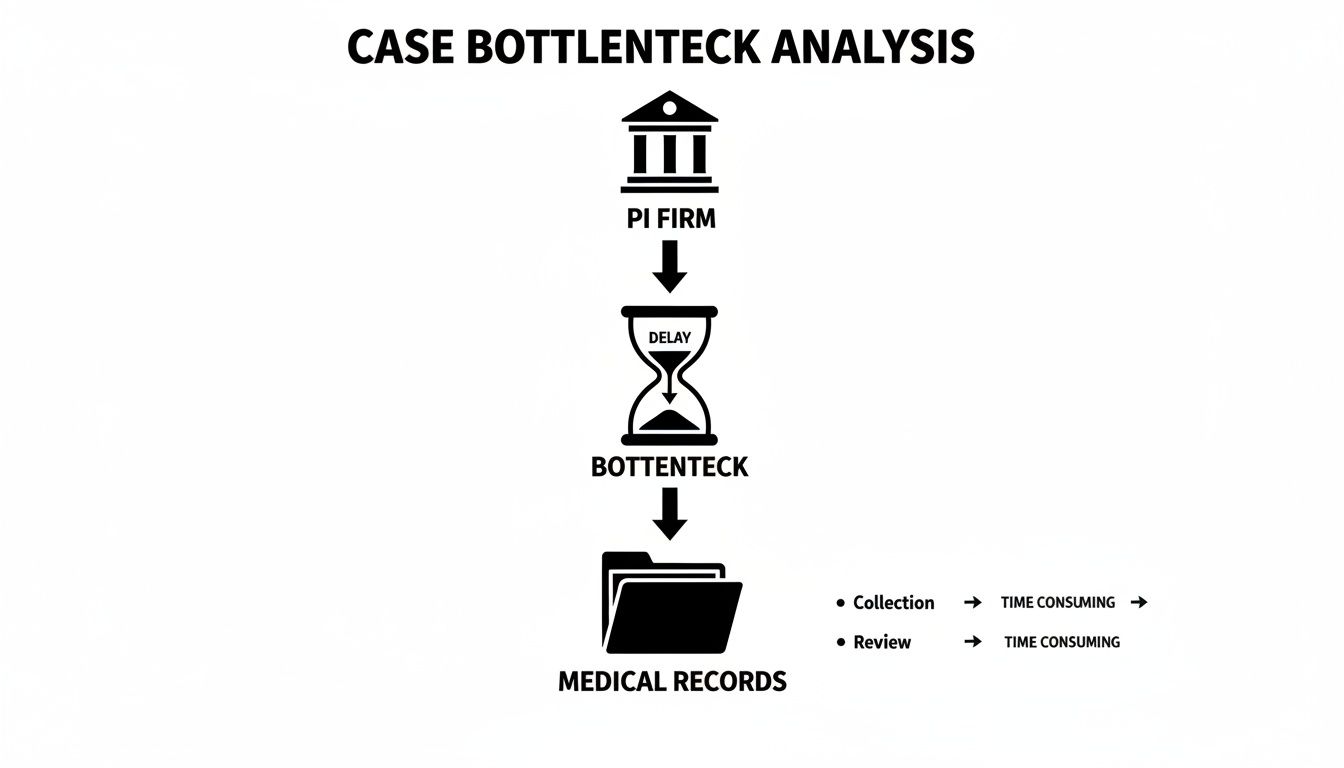
This is the chokepoint where momentum dies. Finding a specialized solution is critical to keeping your cases on track.
The Courier Model: A Specialized Delivery Service
The most basic offering is the Courier Model. Think of this service as a highly specialized delivery driver. You figure out what you need and from where, and their only job is to get the records from the provider’s office to yours, whether it's a physical stack of papers or a secure digital file.
This model is simple and usually the most budget-friendly option. But don't mistake it for a comprehensive solution; its scope is very narrow by design.
- Your team still does all the heavy lifting: You’re the one making the initial requests, filling out every provider's unique authorization forms, and making all the follow-up calls when records are late.
- The vendor's role is simple: They only handle the secure transfer of documents after the provider has already released them.
This approach is a decent fit for firms that already have a seasoned, highly efficient internal team for managing record requests. If your system is already a well-oiled machine but you just need a reliable partner for the final handoff, the Courier Model can work. It offloads a minor task, but the most time-consuming work stays firmly on your team's plate.
The Full-Service Retrieval Model: A General Contractor
The most common option you'll find from traditional medical records retrieval companies is the Full-Service Retrieval Model. This is much more than a delivery service; it's like hiring a general contractor to manage your evidence-gathering project. You hand over the assignment, and they take care of the entire process, from start to finish.
This model is built to lift the entire administrative burden from your staff's shoulders.
This model is the industry standard for a reason: it directly solves the biggest headache for most law firms—the incredible amount of time and energy burned chasing down documents from dozens of different healthcare providers.
A full-service partner handles every single step. They initiate the requests with the correct authorizations, they do the persistent follow-up calls, and they consolidate all the records into one organized file for you. By outsourcing this whole workflow, your paralegals can stop playing phone tag and get back to the high-value legal work they were hired to do. Firms often see an estimated 62% improvement in turnaround time when they switch from in-house efforts to a dedicated full-service partner.
Retrieval Plus Indexing: The Concierge Service
The most advanced model is Retrieval + Indexing/Summarization. This is the white-glove, concierge-level service. It doesn’t just drop a pile of documents on your desk; it delivers actionable intelligence. This kind of partner acts as both your general contractor and your project analyst, not only getting the records but also organizing the raw data into a format you can actually use.
This all-in-one approach typically includes:
- Complete Retrieval: Managing the entire A-to-Z process of getting the records.
- Organization: Sorting all documents chronologically so the timeline makes sense.
- Indexing: Creating a hyperlinked index or a table of contents that makes it easy to jump to specific dates or providers within a massive file.
- Summarization: Some services use nurse consultants or AI to create high-level medical chronologies or summaries of key events.
This model provides the highest degree of support, transforming a chaotic document dump into a case-ready file. For firms that want to maximize their efficiency and build a case strategy faster, this concierge approach offers the biggest time savings and the most strategic value. It lets your attorneys grasp the critical facts of a case almost instantly. Platforms like Ares are built on this very principle, using AI not just to retrieve records, but to immediately analyze and structure the medical evidence for you.
To make it easier to see how they stack up, here’s a quick comparison of the three models.
Comparing Medical Record Retrieval Service Models
| Feature | Courier Model | Full-Service Retrieval | Retrieval + Indexing |
|---|---|---|---|
| Who initiates the request? | Your Firm | Vendor | Vendor |
| Who handles follow-ups? | Your Firm | Vendor | Vendor |
| Document Organization | None (delivered as-is) | Basic consolidation | Chronological sorting, Bates stamping |
| Document Navigation | Manual review | Manual review | Hyperlinked index, bookmarks |
| Best For... | Firms with strong in-house processes seeking delivery help | Firms wanting to fully outsource the administrative burden | Firms focused on maximum efficiency and faster case analysis |
| Primary Value | Secure, reliable transmission | Time savings for paralegals | Actionable, case-ready intelligence |
Ultimately, the best choice depends entirely on where your current process is breaking down and how much of your team's valuable time you want to reclaim.
Security and HIPAA: The Foundation You Can't Afford to Ignore
When you're shopping for a medical records retrieval company, it's easy to get distracted by flashy portals and promises of lightning-fast speed. But none of that matters without an ironclad commitment to security. We're talking about Protected Health Information (PHI), and handling it is a massive legal and ethical weight on your shoulders.
One mistake can bring on staggering penalties, shatter your firm's reputation, and completely destroy the trust you've built with your clients. This isn't about ticking a "HIPAA compliant" box. Real compliance is a constant, active process built into every single piece of a vendor's technology and workflow. It's the critical difference between a company that just follows the rules and a true partner that protects your firm's integrity as if it were their own.
The Core Pillars of a Secure Partner
To properly vet a potential partner, you have to look past the marketing claims. You need to focus on the concrete security measures they use to protect your client's most sensitive data, from the second a request is initiated until it lands securely in your hands.
Here are the three absolute must-haves:
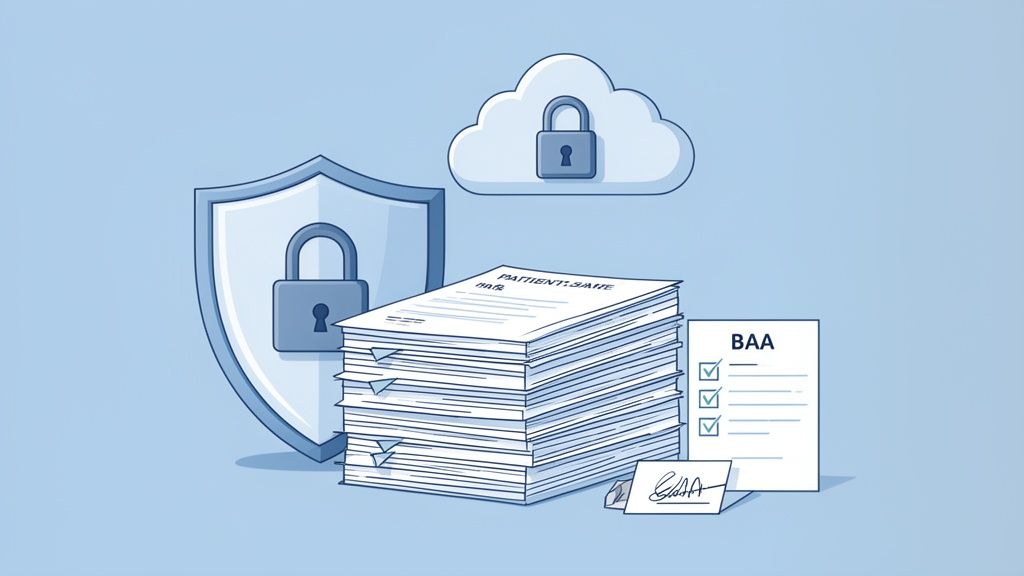
Business Associate Agreements (BAAs): This is the fundamental legal contract HIPAA demands. It binds the retrieval company to the same strict PHI protection standards as a hospital or doctor's office. If a vendor hesitates to sign a BAA, walk away. Period.
End-to-End Encryption: Your data has to be locked down at all times. That means encryption in transit (as it travels across the internet) and encryption at rest (while it's stored on their servers). This two-pronged approach ensures that even if someone physically broke into a data center, the files would be completely unreadable.
Secure Portal Access: Any modern retrieval partner worth their salt will offer a secure, password-protected online portal. This isn't just a website; it should have role-based access controls (so you can decide who on your team sees what) and a clear audit trail logging every single action.
Questions Every Managing Partner Must Ask
Don't be shy about grilling potential vendors on their security practices. Asking tough, specific questions is the only way to uncover the true strength—or weakness—of their compliance posture. Keep in mind that real security requires a significant investment; a look at the typical HIPAA compliance audit cost shows just how serious a commitment it is.
A vendor's response to your security questions tells you everything about their company culture. If you get vague answers or a dismissive attitude, that’s a massive red flag. It means security is an afterthought, not a core value.
Start with these essential questions:
- What does your data breach response plan look like?
- Do you undergo regular third-party security audits or penetration tests?
- What specific HIPAA and data privacy training do your employees receive?
- How do you secure your physical data centers?
This is where purpose-built platforms like Ares really stand apart. Security isn't just a feature added on top; it's woven into the very architecture with an enterprise-grade, zero-trust model from the start. For a deeper dive, our guide on HIPAA-compliant document management explains this approach. It makes top-tier security an effortless part of your daily workflow, so you can focus on building your case, not worrying about your data.
In-House vs. Outsourcing vs. AI: Making the Right Strategic Choice
Deciding how to get your hands on medical records isn't just another item on the to-do list. It's a strategic call that has a direct line to your personal injury firm's bottom line, speed, and ability to grow. Get it right, and you can shave weeks off your case timelines and let your best people focus on work that actually wins cases. Get it wrong, and you’re stuck with a constant drag on your resources and momentum.
When you boil it down, you've got three real options: keep everything in-house, hand it off to traditional medical records retrieval companies, or embrace a modern, AI-powered platform. Each path comes with its own unique blend of costs, control, and efficiency. Let's break them down.
The In-House Approach: Keeping Control, but at What Cost?
Running medical record retrieval yourself means your firm holds all the cards. Your paralegals are on the front lines, sending every request, making every follow-up call, and tracking every piece of paper. It’s a hands-on method that guarantees total oversight.
But that level of control comes with a hefty price tag. The reality is that this process is an incredible time-sink. It often pulls your most talented paralegals away from high-value legal work—like drafting motions or prepping for depositions—and sticks them in an endless loop of administrative busywork.
Pros of In-House Retrieval:
- Total Control: You’re in the driver's seat for the entire process, from start to finish.
- Direct Provider Communication: Your team can build relationships directly with the records custodians at local hospitals and clinics.
Cons of In-House Retrieval:
- High Opportunity Cost: Every hour a paralegal spends chasing records is an hour they’re not spending on billable, case-winning tasks.
- Inefficiency and Delays: Without specialized systems and a deep network of provider contacts, in-house teams often hit roadblocks and face longer turnaround times.
- Hidden Expenses: The cost isn't just a salary. It’s also overhead, phone bills, and the sheer productivity lost to chasing paper.
This approach quickly becomes a major bottleneck, making it nearly impossible for a firm to scale its caseload without just hiring more and more administrative staff. You can learn more about the different types of record retrieval solutions that help firms break out of this cycle.
Outsourcing to Traditional Retrieval Companies: The Time-Saving Trade-Off
For years, the classic answer to the in-house headache has been to partner with a traditional medical records retrieval company. The idea is simple: you offload the entire administrative slog to a third-party specialist. They take on the requests, the persistent follow-ups, and the document collection, which frees up your team to focus on legal strategy.
This model is a massive upgrade in terms of raw efficiency. The global Medical Record Retrieval Service market is expected to jump from US$476 million in 2025 to US$731 million by 2032. For PI attorneys, this growth is all about services that can cut retrieval times from 21-30 days down to a nimble 7-12 days—a 62% improvement that keeps cases moving forward. You can read more about this growing market and its impact on legal workflows on marketpublishers.com.
Outsourcing is great at solving the retrieval problem, but that's often where the service stops. The vendor delivers a mountain of documents—sometimes thousands of pages—and your team is right back where they started, manually sifting through it all to find the key facts.
Pros of Outsourcing:
- Significant Time Savings: It gets your paralegals out of the administrative weeds.
- Expertise and Networks: These companies have established processes and contacts with providers all over the country, which speeds things up.
Cons of Outsourcing:
- Limited Scope: The job is done once the raw documents are delivered, leaving the critical analysis entirely up to your team.
- Communication Gaps: You give up direct control, and getting clear status updates can sometimes feel like pulling teeth.
- Variable Quality: The organization and completeness of the records you get back can be inconsistent from one vendor to the next.
AI-Powered Platforms: The Modern Hybrid Solution
Then there's the third option: an AI-powered platform like Ares. This isn't just another way to get records; it’s a completely different way of thinking about them. It blends the best parts of the other two approaches while getting rid of their biggest weaknesses. This model isn't just about retrieving records—it's about turning that raw data into actionable case intelligence right from the start.
An AI platform automates the entire retrieval process, but then it does something crucial. It actually analyzes, organizes, and summarizes the records for you, automatically pulling out key information like diagnoses, treatment dates, and billing codes.
With this approach, you get the control of an in-house expert, with full visibility into the process and deep insights into the records themselves. At the same time, you get the speed and cost-efficiency of a top-tier outsourcing partner. Instead of a 1,000-page PDF getting dropped in your lap, you receive a structured, searchable summary that flags the most critical facts in the case. This turns a simple administrative decision into a real strategic advantage, helping your firm build stronger cases and settle them faster.
How to Evaluate and Choose the Right Retrieval Partner
Picking a partner from the crowded field of medical records retrieval companies is a decision that goes way beyond a simple price sheet. Get it right, and you can unlock a new level of efficiency. Get it wrong, and you've just created new bottlenecks, added risk, and frustrated your team. This isn't just about hiring a vendor; you're bringing on an operational partner whose performance has a direct line to how quickly and profitably you can settle cases.
To make a smart choice, you have to look past the sales pitch and dig into real-world performance metrics and tech capabilities. A great partner should feel like a natural extension of your firm, one that anticipates your needs and delivers not just documents, but clear, usable intelligence that strengthens your cases from the start.
The Essential Evaluation Checklist
Before you even think about signing a contract, you need to put potential partners through their paces. A structured evaluation is the only way to see their true strengths and weaknesses. Think of it like a pre-flight checklist; running through these points ensures you’re set up for a smooth partnership.
A great way to start is with a pilot program. Hand over a small batch of 5-10 active cases and see how they actually perform. This test run gives you invaluable, real-world data on their turnaround times, their communication style, and the quality of the records they actually deliver.
Here are the key areas to scrutinize:
- Performance and Speed: How long does it really take to get records back? Ask for their average turnaround time (TAT) and then track it yourself during the pilot.
- Technology and Integration: Does their platform play nice with your case management software? Can you easily see the status of every request in real-time through a secure portal?
- Pricing Transparency: Is the pricing model straightforward? You need to know if it's a flat rate, a per-page fee, or a subscription. More importantly, you need to hunt down any hidden costs before they bite you.
- Customer Support: What happens when a provider is dragging their feet or a record comes back incomplete? This is a crucial test. See how their team responds and solves problems when things don't go perfectly.
Key Questions to Ask Potential Partners
Drilling down with specific, targeted questions is the best way to separate the real contenders from the rest. If you get vague answers, that’s a major red flag. A confident, capable partner will have direct, clear responses ready to go.
A vendor's process for handling exceptions—like a non-compliant provider or a missing authorization—is the true test of their value. Smooth sailing is easy; how they navigate choppy waters reveals their expertise and commitment to your firm's success.
Use this checklist during your evaluation calls:
- What is your documented process for follow-ups with unresponsive providers? You're looking for a systematic approach, not just "we call them a lot."
- How do you ensure record accuracy and completeness? Do they have a quality assurance team or process to check for missing pages or incorrect documents?
- Can you provide a clear breakdown of all potential fees beyond the initial quote? Get them to detail provider fees, postage, and any special handling charges.
- What level of technological support and training do you offer our team? A sophisticated platform is useless if your team doesn't know how to use it.
Focusing on ROI Beyond Cost Savings
While cutting down on overhead is a fantastic benefit, the real return on investment comes from reclaiming your team’s most valuable asset: time. Outsourcing medical records retrieval, especially to an AI-hybrid operation, can deliver 60-62% cost savings on the roles that handle this work. For instance, a retrieval specialist in the U.S. might earn $70k–$90k, while the same secure, HIPAA-compliant work can be done in an optimized offshore hub for just $28k–$40k. You can learn more about the trends shaping the record retrieval market on stax.com.
This financial upside is huge, but the strategic advantage is even bigger. When your paralegals aren’t bogged down chasing records, they can dedicate their time and expertise to higher-value work that actually moves cases forward. This is where platforms like Ares create a serious advantage, automating not just the retrieval but also the analysis that follows—turning stacks of raw documents into case-ready summaries and even demand letter drafts, all on their own.
The Future Is Here: AI-Powered Automation and Analysis
Traditional medical records retrieval companies solve a huge logistical headache by getting documents to your firm's doorstep. But that's usually where their job ends—and where your team's most time-intensive work begins. This hand-off point is precisely where the next wave of legal technology is creating a massive strategic advantage for personal injury firms.

AI-powered platforms don't just fetch records; they dive in and automate the deep analysis that comes next. Instead of your paralegals spending hours slogging through hundreds of pages, an AI system can process the entire file in mere minutes. It transforms a dense stack of raw documents into a structured, searchable, and genuinely usable case summary.
From Raw Data to Actionable Intelligence
This new generation of tools goes way beyond simple document delivery. They provide immediate case intelligence. The technology is built to understand the context within medical records, automatically pulling out the most critical data points. To get the most out of these AI workflows, having the right records retrieval solutions is key to finding the needle in the haystack and getting it ready for analysis.
This automated process instantly extracts key information, such as:
- Diagnoses and ICD Codes: Pinpointing all official diagnoses.
- Treatment Timelines: Building a crystal-clear, chronological history of care.
- Billing Information: Connecting treatments directly to their associated costs.
- Key Providers: Mapping out every doctor, specialist, and facility involved in the case.
This isn't just about saving time—it's about seeing the complete picture faster than ever before. AI analysis can instantly spot gaps in treatment, uncover details you might have missed, and surface the most compelling evidence for your case.
This capability is truly changing the game. The global EMR market is on track to hit USD 46.34 billion by 2031, with AI being a major force behind that growth. By automating documentation and improving accuracy by up to 25%, these platforms give case managers back more than 10 hours per case. That's time they can use to help the firm take on a much higher caseload.
The True ROI for Forward-Thinking Firms
The value of an AI-powered partner like Ares goes far beyond just administrative efficiency. It directly impacts your firm's ability to build stronger cases and secure better outcomes for your clients. By taking the grunt work of record review off your team's plate, they can immediately shift their focus to high-level strategy.
The benefits create a powerful competitive edge:
- Eliminate Manual Review: Free up your most talented paralegals from the tedious task of reading every single page.
- Strengthen Negotiations: Quickly spot treatment gaps or inconsistencies to build a more formidable argument.
- Draft Compelling Demand Letters Faster: Use AI-generated summaries and timelines to craft a stronger narrative in a fraction of the time.
Ultimately, this positions modern platforms as much more than just another retrieval service. They become a strategic partner in your firm's success. They amplify your ability to win bigger and settle faster, making them the logical next step for any practice serious about growth and delivering superior client service. To learn more, check out our guide on how AI medical record review is changing the game for PI firms.
Answering Your Top Questions
When it comes to outsourcing medical records retrieval, most personal injury firms boil it down to the same core questions: What does it cost, how fast is it, and is it secure? Let's get straight to the answers you need before you bring a new partner into your workflow.
What’s the Real Cost of a Medical Records Retrieval Service?
Pricing is all over the map, which is why you need to press for total transparency from any potential vendor. You'll typically run into one of three models, and each impacts your firm's budget differently.
- Per-Page: You're billed for every single page retrieved. This model can get out of control quickly, especially in cases with long, complex medical histories.
- Flat-Fee: This is the most predictable option. You pay one set price for each retrieval, no matter how many pages come back. It makes forecasting your case expenses a whole lot easier.
- Subscription: For firms handling a high volume of cases, a monthly or annual fee can cover a certain number of requests, often at a better overall rate.
The key is to ask for a complete fee schedule right from the start. You need to know about any potential "gotchas" like provider fees, postage costs, or extra charges for rush jobs. A partner worth their salt will be completely upfront about every possible cost.
How Long Will I Be Waiting for Records?
This is the million-dollar question because time is money. While every provider is different, a professional service should give you a major speed advantage over trying to do it all in-house.
With a traditional service, you can generally expect to wait somewhere between 15 and 30 days. Most will offer an expedited option if you're in a pinch. However, this is where modern, tech-focused platforms really shine. They often have established digital pipelines with healthcare networks, which can slash that wait time, sometimes by more than half.
The secret to a vendor's speed isn't just technology—it's their follow-up game. An expert retrieval partner is relentless and systematic about chasing down providers. That persistence is what keeps your requests from getting lost in a pile on someone's desk and ensures your cases stay on track.
Can I Trust These Services with Sensitive Client Data?
You absolutely can, but only if you choose a vendor who lives and breathes security. Handing over Protected Health Information (PHI) is a massive responsibility, and you can't afford to get it wrong.
Any company you even consider must be fully HIPAA compliant. That’s non-negotiable.
This means they are legally required to protect your client's data with the same level of care as a hospital. Before signing anything, make sure they will sign a Business Associate Agreement (BAA). Ask them to walk you through their security measures, like end-to-end encryption for data as it's being sent and while it's being stored. Your firm's reputation—and your clients' trust—is on the line.
Ready to eliminate the retrieval bottleneck and the hours of manual review that follow? Ares uses AI to not only retrieve records but also analyze them, providing you with case-ready summaries and demand letter drafts in minutes. Discover how Ares can help you settle faster and claim bigger.