
At 9 p.m. on Sunday, a personal injury file can feel less like a case and more like an archaeological dig. The chronology spreadsheet has conflicting dates, a hospital has delivered a 600-page PDF, another provider's portal is open in a second tab, and a deposition is scheduled for the next morning. The attorney still needs to determine what happened before the incident, which diagnoses relate to it, whether treatment supports the claimed damages, and what remains missing.
That pressure isn't created by slow note-taking. It comes from volume across providers and years of treatment. A demand may depend on a single operative report, a gap in care, a prior complaint, or a statement buried in a nursing note. Manual review forces attorneys and paralegals to triage every page while trying to preserve a defensible record of where each fact came from.
AI medical documentation software can serve PI firms differently from hospitals and clinics. The relevant use case isn't only ambient capture during a two-person visit. It's batch medical-record review, chronology construction, issue spotting, and demand drafting across an entire case file.
The Sunday Night Stack of Records
The attorney starts with the hospital PDF, searching for the incident date and finding several references that don't line up. A specialist's note describes worsening symptoms, but the primary care records contain earlier complaints that could affect causation. The billing pages show treatment occurred, yet the clinical notes needed to explain that treatment are missing. By midnight, the spreadsheet has grown, but the attorney still doesn't have a reliable narrative.
That experience is common in PI operations because the record set expands horizontally. One patient may have emergency care, imaging, surgery, physical therapy, pain management, primary care, and pharmacy records. Each provider uses different terminology, date formats, note structures, and levels of detail. The review challenge isn't just reading faster. It's connecting events that were never designed to connect.
Practical rule: A demand timeline is only as dependable as its weakest unresolved date, diagnosis, or source document.
The consequences show up in the case calendar. A firm may have enough information to request records but not enough organization to evaluate the claim. The demand waits while a paralegal checks whether a diagnosis is new or pre-existing, whether the claimant reached maximum medical improvement, and whether a provider's statement supports a future-care position. A case that could move in a month can remain in review for much longer because every new document restarts manual sorting.
The PI use case is broader than clinical scribing
In healthcare, ambient tools capture a patient-clinician conversation and create a draft note for review. That foundational pattern has moved into mainstream hospital workflows. A 2025 study of U.S. hospitals using Epic found that 1,744 of 2,785 hospitals had implemented at least one ambient AI tool, a 62.6% adoption rate, with adoption particularly high among nonprofit and metropolitan hospitals, as reported by Becker's Hospital Review.
PI firms need a different operating lens. The raw material is usually an accumulated record set, not one live encounter. The useful output is a page-cited chronology, provider and diagnosis map, treatment-gap list, and editable demand narrative. The attorney remains responsible for interpretation, strategy, privilege decisions, and final language.
What AI Medical Documentation Software Actually Does
AI medical documentation software turns unstructured medical records into organized working material. A PI-oriented system ingests PDFs, scanned pages, reports, notes, and related documents, then produces artifacts that resemble the work of a trained records-review paralegal: searchable text, categorized documents, extracted dates, medical events, providers, diagnoses, treatment sequences, and draft summaries.
The first technical layer is usually optical character recognition, or OCR. It converts scanned pages into machine-readable text. Classification then separates document types, such as imaging reports, operative notes, emergency records, therapy notes, discharge summaries, and billing material. Extraction models identify entities and relationships, including dates, facilities, clinicians, symptoms, diagnoses, procedures, medications, and references to prior conditions.
Large language models add the interpretation layer. They can summarize a treatment course, compare statements, group related events, and draft narrative sections. That doesn't mean the model understands medical causation or legal responsibility as an attorney does. It means the system can reduce the effort required to locate and arrange relevant information before professional judgment is applied.
Three jobs the software should perform
Organize the record set. The platform should make a multi-provider file searchable and structured instead of leaving the team with a stack of PDFs and a manually maintained spreadsheet.
Surface relevant facts. It should identify treatment milestones, diagnoses, gaps, inconsistencies, pre-incident history, post-incident changes, and references that deserve attorney review.
Produce a first draft. It can prepare a medical summary, chronology narrative, or demand section that counsel edits against the underlying records. A useful first draft reduces blank-page work. It doesn't replace source verification.
The distinction matters when evaluating adjacent products. A tool designed for ambient clinical capture may be excellent at producing a note from a conversation but weak at processing a large historical record. For a broader view of drafting workflows, a resource on an AI legal document generator can help teams compare general legal drafting capabilities with medical-record-specific systems.
Core Features That Matter for PI Casework
A PI firm shouldn't buy based on whether a vendor can produce an attractive summary from a clean sample file. The evaluation should start with the recurring work that slows real matters.
Chronology depth comes first
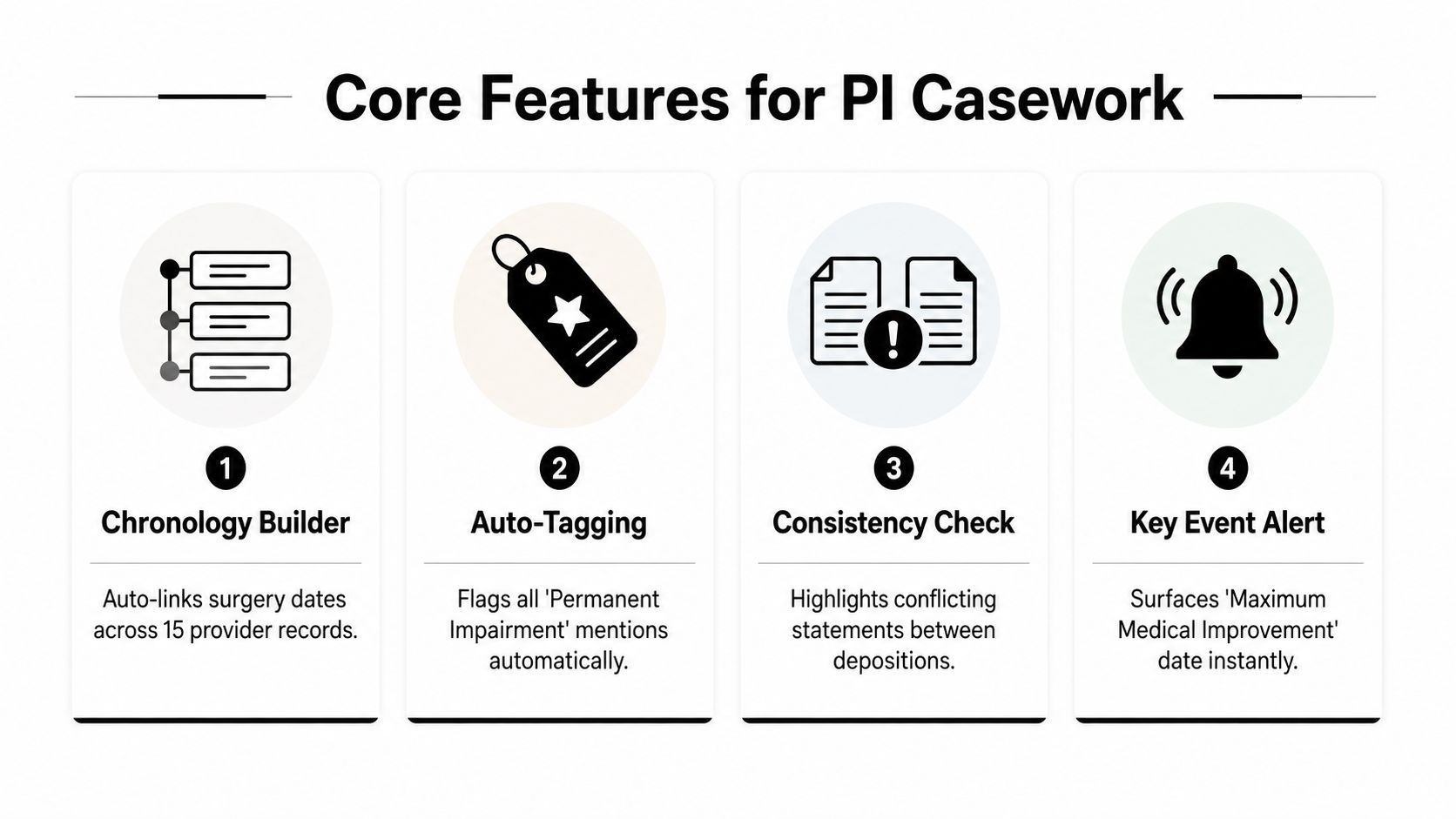
The chronology engine needs to connect dates across providers without flattening important distinctions. It should identify the incident, emergency evaluation, diagnostic testing, procedures, follow-up visits, therapy sessions, medication changes, work restrictions, and later assessments. It should also preserve the source page or document for each event, because a polished timeline without traceability creates review risk.
Auto-tagging makes the chronology more usable. Tags for surgery, imaging, injections, worsening symptoms, permanent impairment, maximum medical improvement, and future care can give a reviewer a focused route through a large file. The system should also support pre-incident and post-incident comparisons, rather than treating every diagnosis as part of the claim.
Extraction should map the whole medical cast
Provider extraction needs to capture more than the attending physician. Facilities, radiologists, surgeons, therapists, nurses, primary care clinicians, and specialists may each contribute a fact that changes the case theory. Diagnosis extraction should preserve the wording used in the record while allowing the team to group related conditions for review.
medical record summarization for litigation can serve as a useful reference point for teams defining the level of detail, source traceability, and chronology structure they expect from a system.
Gap detection is a case-management feature
A strong platform should flag more than missing pages. It should help identify:
- Missing source material: A report references imaging, but the imaging report isn't in the production.
- Unsigned or incomplete notes: A draft or partial note may not support the conclusion a summary draws from it.
- Treatment discontinuities: A patient reports ongoing symptoms, but the file contains no follow-up for a meaningful period.
- Unexplained changes: A diagnosis, restriction, or medication appears without an obvious preceding event.
- Conflicting accounts: Different providers describe onset, mechanism, or prior symptoms differently.
The output should also help assemble a demand narrative covering mechanism of injury, treatment course, functional impact, permanency, and future medical needs. The attorney should edit that language, test it against the records, and decide what belongs in the demand.
Collaboration cannot be an afterthought
Multiple attorneys, paralegals, experts, and co-counsel may touch the same matter. Annotation, redaction, permissions, version history, and export controls matter because a chronology becomes part of a broader litigation process. A practical overview of AI tools for lawyer case prep can help firms think through how medical-record tools fit beside broader case-preparation systems.
HIPAA, PHI, and the Trust Layer You Cannot Skip
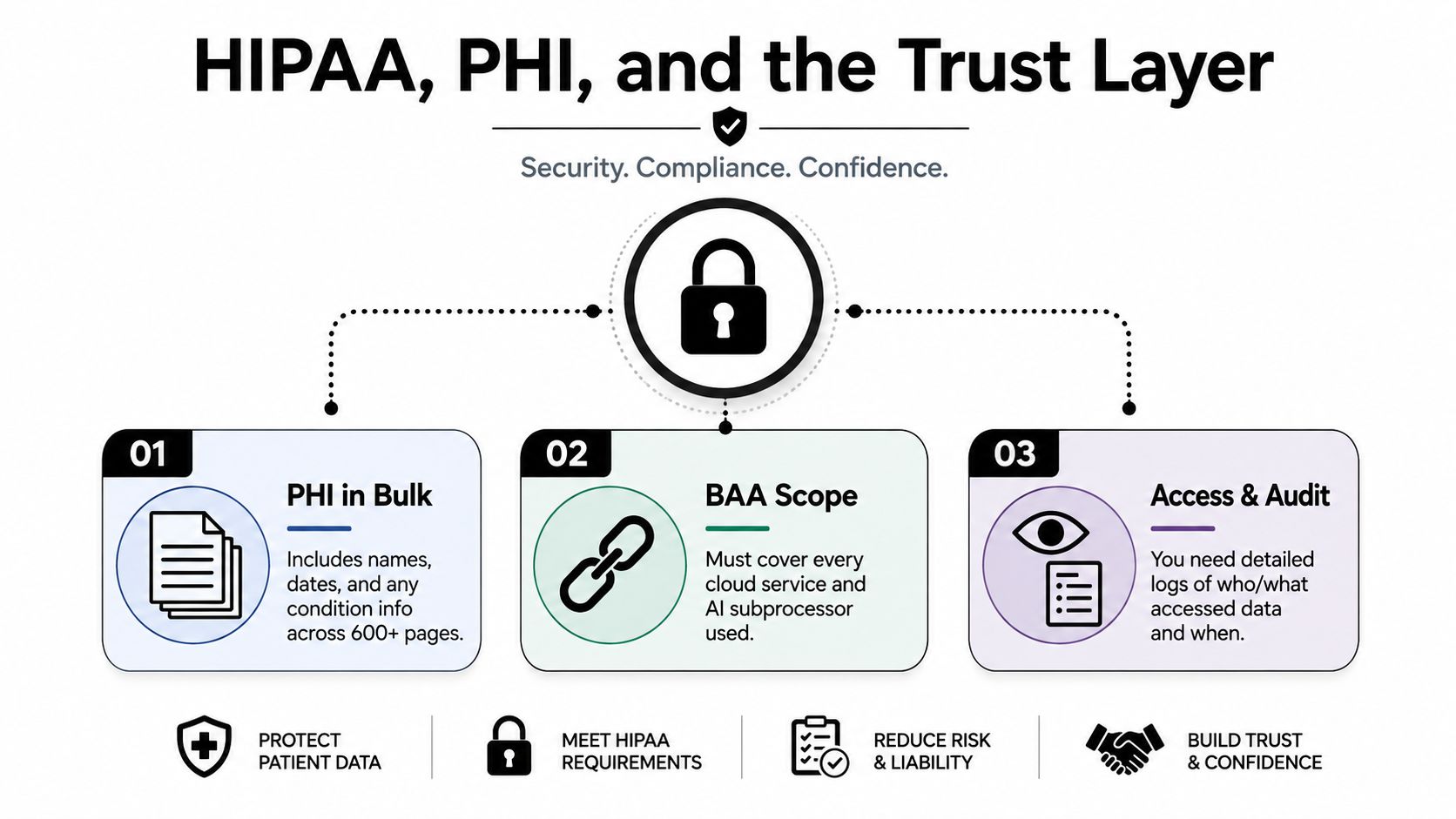
A PI firm reviewing medical records handles protected health information, whether a matter contains one page or hundreds from multiple providers. Names, dates, diagnoses, imaging references, treatment details, and provider information remain sensitive throughout the workflow. Privacy controls must therefore cover storage, model access, subcontractors, exports, and deletion, not just the upload screen.
A Business Associate Agreement establishes the contractual baseline. Counsel still needs to identify every cloud service and AI subprocessor, confirm that the BAA matches the actual data flow, and determine whether customer data may be used for model training. A plaintiff's MRI or operative report should not help tune a system that later processes another firm's matters. Firms assessing these requirements can also review our guide to HIPAA-compliant document management.
Controls should be reviewable
Before rollout, ask the vendor to demonstrate how the platform handles:
- Access control: Users receive only the permissions their roles require.
- Audit records: The firm can determine who accessed, changed, exported, or deleted information.
- Encryption: Data remains protected in transit and at rest.
- Retention: The firm knows how long files, extracted text, and temporary processing artifacts remain available.
- Incident response: The contract explains notification, investigation, and cooperation duties after a breach.
SOC 2 evidence can support vendor review, but it does not replace reading the BAA or testing the product against real PI workflows. A managing partner should be able to explain the setup clearly to a state bar disciplinary panel, a client, or an opposing expert. That explanation should include how records move through the system and who can retrieve generated summaries during demand preparation.
Human review completes the trust model. HIPAA compliance does not make an incorrect chronology safe, and secure hosting does not remove the lawyer's duty to check summaries against source pages. That review matters especially when AI connects hundreds of records into a causation or damages narrative. Governance questions remain around cost, regulatory uncertainty, immature tools, and accountability for generated errors, issues discussed in coverage of AI clinical documentation adoption and governance.
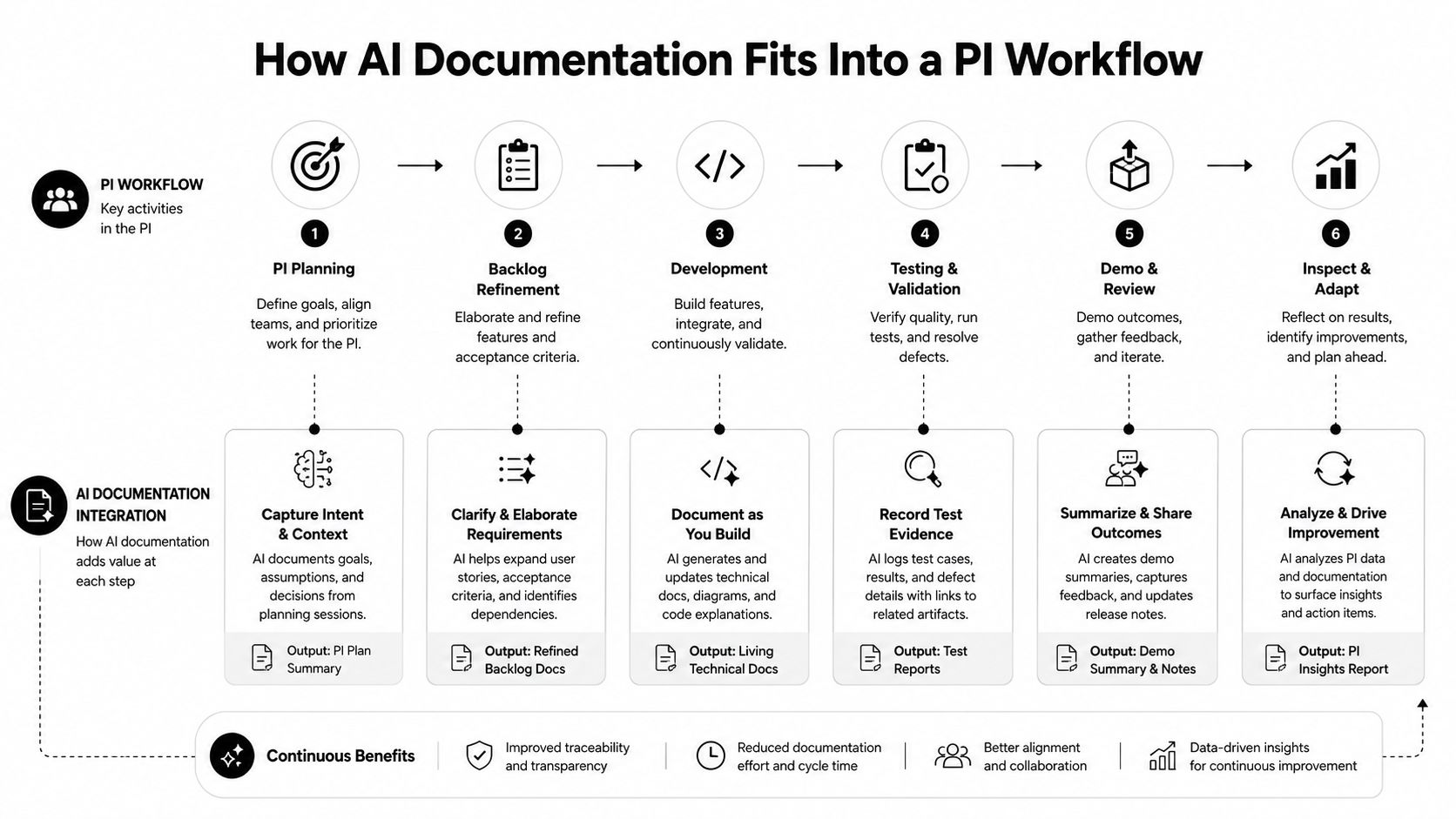
How AI Documentation Fits Into a PI Workflow
The most reliable rollout follows the matter instead of creating a separate AI project that staff must remember to use.
Start at intake
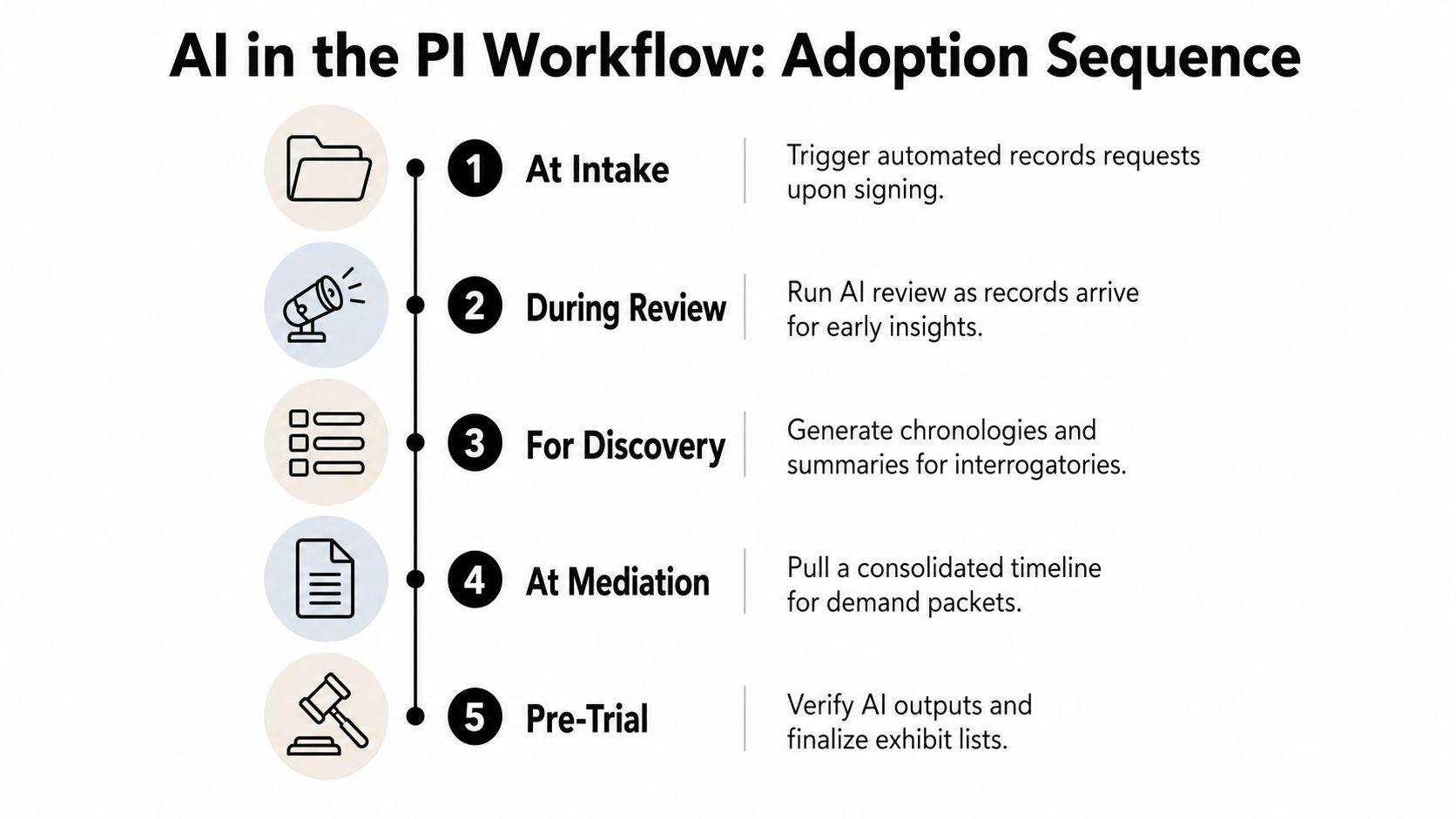
When the representation agreement is signed, the case team sends records requests and creates the matter's document structure. As records arrive, the platform can ingest them in batches rather than waiting for a complete package. Early processing gives the team a working view of providers, dates, diagnoses, and missing material while the case is still developing.
During review, the paralegal checks the extracted events against source pages and resolves obvious gaps. The attorney then uses the organized chronology to assess liability, causation, damages, and the next records or expert requests. This sequence is more useful than waiting until a demand is due, when a missing report can delay the entire package.
Move from chronology to drafting
Once the record set is sufficiently complete, the system can produce a medical overview and draft demand sections. The handoff changes: instead of asking a paralegal to build the narrative from a blank document, the attorney receives a structured starting point with citations and flagged issues. The team can then focus on factual correction, legal framing, valuation strategy, and client-specific judgment.
For firms refining their operational model, practical guidance on reviewing medical records for litigation can complement the technology discussion by clarifying what a defensible review process needs to preserve.
Decide where the work lives
Three integration questions determine whether adoption sticks:
- Repository location: Will the records remain in the existing document-management system, or will the AI platform become a parallel workspace?
- Structured output: Can the chronology, tags, and citations move into the case-management system, or will staff copy summaries manually?
- Handoff ownership: Who verifies extracted facts, resolves flags, and approves the demand draft?
A firm should define these answers before selecting a vendor. The workflow principles in case management and workflow design for legal teams are relevant because documentation automation only creates capacity when the output enters the process where people already work.
Pilot before expansion
A practical pilot uses one attorney, one case type, and a short evaluation window. Compare the result with the firm's current baseline, including review time, citation accuracy, missing-record identification, attorney corrections, and time from records completion to demand-ready draft. A clean pilot isn't proof of universal reliability, but a failed pilot on the firm's own records is valuable evidence before a wider commitment.
Time Savings, Capacity Gains, and Real ROI
The financial question isn't whether software writes faster. A PI managing partner needs to know whether the firm can clear more files, move demands sooner, redeploy paralegal time, and reduce dependence on outside review without lowering quality.
The evidence supports meaningful efficiency gains, but it also shows why implementation has to be measured. In an adult emergency-department study, ambient AI was associated with a 28% reduction in on-shift documentation time, with average documentation time falling from 3:50 to 2:45 per encounter, and a 16% reduction in total electronic health record time, according to the peer-reviewed study in PMC. Those results concern clinical documentation, not PI records review, but they establish that documentation automation can affect throughput when it fits the workflow.
A separate real-world analysis found that after-hours work initially rose by 32.1% on day 10, then fell to 41.7% below baseline by day 50. Delayed note-closure odds dropped by about 66%, while financial productivity increased by up to 12.1%, as reported by the American College of Physicians. For a PI firm, the parallel lesson is direct: early review and correction work may rise before the team learns how to use the system efficiently.
Translate the effect into firm operations
A useful ROI model tracks:
- Review hours per case: Time spent locating, reading, organizing, and citing medical facts.
- Demand-cycle time: Days between receiving a workable record set and sending a demand.
- Capacity released: Paralegal and attorney time moved to client contact, investigation, discovery, and negotiation.
- Correction burden: Time spent fixing extraction errors, unsupported language, or missing citations.
- Outside-review spend: Work that the firm can keep in-house without sacrificing quality.
| Metric | Before AI | After AI | Delta |
|---|---|---|---|
| Medical-record review | Firm baseline | Measured pilot result | Hours added or saved per case |
| Chronology preparation | Manual spreadsheet and document review | Structured chronology with source references | Time to attorney-ready review |
| Demand drafting | Blank-page drafting | Editable first draft | Drafting time and correction load |
| Paralegal allocation | Records sorting and repetitive extraction | Verification, follow-up, and case strategy support | Higher-value hours recovered |
| Case velocity | Firm baseline from records receipt to demand | Pilot result | Earlier or later demand readiness |
The savings won't appear as a clean subscription-versus-hours calculation. Training, configuration, attorney review, governance, and quality assurance remain fixed costs. The return comes when the firm measures the complete cycle and confirms that faster production doesn't create more correction work downstream.
How to Choose the Right Tool and Where Ares Fits
Start with the record set, not the vendor demonstration. Ask each platform to process the same difficult file, including scans, multiple providers, inconsistent dates, prior conditions, treatment gaps, and documents that contain irrelevant material. A generic large-language-model wrapper may summarize clean text well but struggle with OCR, page references, classification, and long multi-provider histories.
Compare architecture before features
A PI-focused pipeline should support batch ingestion, medical-document classification, chronology construction, source citations, and demand drafting in one connected workflow. A tool built primarily for ambient clinical capture may process a conversation well but require extra work to handle a historical record set. Human review surfaces matter as much as model output. Teams need a clear way to inspect the source page, correct an event, annotate uncertainty, and preserve the correction.
Ares is one option for this workflow. Its platform is designed for personal injury firms to ingest medical records, extract providers, diagnoses, dates, and treatment events, organize them into a medical chronology, and generate medical summaries and demand drafts for review. Firms evaluating it should test those capabilities against the same files and rubric used for competing tools, rather than treating product fit as an assumption.
Score the workflow, not the sales presentation
| Criterion | Why It Matters | What to Test | Weight |
|---|---|---|---|
| Document extraction | Scanned and poorly formatted records can defeat otherwise strong models | Upload representative PDFs and verify text against source pages | High |
| Chronology depth | PI cases depend on sequence, not isolated summaries | Test pre-incident history, treatment gaps, procedures, and follow-up | High |
| Citation quality | Counsel must trace important facts to the record | Open citations and confirm page or document accuracy | High |
| Demand drafting | A draft should reduce blank-page work without inventing facts | Compare mechanism, treatment, impairment, and future-care sections | High |
| Security posture | PHI requires contractual and technical controls | Review BAA, subprocessors, retention, access logs, and deletion | High |
| Collaboration | Several matter participants may need controlled access | Test annotations, redactions, permissions, and version history | Medium |
| Integrations | Manual exports can create a new bottleneck | Map output to the firm's repository and case-management system | Medium |
| Pricing model | Volume and storage terms can alter the actual cost | Model current records volume, users, exports, and support | Medium |
Demo two or three platforms against one identical case file. Have the same attorney and paralegal score them independently. The tool that produces the most attractive summary isn't necessarily the one that creates the least operational friction.
Pitfalls, Governance, and Your First 90 Days
AI medical documentation software isn't plug-and-play. The most expensive failure I've seen in rollout planning isn't a dramatic model error. It's a firm that assumes the first draft is reliable, skips source-level review, and discovers later that the team has built a demand around an incomplete or misclassified record.
Accuracy remains a central constraint. A systematic review found word error rates ranging from moderate in dictated notes to very high in conversational and emergency settings, with deletions, substitutions, and missed medication names among the common failures. One dictated-document benchmark reported 7.4 errors per 100 transcribed words, and professional review still left about 1 in 300 words incorrect in the final signed note, according to the systematic review from the Journal of Medical Internet Research Human Factors.
The edge cases deserve the test
PI teams should test records involving:
- Multiple speakers: Family members, interpreters, nurses, and clinicians can complicate attribution.
- Noisy or incomplete source material: Scans, handwritten notes, poor OCR, and duplicated pages can distort extraction.
- Multiple languages: Translation and terminology handling need separate validation.
- Nonverbal facts: A record may omit observations that matter to the clinical narrative.
- Cross-system history: Prior records in separate systems may not align cleanly.
- Note bloat: Over-transcription can bury the event that matters.
Use a 30-60-90 day rollout
Days 1 through 30, pilot and baseline. Use five closed cases to establish the firm's current review time, chronology error rate, demand-drafting effort, and missing-record process. Run the AI output beside the existing method. Don't use the pilot to prove the tool works. Use it to find where it fails.
Days 31 through 60, expand with shadow review. Apply the system to live matters while a trained reviewer checks every material date, diagnosis, treatment event, gap, and demand assertion against the source. Record recurring errors and update prompts, templates, and review instructions.
Days 61 through 90, formalize governance. Define role-based access, retention, audit-log review, escalation for suspected model errors, update cadence, and attorney sign-off requirements. Create a checklist that identifies which outputs require source citation before they can enter a demand, discovery response, mediation packet, or expert disclosure.
The operating standard is simple: let the software handle repetitive organization and first-draft production, but keep legal judgment and factual verification with accountable people.
Ares helps PI firms organize high-volume medical records into structured chronologies, provider and diagnosis summaries, and editable demand drafts while keeping source review in the workflow. Visit Ares to evaluate whether its medical-record review process fits your firm, then test it against a representative case file before expanding adoption.