
The opposite of plaintiff is the defendant. In a civil case, the defendant is the party being sued, and in a criminal case, the defendant is the person accused of the crime.
That sounds simple until you start reading actual captions, complaints, appeals, and counterclaims. Then you realize the label isn't just a vocabulary word. It's a procedural role, and that role can change shape depending on the kind of case and the stage of the case.
The Direct Answer and Why the Question Matters
If you're asking what is the opposite of plaintiff, the standard answer is defendant. In modern common-law usage, the plaintiff brings the case, and the defendant is the party against whom the suit is brought, as reflected in the Cornell Legal Information Institute entry on plaintiff.
That answer matters because these aren't casual labels. They control how you read a caption, who has to respond to a filing, and how you track obligations in the file. In U.S. federal court terminology, defendant is used for the person or entity sued in a civil case and for the person accused in a criminal case, according to the U.S. Courts glossary.
Practical rule: If you know who started the case and who must answer it, you can usually identify plaintiff and defendant correctly.
There's also a historical layer that helps the term stick. Legal reference sources trace plaintiff to 1278 and to the Anglo-French pleintif, meaning “complaining,” as noted in the Cornell Legal Information Institute entry on plaintiff. That older meaning still tracks the modern role. The plaintiff is the party complaining to the court about some wrong.
Where readers often get tripped up is assuming the opposite of plaintiff is always defendant in every procedural setting. Usually it is. But not always. In some proceedings you'll see respondent instead, and on appeal you'll see labels that reflect appellate posture rather than trial-level posture.
Understanding the Core Roles in a Lawsuit
A lawsuit starts with role assignment. One side asks the court to do something. The other side has to answer.
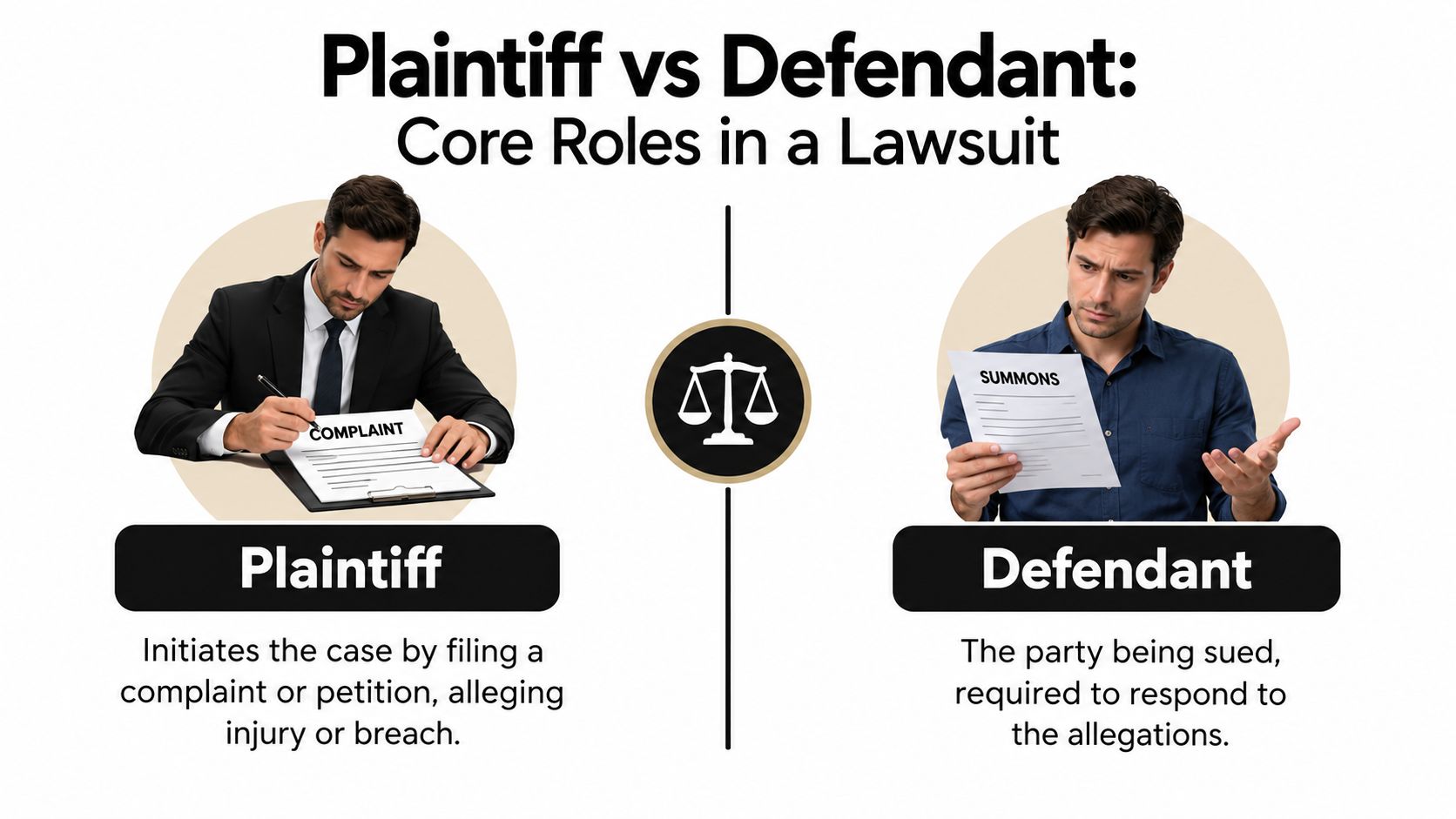
The plaintiff is the person or entity who initiates the case by filing a complaint or petition. The defendant is the person or entity named in that filing as the opposing party. In civil procedure, that basic split is described this way by USLegal's explanation of parties under civil procedure.
A simple analogy that actually works
Think of two neighbors in a dispute over a fallen tree. They argue back and forth and can't resolve it. One neighbor goes to court and files papers claiming the other caused damage.
The filing neighbor becomes the plaintiff. The neighbor named in the papers becomes the defendant.
That sounds almost too basic, but it captures the key mechanic. The court doesn't assign these labels based on morality or truth. It assigns them based on who invoked the court's power first and who must now respond.
Why filing matters more than blame
People often assume the plaintiff is the "good side" and the defendant is the "bad side." That's not what the terms mean. They describe procedural position, not who will win.
A paralegal sees this constantly in the caption, summons, and initial pleading. Once the complaint is filed and served, the named defendant has duties that flow from that status. That's one reason a litigation team needs a crisp grasp of party labels. If you're building that skill set, a useful companion read is this overview of what a litigation paralegal does.
How the Defendant Role Works in Civil Versus Criminal Cases
What changes when the person called a defendant is being sued for money in one courtroom, but accused of a crime in another?
The label stays the same. The machinery around it changes.
In a civil case, the defendant is the party responding to a private claim. In a criminal case, the defendant is the person responding to a public accusation brought in the name of the government. That distinction affects more than vocabulary. It changes who filed the case, what paper starts it, what kind of response is expected, and what burden the other side must carry.
A useful way to sort this out is to focus on the source of the accusation. Civil cases begin with one party claiming a legal wrong such as injury, breach of contract, or property damage. Criminal cases begin with the state alleging a violation of criminal law. The defendant occupies the responding role in both settings, but the opponent is different.
The response is different too. A civil defendant typically answers the complaint or files a motion attacking it. A criminal defendant is called on to enter a plea to the charges. The Federal Rules of Criminal Procedure reflect that structure by governing the prosecution of criminal cases and the defendant's plea and related procedure in federal court, beginning with Rule 1 of the Federal Rules of Criminal Procedure.
The burden of proof also works differently. In civil litigation, the plaintiff bears the burden on the claim, often under the preponderance standard. In criminal cases, the prosecution must prove guilt beyond a reasonable doubt. Cornell Law School's Legal Information Institute explains that standard in its entry on beyond a reasonable doubt.
| Feature that changes the defendant's job | Civil case | Criminal case |
|---|---|---|
| Source of the accusation | A private party files a complaint | The government files charges |
| Defendant's first formal response | Answer, motion, or both depending on the rules | Plea to the charge |
| Burden carried by the opposing side | Plaintiff must prove the civil claim | Prosecution must prove guilt beyond a reasonable doubt |
One point trips up new readers. If criminal cases do not have a plaintiff, is "defendant" still the opposite of "plaintiff"?
In a basic civil vocabulary question, yes. But procedure is less static than that answer suggests. "Defendant" means the party answering an accusation, not a permanent identity that follows someone through every phase of a case. A civil defendant can become a counterclaim plaintiff by filing claims back against the original plaintiff. On appeal, the labels may shift again to appellant and appellee. In criminal court, the opposing party is the prosecution, not a plaintiff, even though the accused person is still the defendant.
That is why the term makes more sense as a role in motion than as a fixed box. The caption gives you the label. The procedural posture tells you what that label means in that moment.
What the Defendant Actually Does Once Named
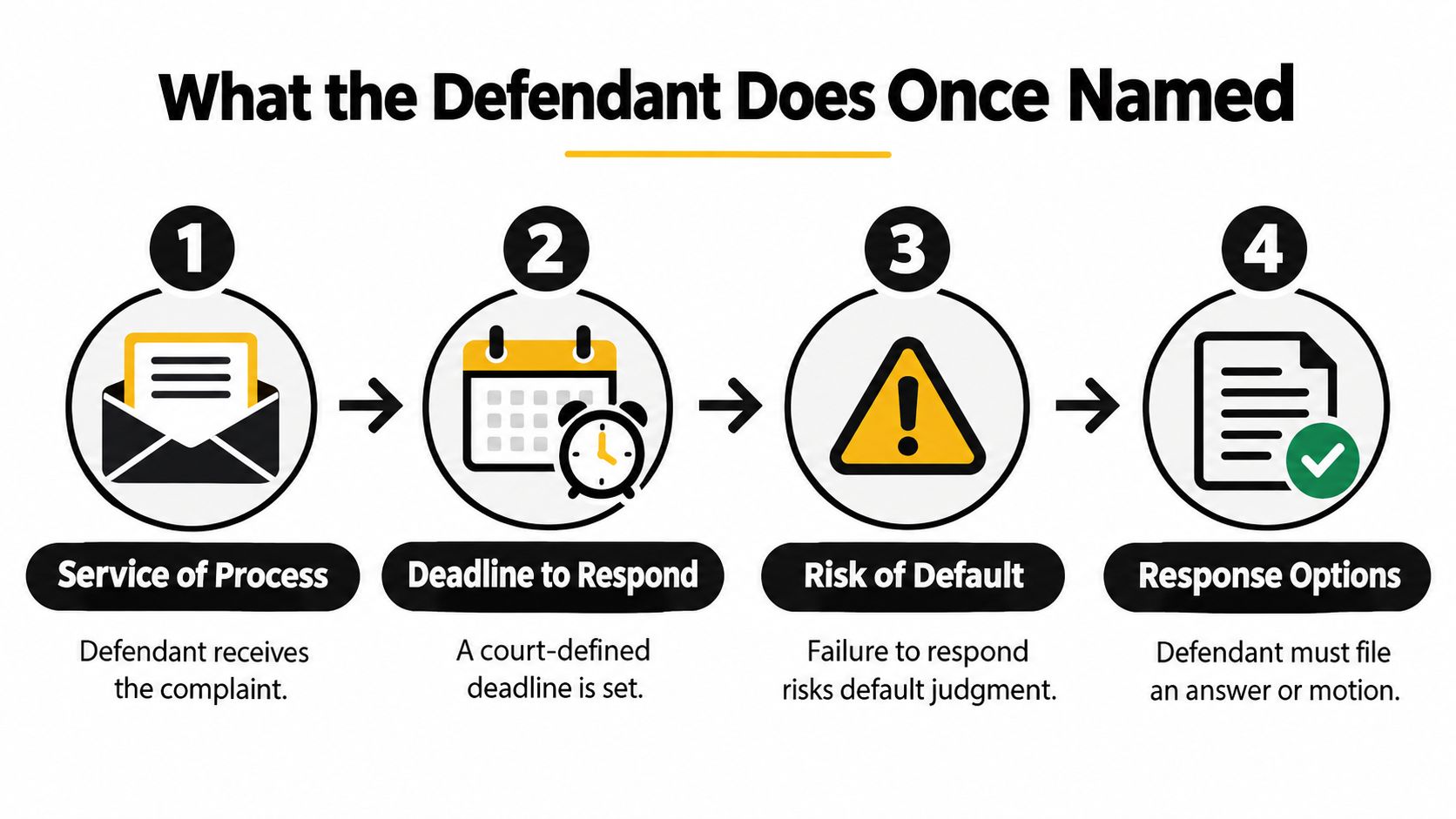
Being named in a lawsuit is the point where a procedural label turns into a job. The defendant now has to respond, protect deadlines, and decide how to meet the claims in the complaint.
The first obligations
Start with the two events that matter most. The defendant must be served, and then the response clock starts. In federal civil cases, Rule 12 of the Federal Rules of Civil Procedure governs the timing and several of the main response options.
That response usually takes one of three forms:
- An answer, which admits, denies, or states that the defendant lacks enough information to admit or deny a particular allegation.
- Defenses in the pleading, which preserve legal positions such as failure to state a claim, lack of jurisdiction, or improper service.
- A motion under Rule 12, which asks the court to resolve a legal problem with the complaint before the case moves further.
A useful way to picture the answer is as a line-by-line reply to the complaint. If the complaint says, "The defendant signed the contract on June 1," the answer tells the court whether that allegation is admitted, denied, or unknown. That matters because the pleadings narrow what is in dispute.
Silence has consequences. If a defendant does not respond on time, the plaintiff may seek a default, which can put the defendant at a steep disadvantage before the merits are fully tested.
Once the pleadings are in place, the file usually shifts into information exchange and case development. If you want a grounded overview of that stage, this guide to discovery in law explains how parties request documents, send written questions, and build the factual record.
This three-minute walkthrough covers the answer deadline, motion options, and what can happen if the defendant does not respond:
The role can shift inside the same case
Many short definitions stop too early. A defendant is not locked into a single posture for the life of the case.
A defendant can file a counterclaim against the plaintiff in the same lawsuit. Once that happens, the original defendant is asserting a claim, and the original plaintiff must answer that claim. The labels do not disappear, but they start doing more than one job at once.
That is why procedural roles work more like positions in a conversation than permanent name tags. One party starts the complaint. The other responds. Then, if counterclaims appear, each side may become both a claimant and a responding party on different parts of the same file.
A party can be a plaintiff for one claim and a responding party for another claim in the same lawsuit.
This is one reason captions, claim charts, and pleading outlines matter so much. In plaintiff-side personal injury practice, tools that organize allegations, records, and claim narratives can help keep those roles straight. One example is Ares, which is built for personal injury firms to review records and draft demand materials from case files.
Real Examples of the Plaintiff Defendant Relationship
Abstract labels make more sense when you watch them move through a file.
Example one: a slip-and-fall case
A customer alleges that a grocery store failed to clean a spill and that the customer fell and suffered injuries. The customer files a civil complaint. The customer is the plaintiff. The store, or the company that owns it, is the defendant.
The defendant answers the complaint, denies some allegations, and requests records. The plaintiff serves written discovery. The parties may also exchange settlement positions, sometimes after a pre-suit communication such as a demand letter.
Example two: a misdemeanor theft charge
A person is accused of shoplifting from a retail store. The store employee reports the incident, but the criminal case is not filed by the store as plaintiff. The case is brought by the government. The accused person is the defendant.
The defendant appears, enters a plea, and contests the charge or seeks a negotiated resolution. The injured private party may be important factually, but it doesn't occupy the same procedural role as a civil plaintiff.
Plaintiff and Defendant Roles in Two Sample Cases
| Case Element | Slip-and-Fall Civil Suit | Misdemeanor Theft Charge |
|---|---|---|
| Who starts the matter | Injured customer | Government prosecutor |
| Party making the accusation | Plaintiff | State or other prosecuting authority |
| Opposing party label | Defendant | Defendant |
| First key response | Answer to complaint | Plea to criminal charge |
| Typical early dispute | Liability and damages | Guilt, defenses, or diversion |
If you want to identify the defendant quickly, ask who must answer the court after the case begins.
Other Labels for the Opposing Party You Should Know
Defendant is the standard answer to what is the opposite of plaintiff, but it's not the only label you'll see in practice.
Respondent
In some jurisdictions and case types, the party opposite the filer may be called respondent rather than defendant. Civil procedure references note that the same role may carry that label in some proceedings, as described in USLegal's discussion of party terminology.
You'll often see petitioner/respondent rather than plaintiff/defendant in certain appeals, administrative matters, and family-law proceedings.
Appellee and accused
On appeal, the labels usually shift again. The party bringing the appeal is the appellant. The opposing party is the appellee. That appellee may have been the defendant in the trial court, but the appellate label reflects the new posture.
In criminal practice before formal charging, you may also hear suspect or accused. Once the criminal case is formally in court, the more precise courtroom label is usually defendant.
Why these labels matter
A docket entry can look confusing if you expect one set of terms everywhere. But the shift in labels usually tells you something useful about the forum or stage of the case.
- Petitioner and respondent often signal a nonstandard trial posture.
- Appellant and appellee tell you the case is on review.
- Defendant usually means the person or entity answering a claim or charge in the court where the matter is currently pending.
Why This Term Matters in Everyday Legal Practice
Why spend time on a term that seems this basic? Because party labels drive the mechanics of a case. If you misread who is the plaintiff, who is the defendant, and whether that posture has shifted, the mistake does not stay academic. It shows up in the caption, the calendar, the client call, and sometimes the court file.
A lawsuit works a bit like a relay. The first filing hands the next task to the other side. The plaintiff files the complaint. The defendant must respond. If the defendant files a counterclaim, that same party now acts as a claimant on that issue. If the case goes up on appeal, the labels may switch again to appellant and appellee. The name matters because it tells you who has the next procedural job.
Where mistakes show up
Mislabeling parties creates practical problems fast:
- Caption errors can distort the record. A common example is drafting a pleading with the parties reversed, so the defendant is listed first as though it filed the case.
- Deadline mistakes happen when a team assumes the defendant has already answered, even though service was not complete and the response clock never started.
- Client communication problems arise when someone tells a client, "you are the plaintiff," even though the client is defending the case and asking why they are being sued.
Those are not small wording issues. They affect who must respond, what deadline controls, and how everyone understands the posture of the case.
For personal injury practice, that posture shapes daily decisions. The defendant is usually the party accused of causing the injury and the party who must answer the complaint. Defense counsel often begin with preservation, insurance, and response deadlines. Plaintiff's counsel begin with allegations, damages support, and service. A state bar explainer from the New York City Bar Association on civil litigation basics reflects the same practical point. Party roles organize how a civil case moves.
The useful habit
Read the file by role before you read it by story. Start with three questions: Who asked the court for relief? Who must answer now? Has any later filing changed the posture?
That habit prevents a common beginner mistake. New paralegals and law students often treat plaintiff and defendant as permanent identities, as if they describe the person rather than the procedural seat they occupy. In real practice, the label is more like the nameplate on a courtroom table. It tells you where that party stands in this phase of the case. Change the filing, and the functional label can change with it.
Keep one clear rule in mind: the opposite of plaintiff is defendant in the basic civil-case setup, but the better lesson is broader. These terms describe a role in a live procedure. Counterclaims can shift who is asserting a claim. Appeals replace trial-court labels with appellate ones. Criminal cases use prosecution and defendant, not plaintiff and defendant, even though one side is still bringing the case.
If your team handles personal injury matters, Ares offers tools that help organize case records, surface key facts, and support demand drafting so your team can track who alleged what and who must respond next. You can see how it works at Ares.