A defendant is the person or organization responding to a legal action, including the party sued in a civil case or the person accused in a criminal case. In a personal injury case, the defendant may be an individual driver, an employer, a property owner, a manufacturer, an insurer in some jurisdictions, or several parties alleged to have caused or contributed to the injury.
You're reviewing a new intake after a crash. The police report identifies the driver, the vehicle belongs to a company, the driver was working at the time, and the client's treatment records mention a dangerous road condition. The complaint can't name “the person who caused the accident” and leave the rest for later. Each possible defendant changes the liability theory, the evidence you need, the insurance questions you must answer, and the practical path toward settlement.
Introduction to Who the Defendant Really Is
In legal terminology, defendant describes a procedural position, not a conclusion about wrongdoing. The defendant is the party required to respond to a legal action. In civil litigation, that means the person or organization sued by the plaintiff. In criminal litigation, it means the person accused by the government. Being named doesn't establish liability or guilt. The case still has to move through pleadings, evidence, adjudication, and, where applicable, sentencing.
That distinction matters immediately in personal injury work. A defendant may be an individual driver, an employer, a property owner, a product manufacturer, an insurer in some jurisdictions, or multiple parties alleged to have caused or contributed to the claimant's harm. The practical question isn't only, “Who was involved?” It is, “Which party's conduct, legal responsibility, defenses, and ability to satisfy a judgment will the case examine?”
A junior associate who identifies only the driver may miss an employment relationship. A paralegal who treats the insurer as the defendant may confuse the party named in the complaint with the organization making payment decisions. A medical summary that lists providers without connecting the records to the defendant's conduct may leave the central causation theory buried.
Key concept: The defendant is not simply the opposite of the plaintiff. The defendant is a strategic variable that affects who must answer, who controls the defense, who may fund resolution, and which facts matter most.
For a concise reference on key legal phrases explained, use a legal terminology glossary alongside the governing rules in your jurisdiction. It can also help to distinguish the defendant from the opposite of plaintiff, because ordinary language often makes those roles sound more symmetrical than they are.
Start the file by separating four questions:
- Who is named? Identify every formal party in the caption.
- What did each party allegedly do? Tie each defendant to duty, breach, causation, and damages.
- Who may provide a defense? Determine whether counsel is appointed, retained, or still unknown.
- Who may fund payment? Investigate insurance, indemnity, corporate resources, and other practical sources of recovery.
That framework keeps the definition useful. It moves the team from a dictionary answer to a case theory.
Civil Versus Criminal Defendants Explained Simply
The word defendant appears in both civil and criminal cases, but the setting changes the role.
In a civil personal injury case, the plaintiff brings a claim against a person or organization. The plaintiff generally must prove that the defendant's legally significant conduct caused compensable harm, usually under a preponderance of the evidence standard. In plain language, the plaintiff must show that the claim is more likely than not true. The defendant doesn't usually have to prove innocence. The defense can prevail by exposing weaknesses in duty, breach, causation, damages, notice, medical chronology, or comparative fault.
In a criminal case, the government typically brings the prosecution against the accused person. Criminal defendants receive procedural protections that include the presumption of innocence and the prosecution's burden of proving guilt beyond a reasonable doubt. A civil defendant facing damages and a criminal defendant facing criminal punishment may both be called defendants, but their legal environments are materially different.
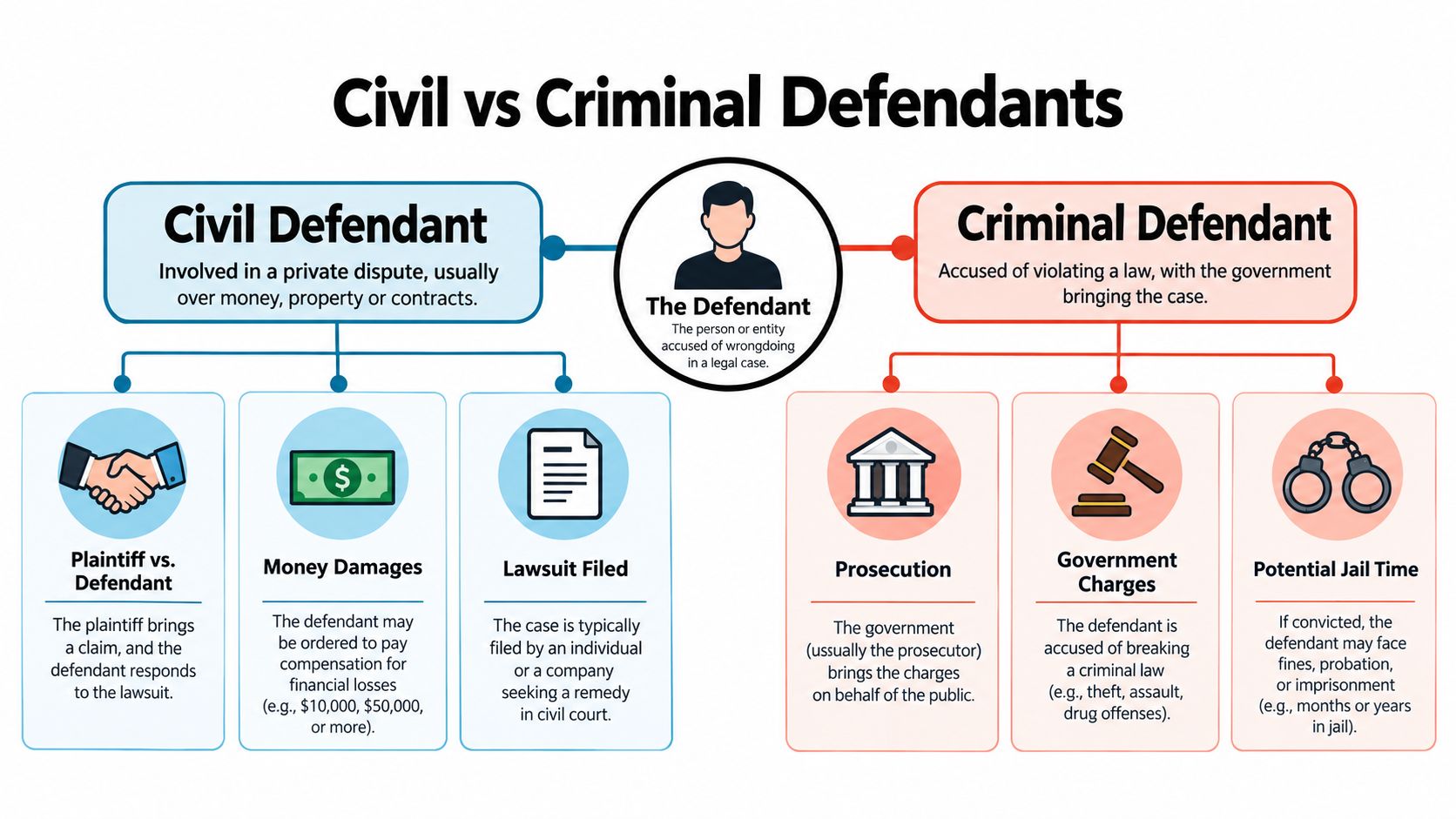
A useful analogy is a disputed bill. In a civil case, the plaintiff says, “You owe compensation because your conduct caused my loss.” The defendant can respond, “You haven't shown that I caused this loss,” or “The amount isn't supported,” without proving a complete alternative story. In a criminal case, the government says, “You committed an offense,” and must satisfy a more demanding burden before the court can impose criminal punishment.
That distinction changes how a PI team reads a defense answer. A denial doesn't mean the defendant must produce a competing accident narrative immediately. It may mean the defense intends to force the plaintiff to prove every required element through testimony, documents, experts, and admissible records. The defendant may also raise affirmative defenses, which introduce additional facts or legal theories that could limit or defeat liability.
For further terminology, the distinction between a complainant and a respondent can help staff avoid importing criminal or administrative labels into a civil complaint.
The key working rule is simple: civil liability isn't criminal guilt, and a civil defendant doesn't have to prove innocence. The plaintiff's evidence must connect the specific defendant to the alleged duty, breach, injury, and damages.
Common Types of Defendants in Injury Claims
Personal injury cases often involve several possible defendants, but the legal and strategic consequences differ by category. The same incident can create different evidence demands depending on whether the target is a driver, employer, owner, manufacturer, insurer-related entity, or group of parties.
Individual driver. The driver is often the most visible defendant in a collision case. The liability theory may focus on speed, distraction, impairment, unsafe lane movement, or another act or omission. The file should still examine employment status, vehicle ownership, permissive use, personal insurance, and any facts suggesting another party contributed to the event.
Employer. An employer may become relevant when the driver was acting within the scope of employment or when the employer's own conduct matters, such as hiring, supervision, training, maintenance, or scheduling. The employer's presence can change discovery because personnel records, policies, route information, electronic logs, and corporate admissions may become important.
Property owner or occupier. In a premises case, the defendant may be the owner, tenant, manager, maintenance contractor, or another entity responsible for inspection and repairs. The central questions often concern control, notice, the dangerous condition, warnings, inspection practices, and whether the defendant had a reasonable opportunity to correct the hazard.
Manufacturer or distributor. A defective product claim may require a theory based on design, manufacture, warning, marketing, or distribution. The relevant evidence can include product specifications, instructions, recall information, testing materials, purchase records, and the chain linking the product to the injury.
Insurer-related entity or multiple defendants. An insurer may influence defense strategy or payment without being the formal defendant, and the rules differ by jurisdiction. Multiple defendants may have separate counsel, different defenses, different coverage, and competing positions on allocation. The complaint and records review must distinguish formal party status from contractual obligations and practical control.
| Defendant Type | Liability Hook | Strategic Impact for Plaintiff |
|---|---|---|
| Individual driver | Negligent operation or conduct | Focus on event evidence, statements, vehicle information, and available coverage |
| Employer | Scope of employment or direct corporate negligence | Seek employment, training, supervision, maintenance, and policy evidence |
| Property owner or occupier | Control, dangerous condition, and notice | Build the condition timeline and identify inspection and repair responsibility |
| Manufacturer or distributor | Defective product or inadequate warning | Preserve the product and trace design, warning, testing, and distribution evidence |
| Multiple parties or insurer-related entity | Shared allegations, indemnity, or coverage involvement | Map party status, counsel, coverage, defenses, and potential allocation issues |
A records-review workflow should separate identity facts from legally material conduct. Capture the defendant's role, incident date, mechanism, claimed injuries, treatment chronology, prior conditions, and the evidence linking the conduct to the harm. That approach prevents a provider-by-provider medical narrative from losing the defendant-specific causal theory.
If another person or business may bear responsibility without being the obvious target, review the framework for what is a third-party liability claim. The point isn't to name everyone reflexively. It is to identify every plausible liability and recovery path before pleading choices narrow the case.
How Defendants Respond After Being Served
A defendant's response timeline usually turns on service and appearance, not the date the complaint was filed. Federal practice provides a useful operational model. Under Federal Rule of Civil Procedure 4, the summons states the time for the defendant to appear and defend, and service generally must be completed within 90 days after filing, subject to dismissal without prejudice or an extension for good cause. The rule and jurisdiction-specific orders still control the actual file.
After service of the summons and complaint, a defendant ordinarily has 21 days to serve an answer. A timely waiver of service generally extends the period to 60 days after the waiver request was sent, or 90 days when the request was sent outside a U.S. judicial district. These rules are summarized in the Federal Rules of Civil Procedure materials.
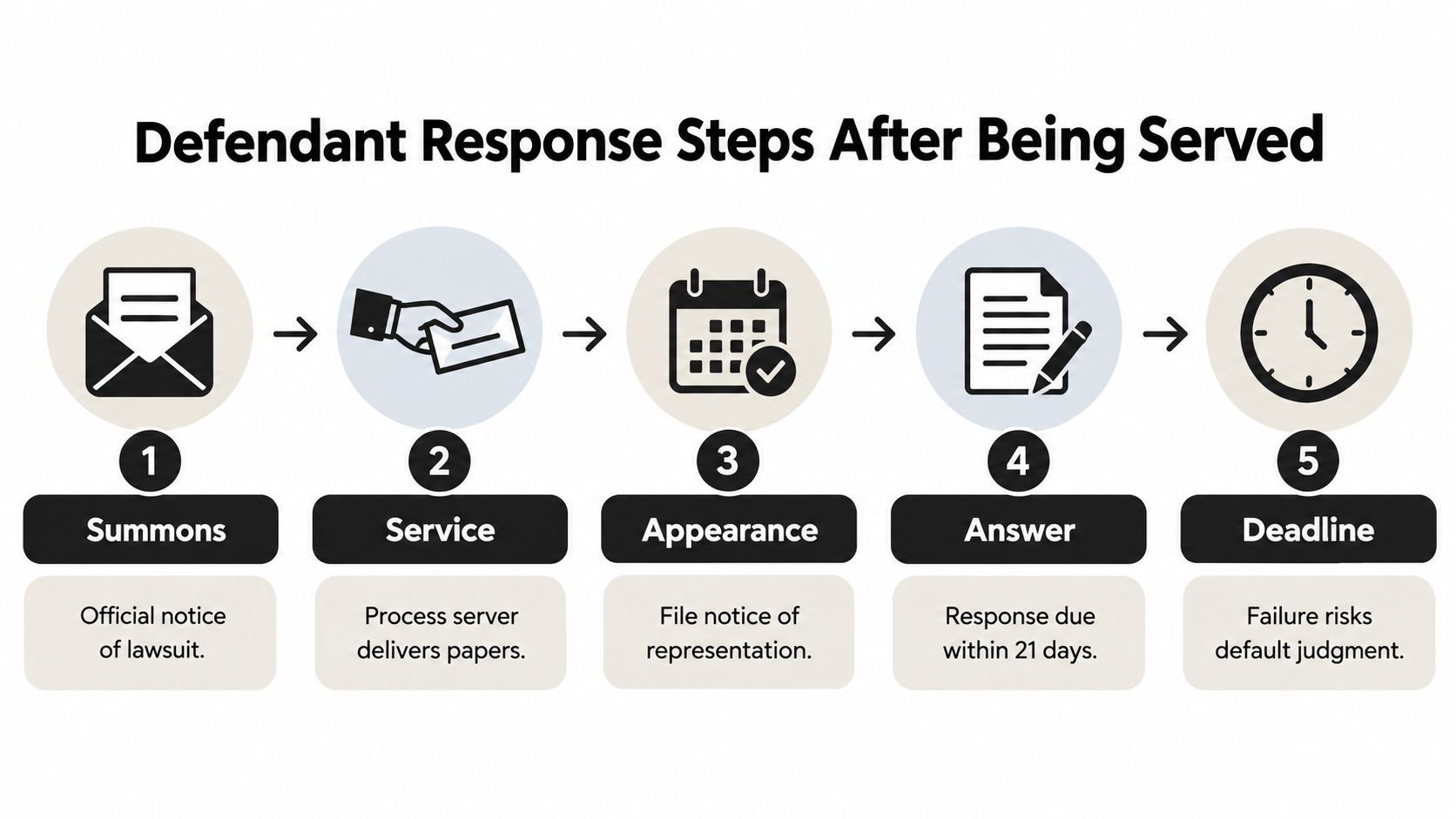
A plaintiff-side team should treat each defendant as a separate deadline track. One defendant may have been personally served, another may have accepted a waiver, and a third may challenge service. A single “answer due” field can hide those differences and create avoidable mistakes.
The docketing fields that matter
Record these events independently:
- Complaint filing date. This starts the service analysis but doesn't by itself establish the answer deadline.
- Service date for each defendant. Identify the method and preserve the proof of service.
- Waiver request date and status. Don't assume a mailed waiver was returned or effective.
- Appearance and counsel information. Note whether counsel has entered an appearance and whether representation is limited.
- Answer due date. Calculate from the applicable service or waiver event, then check for amended pleadings, extensions, and court orders.
A missed response deadline can expose a defendant to default-related consequences. Incorrect service tracking can also produce motion practice over whether the court obtained personal jurisdiction. For the plaintiff's team, these aren't clerical details. They affect strategy, scheduling, and the reliability of every later procedural decision.
Defenses PI Defendants Use to Challenge Your Case
A defendant can attack a PI case without proving that the plaintiff's entire account is false. The defense often works issue by issue, looking for a missing element, an evidentiary gap, or a factual dispute that reduces settlement value.
Denials and affirmative defenses
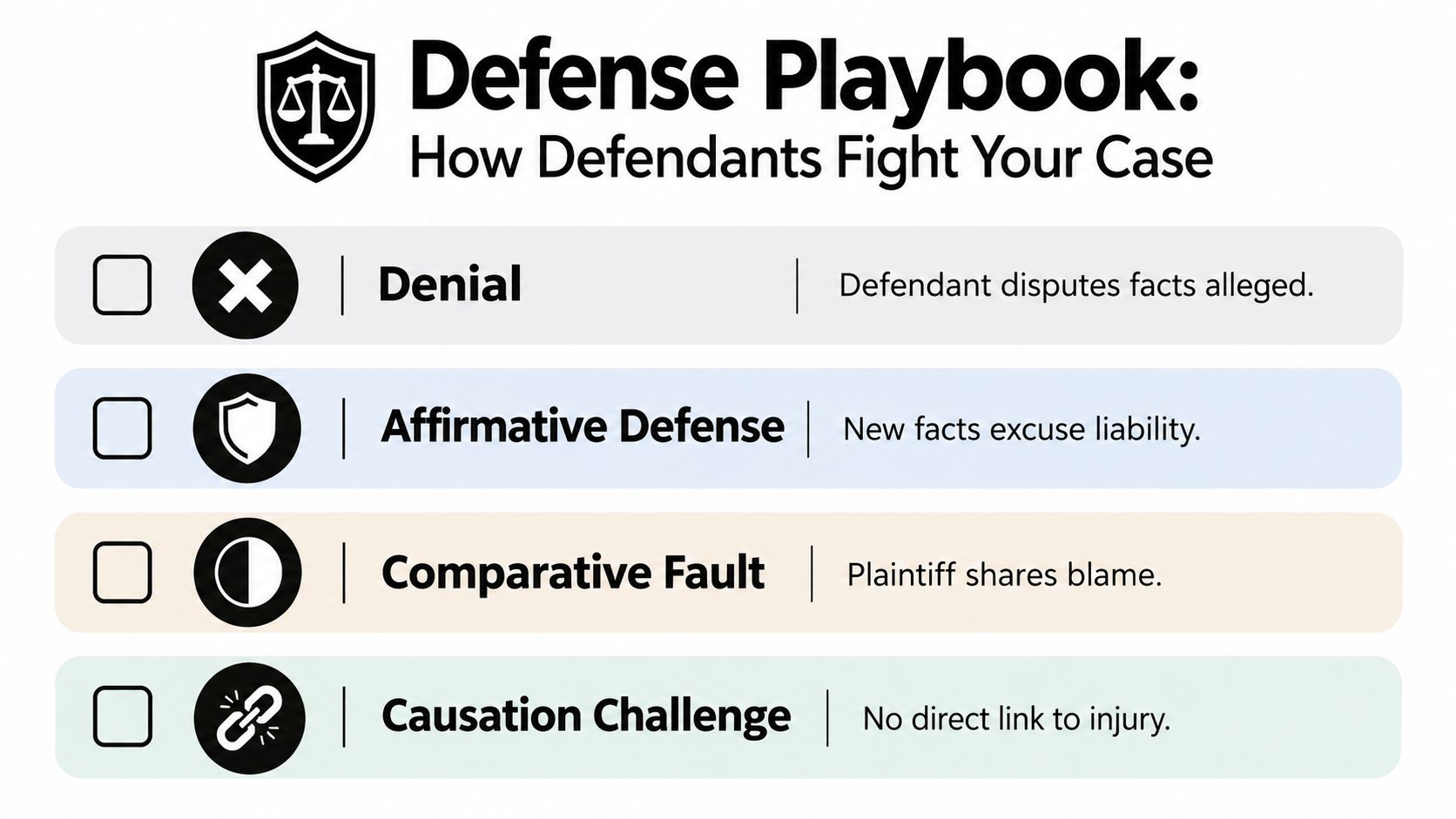
A denial puts the plaintiff to proof. The defendant may dispute the accident mechanism, the alleged duty, notice of a dangerous condition, the severity of impact, or whether the claimed treatment was reasonable and necessary. The answer may also assert affirmative defenses, which introduce separate legal or factual reasons for limiting liability.
Comparative fault is a common example. A defendant may contend that the plaintiff failed to use reasonable care, ignored a warning, or contributed to the event or resulting harm. The precise effect depends on the governing jurisdiction, but the practical lesson is consistent: the plaintiff's evidence should address foreseeable fault arguments rather than focus only on the defendant's conduct.
Causation and damages attacks
Causation disputes frequently arise through the medical chronology. A defense may point to a gap in treatment, a prior condition, inconsistent symptom reports, delayed complaints, intervening events, or findings that don't match the alleged mechanism. A low-impact argument can target the relationship between force and injury, but it doesn't answer the medical evidence by itself. The plaintiff still needs a coherent explanation connecting the incident, symptoms, examination findings, treatment, and functional effects.
Damages can be challenged separately from liability. The defense may question whether treatment was necessary, whether a provider relied on an incomplete history, whether a claimed limitation is supported by objective findings, or whether future care is reasonably expected. An independent medical examination, defense expert, or cross-examination may be used to develop those points.
Practical rule: Build the medical summary around the defendant-specific causal theory, not around the order in which providers appear in the chart.
Notice and product-specific attacks
Premises defendants may argue that they lacked actual or constructive notice, didn't control the relevant area, or had no reasonable opportunity to correct the condition. Product defendants may challenge product identification, substantial change, misuse, warnings, alternative causes, or the theory connecting the product defect to the injury.
The response should be targeted. For every anticipated defense, identify the record that answers it:
- Treatment gaps: Explain what happened during the gap without speculating.
- Prior conditions: Separate baseline symptoms from changes after the incident.
- Inconsistent histories: Locate the earliest account and reconcile material differences.
- Comparative fault: Gather photographs, witness evidence, scene information, and conduct records.
- Notice: Collect inspection, complaint, repair, maintenance, and warning evidence.
- Product causation: Preserve the product and document its condition, use, and chain of possession.
A strong plaintiff file doesn't merely repeat that the defendant is liable. It anticipates how the defendant will try to make liability, causation, or damages uncertain.
What Defendant Strategy Means for Discovery and Settlement
The defendant's posture affects the entire case, from document requests to expert selection to the shape of a demand. A represented individual may focus on personal testimony and available policy limits. An employer or manufacturer may defend through several layers of counsel, corporate witnesses, technical experts, and document objections. An unrepresented defendant may misunderstand the summons, miss deadlines, or fail to preserve evidence, while an insured defendant may have appointed counsel whose work is influenced by coverage duties and policy limits.
The plaintiff's team should distinguish three roles:
- Named defendant: The person or entity formally sued.
- Defense counsel: The lawyer responding to the allegations and directing litigation activity.
- Insurer or other payor: The organization that may fund counsel, evaluate exposure, and make payment decisions without being the formal party.
Those roles overlap in practice, but they aren't interchangeable. A demand directed at the named defendant should still address the evidence and valuation questions likely to matter to the payor and defense counsel.
Discovery follows the defense theory
If the defense disputes the incident mechanism, prioritize photographs, vehicle data where available, scene evidence, witness accounts, and admissions. If it attacks causation, organize records by symptom onset, objective findings, treatment decisions, prior history, and functional change. If it disputes damages, support the relationship between treatment and limitations rather than presenting a stack of invoices without context.
Federal criminal-case data illustrates why negotiated resolution deserves serious preparation. In 1998, U.S. district courts commenced criminal cases against 78,172 defendants, and 64,769, or 83%, faced felony charges. More than 87% of all defendants were convicted, and among those convicted, more than 93% pleaded guilty while 6% were convicted at trial, according to the Bureau of Justice Statistics report on federal criminal case processing. Those figures concern criminal cases, not PI litigation, but they show how a formal trial right can exist within a system where negotiated or earlier dispositions dominate.
The same strategic principle applies in civil practice. The settlement value of a claim is shaped before the negotiation when the team organizes allegations, evidence, timelines, medical proof, and damages. A defendant who sees a clean causal narrative has fewer easy objections. A defendant who sees unexplained gaps can turn those gaps into valuation pressure.
Building a Stronger Case Against Any Defendant
The best defendant analysis begins before the demand letter. Treat the defendant as both a legal role and part of a payor map. That means identifying who is formally responsible, who may be contractually obligated to indemnify, who controls the defense, and who may decide whether the claim resolves.
A practical file review should answer these questions:
- Party map: Which person or entity is named, and what conduct connects each one to the claim?
- Coverage map: What insurance, indemnity, employer responsibility, or other recovery source may exist?
- Deadline map: When did filing, service, waiver, appearance, and answer events occur for each defendant?
- Causation map: Which facts connect the defendant's conduct to the injury and treatment?
- Defense map: Which denials, affirmative defenses, comparative-fault arguments, notice disputes, or damages attacks are foreseeable?
- Resolution map: What evidence will make the claim easier to evaluate and harder to discount?
Procedural literacy also matters for defendants who represent themselves. As many as two-thirds of litigants appear without lawyers in important civil matters, according to the National Center for Access to Justice discussion of self-representation. A 2025 report on remote civil hearings found that more than 80% of surveyed unrepresented litigants could access proceedings from home or work, while Minnesota's 2023 civil-court survey reported that 63% of responding civil litigants were self-represented. Those figures don't eliminate the need for clear process. They reinforce it.
A defendant may not understand the significance of an admission, a preservation request, a medical chronology, or an answer deadline. That doesn't reduce the plaintiff's burden to prove the case. It does mean the file should be written clearly enough that the issues remain visible to counsel, the court, experts, and any person evaluating resolution.
For firms that want to reduce manual records sorting, Ares can extract dates, diagnoses, treatments, providers, and symptom chronology from uploaded medical records and produce organized summaries and demand drafts for review. Used as part of attorney-controlled preparation, that kind of structured output can help teams test whether the medical narrative answers the defendant's likely causation and damages objections.
The most important habit is consistency. Before demanding payment or preparing for trial, review the case from the defendant's chair. Ask what the defendant can deny, what the defense can delay, what the insurer can discount, and which missing record would make the plaintiff's theory harder to prove.
Build that defendant-centered checklist into every new PI file, then use it to connect party identity, coverage, deadlines, medical causation, and anticipated defenses before negotiation begins. To organize medical records and develop case-ready summaries and demand drafts, visit Ares and see how its workflow can support faster, more consistent personal injury case preparation.