

Return on investment is a percentage efficiency metric calculated as (net gain ÷ total cost) × 100. It helps compare an investment with alternatives, including the long-run equity market return, which has often been estimated at about 10% annually for the S&P 500 over extended periods.
A managing partner at a personal injury firm may be looking at three competing uses for the same budget: a new case-management platform, another paralegal, or a marketing campaign. Each option promises growth, but the promise arrives in a different form. Software may reduce medical-record review time, a hire may increase daily capacity, and marketing may bring in more signed cases. Comparing those options by price alone won't tell you which one creates the stronger business result.
That's where ROI becomes useful. It gives you a common language for judging money, time, staffing capacity, and operational improvements together. The calculation is simple, but applying it well requires more than plugging two numbers into a formula. You need to define the investment, identify every relevant cost, measure the resulting gain, and account for timing, risk, and alternatives.
Introduction to Return on Investment for Law Firms
Suppose a personal injury firm is deciding whether to purchase workflow software or add a full-time employee. The software invoice is easy to see. The salary is easy to see. The harder questions are operational: Which option reduces repetitive work? Which one lets the existing team handle more matters? Which one improves the quality or speed of demand preparation? Which one produces value soon enough to support the firm's cash flow?
A partner might initially describe the decision as “software versus headcount.” ROI reframes it as value created compared with resources consumed. That framing lets the firm compare investments that look nothing alike on the surface.
A virtual legal assistant may reduce administrative pressure without creating the same fixed staffing commitment as an internal hire. Firms evaluating that route can review a virtual legal assistant resource alongside their own workload, supervision, and quality requirements. The relevant question isn't whether the service sounds efficient. It's whether the resulting time, capacity, and case progress justify the complete cost.
Practical rule: Measure the investment against the decision you could make instead, not against a fictional zero-cost option.
ROI also supports broader profitability analysis. A firm reviewing ways to improve law firm profitability should connect revenue decisions with labor utilization, rework, delays, and overhead. A process that doesn't directly increase revenue can still create a worthwhile return if it releases attorney or paralegal time for higher-value work.
This guide is designed for personal injury attorneys, managing partners, case managers, and operations leaders who need a practical decision filter. It starts with the basic meaning of ROI, then moves through calculation, time-sensitive metrics, firm-specific examples, measurement pitfalls, and a reusable template. The objective isn't to turn every operational choice into a financial model. It's to help you recognize which inputs matter before approving a spend.
What Return on Investment Really Means
ROI measures gain relative to cost, expressed as a percentage. For a personal injury firm, that gain might come from additional fee revenue, avoided outsourcing expense, or attorney time redirected to higher-value casework. The number becomes useful when it helps partners compare a real investment with another practical use of the firm's money and capacity.
ROI = (net gain ÷ total cost) × 100
A percentage puts investments of different sizes on a comparable scale. A records-review process and a staffing change can therefore be evaluated together, as long as the firm uses consistent assumptions. Investopedia's ROI guide describes ROI as net gain or net return divided by total cost, multiplied by 100.
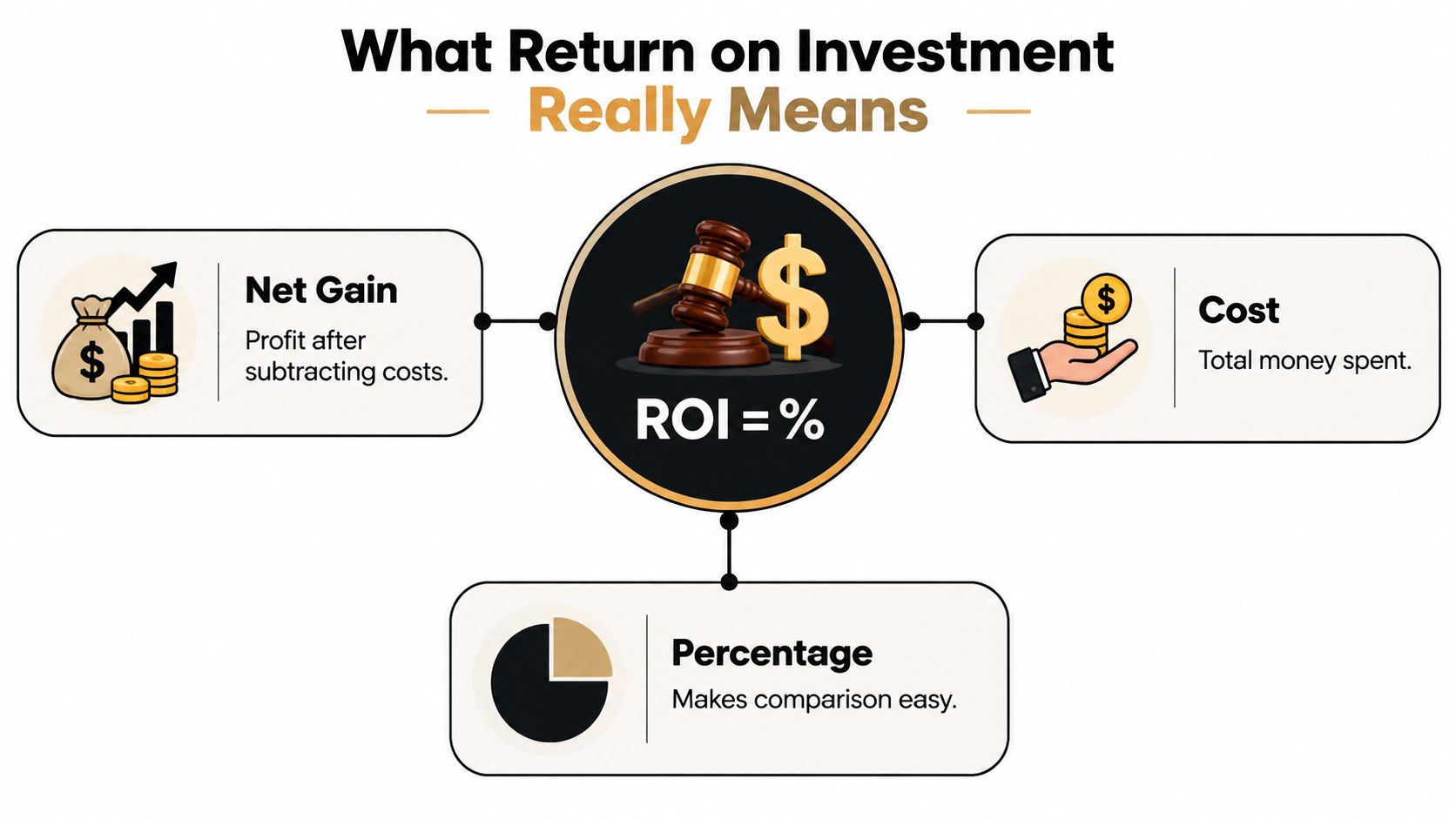
The three pieces of the equation
Total cost covers the resources required to make the investment work. A legal technology purchase may involve subscription charges, onboarding, configuration, training, integration, and added review time. A hire may involve compensation, benefits, recruitment, management time, equipment, and workspace.
Net gain is the value created after relevant costs are deducted from proceeds or benefits. In a contingency-fee practice, it may include additional fee revenue from matters the firm can accept or advance. It can also include avoided contractor expense, lower overtime, reduced rework, or hours released for case strategy and client work.
Percentage makes comparison easier, but it does not decide the investment by itself. ROI is a comparison framework, not a universal measure of quality. A high percentage can reflect a small dollar gain, while a lower percentage may accompany meaningful caseload capacity, steadier operations, or greater control over a process.
Time changes the interpretation. Saving staff hours may look attractive on a spreadsheet, yet those hours create financial value only when the firm uses them for additional matters, faster case progress, settlement preparation, or other productive work. A settlement uplift can also improve ROI, provided the firm includes the added cost and time required to achieve it.
Cost reduction affects the result as well. If the return remains constant while total cost falls, ROI rises. Lower labor expense, less rework, and shorter cycle time can therefore improve efficiency even when revenue stays unchanged, as reflected in Investopedia's explanation of ROI calculation. Time horizon still matters, so the percentage should be read alongside dollars, capacity, and the period required to produce the gain.
How to Calculate ROI Step by Step
A personal injury firm considering a medical-records review tool should begin with the decision itself, not the percentage. List the cash paid, the staff time required, and the gains the tool can reasonably produce. Time saved matters only when it supports more case work, faster preparation, or better client service.

Step 1. Identify total proceeds
List every financial benefit attributable to the tool. These may include additional fee revenue from matters the firm can accept because review capacity increased. They may also include avoided contractor expense, reduced overtime, fewer repeated tasks, or settlement value supported by more complete record analysis.
Keep the connection reasonable. If staffing, intake, and case-selection changes occurred at the same time, count only the portion that the records tool plausibly produced. A faster review is a business benefit, but it becomes a financial return only when the released hours create measurable value.
Step 2. Add total costs
Count the purchase price and the work required to put the tool into dependable use. Fidelity's ROI guidance recommends comparing total proceeds with total costs, including fees and other payments, rather than using gross income alone.
For the medical-records example, include:
- Subscription or purchase charges: Record the full amount paid for the measurement period.
- Implementation effort: Include configuration, data transfer, and process setup.
- Training and supervision: Count attorney and staff time spent learning and checking results.
- Process changes: Include temporary duplication, quality review, and integration work.
Step 3. Calculate net gain
Assume the firm pays $12,000 for the tool and records $20,000 in attributable benefits during the measurement period. Those benefits might combine avoided review expense with additional fee revenue from matters the team could handle.
Use the formula:
Net gain = total proceeds − total cost
Here, net gain equals $8,000, because $20,000 minus $12,000 leaves $8,000.
Step 4. Divide and convert to a percentage
Divide the $8,000 net gain by the $12,000 total cost, then multiply by 100. The ROI is 66.7%, rounded to one decimal place.
That percentage says the tool produced a net gain equal to about two-thirds of its cost. It does not show how quickly the benefits arrived, whether the additional matters created collection risk, or whether staff used the released time productively. Review the dollars, hours, added caseload capacity, and settlement effect alongside the headline percentage.
Before approving the result: Confirm that the calculation uses total costs, net gain rather than gross proceeds, and a measurement period that matches the firm's decision.
If the investment spans multiple periods, annualization can support comparisons across different time frames. A common formulation is (1 + ROI)^(1/n) − 1, where n represents the relevant number of periods, as described in Fidelity's annualized ROI explanation. Annualization changes the presentation, not the underlying assumptions or uncertainty.
Beyond Basic ROI When to Use Annualized ROI NPV and Payback Period
Basic ROI answers an important question: how much net gain did the investment produce relative to its cost? It doesn't answer every question a law firm faces.
A percentage can hide the time required to earn the return. It can also ignore when cash arrives, whether the firm can withstand a delayed payoff, and whether the result depends on uncertain future outcomes. For a personal injury practice, those details matter because case work, settlements, receivables, and staffing commitments often unfold on different schedules.
Match the metric to the decision
| Metric | What It Measures | Best Use Case | Limitation |
|---|---|---|---|
| Basic ROI | Net gain relative to total cost | Comparing investments with a similar time horizon | Doesn't show how long the return took |
| Annualized ROI | Return normalized across time | Comparing a subscription, campaign, or hire with different durations | Depends on the chosen period and assumptions |
| NPV | The present value of future cash flows after accounting for the value of money over time | Long-term investments with benefits arriving at different points | Requires estimated future cash flows and a discount rate |
| Payback period | How long it takes to recover the initial investment | Decisions where liquidity and downside exposure matter | Ignores benefits received after payback and can overlook total profitability |
A short software evaluation may be reasonably screened with basic ROI if costs and benefits occur within a comparable period. A long-term hire deserves closer attention to ramp-up time, recurring cost, and the point at which additional capacity begins producing value.
NPV becomes more helpful when the timing of benefits differs substantially. A dollar received later isn't operationally identical to a dollar received now because the firm may need that capital for payroll, case expenses, technology, or another growth opportunity.
Use payback to protect operating flexibility
Payback period is especially practical for firms with uneven cash flow. A project may show an attractive eventual ROI but still create pressure if the firm must fund the cost for a long time before benefits appear.
For workflow automation, firms can also use legal workflow automation software as a reference point while identifying which processes create measurable delays. The right metric depends on the decision. ROI evaluates efficiency, annualized ROI supports time comparisons, NPV evaluates timing, and payback tests recovery speed.
Real World ROI Examples for Personal Injury Firms
ROI becomes easier to understand when the investment is tied to work the firm performs every week. Consider four operational scenarios. The numbers in the formula should come from the firm's own records, not assumptions imported from another practice.

Medical records review and demand drafting
A firm introduces a process that organizes medical records and supports demand drafting. The direct cost includes the technology, implementation, quality review, and staff time required to use it correctly.
The gain may come from several sources: fewer hours spent searching for dates and providers, less duplicated review, faster preparation, and more attorney time available for negotiation or litigation strategy. The firm should record baseline review effort, post-implementation effort, the value assigned to released hours, and any attributable fee revenue.
The key is to avoid counting the same time twice. If a released paralegal hour becomes capacity for another case, value it once as productive capacity. If it only reduces overtime, use the avoided overtime cost instead.
Time savings that release paralegal capacity
A paralegal may spend substantial time locating treatment chronology, reconciling provider records, and checking whether a demand package contains the necessary support. A process improvement can create value even if the firm's caseload remains unchanged.
The calculation can treat avoided labor cost, reduced overtime, or reassigned productive work as the gain. Management should document which tasks changed and verify that the team used the released time for work with economic value.
Measure behavior, not intention: Time saved only becomes ROI when the firm converts it into lower cost, greater capacity, faster progress, or another defined benefit.
Additional caseload capacity without immediate headcount
A firm that handles work more efficiently may be able to accept matters without adding staff immediately. The potential gain comes from the contribution associated with additional matters, after subtracting case expenses and the incremental operational cost of handling them.
That doesn't mean every available hour should become another file. Leadership must consider supervision, quality control, client communication, ethical obligations, and whether the new workload would create bottlenecks elsewhere.
Better organization and settlement leverage
Improved organization may help attorneys spot treatment gaps, identify chronology problems, and build a clearer narrative across multiple providers. Those benefits can influence negotiation preparation, although the firm shouldn't assume that every organized file will produce a particular settlement result.
To measure this category, compare defined indicators such as preparation time, missing-document follow-up, revision cycles, escalation patterns, and documented negotiation outcomes. Firms considering operational investments beyond technology can use resources such as this guide to solar for businesses as a reminder to evaluate recurring costs, savings, and payback rather than focusing only on the purchase price.
The following video can supplement a firm's discussion about how automation may affect daily work, but leadership should still validate any claimed benefit against internal records.
Common ROI Pitfalls and How to Measure Intangible Benefits
ROI looks precise because it ends with a percentage. The percentage can still mislead if the inputs leave out friction, timing, or risk.
Morningstar's 2026 investor-return study found that U.S. mutual fund and ETF investors missed about 12% of aggregate fund returns over the past decade because of the timing and size of their cash flows, with an annual investor-return gap of about 1.2 percentage points compared with aggregate total return, as summarized by AdvisorAnalyst's coverage of the study. The lesson applies beyond public markets. A headline return may not match the return the decision-maker realizes.
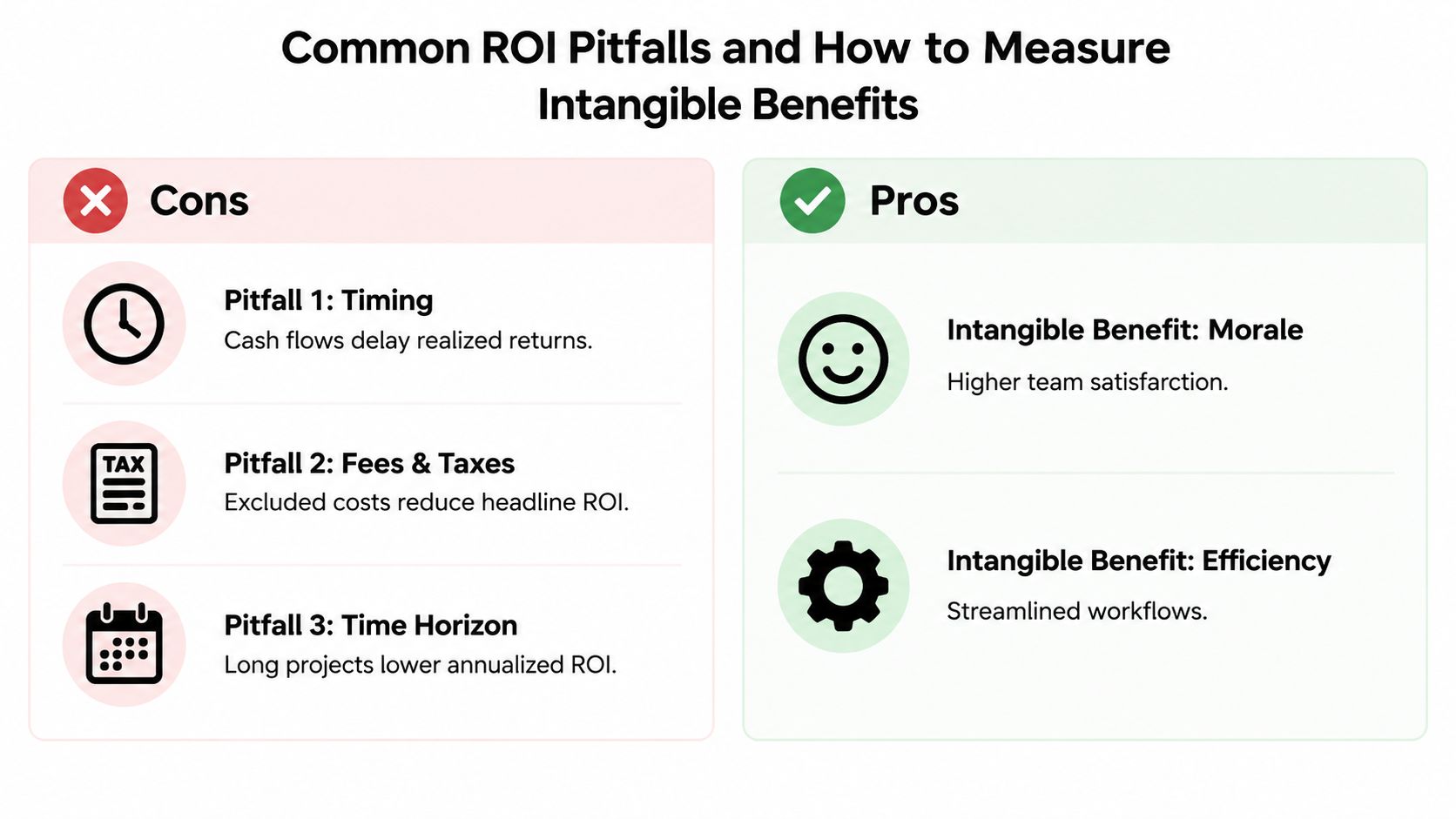
Where the percentage goes wrong
Timing: A project that produces the same total gain over a shorter period is usually more attractive operationally than one that ties up resources for much longer. Basic ROI doesn't show that difference.
Fees and taxes: Excluding implementation costs, payment fees, taxes, maintenance, or internal labor inflates the result. Britannica's explanation of ROI notes that ROI can omit fees, taxes, and other frictions.
Nominal versus real return: Inflation changes purchasing power. Historical context helps explain why nominal gains aren't the whole story. One long-run S&P 500 estimate reports 10.51% nominal annual return and 6.64% real annual return after inflation since 1957, according to Investopedia's S&P 500 return overview. A separate historical series reports 10.02% geometric average return for U.S. equities from 1928 through 2025, while the arithmetic average was 11.85%, in NYU Stern's historical returns dataset. These figures show why a firm should distinguish nominal improvement from purchasing-power improvement.
Put intangible benefits into measurable terms
Intangibles become more useful when converted into observable inputs:
- Reduced rework: Count revision cycles, correction time, duplicated review, and follow-up tasks before and after the change.
- Faster case progression: Track elapsed time between records receipt, review completion, demand preparation, and attorney approval.
- Improved team experience: Use structured internal feedback, retention observations, and workload indicators rather than assigning an arbitrary dollar value.
- Stronger negotiation preparation: Record identified gaps, chronology issues, supporting documents, and attorney-reported preparation quality.
A defensible estimate beats a dramatic estimate. Use a range of plausible benefits, document the assumptions, and revisit them after implementation.
Your Simple ROI Template and Next Steps
A practical firm worksheet can stay compact while still forcing better decisions:
| Field | What to enter |
|---|---|
| Total investment cost | Purchase, fees, labor, training, implementation, and ongoing expense |
| Total gain | Attributable revenue, avoided cost, released capacity, or documented operational value |
| Net gain | Total gain minus total investment cost |
| ROI percentage | Net gain divided by total investment cost, multiplied by 100 |
| Annualized ROI | Time-normalized return when the comparison periods differ |
Before relying on the result, check five things:
- Confirm scope: Define exactly which project, workflow, or campaign the calculation covers.
- Capture full cost: Include internal labor and implementation effort, not only the invoice.
- Separate gross from net: Use the gain remaining after relevant costs.
- Set the time horizon: Record when spending occurs and when benefits arrive.
- Compare alternatives: Evaluate the result against another use of the firm's capital and team capacity.
A firm evaluating a legal technology company should ask whether the product's claimed benefits can be connected to these fields. If the vendor can't explain what changes, how the firm will measure it, and when value should appear, the ROI case needs more work.
Run the template on one current initiative, such as medical-record review, demand drafting, intake, or staffing. Use the result as a decision aid, then reassess it with actual operating data. The strongest investments are the ones that help the firm save time, expand capacity, improve case preparation, and move matters toward resolution without sacrificing quality.
Ares provides an AI-powered platform for personal injury firms that organizes medical records, extracts case-ready insights, and supports demand letter drafting. Visit Ares to see how your firm can connect time saved and better case organization to a clearer ROI decision.