
A client may have a thick treatment file, consistent billing, and a diagnosis that appears on every claim. The adjuster still asks the same uncomfortable question: Why was each service medically necessary? A records stack proves that care occurred. It doesn't automatically prove that the care was related to the injury, appropriate in intensity, or supported by the clinical record.
For a personal-injury firm, the answer lives in the connection between symptoms, findings, treatment decisions, timing, response, and documentation. Medical necessity is a clinical and coverage standard, not merely a statement that treatment occurred. A service generally must follow accepted medical practice, fit the patient's condition in type, frequency, extent, location, and duration, and not cost more than an equivalent alternative expected to produce comparable results, as described in this overview of medical-cost and necessity standards.
The practical question isn't only “Was the patient treated?” It is “Can another person follow the record and understand why this service was selected, at this time, at this level, for this patient?” That is the question a payer asks, defense counsel attacks, and a fact finder may ultimately evaluate.
Why a Billed Service Can Still Lose a Case
A paralegal receives a file after a rear-end collision. The client attended therapy, underwent diagnostic imaging, saw a specialist, and continued treatment after reporting persistent pain. The chart is substantial. Yet the demand reviewer flags the imaging as excessive, questions the number of therapy visits, and points out that several notes repeat the same language without documenting functional change.
Nothing about the existence of treatment resolves those objections. A billed service can be genuine, properly coded, and delivered while still failing to persuade someone that it was necessary for the claimed injury.
Practical rule: Treat every major service as an argument that needs supporting documents, not as a line item that speaks for itself.
Medical necessity asks whether a prudent physician would provide the service to prevent, evaluate, diagnose, or treat an illness, injury, disease, or symptom. The service should satisfy three related requirements: it should follow generally accepted practice, be clinically appropriate for the patient's condition and circumstances, and be effective for that condition. It also shouldn't exist primarily for the convenience of the patient, provider, or physician.
That standard creates different pressure points for different audiences:
- Payers examine coverage rules, coding, authorization, setting, frequency, and supporting clinical information.
- Medicare reviewers apply the reasonable-and-necessary payment principle, even when the provider's note is complete.
- Defense counsel looks for breaks in causation, unsupported escalation, repetitive care, and inconsistencies between the history and the bills.
- A judge or jury needs a coherent story showing why the care followed from the injury and why its scope made sense.
The distinction between amounts paid and amounts merely billed can also affect damages analysis. When that issue arises, a concise explanation of the paid vs incurred legal term can help the team separate the value of treatment from the legal rule governing recoverability.
A diagnosis is a starting point, not a conclusion. The record must show the condition treated, the objective or functional problem, the provider's rationale, the patient's response, and the reason care continued, changed, or stopped. Without that chain, the defense can characterize treatment as routine billing rather than injury-driven care.
The Three-Part Test and Four Review Dimensions
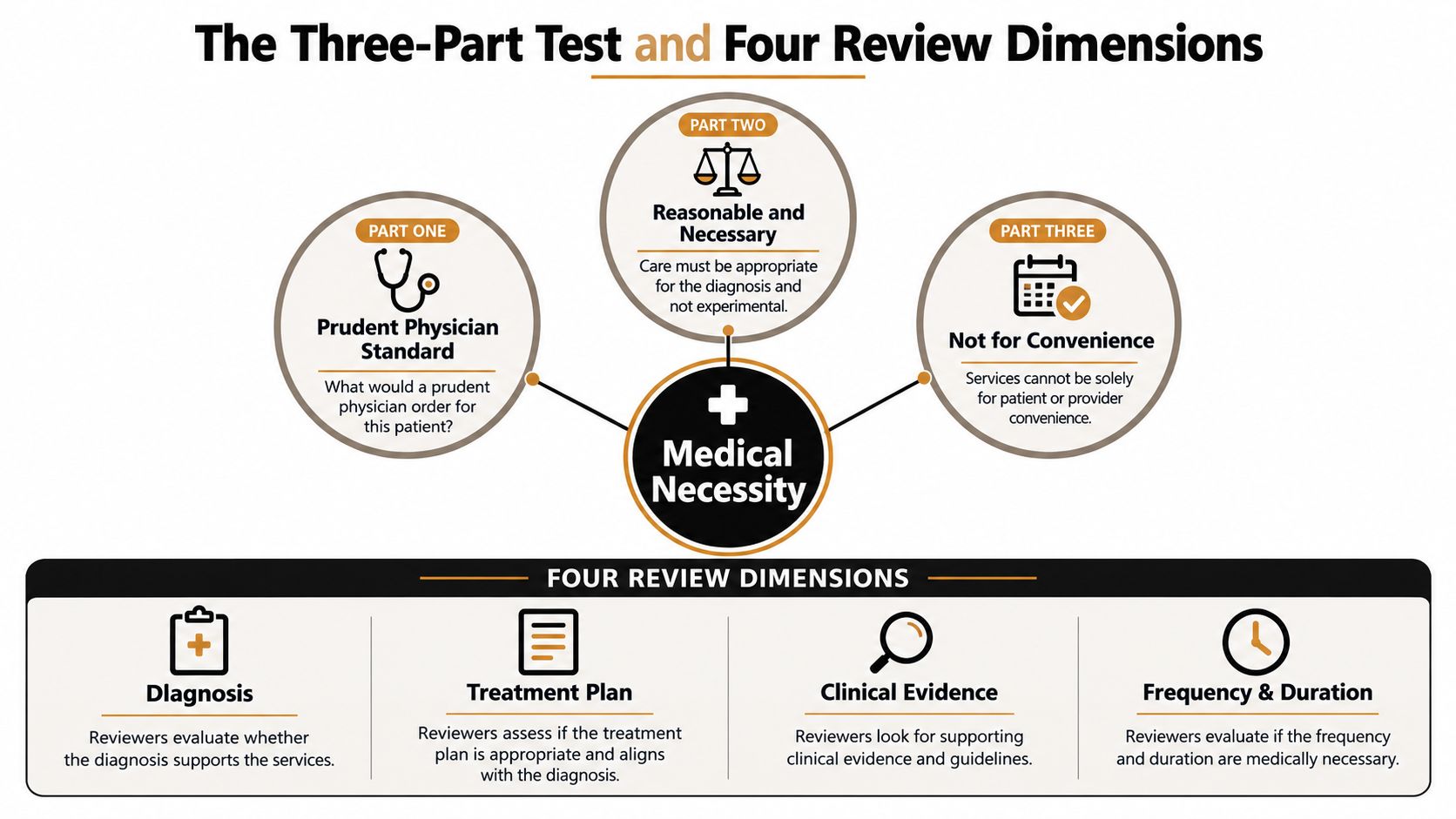
The cleanest way to review a billed service is to apply two filters. First, ask whether the service satisfies the substantive medical-necessity test. Then ask whether the record survives the technical review dimensions used to test the claim.
The substantive test
The prudent-physician question is the anchor: Would a prudent physician provide this service for this patient and this documented problem? That doesn't mean every reasonable physician would choose the identical modality. It means the decision should fit accepted practice and the clinical circumstances.
The three substantive tests are:
- Accepted practice. Does the service conform to generally accepted medical practice for the documented condition?
- Clinical appropriateness. Is the type, intensity, frequency, duration, and setting suitable for the patient's symptoms and findings?
- Effectiveness. Does the record show that the service was reasonably expected to diagnose, treat, or improve the condition?
Consider an MRI ordered after a collision. The study is stronger when the chart records persistent or worsening symptoms, examination findings, functional limitations, and a clinical reason that imaging is needed at that point. It is weaker when the record contains only a diagnosis code and a generic order with no explanation of what question the MRI is intended to answer.
The review dimensions
Technical review commonly tests whether the service is proper for the documented condition, directly provided for diagnosis or treatment, delivered at an appropriate level and setting, and not primarily performed for convenience, as reflected in this medical-necessity guidance.
| Test or dimension | What it asks | Failure pattern |
|---|---|---|
| Accepted practice | Would a prudent physician recognize the service as appropriate? | The record gives no clinical rationale |
| Clinical appropriateness | Does the service fit the patient's condition, timing, intensity, and setting? | The treatment level exceeds the documented course |
| Effectiveness | Was the service intended to diagnose or treat the condition? | No objective outcome or response is recorded |
| Proper for condition | Does the billed service match the diagnosis and findings? | The code and narrative point to different problems |
| Diagnosis or treatment purpose | Was the service directly connected to care? | The record suggests screening, convenience, or an unrelated purpose |
| Appropriate level and setting | Was this modality, location, or provider level justified? | A less intensive option is not considered or explained |
| Not for convenience | Was the decision clinically driven? | Scheduling or preference appears to drive the service |
The same logic applies to therapy. A block of visits earns credibility when the initial evaluation identifies measurable limitations, each visit records response or continued impairment, and the plan explains why the frequency remains appropriate. If every note repeats pain complaints without functional measures or reassessment, the service may look repetitive even when the patient attended.
Lawyers building evidence systems can also compare this approach with an SSDI evidence checklist, particularly for organizing diagnoses, treatment history, functional effects, and supporting records. The legal standards differ, but the documentation lesson is similar: decision-makers need a record that connects medical facts to functional consequences.
Medicare, EMTALA, and the Prudent-Layperson Standard
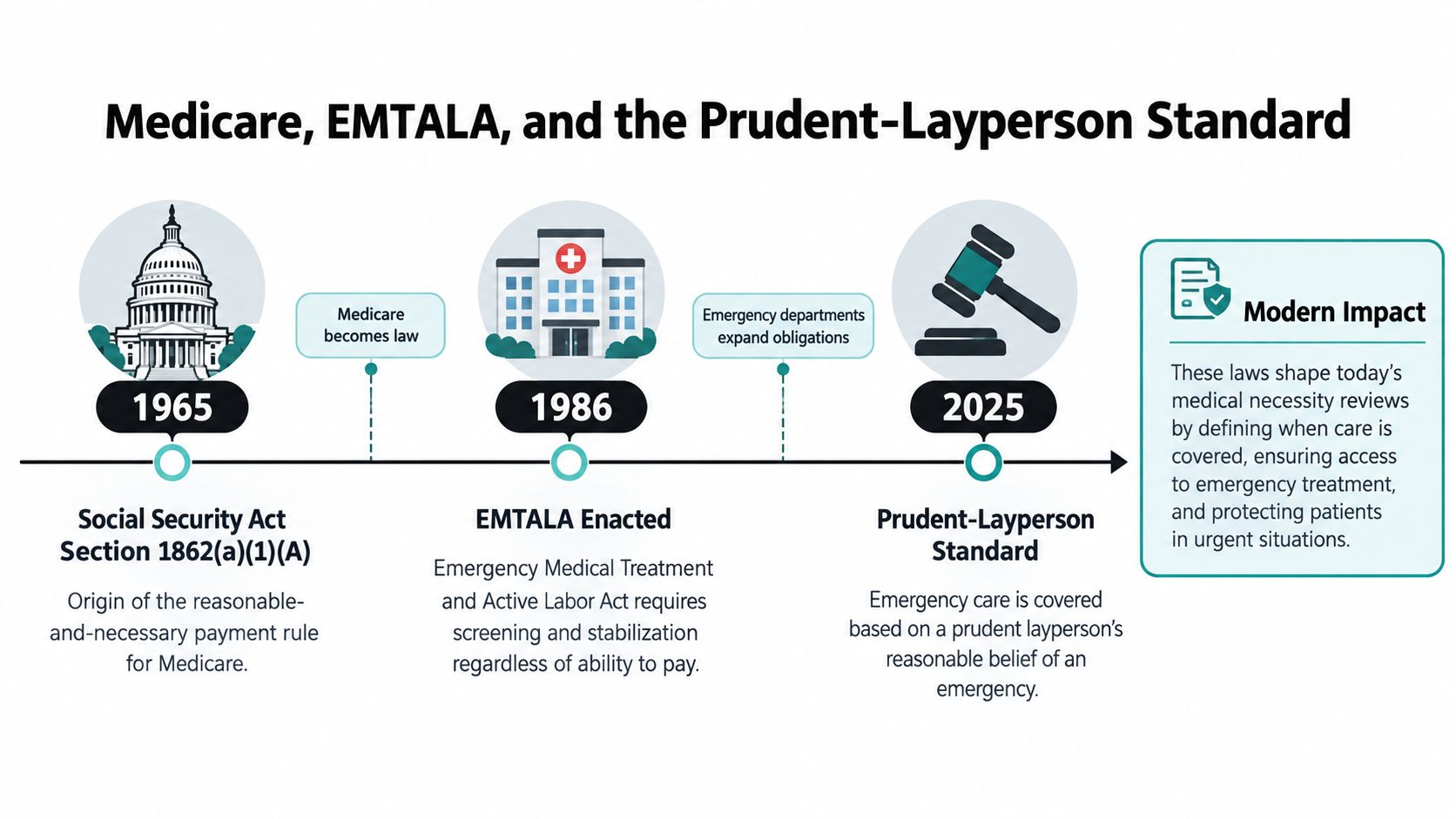
The phrase “reasonable and necessary” has a specific payment history. Section 1862(a)(1)(A) of the Social Security Act, enacted with Medicare in 1965, established that Medicare doesn't pay for items or services that aren't reasonable and necessary to diagnose or treat illness or injury, or to improve the functioning of a malformed body member, as explained by the National Academies' discussion of the Medicare payment rule.
That rule answers a payment question: should the program pay for this service? It doesn't mean that every emergency encounter can be postponed until a payer finishes deciding whether the eventual treatment will be covered.
Separate access from payment
Congress enacted EMTALA in 1986 to protect public access to emergency services regardless of ability to pay. Its emergency-access function is distinct from a later utilization review. A hospital's obligation to evaluate or stabilize an emergency condition isn't identical to the payer's later decision about whether a particular service satisfies coverage criteria.
That distinction matters in injury litigation. An emergency department record may strongly support the existence and initial evaluation of an acute problem, while a later dispute may focus on whether follow-up imaging, therapy, or specialist care was appropriate. The same patient encounter can therefore look necessary under an access rule and still produce a separate payment dispute under a coverage rule.
Congress later enacted the prudent-layperson standard for Medicare and Medicaid managed-care plans in 1997. The standard recognizes that a patient may reasonably believe an emergency exists based on symptoms, even before a final diagnosis is known. It protects access based on the circumstances apparent to the patient, while medical-necessity review can later examine the clinical basis and scope of services delivered.
Use precise vocabulary in the file
A demand or appeal should identify which question is being answered:
- Emergency access: Was evaluation or stabilization required under the emergency-care protection?
- Clinical necessity: Was the service appropriate for the condition and clinical course?
- Coverage: Did the service satisfy the applicable plan or program rules?
- Damages: What treatment and expense are legally recoverable under the governing jurisdiction?
Those questions overlap, but they aren't interchangeable. A billing specialist handling emergency claims may provide useful operational context through resources on emergency medicine billing services, while the PI team must still build the injury-specific clinical chronology.
The legal pedigree of the phrase helps explain why a diagnosis code alone is inadequate. A code identifies a condition category. It doesn't establish the findings, rationale, timing, response, or proportionality that make the service defensible.
Building a Defensible Cause-and-Effect Chronology
A defensible chronology does more than list appointments in date order. It explains why each service appears when it does and how the clinical course supports its intensity.
Start with the incident and the earliest documented symptoms. Identify the first examination findings, the functional complaints, the initial treatment plan, and any relevant history. Then trace each major service through the record without allowing the billing statement to become the primary narrative.
Use a per-service extraction
For every significant visit, study, procedure, referral, or treatment block, capture the following:
- Diagnosis or symptom addressed: What condition or complaint was the provider treating?
- Provider rationale: Why did the clinician select this service rather than observation, a lower-intensity option, or another modality?
- Timing relative to the incident: Did the service occur immediately, after conservative care, after worsening symptoms, or after a documented change?
- Objective support: What examination finding, imaging result, functional limitation, or observed response supports the decision?
- Response to prior care: Did the patient improve, fail to improve, relapse, or develop a new concern?
- Alternative or escalation analysis: Does the chart explain why the selected care was preferred or why escalation became appropriate?
- Outcome: Did the service produce improvement, clarify diagnosis, change the treatment plan, or document continuing impairment?
This extraction turns a large file into a series of short arguments. For example, a specialist referral may be supported by persistent symptoms despite initial care, abnormal examination findings, and a need to evaluate whether a different intervention is appropriate. If the referral appears without those connecting facts, the defense can describe it as an unexplained escalation.
The chronology should also identify gaps, but don't treat every gap as abandonment or proof that care was unnecessary. Ask whether the record contains an explanation such as improvement, scheduling difficulty, insurance interruption, travel, provider transition, or a change in the plan. An unexplained gap is a question to investigate, not a conclusion to assume.
Compare value, not just price
CMS-derived criteria evaluate whether care is consistent with accepted practice, suitable to the patient's condition and setting, and appropriate in duration, frequency, and cost-effectiveness. An alternative can weaken the necessity argument when it is less costly and at least as beneficial, as described in this comparative medical-necessity guidance.
That doesn't mean the least expensive service always wins. It means the record should explain why the selected service offered a clinically relevant advantage for this patient. A more expensive diagnostic study carries a heavier documentation burden when a comparable alternative appears available.
For larger files, a structured medical record chronology workflow can help the team organize dates, providers, symptoms, findings, and treatment changes before drafting the demand. The output should still be reviewed by a human who understands the claim, because chronology is useful only when it preserves causation and clinical meaning.
Why Approved Care Still Gets Denied
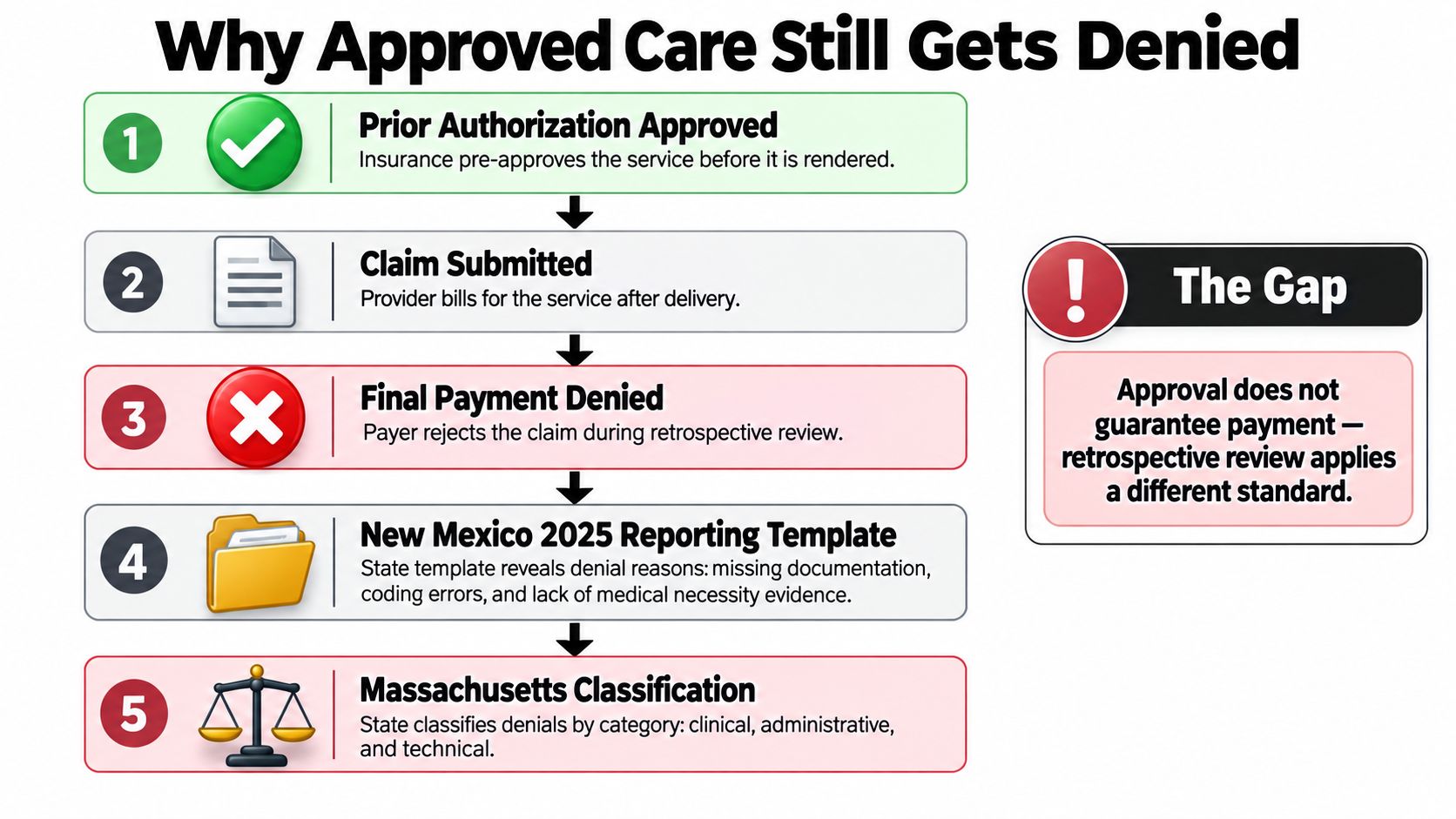
Prior authorization is evidence that a payer approved a request under a particular review process. It isn't a guarantee that the submitted claim will receive final payment.
New Mexico's 2025 commercial prior-authorization reporting template asks insurers to identify claims for which authorization was approved but the claim was later denied for payment. Massachusetts distinguishes approved requests, defined as requests determined medically necessary, from denied requests that can include both lack of medical necessity and administrative reasons, as reflected in the New Mexico prior-authorization reporting template.
Classify the denial before using it
A later denial can reflect a clinical dispute, but it can also involve eligibility, coding, missing records, benefit exclusions, site-of-service rules, or a mismatch between the authorized service and the submitted claim. Those categories have different evidentiary value in an injury case.
A denial for a missing modifier isn't persuasive evidence that the patient's therapy was unnecessary. A denial stating that the service wasn't medically appropriate requires a different response. The file should preserve the exact language instead of reducing every denial to “insurance refused payment.”
Create a denial log with these fields:
- Authorization: Approval notice, approved service, dates, units, and conditions.
- Clinical record: Referral, order, evaluation, progress notes, and reassessment.
- Claim record: Submitted codes, dates of service, provider information, and place of service.
- Payer explanation: Explanation of benefits, denial code, correspondence, and review rationale.
- Appeal history: Records submitted, decision reached, and any revised explanation.
- Disputed criterion: Clinical necessity, coding, eligibility, benefit scope, documentation, or another issue.
Maryland's 2025 reporting framework defines an adverse decision broadly as a utilization-review determination that care wasn't medically necessary, appropriate, or efficient. That classification reinforces the need to identify what the reviewer decided rather than treating the denial as a general verdict on the claim.
A payment denial is a document to interpret. It isn't automatically a medical opinion against causation, treatment, or damages.
The best response often combines the authorization with the later clinical record and claim detail. If the payer approved a service but denied payment because the submitted code or documentation didn't match, correct the administrative issue while preserving the authorization as evidence that the service had passed an earlier review.
Documentation Pitfalls Versus Documentation Wins
Most weak necessity records don't fail because the patient received no care. They fail because the chart doesn't explain the transitions. The treatment may be reasonable, but the file leaves the reviewer to infer why it started, continued, intensified, or ended.
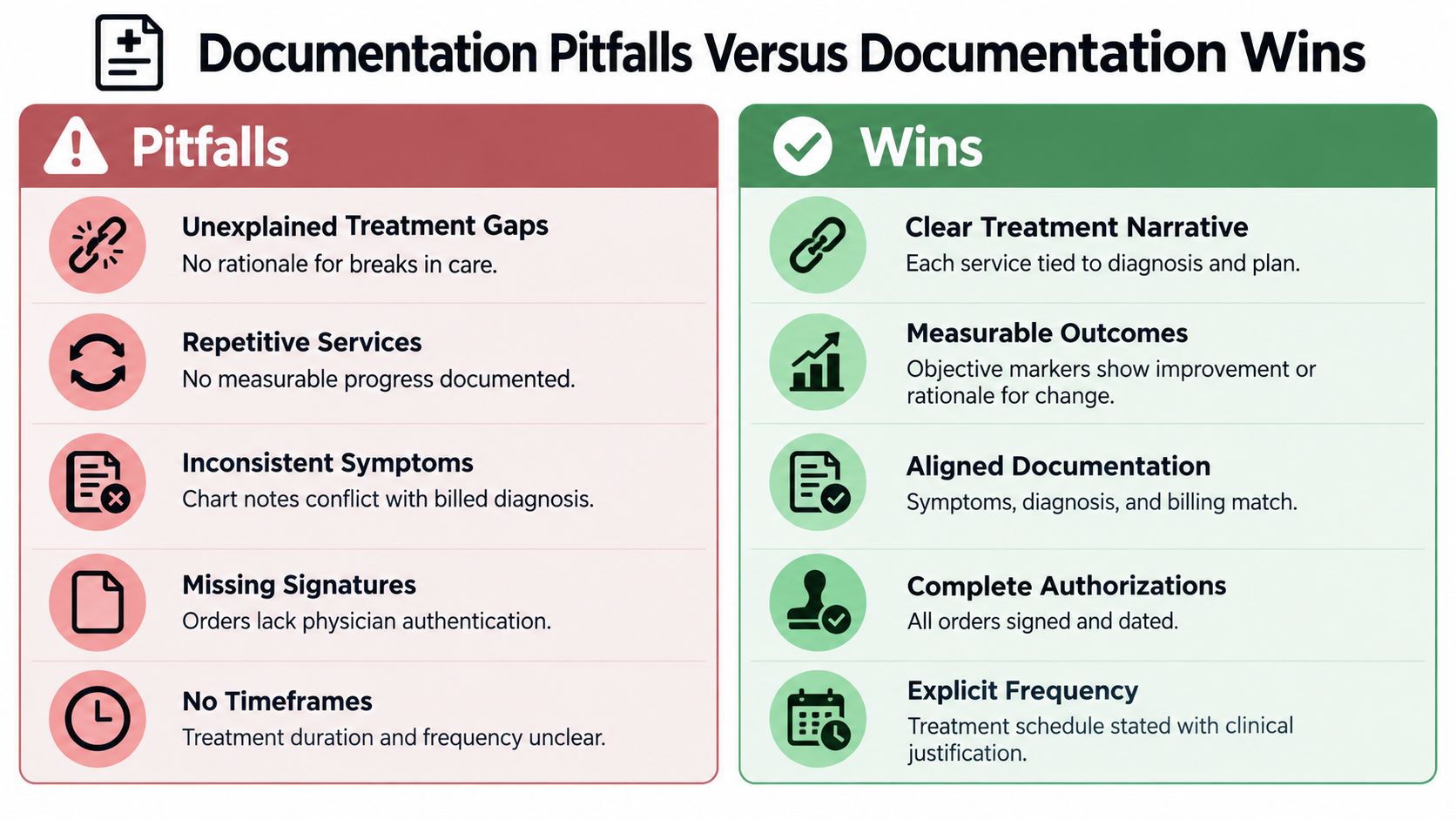
The side-by-side audit
| Documentation pitfall | Documentation win |
|---|---|
| Unexplained treatment gaps: The chart jumps from one course of care to another without stating what happened. | Clear treatment narrative: The next provider explains the prior response, continuing symptoms, and reason for the new plan. |
| Repetitive services: Progress notes repeat pain scores or boilerplate language without showing change. | Measurable outcomes: Notes record range of motion, strength, work limits, activity tolerance, or another relevant functional marker. |
| Inconsistent symptoms: The history, diagnosis, and billed service don't align. | Aligned documentation: The symptom description, assessment, order, procedure, and billing code tell the same story. |
| Unsupported diagnosis changes: A new diagnosis appears without examination findings or explanation. | Documented diagnostic reasoning: The provider identifies the new finding and explains how it changes treatment. |
| Continued care without reassessment: Visits continue even though the plan never changes. | Escalation or discharge rationale: The record explains continuation, modification, referral, or release from care. |
One of the most damaging patterns is not a missing document but a contradiction. A patient reports severe limitation in one note, then describes unrestricted activity in another, while the treatment plan remains unchanged. The inconsistency may have an innocent explanation, but the file needs one. Obtain clarification where possible instead of expecting the adjuster or jury to resolve it favorably.
Audit before drafting
Read the file in two directions. First, read chronologically to understand the clinical course. Then read by service type, grouping therapy, imaging, medication management, specialist visits, and procedures. The second pass exposes repetition, unexplained frequency, and diagnosis drift that a date-only review can miss.
Flag records that need supplementation:
- Missing orders or signatures: Confirm that the service was ordered, authenticated, and dated where required.
- Unclear frequency: Find the plan that explains how often care should occur and why.
- No response measure: Request records showing improvement, non-response, or continuing impairment.
- No closing explanation: Obtain a discharge or final status narrative tying the course to the injury and remaining symptoms.
A structured medical record summary process can help the case team locate these gaps before the demand relies on an incomplete narrative. It shouldn't replace source review. The summary must point back to the underlying note, date, provider, and clinical statement.
Appeals, Dispute Strategy, and Where AI Review Helps
An appeal succeeds when it answers the denial criterion directly. Sending the entire file without a map usually creates work for the reviewer without making the clinical logic easier to follow.
Build the response in stages
For an internal appeal, submit the plan or applicable coverage rule, the relevant clinical records, the order or referral, and a short chronology showing why the disputed service was selected. Include the exact billed service, not merely a general statement that the patient required care.
If the dispute concerns the modality, add appropriate clinical literature or accepted-practice material that explains its role. If the dispute concerns frequency or duration, focus the treating physician's letter on the patient's documented response, functional limitations, and reason for continuation. A generic letter saying “the treatment was medically necessary” won't carry the same weight as a criterion-by-criterion explanation.
For external review, preserve the internal decision and identify what the first reviewer did not consider. The submission should distinguish clinical necessity from administrative defects and attach the records that resolve each issue. In litigation, use the same chronology as a foundation for deposition questions, expert review, and the damages presentation.
A practical sequence is:
- Identify the denial: Quote or accurately summarize the disputed criterion.
- Match evidence to criterion: Put the relevant note, order, finding, or authorization beside it.
- Explain the clinical progression: Show what changed, what failed, and why the next service followed.
- Address alternatives: Explain why a lower-intensity or less costly option wasn't equivalent in the patient's circumstances.
- Close the loop: State the outcome, continuing impairment, modification, or discharge decision.
Use automation for extraction, not judgment
AI review is most useful when it turns a records stack into a sourceable working file. A tool such as Ares AI medical record review can extract dates, diagnoses, treatments, providers, billing information, and symptom chronology so a paralegal can find the services that require closer necessity analysis.
The human reviewer still decides whether the record supports causation, proportionality, credibility, and strategy. Before adopting any automation partner, verify HIPAA compliance, source-linked extraction, transparent handling of uncertainty, and exports that fit the firm's litigation workflow. A fast summary that can't be traced back to the underlying note is a convenience, not a defensible work product.
Ares organizes medical records into case-ready timelines and summaries that surface diagnoses, treatments, providers, billing information, and symptom changes relevant to medical-necessity review. Upload the file, inspect the extracted chronology, and use the result to identify documentation gaps before an adjuster or defense lawyer does by visiting Ares.