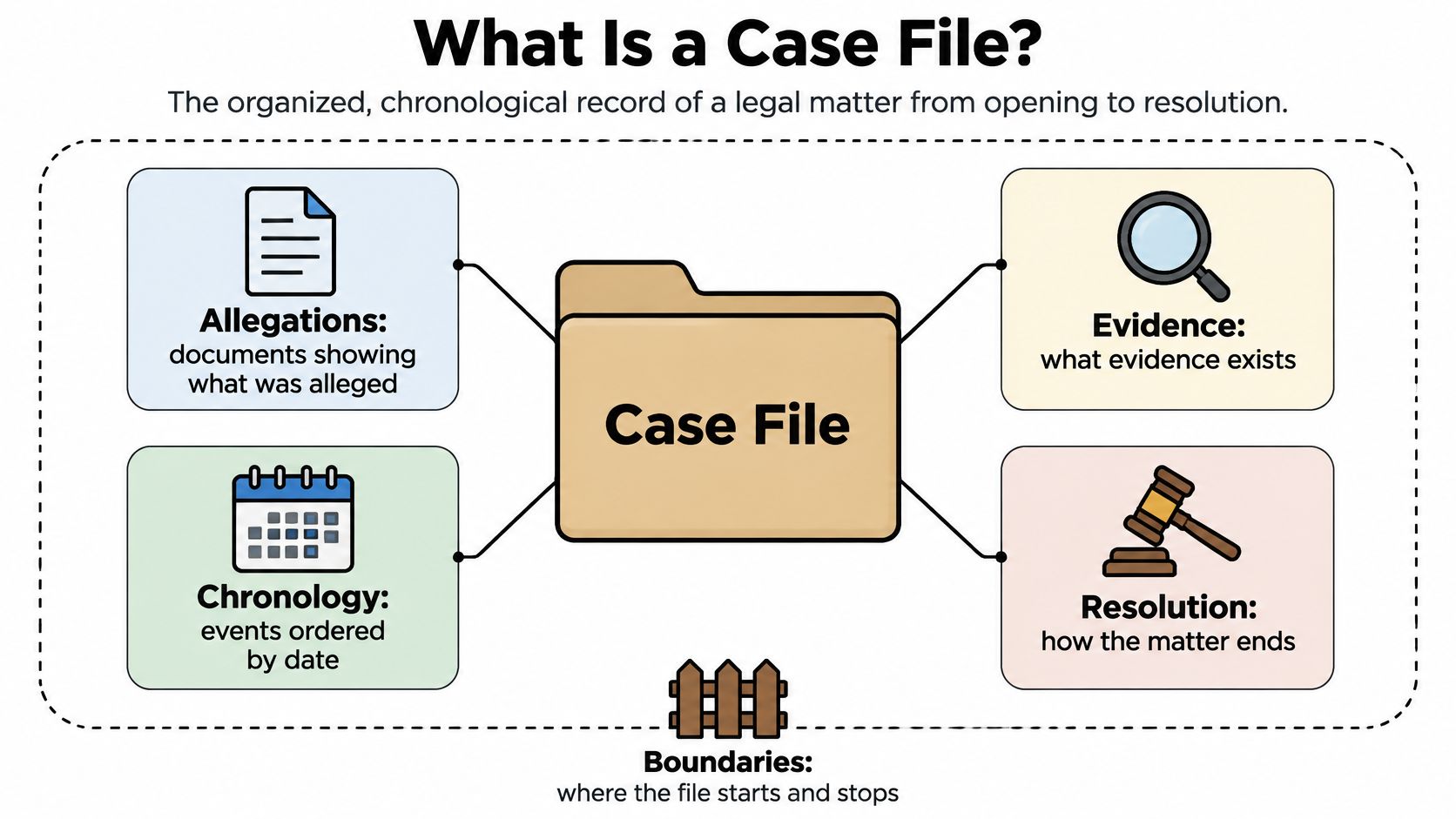
A case file is the organized, chronological record of a legal matter from opening to resolution; in personal injury work, it holds the pleadings, discovery, medical records, correspondence, and timelines needed to prove and value the claim.
If every document has been scanned into a searchable folder, why might the file still be incomplete? Because storage doesn't establish what's missing, where a record came from, or whether someone should receive it. A useful file lets another team member reconstruct the claim without relying on the memory of the person who assembled it.
What a Case File Is and Where Its Boundaries Sit
Think of a case file as a ship's logbook. Each entry needs a date, a source, and a place in the sequence so someone else can reconstruct the voyage.
The U.S. National Archives identifies case files as the primary record type in its federal court holdings, covering civil, criminal, bankruptcy, and other proceedings. For a personal injury team, the practical purpose is similar: preserve what was alleged, what evidence exists, what happened procedurally, and how the matter ended.
Three layers of a personal injury case file
The answer to “What is a case file?” changes slightly depending on who's asking. A court clerk, client, and supervising attorney may mean different collections.
| Layer | Typical contents | Who may see it |
|---|---|---|
| Court file | Filed pleadings, motions, orders, judgments, service papers | Court-held record; access follows court rules |
| Client file | Medical records, bills, photographs, insurer letters, witness communications | Client access follows jurisdiction-specific file-delivery rules and appropriate review |
| Internal work product | Chronologies, analysis, strategy notes | Restricted firm access; review protection and release obligations before disclosure |
Pleadings are formal documents stating claims and defenses. Work product is material prepared for litigation, such as an attorney's assessment of weaknesses in the evidence.
The Ohio court records primer helps distinguish court-maintained records from the broader materials a firm keeps. These collections overlap, but they aren't interchangeable.
Separating internal analysis is a review safeguard, not a blanket reason to withhold documents from a client.
Protection and access turn on jurisdiction and purpose. A factual chronology doesn't become privileged merely because someone places it in an internal folder.
The illustration captures the file's central functions; the boundary table identifies the separate access questions.
The Five Core Components of a Personal Injury Case File
| Component | Typical contents | Question it answers |
|---|---|---|
| Pleadings | Complaint, answer, motions, orders | What is claimed, and what is disputed? |
| Discovery | Interrogatories, requests for production, depositions, expert disclosures, medical authorizations | What does the other side hold, and what can each side prove? |
| Medical records | EMS and ER reports, imaging, treatment notes, diagnoses, itemized bills | Does the treatment link the injury to the incident, and what did it cost? |
| Correspondence | Adjuster letters, demand letters, provider request logs, client messages | What offers, denials, promises, and deadlines were communicated? |
| Timelines | Incident date, first treatment, symptom reports, work loss | What is the sequence, and where are the gaps? |
What each component contributes
Pleadings and court papers establish the legal dispute. The complaint states the allegations; the answer identifies admissions and denials. Motions ask the court to act, while orders record its decisions. Those last documents aren't technically pleadings, even when a firm groups them together.
Discovery is the formal exchange of information. Interrogatories are written questions; requests for production seek documents; depositions preserve sworn testimony. Track requests, responses, objections, and supplements together so staff can distinguish a missing response from a request never sent.
Medical records support the injury narrative, but bills serve a different function from treatment notes. A chart may document symptoms without establishing the amount charged. For context on organizing financial losses, Olson & Sons' explanation of special damages in personal injury cases is a useful companion.
Reading the components together
Correspondence preserves commitments and explanations that may never appear in clinical records. Keep an adjuster's denial with its attachments, and log a provider's response that records aren't available.
Timelines connect those separate materials. Say a client reports neck pain after a crash but doesn't seek treatment until later: compare the intake account, first treatment note, and intervening messages before presenting a continuous symptom history.
Completeness check: Confirm that each component is present, dated, and usable, not merely represented by an empty folder.
These are the core categories, not the entire inventory. Wage records, photographs, witness statements, and property-damage materials also belong where the team can retrieve them.
How a Case File Grows From Intake to Closure
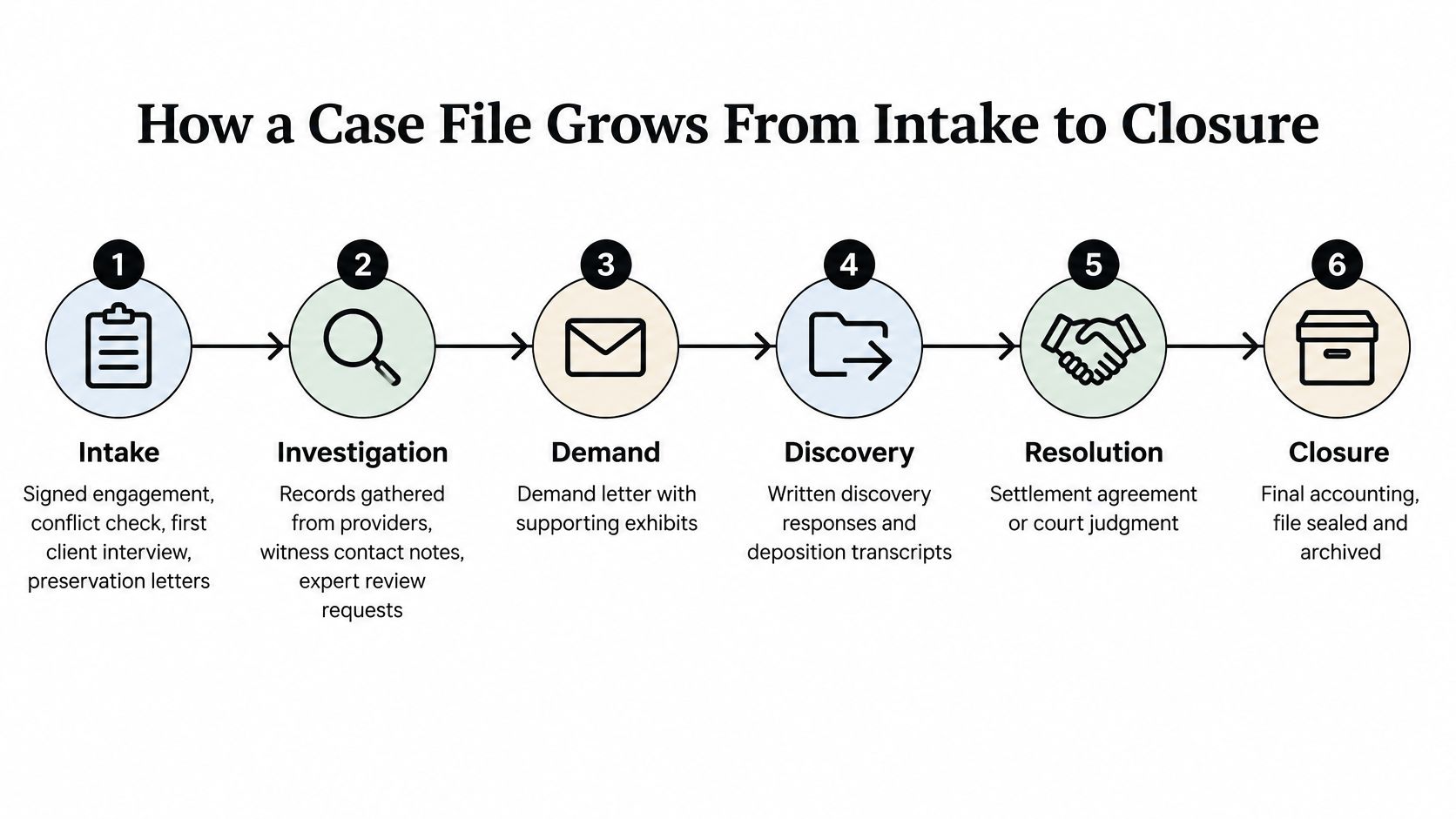
A file begins before anyone files a lawsuit. It develops as the team accepts representation, investigates the incident, evaluates the claim, and records the outcome.
Historical files show the same beginning-to-end principle: the National Archives' Army court-martial collection includes charges, pleas, exhibits, proceedings, findings, sentences, review reports, and correspondence. A complaint or initial accusation alone can't explain a matter's history.
Following an injury claim through its working phases
- Intake: Record the engagement, conflict review, client interview, and preservation correspondence. Date the interview and identify who supplied each account.
- Investigation: Add incident reports, scene photographs, witness notes, and medical-record requests. Record both the request date and the receipt date.
- Pre-suit demand: Preserve the demand package, medical summary, supporting exhibits, and exact version delivered to the insurer.
- Pleadings: If litigation becomes necessary, add the complaint, filing confirmation, service documents, and answer. Counsel must verify the applicable filing deadline.
- Discovery: Collect written exchanges, deposition transcripts, expert materials, and any independent medical examination documents.
- Resolution and closure: Preserve mediation materials, settlement documents or trial results, final accounting, a closing memorandum, and the retention decision.
The visual shows the broader progression, although a real claim may settle before litigation or require further investigation during discovery.
Dates that make reconstruction possible
Suppose a preservation letter seeks surveillance footage. Keep the sent letter, delivery evidence, recipient's response, and follow-up task together, rather than saving only the final response.
Use separate fields for when an event occurred and when the firm learned about it. A late-arriving record belongs in the event chronology without concealing its later receipt.
Organizing Records So Gaps Show Up Early
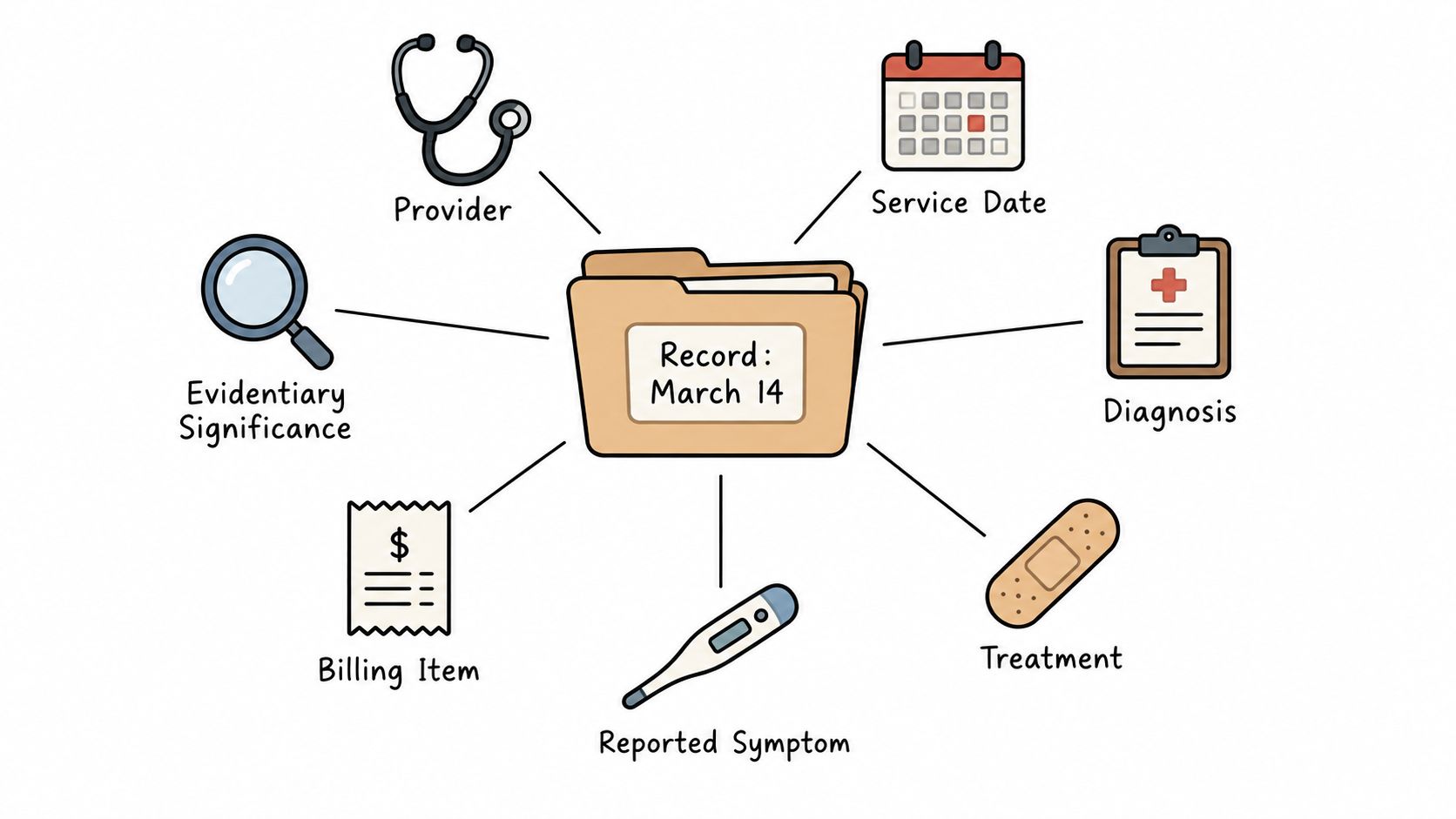
Organize around relationships, not just filenames. Each medical entry should connect the provider, service date, symptoms, diagnosis, treatment, billing item, and significance to the claim.
The image illustrates those connections around a single encounter.
Build a source-linked encounter entry
Say an emergency visit documents cervical strain. Link the treating provider's note, the client's reported symptoms, discharge instructions, and matching bill to that encounter. Identify the source page for each extracted fact, and distinguish what the client reported from what the clinician observed.
The American Bar Association's civil legal-aid case-file standard recommends chronological records of interviews, contacts, investigations, and searches, including dates, participants, facts learned, and concessions. Apply that discipline to provider follow-up as well as substantive evidence.
Capture matter ID, client, custodian, document type, creation or service date, source, version, access history, and retention trigger. The custodian is the person or organization responsible for the record; the retention trigger is the event used to calculate its preservation period.
Make exceptions visible
- No nearby treatment: Flag an alleged injury without a corresponding contemporaneous medical entry.
- Unexplained interval: List a break in treatment for follow-up rather than inventing an explanation.
- Unexpected sequence: Review later diagnoses and pre-incident symptoms without assuming either proves or defeats causation.
Use a consistent pattern such as service-date_record-type_provider_version. These file-naming conventions can help staff apply the same pattern across matters.
Separate original records from extracted summaries and chronologies. Keep correspondence organized by sender and purpose, with internal legal analysis in a restricted location rather than a general correspondence folder. Back up the electronic file and test retrieval.
The video provides an additional workflow reference.
How Long to Keep a Case File and When to Destroy It
| Record stage | Retention rule | Action before destruction |
|---|---|---|
| Active matter | Keep the complete file; suspend routine deletion when a claim is reasonably anticipated | Confirm the litigation hold covers relevant records |
| Closed matter, jurisdiction using five years | Apply the jurisdiction's prescribed period and trigger; retain longer when another obligation requires it | Verify the governing rule and limitation period, then calendar review |
| Closed matter, jurisdiction using seven years | Apply the jurisdiction's prescribed period and trigger; retain longer when another obligation requires it | Verify the governing rule and limitation period, then calendar review |
| Original client documents | Preserve until ownership and return obligations are reviewed | Return or release client-owned originals appropriately |
| Extracted summaries and chronologies | Preserve with traceable links to source records | Don't treat summaries as substitutes for originals |
| Electronic records and metadata | Preserve identifying and provenance information throughout retention | Test restoration before deleting a source copy |
Choose the governing rule before setting a date
There isn't a universal destruction period for every injury file. Counsel should identify the longest applicable ethical, contractual, regulatory, and limitation-period requirement, then verify when its clock begins. Closure is a useful administrative checkpoint, but don't assume it starts every applicable period.
The federal electronic records management provisions provide a records-management framework, not a universal law-firm retention schedule. Don't use a federal agency rule as authority for destroying a private client file.
A litigation hold is an instruction to preserve relevant information and suspend conflicting deletion practices. Keep it effective while preservation obligations remain, including where a closed matter may generate a later dispute.
Before destruction: Require an authorized reviewer to approve the decision, not merely a calendar reminder to trigger deletion.
Confidentiality continues after closure. Restrict health information by job responsibility, and review HIPAA documentation retention requirements separately from the broader client-file policy.
Assign a named owner to the retention decision and destruction review. Record what was returned, preserved, or securely destroyed so the firm can explain its actions later.
Digital Pitfalls and the Pre-Demand Audit
Can you search the PDF? Good. Can you trace the proposed demand's medical assertions to legible source records and identify exactly what the insurer will receive? That's the more useful test.
A digital file becomes reliable enough for decisions when staff can retrieve its contents, verify its sources, distinguish versions, control access, and check extracted facts. Searchability helps, but it doesn't establish completeness.
The DC Bar's Ethics Opinion 357 addresses electronic client files and the need to preserve accessibility and prevent unauthorized disclosure. Electronic storage doesn't remove the responsibilities attached to the underlying records.
Fix the defects a search box won't catch
- Unreadable scans: Search for a known provider or diagnosis, then inspect the page visually. Optical character recognition can miss text even when the image looks clear; request a better copy when necessary.
- Duplicate medical records: Compare encounter dates and page contents before counting visits or charges. Preserve meaningful differences, including amended notes.
- Missing provenance: Record who sent a document, how it arrived, and when. A recognizable logo isn't a substitute for a receipt history.
- Separated attachments: Relink attachments to their parent emails. Without the covering message, staff may misunderstand whether a document was a draft, an offer, or a final agreement.
- Unchecked chronology: Compare extracted events with their source pages. Distinguish service dates from dictation, signature, billing, and receipt dates.
- Mixed privileged analysis: Review the actual outgoing package, not just folder labels. Comments, tracked changes, and embedded notes can expose internal assessments.
- Unrestricted health information: Limit access to people whose work requires it, and review sharing permissions before external delivery.
An audit trail requirements checklist can help a team document receipt, transformation, review, and export. Keep the issued demand package identifiable so later revisions don't overwrite what was sent.
Client delivery also needs a workable process. Prepare a searchable, organized export for the client or successor counsel, subject to the applicable access and protection rules, rather than handing over an unexplained collection of files.
Ask before sending the demand
Bell Law's demand letter guidance for Oregon injury victims provides context for how the demand communicates the claim. Before that narrative leaves the firm, use a release checklist:
- Core materials: Are the necessary claim, evidence, medical, communication, and timeline materials present for this stage?
- Medical traceability: Is every relied-on encounter dated, sourced, and connected to its provider and available bill?
- Treatment gaps: Are unexplained intervals identified, with documented explanations distinguished from assumptions?
- Disclosure review: Has the team removed protected internal analysis from the release package?
- Preservation status: Are the retention decision and litigation-hold status recorded?
Resolve missing evidence or expressly qualify an unresolved point before sending. Don't let a polished narrative imply certainty the source records don't support.
For teams evaluating automation, Ares is one option for extracting dates, diagnoses, treatments, providers, and symptom chronology from uploaded files and producing medical summaries and demand drafts. Compare it with your existing manual review or document-management workflow on a closed matter, checking each material assertion against its source before relying on it in a live claim.
Turn raw medical records into reviewable summaries and demand drafts while keeping source verification part of the workflow. Visit Ares to explore how its extraction and drafting tools could fit your firm's case-file process.