
The HIPAA baseline is 6 years from the date of creation or the date the documentation was last in effect, whichever is later, for required administrative compliance documentation. HIPAA does not establish a medical-record retention period.
A personal injury firm often discovers the problem during litigation. Opposing counsel asks who had access to a client's medical records, which privacy policy governed the file at a particular time, or whether a vendor had authorization to process PHI. The firm searches its document system and finds the current policy, a few scattered training emails, and no reliable record of the superseded version.
That gap creates more than an administrative inconvenience. It can complicate a discovery response, weaken the firm's explanation of its safeguards, and create avoidable professional-liability risk. Law firms that review medical records, prepare demands, communicate with providers, or use software to organize PHI need a retention system that preserves both the underlying information and the evidence showing how the firm handled it.
Introduction to HIPAA Documentation Retention for Law Firms
The phrase HIPAA documentation retention requirements sounds like it describes one rule. In practice, a PI firm has to manage several distinct record groups with different legal triggers.
The federal HIPAA documentation rule applies to required administrative records, including privacy and security policies, notices, complaint dispositions, and other documented compliance actions. Under the Privacy Rule, covered entities must retain required documentation for six years from creation or the date it was last in effect, whichever is later, as summarized in the HIPAA administrative documentation requirements. The Security Rule applies the same version-sensitive standard to covered entities and business associates under 45 CFR § 164.316.
That rule doesn't mean a law firm can automatically delete a client's medical records after six years. HHS states that the HIPAA Privacy Rule does not impose a medical-record retention period. Clinical records instead require analysis under applicable state law, contracts, payer rules, professional obligations, active claims, and litigation holds, as confirmed by HHS guidance on medical-record retention.
Why PI firms face a distinct retention problem
A firm may hold PHI in a provider chart, a medical chronology, a demand draft, an expert packet, email correspondence, a case-management workspace, and a document-review platform. Some of those materials are evidence in the client's claim. Others are evidence of the firm's own privacy and security practices.
Those records shouldn't sit in one undifferentiated folder. The firm needs to identify:
- Administrative compliance records, which document how the firm governs PHI.
- Client and medical records, which support the claim and may be governed by state or litigation requirements.
- Operational evidence, such as access activity, training completion, vendor agreements, and incident documentation.
Treat retention as an operating system, not a date printed on a filing label. The system should identify the document type, preserve version history, record lifecycle dates, apply the longest applicable obligation, and automatically suspend destruction when a legal hold arises.
Practical rule: If your firm can't show what policy applied when a document was handled, it has a retention problem even if the current policy is excellent.
Business associates also matter. A firm may act as a business associate when it handles PHI for a covered entity, and a software or storage provider may perform business-associate functions for the firm or its client. Contracts, access records, and documented safeguards therefore belong in the same governance picture.
Categories of HIPAA Documentation You Must Retain
Start with classification. A retention schedule can't work if the firm doesn't know what it possesses or why the record exists.
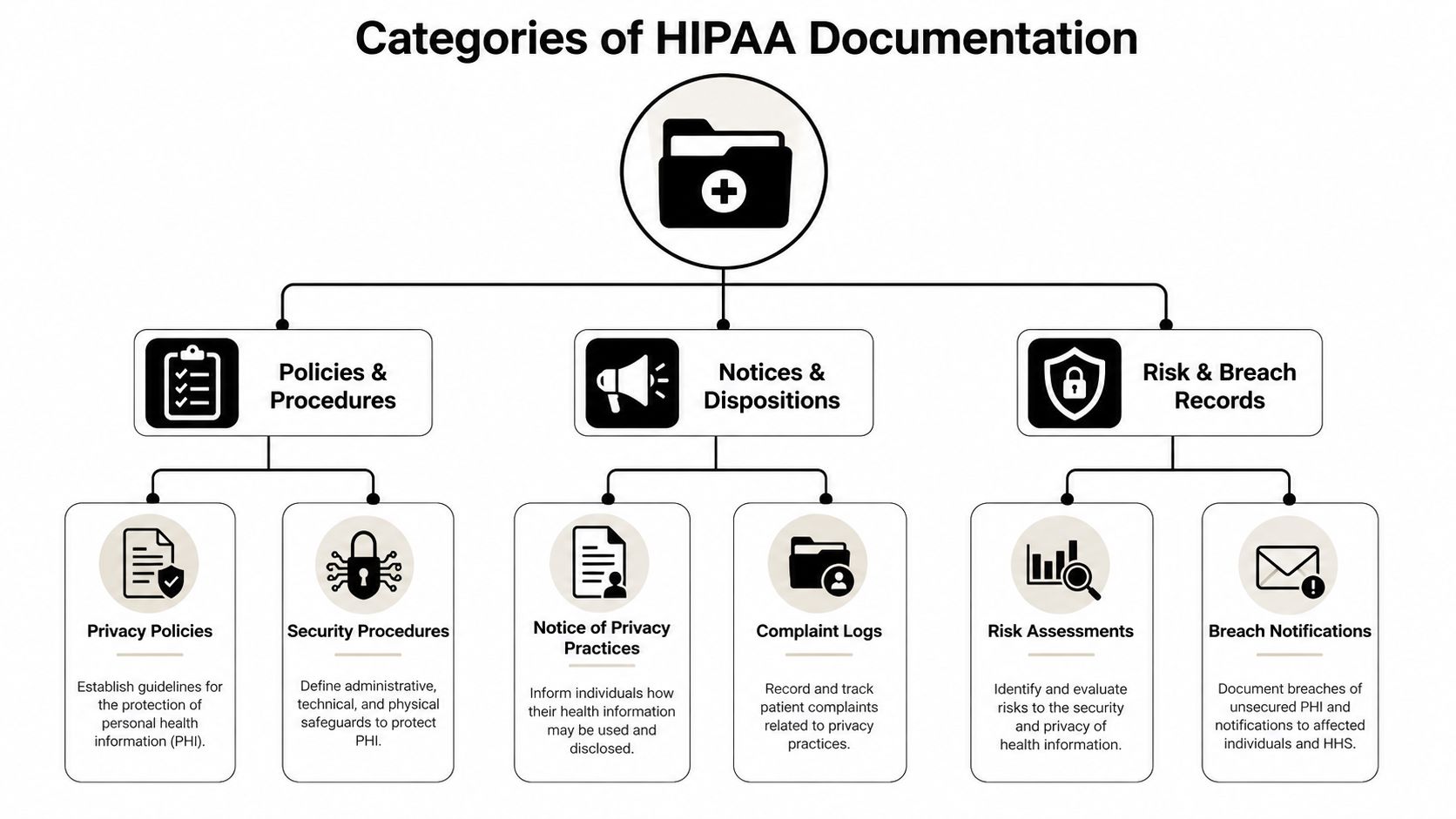
Policies and procedures
Keep the firm's privacy and security policies, procedures for handling requests and disclosures, incident-response procedures, access-control rules, remote-work instructions, and secure-disposal procedures. A policy isn't complete without its approval record, effective date, revision history, and the identity of the person or committee that authorized it.
For a PI workflow, that may include the procedure governing how a paralegal downloads a provider chart, how an attorney shares records with an expert, and how the firm removes PHI from an internal template. Preserve the signed or approved version in a durable repository, not only in a word-processing file that can be overwritten.
Notices, complaints, and documented actions
Retain notices of privacy practices where applicable, complaint records, complaint dispositions, and documented responses to privacy questions. A complaint file should show the complaint received, the issue reviewed, the decision made, and any corrective action.
The same logic applies to documented access or disclosure decisions. A short email may be evidence of an important compliance action, so don't classify records by format. Classify them by function.
Risk and security records
Risk analyses, risk-management plans, remediation decisions, security reviews, and incident documentation demonstrate how the firm identified and addressed threats to PHI. Access logs can show who viewed or exported a client file. Incident records should preserve the report, investigation, affected systems, response steps, and closure decision.
Training and vendor records
Training records should identify the learner, assigned subject, completion status, and applicable version of the training material. A completion checkbox without the underlying course version may not prove what the employee learned.
Business associate agreements, amendments, security exhibits, and vendor due-diligence records also deserve separate classification. A firm using a cloud repository, document-review service, transcription vendor, or destruction provider should preserve the agreement and evidence of the vendor's role.
Format and integrity controls
Use formats that remain readable and exportable. Preserve the original document, a rendered copy where useful, metadata showing creation and effective dates, and an audit trail showing material changes. Don't rely on a shared drive's current-state file as the only record of a policy lifecycle.
A practical inventory should answer four questions for every category:
- What is it? Identify the record type and business purpose.
- Where is it? Record the system, mailbox, folder, archive, or physical location.
- Who owns it? Assign a responsible role, not merely a department.
- What proves integrity? Preserve approvals, timestamps, access history, and version identifiers.
How Long to Keep Records Under the Six Year Rule
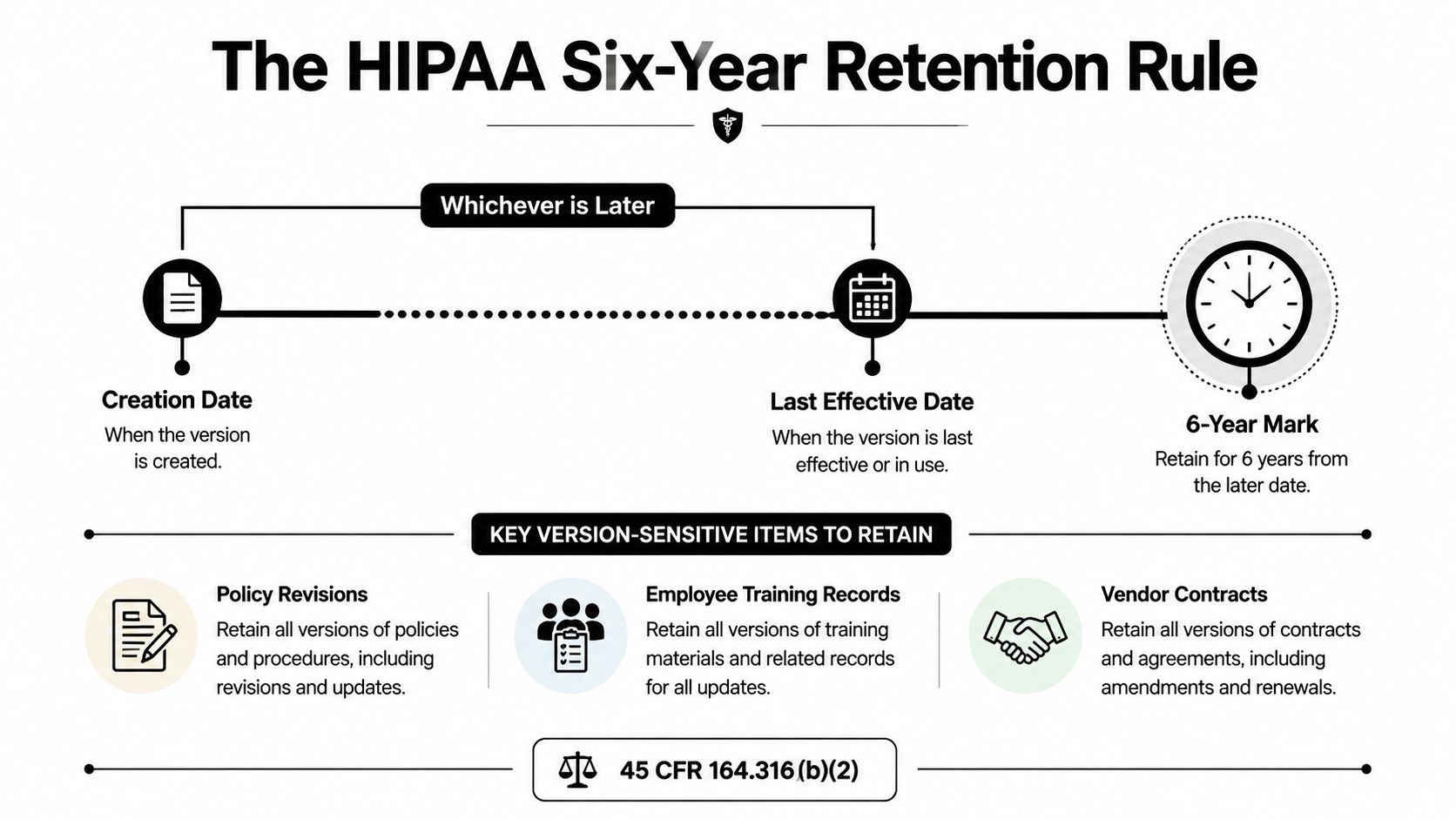
The six-year rule is simple to state and easy to apply incorrectly. The retention period begins with the date of creation or the date the document was last in effect, whichever is later, under 45 CFR § 164.316(b)(2). The later-date rule prevents an organization from treating an active or recently used document as old merely because someone drafted it years earlier.
Apply the clock to every version
Treat each superseded policy as its own record. Preserve the document, its creation date, its effective date, its supersession date when available, and the approval record connecting it to the next version.
For example, a security procedure may have been drafted in one year but remain effective after a later revision cycle. The firm should calculate the retention horizon from the later applicable date, not assume that the drafting date controls. The same approach applies to amended procedures and training materials that remain in use after their original creation.
The HIPAA retention requirements analysis highlights this operational issue, especially for current and superseded policies, risk analyses, training records, and audit trails.
Build a version register
A version register should sit beside the document repository. At minimum, record:
- Document identifier, such as Security Procedure 04.
- Version label, such as approved revision.
- Creation date.
- Date last in effect.
- Approver and approval record.
- Superseding document, if one exists.
- Retention end date, calculated from the later date.
- Hold status, including the hold owner and release decision.
Don't delete a prior version because a new version has replaced it. The prior version may be the only evidence of the controls that applied when a disputed disclosure or access event occurred.
A firm can use a document-management platform, a records-governance module, or a controlled spreadsheet for the register. The technology matters less than the discipline. Staff must not be able to overwrite dates or remove a version without an authorized event.
For firms managing broader administrative files, a separate resource on how long to keep business records UK can help distinguish general business-record governance from HIPAA-specific obligations. Don't import another jurisdiction's rule into a U.S. HIPAA schedule, but use the comparison to sharpen your classification process.
Preserve evidence of the calculation
The firm should be able to explain why a record remains in the archive or why destruction was authorized. Retain the lifecycle fields, system-generated events, approval notes, and any legal-hold override. A bare folder name such as “old HIPAA documents” doesn't establish a defensible retention decision.
State Medical Record Retention Variations and How They Interact
HIPAA supplies a federal documentation baseline. It doesn't resolve how long a PI firm should preserve a client's clinical records, medical chronology, or evidence packet.
HHS expressly distinguishes administrative documentation from medical records. For a law firm, the safest operational rule is to identify every potentially applicable requirement and apply the longest active horizon, while separately documenting the legal basis for each category. That analysis may include state medical-record law, the provider's obligations, a client agreement, an insurer requirement, an open claim, or a litigation hold.
Compare the governing rules
State rules can vary by jurisdiction, provider type, patient age, and the status of the patient. A physician's obligation may not match a hospital's obligation, and a minor's file may require a different analysis from an adult's file. Don't place a single “medical records” line in the firm schedule and assume it works for every matter.
| Record Type | HIPAA Federal Rule | State Law Consideration | Retention Trigger to Apply |
|---|---|---|---|
| Administrative HIPAA documentation | Six years from creation or last effective date, whichever is later | State law may impose additional professional or contractual duties | The later applicable HIPAA date, extended by a hold or stricter obligation |
| Provider medical records | HIPAA doesn't set a medical-record period | Check the state, provider type, patient age, and record-specific rules | The longest applicable clinical, contractual, and litigation trigger |
| PI firm medical-record copies | HIPAA governs handling when the material is PHI, but not a universal clinical retention period | Consider the engagement, malpractice exposure, client instructions, and state requirements | The longest applicable obligation, plus any hold |
| Expert reports and demand drafts containing PHI | Treat related privacy and security documentation under the federal rule | Apply case, professional, contractual, and discovery requirements to the work product | The case-specific schedule or hold, not an automatic deletion date |
Create a state-aware matrix
For a multi-state practice, add jurisdiction and provider type as required fields. The intake team should capture where the care occurred, who created the record, whether the patient was a minor, and whether the file is tied to a pending claim or dispute.
Verify current requirements through official state statutes, regulations, licensing authorities, and counsel's current legal research. A general online summary can identify issues, but it shouldn't replace jurisdiction-specific review. Firms looking for a focused explanation of the clinical-record question can consult how long medical records must be kept, then validate the result against the applicable state's current authority.
Separate copies from source obligations
A law firm shouldn't assume that returning or receiving a provider's chart transfers every retention obligation. Keep the firm's copy according to the engagement, litigation, professional, and privacy analysis that applies to the firm's possession and use.
If a matter closes, don't trigger destruction until the firm checks the state matrix, the client file schedule, outstanding disputes, insurance requirements, and legal-hold register. The decision should be documented, approved, and reversible until destruction occurs.
Building a Compliant Retention Policy for Your Firm
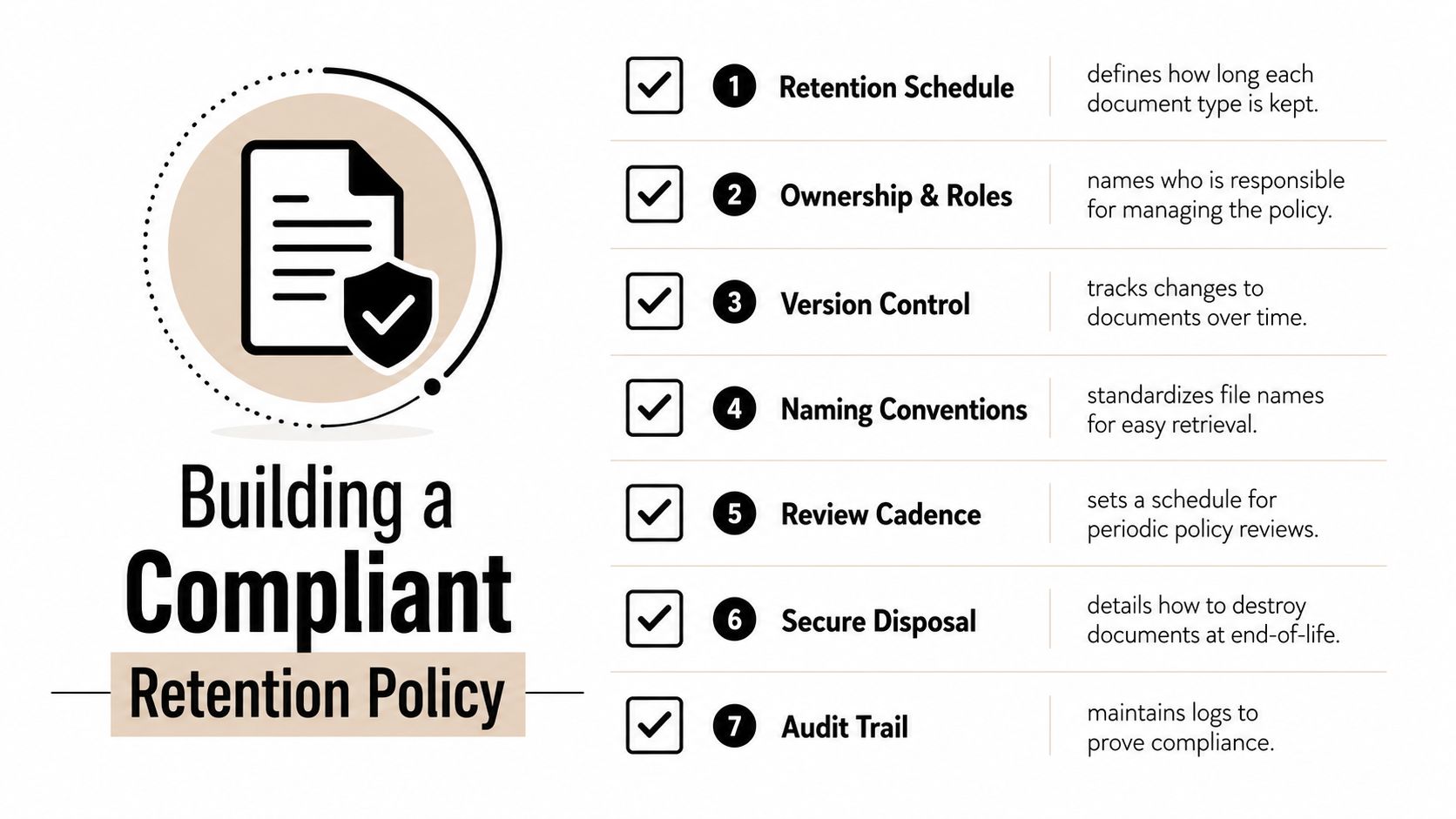
A workable policy must tell people what to do on an ordinary Tuesday. It should identify the record, assign an owner, calculate the applicable date, control access, and explain when destruction must stop.
Write the policy around decisions
Use a short decision sequence for every new document type:
- Does the record contain PHI or document how the firm handles PHI?
- Is it an administrative compliance record, a client record, work product, or a vendor record?
- Which federal, state, contractual, professional, and litigation obligations apply?
- Which date starts the relevant clock?
- Is a legal hold, investigation, complaint, or dispute blocking destruction?
- Where will the firm preserve the record and its lifecycle metadata?
- Who can approve disposition?
The policy should state that no employee may destroy a record subject to a legal hold or unresolved investigation, even if an automated schedule marks it eligible.
Assign ownership and naming rules
Give the privacy lead responsibility for policy content and compliance interpretation. Give the security or IT lead responsibility for access controls, logs, backups, and deletion mechanics. Give the records manager or operations lead responsibility for the schedule, version register, exception log, and destruction certificates. Attorneys must own matter-specific holds and release decisions.
Use names that carry meaning without exposing PHI in the filename. A controlled identifier, record category, version, creation date, effective date, and matter reference should be searchable. Avoid embedding a client's diagnosis or full name in filenames used across shared systems.
Control review and exceptions
Set a documented review cadence based on the firm's operations and legal environment. Each review should record the participants, scope, findings, decisions, and policy version affected. A retention exception should identify who approved it, why it exists, which records it covers, and when someone will reassess it.
Counsel's recommendation: Never approve a schedule that names only a period. Every line needs a record type, governing basis, trigger date, owner, storage location, hold rule, and disposition method.
For broader records-governance ideas, firms can review Attorney Assistant records management insights, then adapt the governance model to PHI, legal holds, and matter-level accountability.
Integrate the schedule with daily work
The schedule should appear in intake procedures, medical-record review instructions, expert-disclosure checklists, closing memos, and vendor onboarding. If staff must consult a separate manual every time they save a file, they will eventually create uncontrolled copies.
A platform used for medical-record review should support access restrictions, export controls, and clear deletion procedures. Ares can organize medical records and draft demand materials for PI workflows, but the firm remains responsible for classifying outputs, preserving required administrative evidence, and applying its legal-hold process.
Secure Storage Access Controls and Compliant Disposal
Retention only helps if the firm can retrieve an authentic record and show who accessed it. Store administrative documentation and PHI in systems that preserve readability, restrict access by role, and capture material lifecycle events.
Make storage durable and controlled
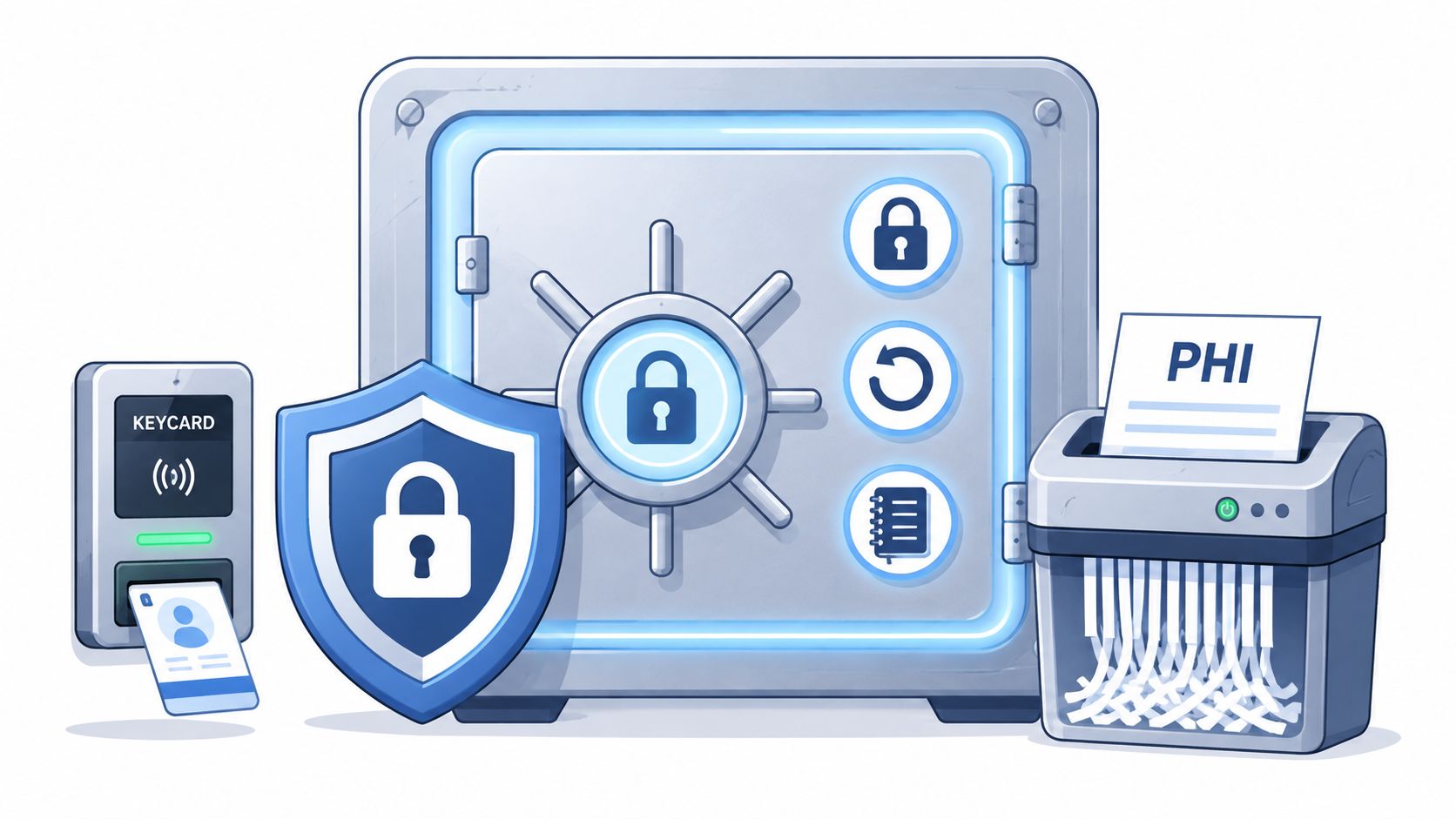
Electronic repositories should preserve original files, revision history, approval metadata, and access logs. Use encryption, role-based permissions, multifactor authentication where appropriate, controlled exports, and tested backup procedures. Physical files require locked storage, controlled access, and a movement record when a chart leaves the records area.
Separate active workspaces from long-term archives. A paralegal may need access to a current medical chronology, while the entire firm doesn't need access to every historical incident file or vendor assessment. Review permissions when personnel change roles or leave the organization.
Capture the audit trail
Logs should show access, modification, export, sharing, retention changes, and deletion events where the system supports those functions. Preserve the log with enough context to explain the event, including the user, record identifier, action, and timestamp.
Don't treat backups as an invisible exception. Include backup repositories, local downloads, email attachments, collaboration tools, and portable media in the firm's PHI inventory. If a vendor stores or destroys PHI, confirm the agreement, security responsibilities, access process, return or deletion terms, and evidence the vendor completed the required action.
For a practical overview of systems that support HIPAA-compliant document management, focus on whether the platform gives the firm usable controls and evidence, not merely a compliance label.
Dispose only after authorization
Destruction requires three confirmations:
- Eligibility: The applicable retention period has expired.
- No exception: No litigation hold, investigation, complaint, audit, or unresolved dispute blocks destruction.
- Evidence: The firm can document what was destroyed, when, by whom, under which authority, and by which method.
Paper PHI must be shredded, pulped, or otherwise rendered unreadable. Electronic media may require secure erasure, degaussing where appropriate, or physical destruction. Use qualified vendors, confirm contractual coverage, and obtain a certificate or comparable destruction record.
A routine recycling bin, an unverified device wipe, or a deleted shared-drive file isn't a defensible disposal program. Keep destruction logs with the same care as the records they document.
Cross References for E Discovery Litigation Holds and Audits
A retention schedule is a default destruction instruction. A litigation hold overrides that instruction.
The hold trigger may arise when the firm accepts a claim, receives a preservation request, anticipates a dispute with a provider or vendor, learns of a privacy complaint, or identifies facts likely to produce litigation. The trigger doesn't need to arrive as a formal complaint. Attorneys should assess reasonably anticipated disputes and issue a hold before routine deletion can remove relevant evidence.
Map the hold to every data source
A hold notice should identify the matter, custodians, record categories, relevant systems, and preservation instructions. In a PI file, that may include:
- Medical-record copies, including scans, downloads, and provider portals.
- Medical chronologies and summaries, including working drafts.
- Demand letters and exhibits, including redlined versions.
- Expert materials, including reports, source records, and communications.
- Vendor and platform records, including access history and export events.
- Administrative evidence, including policies, training records, and incident files.
The records manager should connect the hold to the retention register and mark affected records as non-destructible. IT or the relevant platform administrator should disable automated deletion where necessary, while counsel documents the decision and scope.
Preserve authenticity and chain of custody
Discovery disputes often focus on whether a record is complete, altered, or missing. Preserve the original where possible, retain relevant metadata, document exports, and record transfers. A chain-of-custody log should identify who collected the item, from which system, when it was transferred, and where it was stored.
The firm's policy version may matter as much as the medical record itself. If an opponent alleges improper handling, the firm may need to show the policy in effect, the staff training associated with it, access events, and any incident response. That is why version-sensitive administrative records belong in the hold assessment.
Keep audit readiness separate from discovery convenience
An audit response needs organized evidence of governance. Discovery requires defensible preservation and production decisions. The same audit trail can support both, but the purposes differ.
Use a hold log containing the issue, date issued, recipients, systems covered, acknowledgment status, exceptions, follow-up actions, and release approval. The audit trail requirements guide can help teams think through event tracking, but the hold protocol must remain under attorney control.
Preservation rule: A scheduled deletion is never a reason to destroy evidence after a hold begins. Stop the process, document the override, and notify every custodian who controls a relevant copy.
When the matter closes, counsel should issue a documented release. The firm can then reassess each record under the ordinary schedule, state requirements, client instructions, and any remaining dispute.
Quick Reference Lookup and Practical Examples
Use this page as the firm's operational checkpoint. Staff should be able to identify the record, find the trigger, and know whether destruction is blocked without guessing.
Retention schedule
| Record Category | Baseline Treatment | Trigger to Record | Immediate Action |
|---|---|---|---|
| Privacy policies and procedures | Retain for six years from creation or last effective date, whichever is later | Creation and last-effective dates | Preserve every approved version |
| Security policies and procedures | Apply the same six-year documentation rule | Creation and last-effective dates | Link the superseded version to the replacement |
| Notices and complaint dispositions | Retain as required administrative documentation | Creation or last-effective date | Preserve the notice, complaint, decision, and corrective action |
| Risk analyses and security records | Retain the documented analysis and related action records | Creation and applicable lifecycle date | Keep findings, approvals, and remediation evidence together |
| Training records | Preserve completion evidence and the material version used | Training completion and material lifecycle dates | Link the learner record to the course version |
| Business associate agreements | Preserve agreements, amendments, and relevant compliance records | Creation and last-effective dates | Keep the vendor relationship history intact |
| Medical records and PHI work product | HIPAA doesn't set the clinical retention period | State, matter, contract, and hold triggers | Apply the longest applicable obligation |
Version-clock example
A policy register should calculate from the later of creation or last-effective date. If staff continue using a policy after it was drafted, the register must preserve the later lifecycle event rather than treating the document as eligible based only on its original file date.
Record the calculation, not just the outcome. A reviewer should see the source dates, the rule applied, the person who approved the schedule, and any hold that changes the disposition decision.
Pre-audit checklist
- Inventory: Locate policies, notices, complaints, risk records, training evidence, agreements, logs, and incident files.
- Versioning: Confirm superseded documents remain identifiable and readable.
- Dates: Verify creation and last-effective dates are recorded.
- Access: Review permissions and investigate unexplained exports or deletions.
- Vendors: Confirm agreements and destruction evidence are available.
- Holds: Compare the destruction queue with the active legal-hold register.
- Disposal: Confirm each completed destruction has an authorization and certificate or log.
PI workflow examples
Intake file: A provider chart arrives through a secure transfer. The firm classifies the chart as matter evidence, records its source and receipt, stores it in the controlled matter repository, and prevents routine destruction if a dispute or hold arises.
Expert report: An expert receives selected records and creates a report containing PHI. The firm preserves the transmitted source set, the report version, the delivery record, and the applicable hold status. It doesn't rely on the final report alone.
Demand draft: A demand letter includes medical facts and attachments. The firm preserves the issued version and material working records under the matter schedule, while administrative policies and training records remain governed by their own documentation lifecycle.
Use these examples during onboarding and file-closing reviews. A clear classification decision is more valuable than a vague instruction to “keep HIPAA records.”
Ares helps personal injury firms organize medical records, extract dates, diagnoses, treatments, providers, and symptom chronology, and create case-ready medical overviews and demand drafts while supporting controlled handling of sensitive PHI. Review the workflow and security information, then visit Ares to evaluate whether it fits your firm's retention, medical-review, and litigation operations.