
The 30-day date is a negotiation milestone: the insurer may counter, stay silent, or deny, and missing it doesn't by itself create liability or force payment. A counteroffer is the most common substantive response, not an automatic settlement check.
The popular advice to file immediately after the deadline misses the practical question: what prevented resolution? An unsupported coverage defense, an unanswered demand, and a missing surgical record call for different responses. Counsel should diagnose the obstacle before spending the client's money on escalation.
The 30-Day Deadline Does Not Force Payment
The morning after the demand expires creates a decision, not an automatic payment obligation. In a typical bodily-injury claim, counsel selected the response date to move negotiations forward. That date isn't interchangeable with the statute of limitations.
The legal effect turns on the jurisdiction, policy, claim type, and whether counsel made a qualifying time-limited settlement offer. EvenUp's demand-letter timing guide distinguishes demand deadlines from separate claims-handling requirements, including a commonly cited model framework calling for acknowledgment within about 15 days, subject to state modifications. Don't restart an acknowledgment clock just because your demand expired.
Separate the clocks before escalating
Keep the demand deadline, applicable claims-handling obligations, and filing deadline in separate calendar entries. Check which obligations apply to the particular claim and claimant rather than assuming every insurance regulation governs a third-party bodily-injury demand.
Practical rule: A missed demand date is evidence to preserve, not a substitute for analyzing the governing law.
Immediate filing can be premature when the adjuster lacks a record, needs additional settlement authority, or is investigating coverage. Conversely, a request for more time doesn't justify leaving the file unattended.
Identify what the carrier received, what it disputes, and what it needs to take a position. A short written follow-up can clarify those issues without conceding an extension, renewing an expired offer, or abandoning a legally significant demand. Draft that communication deliberately.
How Insurers Answer Once Day 30 Passes
| Position | What it usually means | Counsel move | Escalation signal |
|---|---|---|---|
| Silence | No position communicated; possible neglect or delivery failure | Confirm receipt in writing and set a short reply date | Silence continues after a documented chase |
| Receipt only | File acknowledged, evaluation unfinished | Ask what remains disputed or missing | No substantive update after a reasonable investigation window |
| Records request | Adjuster won't price treatment, wages, or causation on the existing package | Send a targeted supplement | Requests repeat documents already produced |
| Reservation of rights | A coverage or policy defense is under review | Obtain the writing and separate coverage from claim value | Carrier adopts a coverage denial distinct from a damages dispute |
| Counteroffer | Negotiation has started | Test damages, limits, fault, liens, and release terms | Offer disregards supported future care or requires unacceptable terms |
| Partial offer | Carrier accepts some components but rejects others | Address the rejected valuation assumption | Carrier won't reconsider after the identified gap is closed |
| Formal denial | Carrier rejects liability, causation, or coverage | Preserve its exact reasons and prepare the filing decision | No resolution path while filing time diminishes |
| Acceptance | Carrier agrees to the settlement proposal | Confirm agreement and review release and lien obligations | Proposed documents materially depart from accepted terms |
Just Great Lawyers' personal-injury timeline guide describes the counteroffer as the most common response and estimates that roughly 70% of personal-injury claims resolve during pre-litigation negotiations. Treat that estimate as practice guidance, not a prediction for your inventory.
Distinguish administrative replies from decisions
The diagnostic problem usually falls into six nonfinal positions: silence, receipt acknowledgment, records request, reservation, counteroffer, or partial offer. Denial and acceptance require a different kind of review because they purport to resolve the carrier's position.
Silence tells you little about value. Confirm delivery before interpreting it as deliberate refusal. A receipt acknowledgment establishes something narrower than substantive review: someone logged the submission, but the adjuster hasn't necessarily evaluated it.
A records request is useful when it identifies a genuine deficiency. A generic request for everything already sent is different. Answer with the production date, document index, and relevant page references so the next exchange addresses substance.
A reservation of rights concerns the insurer's relationship with its insured and potential coverage defenses. It isn't automatically a rejection of the claimant's liability evidence. Obtain the actual language rather than relying on an adjuster's shorthand description.
Read substantive answers precisely
A counteroffer opens an exchange over valuation and settlement conditions. A partial offer is narrower: the adjuster may accept an emergency visit while disputing later care. Don't respond to that distinction with a general argument that the entire demand is reasonable.
Preserve a formal denial word for word, including its stated factual and policy grounds. An acceptance also deserves careful reading. Agreement on the amount doesn't excuse a release that adds parties, claims, or obligations the offer didn't contemplate.
Select the position that describes today's file. Nonpayment alone isn't a useful classification, and sending the same escalation letter in every case wastes the information the insurer has provided.
What Counsel Should Do on Day 31
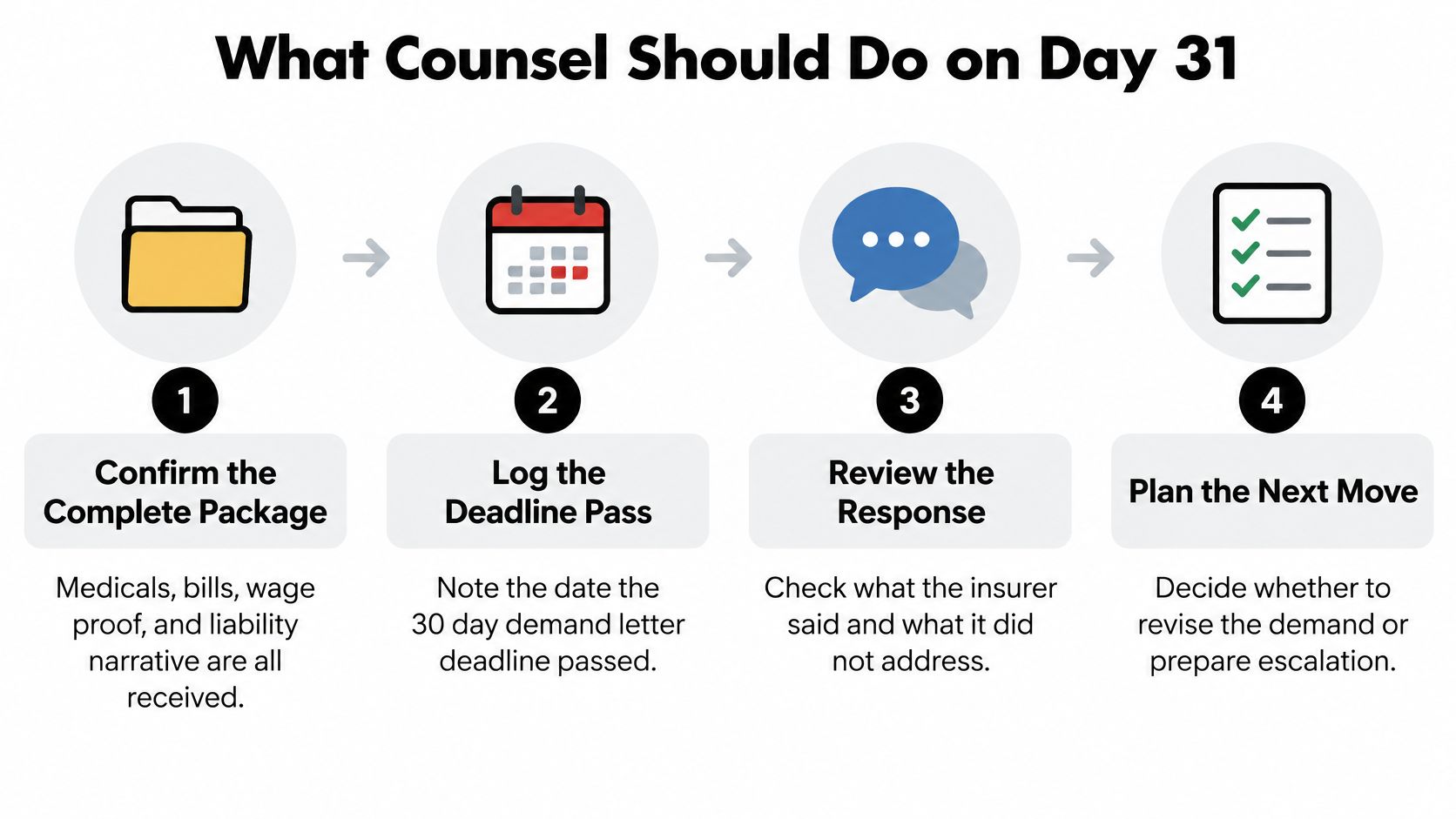
Assign the file to a named handler and produce a written action record. Stephen Babcock's post-demand guidance supports confirming the complete submission, obtaining the carrier's written position, and answering disputed valuation assumptions with targeted evidence.
Use this flowchart as the file-handling overview.
Run the file in this order
Verify the complete delivery. Match the transmitted attachments against the demand's exhibit list: medical records, bills, wage proof, and liability narrative. Save delivery confirmation and identify inaccessible links or corrupted files. Proof that an email arrived isn't proof that every exhibit was usable.
Obtain the position in writing. After a call, send a neutral confirmation identifying the offer, outstanding request, or promised review. Invite correction. Don't let a paraphrased telephone note become the only record of a consequential exchange.
Isolate the disputed issues. Ask the carrier to identify its objections to liability, causation, treatment, damages, and any missing documentation. Ask what policy-limit information it will provide under the applicable disclosure framework. Broad disagreement needs a specific factual explanation before counsel can answer it efficiently.
Read the conditions before arguing price. Check the release, lien allocation, subrogation provisions, comparative-fault assumptions, and treatment of future care. A policy-limits offer may still leave the client with a hospital lien and no additional recovery for anticipated surgery. That may be an acceptable compromise, but it isn't a clean win merely because the carrier offered its limits.
Protect filing and notice requirements. Verify accrual, the proper defendants, service planning, and applicable pre-suit prerequisites. Put the controlling deadlines on the litigation calendar. A follow-up letter must not become the reason counsel misses the filing window.
Answer the actual counteroffer. Use chronological records, billing support, employer documentation, and liability evidence tied to the adjuster's objections. An attachment index with pinpoint references does more work than resending the original damages total.
Preserve the claims-handling record. Log unanswered requests, partial responses, duplicate document demands, and explanations for delay. Keep the underlying communications. Whether that conduct supports an insurance-law remedy requires jurisdiction-specific analysis, not an accusation inserted into every status letter.
Set timing by the correct trigger
| Stage | What happens | Timing |
|---|---|---|
| Day 31 | Confirm receipt and request a written position | Begin promptly after expiration |
| Early follow-up | Check acknowledgment obligations | Run from the applicable legal trigger, not a new post-demand clock |
| Open investigation | Track required explanations and updates | Use the governing state rule |
| After a counteroffer | Prepare a targeted response | After evaluating assumptions and obtaining necessary proof |
| Statute of limitations | Protect filing and pre-suit requirements | Use the applicable jurisdiction's deadline and accrual rules |
Keep the response review tied to the documents in the file.
The work product should identify the obstacle, the person responsible for addressing it, and the next action. Negotiation can continue after filing, so this workflow prepares a documented choice rather than forcing an artificial end to settlement discussions.
How a Counteroffer Gets Tested
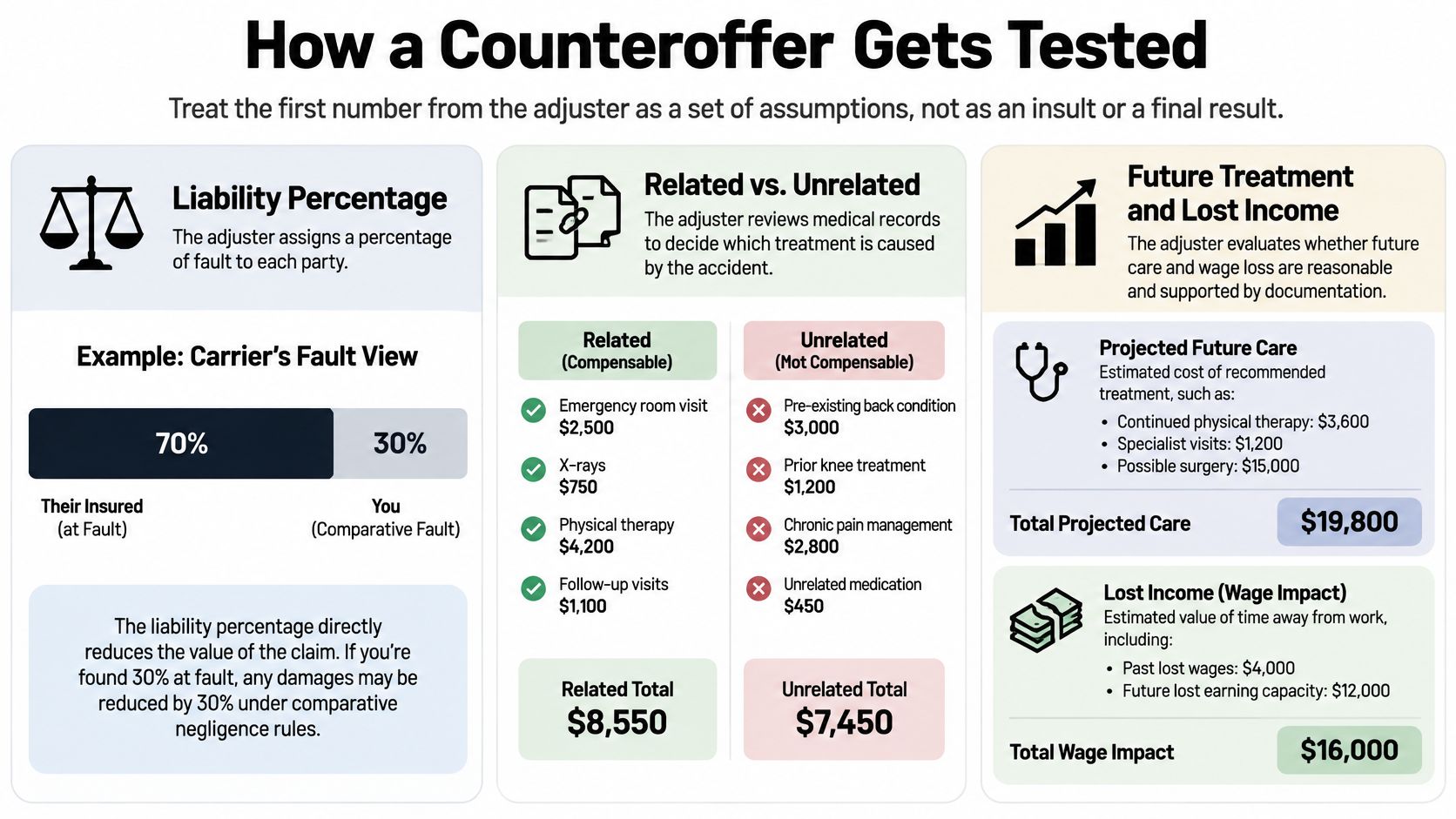
Treat the first number from the adjuster as a set of assumptions, not as an insult or a final result. Ask what the carrier accepted, what it excluded, and how it translated those decisions into its offer.
The valuation components should remain separate during review.
LegalClarity's summary of industry figures reports an average bodily-injury auto-liability claim payment of $27,373 in 2024, an 8% year-over-year increase. That's an industry marker, not a settlement target, floor, or ceiling for this client.
Rebuild the carrier's calculation
Start with the liability allocation. Then separate related from disputed treatment, reconcile billed and paid medical expenses under the applicable damages rules, verify wage loss, and identify the evidence supporting future care. Set the resulting assessment beside available coverage and realistic collectibility.
Use a valuation worksheet that records both sides' assumptions:
- Fault allocation: Identify the evidence supporting each disputed act, not merely the percentage the adjuster selected.
- Medical expenses: Match each challenged charge to a provider note, diagnosis, and treatment date.
- Income loss: Reconcile claimed absences with employer records or reliable self-employment documentation.
- Future care: Identify the provider's recommendation and the support for necessity, timing, and cost.
- Client recovery: Calculate liens, fees, and expenses separately from gross claim value.
Work the disagreement, not just the number
Suppose the demand rests on documented medical expenses and wage loss, but the counteroffer discounts liability and excludes chiropractic treatment as unrelated. A larger demand unsupported by new analysis won't resolve either objection.
The reply should identify the crash evidence contradicting the fault allocation and connect the disputed treatment to contemporaneous symptoms, referrals, and provider findings. Then offer a reasoned negotiating bracket that reflects the corrected assumptions. Don't claim that removing a fault discount mechanically establishes the settlement value.
An offer can be too low because the adjuster disagrees with the evidence, or because the adjuster never received the evidence needed to evaluate it.
Our guide to negotiating a personal-injury settlement develops the bargaining process, but the immediate decision is narrower: accept, counter with a specific evidence packet, or pause price negotiation to repair proof.
Liens belong in the net-to-client analysis. They aren't an additional damages theory, and a higher gross offer may not solve the client's practical problem unless counsel also understands the deductions.
When a Thin Medical File Sinks the Offer
Consider a hypothetical rear-end claimant who begins treatment, stops attending, and later starts at a different clinic. The adjuster reads the interruption as recovery followed by an unrelated complaint. Counsel knows the client struggled to obtain an appointment, but the demand contains no record supporting that explanation.
The carrier has answered, and the number is low. The immediate problem may be the chart rather than the injury.
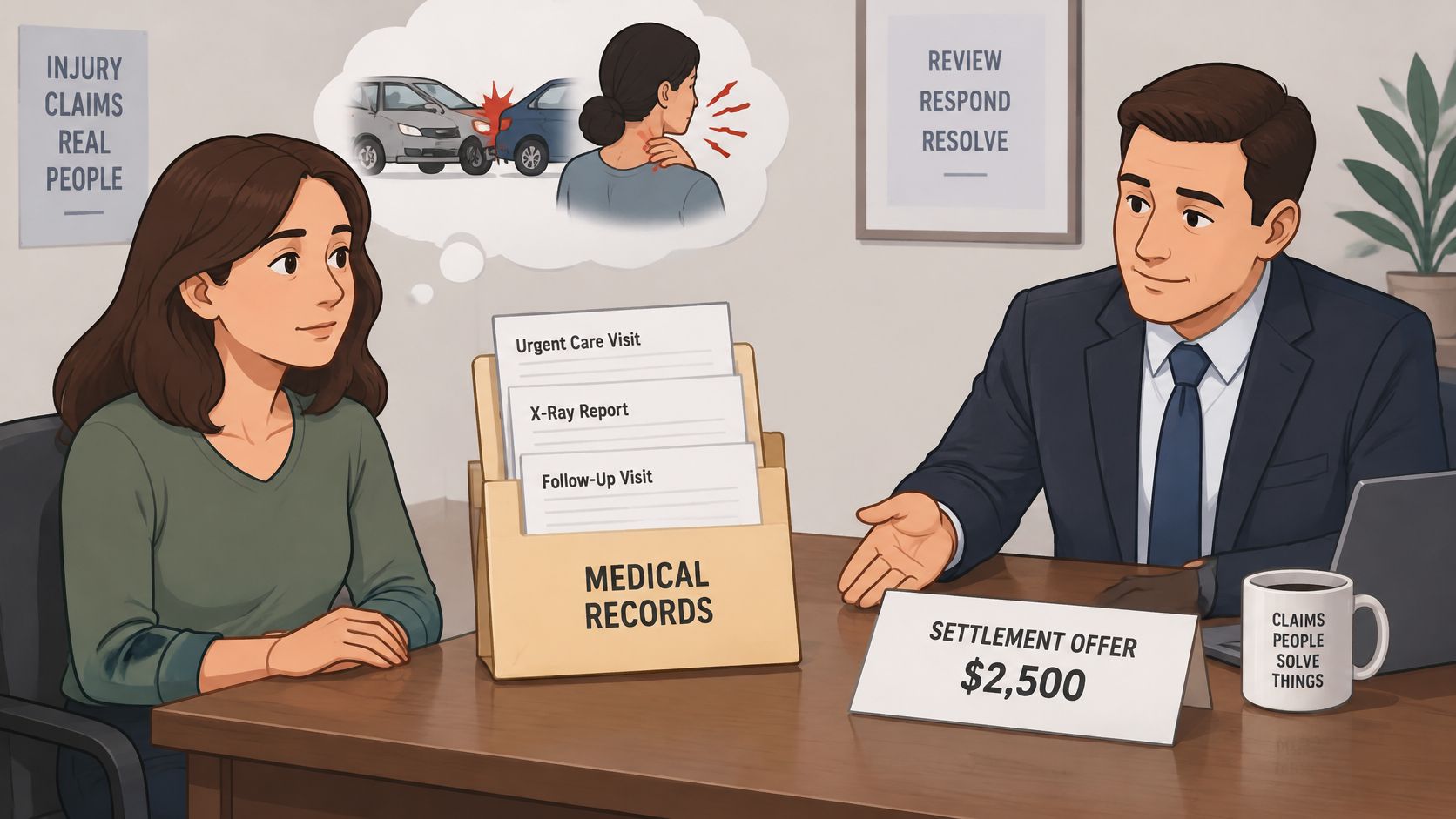
Osbornes Law's discussion of personal-injury settlement and court proceedings provides context for treating negotiation as a continuing process rather than assuming an unresolved demand must proceed directly to trial. The practical task is to determine whether better documentation could change the carrier's position.
Audit the chronology before redrafting
- Treatment gaps: Locate appointment requests, referral delays, discharge notes, and the client's explanation. Distinguish missing records from an actual interruption in care.
- Provider handoffs: Confirm that the receiving clinic had the prior history and documented why treatment continued.
- Preexisting conditions: Compare baseline symptoms and function with the post-collision course. Don't conceal unfavorable history.
- Wage proof: Tie absences and restrictions to the relevant treatment period and employer documentation.
- Liens: Reconcile the lien inventory with the provider list. An unexplained provider balance may reveal an omitted treatment episode.
- Symptom dates: Check intake forms, emergency records, referrals, and later histories for conflicting onset descriptions.
A true valuation disagreement engages the records but reaches a different conclusion about their significance. A documentation defect appears when the adjuster prices the case as though a provider never treated the client, a referral never occurred, or symptoms ended during the interruption.
Repair the missing connection
Obtain the missing note, place it in chronological order, and explain what it changes. A revised demand should connect the collision, initial complaints, interrupted care, provider transition, and continuing limitations without overstating medical causation.
Use a clear exhibit index and pinpoint citations. The workflow for addressing incomplete medical records should distinguish documents still outstanding from records that don't exist.
Credibility check: Explain a genuine treatment interruption honestly. Don't turn a client's later recollection into a contemporaneous medical finding.
If the client stopped because symptoms improved, acknowledge that fact and evaluate the later recurrence on its actual support. Padding the explanation creates deposition problems.
Revise when a complete chronology could change a material valuation assumption. If the chronology is complete and the carrier still disregards supported care, the decision is no longer about retrieving another chart.
Choosing Between a Revised Demand and Suit
File because litigation can accomplish something the remaining negotiations can't, not merely because the printed response date passed. The usual escalation after an unsuccessful demand is suit, but filing and trying the case are different decisions.
The path should reflect the obstacle counsel needs to resolve.
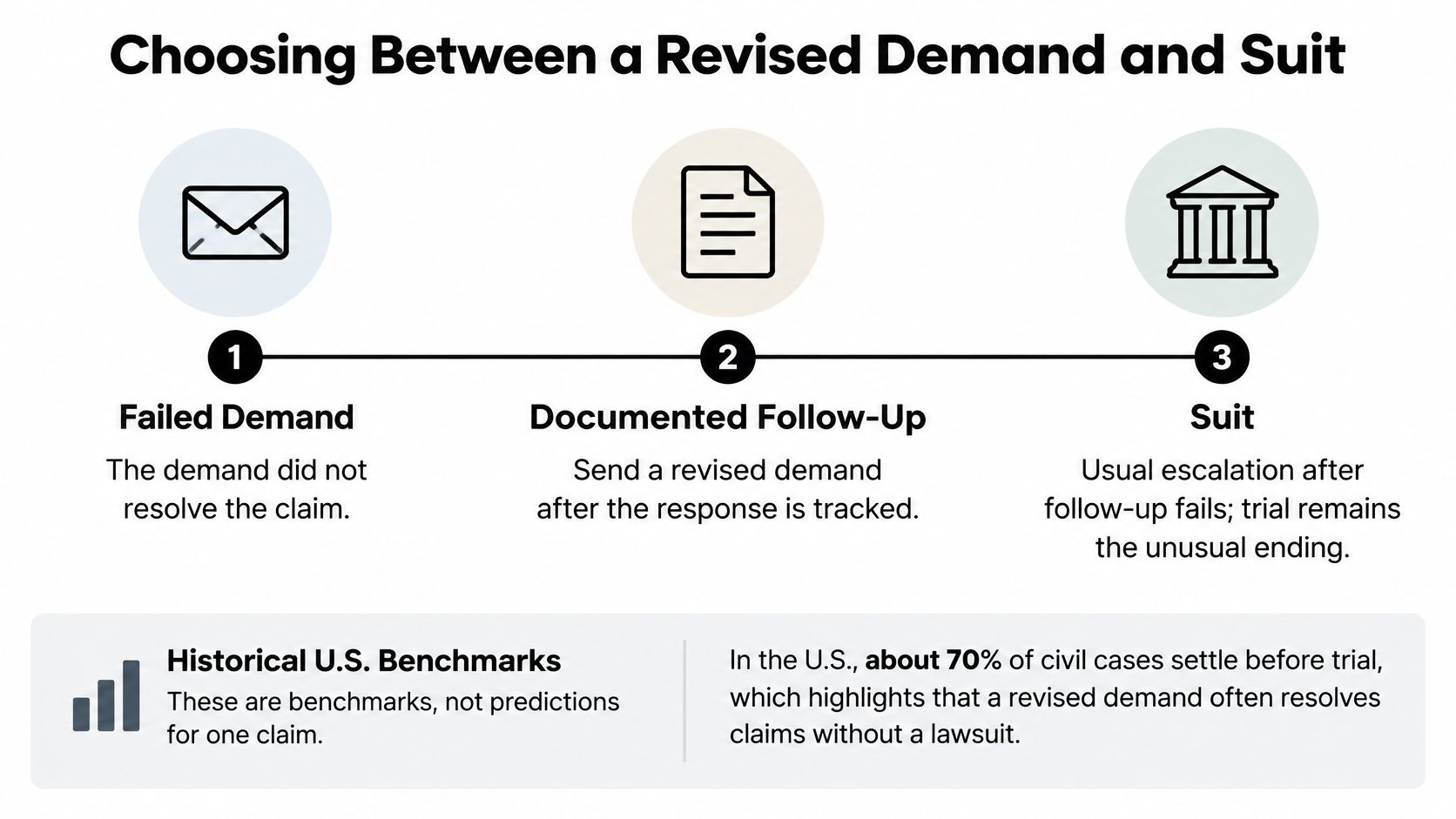
Historical federal figures discussed in Justia's settlement-versus-trial primer show that 3% of 41,696 tort cases terminated in federal district courts in fiscal year 2000 were decided at trial. Those figures describe an older federal tort population, not the odds that a particular injury claim will settle.
Compare the next work product
| Path | Historical benchmark | Timing | Cost to the file |
|---|---|---|---|
| Pre-suit settlement | Common resolution path in personal-injury practice | Governed by evidence readiness, carrier review, and filing constraints | Less discovery expense, but unresolved proof can constrain value |
| Settlement after filing | Settlement remains possible after proceedings begin | Influenced by pleadings, discovery, and mediation opportunities | Filing, service, discovery, and potentially expert work |
| Jury trial | Uncommon endpoint in historical tort reporting | Controlled by the court's schedule and case readiness | Witness preparation, experts, exhibits, and trial attendance |
| Bench trial | Another trial route within the smaller tried population | Controlled by the court and applicable procedure | Substantial preparation remains necessary without a jury |
A revised demand is the better next move when counsel can cure a defined evidentiary defect and the carrier has shown willingness to reassess. Set a short, realistic response date without confusing it with the controlling filing deadline.
Suit helps when compulsory discovery is needed, liability remains disputed, the carrier has adopted a hard denial, or the parties have reached a supported but irreconcilable valuation gap. It also becomes necessary when further negotiation would jeopardize timely filing.
Budget for what filing changes
Assess liability strength, injury severity, insurance limits, venue, medical documentation, and defendant collectibility together. Strong damages don't eliminate a coverage problem, and a favorable verdict against an uncollectible defendant may not produce a useful recovery.
The personal-injury case timeline should inform client counseling before counsel commits to pleadings, discovery, and expert expense. Explain what evidence litigation could obtain and why that evidence justifies the cost.
For a revised demand, our Demand Letters use the customer's medical evidence and case records to build causation narratives, special damages, and liability arguments cited to source. Ares reports an 80% reduction in demand-drafting time, and a solo attorney at Moreno Legal reclaimed 10 hours per case. Those efficiencies support preparation; counsel still must verify the record and choose the strategy.
Make the binary choice explicit: send a tighter demand with a defined response date, or prepare and file suit when the deadline, denial, or valuation impasse warrants it. Don't leave the file in indefinite follow-up.
Ares helps personal-injury firms organize medical evidence and draft source-cited demands, making it easier to address the specific gap behind a low offer. Visit Ares to turn the existing case file into a revised demand for attorney review before deciding whether further negotiation is worthwhile.