
A 600-page production lands in the case folder as a mix of portal PDFs, scanned forms, imaging reports, and billing pages. The attorney needs to find the first complaint, understand how treatment unfolded, and spot what may be missing before drafting a demand. The practical answer to what medical records look like isn't one standard form. It's a mixed file assembled from different providers, systems, and document types, and it takes review to make that file case-ready.
Opening a PI Medical Production in Review
The first pass through a medical production is less about reading every page than figuring out what the file contains. A hospital may provide a portal export, a records vendor may deliver searchable PDFs, and a smaller clinic may send scanned pages with handwritten notes. Those files can sit together in one folder without a shared format or a reliable sequence.
Start by identifying the sources and date ranges. Look for facility names, provider names, encounter dates, and any index or cover letter that describes the production. Then check whether the apparent timeline makes sense: does the file begin near the reported injury, and does it continue through the treatment period the client describes? A missing interval doesn't prove that no treatment occurred, but it does give the team a concrete follow-up task.
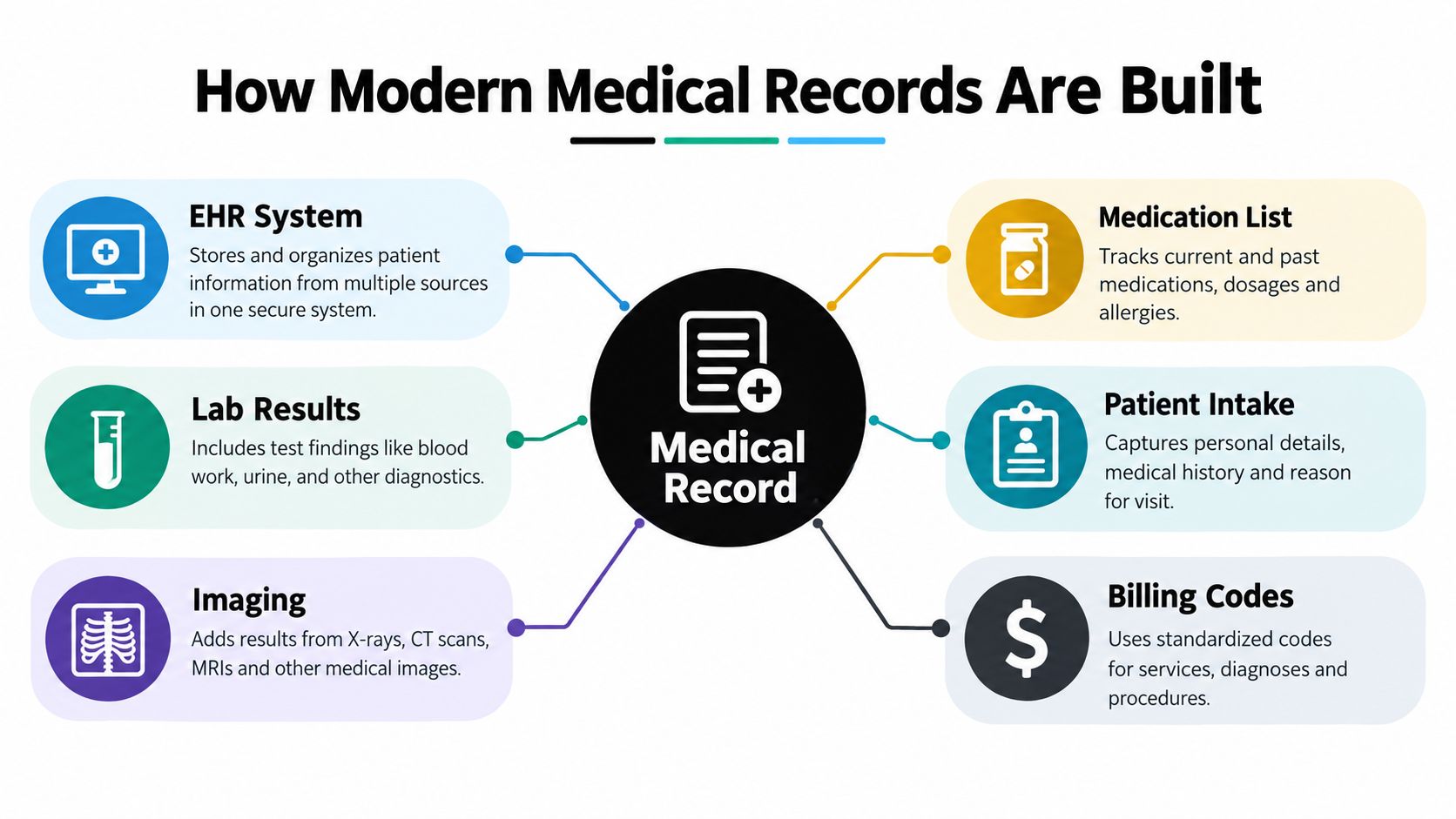
The familiar components are usually there: identification details, visit records, diagnoses, treatment plans, medication lists, test results, provider notes, discharge information, and billing or insurance documents. The harder part is locating those components when they're split across separate files or buried in a long export. An imaging result might be a standalone report, an attachment to a visit, or an imported document from another facility.
Practical rule: Treat the first review as inventory, not interpretation. Record what arrived, who created it, the dates it covers, and what seems absent before building the injury narrative.
That distinction matters. A production can be available to the firm yet still be difficult to use: duplicate pages can obscure chronology, scanned pages may not be searchable, and a polished portal summary can omit documents held by outside providers. The aim is to turn that stack into a sourced timeline, while keeping uncertainty visible rather than smoothing it away.
How Modern Medical Records Are Built
Medical records shifted from primarily paper files to electronic health records, but the modern record is best understood as a collection of clinical data, not one document. In the United States, the HITECH Act was enacted in 2009, and federal EHR incentive programs encouraged adoption. Federal data reports that 96% of non-federal acute-care hospitals and roughly 95.0% of office-based physicians used some form of EHR by the early 2020s, while 83.6% of office-based physicians used a certified system in 2024 (federal EHR adoption data).
That digital shift didn't make records uniform. A current production may combine portal downloads, structured EHR exports, scanned faxes, PDFs, imported outside notes, and image-based documents. Some pages use tables or discrete fields; others are narrative notes or scans. Even records from the same episode may arrive in different formats.
Think in artifacts, not pages
A useful mental model is a set of related clinical artifacts. The HL7 FHIR standard represents health information as modular resources, such as patient details, encounters, diagnoses, medications, observations, notes, and procedures. The US Core implementation guide defines a baseline for accessing certain data, but it doesn't dictate one visual layout for every EHR (HL7 US Core).
So one emergency visit may surface as several separate items: an ED note describing the reported mechanism, a diagnosis code, an imaging report, a medication order, discharge instructions, and a later specialist note. Each item answers a different question, and none should automatically stand in for the others.
The same principle applies to the production as a whole. Federal guidance notes that records can arrive as PDFs, Word files, or images, and that a full record differs from targeted extracts such as medications, visit notes, and test results (guidance on getting and checking health records). For PI review, stop expecting a single, consistently organized report. Expect a longitudinal file whose sources, dates, and gaps must be reconstructed.
Core Sections Every PI Record Contains
A repeatable scan starts with the basics, then moves toward evidence of injury, treatment, and cost. The table below isn't a guarantee that every production contains every item. It's a practical checklist for recognizing what's present and what deserves closer attention.
| Component | Typical Format | Spot for PI Cases |
|---|---|---|
| Patient identification and demographics | Structured fields, intake form, or cover sheet | Check identity and whether the same patient details appear consistently across providers. |
| Encounter history | Visit list, timeline, or billing export | Find the first relevant visit and identify gaps or unexplained date changes. |
| Chief complaint and history | Narrative note or intake form | Compare the reported mechanism, symptom onset, and body region across early records. |
| Diagnoses and problem lists | Structured codes and narrative assessments | Separate pre-existing conditions from complaints linked to the incident, and note when each appears. |
| Medication and allergy records | Structured lists or medication reconciliation | Track changes, reported use, and relevant allergy information without treating an active list as proof a drug was taken. |
| Laboratory and imaging results | Tables, standalone reports, or imported documents | Review the result and its date; distinguish the report from a provider's later interpretation. |
| Procedures and operative reports | Procedure record or signed narrative | Identify the procedure performed, documented findings, and postoperative instructions. |
| Provider notes and discharge summaries | Narrative blocks, templates, or scanned pages | Look for assessments, recommendations, restrictions, and the author or signing status. |
| Billing and insurance information | Itemized charges, codes, or claim documents | Use it to trace services and charges, not as a substitute for clinical documentation. |
Demographics and encounter data establish who was seen and when. They don't establish what happened clinically. A date in a billing export can point to a service, but the corresponding note or report may be needed to understand the complaint, examination, and plan.
For practical ways to bring a disordered production into a usable sequence, this guide to organizing medical records offers a helpful organizational reference. In the case file, preserve the original source alongside any summary. That makes it easier to check the wording and provenance when a date, diagnosis, or body side becomes important.
Comparing ED Notes, Operative Reports and Imaging
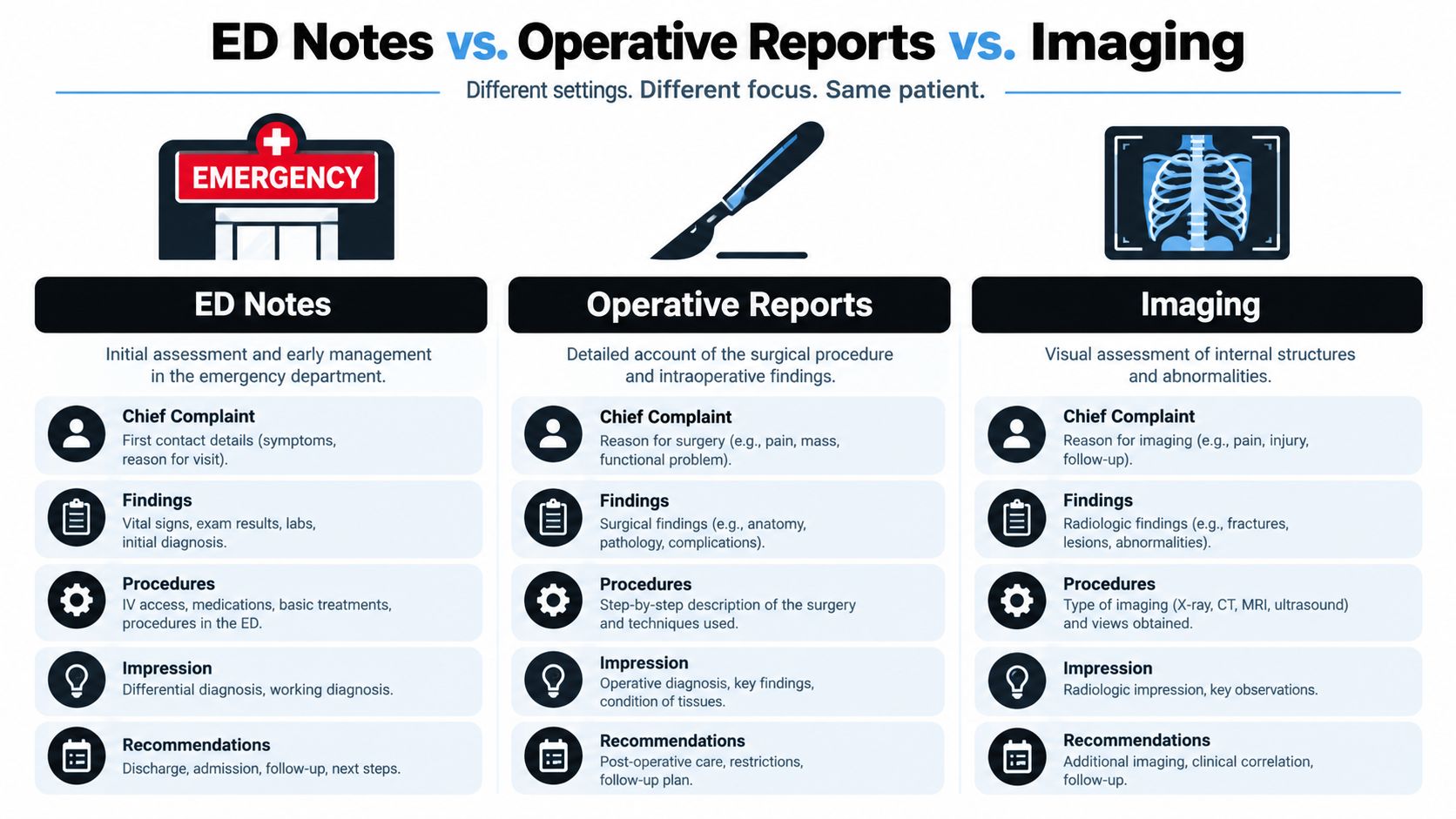
Not all pages carry the same kind of evidentiary value. An emergency department note often captures an early account and examination. An imaging report records a diagnostic interpretation. An operative report documents what the surgeon performed and observed. A discharge summary condenses a stay, while billing entries help identify services and charges. Read each for what it can establish, not for what you wish it established.
| Record type | High-value fields | Common caution |
|---|---|---|
| ED note | Chief complaint, history of present illness, reported mechanism, examination, assessment, plan | The history may be copied forward or reflect patient-reported information rather than a clinician's direct observation. |
| Imaging report | Study, findings, impression, recommendations | A report's impression isn't the same as a later treating-provider assessment or a complete account of symptoms. |
| Operative or procedure report | Indication, procedure, findings, technique, postoperative plan | Check the final version and author; an addendum or unsigned page may affect how the document should be characterized. |
| Discharge summary | Diagnoses, hospital course, discharge condition, instructions | It summarizes care and may leave out detail recorded in contemporaneous notes. |
| Billing entry | Service date, procedure or diagnosis codes, charge information | It can identify a billed service, but it doesn't by itself prove the clinical findings or treatment response. |
The highest-impact review often starts with the earliest ED note, the relevant diagnostic report, and any procedure record. Compare their dates, body region, laterality, and account of the incident. If the ED note describes one side and the imaging report names the other, don't choose the version that fits the demand. Flag the discrepancy and look for clarification in later documentation.
Documentation quality requires that same care. A 2024 systematic review of 48 studies reported deficiencies in all of them, including incompleteness in 47, inaccuracy in 14, inconsistency in 8, and unsigned documentation in 4; the review linked errors with manual documentation and occupational stress (systematic review of medical record documentation). That evidence supports a cautious review method, not a presumption that any particular note is wrong.
A radiology report can be important evidence, but it still needs to be read in context with the clinical record. This overview of diagnostic test results is a useful companion when assessing how results relate to the rest of the file.
Extracting Case-Ready Facts From a Record Stack
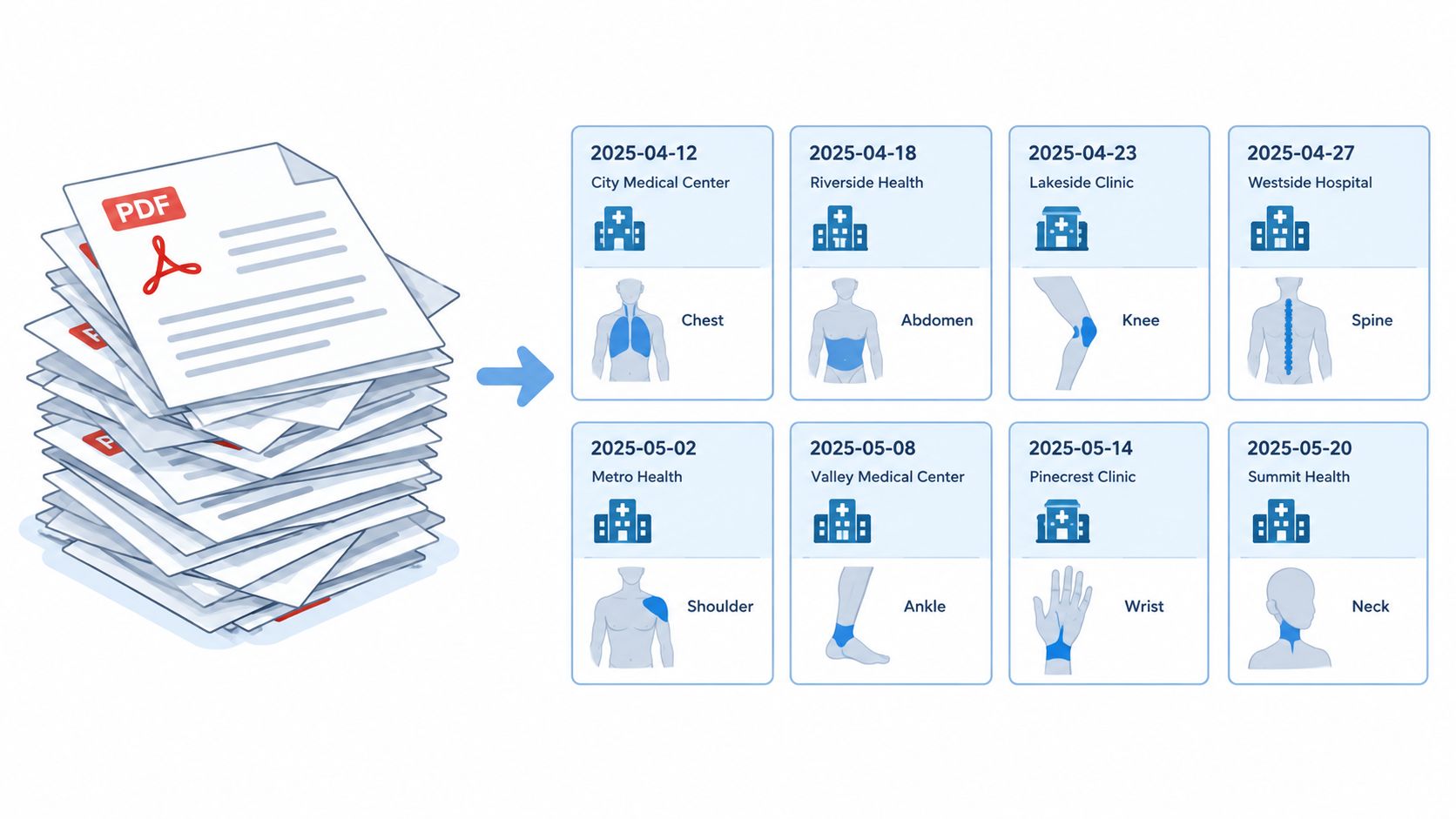
Reading a stack from beginning to end is not the same as producing a reliable chronology. A case-ready review captures each relevant event in a consistent format and keeps a route back to the source document.
Build the chronology around source facts
For every encounter or clinical artifact, record the service date, provider, facility, body region, finding, treatment, and source document. Add a page reference or file name so another reviewer can verify the entry without searching the full production from scratch. Preserve the source wording for consequential facts such as how the injury occurred or when symptoms began.
Start with the earliest relevant complaint and compare it with later accounts. Then map diagnostic studies, referrals, procedures, follow-up visits, and documented treatment response. If an imaging report describes a finding that a visit note doesn't mention, record both. The difference may reflect separate purposes or incomplete documentation, and it should remain visible until someone resolves it.
Duplicates need attention too. A page may be repeated in a portal export, imported from another facility, or included once as a scan and again as a structured note. Keep track of the duplicates rather than counting them as separate encounters. For late addenda, note the date of the service and the date the addendum was entered if both are available. Patient-entered portal material should be identified as such, not blended into clinician-authored documentation.
A clear chronology can also help connect treatment history to the issues that matter to a claim. This resource on what medical records mean for your case provides useful context for that relationship.
Here's a short video to accompany the review workflow:
The standard is not a perfectly polished narrative. It's a chronology that lets the attorney distinguish what a record directly documents from what another note repeats, and quickly find the source for every material fact.
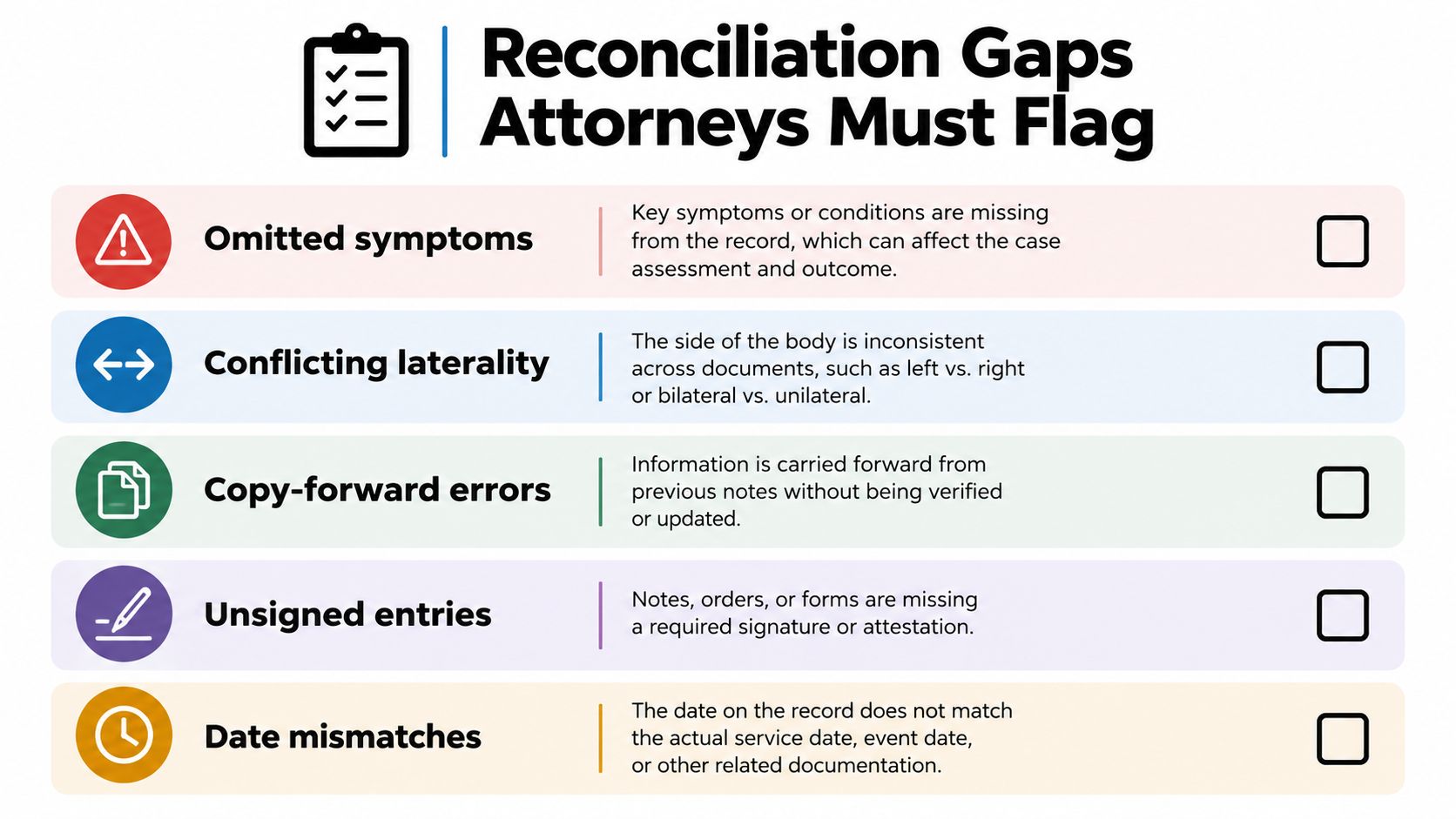
Reconciliation Gaps Attorneys Must Flag
Medical records are evidence to reconcile, not a complete and error-free account. A summary that copies a single note can carry forward an omission, a mistaken historical statement, or a discrepancy that another document would have exposed.
Label the evidence before drawing conclusions
Use an evidence label that tells the reader what kind of statement they're seeing: direct observation, patient-reported history, clinician assessment, diagnostic result, procedure record, or retrospective summary. A patient's report of pain, a clinician's examination finding, and an imaging impression may all matter, but they aren't interchangeable.
Then cross-check the details most likely to affect causation and chronology:
- Omitted symptoms: Compare early complaints with later notes and identify when a symptom first appears in the file.
- Conflicting laterality: Check left-versus-right references across history, examination, imaging, diagnosis, and treatment.
- Copy-forward errors: Look for repeated text that doesn't match the current encounter or reported body region.
- Unsigned entries: Verify whether a note or addendum shows an author and completed signature status.
- Date mismatches: Compare service dates with note dates, imaging dates, and billing entries.
A portal view can make a production look complete while scanned ambulance reports or outside-provider notes remain elsewhere. A “complete” label on a records packet doesn't remove the need to compare the requested date range and providers against what arrived. Missing treatment intervals should be recorded as questions for follow-up, not automatically described as lack of treatment.
When inconsistencies remain, present them plainly for attorney review. Don't resolve a contradiction by picking the most favorable version, and don't describe an unsigned or retrospective entry as if it were a contemporaneous, signed observation. A resource on incomplete medical records can help frame the practical consequences of missing material. The case narrative is strongest when it distinguishes supported facts from unresolved gaps.
HIPAA, Redaction and Records Requests
Records review also requires disciplined handling of protected health information. A signed authorization and a records request letter serve different purposes: the authorization permits a release within its stated scope, while the request identifies the records sought and where they should be sent. Confirm that the patient, provider, requested dates, and scope match the case, and follow applicable law and firm procedures rather than treating a request letter as a substitute for authorization when one is needed.
Keep records in approved, access-controlled systems. Use the firm's secure method for sharing files, limit access to people working on the matter, and avoid sending sensitive PDFs through unapproved channels. Before sharing a record set with an expert, co-counsel, or another recipient, confirm that the disclosure is authorized and remove information that isn't needed for the permitted purpose under the firm's procedures. Don't leave portal credentials saved on a shared or unsecured device.
Patients are generally entitled under the 21st Century Cures Act information-blocking rule to immediate electronic access to clinical information such as notes, test results, medication lists, pathology reports, and radiology reports. Yet access doesn't guarantee that a patient can manage or consolidate records across organizations. A 2025 study of 43,588 hospitalized patients found that 31.0% had an active portal account (study of hospitalized patients' portal accounts).
For PI teams, the operational point is simple: a portal download may be a useful starting point, not the whole case file. Keep a request log, document what each provider produced, and follow up when a provider, date range, or expected record type is absent. For matters involving a fatal injury and the related legal process, this resource on when to hire a wrongful death lawyer provides relevant context. For release and authorization issues, consult the firm's established procedures and this overview of HIPAA medical records release laws.
Turning Records Into a Demand-Ready Case File
Before drafting, confirm that the file has a sourced chronology, the key encounters and diagnostic reports, treatment and discharge details, billing information, and a clear list of missing records or unresolved conflicts. Keep evidence labels and source references with the summary, then hand off the timeline, treatment gaps, and provider responsibilities to the attorney preparing the demand.
A polished PDF stack isn't a case-ready file. Ares offers AI-assisted medical-record review that organizes dates, providers, diagnoses, treatments, and symptom chronology into structured summaries with source-linked references, which teams can use as part of their review and demand-drafting workflow. Visit Ares to see how it can fit into your firm's process.