You've got the chart, the MRI report, the lab printout, and the discharge summary. The client says the doctor “found something,” the adjuster says the records are incomplete, and the defense is already looking for a clean way to argue that the injury was preexisting, mild, or unrelated. In personal injury work, diagnostic test results are where those arguments either hold up or fall apart.
A lot of case value gets lost because teams read the impression line and stop there. That's a mistake. A result only matters when you know what test was done, when it was done, what the report measured, and how strongly it supports causation, treatment, and damages. The legal question is rarely “Was the result positive?” It's “What does this result prove, what does it leave open, and how vulnerable is it when a defense doctor looks at it?”
Why Diagnostic Test Results Drive the Outcome of PI Cases
A rear-end collision lands on your desk, the client complains of neck pain, and the first MRI comes back with “degenerative changes.” The insurer seizes on that phrase immediately. If nobody on your team knows how to read the rest of the report, the file can drift into a low-value settlement before anyone has tested whether the imaging, the timing, and the clinical course line up with the injury story.
That happens because diagnostic reports do more than confirm a complaint. They anchor the narrative that links the crash to the body, the treatment to the injury, and the injury to the demand number. If the report is weak, vague, or read out of context, the defense gets room to say the findings are incidental or unrelated. If the report is strong and properly framed, it becomes one of the cleanest pieces of corroboration in the file.
The legal value sits in the interpretation, not just the image
In practice, the same scan can support very different narratives depending on how the report is written and what the record history shows. A note that says “no acute abnormality” does not always end the inquiry, because the absence of a finding can still matter when symptoms persist and other records show a delayed workup. The report has to be read alongside the mechanism of injury, follow-up complaints, and treatment course.
That's why teams handling complex files, especially where symptom presentation is mixed or evolving, need a disciplined way to read test results rather than treating them as standalone truth. For background on how medico-legal reviewers handle specialty records in nuanced matters, autism and ADHD legal support is a useful example of how careful interpretation changes case presentation.
Practical rule: a diagnostic result only helps your case when it can be tied to timing, mechanism, and a documented functional change.
The best PI teams do not ask whether a test was “positive.” They ask whether the result moves causation, damages, or treatment forward. That distinction saves time and keeps the demand letter focused on evidence that matters.
The Core Metrics Behind Every Diagnostic Result
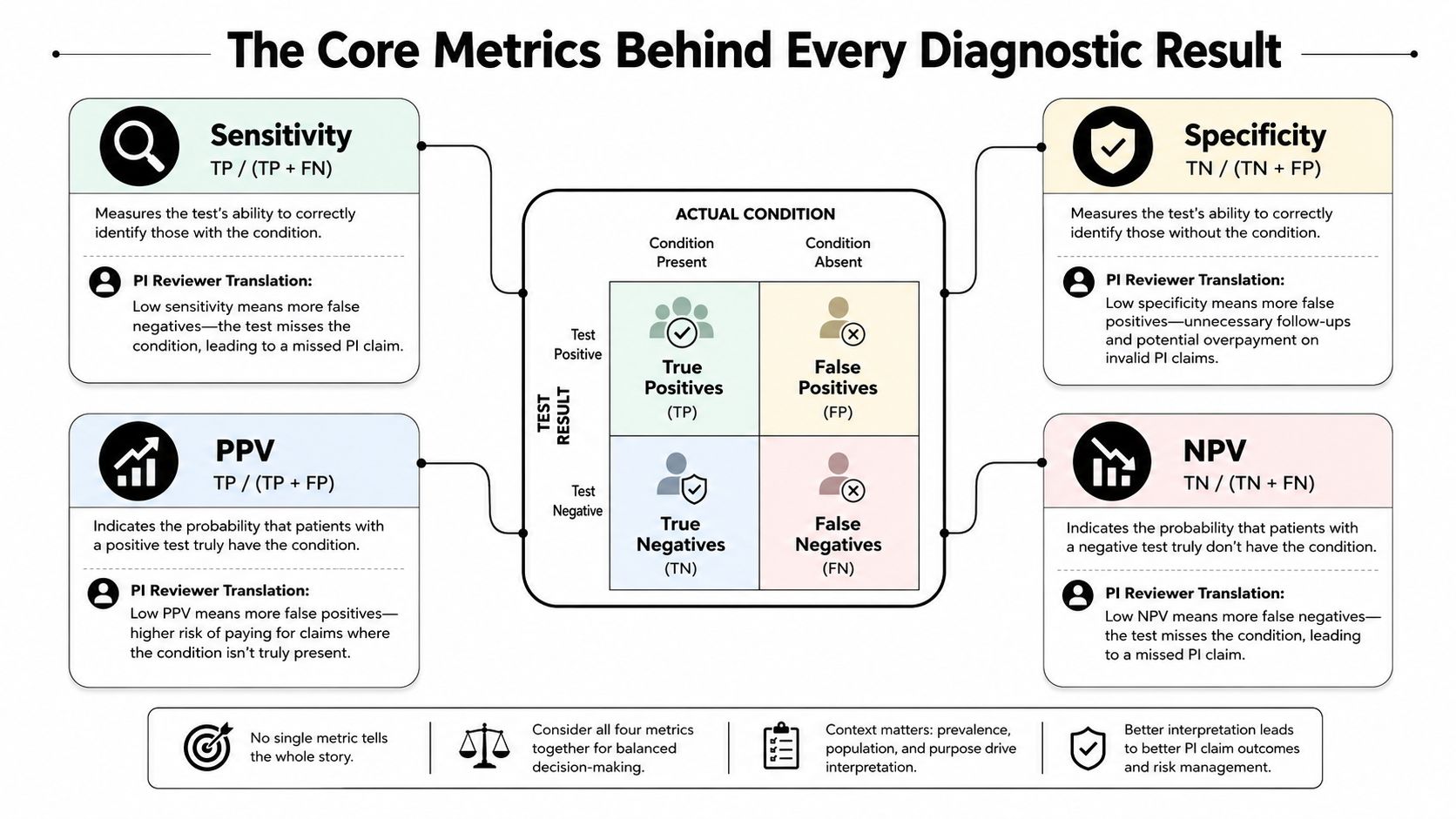
A diagnostic result only makes sense when you know what the test is doing in the first place. The basic structure is the 2×2 contingency table, which sorts outcomes into true positives, false positives, false negatives, and true negatives. From that table come sensitivity, specificity, positive predictive value (PPV), and negative predictive value (NPV) (PMC review on diagnostic test accuracy, Johns Hopkins diagnostic test evaluation guide).
What those four metrics mean in PI language
Sensitivity tells you how well a test catches people who have the condition, using true positives divided by all diseased cases (Johns Hopkins diagnostic test evaluation guide). In a PI file, a low-sensitivity test is the kind that misses a fracture, a bleed, or another injury the defense later calls “unproven.” That is the practical risk, because a missed finding can shape the entire causation story.
Specificity tells you how well the test rules out people who do not have the condition, using true negatives divided by all non-diseased cases. When specificity is weak, a positive result can become an easy target for an IME doctor who says the finding is a false alarm.
PPV is the share of positive results that are positive, and NPV is the share of negative results that are negative (Johns Hopkins diagnostic test evaluation guide). Those are the metrics that matter when a claims file has to answer a simple question, how much confidence should the team place in this report when it is used to support causation, damages, or treatment timing?
Why the full table matters to your review
A report can look decisive and still be weak in case terms. Diagnostic accuracy reviews recommend looking at paired measures such as sensitivity and specificity, along with likelihood ratios and confidence intervals, because a bare “positive” or “negative” line does not show the error structure that matters in litigation (PMC review on diagnostic test accuracy). That matters when the defense starts arguing that the result is noise, artifact, or a finding that does not match the injury mechanism.
The practical takeaway is straightforward. A false negative is the test that missed the injury. A false positive is the test that may overstate or mislead. Both can change how a demand reads once the file is reduced to exhibits, summaries, and the medical chronology that supports the narrative. For teams doing careful file review, medical record review for attorneys is the kind of workflow that keeps the interpretation tied to the record instead of the label.
Anatomy of a Diagnostic Report
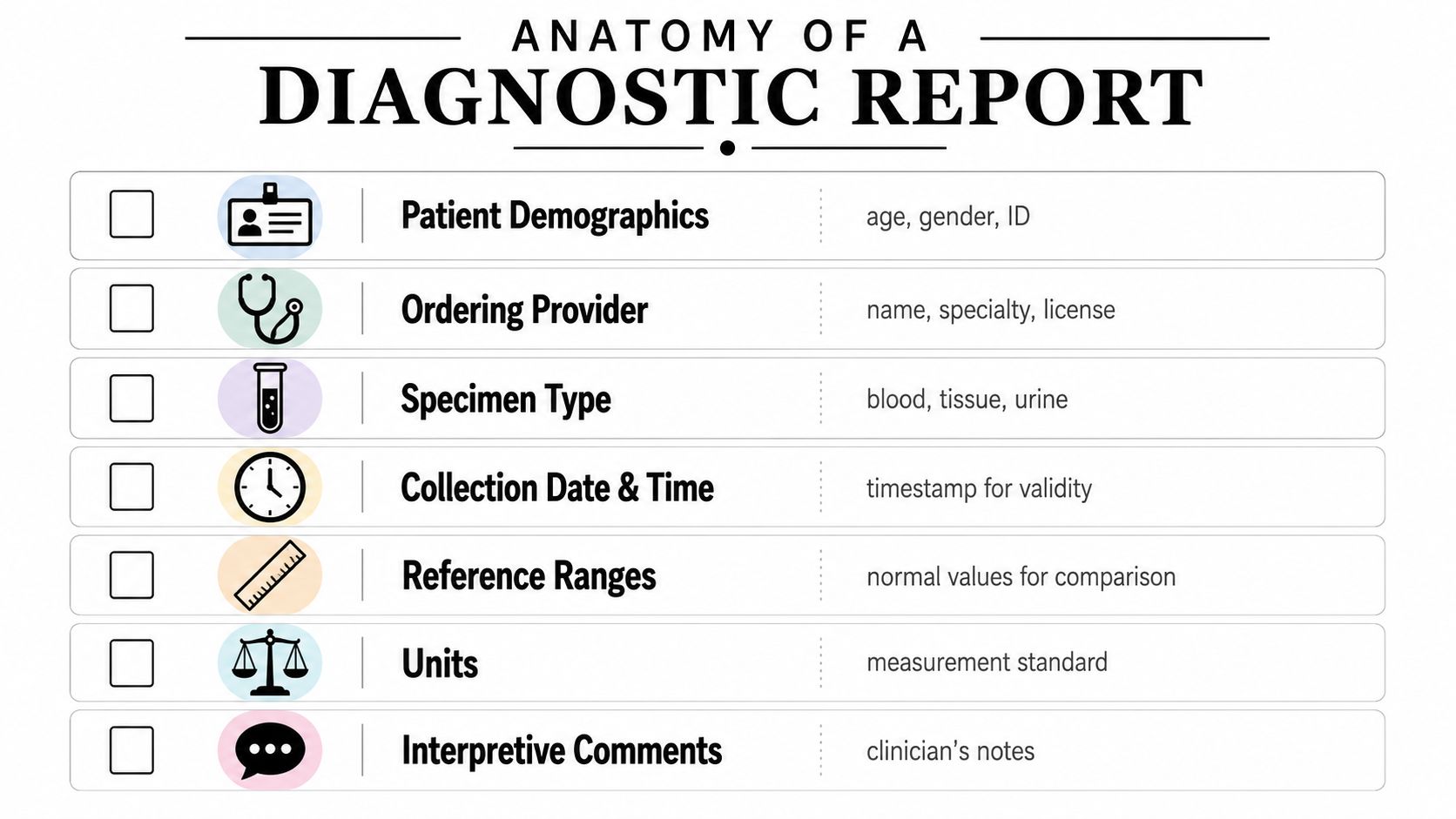
A report is not just the impression. WHO guidance on test-result certificates emphasizes the basics that make a result usable in clinical and interoperable settings, including the person's core demographics, the testing center or lab, the collection date and time, the test type, and the result itself (WHO test-result certificate guidance). If those pieces are missing, you do not just have an inconvenient record. You have a weaker evidentiary record.
Read the report in this order
Start with patient identity. Age, identifiers, and matching demographics tell you whether the report belongs to your client and whether you need a chain-of-identity check. Then look at the ordering provider and the facility, because provider credentials and the care setting affect how the result should be weighted.
Next, verify the specimen type, collection date and time, and test type. WHO guidance treats those fields as core because they control whether the result is clinically interpretable and whether it lines up with the timeline of injury and treatment (WHO test-result certificate guidance). A report collected too late, or from the wrong specimen source, can change the entire case theory.
Then read the reference ranges, units, and interpretive comments. Those are the parts adjusters love to skim and defense doctors love to exploit. A value without a range or unit is hard to defend in a demand letter, because the reader cannot tell whether the result is abnormal, borderline, or perfectly ordinary.
Practical rule: never summarize a diagnostic report until you've checked identity, timing, specimen, range, and the interpreting provider.
There's a reason detailed medical record review matters so much in PI work. The record tells a story only when the data fields line up, and sloppy extraction turns a strong report into boilerplate noise. For a practical framework on pulling useful facts out of a medical file, the attorney-focused guide on medical record review for attorneys is a solid reference point.
How Prevalence Changes What a Result Really Means
A positive result does not mean the same thing in every file. That's the mistake that leads people to overread screening tests and underread what a result means for one injured client. The same test can look persuasive in a symptomatic patient and weak in a low-prevalence setting, even when the lab technique itself hasn't changed.
Pre-test probability controls the meaning
Merck's guidance on medical testing is blunt on this point, a test result only estimates disease likelihood and varies greatly with pre-test probability (Merck Manual on understanding medical tests and test results). That is the idea PI teams need to keep in mind when a client had a broad panel, a screen ordered “to be safe,” or an MRI taken before the clinical picture was clear.
A positive finding in a client who already has matching symptoms, a fitting mechanism, and documented exam changes carries more weight than the same finding in a low-risk, asymptomatic screen. The reason is simple. PPV and NPV shift with prevalence even when the assay itself is unchanged (Johns Hopkins diagnostic test evaluation guide).
What that means in a PI file
If you have a soft-tissue MRI in a client with a clear crash history, ongoing complaints, and repeat treatment, the result may fit a broader injury picture. If you have the same MRI in a person with no symptoms and a vague incidental complaint, the defense has an easier time calling the finding degenerative, unrelated, or clinically meaningless.
That's not just a medical nuance. It changes how a demand reads. A report with weak pre-test probability needs careful framing, because the same positive mark on the page can be a false lead in legal terms even if it is technically “abnormal.” High-value testing guidance also stresses that testing should be ordered only when it improves outcomes or adds information beyond history and exam, which is why repeat or reflex testing without a purpose can weaken the narrative rather than strengthen it (Merck Manual on understanding medical tests and test results).
The teaching point is straightforward. Before you rely on a result, ask what the client's odds looked like before the test was ordered. That single question often tells you whether the report is persuasive evidence or just background noise.
Red Flags, Indeterminate Results, and Chain-of-Custody Pitfalls
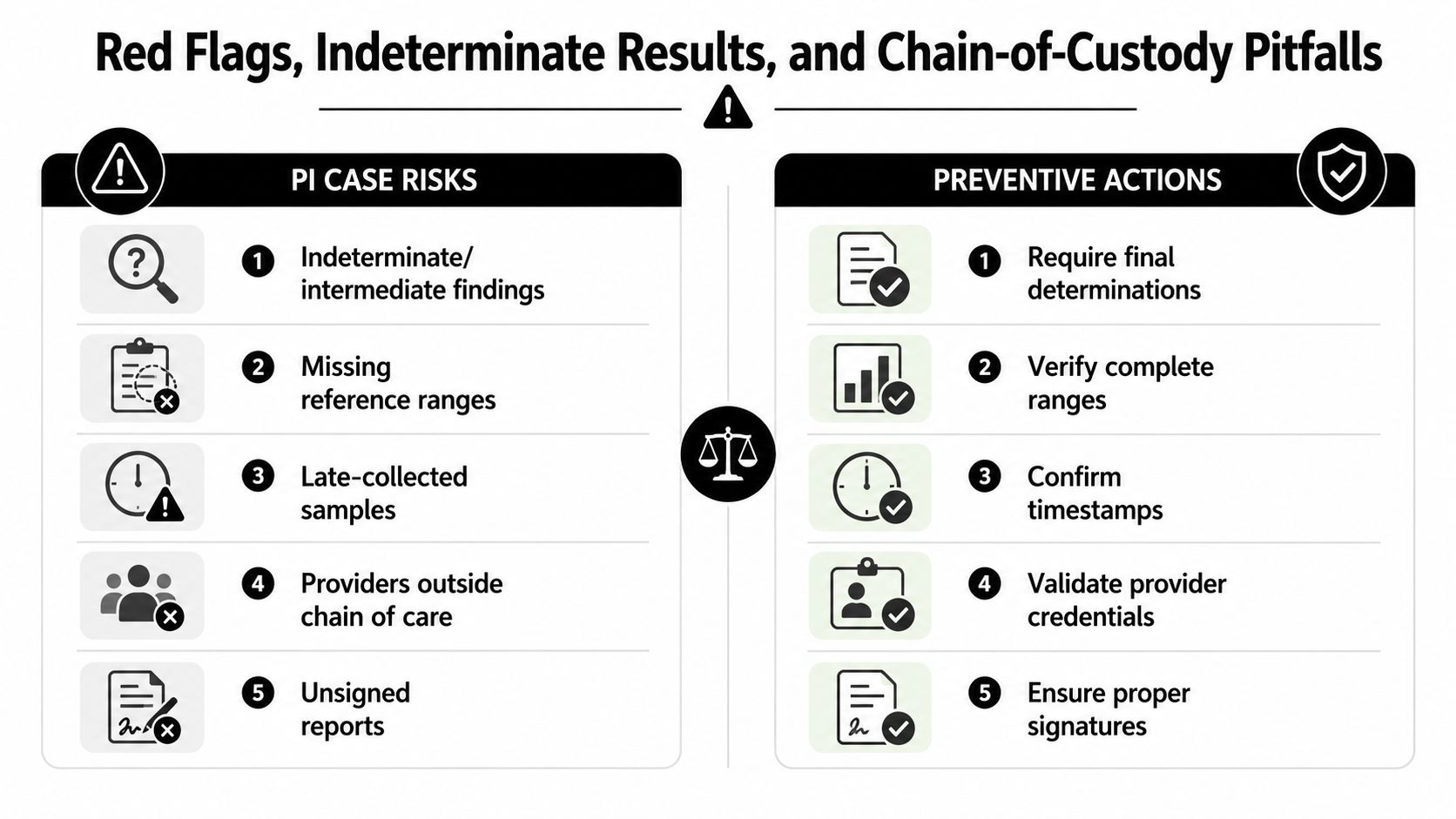
Diagnostic results don't always come back cleanly. A classic PubMed-indexed paper notes that tests can be intermediate, indeterminate, or uninterpretable, not just positive or negative (PubMed paper on non-binary diagnostic outcomes). That reality matters in PI work because ambiguity creates follow-up questions, and follow-up questions create an advantage if the file isn't documented properly.
What should trigger a second look
Watch for indeterminate or intermediate findings. Those should never be summarized as if they were firm confirmations. If the report uses uncertain language, preserve that uncertainty in your memo and ask for the complete interpretive context.
Watch for missing reference ranges and missing units. Without them, you can't tell whether the number is actionable or merely recorded. Watch for late-collected samples, because timing can undercut whether the result reflects the injury period or a later, unrelated condition.
If the report can't stand on its own, don't let a summary pretend that it can.
Also check whether the report came from a provider outside the chain of care or whether it lacks a proper signature. Those issues are not cosmetic. They affect authenticity, chronology, and whether the document can be safely used in negotiations or at deposition.
How to document the problem
When something is off, flag it in plain language. Write that the result is indeterminate, that the report is missing the reference interval, or that the collection time must be verified against the treatment timeline. Do not soften the issue into vague commentary, because vague commentary gets lost when the defense reviews the file.
If the record crosses language barriers, use a medical translator who understands the risk of altering clinical meaning. A service like Translators USA risk-free translation can be useful when the underlying question is whether a term, date, or diagnostic phrase was rendered accurately in the file. The key is to preserve the original meaning, not just make the pages readable.
The practical triage is simple. Escalate ambiguous results, missing metadata, and timeline mismatches. Accept only the reports that are complete enough to support a clean factual summary. Authenticate anything that looks abbreviated, unsigned, or disconnected from the rest of the care record.
Sample Summary Language and a Review Checklist
The strongest summaries sound measured, not dramatic. A good PI memo tells the reader what the report shows, how certain it is, and what still needs verification. That keeps the demand letter accurate and keeps you from overstating a finding that the defense can easily knock down.
Drop-in summary language
If the report confirms the injury, use language like this, “The imaging report documents a finding consistent with the claimed condition, and the result aligns with the client's reported symptoms and treatment timeline.”
If the report is useful but limited, try this, “The study shows an abnormality that supports further review, but the report should be read together with the full clinical history and prior records before any final causal conclusion is made.”
If the result is indeterminate, write, “The report does not give a definitive positive or negative conclusion, so the uncertainty should be preserved in the case summary and verified against follow-up records.”
If testing was incomplete, note, “The available diagnostic record is not sufficient on its own because key metadata, interpretive detail, or follow-up confirmation is missing.”
For examples of how organized medical summaries are typically framed, the medical report examples resource can help you compare structure without copying someone else's wording.
Diagnostic Result Review Checklist
| Field to Verify | What to Confirm | Common Pitfall |
|---|---|---|
| Patient identity | Match name, DOB, and identifiers to the client | File mix-up or partial match |
| Collection date and time | Confirm when the sample or image was taken | Result read out of timeline |
| Ordering provider | Confirm specialty and role in care | Unrelated provider used as if authoritative |
| Specimen type or study type | Verify blood, urine, tissue, MRI, CT, or similar | Wrong test summarized as the right one |
| Reference ranges | Confirm the normal range shown on the report | Abnormality overstated without baseline |
| Units | Make sure the number is reported in the correct unit | Misread value from unit confusion |
| Interpretation | Check whether the impression is definitive or qualified | Ambiguous language rewritten as certainty |
| Prior comparison | Compare against earlier reports when available | New finding treated as isolated fact |
Read the report once for the medical facts and again for the legal facts. The second pass is where the case usually gets stronger.
Where AI Document Extraction Fits in the Review Workflow
The best use of AI in medical review is not to replace judgment. It's to get the paper under control fast enough that a human can do the part humans are better at. A platform can pull dates, providers, diagnoses, and treatment entries from hundreds of pages, which gives the review team a usable structure before anyone starts writing a narrative.
The workflow that actually works
Upload the file, let the system extract the structured data, then have a reviewer confirm the chronology and spot gaps. After that, the legal team can decide what belongs in the demand draft, what needs corroboration, and what should be marked as uncertain. That sequence matters because raw medical records are often too dense for a line-by-line manual pass to be efficient.
The practical value is not speed alone. It's consistency. A structured extraction process helps the team notice missing dates, provider mismatches, and treatment gaps earlier, which makes it easier to build a clean factual story before the file is sent out for negotiation.
AI should surface the record, not author the theory.
That distinction matters for PHI and for evidentiary quality. Teams still need human control over what the result means, how it should be phrased, and whether the record supports the causal argument the demand letter is about to make. If you're evaluating this kind of workflow, the AI document review discussion is useful for understanding where automation helps and where judgment still has to take over.
The firms that benefit most are the ones that use AI as a triage layer, not an oracle. It catches the obvious work, frees up review time, and leaves the legal team to do what matters most, which is interpretation.
A Repeatable Playbook for PI Teams
Start with the report, not the conclusion. Read the identity, timing, specimen type, reference range, and interpretation first. Then apply the 2×2 lens, ask whether the result fits the client's pre-test probability, and decide whether the finding helps causation, damages, or treatment.
After that, look for uncertainty. Indeterminate language, missing metadata, late samples, and chain-of-care issues should be documented before they get buried in a summary. If a result is useful but incomplete, label it that way. If it is weak, don't force it into a stronger story than the record supports.
A strong PI workflow usually looks like this:
- Verify the report's identity and timing.
- Check whether the result is definitive, qualified, or indeterminate.
- Compare the finding to prior records and the injury timeline.
- Decide whether the result helps causation, damages, or only background context.
- Write the summary before the demand draft so the legal theory matches the record.
The self-audit is simple. If your team pulled the impression but not the range, the units, the date, the provider, and the follow-up context, you do not yet have a review process. You have a clipping process.
If your team wants faster medical record review without losing the judgment that PI cases need, take a close look at Ares. It's built to turn raw records into organized summaries and demand-ready insights, so your staff can spend less time sorting pages and more time building the causation story that settles cases.