
A complete medical chronology typically takes 10+ hours of manual work per case, which is why AI tools are changing the process. The practical question isn't whether to build a timeline, but how to build one that separates missing care from missing paperwork.
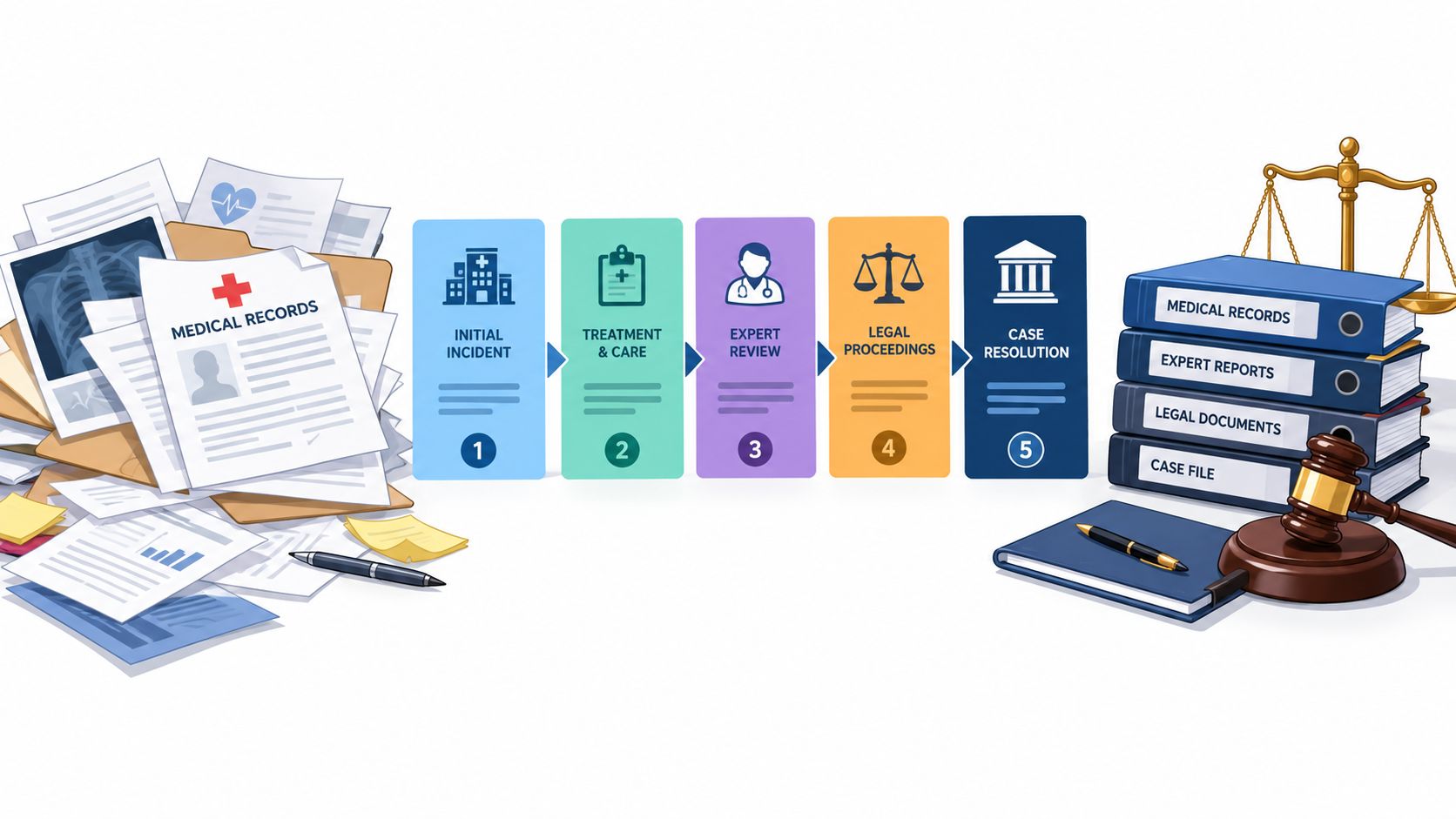
The problem usually appears just before a deposition or settlement conference. The file contains emergency records, imaging, therapy notes, specialist opinions, billing documents, and records from providers who never appeared in the original treatment narrative. The attorney knows the client was hurt, but the sequence is buried in documents that use different dates, different terminology, and different levels of detail.
A useful timeline medical history turns that file into an auditable account of what happened, what was documented, what remains uncertain, and why each event matters to causation and damages. The strongest chronologies don't merely list dates. They show the baseline before the incident, the immediate response, the progression of symptoms, the treatment decisions, and the points where the record stops answering important questions.
Why Medical Timelines Are Case-Defining
A disorganized chart gives opposing counsel room to frame the case. A defendant may point to a delayed visit, an incomplete referral, or a quiet period in the records and argue that the injury was minor, unrelated, or resolved. Without a reliable chronology, the plaintiff's attorney may know the explanation but struggle to prove whether the silence reflects absent treatment or absent documentation.
A properly built timeline changes that conversation. It places the incident, first complaints, examinations, diagnostic findings, referrals, treatment decisions, and later symptoms in an order the reader can verify. The chronology doesn't decide causation by itself, but it makes the relevant sequence visible.
Medical history also shows how modern clinical reasoning developed through connected breakthroughs rather than isolated observations. The history of modern clinical science traces foundational milestones including Jenner's smallpox vaccination in 1796, Laennec's stethoscope in 1816, Semmelweis's handwashing work in 1847, Lister's antiseptic surgical methods in 1867, and the establishment of germ theory by 1870. Those milestones illustrate a basic principle that also applies to litigation records: the meaning of an event becomes clearer when it is placed in sequence with the observations and interventions around it.
A chronology exposes the case's pressure points
Suppose the defense says a claimant's back condition existed before a collision. The records may show prior intermittent complaints, followed by a distinct post-incident change in symptom intensity, new imaging, a referral, and continuing treatment. The chronology should preserve both stories rather than erase the pre-existing history or overstate the post-incident evidence.
The same document can expose contradictions. A provider may describe symptoms as improving while later records document continued limitations. A radiology report may contain a significant impression that isn't discussed in a follow-up note. A discharge instruction may recommend care that never appears in the records later produced.
Practical rule: A timeline should make the attorney ask better questions. It shouldn't quietly answer disputed medical or legal issues through unsupported interpretation.
The timeline becomes especially valuable when the file is large enough that memory is no longer reliable. Attorneys need to know not only what a provider wrote, but when the provider wrote it, whether the entry reflects an encounter or a later report, and which source page supports the summary. That structure gives the attorney a defensible foundation for questioning witnesses and explaining damages.
How to Extract and Organize Medical Data
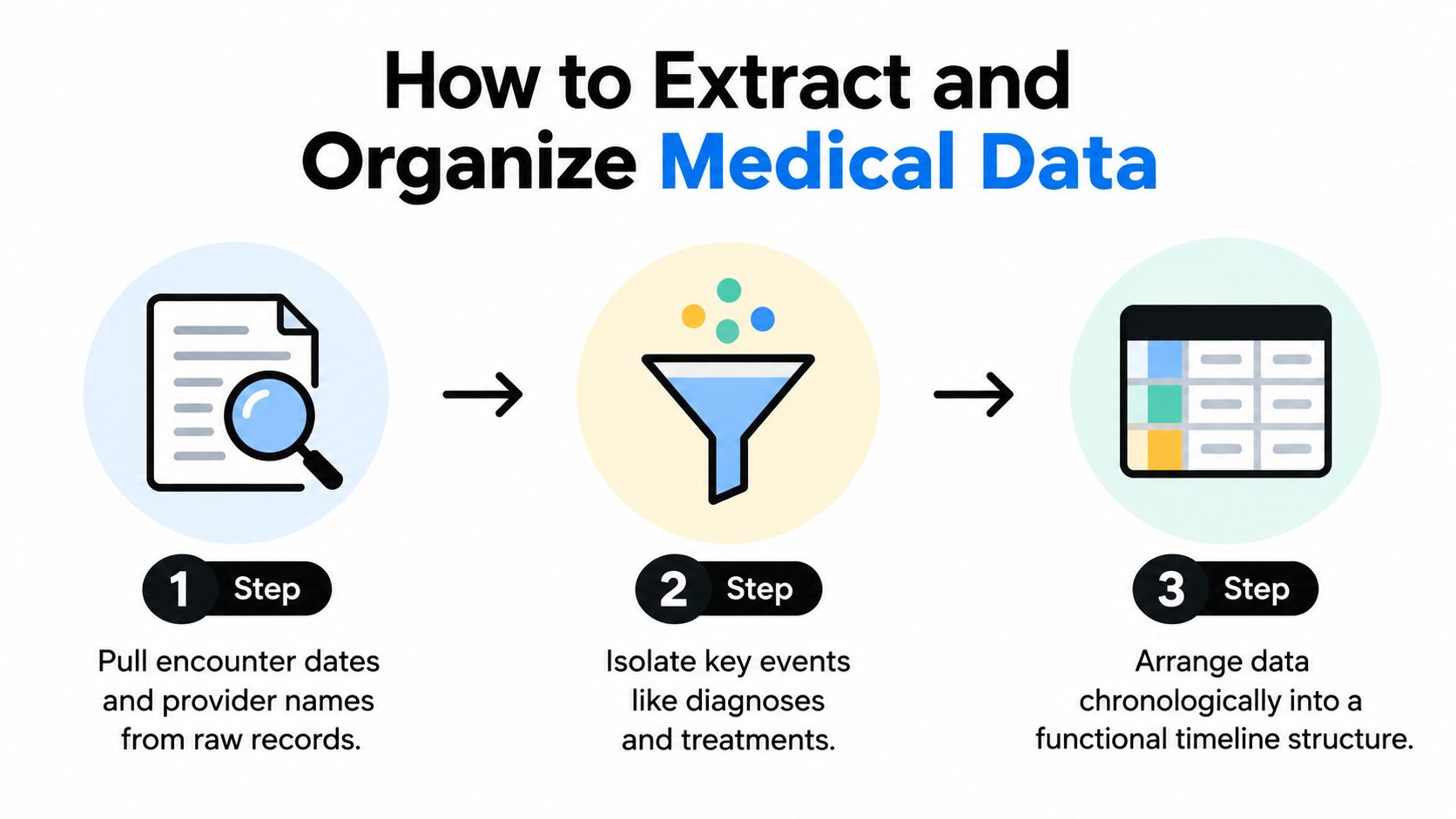
Start with the records, not the story you expect the records to tell. Build a master inventory that identifies each provider, facility, record type, date range, and source location. Keep the original files untouched, then work from a searchable copy or structured review environment so every summary entry can be traced back to the underlying document.
Build the source inventory first
Capture the encounter date separately from the date a report was finalized or signed. A radiology study may occur on one day and receive a finalized interpretation later. A hospital admission may also contain several clinically distinct events that shouldn't be compressed into a single vague entry.
For every relevant document, extract:
- Encounter information: Record the service date, facility, provider, specialty, and encounter type.
- Clinical content: Capture complaints, objective findings, assessments, diagnoses, imaging, procedures, medications, referrals, and treatment response.
- Source location: Preserve the page, Bates reference, or other precise locator available in the production.
- Status and uncertainty: Mark whether a finding is confirmed, suspected, historical, patient-reported, or awaiting further evaluation.
- Open issues: Flag missing reports, inconsistent dates, contradictory findings, and unexplained breaks.
The writer's job is to preserve the source's level of certainty. An impression isn't automatically a confirmed diagnosis. A note saying a condition is stable doesn't necessarily establish recovery, and a patient's reported symptom belongs in the chronology as a report, not as an objective finding.
Use a repeatable chronology structure
A practical row can include the date, provider or facility, clinical summary, legal relevance, and source reference. Keep factual summary and attorney-facing commentary distinguishable. That separation helps a litigator see what the record says and what requires legal judgment.
For a more detailed workflow, organizing medical records for legal review can help firms establish a consistent foundation before drafting the chronology.
The key distinction is the one many date-based guides leave unresolved. A blank space in a timeline may represent a true treatment gap, a records gap, a provider's failure to send records, or a documentation lag. Guidance on medical chronology gap analysis emphasizes flagging missing records, contradictions, and unexplained breaks, with source-based annotation rather than narrative inference. If the chronology fills the silence with a conclusion, it creates a vulnerability instead of resolving one.
Manual Workflows versus AI-Powered Tools
Manual review gives the attorney or paralegal direct control over every entry. That control matters in unusual cases, especially when records contain conflicting accounts, multiple injuries, or subtle distinctions that require judgment. The cost is time, inconsistent formatting, and the risk that a reviewer misses an important event while moving between PDFs, spreadsheets, and medical terminology.
A spreadsheet works well as a transparent working file. It can sort dates, filter providers, and expose blank periods. It becomes less effective when the team must repeatedly search scanned documents, reconcile duplicate entries, identify symptom references outside the principal treatment trail, and attach source citations to every conclusion.
The manual workload can exceed 10 hours per case, which is why firms evaluate automation for extraction and first-pass organization. That figure is required by the workflow brief, but it should be treated as a practical planning benchmark rather than a promise for every file. A straightforward chart may take less time, while a fragmented record set may require substantially more attorney review.
| Feature | Manual Spreadsheets | AI-Powered Platforms |
|---|---|---|
| Initial extraction | A reviewer reads records and enters dates, providers, findings, and treatment details | Software extracts recurring fields and organizes them for review |
| Control | The reviewer controls every line from the start | The attorney reviews and corrects machine-generated structure |
| Source tracing | Citations must be added and checked manually | Some platforms produce page-cited or source-linked entries |
| Gap detection | Depends on careful sorting and human comparison | Automated organization can surface blank periods and missing event patterns |
| Clinical nuance | Strong when the reviewer understands the case context | Requires human validation of qualifiers, contradictions, and causation issues |
| Scalability | Additional files usually require additional review time | Firms can process more records through a repeatable workflow |
| Security review | Depends on the firm's storage and access controls | Requires diligence on privacy, PHI handling, retention, and vendor controls |
Automation helps, but it doesn't replace judgment
An AI chronology should be treated as a structured first pass, not an expert opinion. The reviewer must confirm dates, distinguish encounter dates from report dates, preserve terms such as “possible” or “rule out,” and ensure that the output doesn't convert a patient's statement into a medical fact.
A platform such as Ares can organize uploaded medical records into chronology-oriented summaries containing dates of service, providers, diagnoses, treatments, and source-oriented case insights. Its usefulness depends on the same discipline as a spreadsheet: attorneys still need to inspect the source, resolve ambiguity, and decide how a fact fits the litigation theory. Firms evaluating this approach can review AI medical chronology workflows before selecting a process.
The best division of labor is clear. Software handles repetitive extraction and arrangement. Legal professionals handle interpretation, verification, privilege decisions, strategy, and the final presentation of disputed facts.
Identifying Treatment Gaps and Documentation Errors
A gap is not a conclusion. It is an investigative signal.
The last documented therapy visit may be followed by a long period with no records. That silence could mean the patient stopped treating, continued care with a provider whose records weren't produced, relied on home treatment, faced a scheduling or financial barrier documented elsewhere, or generated no record that was included in the production. Each explanation carries a different implication for causation and damages.
Separate the kinds of silence
A treatment gap means the available evidence supports a break in care. A records gap means the chronology lacks documents needed to determine whether care continued. A provider-records omission occurs when a known provider or facility hasn't supplied the relevant chart. A documentation lag occurs when care happened but the record was created, finalized, or transmitted later.
The chronology should identify the last confirmed event, the first later confirmed event, and the evidence surrounding the interval. Avoid writing “the claimant received no treatment” unless the record supports that statement. Safer language identifies what is known and what remains unresolved.
A missing record is evidence of an incomplete file. It isn't automatically evidence of missing treatment.
Pre-existing conditions require the same restraint. Separate the pre-incident baseline from the incident response and later progression. Include symptoms documented by primary-care providers, emergency departments, specialists, therapists, and other providers, even when those records weren't created specifically for the injury claim. A symptom noted during another encounter may help establish persistence, but it shouldn't be treated as proof of causation without appropriate medical support.
Keep date and source problems visible
Recent chronology guidance stresses that a defensible timeline should distinguish encounter dates from report-finalization dates, divide multi-day admissions into discrete entries, and annotate missing provider records and delayed intervention windows. The medical chronology reporting guidance also highlights the challenge of reconstructing symptom progression across fragmented providers and overlapping chronic conditions.
Use a deficiency log rather than burying unresolved issues inside ordinary entries. Record the missing provider, requested date range, last known treatment event, and reason the gap matters. If the patient reports continued care, identify that statement as retrospective history and seek corroborating records rather than converting it into an established fact.
The same method helps counter a defense claim of noncompliance. Instead of arguing broadly that the client was compliant, show the documented recommendation, the next confirmed event, the explanation for the interval if one exists, and the records still needed. A chronology structured this way gives the attorney a factual response without overstating what the chart proves. For a focused review of this issue, see the discussion of gap analysis in personal injury cases.
Using the Timeline for Depositions and Settlements
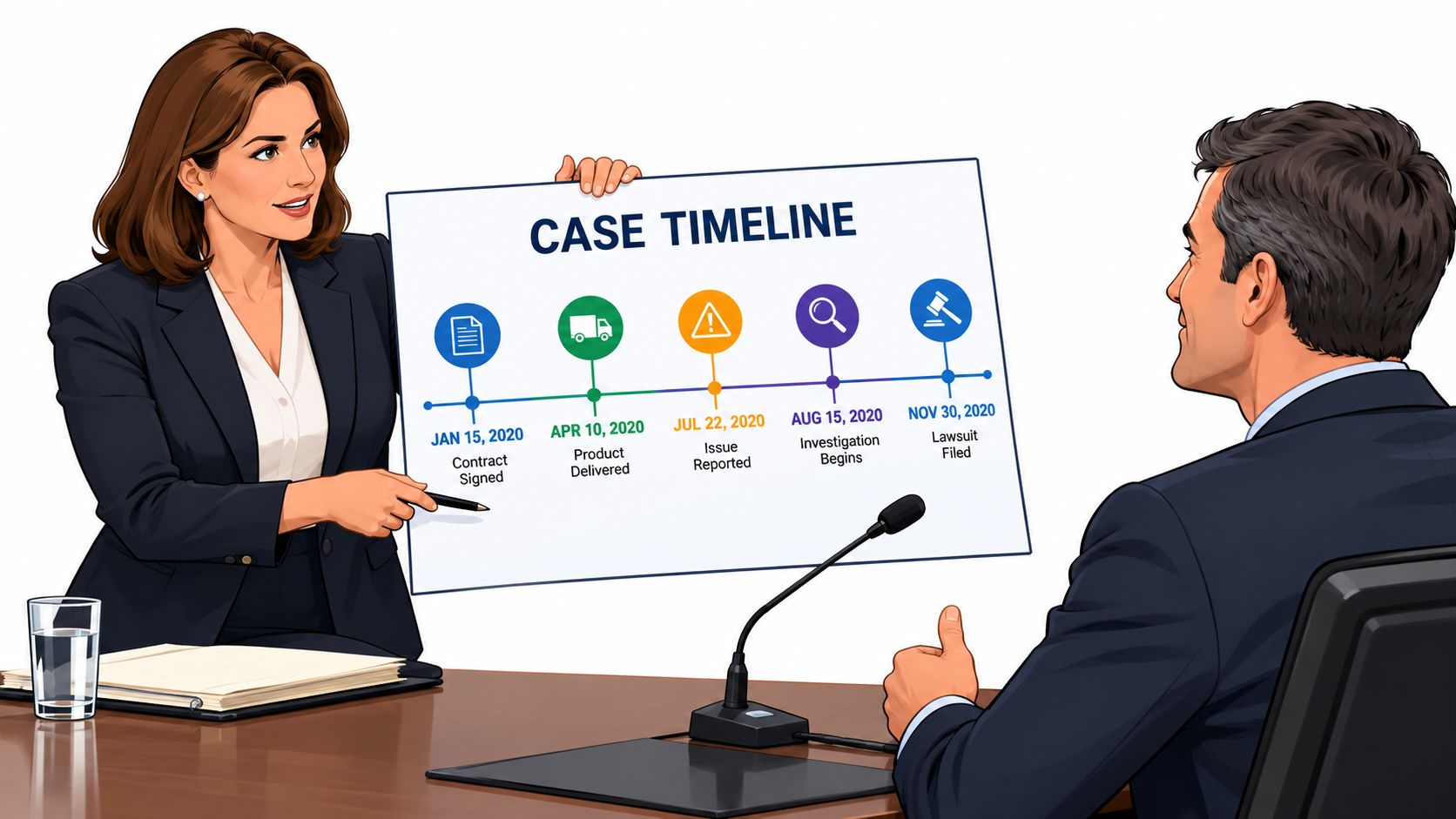
A verified chronology earns its value when someone challenges the case. In a deposition, use it to move from general recollection to specific records. Ask the witness to identify the first documented complaint, the recommendation made at that visit, the later finding, and the basis for any claimed change in symptoms.
Don't use the timeline as a script that hides uncertainty. Use it as a control document. If a witness says treatment stopped, the chronology should show whether the records establish that. If a defense expert relies on a date that conflicts with the source, the page citation lets you address the discrepancy without searching the entire chart during the examination.
Make the settlement narrative easy to test
At a settlement conference, the chronology should let the reader follow the injury from baseline through treatment and current limitations. Put the strongest objective findings beside the relevant dates, but preserve the distinction between provider findings, patient reports, and attorney analysis. A concise visual sequence is more persuasive than a dense narrative that forces the adjuster or defense lawyer to reconstruct the case.
The gap analysis deserves its own presentation. Identify whether the interval is explained, unresolved, or contradicted by later records. That approach prevents the defense from turning an incomplete production into an accusation of noncompliance, while also acknowledging weaknesses the other side will likely raise.
For firms handling substantial paper records alongside digital files, document control remains part of litigation readiness. A resource on high-density filing for legal archives may help teams think through physical storage and retrieval when the case file extends beyond the workstation.
A timeline also improves preparation for medical testimony. The attorney can identify which entries support the claimed progression, which findings require expert interpretation, and which missing records should be requested before the witness appears. The purpose isn't to manufacture a cleaner story. It's to make the actual record clear enough that the opposing side must address its sequence rather than replace it with a simpler narrative.
The following video can serve as a visual reference for presenting a chronology during a legal discussion.
Final Checklist for a Defensible Medical Timeline
Before relying on a chronology in a demand, deposition, mediation, or expert review, perform a final audit. Read the source record against the summary, not just the summary against itself. The most damaging errors often arise when a polished entry changes a qualifier, date, or provider attribution.
Verify the factual foundation
- Dates: Confirm that the service date, admission date, discharge date, imaging date, and report-finalization date are not being conflated.
- Providers: Check names, specialties, facilities, and referral relationships against the original records.
- Clinical language: Preserve distinctions among reported symptoms, impressions, suspected diagnoses, confirmed findings, and historical conditions.
- Sequence: Confirm that entries appear in chronological order and that multi-day admissions or multiple encounters aren't collapsed improperly.
- Sources: Attach a page, Bates reference, or precise source locator to every material entry.
Test the narrative for weaknesses
Ask whether the chronology separates pre-existing conditions from post-incident developments without deciding aggravation prematurely. Check whether symptoms appearing in records from other providers have been included and clearly identified. Review every quiet period and label it as an established treatment gap, a records gap, an unexplained interval, or an issue requiring further investigation.
Then read the document as opposing counsel would. Could someone claim that a suspected diagnosis was presented as confirmed? Could a “stable” finding be misread as resolution? Does a later symptom appear without any indication of when it first surfaced? Is a missing report visible, or does the chronology look more complete than the production is?
Final review standard: Every important conclusion should either point to a source or be labeled as an issue for attorney or expert analysis.
Keep factual entries separate from legal commentary, maintain an inventory of reviewed records, and place unresolved deficiencies in a dedicated section. A defensible timeline medical history doesn't eliminate ambiguity. It identifies ambiguity precisely, preserves the evidence around it, and gives the litigation team a reliable basis for deciding what to request, prove, or concede.
Ares helps personal injury firms turn medical records into structured chronologies, treatment summaries, and case-ready insights, including dates, providers, diagnoses, treatments, and symptom progression. Visit Ares to review a repeatable way to organize fragmented records, identify gaps, and prepare a clearer medical narrative for settlement and litigation.