

You're probably living this already. A paralegal pulls intake notes from the case management system, copies medical provider details into a spreadsheet, pastes a treatment chronology into an AI review tool, then retypes the same names and dates into a demand letter draft. By the time the letter goes out, somebody has already cleaned up one typo, chased one missing PDF, and asked whether the latest version is the one in the record.
That mess isn't a temporary inconvenience. It's what a fragmented legal stack looks like when no one has owned the software integration strategy from day one. In a personal injury practice, disconnected systems don't just waste time, they create PHI exposure, audit problems, and avoidable mistakes that can follow a case all the way to settlement.
The scale of the problem is bigger than most firms admit. One 2022 industry synthesis reported that companies used an average of 976 applications, yet only 28% were integrated, and 38% of respondents said integrating siloed software was their biggest digital transformation challenge (enterprise application integration statistics). That's not a niche IT issue, it's the operating reality behind why a law firm can feel busy all day and still move too slowly.
The right response is not “buy one more tool.” It's to decide how your systems should talk, who owns that conversation, and how you'll keep it reliable after launch. If your team is still trying to patch process gaps with manual copying, compare that with a more structured case-management setup in case management for law firms, then come back to integration as the bigger operating problem. And if you need a quick refresher on secure communication tips for lawyers, that's the right lens for thinking about PHI before any automation goes live.
Why Your Law Firm's Tech Stack Feels Disconnected
A PI firm stack usually grows by accretion, not design. You add a case management platform, then a medical records vendor, then billing, then an AI summarizer, then a text or e-sign tool. Each purchase solves one problem and creates new handoffs, and nobody defines how the systems should exchange case IDs, provider names, record dates, treatment summaries, or status updates. Staff end up serving as the integration layer.
That is why manual rekeying survives in firms that already spend on software. A paralegal pulls a record set from one platform, updates a chronology in another, and then checks a draft demand in a third. Every copy-and-paste step introduces drift. In a PHI-heavy practice, drift is a risk, not just inefficiency.
Practical rule: If a staff member has to interpret the same data twice in two different systems, you do not have an integration, you have a liability with a login screen.
Fragmentation is now the normal operating condition
The broader enterprise environment has become fragmented, which is why legal teams keep inheriting disconnected tools instead of clean stacks. One 2022 synthesis found that companies used an average of 976 applications, yet only 28% were integrated, and 38% of respondents said integrating siloed software was their biggest digital transformation challenge (enterprise application integration statistics). That is the operating reality behind why a law firm can feel busy all day and still move too slowly.
The strategic mistake is treating this as an IT side project. In PI work, disconnected software hits billable time, intake quality, record chronology, and confidentiality all at once. If your workflow depends on a human remembering to move the right field from one screen to another, your process is already brittle.
A better legal operations mindset is to ask which tasks should never be manual in the first place. Demand letters, medical chronology building, case status updates, and invoice reconciliation are obvious candidates. Anything that depends on repeating the same data across multiple systems deserves an integration review before it deserves more staff time.
Why the cost shows up in operations, not just technology
The hidden expense is not the software license. It is the lost attorney attention, the extra review cycles, and the clean-up work after a record sync fails or a document version goes stale. When a firm scales case volume without fixing the handoff points, the backlog gets disguised as process.
That is especially dangerous in PHI-rich matters because the operational failure can become a confidentiality problem. Medical records, provider notes, and AI-generated summaries need controlled paths, not ad hoc inboxes and shared drives. If your staff cannot explain who touched what, when, and why, the integration design is too loose. For secure communication tips for lawyers, use the CIPHR guidance at secure communication tips for lawyers before any automation goes live.
Your goal is simple, even if the execution is not. Build a stack where the systems exchange the right data automatically, humans handle exceptions only, and every transfer can be explained later if a client, judge, or auditor asks.
Five Integration Architectures Every Legal Operations Leader Should Know
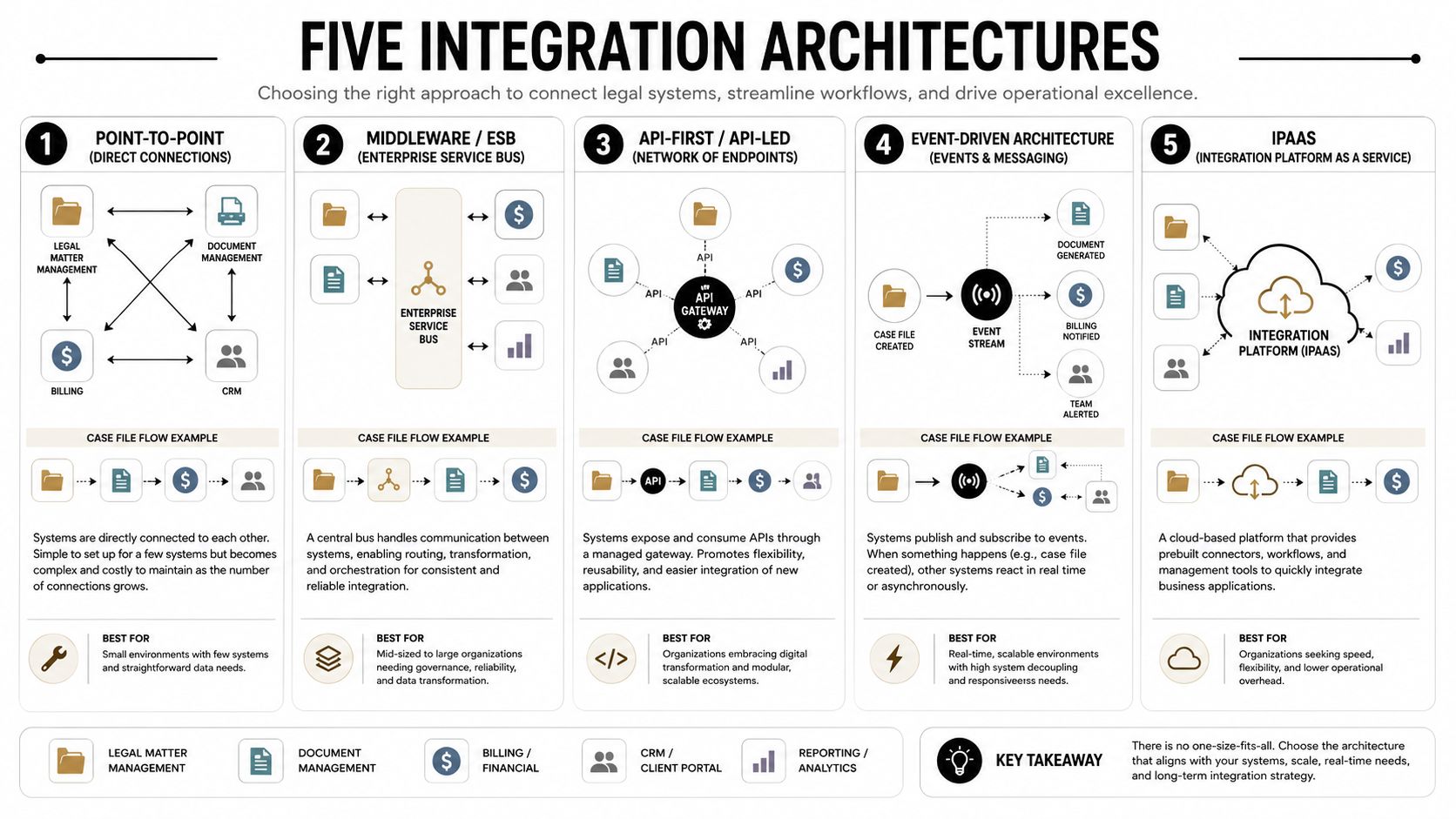
A PI intake team gets a new MRI packet, an AI tool drafts a summary, and the case manager updates the file in the same afternoon. If those systems do not speak to each other cleanly, staff start copying PHI by hand, version control slips, and nobody can explain where the record came from. The architecture you choose decides whether your firm can keep pace or ends up with a hidden maintenance burden.
The right pattern depends on how many systems you connect, how quickly the data must move, and how tightly you need to control PHI. That is the true test. A flashy integration demo means nothing if the workflow breaks the first time a vendor changes a field, a document source goes offline, or an AI summary needs review before it enters the file.
Point to point and why it only works at the edges
Point to point is the direct connection model, one system talks to one other system with little or no middleware in between. It works for a narrow task, such as sending case updates from one case management tool into email or a calendar system. It is easy to understand, but every added connection creates another custom edge your team has to protect.
Use it only when the workflow is small and stable. A solo or very small firm can live with this for one or two simple links, but the model falls apart once you need version control, alerting, and change review. In PI practices, that is where PHI mistakes start, because every manual fix is another chance to expose medical details in the wrong place.
Middleware, ESB, and the control tower pattern
Middleware, including ESB-style routing, places a central layer between systems so data can be transformed and distributed in one place. That makes sense when you are bridging legacy platforms that do not natively speak the same language, or when one record source needs to feed multiple downstream tools. It gives you more central control, but it also adds another system to govern and secure.
That trade-off matters in firms with old and new tools living side by side. A middleware layer can reduce point-to-point sprawl, but it also becomes a single point of outage risk and ownership confusion if nobody knows who manages it. The older your stack, the more tempting this model becomes, and the more disciplined your governance has to be. For firms formalizing that control layer, data vault implementation is a useful reference for structuring data relationships before the integration web gets messy.
API first and event driven for modern legal workflows
API-first design is the cleaner choice when you want systems to expose data and actions predictably. In PI work, that is the right mindset for custom connections to AI medical record reviewers, case timelines, or document assembly tools that need precise inputs and outputs. It is also the most sensible way to build durable integrations when you expect your stack to keep changing.
Event-driven architecture fits a different need, one where the system should react the moment something happens. A new medical record arrives, a deadline changes, or a settlement offer gets logged, and the downstream workflow triggers immediately. For time-sensitive PI operations, that reaction chain is usually better than scheduled polling because it keeps the team closer to real time and reduces the chance that a critical update sits unnoticed in a queue.
iPaaS for firms that want speed without building everything
iPaaS gives you a cloud integration platform with connectors and orchestration already in place. If you need to connect cloud-based tools quickly without building every bridge by hand, this is often the fastest route. It is practical for growing firms that want usable integrations without hiring a dedicated integration engineering team.
The warning is vendor dependence. If the platform becomes the only place your workflows live, switching costs rise, and every custom workflow you build inside it makes future change harder. That does not make iPaaS a bad choice, it makes governance mandatory. You still need clear ownership, logging, and review rules, especially when PHI moves through AI tools, case management systems, and medical record platforms.
Evaluating Trade-Offs for Personal Injury Workflows
The integration question in a PI firm isn't “what's modern?” It's “what won't create PHI risk, audit headaches, and operational debt six months from now?” That means evaluating every architecture against the realities of confidentiality, timing, and long-term maintenance, not just ease of setup.
The five criteria that matter
Security and encryption standards come first because PHI moves through these workflows. If an integration can't be explained in plain language from a security perspective, it's not ready for production. PHI compliance is next, because a tool can be useful and still be a poor fit if it creates unclear handling of medical records or summaries.
Then look at vendor lock-in risk, data latency, and maintainability. A workflow that is acceptable in a solo shop may be a liability in a high-volume practice if it can't survive staff turnover, vendor changes, or growth in record volume.
Integration Strategy Comparison for PI Law Firms
| Strategy | Security | PHI Compliance | Vendor Lock-In | Latency | Maintainability |
|---|---|---|---|---|---|
| Point to point | Simple at first, but fragile as edges multiply | Hard to govern at scale | Low at the start, then grows with every custom link | Good for narrow, direct transfers | Weak when the stack expands |
| Middleware or ESB | Central control, but one more critical system to protect | Better if governance is disciplined | Moderate | Good for routing, less ideal for highly dynamic workflows | Can become heavy to manage |
| API first | Strong when access, auth, and scopes are designed well | Better fit for auditable exchanges | Moderate | Strong for direct requests and responses | Strong if versioning is handled well |
| Event driven | Strong for monitored, time-sensitive triggers | Good when event logs are preserved | Moderate | Very strong for immediate workflow reactions | Good, but needs clear ownership |
| iPaaS | Often solid, depending on platform controls | Useful for common cloud-to-cloud flows | Higher if workflows become platform-specific | Good for many standard transfers | Good early, can get messy if overbuilt |
How to choose by firm type
A solo practitioner usually needs the least complex answer that still protects PHI. Simple point-to-point links or a small iPaaS footprint can work if the workflow is narrow and stable. A mid-size practice should lean toward API-first or iPaaS with clear governance, because the first real pain point is usually coordination, not code.
A high-volume PI operation needs architecture that can survive scale, staff turnover, and frequent case movement. That usually means API-first with event-driven triggers, or a carefully governed middleware layer where ownership is explicit and monitoring is essential.
A firm should never choose an architecture because it looks elegant in a demo. It should choose the one it can still defend after the third vendor change and the first serious exception.
The source brief notes that low-latency, event-driven use cases favor APIs or CDC, while high-volume analytical pipelines often favor ELT or CDC-driven replication because they reduce transformation load on source systems (guide to software integration). That logic maps cleanly to legal ops. If the work is operational and immediate, favor faster exchange. If it's analytical and batch-heavy, favor the pattern that puts less strain on the source.
Planning Your Integration Before Writing Any Code
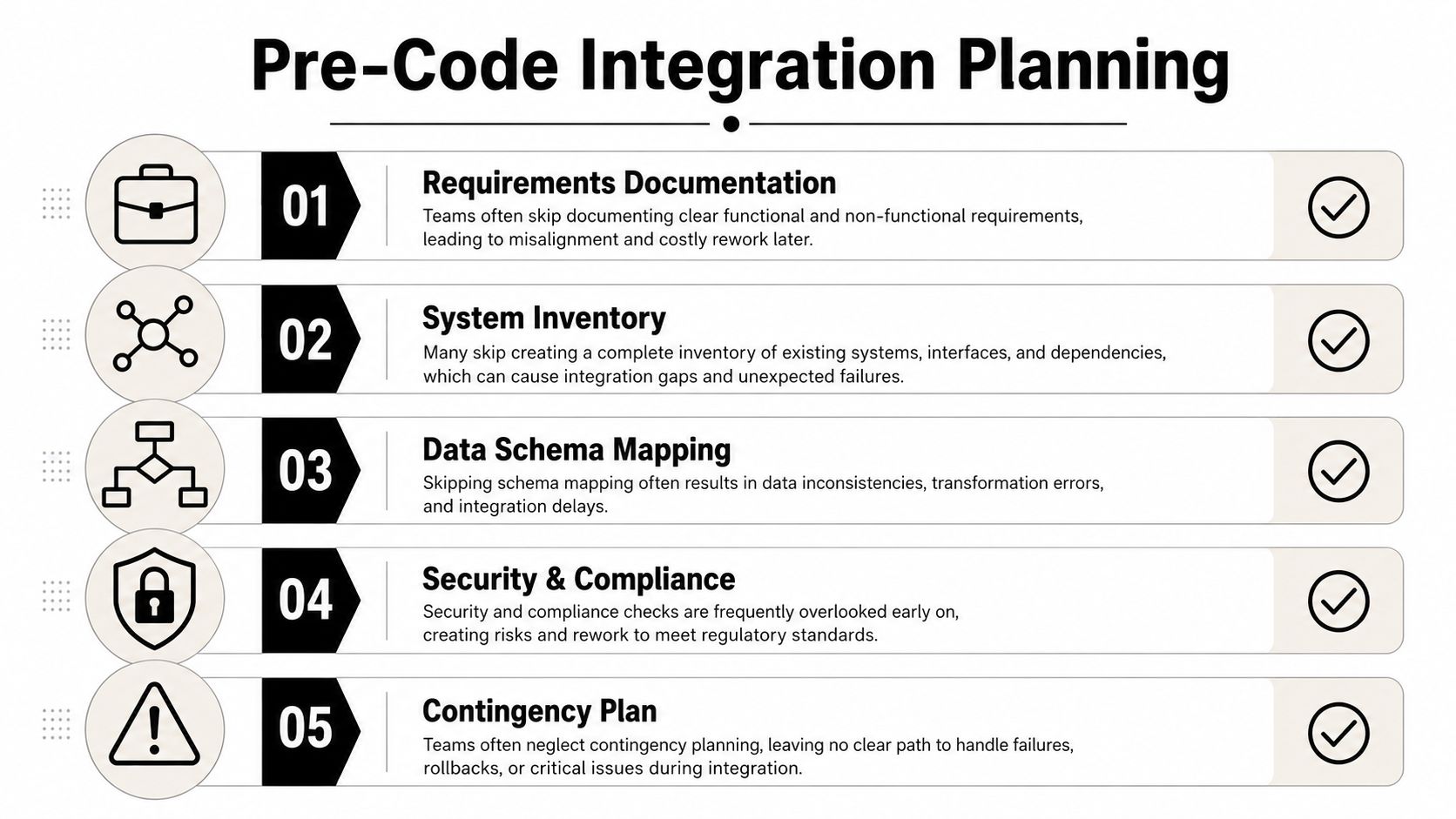
Most bad integrations start with a vague sentence like, “We need these systems to talk.” That's not a requirement, it's a wish. Before any connector gets built, the firm has to document what gets exchanged, who owns it, how often it moves, and what happens when it fails.
Start with the interface inventory
List every system that touches a case. That includes the case management platform, medical record portal, AI review tool, billing system, communication tools, and any document assembly software. For each interface, document the communication protocol, security and availability requirements, data-flow direction, ownership, sharing frequency, privacy and obfuscation rules, and data standards before implementation, because that is exactly what reduces brittle point-to-point design and inconsistent handling across systems (effective integration solution strategy).
Align the humans before the tools
Attorneys want accuracy, paralegals want speed, IT wants stability, and vendors want the smallest support burden possible. If you skip that conversation, the first production issue becomes a blame exercise. Get the practice leader, operations lead, and whoever owns the records workflow in the same room and force decisions about what matters most.
A useful internal checkpoint is whether the team can agree on the one or two connections that will change daily work the most. If nobody can name them, the project is too broad. Start with the transfer that removes the most manual re-entry from the most sensitive workflow.
Use a phased roadmap, not a grand launch
The mistake I see most often is firms trying to wire everything at once. That creates too many moving parts to test, too many people to train, and too much risk if a single link fails. A phased approach gives you room to prove the connection, review exceptions, and harden the process before adding the next layer.
For firms evaluating what kind of vendor or implementation partner they need, a structured legal-technology planning lens like the one used in legal technology company conversations is useful, because the vendor isn't just selling software, it's taking on part of your workflow design. That distinction matters in PHI-heavy practices, where implementation quality is often the difference between a useful tool and an operational headache.
Governing Integrations After Launch
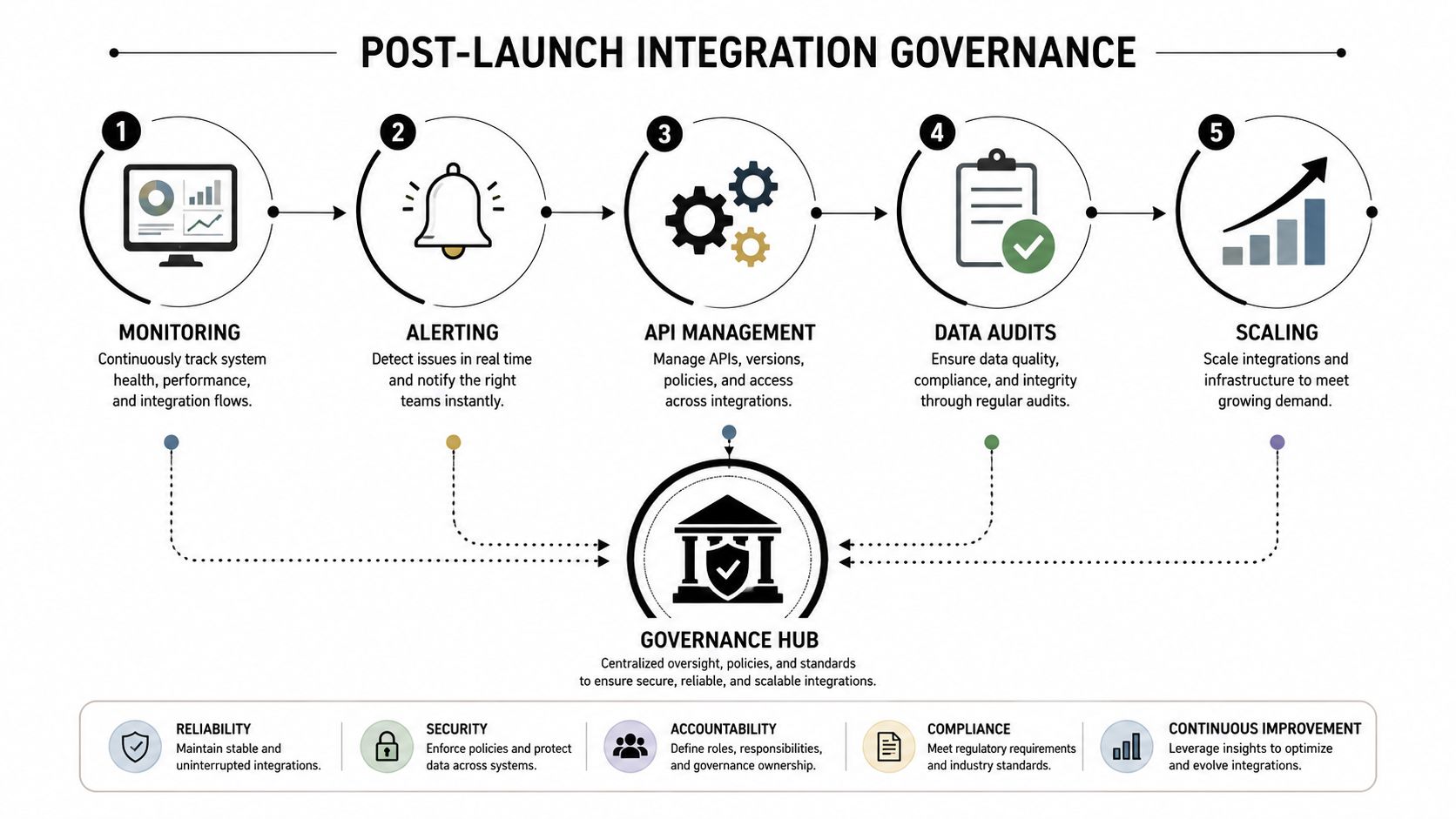
Launching an integration is the easy part. Keeping it reliable is where firms usually fail. APIs change, records formats drift, volumes increase, and a workflow that looked clean in pilot mode starts throwing exceptions the first time it meets real case traffic.
Own it like a business process
Every integration needs a named owner. Not a vendor. Not “IT.” A person or role inside the firm who is responsible for monitoring the workflow, approving changes, and deciding when an issue escalates. Without that owner, problems linger because everyone assumes somebody else is watching.
The governance layer should also define version control and change review. If someone modifies a field mapping or changes an API endpoint, that needs to go through review before it reaches production. In regulated legal workflows, that discipline is not overhead, it's how you avoid creating a quiet compliance issue.
Monitor, alert, and roll back fast
The source material is blunt about this gap, most articles cover goals and testing, but much less covers ownership, rollback, monitoring, alerts, and who can modify integrations after launch (software integration). That's the right criticism. The integration problem usually isn't the initial connection, it's long-term reliability across many systems and teams.
Build dashboards that show whether records are flowing, not just whether a job technically ran. Alert on failed transfers, unusual delays, and data mismatches that matter to case work. If a record sync fails between a medical records platform and a demand letter generator, the firm needs a rollback procedure and an error-handling playbook, not a conference call.
Stage changes, don't improvise them
A staged rollout is the only sane way to change a live legal workflow. Test on a small subset of cases, confirm that downstream documents still look right, and then expand. If you skip that, the first hidden schema change can poison more files than anyone notices at once.
The broader lesson is simple. Integration governance is operational risk management. If your firm treats it like a one-time IT project, you'll eventually pay for the mistake in missed deadlines, broken records chains, or avoidable PHI exposure.
Integrating AI Tools Into Governed Legal Workflows
AI changes the integration question because the output isn't just data, it's machine-generated interpretation. A record summary, chronology, or demand draft still has to fit inside a controlled legal workflow where the firm can audit what the tool produced and decide what humans must verify before use.
If you're comparing platforms, a practical place to start is to compare AI agent tools with a focus on workflow control, not novelty. The tool matters less than whether its output can be traced, reviewed, and safely moved into your case system.
Treat AI output as governed content
An AI summary of medical records is not the same thing as a final work product. It needs a chain of custody, a review step, and a clear handoff into the case management system or document workflow. That is especially true when outputs are semi-structured and may need human correction before they're safe to rely on.
Security-by-design and interoperability standards stop being buzzwords and become practical requirements. The integration should preserve the source context, the generated summary, and the reviewer's edits. If it doesn't, you've made the AI useful but not trustworthy.
Use AI where it fits the governed workflow
Some tools are best for extraction, some for summarization, and some for draft generation. A platform like Ares can sit in that environment as one option for turning raw medical documents into organized case-ready outputs, but only if the firm controls how those outputs move into the rest of the stack. The same standard should apply to any AI tool handling PHI.
The strategic shift is this. You're not just connecting apps. You're deciding how machine-generated information becomes admissible, auditable, and operationally useful without breaking your controls.
Measuring Integration Success and Planning Next Steps
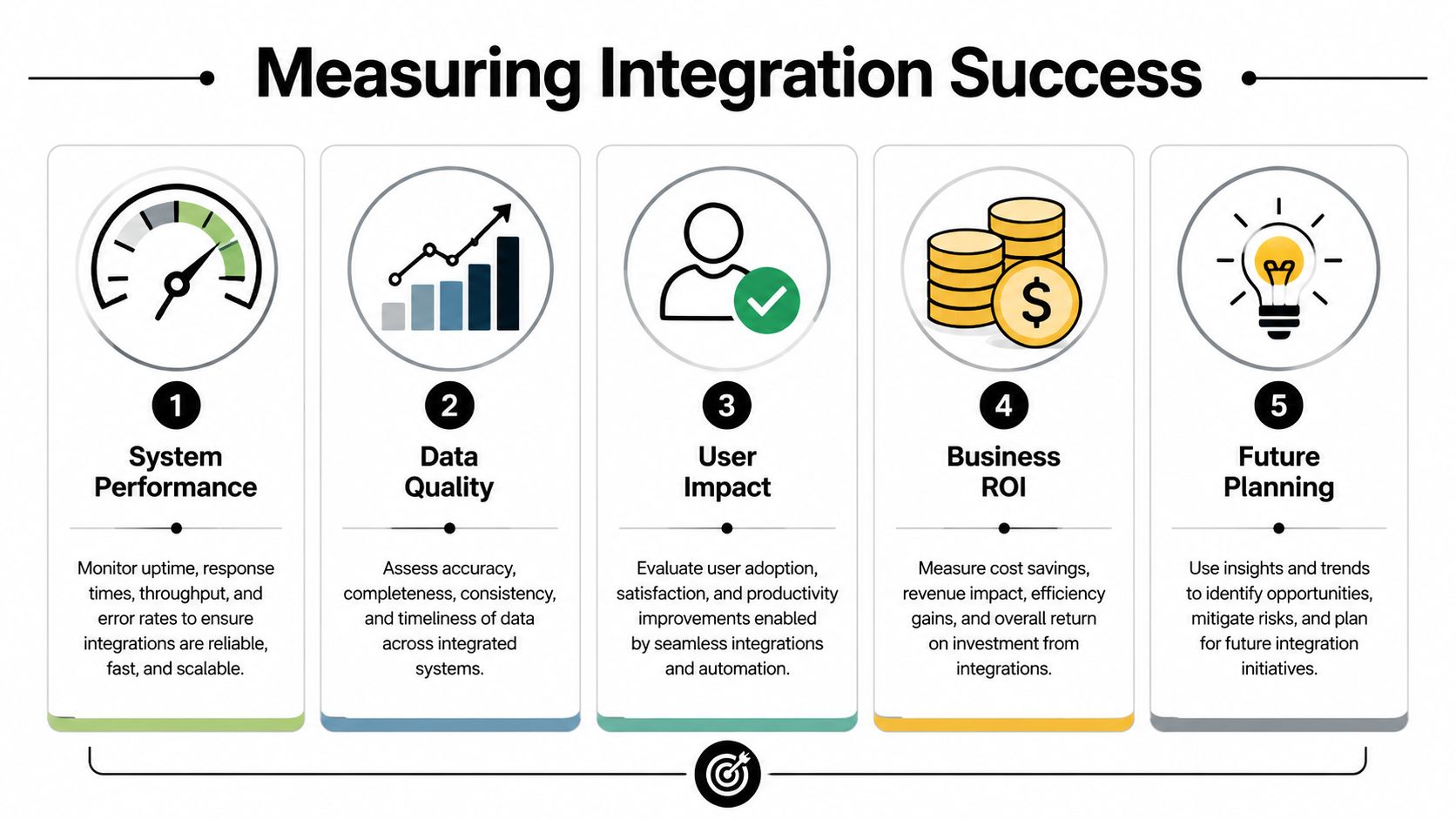
Forget vanity dashboards. If your integration isn't reducing manual re-entry, lowering transfer errors, and making PHI workflows easier to explain, it's not delivering. The measures that matter are time saved per case, error rates in data transfers, system uptime, compliance audit results, and attorney satisfaction.
Review the right metrics on a fixed cadence
Run a quarterly integration health review. Ask whether the connections still match the workflow, whether any vendor changes have altered data shape, and whether staff are still working around the system instead of through it. If a process still requires a human to clean up the same error every week, that's not a minor annoyance, it's a design failure.
For firms that are also evaluating AI-heavy workflows, a practical AI integration guide like the one from Technioz can help frame deployment questions, but your internal scorecard should stay focused on legal operations outcomes. The tools change. The control requirements don't.
Match next steps to maturity
If you're just starting, connect one high-friction workflow and make it reliable. If you already have several links in place, centralize ownership, document your interfaces, and add monitoring and rollback procedures. If you're running a high-volume practice, optimize for governance, not novelty, because complexity without control is where most firms get hurt.
Here's the bottom line. The firms that win on integration don't chase every tool. They choose a manageable architecture, document the data rules, govern the stack after launch, and make PHI handling a design constraint instead of an afterthought.
If you want a practical way to reduce manual record review, tighten demand letter workflows, and keep PHI handling under control, visit Ares. It's built for personal injury teams that need AI-generated medical summaries and drafts to move into a governed case workflow without creating more cleanup work.