
You're reviewing a new personal-injury file. The client's account sounds credible, the medical records are arriving in pieces, and the insurer is already asking for a demand. The temptation is to send what you have, reserve the rest for later, and move on to the next intake.
That shortcut often determines the value of the claim before anyone files a complaint. A pre litigation attorney turns scattered records, uncertain causation, and incomplete liability evidence into a decision-ready case. The work isn't clerical. It shapes whether an insurer sees a defensible settlement opportunity or a file worth delaying until litigation becomes unavoidable.
The Hidden Battlefield Before the Lawsuit
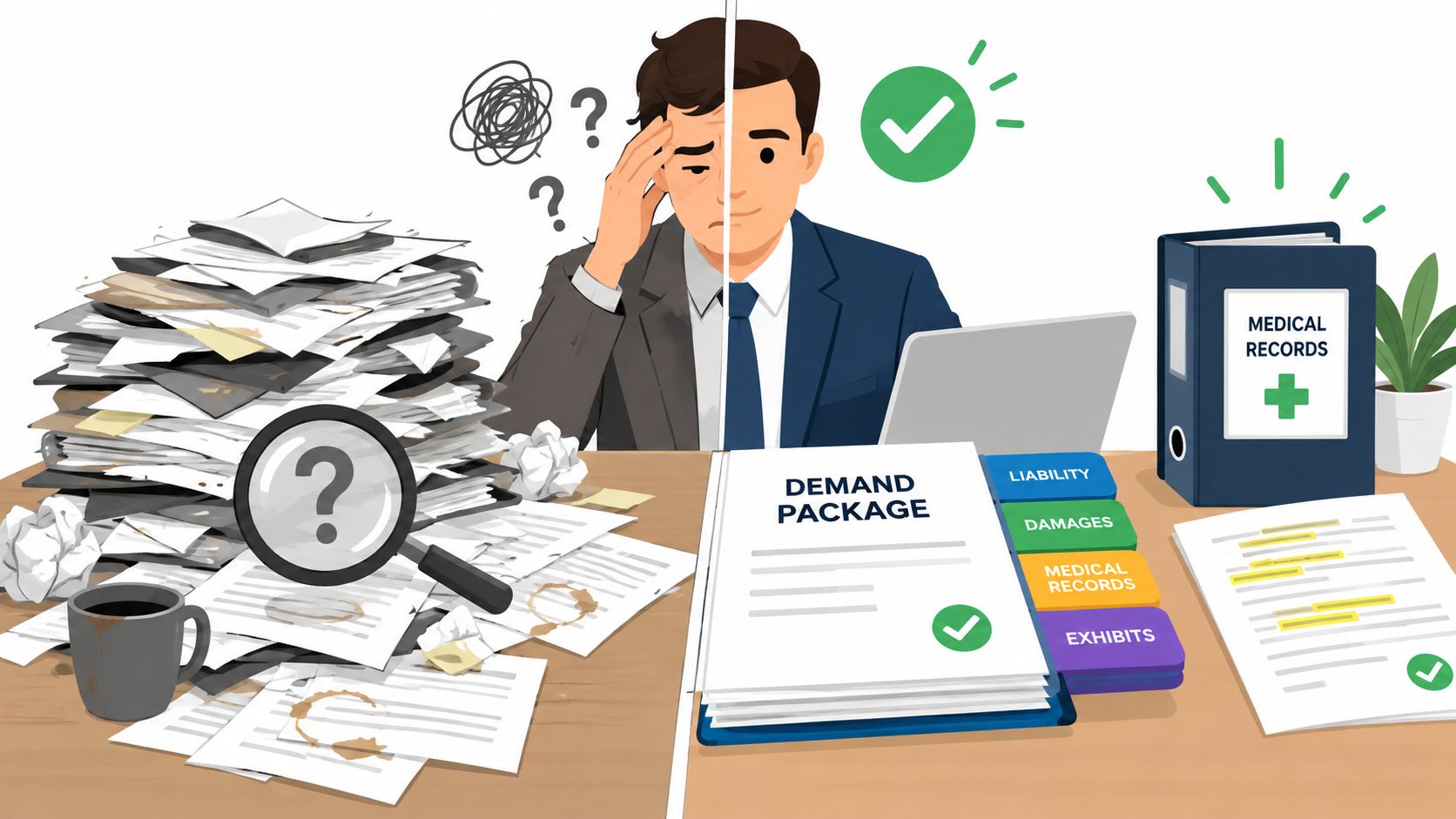
Two personal-injury files can reach the same adjuster on the same day. One contains a concise liability analysis, a medical chronology, clearly labeled billing records, photographs, witness information, and an explanation of every apparent treatment gap. The other contains hundreds of pages with no usable sequence, a generic demand letter, and no answer to the adjuster's central question: why did this accident cause these damages?
The injuries may be comparable. The difference is the quality of the record presented for evaluation.
The first file gives the adjuster a path to authority. The liability theory is easy to test, the treatment history is understandable, and the demand explains what remains uncertain instead of hiding it. The second file creates work without creating confidence. The adjuster may request more records, question unrelated treatment, or make a low offer just because the attorney hasn't made the case easy to value.
Preparation changes the negotiation
A demand package doesn't win because it's long. It works when it answers the insurer's practical questions in the order they arise:
- What happened: Identify the incident, responsible parties, witnesses, photographs, reports, and disputed facts.
- What changed: Connect the pre-incident baseline to the first symptoms, diagnosis, treatment, and continuing limitations.
- What supports the claim: Match medical opinions, bills, work records, and other damages evidence to the chronology.
- What remains open: Address gaps directly and explain whether they reflect delayed care, access problems, preexisting conditions, or incomplete production.
A useful demand is an argument supported by an organized record. It doesn't pretend that every fact favors the client. It shows the attorney has found the weaknesses and can explain them.
Practical rule: An adjuster should never have to build your chronology before evaluating your demand.
The phrase pre-litigation describes more than the time before a complaint. It describes the period in which counsel investigates, preserves proof, tests causation, evaluates damages, and determines whether negotiation can produce a result that justifies avoiding suit. A practical explanation of the broader concept appears in this guide to what pre-litigation means.
Defining the Pre Litigation Attorney Role
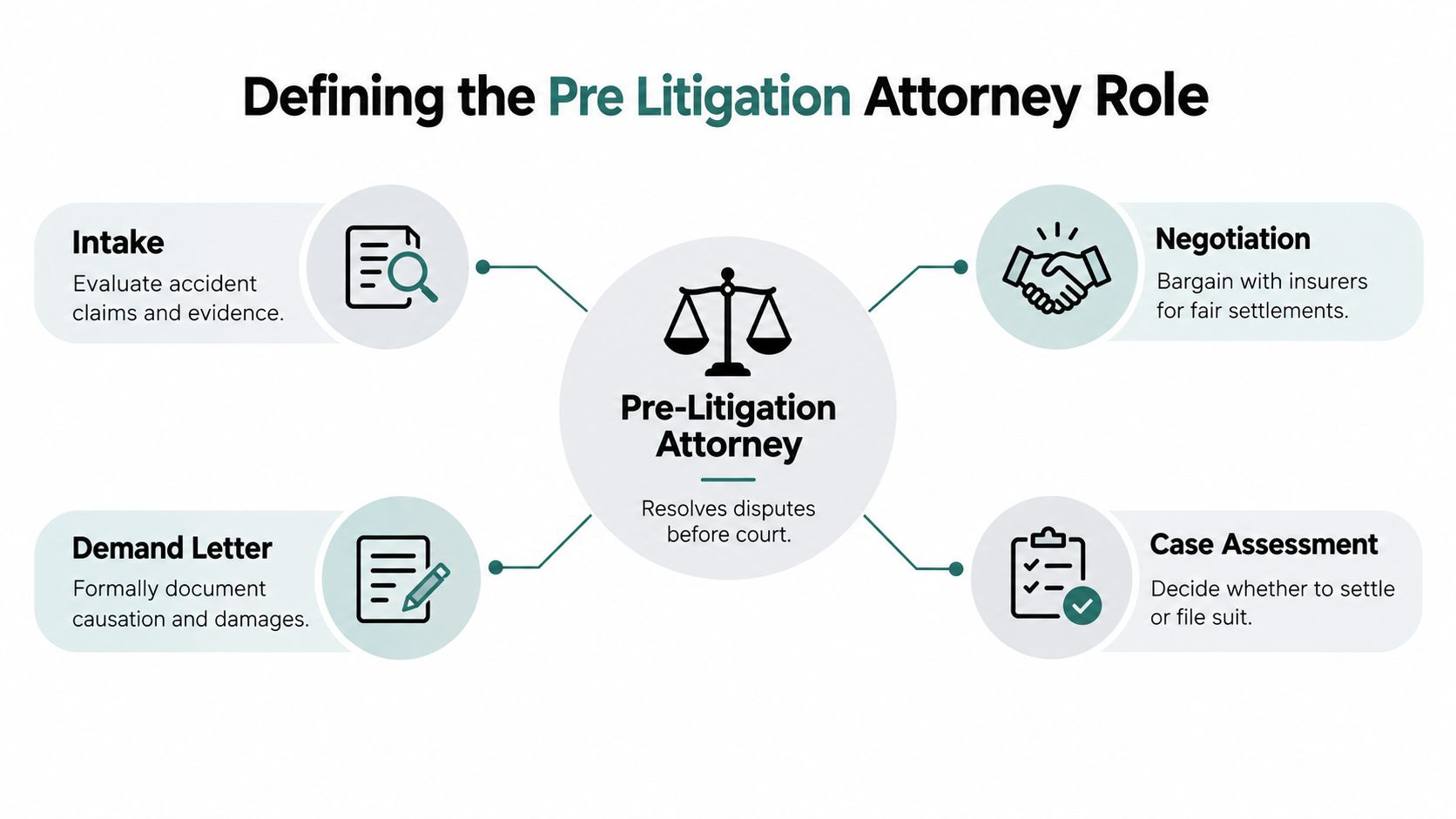
A pre litigation attorney manages the case during the interval between incident and formal filing. The attorney's job is to convert an allegation into an evaluated claim, then choose the next action based on evidence rather than urgency.
That requires more than sending records to an insurer. Counsel must determine whether the available material supports a demand, whether investigation is still necessary, whether a medical issue requires expert input, and whether filing suit would improve the client's position or merely increase cost and delay.
The work begins with structured intake
At intake, the attorney should establish the basic decision record:
- Incident facts: What happened, when, where, and under what conditions?
- Liability evidence: Which documents, photographs, statements, or physical facts support responsibility?
- Medical baseline: What symptoms, diagnoses, providers, and treatment existed before the incident?
- Post-incident sequence: When did symptoms begin, and how did treatment develop?
- Economic effect: What work, household, or daily activities changed?
- Procedural risk: What limitation, notice, preservation, insurance, or party-identification issues could affect the claim?
This structure separates evidence from assumption. A client may describe severe pain, but the attorney still needs records showing onset, progression, objective findings, treatment, and functional impact. A police report may identify a collision, but it may not establish every fact needed for negligence.
Investigation is the dividing line
Trial counsel may eventually present testimony and exhibits. Pre-litigation counsel must first decide which testimony and exhibits are worth developing. That means contacting witnesses before memories fade, identifying surveillance before automatic deletion, confirming insurance coverage, and testing whether an apparent factual gap can be closed.
The distinction is strategic, not hierarchical. A strong trial lawyer can conduct excellent pre-litigation work, and a negotiation-focused attorney must understand how the file would perform if filed. The best approach uses the likely litigation standard to improve the settlement record without automatically committing the client to litigation.
A pre-litigation attorney should ask a simple question at every stage: What would the opposing side challenge first, and can we answer that challenge now?
Core Services That Drive Settlement Success
The strongest pre-litigation files are built through several connected services. Evidence preservation protects the factual foundation. Medical review explains injury and causation. Demand drafting presents the result in a form an insurer can evaluate.
Evidence preservation must be targeted
Under Federal Rule of Civil Procedure 37(e) guidance, sanctions for lost electronically stored information depend on whether litigation was anticipated, whether reasonable preservation steps were omitted, and whether the information can be restored or replaced. The practical lesson applies before filing: once litigation is reasonably anticipated, counsel should document a proportional preservation protocol.
A useful notice identifies custodians, systems, date ranges, and deletion risks. Depending on the claim, it may cover incident reports, photographs, surveillance, vehicle telematics, text messages, relevant social-media content, medical billing data, claim communications, and cloud accounts.
Indiscriminate preservation creates noise and cost. Narrow preservation can weaken one's position. The attorney's task is to preserve material that may prove liability, causation, damages, credibility, or the opposing party's knowledge.
Medical review should expose the story's weak points
A medical summary isn't a transcript of every page. It should identify the first post-incident complaint, diagnoses, objective findings, treatment changes, referrals, medication history, prior conditions, missed visits, and points where the record stops answering an important question.
For example, a chronology may reveal that the client reported neck pain immediately, received conservative treatment, later underwent imaging, and then developed persistent limitations. It may also show a prior complaint in the same body region. Ignoring that prior history doesn't strengthen the claim. Addressing it with a reasoned causation analysis gives the insurer less room to characterize the entire injury as unrelated.
Demand letters should make valuation easier
A persuasive demand letter links four components:
- Liability: Explain the rule, conduct, supporting evidence, and likely defense.
- Causation: Connect the event to symptoms, diagnoses, treatment, and prognosis.
- Damages: Separate medical expenses, wage loss, functional limits, and non-economic harm.
- Resolution position: State what the client seeks and why the demand is supported.
The demand should cite exhibits by consistent labels. It should distinguish billed charges from paid amounts where relevant, identify missing records, and explain why treatment was reasonable. A practical reference on structuring this work is this guide to pre-litigation demand letters.
Investigation may also require help outside the firm. When witness location, surveillance, scene work, or discreet fact development is necessary, counsel can evaluate private detective services as part of a documented investigation plan. The attorney remains responsible for deciding what evidence is relevant and how it should be used.
The Economics of Pre Litigation Preparation
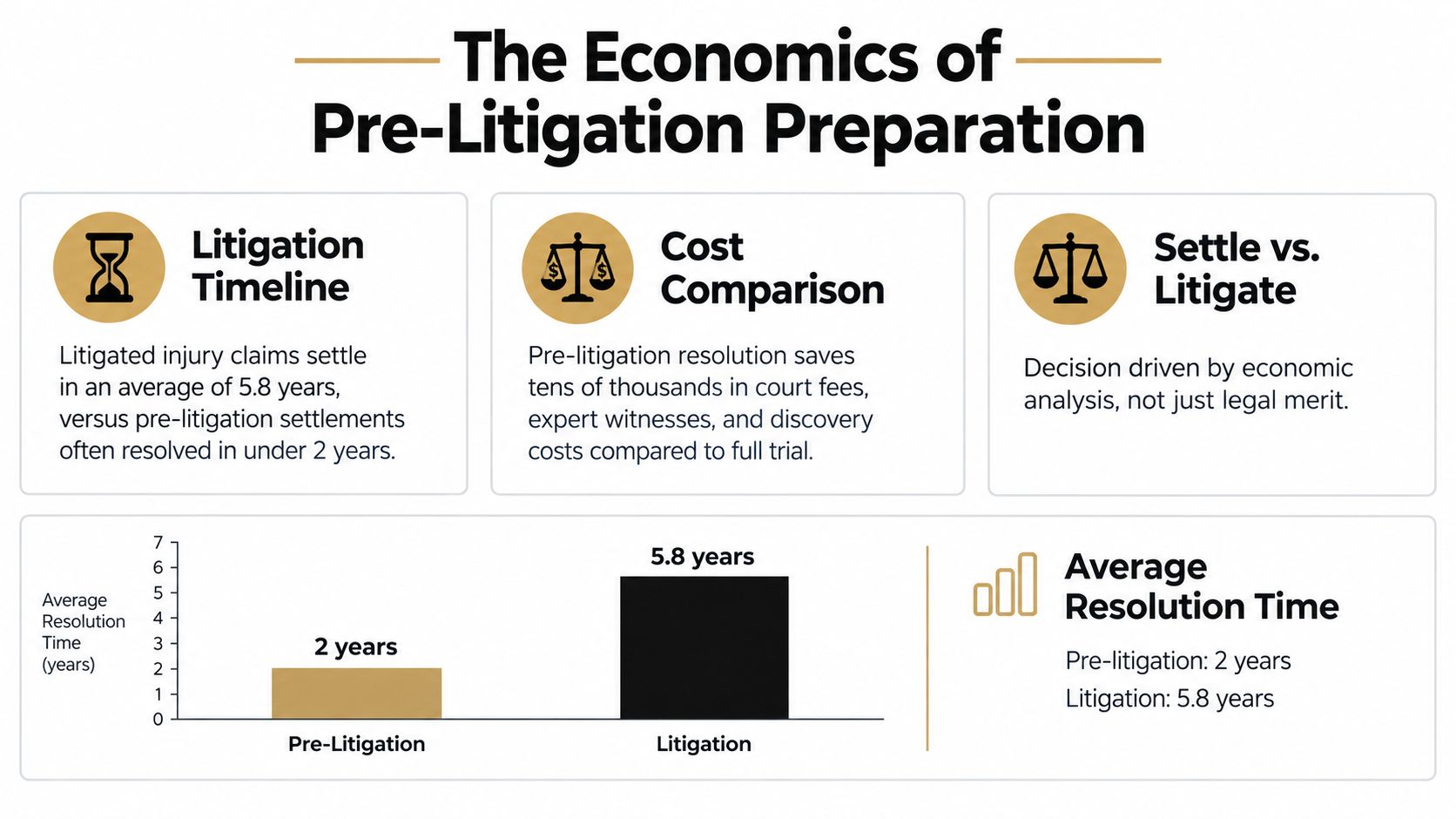
Legal merit alone doesn't answer whether filing suit is sensible. The attorney must compare the expected incremental recovery from litigation with the financial and human costs of pursuing it.
The available resolution pattern makes preparation especially important. Commonly cited industry estimates place the share of personal-injury matters settling before trial at approximately 95%, with roughly 4% to 5% resolved by a judge or jury, as discussed in this national personal-injury settlement overview. That estimate isn't a government census, so it should be treated as a broad benchmark rather than a precise national rate.
Federal data provide a separate measure of the litigation pipeline. The U.S. Courts' Judicial Business 2024 report records 104,254 diversity-of-citizenship civil filings, a decline of 33%, or 50,375 cases, and reports 69,506 personal-injury filings, a 41% decrease within that category. Those figures cover federal filings, not the much larger universe of state-court claims and private settlements, but they confirm that formal case volume can shift sharply.
Compare value, not just verdict potential
The decision model should include:
| Question | Why it matters |
|---|---|
| What additional recovery could litigation produce? | Filing should offer a realistic benefit, not merely a theoretical one. |
| What evidence would increase that probability? | The answer may justify investigation before suit. |
| What fees and expert costs will arise? | Gross recovery can overstate client value. |
| What liens, financing needs, or adverse-cost exposure exist? | Delay can create pressure that changes settlement authority. |
| Can the client tolerate a prolonged process? | A legally strong case may still be economically unsuitable for the client. |
Ireland's Central Bank reported that litigated injury claims settled in an average of 5.8 years, compared with 1.9 years for direct settlements and 2.2 years through the Injuries Resolution Board. The same report found litigation-related legal costs reached 45% of total costs, or 84% of the compensation award, as summarized in this analysis of the Central Bank figures.
The lesson isn't that filing is usually wrong. It's that a better chronology, stronger causation explanation, or complete damages package may produce more client value than immediate escalation. A pre-litigation attorney earns trust by explaining that trade-off plainly.
Integrating Technology Into Pre Litigation Workflows
Manual review still has a place in personal-injury practice. Attorneys must exercise judgment, verify summaries, inspect important records, and decide how facts affect liability and causation. But requiring lawyers or case managers to repeatedly search long medical files for dates, providers, diagnoses, and billing details is a poor use of professional attention.

An AI-assisted workflow can organize records before the attorney performs the substantive review. Ares, for example, processes uploaded personal-injury files, extracts key dates, diagnoses, treatments, providers, and symptom chronology, and produces medical overviews and demand-letter drafts for attorney review. The firm still validates the output, but it begins with a structured working file rather than an unindexed document pile.
The benefit is operational consistency. A standardized extraction process can make it easier to spot an undocumented treatment gap, compare providers' accounts, locate billing support, and identify facts that need confirmation before a demand goes out. It also gives case managers a repeatable handoff point instead of relying on informal notes.
Technology should support judgment, not replace it
A generated summary can miss context, misread a date, or treat a copied-forward diagnosis as a new development. The responsible workflow includes source verification:
- Review the original record: Confirm every material date, diagnosis, and causation statement.
- Mark uncertainty: Separate documented facts from inferred connections.
- Protect sensitive information: Use a platform with appropriate privacy and security controls for PHI.
- Keep attorney ownership: The lawyer decides what belongs in the demand and what requires further investigation.
- Preserve version control: Retain the source documents and track edits to the draft.
The technology becomes valuable when it removes repetitive searching while increasing the time available for analysis. Firms considering broader operational changes can also consult this client handoff workflow guide to make responsibility and information transfer more explicit.
A demand workflow should end with a human quality check, not an automatic send. The attorney must test whether the narrative is supported, whether the damages calculation is coherent, and whether the package anticipates the insurer's strongest response.
For a closer look at how AI can fit into this stage of practice, review AI for personal-injury lawyers. The central principle remains simple: automate retrieval and organization where appropriate, then reserve legal judgment for the decisions that change case value.
Best Practices for Law Firms Adopting Pre Litigation Strategies
Firms usually choose between two operating models. The traditional model assigns a case manager or attorney to read records manually, make notes, draft a chronology, and prepare a demand from memory and scattered documents. An AI-assisted model organizes the source material first, then gives the legal team a structured draft to verify and refine.
Neither model removes the need for attorney review. The difference is where the firm spends its scarce attention.
Build a repeatable control system
Start with a written workflow that assigns ownership at each stage:
- At intake: Capture incident facts, parties, insurance information, medical baseline, and potential preservation issues.
- During investigation: Issue targeted preservation notices, obtain reports, identify witnesses, and record unresolved factual questions.
- Before demand: Confirm medical chronology, causation, billing, wage loss, liens, and damages exhibits.
- During negotiation: Log offers, counterarguments, missing information, and the evidence needed to move valuation.
- Before filing: Compare expected incremental recovery with projected costs, delay, procedural risk, and client priorities.
The firm should also hold regular case-review meetings. The point isn't to discuss every file indefinitely. It's to force a decision when a claim is stalled, a demand is unsupported, or litigation is being considered without an economic rationale.
Preserve first, measure second
Reasonably anticipated litigation should trigger a documented preservation protocol. Counsel should identify custodians, systems, relevant date ranges, and automatic-deletion risks, then keep a record of what was requested and when. A checklist helps, but proportionality matters. Preserving everything can bury the evidence that actually matters.
Manual review remains appropriate for nuanced records, unusual injuries, disputed causation, and final attorney analysis. Automated assistance is most useful for repeatable extraction and organization. The firm should compare the resulting chronology with source records rather than assuming that speed equals accuracy.
Track operational signals that reveal whether the process is working: time from intake to demand, reasons for demand delay, recurring missing records, negotiation movement, and client feedback. Review both favorable and unfavorable files. A successful settlement can still conceal a weak process, while an unsuccessful one may expose a gap that future checklists should address.
For broader thinking about law-firm operations and leadership, these legal-sector insights from Carlos Alba Media offer useful context. The firms that benefit most from pre-litigation strategy treat it as a core production system, not an administrative period before the “real” case begins.
Ares helps personal-injury firms organize medical records, extract chronology and damages information, and prepare demand-letter drafts for attorney review. Visit Ares to evaluate how a structured pre-litigation workflow could improve case preparation and negotiation readiness.