Pre-litigation is the structured evidence-and-demand window before a lawsuit is formally filed, where parties investigate liability, document damages, exchange information, and pursue negotiation, mediation, or a demand process. In many Indian commercial disputes, pre-litigation mediation can be mandatory unless urgent interim relief is sought, with a 120-day process extendable by 60 days by consent.
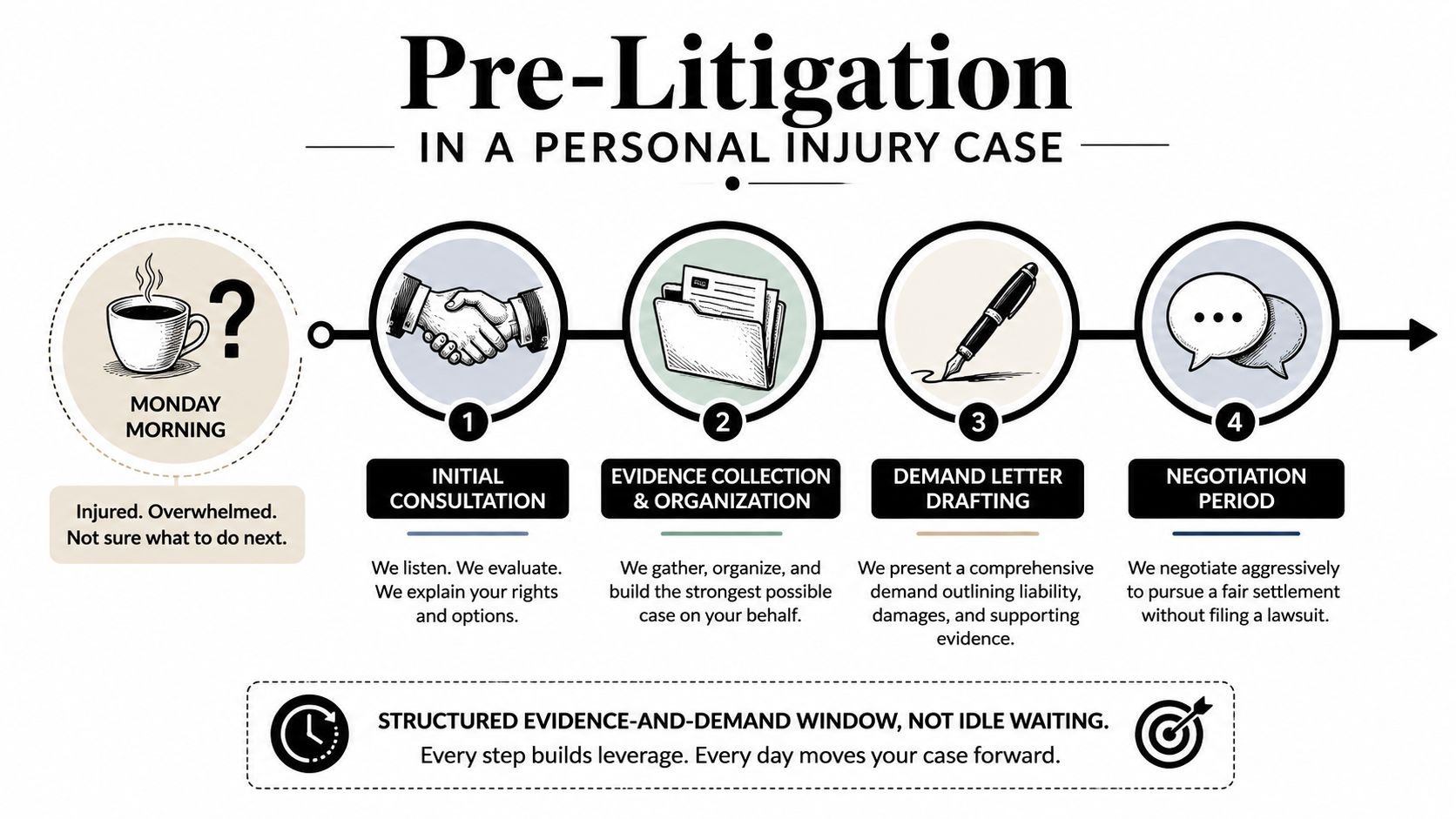
It's Monday morning, and a new associate asks the question every busy personal injury partner eventually hears: “What does pre litigation mean in this file?” The wrong answer is “the time before we sue.” That definition is technically serviceable and practically useless. It encourages teams to treat the file as dormant while records sit in an inbox, witnesses go uncontacted, and the medical story becomes a stack of PDFs nobody can explain quickly.
The working definition is more demanding. Pre-litigation means the active period before formal filing when the firm builds the claim record, confirms its theory, values the damages, and uses a demand or negotiation process to seek resolution. The quality of that work determines whether the carrier sees a coherent claim, asks for another round of documentation, or decides the firm has not yet earned serious settlement authority.
What Pre Litigation Means in a Personal Injury Case
In civil practice, pre-litigation is the phase before a lawsuit is formally filed. It operates as a structured evidence-gathering and settlement window. The parties investigate liability and damages, exchange information, and attempt resolution through negotiation, mediation, or a demand process before court proceedings begin, as described in this legal glossary explanation of pre-litigation.
For a personal injury firm, the phase starts at intake but becomes strategically meaningful once the team begins building a defensible causation narrative. That means organizing the accident facts, identifying the responsible parties and insurers, collecting medical records, mapping providers, tracking treatment, analyzing wage loss, and testing whether the claimed injuries fit the mechanism of the event.
Where the boundary sits
Pre-litigation ends when the dispute moves into formal court proceedings, but the boundary isn't always marked by a single dramatic event. A demand can be sent before treatment is complete, and negotiations can continue after a complaint is drafted but before service. The operational distinction is whether the firm is still trying to resolve the matter without invoking the court's formal discovery and adjudicative machinery.
Post-filing discovery gives counsel compulsory tools that pre-litigation lacks. In the pre-suit phase, cooperation, persistence, and credibility must do more of the work. A carrier may provide policy information voluntarily, but the firm can't assume it has the same enforcement mechanisms available after filing.
Practical rule: Treat pre-litigation as evidence development with a settlement objective, not as administrative waiting time.
A useful way to understand what pre litigation means is to ask three questions. What must be proved? What documents prove it? What can the adjuster understand without reconstructing the file personally? Firms that answer those questions before issuing a demand usually create more useful leverage than firms that send every document they've collected. When researching legal terminology or workflow questions, an associate may also browse the HyperWhisper legal page for general legal definitions, but the file-specific analysis still belongs to the case team.
The Core Legal Objectives of the Pre-Litigation Phase
A productive pre-litigation phase is a sequence of legal moves, not a checklist of clerical tasks. Each move should produce an evidentiary asset that improves the firm's position in negotiation or preserves the foundation for a later complaint.
Develop liability before naming a value
The first objective is to turn an accident account into a liability theory. The team should identify the actor, conduct, duty, breach, causal connection, and likely defenses. In a motor vehicle claim, that may require the police report, photographs, vehicle information, witness statements, traffic-camera material, scene measurements, and insurance disclosures. In a premises claim, it may involve incident reports, maintenance records, inspection history, notice evidence, and preservation demands.
The output isn't “liability investigated.” It's a short, defensible theory that explains why the defendant is responsible and answers the obvious comparative-fault argument.
Build damages around proof
The second objective is to quantify damages without separating medical treatment from the underlying story. Medical records should show what happened immediately after the event, how symptoms developed, what providers diagnosed, why treatment continued, and whether the prognosis supports future care. Bills alone don't establish injury value. The record must connect the event, the condition, the treatment, and the expected consequences.
Economic damages need the same discipline. Wage-loss claims require employer or payroll support, work restrictions, time missed, and a clear calculation. Unsupported estimates invite skepticism across the rest of the demand.
Identify the insurance and procedural landscape
The team should establish the available insurance, applicable defendants, venue, notice requirements, limitation deadlines, and any pre-action process that controls the dispute. A demand letter can be optional in one jurisdiction and strategically or procedurally significant in another. Legal scholarship describes the demand letter as a precursor to litigation that informs the defendant of the cause of action and gives the recipient an opportunity to avoid formal proceedings, as discussed in this analysis of demand letters in pre-litigation practice.
| Pre-Litigation Objective | Strategic Purpose | Leverage Artifact Produced |
|---|---|---|
| Liability development | Establish responsibility and anticipate defenses | A concise fault theory supported by reports, images, and witness material |
| Damages development | Tie injury, treatment, impairment, and loss to admissible proof | A medical chronology, damages ledger, and prognosis narrative |
| Coverage and party identification | Prevent negotiation against an incomplete insurance picture | Confirmed insurer, policy information, and defendant map |
| Demand framing | Present the claim in a form the carrier can evaluate | A focused demand letter with indexed exhibits and a response deadline |
The final objective is demand framing. The letter should state the claim, relief sought, supporting facts, and response expectations in a way that creates a decision point. A well-framed demand can prompt settlement, expose the carrier's real defenses, or narrow the dispute before filing. A generic letter usually does none of those things.
Why Chronology and Evidence Quality Drive Settlement Leverage
An adjuster can't value what the file fails to explain. That doesn't mean the claim needs fewer records. It means the records need an organizing logic that makes the important facts verifiable without forcing the reviewer to perform the firm's analysis.
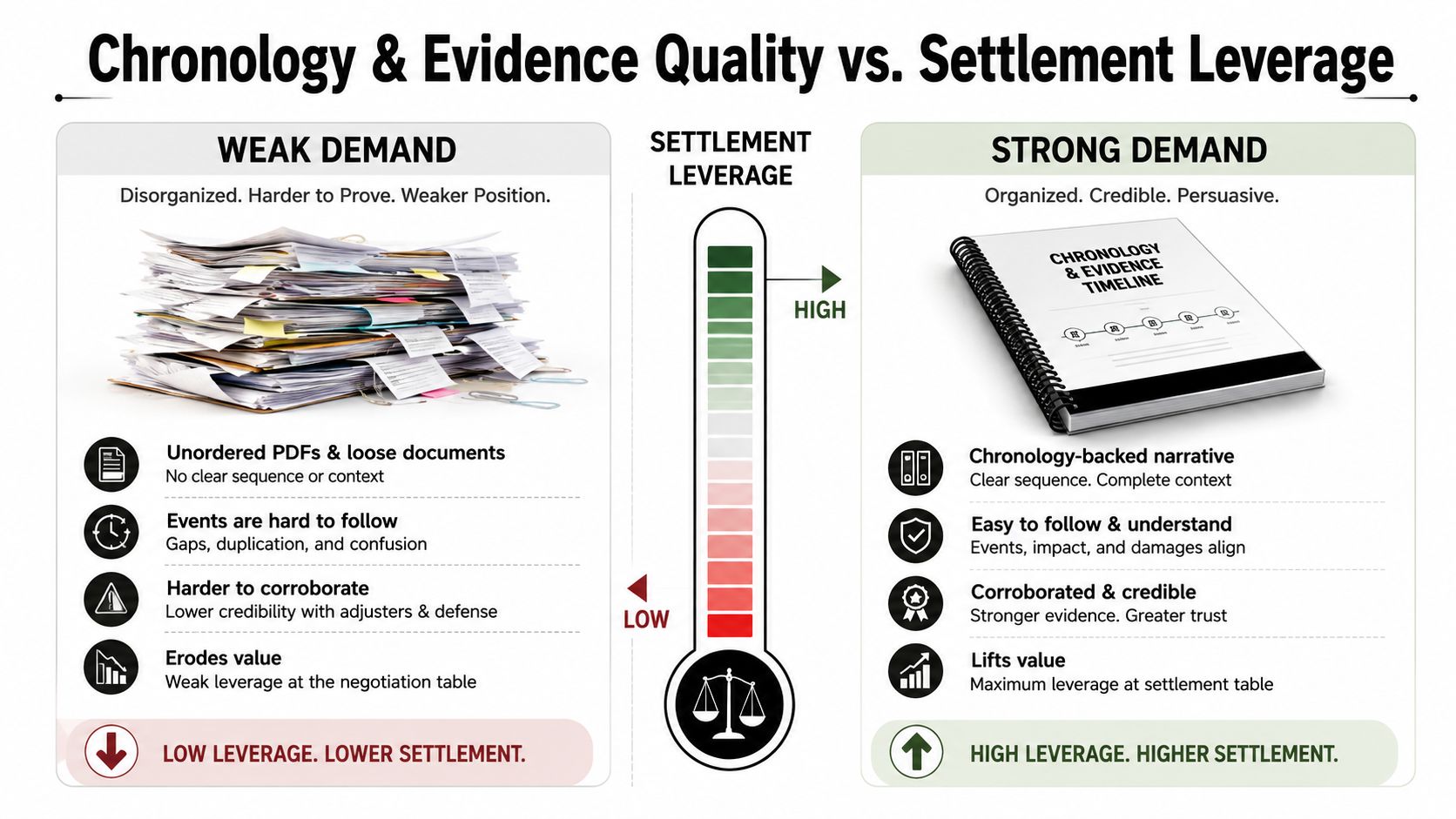
Consider two files involving the same accident. The first contains an emergency-room record, imaging, therapy notes, specialist visits, bills, work records, and correspondence saved in no meaningful order. The second contains those same materials, arranged around the event date, symptoms, diagnoses, treatment decisions, functional limitations, gaps, and prognosis. The first file may contain strong evidence. The second makes that evidence usable.
The weak demand
A weak demand often has recognizable symptoms:
- Unordered records: The carrier receives documents without a clear sequence or explanation.
- Unresolved gaps: The firm doesn't identify missed appointments, treatment pauses, prior complaints, or provider transitions.
- Generic causation: The letter says the accident caused the injuries but doesn't show how the records support that conclusion.
- Unverified losses: Wage claims, household-service claims, and future-care assertions appear without corresponding proof.
That package forces the adjuster to ask questions. Each question creates another delay and gives the carrier a reason to reserve judgment. The problem isn't merely presentation. The missing analysis may conceal a causation weakness the firm should address before making a settlement demand.
The strong demand
A chronology-backed package tells the reader what changed after the event and where the record supports each step. It distinguishes the first complaint from later diagnoses, explains why treatment escalated or paused, identifies contradictions, and flags issues before the carrier does.
A useful chronology doesn't merely list visits. It maps date, provider, complaint, finding, diagnosis, intervention, response, restriction, and next step. It also cites the underlying record so the reviewer can verify the entry quickly. Firms working through the medical-record problem can use this guide to chronological medical records as a reference point for structuring that analysis.
The trade-off is straightforward. A raw PDF pile feels faster to send, but it transfers the work to the carrier and weakens the firm's control over the narrative. A clean chronology takes judgment, yet it lets counsel identify the claim's strongest proof, repairable weaknesses, and appropriate negotiation theme before dispatch.
Anatomy of a Strong Demand Package
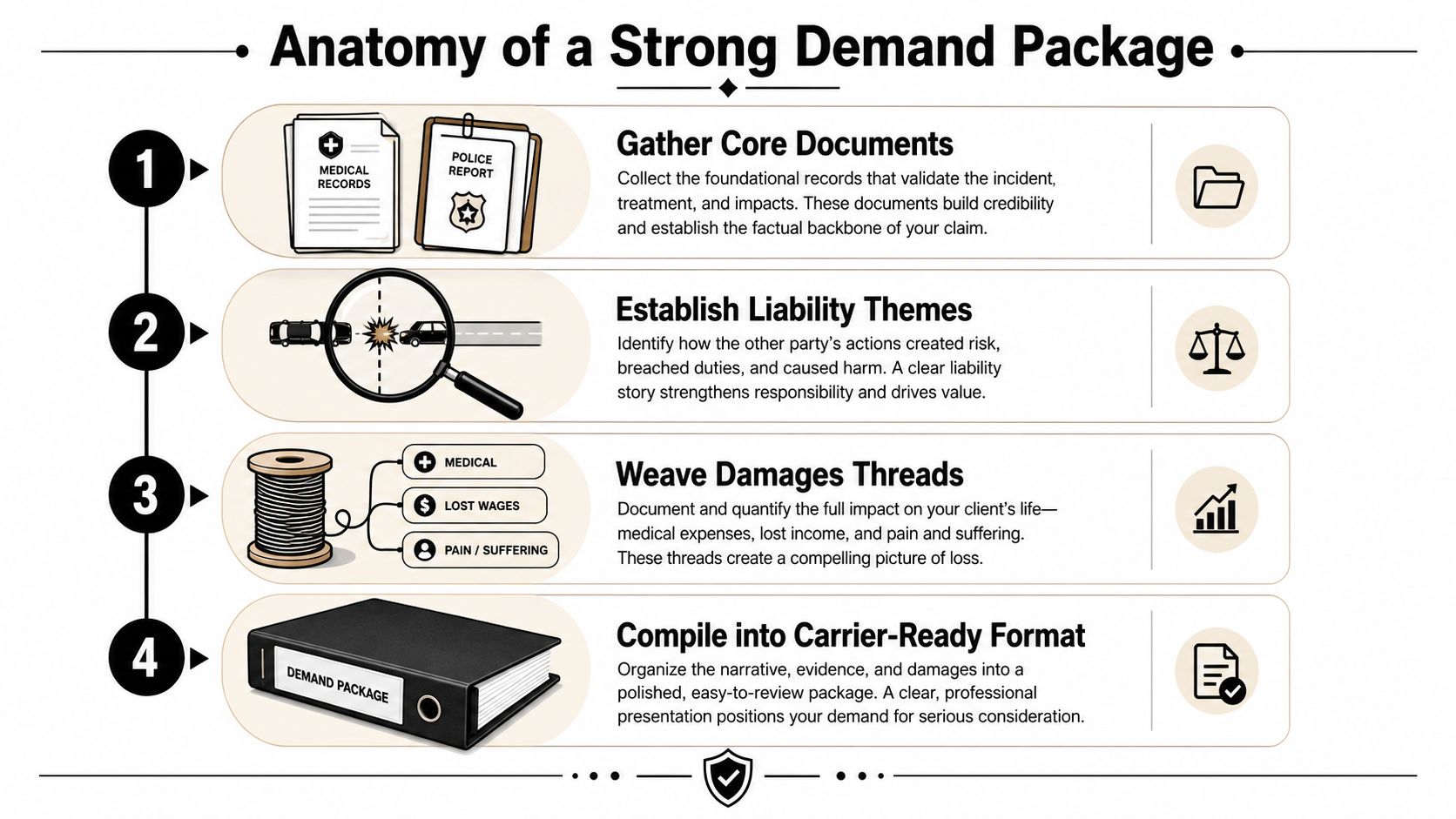
A strong demand package has a narrative spine. The cover letter should establish liability early, then move quickly into damages, so the reader understands both why the insured is responsible and what the injury has done to the client's life.
Start with the event. The opening liability paragraph should identify the date, location, responsible conduct, and evidence supporting fault. If the police report, photographs, or witness statement matters, reference it directly. Don't bury the liability theory after pages of medical discussion.
Build the medical story around change
The damages section should explain the client's condition before the incident, the immediate response, the diagnostic findings, the treatment course, and the current prognosis. A representative exhibit set might include:
- Emergency-room material: Triage notes and initial complaints establish timing, mechanism, and early symptoms.
- Imaging and specialist records: These support objective findings, diagnoses, treatment recommendations, and surgical or procedural decisions.
- Treatment chronology: Therapy, follow-up, medication, restrictions, improvement, persistence, and gaps belong in an intelligible sequence.
- Economic-loss records: Employer verification, payroll material, disability notes, and work restrictions support wage loss.
- Liability exhibits: Photographs, the police report, incident documentation, and applicable insurance or identification material anchor the fault theory.
The associate's job isn't to summarize every page. It's to identify the records that prove each important proposition and explain how they fit together. A chronology with record citations is more useful than a long attachment list because it allows the adjuster to test the narrative without starting over.
Make the theory quotable
The liability theory should fit into a sentence an adjuster can paste into an internal email. For example, the sentence might connect the insured's conduct, the collision mechanism, the immediate complaint, and the objective diagnosis. The wording must remain faithful to the record, but it should be direct enough that the carrier can repeat it accurately.
The negotiation hierarchy should then be deliberate:
- Fault admission: Establish why liability should not consume the negotiation.
- Coverage position: Frame the available policy and the reason the demand belongs within that context.
- Comparative-fault response: Address the defense before it becomes the carrier's central talking point.
- Future exposure: Explain ongoing treatment, impairment, recommended care, and prognosis without overstating certainty.
For teams refining the letter itself, this personal injury demand letter template resource can help organize the document around liability, medical proof, economic damages, and supporting exhibits. The template is only a starting structure. Counsel still has to test every assertion against the underlying records.
The Practical Pre-Litigation Workflow for PI Teams
High-volume firms need a workflow that separates judgment from extraction. Attorneys and experienced case staff should decide what matters, whether the evidence is credible, and how the theory should be framed. Software should handle repetitive work such as OCR ingestion, date normalization, provider grouping, duplicate detection, and first-pass chronology construction.
Intake through records
The workflow begins with intake, conflicts review, engagement documentation, and preservation. Send representation notices where appropriate, issue preservation requests when evidence may disappear, identify the defendant and insurer, and calendar limitation deadlines immediately.
Records collection then proceeds by provider and category. The team should track requests, authorizations, receipts, missing ranges, duplicate productions, and billing gaps. Medical records often arrive over 30 to 75 days, while surgical matters can take more than 90 days, according to the verified workflow data supplied for this article. Those are planning benchmarks, not excuses to let the file sit.
Once records arrive, automation can ingest Bates-stamped files, normalize dates, group records by provider, identify duplicates, extract diagnoses and procedures, detect treatment gaps, and map complaints to later findings. The human reviewer then checks flagged anomalies, confirms the significance of a gap, resolves conflicting dates, and tests the chronology against the client interview.
Liability, damages, and drafting
Liability investigation should run alongside medical review. Obtain photographs, reports, witness material, employment documentation, applicable coverage information, and evidence needed to rebut foreseeable defenses. Damages analysis should distinguish supported economic loss from estimates and separate past treatment from future recommendations.
The demand draft comes after the team has a reliable factual package. The attorney owns the theory, valuation judgment, tone, legal framing, and final verification. A medical-review platform such as Ares can turn uploaded case materials into organized medical summaries, treatment chronologies, injury analysis, billing information, and demand drafts, but the output still requires human review against the source records.
The time savings come from removing rote indexing, not from surrendering legal judgment. A workflow that previously required a 40-hour indexing project can reduce the attorney review component to under five hours, based on the verified data provided for this article. Every firm should validate that result against its own records, staffing, and quality-control process.
| Workflow Stage | Owner | Automation Role | Typical Duration |
|---|---|---|---|
| Intake and conflicts | Attorney and intake team | Matter setup, field capture, deadline prompts | Case dependent |
| Preservation and requests | Attorney and paralegal | Task tracking and reminders | Begins at intake |
| Records collection | Paralegal or case manager | Request tracking, receipt organization, duplicate detection | Often 30 to 75 days, longer in surgical cases |
| Medical chronology | Paralegal and attorney | OCR, date normalization, provider grouping, gap flags, chronology export | Review time varies by file |
| Liability investigation | Attorney and investigator | Document organization and evidence indexing | Case dependent |
| Damages calculation | Attorney, paralegal, and client | Ledger structure and extraction support | Case dependent |
| Demand drafting | Attorney | Draft assembly from verified facts and firm format | After core proof is ready |
| Negotiation or escalation | Attorney | Communication tracking and deadline control | Until resolution or filing |
Negotiation is a cycle, not a single letter. Send the demand with a defined response window, record every carrier position, answer material questions with targeted evidence, and escalate when the carrier's posture stops reflecting a live evaluation.
When Pre-Litigation Should Escalate to Filing
Delay doesn't automatically create an advantage. It can preserve time for treatment and evidence development, but it can also allow witnesses to fade, digital material to disappear, records to become harder to obtain, and the chronology to lose its clarity.
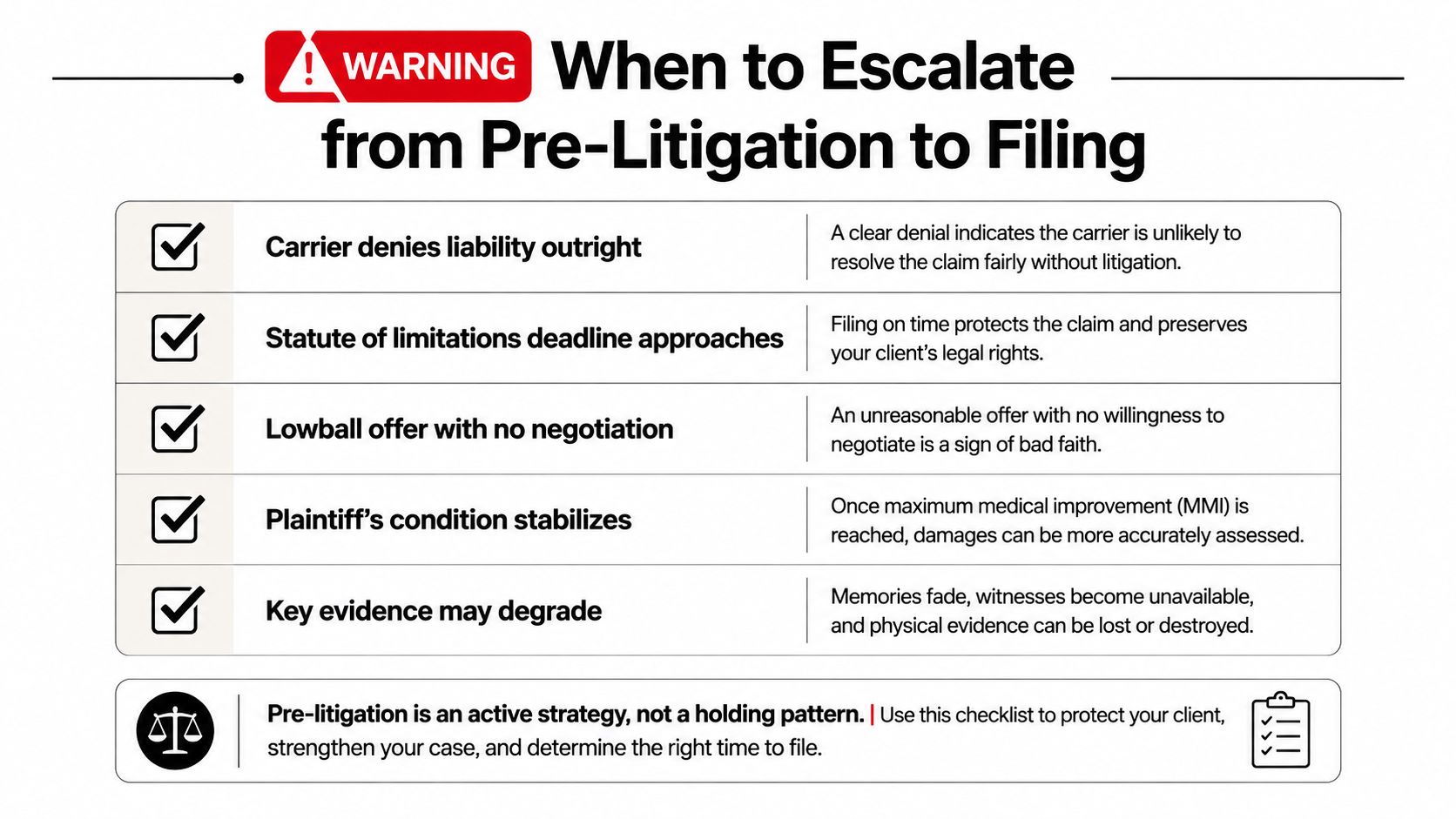
A partner should look for concrete filing signals rather than waiting for an abstract feeling that negotiations are “going nowhere.” The following issues deserve immediate review:
- Liability has hardened into a denial: The carrier refuses responsibility despite the available evidence.
- The records process is stalled: Necessary information remains unavailable and the carrier won't engage meaningfully.
- The offer is disconnected from the proof: The carrier makes a low offer without addressing clear liability or documented damages.
- The client's condition has stabilized: The medical picture is sufficiently developed to value, and further waiting adds little.
- The limitation deadline is approaching: Filing strategy must account for the governing jurisdiction, tolling rules, and any required pre-action process.
- Coverage or policy-limit exposure may be lost: The firm still lacks a reliable insurance position or fears dissipation of available recovery.
- Key evidence is degrading: Witness availability, scene conditions, electronic data, or physical evidence may change.
The answer also depends on jurisdiction. In India's commercial disputes, the Mediation Act 2023 and Commercial Courts framework make pre-litigation mediation mandatory in many matters unless urgent interim relief is sought. The process is 120 days and may be extended by 60 days by consent, according to this discussion of mandatory pre-litigation mediation. That is a procedural requirement in the relevant setting, not a universal rule for every personal injury claim.
Apply a disciplined filing judgment
Filing changes the available tools. Defense counsel becomes more directly involved, formal discovery becomes available, and the carrier may reassess the matter through a litigation budget and defense-risk lens. But filing also creates cost, client stress, disclosure obligations, and the possibility that weaknesses hidden during negotiation become central to the case.
Associates often overstay pre-litigation because they fear wasting the records work already completed, hope the next counter will move the number, or want to spare a tired client from litigation. Those concerns are real, but they shouldn't replace a decision rule. If any two escalation signals are present, the file deserves a partner-level filing decision rather than another automatic demand cycle.
Once the decision is made, use a controlled filing process. Teams can review practical logistics for filing through FaxZen, while counsel confirms the court's specific procedural and service requirements. Pre-litigation is an active strategy, not a holding pattern.
Checklist, Pitfalls, and the Case for Automation
The finished file should pass a practical readiness test before the demand leaves the office. A partner should be able to open the matter and locate the liability theory, medical chronology, damages support, deadline analysis, and negotiation plan without asking the associate to reconstruct the case from memory.
The pre-litigation readiness checklist
- Intake is complete: Engagement, conflicts, client objectives, and relevant background are documented.
- Liability evidence is secured: Reports, photographs, witness material, preservation steps, and defense issues are identified.
- Medical chronology is finalized: Dates, providers, diagnoses, treatment, gaps, prior complaints, and prognosis are reviewed against source records.
- Economic damages are supported: Wage loss, bills, restrictions, and other claimed losses have documentation.
- The demand has a theory: The letter states responsibility, causation, damages, requested relief, and a response deadline.
- The limitation date is calendared: The team knows the governing deadline and any applicable notice or mediation requirement.
- The negotiation plan is defined: Someone owns the response, follow-up, authority analysis, and escalation decision.
The recurring failures are equally clear. Delayed records requests compress the period available for review. Generic templates produce letters that sound interchangeable. Unverified wage loss invites distrust. Premature settlement numbers anchor the file before the medical picture is ready. Missed preservation risks can remove evidence that later cannot be recreated.
Use automation without outsourcing judgment
Automation is most useful where the work is repetitive and the consequences of omission are high. A system can sort incoming records, extract dates and diagnoses, identify provider transitions, flag gaps, assemble billing information, and produce a draft chronology. The lawyer still decides whether a gap is harmless, whether a prior condition changes causation, whether a diagnosis is objective, and how aggressively the demand should be framed.
That division matters because legal AI must be verifiable. Tools handling protected health information should be evaluated for security, transparent limitations, source traceability, and meaningful human review. The practical standard is simple: every material statement in the demand should be traceable to a record or clearly identified as counsel's analysis.
A disciplined automation workflow also reduces paralegal rework. Instead of sorting the same records repeatedly for intake, chronology, demand drafting, and negotiation responses, the team maintains a reviewed factual base and reuses it across work product. Firms assessing broader process improvements can consult this legal workflow automation guide while designing their own review and approval controls.
The difference between a demand that gets a serious response and one that gets ignored usually isn't dramatic rhetoric. It's whether the firm has made the facts easy to verify, the injuries easy to follow, the losses easy to support, and the next procedural step credible.
Ares helps personal injury firms organize medical records, generate page-cited chronologies, identify treatment gaps, and assemble demand drafts from the case materials the team uploads. Visit Ares to see how your firm can move from PDF sorting to a reviewed, demand-ready narrative with a repeatable pre-litigation workflow.