
You're reviewing a file that initially looks straightforward. Your client was struck by a turning vehicle, landed on the shoulder, received a sling, and later learned that the clavicle fracture might require fixation. The records show a clear injury, but the adjuster has already reduced the case to “a broken collarbone that should heal.”
That shorthand is where value gets lost. A strong personal injury claim for a broken collarbone depends on the sequence of events, the treatment decision, the claimant's actual restrictions, and the economic consequences that remain after the fracture appears on an X-ray. Surgery may matter, but it isn't a damages formula. The work is converting clinical records into a defensible account of what the claimant could no longer do, for how long, and why.
Why Clavicle Fracture Cases Deserve Their Own Playbook
A typical intake may begin with a cyclist hit by a turning driver. Emergency personnel place the cyclist's arm in a sling. Urgent care confirms a fracture, an orthopedist reviews the films, and surgery is recommended within the following week. The liability theory may be familiar, but the damages file is not complete just because the fracture and treatment are documented.
The collarbone sits in a difficult middle ground. The injury is visible on imaging, yet the claimant may leave the hospital without an overnight admission or prolonged inpatient record. The fracture can be common in trauma practice while producing very different consequences for a construction worker, a driver, a parent, or an office employee. Your job is to show those consequences without overstating them.
Start with the chronology, not the settlement range
At intake, establish four dates immediately:
- Incident date: Identify the mechanism, direction of impact, fall position, and reported shoulder symptoms.
- First medical evaluation: Confirm what the initial imaging showed, what the provider diagnosed, and what restrictions were given.
- Treatment decision: Record when an orthopedist recommended continued immobilization, therapy, or fixation, and the reason documented for that decision.
- Functional turning points: Mark the first attempted return to work, changes in duties, therapy milestones, persistent symptoms, and any later procedure.
That sequence answers the questions an adjuster will ask. Did the incident cause the fracture? Was the treatment medically supported? What did the injury prevent the claimant from doing? A stack of bills answers only part of the second question.
Practical rule: Treat the fracture as the beginning of the damages inquiry, not the conclusion.
The rest of the file should test the story against objective records. A surgery date, serial radiographs, work restriction, therapy note, and return-to-duty record each establish a point in time. If the claimant reports continuing pain but the records never describe a restriction, the defense will exploit that gap. If the records document limited lifting, disrupted sleep, and delayed work resumption, the demand has a factual spine.
This is also where the surgery trap begins. Operative treatment can indicate a more complex fracture pattern, but it doesn't automatically establish permanent impairment or a high-value claim. Later sections address how to prove treatment necessity, evaluate delayed healing, and write a demand that ties every damages position to the chronology.
How Common Clavicle Fractures Really Are
Epidemiology gives a case useful context, but it doesn't decide the case. Medical literature estimates that clavicle fractures account for approximately 2% to 10% of all fractures, affect roughly 1 in every 1,000 people annually, and represent about 2.6% to 4% of adult fractures. Among shoulder-girdle injuries, they account for approximately 35% to 45%. These figures appear in the medical overview of clavicle fractures.
The pattern matters more than a generic label. A large Swedish registry recorded 2,422 clavicle fractures during 2013 and 2014. Males accounted for 68%, females for 32%, and males aged 15 to 24 represented 21% of the recorded fractures. Displaced midshaft fractures represented 43% of the fractures in that study and were the most frequently operated pattern.
A separate Danish adult study recorded 3,156 clavicle fractures in 1996 and 3,885 in 2018, an increase of 23%, while the adult population grew 11%, from 4.1 million to 4.6 million. The overall incidence was 82 fractures per 100,000 person-years, rising from 76 per 100,000 in 1996 to 84 per 100,000 in 2018. The study reported 113 per 100,000 person-years among males and 53 per 100,000 among females, with the highest male incidence at 129 per 100,000 among men aged 40 to 59 and the highest female incidence at 161 per 100,000 among women aged 80 or older. Those figures come from the Danish population study.
What prevalence can and cannot establish
| Metric | Figure / Range | Case use |
|---|---|---|
| Share of all fractures | Approximately 2% to 10% | Shows the injury is recognized and clinically established, but doesn't value an individual claim |
| Adult fracture share | Approximately 2.6% to 4% | Provides adult population context |
| Shoulder-girdle injuries | Approximately 35% to 45% | Helps explain why the shoulder mechanism and functional complaints deserve focused review |
| Displaced midshaft pattern | 43% in the Swedish registry | Directs attention to imaging language, displacement, and treatment rationale |
| Recorded Swedish fractures | 2,422 during 2013–2014 | Supplies registry context, not proof of this claimant's damages |
| Danish incidence | 82 per 100,000 person-years across the study period | Separates population frequency from case-specific causation |
These numbers may help rebut an argument that a clavicle fracture is medically implausible after a particular impact. They don't prove that the incident caused this claimant's fracture, that the fracture will be permanent, or that the claimant lost a particular amount of income. Match the epidemiologic baseline to the actual radiology report, mechanism, side, fracture location, displacement, associated injuries, and documented functional effects.
Treatment, Healing, and What Each Pathway Tells You
Treatment is both a medical decision and an evidentiary trail. Nonoperative care commonly involves sling immobilization, follow-up imaging, and a staged return of shoulder movement. The American Academy of Orthopaedic Surgeons generally prefers sling immobilization over a figure-of-eight brace for acute clavicle fractures. The record should show not only that the claimant used a sling, but also what the provider prohibited, when movement was introduced, and whether those restrictions affected work.
For adults with displaced midshaft fractures, the AAOS clinical guidance reports strong evidence that operative treatment produces higher union rates and better early patient-reported outcomes than nonoperative care. The same guidance states that long-term functional outcomes and satisfaction may be similar. That distinction prevents a common valuation error: treating fixation as proof that the claimant will have a worse long-term result.
Read the treatment record for what it actually proves
An operative file can establish the fracture pattern, displacement, medical reasoning, implant used, anesthesia, postoperative restrictions, and follow-up plan. It can also introduce risks that belong in the analysis, including infection, wound-healing problems, hardware irritation, numbness below the clavicle, neurovascular injury, and possible lung injury.
A nonoperative file may look less dramatic, but it can contain equally important evidence:
- Radiology sequence: Compare alignment and healing across serial studies.
- Orthopedic instructions: Identify lifting, driving, sling, and activity restrictions.
- Therapy documentation: Track measured movement, strength, pain behavior, and progress.
- Work records: Confirm whether the claimant stopped work, used modified duties, or returned with limitations.
Complete bone healing commonly takes 8 to 12 weeks, and most patients return to regular activities within about three months, according to the AAOS material. Those are clinical reference points, not deadlines that override this claimant's records. Premature lifting can displace fragments or damage fixation, so an employer's insistence that the claimant resume heavy work may become important when the medical restrictions are clear.
A claimant seeking additional conservative support for shoulder discomfort may also encounter general wellness resources such as relief for shoulder pain. That kind of resource doesn't replace orthopedic care, diagnostic imaging, or legal proof. In the claim file, the relevant evidence remains the treating provider's assessment and the documented effect on function.
Building a Medical and Wage Chronology That Holds Up
A paralegal should be able to run the first chronology pass without guessing what matters. The file should read in provider order and date order, not in the order documents happened to arrive.
The records checklist
Begin with EMS, emergency department, urgent care, and the first orthopedic visit. Capture the mechanism, side, pain location, swelling, deformity, neurological findings, initial diagnosis, and all instructions. Then collect every imaging report and the underlying images when available. The report should identify whether the fracture is midshaft, lateral, or medial, whether it is displaced, and whether there are associated injuries.
The medical record chronology workflow is useful as a reference for organizing providers, dates, diagnoses, and treatment events into a coherent sequence.
Next, place the records in this order:
- Initial evaluation: EMS notes, emergency records, urgent care notes, first radiology report, prescriptions, and discharge instructions.
- Specialist assessment: Orthopedic examination, treatment alternatives, surgical recommendation, consent discussion, and restrictions.
- Procedure documentation: Operative report, implant or hardware records, anesthesia record, discharge instructions, and postoperative diagnosis.
- Recovery evidence: Serial radiographs, therapy evaluations, progress notes, home exercise instructions, and discharge summary.
- Employment proof: Job description, wage verification, absence records, modified-duty notices, time sheets, and return-to-work documentation.
Add the functional facts
A medical chronology should capture more than diagnoses and procedures. Flag each dated reference to difficulty sleeping, driving, dressing, reaching overhead, lifting, carrying, using tools, performing repetitive work, caring for children, or completing household tasks. Record whether the limitation was self-reported, observed by a provider, measured in therapy, or imposed by an employer.
For wage loss, reconcile the work restriction with payroll evidence. A statement that the claimant “couldn't work” is weaker than a provider's dated lifting restriction matched to an employer's modified-duty letter and a wage record showing the resulting difference.
If hardware removal is discussed, preserve the provider's reason, the coding and chart notes supporting the recommendation, and any later estimate or scheduling record. Don't assume that the possibility of another procedure is a recoverable future cost. Tie it to a documented recommendation, medical necessity opinion, and reasonable projection.
Valuing Medical Costs, Lost Wages, and Pain and Suffering
A broken collarbone claim should be valued in separate damages buckets. Combining every consequence into a single injury label makes the demand easier to discount. The stronger method is to connect each claimed item to a record, a date, and a measurable effect.
Medical specials begin with itemized bills and explanation-of-benefits records. Add documented follow-up care, therapy, prescriptions, imaging, and operative charges. If the treating orthopedist recommends hardware removal or future therapy, identify that recommendation separately from past expenses. The file should explain why the future care is related to the injury and what clinical event makes it reasonably necessary.
Lost wages require reconciliation, not a claimant's estimate. Compare the claimant's verified earnings with missed workdays, modified-duty pay, reduced hours, and any later wage differential. Preserve employer correspondence and payroll records. Paid time off may show an economic consequence, but it shouldn't be treated as wage loss without analyzing the applicable law and the claimant's actual loss of accrued benefits.
Surgery is not a multiplier
An uncomplicated fixation may generate substantial bills and a scar, but neither fact establishes the full value of pain, impairment, or future loss. Conversely, a fracture treated without surgery can still interfere with overhead work, driving, sleep, sports, caregiving, or ordinary household tasks. The operative report is important evidence. It isn't a substitute for a functional narrative.
The pain-and-suffering damages framework can help structure the non-economic portion of the demand, but the claim still needs case-specific proof. Use therapy measurements, provider restrictions, photographs where relevant, testimony from household members, and employer records. A radiographically healed fracture may coexist with documented functional limitations, while another claimant may recover well after fixation.
| Damages Bucket | Supporting Documents |
|---|---|
| Medical expenses | Itemized bills, payment records, imaging, operative report, therapy invoices, prescriptions, and documented future-care recommendations |
| Wage loss | Employer verification, payroll records, attendance reports, restriction letters, modified-duty records, and wage calculations |
| Functional impact | Therapy measurements, orthopedic examinations, claimant diary, household witness statements, and activity restrictions |
| Pain and suffering | Treatment chronology, pain descriptions in contemporaneous records, sleep disruption, medication history, therapy burden, scar evidence, and residual limitations |
| Future consequences | Specialist opinions, serial imaging, hardware recommendations, work-capacity evidence, and documented ongoing symptoms |
The demand should use concrete language. “The claimant experienced pain” is thin. “The claimant couldn't drive to work, lift the required equipment, or sleep on the injured side during the documented restriction period” gives the adjuster something to evaluate.
Delayed Diagnosis and Nonunion as a Chronology Problem
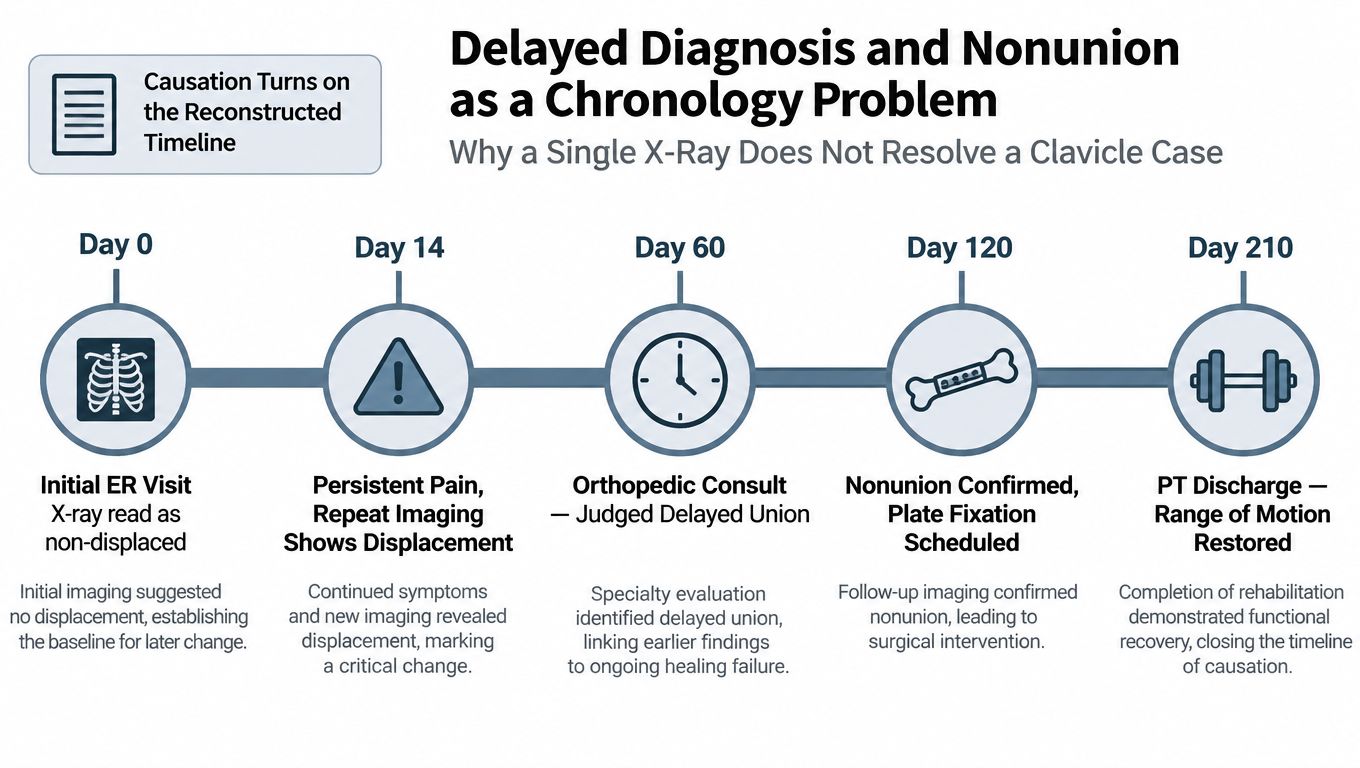
A later X-ray showing a fracture doesn't answer every causation question. It may establish that a fracture existed when the image was taken, but the contested issues can include whether the injury was missed earlier, whether continued loading worsened healing, whether another incident intervened, and whether earlier restrictions or follow-up would likely have changed the outcome.
One reported clavicle-fracture matter involved a patient who returned to heavy construction work, remained symptomatic, and wasn't diagnosed until four months later. Later imaging showed failure to unite, as described in the reported clavicle-fracture case. That account illustrates the investigative problem without proving that every delayed diagnosis causes nonunion.
Build the second chronology
For a delayed-diagnosis file, create a parallel timeline for symptoms and loading:
- What did the first provider observe, image, and diagnose?
- When did the claimant report persistent or increasing pain?
- What work, lifting, driving, or sports activity continued?
- When did the claimant seek another evaluation?
- What did the later imaging show about union, displacement, or alignment?
- When did the treatment plan escalate, and what restrictions followed?
Separate delayed union, nonunion, and malunion in the medical analysis. Those terms may carry different treatment implications and shouldn't be used interchangeably. Ask the orthopedic expert to address the actual records, not a generalized proposition that the earlier provider must have caused the later outcome.
The same chronology can support or weaken liability. A documented missed finding followed by persistent symptoms and continued unrestricted heavy work may support a delayed-care theory, but the defense may argue that the fracture was initially occult, that the claimant failed to follow instructions, or that a later incident caused the worsening. The answer comes from the records, not from the eventual surgery alone.
Demand Letter Language and Negotiation Anchors
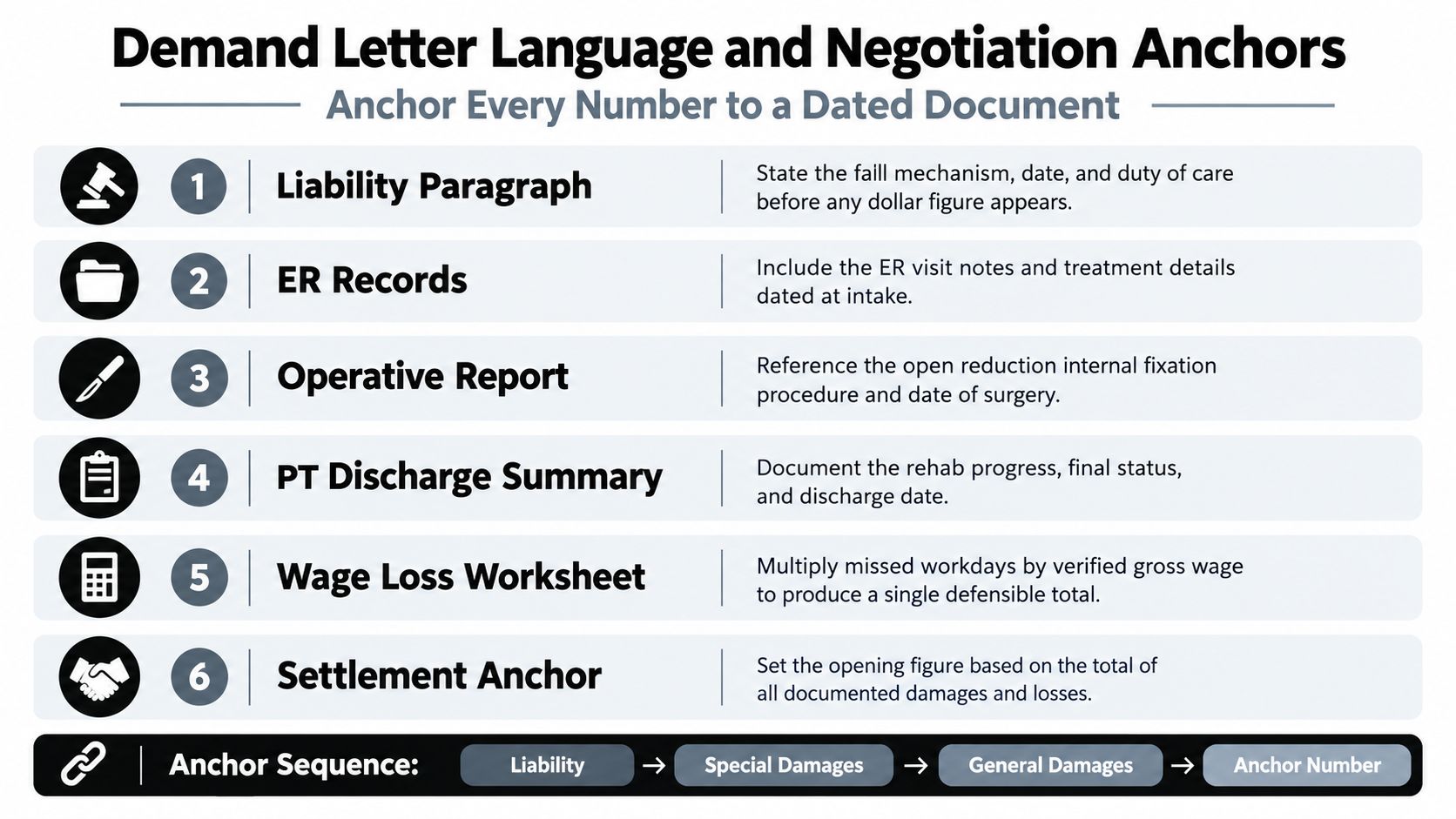
Every number in the demand should have a dated document behind it. The emergency records establish the initial injury. The operative report establishes the procedure. Therapy records establish recovery and restrictions. The wage worksheet establishes the claimed earnings loss. The letter should let the adjuster trace each position without searching through an undifferentiated record dump.
Open with a factual liability paragraph:
On [date], the insured turned into the claimant's path and caused the collision documented in the incident report. The impact caused the claimant to fall onto the [left or right] shoulder. EMS and the first treating provider documented immediate shoulder pain, and imaging identified the clavicle fracture.
Then move to damages in a fixed order:
- Medical expenses: State the past total and identify the bills and procedures supporting it.
- Future care: Describe only documented recommendations, such as additional therapy or a medically supported hardware procedure.
- Wage loss: Tie the calculation to the employer's records, restriction dates, and verified earnings.
- Functional impact: Describe work, driving, sleep, dressing, exercise, caregiving, and household effects that appear in the record.
- General damages: Explain the treatment burden, pain course, activity loss, scar or hardware concerns, and residual symptoms without inflating them.
Use precise phrasing for complaints that are easy for an adjuster to minimize: “The claimant reported night pain that interrupted sleep during the documented recovery period,” or “The treating provider restricted overhead lifting, and the employer assigned modified duties during that interval.” Don't call a symptom permanent unless a provider supports that conclusion.
Surgery shouldn't double a multiplier by itself. If fixation was uncomplicated and the claimant regained function, say so while documenting the scar, recovery burden, restrictions, and expenses. If the claimant retained stiffness, weakness, hardware irritation, or work limits, make those facts the negotiation anchor.
The demand-letter drafting guide can help with organization. The final letter should include a specific demand, a response deadline, and reservation-of-rights language appropriate to the jurisdiction and posture of the claim. During negotiation, trade concessions against documented milestones. A concession on future care might follow a treating opinion that no further procedure is anticipated. A concession on wage loss should follow payroll verification, not carrier pressure.
Bringing the Claim File Together for the Adjuster
An adjuster usually needs to make three decisions. First, is the insured legally responsible? Second, was the treatment medically necessary? Third, how did this particular injury affect this particular claimant? Organize the file around those decisions instead of arranging it as a chronological document warehouse.
The liability packet should contain the incident report, photographs, witness information, insurance materials, admissions, and evidence addressing comparative fault. The medical-necessity packet should make the fracture pattern and treatment pathway readable within minutes. Include the relevant imaging reports, orthopedic recommendations, operative records if applicable, therapy records, and follow-up imaging.
The individualized-impact packet is where many collarbone files fail. It should contain the medical and wage chronology, restriction history, employer letter, wage worksheet, and a short narrative describing the activities the claimant couldn't perform. Keep the narrative factual. A claimant who couldn't lift equipment at work presents a different damages question from a claimant who could perform the job but couldn't return to recreational cycling.
| File Tab | Primary Adjuster Decision Addressed | Key Document Inside |
|---|---|---|
| Liability | Responsibility for the incident | Police report, incident log, photographs, and witness statement |
| Initial injury | Whether the claimed injury followed the event | EMS record, first examination, and initial imaging report |
| Treatment necessity | Whether care was reasonable and supported | Orthopedic recommendation, operative report, or conservative-care plan |
| Recovery | Duration and objective course | Serial radiographs, therapy notes, and provider restrictions |
| Economic impact | Whether claimed losses are documented | Employer letter, payroll records, and wage worksheet |
| Individualized damages | How the injury affected daily life | Functional narrative supported by contemporaneous records |
| Executive summary | How the whole claim fits together | One-page map linking each demand line to a file tab |
Resist padding. A clean file that answers liability, necessity, and impact is more useful than a large production in which the key record is buried. Ares is one available workflow for personal-injury firms. It reviews uploaded medical records, extracts diagnoses, treatment dates, providers, symptom chronology, and billing information, and can produce organized medical overviews and demand drafts for attorney review.
The executive summary should sit at the front. Map each demand line to a tab, identify any unresolved gap, and state what the next record or expert opinion must establish. That page becomes the file's spine and keeps the negotiation focused on proof rather than on the label “broken collarbone.”
If your firm is handling a personal injury claim involving a broken collarbone, Ares can help organize medical records, treatment chronology, billing details, and demand-letter inputs into case-ready summaries. Visit Ares to see how the platform can support faster file review while leaving legal judgment and final strategy with your team.