
You've received a medical-record production that looks complete until you try to answer a simple question: what happened first, and which provider documented it? The file may contain scanned PDFs, handwritten notes, duplicated records, inconsistent service dates, and treatment from several facilities. A chronology assembled too quickly can create the appearance of order without giving the attorney a reliable foundation for causation, damages, or cross-examination.
Medical records chronology software can reduce that organizational burden, but speed isn't the standard that matters most. The useful question is whether every important entry can be traced to the original record, whether uncertainty is visible, and whether a paralegal or attorney can defend the review process when opposing counsel challenges it.
Why Personal Injury Firms Need Chronology Software
A paralegal handling a complicated injury file often starts with folders named after providers, not events. One hospital sends a searchable export, another sends scanned pages, and a specialist's records arrive with handwritten annotations. The accident date may be clear, but the first complaint, first diagnostic image, change in symptoms, and treatment interruption are scattered across documents that weren't created to tell a litigation story.
Manual chronology work requires repeated sorting and re-sorting. A reviewer identifies a date, turns to another provider's records, discovers a related visit, then returns to the earlier entry to revise the narrative. That process can produce a strong work product, but it also makes omissions, transcription errors, and inconsistent descriptions more likely when the file keeps growing.

The technology became practical because medical records changed first. Electronic health records emerged from experiments in the 1960s and early 1970s. A widely cited U.S. milestone was the 2009 HITECH Act, which created a $19.2 billion federal incentive program within the American Recovery and Reinvestment Act to accelerate medical digitization, as described in this history of electronic health records.
The resulting infrastructure created both an opportunity and a problem. By 2008, only 9% of non-federal acute care hospitals and 17% of office-based physicians had adopted an EHR. Hospital adoption reached 97% by 2014, and by 2024, 95.0% of U.S. office-based physicians had adopted EHRs, with 83.6% using a certified system, according to the cited EHR adoption history and national literature. The records are now digital at a scale that makes automated extraction possible, but they're also longitudinal, multi-provider, and difficult to read as a single narrative.
The practical response isn't to eliminate human review. It's to let software create a traceable first structure, then let the legal team test that structure against the source. Firms refining the intake and organization stage can also use guidance on organizing medical records for litigation before sending files into a chronology workflow.
Core Features That Define Quality Chronology Tools
A document repository stores files. A quality chronology platform explains how those files connect. The distinction matters when a complaint appears in an emergency record, a diagnosis appears later in an imaging report, and treatment decisions are recorded by another provider.
Extraction has to survive imperfect records
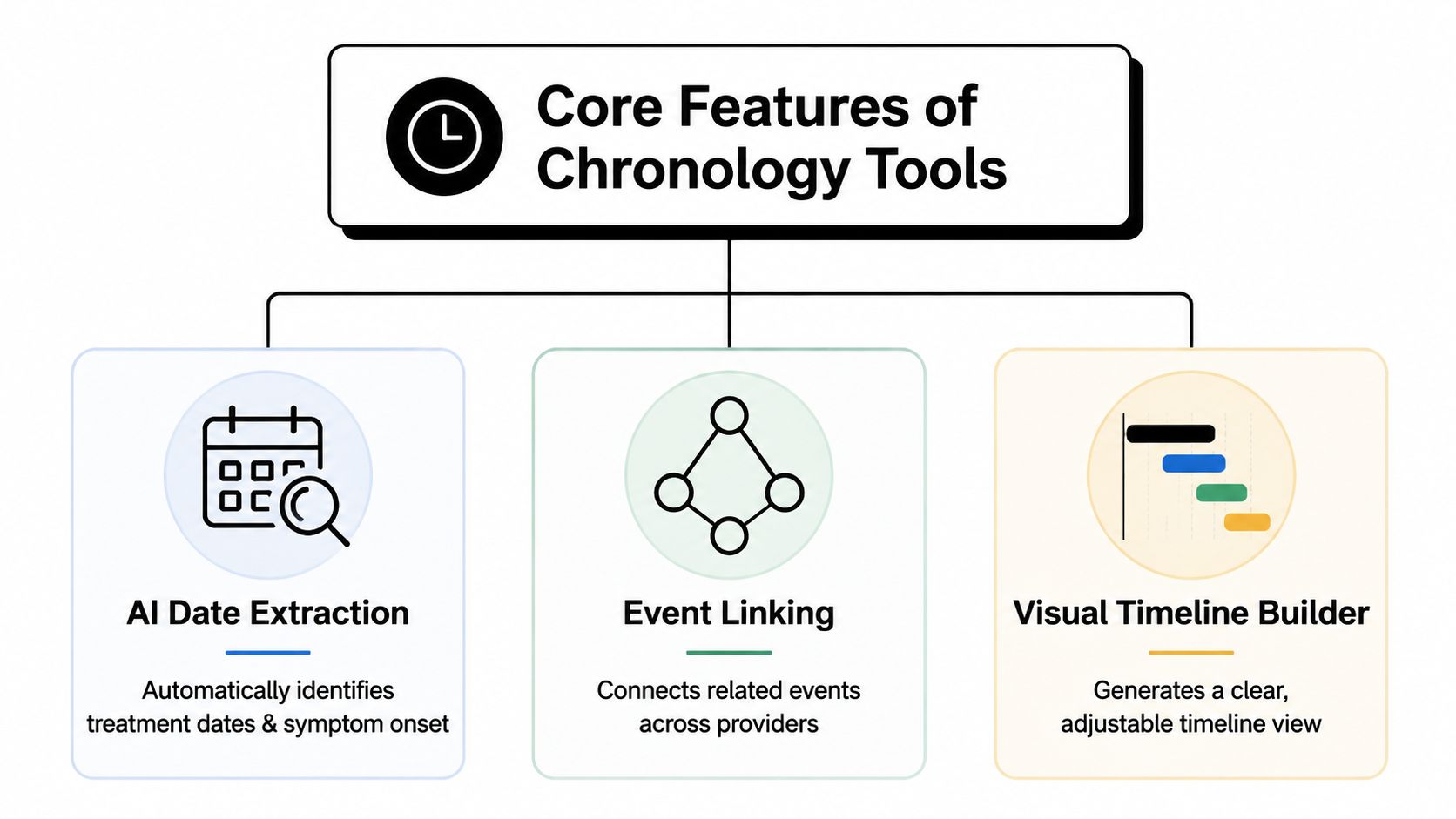
The first capability is date extraction. The platform should distinguish a date of service from a document creation date, signature date, referral date, and historical date mentioned inside a note. It should also identify symptom onset when the patient reports that symptoms began earlier, rather than treating the appointment date as the beginning of the condition.
OCR and structured parsing are central here. Medical chronology software uses those methods to convert scanned PDFs, handwriting, images, and narrative records into discrete entries while preserving full-page citations and handling document layout beyond plain text extraction, as described by Dodon's chronology technology. That doesn't make every extracted field reliable. A blurry scan or ambiguous handwritten date still needs attention.
Event linking turns entries into a case narrative
A usable system should associate a symptom with the relevant encounter, provider, diagnosis, test, and treatment. For example, a raw record set might contain an emergency visit, a radiology report filed separately, and a later orthopedic note referring to the same imaging. Event linking places those records in relationship instead of presenting three disconnected snippets.
The output should let a reviewer see the original page quickly. A chronology that says “persistent back pain” without showing the supporting note forces the team to repeat the search. A page-cited entry gives the attorney a direct verification path and makes later revisions less disruptive. For related guidance, firms can compare chronology output with broader practices for medical record summaries.
Gap detection is useful only when it stays neutral
Gap spotting should flag an interruption in the available record, not announce that the patient stopped treating. Those are different propositions. A missing period may reflect a provider change, an incomplete production, insurance issues, or care that occurred outside the collected file.
Look for tools that let reviewers label the gap, add context, and distinguish document absence from treatment absence. The same principle applies to pre-existing conditions, prior injuries, and overlapping complaints. A platform should surface the material, not decide causation for the legal team.
Measurable Benefits for Personal Injury Practices
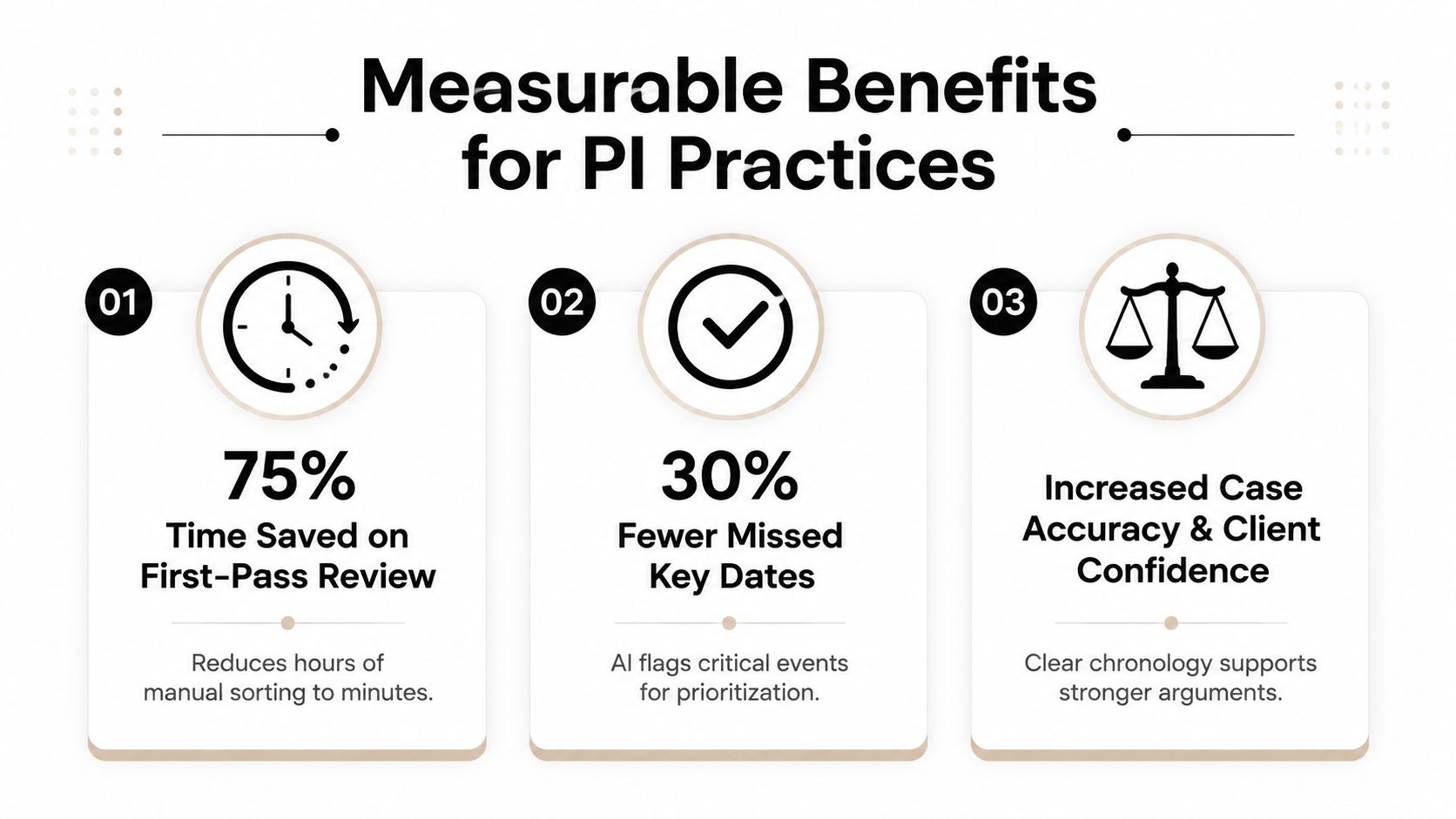
The strongest operational argument for chronology software is not that it replaces a paralegal. It changes where the paralegal spends time. Instead of manually locating every date before an attorney can assess the claim, the team starts with a structured draft and directs human effort toward verification, interpretation, and case strategy.
Some vendor and service content states that first-pass timelines can be generated in 15 to 30 minutes, while also acknowledging that clinicians or legal reviewers may still be needed for quality control, as reported by Medilenz's medical chronology service. That is a useful benchmark for evaluating workflow claims, not a guarantee for every file. A clean digital production and a disorganized collection of scans won't behave the same way.
Faster review changes the timing of legal decisions
A preliminary chronology can help an attorney identify what still needs to be requested before drafting a demand. It can expose a missing specialist record, an unexplained change in diagnosis, or a treatment period that needs client clarification. Those discoveries are more valuable early than after the demand package has already been drafted.
The same structure supports deposition and trial preparation. A reviewer can filter the timeline by provider, symptom, diagnostic study, or treatment type, then compare the chronology with testimony. That makes inconsistencies easier to locate without relying on memory or a collection of disconnected notes.
Capacity is a workflow outcome, not a promise
A firm may use saved review time to open additional matters, improve client communication, prepare earlier for mediation, or reduce the backlog of records waiting for attorney review. The right choice depends on the firm's bottleneck. If attorneys are waiting for organized medical evidence, chronology software can improve throughput. If records are already organized but demand drafting is delayed, another capability may matter more.
Track the operational effects rather than repeating vendor language:
- Review effort: Record the time spent locating, sorting, verifying, and revising chronology entries.
- Revision burden: Count how often attorneys return a chronology because dates, citations, or provider relationships need correction.
- Case readiness: Note when the attorney first has enough verified medical information to evaluate causation and damages.
- Missed evidence: Log material facts discovered after the initial chronology, then identify whether the omission came from extraction, review, or incomplete records.
The benefit is real only if the firm preserves a human quality-control step. A fast draft that requires a complete rebuild has shifted work, not eliminated it.
The Defensibility Question Most Vendors Ignore
A chronology can look polished and still be vulnerable. Opposing counsel may ask who prepared it, what source material was used, whether dates were independently verified, and how the reviewer handled ambiguous language. “The software generated it” is not a defensible methodology.
Messy records create the central risk. OCR may misread a handwritten entry. A note may reference an earlier event without stating its date. A provider may use a different format from every other provider in the file. The system needs a way to preserve uncertainty instead of converting an inference into a confident factual statement.
Source citation is the foundation
Every material entry should point to the original page or document location. The reviewer should be able to move from the timeline to the source, confirm the wording, and record any correction. If the platform strips that connection during export, the team loses an important part of its audit trail.
A defensible chronology also separates levels of certainty:
- Documented fact: The record expressly identifies the date, provider, diagnosis, or treatment.
- Patient history: The note reports what the patient says occurred earlier.
- Reviewer interpretation: The chronology connects related entries based on context.
- Unresolved issue: The available records don't establish what happened.
Recent guidance emphasizes source-cited entries, gap annotation, and pre-existing condition separation, but the available content provides limited hard evidence about error rates, auditability, or AI performance with ambiguous records at scale, as discussed in this medical chronology software overview. That limitation should shape procurement. Ask vendors for validation details, but test the platform on your own records rather than treating a claimed accuracy figure as a substitute for review.
Cross-examination exposes hidden assumptions
A chronology should help the attorney answer questions such as:
- Which page supports this entry?
- Is this the service date or the signature date?
- Did the patient report the prior condition, or did the provider diagnose it?
- What records are missing during the treatment gap?
- Why did the reviewer connect these two events?
- Was the condition present before the incident?
The platform should make those answers easier, not harder. Firms should also define an audit trail for legal AI workflows that records source references, reviewer changes, and final approval.
Practical rule: Treat an AI chronology as a review instrument and a draft work product. Don't treat it as an expert conclusion.
Security Compliance and Platform Evaluation Criteria
PHI security belongs in the buying decision from the first vendor conversation. A chronology platform will handle records that contain diagnoses, medications, identifying information, and treatment histories. A visually impressive interface doesn't compensate for weak access controls or unclear data-handling terms.
For PHI workflows, platforms should support controls associated with HIPAA compliance, including encryption in transit and at rest, restricted access, auditability, and a signed Business Associate Agreement before records are handled, as outlined by MedChronos AI's security guidance. Vendors may describe technical baselines such as AES-256 encryption at rest and TLS 1.3 in transit, but the firm should request documentation rather than rely on a sales summary.
Evaluate the evidence, not the feature list
Run a controlled test using representative records. Include searchable files, scanned pages, inconsistent provider formats, and at least one difficult document type that your firm regularly receives. Compare extracted dates, citations, diagnoses, providers, and treatment descriptions with a manually verified sample.
Security and workflow questions belong in the same review:
- Can the platform restrict access by role or matter?
- Does it log viewing, downloading, editing, and exporting?
- Does the vendor sign a BAA before upload?
- Does the output preserve page references?
- Can the firm export usable files to its case-management system?
- What happens to records after deletion or account closure?
- Can the vendor explain whether humans review uploaded records?
For broader planning, a resource on compliance-ready AI governance can help teams frame ownership, oversight, and documentation beyond a narrow software checklist.
| Criteria | What to Look For | Red Flags |
|---|---|---|
| PHI protection | Signed BAA, encryption, restricted access, audit logs | No BAA before upload, vague retention terms, shared accounts |
| Extraction quality | OCR, layout-aware parsing, date distinction, page citations | Clean-demo testing only, missing source links, unexplained output |
| Defensibility | Gap annotation, editable entries, reviewer history, clear uncertainty labels | Black-box summaries presented as final facts |
| Workflow fit | Compatible exports, case-management integration, searchable output | Manual re-entry, locked formats, no practical export |
| Vendor evaluation | Pilot access, documentation, responsive support | Refusal to test real records or disclose controls |
| Commercial model | Pricing aligned with file volume and matter mix | Unclear fees, unexpected processing charges, inflexible commitment |
Security certification can be valuable, but it isn't the whole evaluation. The firm still needs a documented review process that explains who verifies the chronology and how corrections reach the final case file.
Implementation Strategy and Workflow Integration
Adoption works best when the firm treats chronology software as a controlled workflow change, not a button added to the existing process. Start with a moderate-complexity matter that contains several provider records but doesn't carry the most sensitive strategic risk. The team can test extraction, citations, review time, and export behavior without making the pilot responsible for the firm's hardest file.
Build the review loop before expanding
Choose one paralegal and one attorney to own the pilot. Have them define what a usable chronology must include, such as dates of service, provider identity, symptoms, diagnoses, procedures, treatment response, gaps, and source references. Then compare the software output with the firm's existing manual method.
The human review process should be explicit:
- Confirm the source set. Record which productions were uploaded and identify known missing records.
- Review high-risk entries first. Check the incident-related encounter, surgeries, imaging, first diagnosis, major treatment changes, and unclear scans.
- Classify uncertainty. Mark whether each disputed item is documented, reported history, inferred, or unresolved.
- Correct at the source entry. Preserve the original citation and record why the change was made.
- Obtain attorney approval. The attorney should approve the chronology before it supports a demand, pleading, deposition outline, or expert communication.
Training should use the firm's real examples. A short demonstration with clean files won't prepare staff for duplicate pages, provider abbreviations, handwritten notes, or records that arrive after the first chronology. Teach reviewers how to challenge the output, not just how to accept it.
Connect the tool to existing matter management
Decide where the chronology lives, who owns the working version, and how later records are added. If the firm uses Filevine, Litify, MyCase, Smokeball, CASEpeer, or another system, verify the actual export and integration behavior during the pilot. A nominal integration that still requires downloading, renaming, and re-uploading files can create avoidable handling steps.
For broader task coordination, firms may also streamline processes with monday.com by assigning review stages, tracking outstanding records, and documenting attorney approvals. The platform doesn't replace legal judgment. It can make ownership and deadlines visible.
Roll out the process first for new matters, then decide whether older cases justify conversion. Keep the manual method available during the transition. Attorney skepticism usually falls when reviewers can show both the generated entry and the cited source page, including examples where the human reviewer corrected the software.
Calculating ROI and Measuring Success
ROI should reflect the work the firm actually changes. A chronology subscription may appear inexpensive when compared with a paralegal's hourly cost, but that comparison is incomplete if the team still performs the same full review afterward. Conversely, a platform may create value without reducing headcount if it lets existing staff move matters forward instead of waiting for record organization.
Start with a baseline for several representative matters. Record the time spent on file intake, sorting, chronology drafting, source verification, attorney revisions, and updates after new records arrive. Don't count only the first draft. The review and correction stages determine whether the process delivers usable work product.
Use a simple capacity model
A practical model is:
Net workflow value = avoided review effort + earlier case-readiness value + reduced rework, minus software cost and verification effort.
The firm can apply that model at different scales without inventing a universal savings assumption:
- Solo practice: Measure whether the attorney can review medical evidence earlier without displacing client communication or legal analysis.
- Small team: Track whether paralegals clear record backlogs and whether attorneys receive fewer incomplete chronologies.
- High-volume practice: Compare matters processed per reviewer, revision frequency, and the time between record receipt and demand preparation.
- Litigation-heavy practice: Measure deposition and trial preparation time, especially where source citations and gap notes reduce repeated searches.
Don't claim that a faster chronology automatically produces a higher settlement. The defensible business case is operational. Earlier organization may help the attorney identify missing evidence, ask better client questions, prepare a more complete demand, or approach negotiations with a clearer medical narrative.
Measure quality as carefully as speed
Useful metrics include citation accuracy, the number of material corrections, unresolved gaps identified before demand drafting, attorney revision cycles, and time required to update a chronology after new records arrive. Review those measures over a consistent evaluation period, then compare them with the baseline.
EHR adoption means the platform is generally working over highly digitized, multi-provider charts rather than isolated paper files. By 2024, 95.0% of office-based physicians had adopted EHRs and 83.6% used certified systems, according to the national EHR adoption literature. That scale supports automation, but it also increases the importance of reconciliation across providers and record formats.
A successful implementation produces a repeatable, reviewable process. It gives management evidence about capacity and quality, while giving attorneys confidence that the chronology remains tied to the source record.
Ares offers personal injury firms AI-assisted medical-record review that extracts dates, providers, diagnoses, treatments, and symptom chronology into organized, case-ready insights, with tools for medical overviews and demand drafting. If your firm wants to test a faster chronology workflow without abandoning source verification and human review, visit Ares to evaluate the platform.