
The adjuster says your firm represents the client on every part of the accident claim. Your intake team says property damage was excluded. The letter says all claims, and someone sent it to the vehicle-damage adjuster instead of the bodily-injury handler.
Now the team is untangling both routing and scope. A lawyer representation letter should prevent that conversation, not create it. The useful version identifies the right file, states exactly whom counsel represents, and communicates no more authority than the lawyer has.
Required Elements Every Representation Letter Needs
A carrier-facing representation letter is an operational notice. It tells the insurer who represents whom, which matter counsel handles, and where claim communications should go. It isn't a demand package, and it shouldn't substitute for the client's engagement agreement.
The distinction matters because firms often use representation letter and engagement letter interchangeably. The engagement agreement establishes the client-facing terms; the insurer notice communicates the relevant scope without disclosing unnecessary financial or confidential information.
The American Bar Association's engagement-letter guidance explains that Model Rule 1.5(b) calls for communicating scope and the basis or rate of fees and expenses, preferably in writing, before or within a reasonable time after representation begins. For contingent matters, the client-signed agreement must explain fee calculation and expense treatment.
Required elements and common errors
Build the notice from verified fields rather than editing the last client's letter.
| Element | What to write | Common mistake |
|---|---|---|
| Client full legal name | Name as on ID, plus date of birth or address when needed for matching | Nicknames or a former surname |
| Counsel details | Firm address, phone, email, and insurer portal or fax details | Using an attorney's personal email |
| Loss facts | Date of loss, location, and insured or policyholder | Wrong date or the driver's name in place of the policyholder |
| Policy and claim numbers | Both copied from the intake file and checked against carrier correspondence | Transposed digits that route the letter to another file |
| Matter scope | Named coverages such as bodily-injury liability, MedPay, UM/UIM, or property damage | All claims or all legal matters wording |
| Communication instruction | Direct represented-matter contact through counsel; identify permitted copy recipients | No statement of who else may be copied |
| Requests to the carrier | Adjuster identity, applicable forms, coverage correspondence, and proof-of-loss requirements | Omitting requests and leaving the next action unclear |
| Engagement cross-check | Scope matches the signed engagement agreement | Letter broader than the contract |
Use sensitive identifiers selectively. A full date of birth doesn't belong in an email subject line just because the template has a field for it. Put matching information where the recipient needs it, through an appropriate channel.
Practical rule: Every coverage named in the outgoing letter should have an identifiable basis in the engagement file.
Separate policyholder, insured driver, and claimant fields even when the names happen to match. Staff should never have to infer which role a person occupies.
Broad wording doesn't automatically rewrite a signed contract, but it can create conflicting evidence about the work the firm undertook. Replace all legal matters with the specific accident, claim, and services counsel agreed to handle.
Copyable Template for a Personal Injury Letter
Use this as a drafting starting point, not an unchanged form. Edit every bracketed field, delete inapplicable requests, and remove any paragraph the file doesn't support.
Adaptable carrier notice
Date and delivery: [Date], sent by [Delivery Method]
To: [Adjuster Name or Claims Department]
[Carrier Name]
[Verified Mailing Address, Email, or Portal Destination]Re: [Client Full Legal Name]
Date and location of loss: [Date of Loss], [Location]
Insured or policyholder: [Name]
Policy number: [Policy Number]
Claim number: [Claim Number]Dear [Adjuster Name or Claims Representative]:
Our firm represents [Client Full Legal Name] concerning [Named Claim or Coverage] arising from the incident identified above. Our representation described in this notice is limited to [Scope].
[If useful and verified: The client reports treatment for [Body Area or Reported Condition].]
Please direct communications concerning this represented matter to [Responsible Attorney] at [Firm Contact Details]. [Identify any authorized copy recipient.] Please acknowledge receipt in writing and confirm that this notice has been associated with the correct claim file.
Please provide:
- Claim handling: The assigned adjuster's name and contact details.
- Required submissions: Applicable claim forms and proof-of-loss requirements.
- Coverage information: Relevant coverage correspondence and available policy information.
This notice does not waive any claim, coverage, or other right available to our client. It is not a settlement offer or authorization to resolve the claim.
Sincerely, [Responsible Attorney]
[Firm Name]
[Firm Address, Telephone, and Email]
A fictional routing example could read: Harbor Mutual | Claim HM-[Claim Identifier] | [Client Full Legal Name]. Retain the carrier's actual claim-number format rather than inventing a standardized firm format.
Edit for the coverage involved
For a MedPay-only matter, name medical-payments coverage and remove bodily-injury liability language. For UM/UIM, identify the client's own policy and request the adjuster handling that coverage. For property damage only, replace the treatment paragraph with a factual vehicle-loss description and request the appraisal process.
Keep injury descriptions restrained. A reported symptom isn't a prognosis, and a treatment entry doesn't establish accident-related causation by itself.
After acknowledgment, use a short supplemental notice for changed contact details or newly authorized coverages. Identify what changed, request confirmation, and avoid resending a full template that could introduce inconsistent wording.
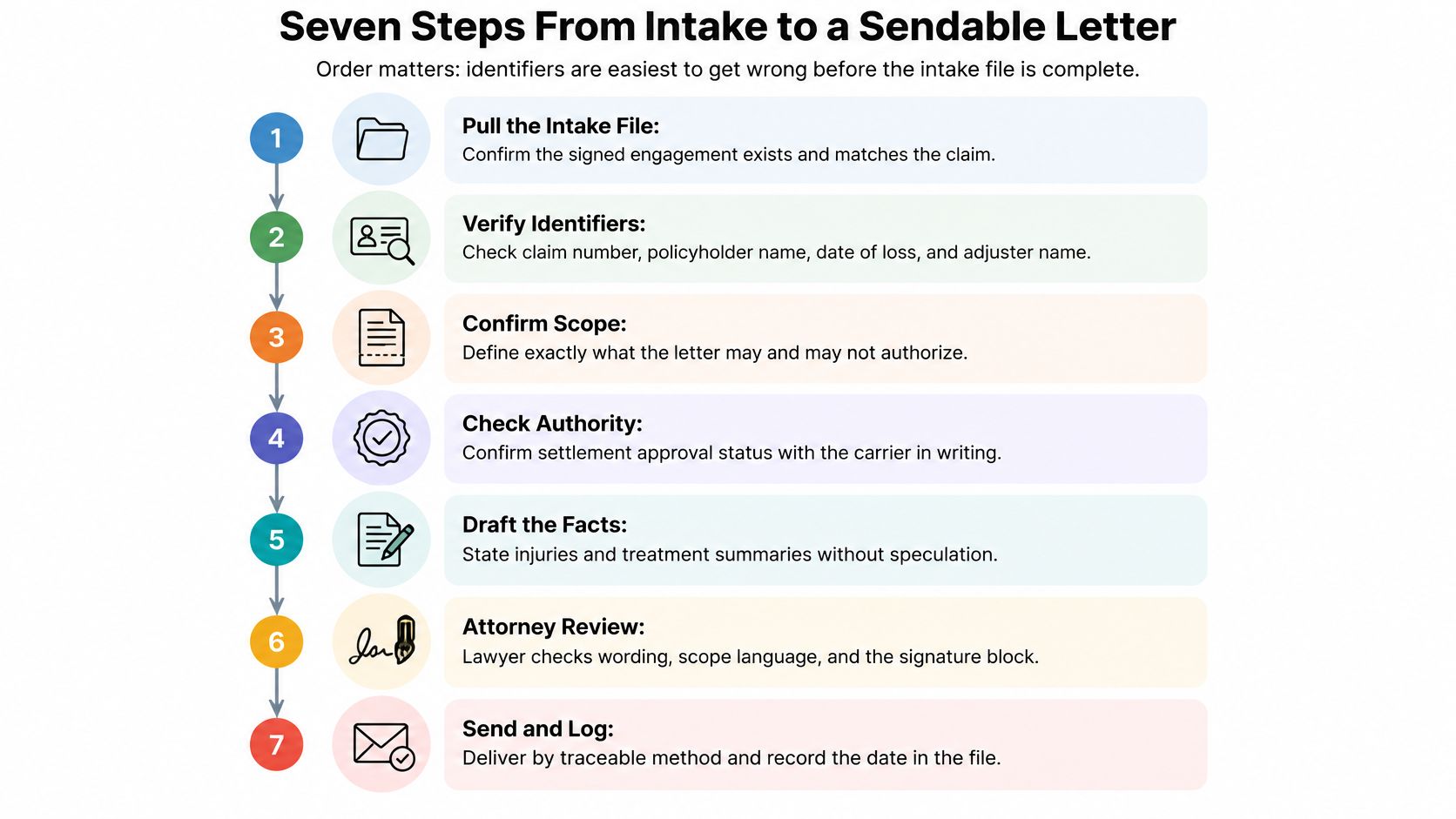
Seven Steps From Intake to a Sendable Letter
Order matters because staff can draft a polished letter before anyone has confirmed the underlying file. A fast draft saves little time if the attorney must reconstruct where its identifiers and assertions came from.
The Justen Law explanation of personal-injury representation letters describes notice, policy-information requests, and evidence preservation as practical functions of the letter. Turn those functions into assigned tasks, not optional paragraphs.
Build from the file, not from memory
Pull the intake file and engagement. Confirm the client signed the agreement, the firm accepted the matter, and the proposed recipient relates to that engagement. Resolve missing signatures, uncertain client identity, or representation of additional family members before drafting. The common slip is treating a completed intake questionnaire as authority to act.
Verify identifiers against source documents. Compare the insurance card, incident report, carrier correspondence, and intake record. Say a rear-end collision intake contains a policy number from another vehicle in the household. Comparing the claim number and insured details against the carrier's opening response exposes the mismatch before staff send medical information to the wrong handler. Don't silently choose whichever document looks newest; record how the discrepancy was resolved.
Select the coverages counsel actually handles. Use a coverage checklist with an included, excluded, or attorney-review status. A client may need help with bodily injury while handling vehicle repairs directly. The common slip is copying every potentially available coverage into the letter before anyone has accepted responsibility for it.
Draft factual notice separately from legal conclusions. State the incident, represented matter, and requested action. If medical information is necessary, distinguish the client's account from documented treatment. Don't convert a note that pain followed the collision into a definitive opinion that the collision caused every diagnosed condition.
These tasks belong within a broader claim life cycle workflow, with named owners and completion statuses. A draft sitting in an inbox isn't a completed notice task.
Review authority, evidence, and technology
Require substantive attorney review. The lawyer should test scope, requests, preservation language, and any statement about causation, damages, deadlines, or settlement. Trace factual statements to identifiable records, including the page or document location where practical.
Ares is one option alongside manual chronologies and document-management tools: it organizes medical records by dates, diagnoses, treatments, and providers and produces drafts for attorney review. Check generated summaries line by line against the underlying records; polished wording isn't verification.
Preservation review should identify both evidence and custodians. Consider scene photographs, vehicle data, dashcam footage, relevant phone content, employment records, and medical records. Send notices specific to the people or organizations that possess the material rather than assuming the insurer controls everything. Avoid a blanket request to preserve every device indefinitely when a focused description would be clearer.
Complete a yes-or-no pre-send gate. Record the answers in the file, not just in a reviewer's memory.
Gate question Required result Do identity, capacity, and authority match the engagement? Yes Has the attorney approved causation, damages, deadlines, and settlement wording? Yes Are vendor confidentiality and security terms confirmed, including a business associate agreement where legally applicable? Yes Are required permissions for sensitive information documented? Yes Are the approved version and review history saved? Yes A business associate agreement isn't automatically required merely because a document contains health information. Determine the vendor's role and applicable obligations rather than treating the agreement as a universal checkbox.
Open the recipient and delivery log. Record the recipient, destination, approved attachment, transmission method, and acknowledgment status. Assign follow-up ownership, then calendar statutory, contractual, and insurer-requested deadlines separately. The common slip is entering the carrier's requested response date while overlooking an independent legal deadline.
Stop rule: If a required gate answer is no, the letter stays unsent until the responsible attorney resolves the issue.
Urgency changes who gets called and how quickly review happens. It doesn't justify sending an unapproved version or using a general representation notice where a separate, time-sensitive preservation notice is needed.
Scope and Authority Wording That Avoids Overreach
The most authoritative-sounding letter can be the riskiest. Language suggesting that counsel can bind everyone involved may exceed the lawyer's instructions, misidentify the client, or conceal a conflict between insurer and insured.
A Miller & Zois sample attorney representation letter offers a useful plaintiff-side starting point. Don't transplant that posture into insurer-appointed defense work without examining client identity and settlement control.

Identify the position before asserting authority
- Plaintiff counsel: Identify the claimant you represent and the matter accepted. Distinguish authority to communicate and negotiate from authority to accept a settlement.
- Insurer-appointed defense counsel: Determine whom counsel represents under applicable law and the appointment terms. Examine the policy's defense and settlement provisions without assuming that payment of legal fees answers the client-identity question.
- Independent counsel: State whose interests counsel protects and what work the appointment covers. Payment by an insurer doesn't, by itself, authorize counsel to speak for that insurer.
A demand above policy limits or a coverage dispute requires renewed conflict analysis. Where the insurance contract gives the carrier settlement control, distinguish that contractual power from the lawyer's own authority and professional duties. Document relevant instructions, disclosures, and any required consent.
For an appropriate plaintiff-side engagement, sample wording is:
We represent [Client Full Legal Name] in the bodily-injury claim arising from [Date of Loss]. We are not authorized to accept a settlement on our client's behalf without the client's written approval.
Use that sentence only if it accurately reflects the firm's instructions. A template shouldn't invent an approval restriction or imply authority that hasn't been granted.
Address the people a routing instruction leaves out
| Situation | What the letter should clarify | What the file should document |
|---|---|---|
| Multiple claimants | Name each represented person; don't imply representation of everyone involved | Conflict analysis, separate instructions, and allocation issues |
| Minor client | Identify the representative's capacity and reserve required approval procedures | Guardianship or other authority documents and applicable court requirements |
| Incapacitated client | Identify the authorized decision-maker and relevant capacity | Conservatorship, agency, or other supporting authority |
| Medical or government liens | Identify counsel's authorized role without promising an unrestricted net recovery | Notices, reimbursement interests, and responsibility for resolution |
| Policy-limits demand | Distinguish representation notice from the actual demand and its conditions | Client instructions, supporting material, recipients, and deadline analysis |
A request to route communications through counsel doesn't resolve any of these authority questions. Resolve them expressly rather than letting the recipient infer the answer.
Client Authorization and HIPAA Rules by Jurisdiction
Written requirements that affect the representation letter
State requirements can change whether a firm needs a contract, an engagement letter, a signature, or additional conflict documentation. Use these reference points to identify what must be checked against current governing law.
| Rule or jurisdiction | Written requirement | Threshold or trigger |
|---|---|---|
| California | Written contract for non-contingency matters | Total expenses, including attorney fees, reasonably foreseeable to exceed $1,000, as described in the ABA engagement-agreement overview |
| New York | Written engagement letter or signed retainer for most matters | Generally required unless the expected fee is below $3,000; other exceptions must be checked |
| Washington | Contingent and flat-fee agreements in writing; contingent agreements signed by the client | Contingent-fee or flat-fee engagement |
| ABA Model Rule 1.5 | Scope and fee basis communicated, preferably in writing | Before or within a reasonable time after representation begins |
| ABA Model Rule 1.7(b) | Written confirmation of informed consent to certain concurrent conflicts | Consent to a permissible concurrent conflict |
| HIPAA authorization | Signed written authorization for release of health records | Before disclosure when authorization is the applicable legal basis |
California's trigger includes expenses, not just the attorney's fee. New York's rule shouldn't be reduced to a universal fee-only exemption because other applicability provisions and exceptions need review.
A multistate firm should identify the governing rules and satisfy all applicable requirements. Using the strictest applicable documentation standard can simplify administration, but a demanding internal template doesn't replace jurisdiction-specific analysis.
Keep records authorization separate
A representation letter isn't a HIPAA authorization. A provider needs a valid disclosure basis, which may be a compliant authorization or another legally permitted route.
When using an authorization, check:
- Information and parties: Describe the records and identify who may disclose them and who may receive them.
- Purpose and duration: State the purpose and an expiration date or event.
- Patient rights: Include required revocation information, signature, date, and other required statements.
- Representative authority: Confirm the signer's capacity when someone signs for the patient.
Use the HIPAA medical-records release guide as an operational checklist while verifying provider requirements and applicable state protections. Share only material needed for the carrier's legitimate claim review, without confusing that practice with a universal legal rule governing every authorized disclosure.
Log what was released, to whom, through which channel, and under what authority. Keep the authorization with the release record rather than assuming the representation notice covers it.
For an additional explanation of the topic, the following video may be useful.
Delivery Methods, Timing and Proof of Receipt
According to a LexisNexis study cited by Insurance Journal, 85% of auto-accident victims in 2024 were contacted by at least one attorney, while 60% were contacted by two or more attorneys. That measures attorney outreach, not completed engagements or insurer acknowledgment, but it underscores how early claim-related communications can begin.
Send the approved notice promptly after engagement, preferably before a recorded statement is arranged. Don't confuse a successful transmission with confirmation that the correct adjuster has recognized the representation.
Delivery methods and the proof to keep
| Delivery method | Proof of receipt | Best used when |
|---|---|---|
| Certified mail, return receipt | Signed return card or tracking record | Formal notice to a carrier's claims office |
| Email to a known adjuster | Saved send log and written reply | Fast first contact with an assigned adjuster |
| Carrier claims portal upload | Portal confirmation number and upload record | The carrier requires portal submission |
| Fax | Transmission report with page count, followed by acknowledgment | The carrier still requires fax |
| Overnight courier | Signed delivery confirmation | A time-sensitive demand or limits request, subject to applicable delivery requirements |
A fax report proves transmission more readily than correct-file handling. Likewise, a portal confirmation may establish upload without proving that the assigned adjuster reviewed the document.
Make acknowledgment a separate task
Choose a primary channel for the formal notice and send a courtesy copy through another appropriate channel when useful. Label copies consistently so staff don't create competing versions.
For email recordkeeping, Mail Tracker for Gmail's documentation guide provides useful context for documenting communications. Tracking signals aren't a substitute for a written carrier response confirming the client, claim, and assigned handler.
Set a follow-up date when sending, based on urgency and applicable deadlines. If acknowledgment doesn't arrive, contact the claims unit, verify routing, and resend the approved version rather than generating a fresh letter.
Store delivery evidence and acknowledgment with the engagement and identify the carrier contact used. Apply separate service and deadline checks when preparing a demand; this guide to sending a demand letter addresses that distinct workflow.
Ares organizes medical records and prepares attorney-review drafts so your team can work from structured case facts rather than scattered documents. Visit Ares to explore how those tools can support claim preparation while your attorneys retain control over scope, authority, and final wording.