
The demand went out last week. The client calls for an update, the adjuster hasn't made a substantive offer, and the file feels quiet. You need to explain what happens next without promising a payment date you can't control.
The answer to how long does a settlement demand take depends on which part of the process you mean. Preparing the package, getting an acknowledgment, negotiating an offer, resolving release and lien issues, and receiving payment are different stages, each with its own possible delays.
How Long a Settlement Demand Usually Takes
A demand doesn't work like a letter dropped in the mail followed by a check. It's a staged negotiation, and each stage must clear its own gates. The adjuster may acknowledge receipt, but still need time to investigate. The insurer may make an offer, but the parties may not agree on terms or be ready to sign a release.
That distinction is useful in the familiar “any news?” call. If the insurer has confirmed receipt but hasn't evaluated the package, the file is at a different point than one where the insurer has made a counteroffer and counsel is negotiating. The client deserves a clear explanation of what has happened, what's holding up the next step, and what the firm is doing about it.
The useful question isn't only how long the demand has been out. It's which stage is stuck, and what decision or document will move it forward.
For attorneys and case managers, separating the stages makes it easier to give a client a realistic range tied to the current status. It also helps distinguish an ordinary investigation from a delay caused by missing records or an unresolved issue. A response date written into the letter isn't the same as a date when the entire claim will be resolved.
For a practical overview of what can happen after an auto claim enters negotiations, settlement steps for injured Texas drivers offers a useful point of comparison. The governing rules and claim facts vary, so any timeline is a planning benchmark, not a promise for every injury, insurer, or jurisdiction.
Demand Time Versus Full Claim Resolution
A client may hear that an insurer is reviewing a demand and assume the claim is close to resolution. Those are separate clocks. Preparing the demand, getting the insurer's acknowledgment, completing its evaluation, agreeing on terms, signing a release, and receiving payment are distinct steps. A quick acknowledgment does not mean the insurer has evaluated the claim, and an agreement does not mean the check has arrived.
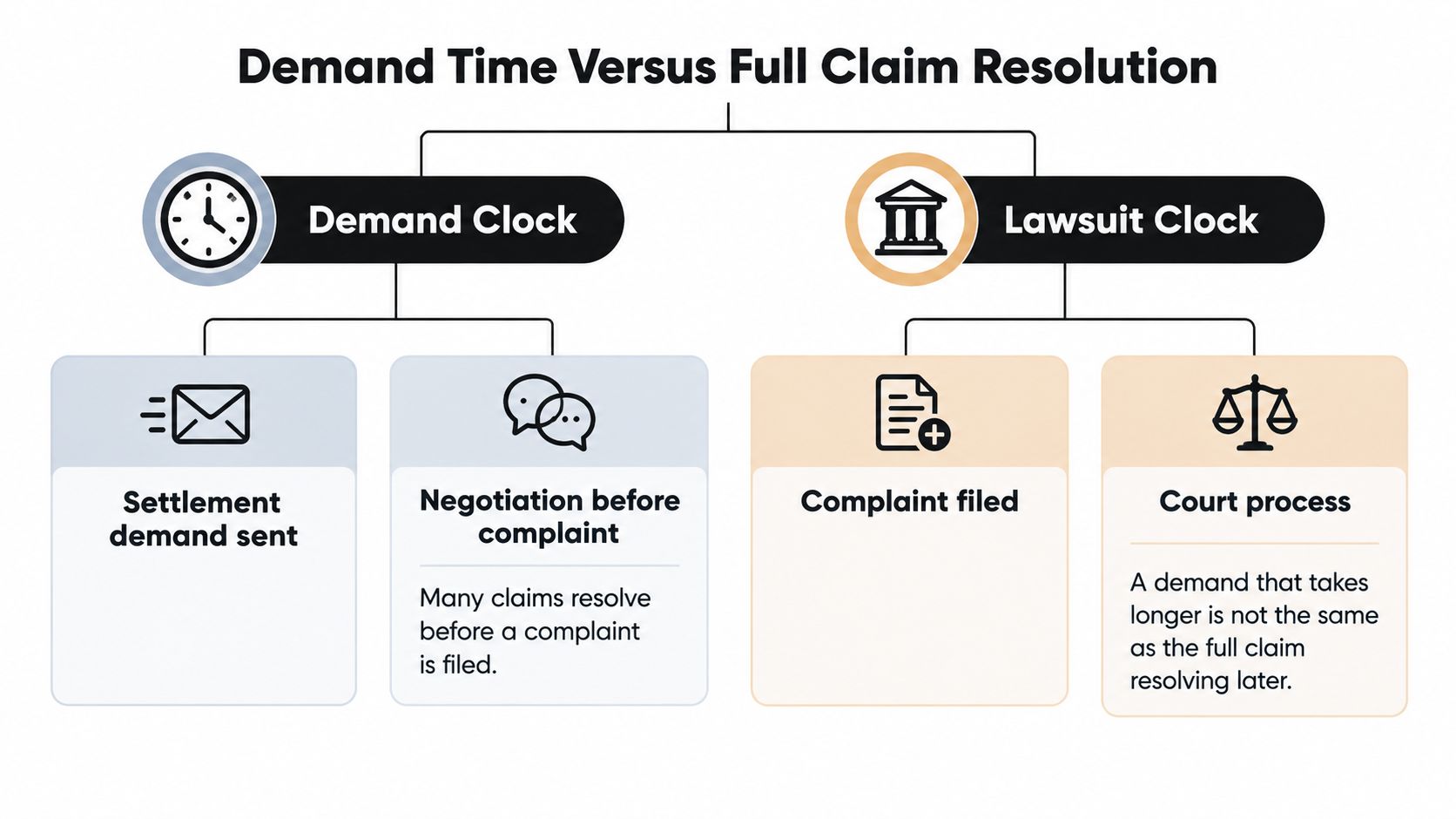
The most controllable delay often happens before the demand goes out. If treatment records, bills, wage-loss documents, or other supporting evidence are missing, the insurer may lack what it needs to evaluate the claim. A well-organized package can support a clearer review, though it cannot guarantee agreement or a particular response time.
If negotiations do not resolve the claim and a lawsuit is filed, a different timeline begins. Court proceedings can involve discovery, motions, continued negotiations, and scheduling. The Bureau of Justice Statistics studied tort cases resolved in the nation's largest counties during the year ending in 1992. From filing to disposition, the mean was 19.3 months and the median was 13.7 months. 44% were disposed within one year and 74% within two years. Settlement or voluntary dismissal accounted for approximately 75% of dispositions, while about 3% ended in a trial verdict. These historical figures describe a broad group of cases, not a forecast for an individual claim or court. (Bureau of Justice Statistics tort-case study)
The distinction matters when setting expectations: demand preparation and insurer review may happen before filing, while litigation can extend the overall path if the parties do not agree. A filed case may still settle without trial, but it has entered a court process with its own steps and scheduling.
For more context on what affects a Florida injury case timeline, consider how jurisdiction and case circumstances shape the broader process. This personal injury case timeline can also help explain why an early demand stage and full claim resolution are not the same measure.
The Four Milestones After You Send a Demand
Once the package leaves the firm, track progress by milestone rather than treating every day of silence as the same problem.
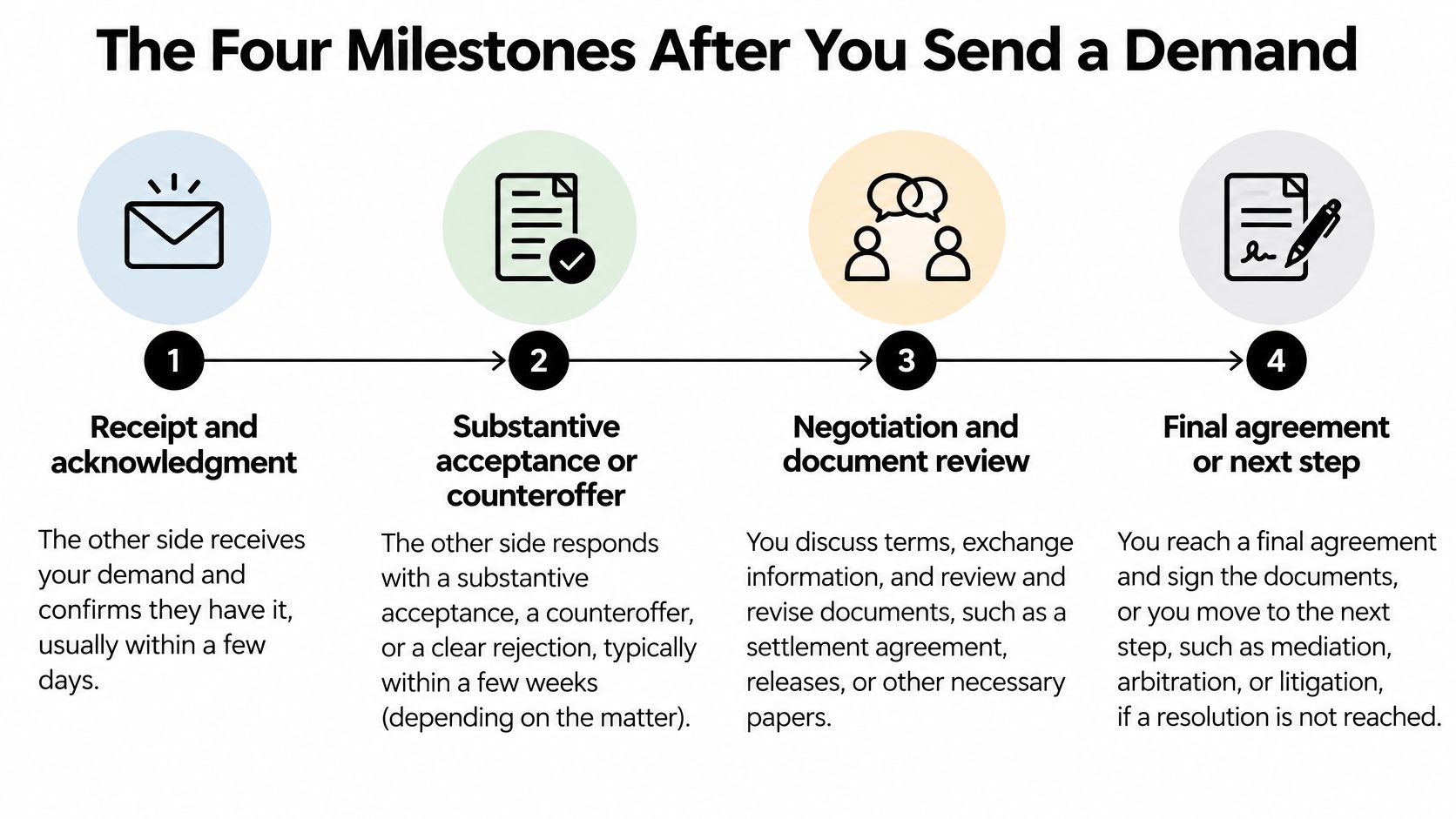
Receipt and acknowledgment. An insurer typically acknowledges a demand within days to roughly two weeks. Model claims-handling rules commonly call for acknowledgment within about 15 days, and may require written updates if an investigation remains open, but requirements vary by state. (Demand-letter response timing and claims handling) Save proof of delivery and confirm that the adjuster received the complete package. If acknowledgment doesn't arrive, follow up and record the date and response.
Substantive acceptance or counteroffer. Acknowledgment only confirms receipt. The insurer still needs to review liability, medical causation, the treatment chronology, damages, applicable policy limits, and whether the submission is complete. Substantive evaluation commonly takes several weeks. Missing records or ongoing treatment can prompt new requests and extend the review. Assign someone to monitor the expected response and follow up if the carrier identifies a specific missing item.
Negotiation and document review. An offer or counteroffer starts a different conversation. The parties may need to discuss the strength of the evidence, the amount demanded, and the insurer's position. Far-apart positions can keep negotiations open for weeks or months, and agreement on the number doesn't automatically resolve lien questions or release language.
Final agreement or next step. Before payment, confirm that the release accurately reflects the agreement and address known liens and other required documentation. Then track the payment itself instead of assuming a signed agreement means the funds have arrived.
Closed insurance complaints show why it's important to distinguish a reply from a resolution. In 2024, claim handling represented 65.2% of closed complaints, delays represented 22.2%, and unsatisfactory settlement offers represented 12.2%. (Insurance complaint categories)
Give each milestone an owner, a documented follow-up date, and an escalation trigger. That trigger might be a missing record the insurer identifies, an unanswered follow-up, or positions so far apart that further discussion needs a strategic decision.
When Medical Records Speed Up or Stall a Demand
A client has finished treatment, but the demand still cannot go out: one provider's notes are missing, a bill does not match the file, and the treatment timeline is unclear. The insurer's review clock has not started. The most controllable delay often happens before the letter is sent, while counsel gathers and organizes the evidence needed to support it. Multiple providers, ongoing care, preexisting conditions, and unresolved future damages can all affect readiness. Even records already in the file may be hard to assess if the package obscures the treatment story.
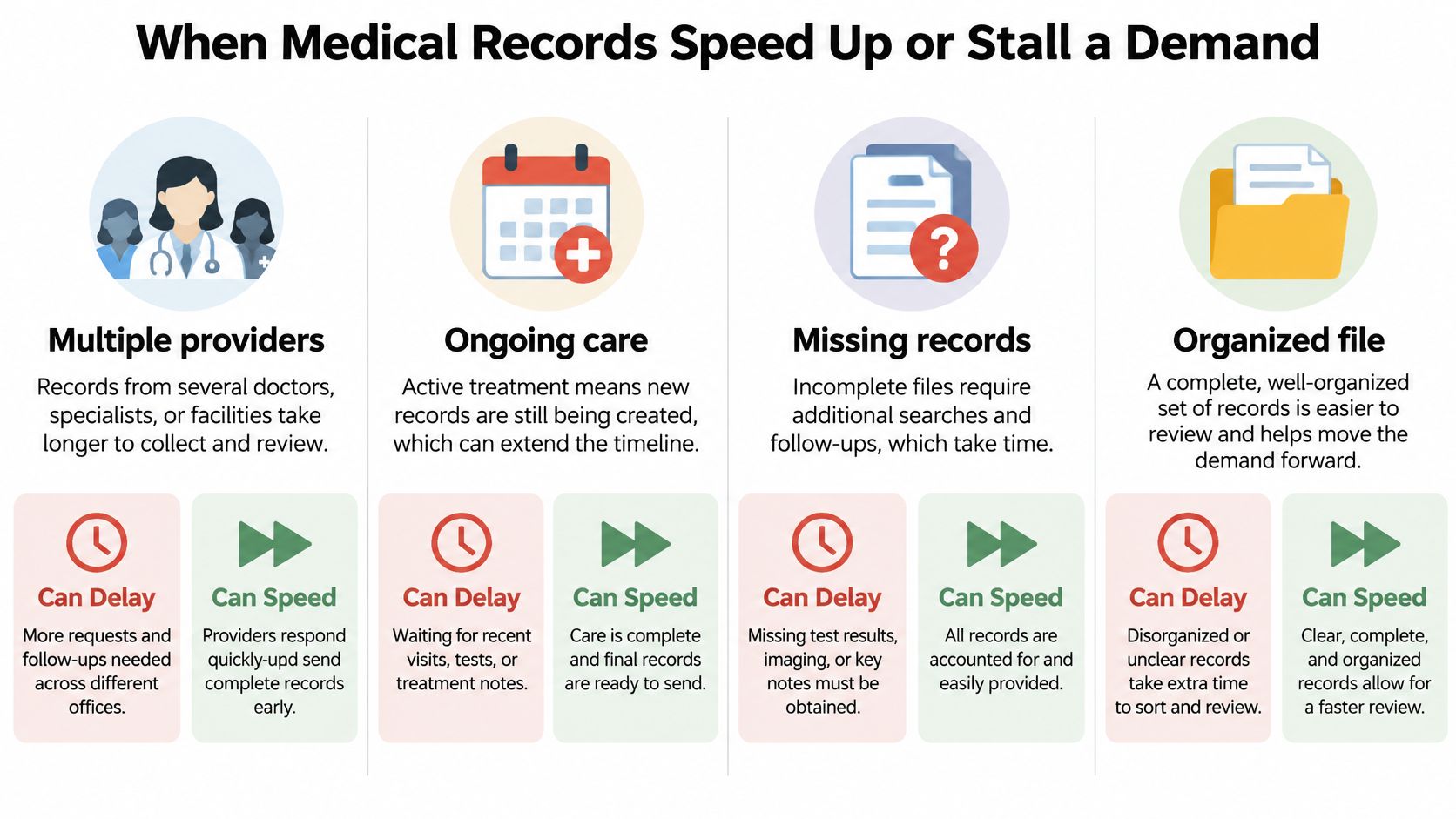
Sending before treatment stabilizes or bills are reconciled can lead to repeated requests, a premature offer, or a later supplemental demand. Waiting without a defined plan creates a different problem: the client may not know what remains outstanding or why the demand has not gone out. Claims-handling guidance also identifies poor management of customer expectations around timescales as a recurring concern. (Financial Conduct Authority guidance on claims handling)
Classify readiness before choosing a send date
A readiness label makes the decision clear to both the team and the client.
- Complete and stable: The available treatment history supports a demand. Counsel can identify providers, key diagnoses, treatment dates, symptom chronology, verified medical expenses, and known liens.
- Materially complete but still developing: Core records are assembled, but care or damages remain open. Decide whether the evidence supports sending now or whether a specific follow-up item could materially affect the claim.
- Strategically premature: Important records are missing, treatment is difficult to summarize, or future damages have not been assessed. Name what must be resolved before sending, rather than leaving the case in an open-ended “not ready” status.
A case manager can track missing records by provider, gaps in the chronology, bills that need verification, and open damages or lien questions. These items are the file's equivalent of a map: they show what supports the demand and where uncertainty remains. A guide to organizing medical records offers a related workflow. The goal is a supported demand, not a perfectly static medical picture. Set a follow-up date for each open item so preparation does not become an indefinite wait.
What a Response Deadline Actually Controls
A date in a demand letter is usually a negotiation-control mechanism, not a universal legal finish line. A response period of 15 to 30 days is common in practice, but a deadline stated by counsel doesn't automatically create a binding insurer deadline or mean a missed date is bad faith. Separate rules may apply, and they depend on jurisdiction and claim type.
California rules generally require an insurer to accept or deny a claim within 40 calendar days after receiving proof of claim, or explain why it needs more time and provide updates. (Personal-injury demand deadlines and handling rules) Counsel should verify the applicable requirements before saying an offer has expired or characterizing a missed date as bad faith.
| Clock | What it usually measures | Planning use |
|---|---|---|
| Demand-letter deadline | The response date requested by counsel as part of negotiation | Set expectations, document the requested response, and plan follow-up |
| Regulatory handling standard | A jurisdiction's requirements for insurer acknowledgment, investigation, or decision | Check the rule that applies before drawing legal conclusions |
| Payment date | When funds are actually issued after agreement and required processing | Track separately from the insurer's first response |
A clear demand should state that the response period begins when the insurer receives a complete package. Identify the medical and damages documents included, state the requested response date, and define what counts as acceptance. The recipient shouldn't have to guess whether the package is complete or what action the firm expects by the stated date.
Draft for clarity: A deadline can help expose whether a file is awaiting investigation, missing evidence, or a negotiation decision. It doesn't turn silence into an automatic resolution.
If the adjuster asks for another record, document what was requested and whether it was already included. That record helps counsel distinguish a genuine information gap from a delay that requires a different response.
Realistic Timelines from Real Case Patterns
Consider three files that reach different points after a demand is sent.
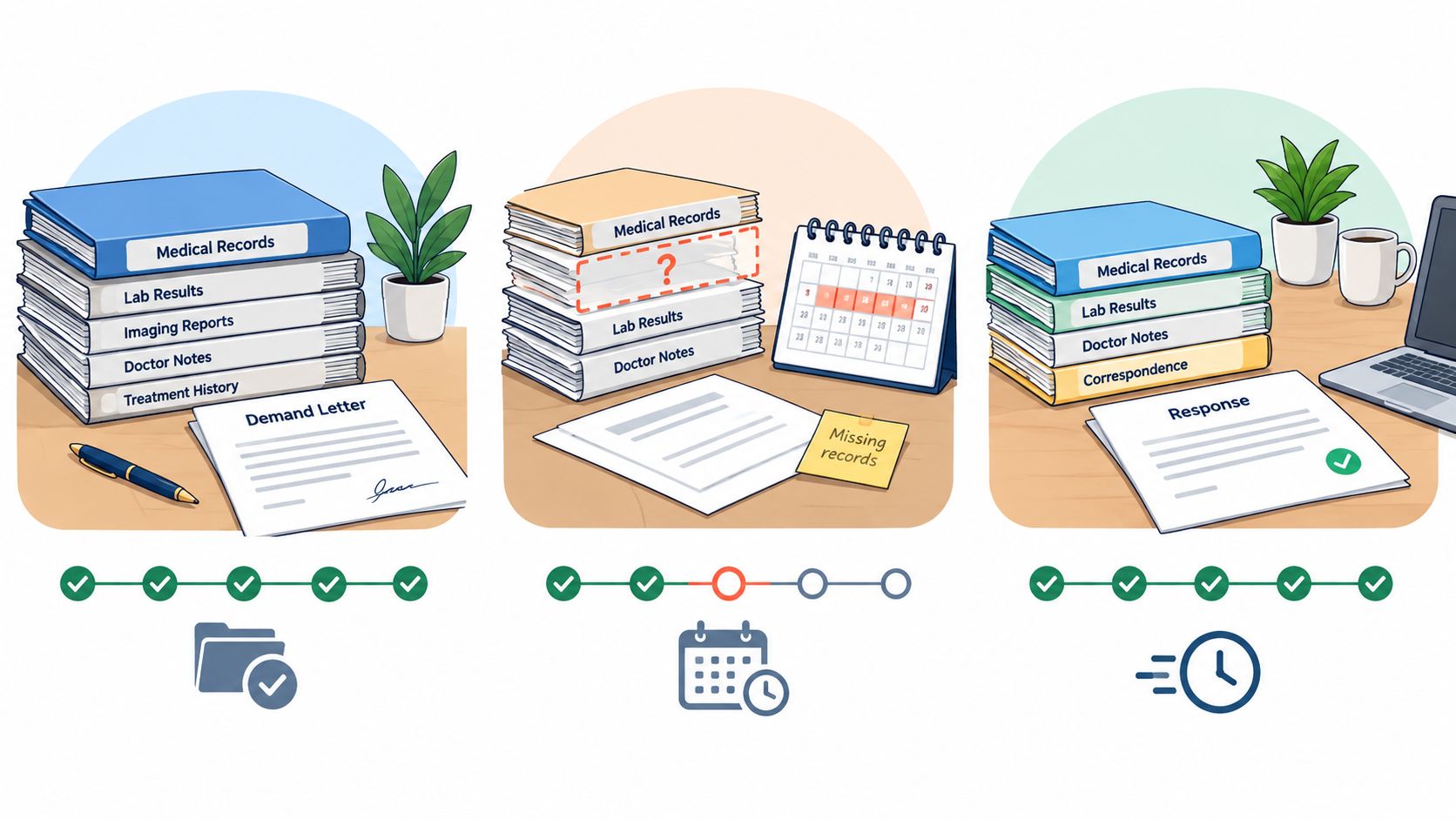
In the first, counsel sends a complete pre-suit package. The insurer acknowledges it, evaluates the evidence, and makes a counteroffer. The response arrived promptly, but negotiation and paperwork still need to run their course. The acknowledgment date isn't a reliable estimate of the payment date.
In the second, the package goes out while the client's treatment is still developing. The insurer begins reviewing it, then requests additional records or clarification about future damages. The file looks active, but the missing information means evaluation can pause or restart. The right client update names the open item and who is responsible for obtaining or addressing it.
The third file has a disputed liability issue that the parties can't resolve in pre-suit negotiations. Once litigation begins, the relevant timeline is no longer just the insurer's response to the demand. It includes the court process and its associated events.
Research offers useful context for these different paths, not a promise about an individual file. In Multnomah County, Oregon, tort matters had a median time to disposition of one year; the mean for the broader civil-case sample was 295.5 days. 22.4% of studied cases took more than one year, and 8.7% took more than two. In federal tort trials, the median from filing to termination was 18.1 months, with a mean of 21.8 months; 68% concluded within two years, while 5% lasted longer than four years. (Federal and state civil-case processing study)
The same research reports that claims settled directly by insurers averaged 12 months from notification to payment, claims involving formal assessment averaged 20 months, and litigated claims ranged from 12 to 60 months. Those are study findings, not a forecast for every claim. Use them to explain why identifying the current stage is more helpful than borrowing the shortest response window as a payment estimate.
The following video provides another way to think about the case process and the evidence behind a claim.
When updating a client, name the pattern, the decision that remains, and the next action. That keeps an early acknowledgment from sounding like a settlement promise and makes a stalled file easier to explain.
How Firms Shorten Demand Prep Before Sending
A file can look nearly ready until a missing therapy note changes the treatment chronology. The firm controls how it prepares the demand, even though it cannot control the insurer's investigation or court schedule. In a manual review, a paralegal may need to compare records from different providers, locate treatment dates, reconcile diagnoses, and build a chronology before drafting begins. If that work happens piecemeal, gaps can surface late and push back the send date.
A structured review makes the process more consistent. Ares is an AI platform for personal-injury firms that accepts case files through drag-and-drop, reviews medical records, and drafts demand material. It extracts dates, diagnoses, treatments, providers, and symptom chronology into summaries attorneys can use. Firms report cutting more than 10 hours of manual review and drafting per case. The platform is HIPAA compliant and uses enterprise-grade privacy controls for sensitive health information.
The workflow does not change an insurer's obligations or guarantee faster negotiations. Its value is earlier visibility into the medical story: the team can identify chronology gaps and prepare a clearer demand once the evidence is ready. Attorneys must still check the records, assess the facts, and confirm that the demand accurately represents the claim. For guidance on demand-letter drafting, consider how organized evidence supports the written presentation.
Before setting a send date, list missing records and unresolved liens. Then use a structured review of the documents in hand, such as Ares, to assess whether the medical story supports the demand. The aim is a complete, accurate package, not a promise that the insurer will respond sooner.
Ares helps personal-injury teams organize medical records, identify case facts, and prepare demand drafts for attorney review. Firms seeking a more structured way to assess record readiness can use it to prepare the file before sending.