

You're looking at a stack of medical bills, a missed-pay summary from your employer, and an insurer's opening offer that seems disconnected from what happened to you. The adjuster may be treating the claim as a collection of invoices, while you're living with pain, disrupted sleep, missed work, and uncertainty about future treatment.
The practical answer to how are personal injury settlements calculated is not a single equation. A settlement usually begins with documented economic losses, adds compensation for non-economic harm, and then changes again based on liability, insurance coverage, evidence quality, venue, and negotiation strategy. A commonly used valuation heuristic multiplies medical special damages by 1.5 to 5, but that range is only a starting point, not a promise of recovery. Sacramento County Public Law Library explains the basic damages framework and multiplier approach.
Why One Formula Never Fits a PI Case
Consider three files on a lawyer's desk. The first involves a low-speed rear-end collision with $4,000 in medical bills and a short course of treatment. The second involves a T-bone crash followed by surgery, extensive rehabilitation, and a clear admission of fault. The third involves persistent soft-tissue pain, minimal imaging findings, and a claimant who can describe serious daily limitations but has relatively modest treatment charges.
Apply the same multiplier to each file and the result looks objective. It isn't. The first claim may have limited damages and a short recovery. The second may require future-care and earning-capacity analysis that a medical-bill formula misses. The third may have substantial non-economic harm that a low specials total suppresses before the negotiation even begins.
Practical rule: A multiplier can organize a discussion, but it can't replace proof of causation, duration, functional effect, or future loss.
Settlement valuation works better as a sequence of adjustments:
- Identify economic damages. Add supported medical expenses, wage loss, property-related losses where applicable, and future financial consequences.
- Evaluate non-economic harm. Measure pain, emotional distress, disfigurement, lost activities, relationship effects, and the claimant's actual change in daily life.
- Test liability. A strong injury claim has limited value against a defendant who may defeat causation or shift fault to the claimant.
- Check available coverage. Insurance limits, additional policies, and other responsible parties can determine whether the defendant has the ability to pay the claimed amount.
- Price negotiation risk. The demand must account for evidence gaps, venue, credibility disputes, medical causation, and the cost of proving the case.
The familiar structure is special damages plus general damages, but every component is adjusted by facts. A median settlement of $75,000 in a Westlaw Edge review of 745 federal personal injury cases resolved between 2013 and 2022 illustrates a distribution of outcomes, not a universal case value. The Sacramento County Public Law Library summarizes that review and its limits.
Economic Damages and the Records That Prove Them
Economic damages are the part of the demand that should be easiest to audit. They're also where weak file organization creates avoidable discounts. An adjuster can challenge a total quickly when the demand gives no clear chronology, includes duplicate charges, or fails to connect treatment to the accident.
Build the medical loss line by line
Past medical expenses should be supported by itemized bills, complete treatment records, diagnosis codes, procedure details, and a chronology that explains why care continued. CPT-coded billing records can help identify what was performed, but the clinical note still matters. A charge for an injection is more persuasive when the record identifies the symptoms, examination findings, diagnosis, response to prior care, and reason for the procedure.
Future medical expenses require more than a sentence saying that treatment may continue. Ask the treating physician to address anticipated care, frequency, duration, medical necessity, and the consequences of stopping treatment. For complex injuries, a life-care planner can organize projected services, equipment, medications, and follow-up needs. An economist may then convert a future loss stream into present value.
Lost wages should be tied to employer verification, payroll records, time sheets, tax documents, and a physician's work restriction. Diminished earning capacity is a different claim. It concerns what the claimant can earn going forward, not just what was missed during recovery. A vocational expert can analyze job demands, transferable skills, restrictions, and realistic employment alternatives, while an economist can calculate the resulting income difference.
Use a structured medical-record workflow to catch missing bills, duplicate entries, treatment gaps, and inconsistent dates. Ares' guide to organizing medical records offers a practical starting point for building that chronology.
| Economic Damages Categories and Supporting Evidence | |||
|---|---|---|---|
| Category | What It Covers | Supporting Records | Common Weakness |
| Past medical expenses | Care already received | Itemized bills, medical records, diagnosis and procedure details | Bills appear without a medical chronology |
| Future medical care | Anticipated treatment and related services | Treating physician narrative, life-care plan, prognosis | Rough estimates unsupported by clinical evidence |
| Lost wages | Income missed during recovery | Employer letter, payroll records, time sheets, tax documents | No proof of work restrictions or actual absence |
| Earning capacity | Reduced future ability to earn | Vocational analysis, work history, medical restrictions, economic model | Treating future loss as ordinary wage loss |
| Related financial loss | Necessary out-of-pocket consequences | Receipts, mileage logs, invoices, payment records | Estimates are not separated from documented amounts |
Medical liens and subrogation also affect the client's actual recovery. A gross settlement can look substantial while outstanding reimbursement claims consume a significant part of the proceeds. Counsel should identify health-plan reimbursement rights, government program interests, provider balances, and lien-resolution options before accepting a number. The demand should show both the gross damages and the expected net recovery, without treating an unresolved lien as someone else's problem.
The Multiplier Method and Where It Breaks
The standard multiplier method starts with economic damages and applies a factor commonly ranging from 1.5 to 5. The lower end generally fits claims with shorter treatment, limited objective findings, and a prompt return to ordinary activities. The higher end may be argued when liability is clear and the injury produces significant lasting pain, impairment, or disruption. A settlement valuation guide from Johnson Law describes the framework and the effects of liability, documentation, and policy limits.
The arithmetic is easy. The advocacy is not. A lawyer who asks for a higher multiplier must explain why the claimant's medical course and life impact justify it. Treatment duration, surgery, permanent restrictions, physician opinions, objective findings, and documented changes in work and family life are more useful than merely labeling an injury “severe.”
The formula breaks down in predictable situations:
- Chronic symptoms with low bills: The claimant may have stopped treatment because of cost, access, fear of procedures, or limited insurance, not because the pain ended. Multiplying a small specials total can understate the actual life disruption.
- Low-property-damage collisions: Vehicle damage does not determine whether a person sustained a disc injury or other bodily harm. The defense may use limited vehicle damage as an argument, but medical causation must be evaluated independently.
- Future impairment: A current-bills multiplier doesn't adequately price ongoing treatment, restrictions, or reduced earning ability.
- Venue-sensitive cases: Some juries may reject a formula that appears mechanical. A demand built only on arithmetic can look inflated when the defense presents it as an artificial calculation.
Carriers often use the softness of the multiplier to anchor the discussion at the low end. The response shouldn't be a larger unexplained number. Tie the requested valuation to the treating physician's prognosis, permanency evidence, functional restrictions, treatment chronology, and comparable jury outcomes where those materials are legally and factually appropriate. This guide to calculating pain and suffering damages provides additional context for separating a starting heuristic from individualized proof.
Non-Economic Damages Beyond the Multiplier
Non-economic damages become more credible when the demand shows what the injury changed. “The claimant has suffered greatly” is a conclusion. A description of the claimant abandoning a regular activity, needing help with ordinary tasks, avoiding social contact, or waking repeatedly because of pain gives the mediator something concrete to value.
Scarring and disfigurement call for evidence of location, visibility, permanence, treatment, and social or professional consequences. Photographs should be dated and consistent with the medical record. The argument becomes stronger when it explains how the scar affects clothing choices, personal interactions, employment, or self-image.
Loss of enjoyment of life is usually proven through contrast. Identify activities the claimant regularly performed before the injury, then document what stopped, changed, or became difficult. A spouse, coworker, coach, or close friend may provide useful observations, but declarations should describe conduct rather than repeat legal conclusions.
Emotional distress and PTSD require careful support. Therapy notes, psychological evaluations, medication history, sleep disruption, avoidance behavior, and changes observed by family members can establish a coherent course. The claim shouldn't depend on dramatic adjectives. It should show symptoms, duration, treatment, and effect.
Loss of consortium focuses on the relationship impact recognized by applicable law. Evidence may include changes in household responsibilities, companionship, intimacy, communication, and shared activities. “Inconvenience” can also matter, particularly when the claimant must rely on others for transportation, personal care, or routine tasks.
| Non-Economic Damage Categories and Valuation Anchors | ||
|---|---|---|
| Category | Common Valuation Anchor | Evidence That Moves the Number |
| Pain and suffering | Duration, intensity, treatment burden, prognosis | Symptom chronology, physician opinions, medication history |
| Scarring and disfigurement | Visibility, permanence, location, social effect | Dated photographs, surgical records, personal observations |
| Emotional distress | Diagnosed symptoms and functional effect | Therapist notes, evaluation, medication history, witness accounts |
| Loss of enjoyment | Activities lost or materially changed | Before-and-after testimony, calendars, photographs, declarations |
| Loss of consortium | Relationship and household disruption | Spouse testimony, shared-activity evidence, care records |
| Inconvenience | Dependence and daily limitations | Transportation records, assistance logs, work and home testimony |
Per diem arguments can help when the recovery period has a defensible endpoint, but they become awkward when symptoms are chronic or permanent. Jury-verdict research may provide an anchor, while a day-in-the-life video can show the human consequences more clearly than several pages of boilerplate. Insurers frequently undervalue subjective symptoms and relationship harm because those categories lack invoices. The demand should answer that skepticism with consistent, specific evidence rather than inflated language.
Liability, Policy Limits, and Venue as Ceiling and Floor
The same medical condition can produce very different settlement discussions depending on who caused the event, what coverage exists, and where the case would be tried. These are not damage categories. They are external variables that shape the amount the parties can realistically negotiate.
A clear liability case puts the claimant in a stronger position because the defense has fewer credible ways to avoid responsibility. Disputed liability changes the conversation. Comparative fault can reduce recovery, and in some jurisdictions it can bar recovery when the claimant's share reaches the statutory threshold. The demand should address unfavorable facts before the adjuster uses them as the first reason to cut the offer.
Policy limits can create a hard ceiling even when the injury is serious. Counsel should investigate additional insureds, underinsured or uninsured motorist coverage, umbrella coverage, stacked policies where permitted, and claims involving multiple tortfeasors. For a practical explanation of how available coverage constrains recovery, review liability coverage limits explained from Select Insurance Group, Inc. A policy limits settlement guide can also help organize the coverage analysis.
Venue affects risk, but it doesn't erase proof problems. Local jury history, judicial tendencies, evidentiary rulings, statutory limits, and the likely cost of trial all influence reserve authority. A large demand against a solvent defendant may still stall when causation evidence is weak. Conversely, a well-supported claim with strong liability may resolve at available limits even when the insurer disputes parts of the damages.
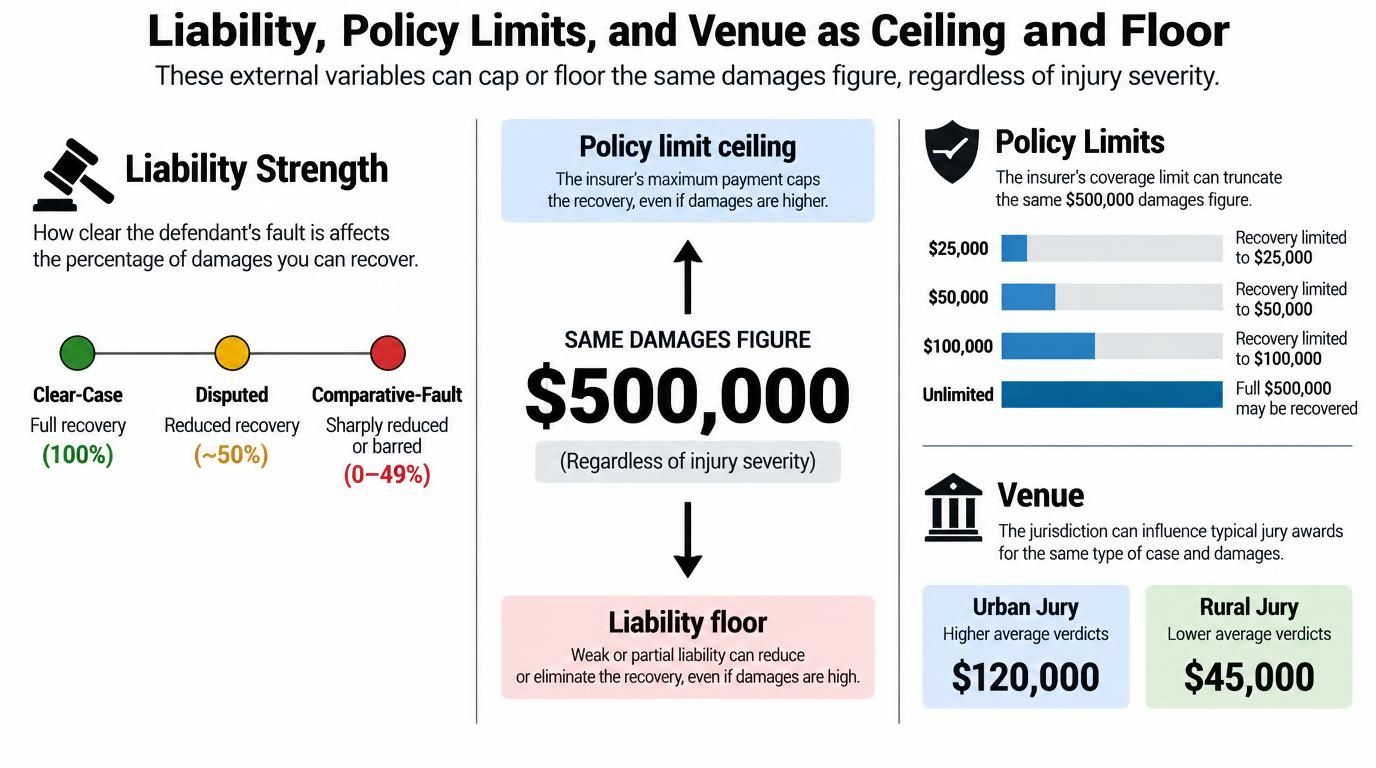
The practical lesson is to price these variables before sending the first demand. Don't present a damages total as if the defendant's coverage and the claimant's liability position are irrelevant.
A Worked Settlement Example From Bills to Net Recovery
A worked example is useful only if its assumptions are visible. The following illustration uses the $20,000 medical-bill example described in the Sacramento County Public Law Library material. Applying a 2x multiplier would produce a preliminary gross valuation of $40,000, but that figure is not a final settlement calculation. It excludes unresolved liability, future care, liens, fees, costs, and coverage.
The sequence matters:
- Confirm which medical charges were caused by the incident and remove duplicates or unrelated care.
- Add documented wage loss and necessary out-of-pocket expenses.
- Ask the treating physician whether future care is reasonably expected.
- Convert a supported future-care stream to present value where appropriate.
- Use a multiplier only as a starting framework for non-economic harm.
- Reduce the result for comparative fault, if supported by the governing law.
- Test the gross figure against available insurance and other recovery sources.
- Calculate the client's net after fees, case costs, medical balances, liens, and reimbursement claims.
| Worked Settlement Walkthrough: Bills to Net Recovery | ||
|---|---|---|
| Line Item | Amount | Notes |
| Past medical expenses | $20,000 | Illustrative medical-bill total from the verified example |
| Preliminary non-economic estimate | $40,000 gross total using a 2x multiplier | A starting heuristic, not a final value |
| Lost wages | Documented amount | Requires employer and payroll support |
| Future care | Supported projected amount | Should be based on medical evidence and present-value analysis |
| Comparative-fault adjustment | Case-specific | Depends on applicable law and proof |
| Coverage adjustment | Policy-specific | Recovery may be limited by available insurance |
| Attorney fees and case costs | Contract and expense specific | No universal deduction should be assumed |
| Liens and reimbursement claims | Claim-specific | Resolve before calculating the client's net |
| Net recovery | Not responsibly calculable without the missing inputs | Gross settlement and net proceeds are different calculations |
Suppose the claimant has a modest future-treatment recommendation. A demand that merely adds an unsupported estimate invites a reduction. A demand supported by a physician narrative and a life-care analysis gives the adjuster a defensible basis for authority, although the future amount may still be discounted to present value.
The same structure misfires in the chronic-pain example. If medical bills are low but the claimant has consistent symptom records, credible treatment explanations, therapist documentation, and strong evidence of lost activities, the lawyer should not let a small specials total dictate the entire non-economic claim. The valuation must shift from mechanical multiplication toward proof of duration, function, credibility, and lived impact.
The net figure can't be calculated from a gross demand alone. Fee agreements differ, costs vary, liens may be negotiated, and reimbursement rights depend on the particular plan or program. A responsible settlement analysis shows those unknowns instead of promising a take-home amount based on assumptions.
Negotiation Tactics That Move the Number
A strong negotiation usually begins before the demand letter. The file needs a clean liability narrative, a medical chronology, a damages summary, and an explanation of the requested non-economic valuation. The first demand should make it easy for an adjuster to explain the exposure to a supervisor who hasn't read every record.
The opening offer often reveals the carrier's theory of the case. A low offer may reflect disputed causation, treatment gaps, a liability argument, a reserve problem, or a simple effort to anchor the discussion. The response should identify the specific defect, answer it with evidence, and revise the demand only when the facts justify a revision.
At mediation, the mediator's early caucus helps identify which issue is blocking movement. One side may be arguing about the multiplier while the dispute concerns a pre-existing condition. Another may be arguing about future care while the carrier has not received the treating physician's prognosis. Reserved authority also matters. An adjuster who lacks authority to resolve the claim may need a focused package showing why additional authority is warranted.
Negotiation advice: Sequence the proof so the carrier understands liability and economic exposure before it is asked to price subjective harm.
Tools that extract dates, diagnoses, treatment, providers, charges, and missing bills can shorten the time between document production and a usable demand. Ares is one option for personal injury firms. Its workflow organizes medical records into summaries, special-damages totals, and demand-letter material for attorney review. The lawyer still has to test causation and judgment, but a structured chronology can expose gaps that a manual skim misses.
| Demand Letter to Mediation: Leverage Levers at Each Stage | |||
|---|---|---|---|
| Stage | Adjuster's Goal | Plaintiff Lever | Evidence That Moves the Number |
| Initial review | Find uncertainty and reserve a low amount | Complete, chronological presentation | Police report, photographs, records, wage proof |
| First offer | Establish the carrier's anchor | Separate disputed issues from unsupported assumptions | Targeted rebuttal with cited records |
| Counteroffer | Compress the valuation gap | Tie movement to specific concessions | Physician narrative, future-care support, venue analysis |
| Mediation | Test trial risk and authority | Show credible willingness to proceed | Deposition testimony, expert opinions, verdict research |
| Final negotiation | Avoid paying for unproven exposure | Protect the net recovery | Lien status, coverage analysis, documented costs |
Walking away can strengthen the claimant's negotiating position when the claimant has a credible litigation path, sufficient time, strong evidence, and a realistic trial budget. It can stall the file when the demand has no new proof, coverage is exhausted, or the claimant has not addressed an obvious liability problem. The decision should follow a risk-adjusted net analysis, not frustration with the last offer.
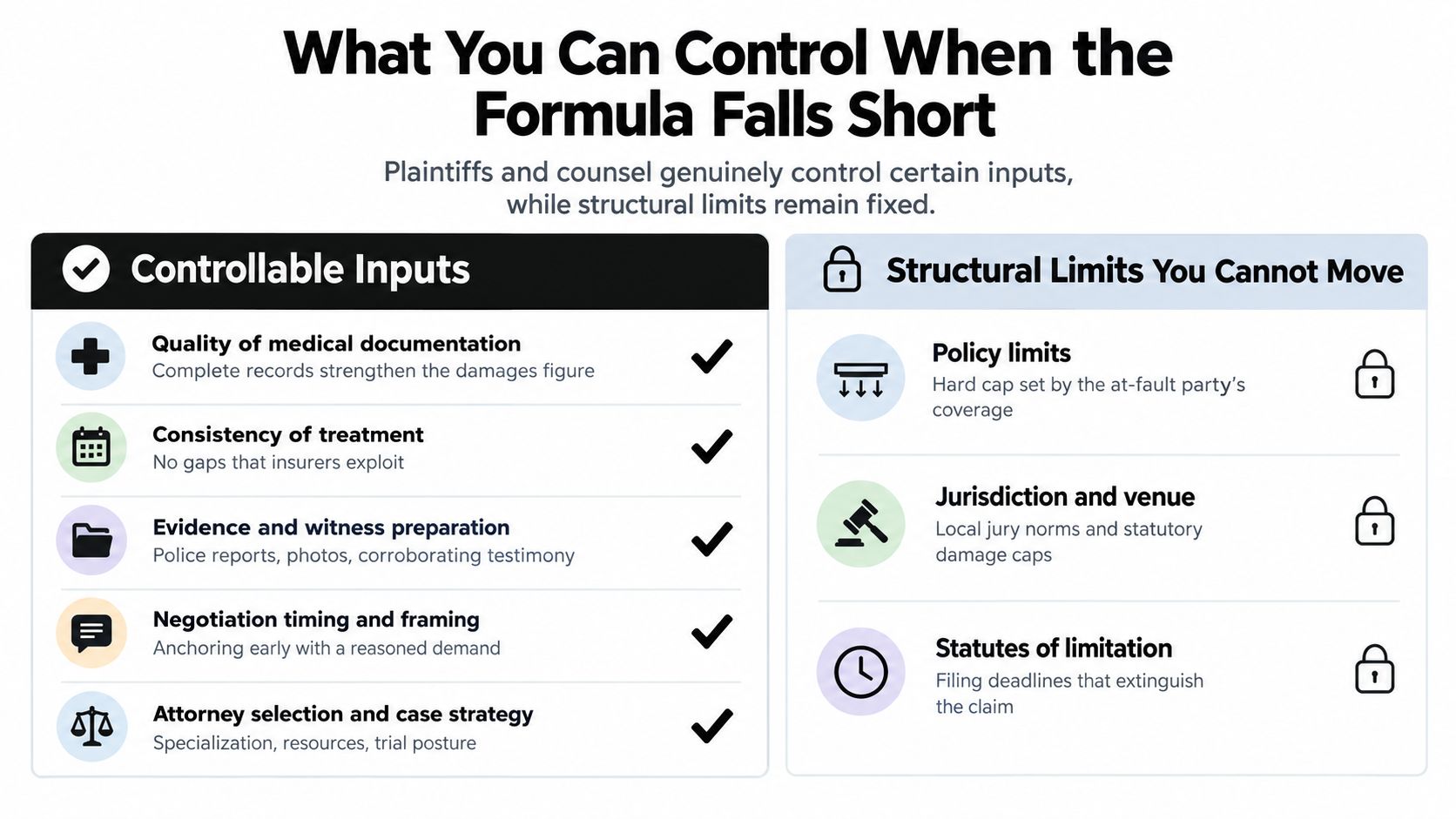
What You Can Control When the Formula Falls Short
The controllable part of settlement value is mostly evidentiary. You can't choose the policy limits after the accident, change the venue's jury tendencies, erase comparative-fault facts, or select the defense lawyer assigned to the file. You can improve the records, clarify the chronology, prepare witnesses, document restrictions, and present a demand that makes the exposure understandable.
Before serious settlement negotiations, check the following:
- Medical records: Confirm that dates, diagnoses, treatment, charges, referrals, and gaps are reconciled.
- Causation: Obtain a treating physician's explanation where the defense may argue pre-existing conditions or an unrelated cause.
- Future loss: Support future care and earning-capacity claims with appropriate medical, vocational, life-care, or economic analysis.
- Wage proof: Match work restrictions to employer records and the actual period of missed or reduced work.
- Non-economic evidence: Gather photographs, symptom journals, therapy records, activity comparisons, and witness observations.
- Coverage: Identify all applicable policies, additional defendants, and reimbursement interests.
- Liens: Obtain current balances and model negotiation outcomes before evaluating the client's net.
- Demand quality: Use a damages table, medical chronology, liability analysis, and a clear explanation of the requested valuation.
- Negotiation posture: Decide in advance which issues justify movement and which require litigation.
The multiplier remains useful because it gives both sides a common starting language. It fails when lawyers treat it as the conclusion. Settlement value is built through medical proof, economic analysis, liability preparation, coverage investigation, and credible negotiation. The formula organizes the conversation, but the records determine whether the conversation moves.
If your firm needs a faster way to organize medical records, calculate specials, identify treatment gaps, and prepare a fact-supported demand, explore Ares. Use it to turn disorganized case files into reviewable settlement material, then apply your litigation judgment to the liability, damages, lien, and negotiation decisions that determine the client's net recovery.