
A Monday morning phishing incident can turn a routine workday into a legal and operational emergency. A paralegal clicks a convincing message, credentials are captured, and an attacker exports months of demand packages, intake forms, and medical-record requests. The managing partner may not know the full scope yet, but the firm already has a problem: the records contain protected health information, the claimants live in multiple states, and a single file may create obligations under more than one regime.
Personal injury firms face this exposure constantly because their case files combine medical records, insurance information, identity data, financial details, and litigation communications. Vendors add another layer. Cloud case-management platforms, record-retrieval services, e-discovery providers, document processors, email systems, and outside investigators may all touch the same file.
The practical answer isn't a collection of disconnected legal summaries. It's one incident-response playbook that identifies the earliest discovery date, preserves evidence, maps affected people by jurisdiction, and drafts a notice broad enough to satisfy the strictest applicable rule. A firm that waits for perfect forensic certainty may miss a deadline. A firm that sends a vague notice may satisfy speed while failing content requirements.
The following framework treats data breach notification requirements as an integrated workflow for PI firms handling PHI across federal, state, and cross-border obligations.
When a Breach Hits a PI Firm
The first call should activate a defined response team, not start an improvised debate about whether the event is “really” a breach. The managing partner, compliance lead, IT contact, breach counsel, insurer, and relevant vendor should preserve the facts while investigators determine what happened.
Start with the earliest reliable timeline
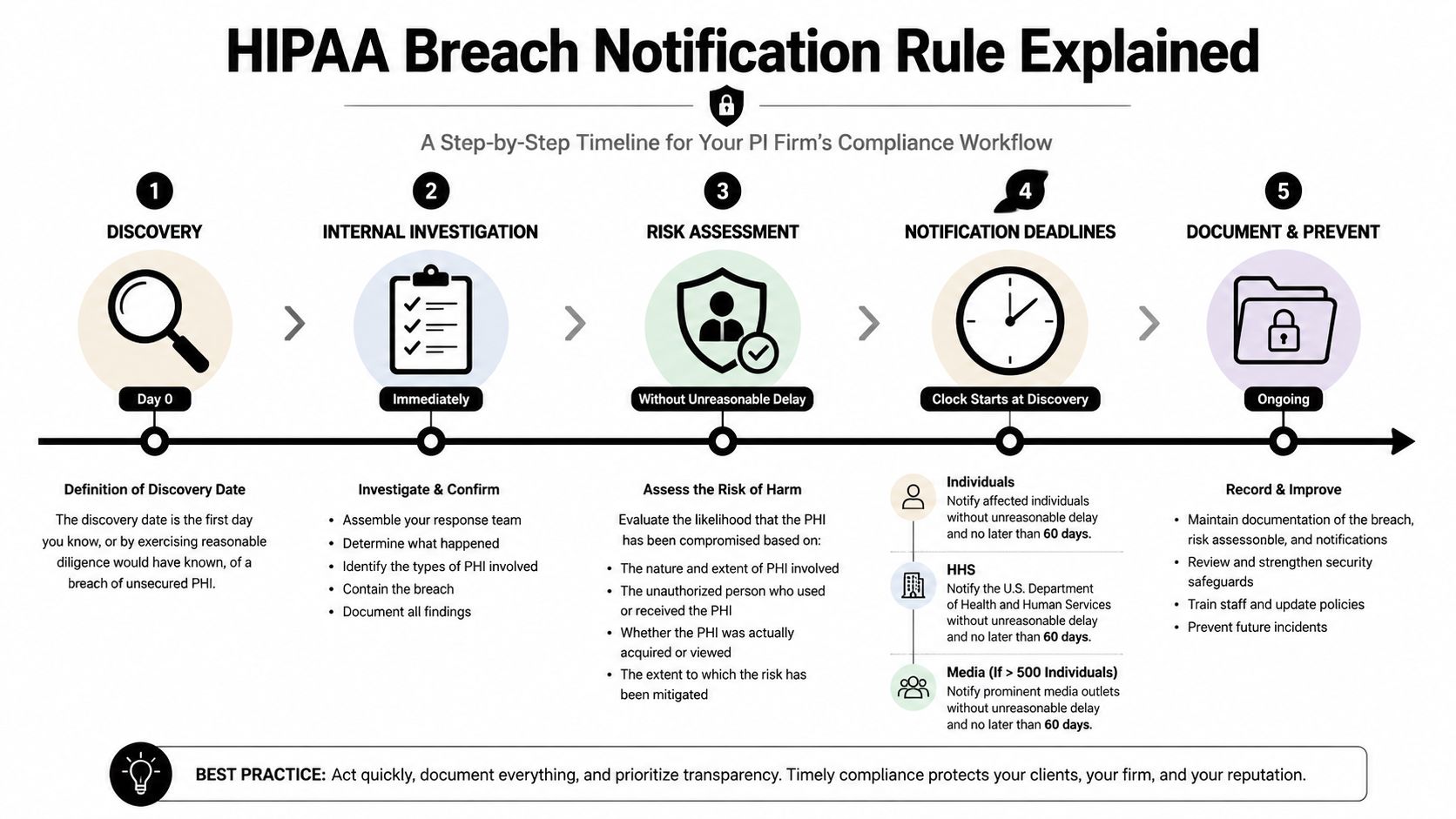
Under HIPAA, discovery is tied to the earliest date the firm or business associate knew, or reasonably should have known, about the breach. That makes the phishing alert, unusual export, vendor notification, or employee report a critical time entry. Record who learned what, when they learned it, and which system generated the evidence.
The firm should immediately:
- Contain access: Isolate the affected workstation or account without destroying volatile evidence.
- Preserve records: Protect authentication logs, email headers, file-access logs, endpoint images, and vendor reports.
- Escalate consistently: Route all communications through the response team and instruct staff not to alter or delete files.
- Map exposure: Identify whose records were present, what information was involved, and where each person resides.
Practical rule: Treat the earliest credible awareness date as the start of the most demanding clock until counsel documents a different conclusion.
A global or cross-border file can create a second layer of urgency. The GDPR generally requires controller notice to the competent supervisory authority without undue delay and, where feasible, within 72 hours of awareness, unless the incident is unlikely to risk individuals' rights and freedoms. The firm may also need to notify affected people when the breach is likely to create a high risk. For operational guidance outside the United States, firms can also review this resource on after a breach actions for UK firms.
The central discipline is simple: build one incident record, then apply each legal rule to the same verified facts. A state may require consumer notice even when a federal analysis is still developing. A vendor may investigate the intrusion, but the firm still needs ownership of its legal calendar.
HIPAA Breach Notification Rule Explained
HIPAA applies differently depending on whether the PI firm is acting as a covered entity, a business associate, or a service provider supporting one. The agreement structure matters, but it doesn't replace operational preparation. A firm should know which party sends notices, which party reports to HHS, and how the parties exchange affected-person data before an incident occurs.
Establish discovery and presume exposure where appropriate
HIPAA's breach analysis begins with discovery. A ransomware event affecting a case-management server may indicate that unauthorized people accessed or acquired PHI, even if the firm can't immediately identify every viewed file. A stolen laptop may fall within an exception when the PHI was properly encrypted and the encryption key wasn't compromised. The firm must document the technical facts supporting either conclusion.
The usual HIPAA risk assessment examines four areas:
- Nature and extent of the PHI, including the types of identifiers and the likelihood that the information could be used to harm a person.
- The unauthorized person, or the person to whom the disclosure was made.
- Whether the PHI was acquired or viewed, based on available system and forensic evidence.
- The extent of mitigation, including retrieval, deletion, access termination, and other protective measures.
A low-probability-of-compromise conclusion requires more than a conclusory sentence. Preserve the evidence, identify the person making each judgment, and connect every conclusion to the facts available at the time.
Separate the audiences and deadlines
Affected individuals must receive notice without unreasonable delay and no later than 60 calendar days from discovery, as explained by the U.S. Department of Health and Human Services breach reporting guidance. HHS reporting follows a separate path. Breaches affecting fewer than 500 individuals can be reported annually within 60 days after the end of the calendar year in which discovery occurred, while larger breaches require a different, more immediate reporting workflow.
A breach affecting 500 or more residents of a single state or jurisdiction may also require prominent media notice. The firm should therefore maintain a person-level data set that records residence, affected PHI categories, mailing status, and the notice channel used. For a practical explanation of the information at issue, firms can consult what PHI means in healthcare.
Don't let the annual HHS option for smaller incidents create delay. State law, contractual terms, professional obligations, and individual-notice requirements may run on different calendars.
State Breach Notification Laws Across PI Jurisdictions
State laws differ in trigger language, deadlines, regulator reporting, and required notice content. A PI firm can't safely treat the claimant's state of residence as a minor administrative detail. It determines which rule may control the notice sent to that claimant and whether an attorney general receives a filing.
California's framework now includes a 30-day consumer-notice requirement and a 15-day Attorney General notice requirement for breaches affecting more than 500 California residents, based on the current development described by Pillsbury's analysis of California breach notification requirements. The same analysis identifies proposed EU changes that would alter the current GDPR regulator-notice framework, so counsel should confirm the rule in effect on the discovery date rather than rely on an old template.
The comparison below is a drafting guide, not a substitute for reviewing the statute and current regulator instructions.
| State | Notification Deadline | AG Notice Threshold | Required Content Highlights |
|---|---|---|---|
| California | Within 30 days under the developing SB 446 requirement | More than 500 California residents, with AG notice within 15 days | Incident description, affected information, protective steps, firm contact information, and regulator submission |
| New York | Without unreasonable delay, subject to statutory limits and regulator coordination | Threshold and recipient depend on the affected population and incident | Incident facts, affected data, protective guidance, contact details, and required agency notices |
| Florida | Without unreasonable delay and within the applicable statutory cap | Regulator notice may apply based on affected residents and incident scope | Incident description, information involved, mitigation, contact details, and required reporting |
| Texas | Without unreasonable delay and within the applicable statutory cap | Attorney General reporting may apply when the statutory threshold is met | Plain-language incident details, data categories, protective actions, and contact information |
| Illinois | Without unreasonable delay, subject to the statute's timing rules | Reporting depends on the affected population and statutory requirements | Description, information involved, response measures, and individual assistance details |
| Pennsylvania | Without unreasonable delay under the applicable state requirements | Regulator notice depends on the statutory trigger and affected population | Incident description, affected information, mitigation, and contact procedures |
Draft to the broadest applicable standard
The effective strictest-state rule is operational rather than purely legal. If California requires a faster consumer notice than another state, use the California deadline as the internal target for the whole affected population when a unified mailing is practical. If one state requires additional content, include it in the master notice rather than creating inconsistent versions without a documented reason.
Track attorney general submissions separately from individual notices. A useful compliance checklist for data breaches can help a firm organize statutory tasks, but counsel should adapt the checklist to the states represented in the actual incident.
GDPR, CCPA, and Cross-Border Obligations
A PI firm's U.S. location doesn't automatically eliminate cross-border duties. The key questions are where the affected person resides, why the firm processed the data, whether the firm offered services or monitored behavior in the EU, and whether the firm meets the applicable California thresholds.
The GDPR controller clock is distinct from HIPAA and state clocks. A controller must notify the competent supervisory authority without undue delay and, where feasible, within 72 hours of becoming aware of a personal data breach when the breach is likely to risk individuals' rights and freedoms. Article 34 adds individual notification when the breach is likely to result in a high risk. The GDPR Article 33 text provides the governing regulator-notice framework.
California analysis requires care because the consumer-notice rule and the CCPA or CPRA privacy framework don't answer every question in the same way. Medical and insurance information common in PI files may qualify as personal information under California breach law when the statutory conditions are met, particularly where the information is unencrypted and unauthorized acquisition creates the relevant risk. The CCPA's broader privacy rights and any private-action analysis should be evaluated separately from the breach-notice trigger.
| Element | GDPR | CCPA/CPRA |
|---|---|---|
| Core trigger | A personal data breach likely to risk individuals' rights and freedoms | Unauthorized access or acquisition of covered personal information under California breach law |
| Regulator notice | Supervisory authority notice without undue delay and, where feasible, within 72 hours | California regulator notice follows the applicable state requirement |
| Individual notice | Required where the breach is likely to create a high risk | Required for affected California residents when the statutory breach trigger applies |
| Geographic focus | EU or EEA data and applicable territorial connections | California residents and the firm's covered business activity |
| Drafting focus | Risk, consequences, mitigation, and authority coordination | Affected information, protective steps, and California-specific delivery and filing rules |
A Canadian claimant's file doesn't automatically create GDPR coverage, but an EU resident's record may require a documented territorial analysis. Keep that analysis with the incident file, and use a structured vendor security assessment before an outside processor handles sensitive records.
Anatomy of a Compliant Breach Notice
A strong notice gives the recipient enough information to understand the event and take protective action without disclosing unnecessary investigative detail. Build a master template around the HIPAA fields, then add state-specific delivery, regulator, and assistance requirements.
Use one factual core
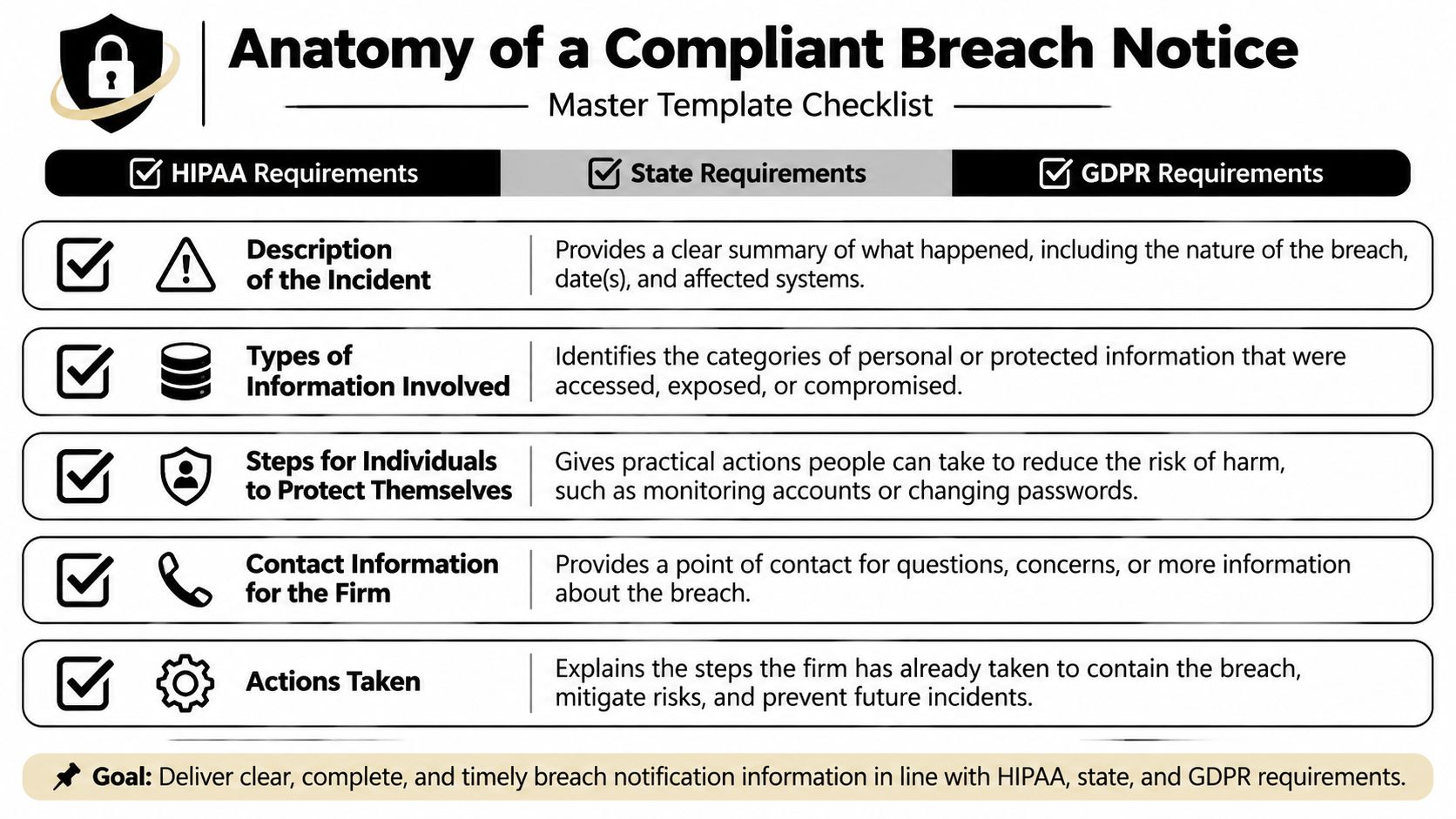
The notice should identify:
- What happened: State the incident type and the relevant discovery and containment facts.
- What information was involved: Describe PHI and other personal information categories without speculating beyond the evidence.
- What the recipient should do: Recommend account monitoring, fraud precautions, medical-record review, or other steps appropriate to the exposed information.
- What the firm has done: Explain containment, investigation, credential resets, vendor action, and protective services provided.
- How to contact the firm: Give a working phone number, mailing address, and a staffed process for questions.
- What misuse could mean: Use plain language to explain risks such as identity misuse, medical-identity fraud, or targeted phishing.
HIPAA notice content should remain understandable to a nonlawyer. State laws may require additional agency information, toll-free contact details, or specific language. GDPR communications may also need the controller's identity, the legal basis for processing, likely consequences, mitigation steps, and the Data Protection Officer's contact information where applicable.
Delivery is part of compliance
First-class mail is the standard route for many HIPAA individual notices. Email may be used when the recipient has consented to electronic communication, and substitute notice may become available when the firm can't reach people, subject to the applicable conditions. HIPAA includes a substitute-notice path involving website posting and statewide media when 10 or more individuals are out of touch.
A useful internal boilerplate structure is: “We're writing to explain what happened, what information may have been involved, what we've done in response, and the steps you can take now.” Counsel should replace that opening with incident-specific facts and confirm every required element before release.
Safe Harbors, Exceptions, and Encryption Defenses
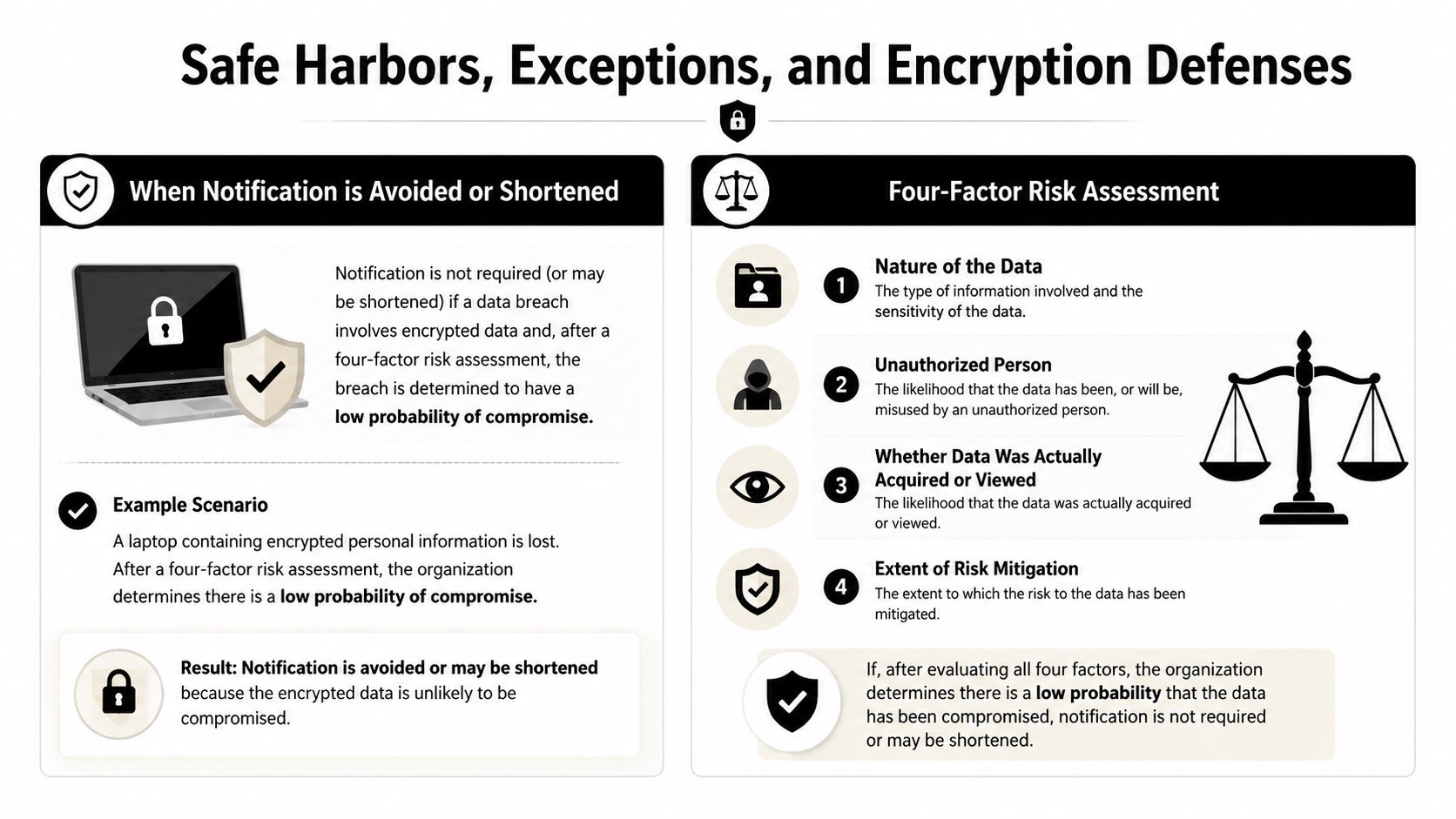
Safe harbors can reduce notice obligations, but only when the firm can prove the technical and factual conditions behind them. A lost device isn't automatically a reportable breach, and a vendor incident isn't automatically exempt.
For HIPAA, the four-factor risk assessment can support a conclusion that there's a low probability the PHI was compromised. A properly encrypted laptop with no indication that the key was accessed presents a different analysis from an unencrypted device, even if both were stolen from the same vehicle. Ransomware demands closer review because unauthorized access, exfiltration evidence, and encryption of files can produce different factual conclusions.
State laws commonly distinguish protected information that is unreadable or unusable from information exposed in clear form. Encryption at rest and in transit can support a safe-harbor position, but the firm must verify the algorithm, key management, backup configuration, and whether an attacker obtained the credentials needed to decrypt the data.
Keep the defense file
A defensible exception analysis should contain:
- Technical proof: Encryption settings, key-access records, endpoint status, and relevant forensic findings.
- Legal reasoning: The rule applied, the facts considered, and the person approving the conclusion.
- Mitigation evidence: Credential revocation, device recovery, data deletion, and communications with affected vendors.
- Residual-risk analysis: Why the remaining facts support no notice or a narrower response.
A business associate's contractual duty to investigate and report doesn't eliminate the PI firm's responsibility to oversee the response. Store the assessment with the firm's security and records workflow. A HIPAA-oriented document management resource may help organize access controls and response records, but the legal team still needs to validate the incident conclusion.
72-Hour Incident Response Checklist for PI Firms
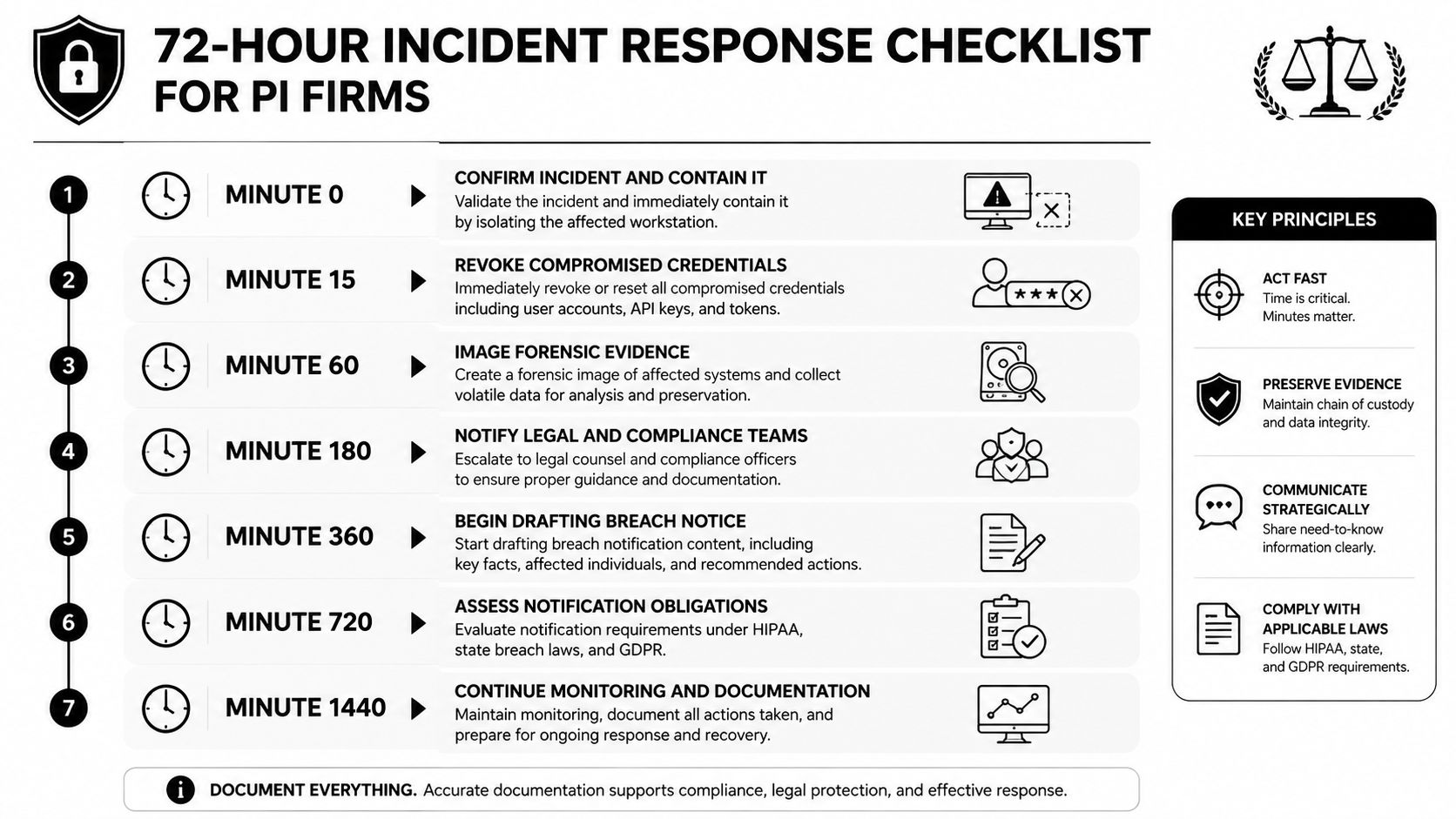
The first 72 hours should produce a reliable incident record and a draft notice, not a promise that the investigation is complete. The GDPR benchmark makes that window especially important for cross-border files, while HIPAA and state laws may impose different deadlines.
Minute zero through hour twelve
- Confirm and contain: Isolate the affected workstation, account, server, or vendor connection. Don't wipe a device before forensic counsel and investigators preserve the evidence.
- Revoke access: Reset compromised credentials, terminate active sessions, disable suspicious tokens, and review privileged accounts.
- Preserve the record: Image relevant systems, collect logs, preserve email evidence, and open a protected incident chronology.
- Convene the team: Notify breach counsel, the compliance lead, IT, the cyber insurer, and the responsible vendor. Assign one person to maintain the legal calendar.
- Start the HIPAA analysis: Apply the four factors to the known evidence, while treating missing evidence as an investigation task rather than a reason to delay containment.
Hours twelve through forty-eight
Map affected case files to individuals, PHI categories, states, and any EU connection. Separate confirmed access from possible access, but don't remove a person from the working list solely because the investigation hasn't found a definitive viewing event.
Then prepare the master notice. Include the HIPAA factual core, the broadest state content, the fastest applicable deadline, and any GDPR risk and consequence analysis. Create separate regulator packets for HHS, state attorneys general, supervisory authorities, and media where required.
Hours forty-eight through seventy-two
Finalize the decision log, obtain legal approval, submit urgent regulator notices, and begin individual mailings when the facts support them. Activate any promised assistance only after confirming the provider, scope, eligibility, and contact process.
Use this video as a staff-training supplement after the immediate response has begun.
Keep copies of notices, mailing records, returned mail, regulator confirmations, forensic reports, vendor communications, and every decision to notify or not notify. The file should let a later reviewer reconstruct the firm's reasoning without relying on memory.
Penalties, Enforcement, and Final Takeaways
A weak response exposes a PI firm to more than one regulator. HHS may examine HIPAA compliance, state attorneys general may investigate state-law notice failures, clients may assert contractual claims, and affected individuals may pursue negligence or privacy theories. The firm may also face insurer disputes, vendor indemnity fights, professional-liability questions, and damage to referral relationships.
The enforcement risk is cumulative because each failure creates evidence for the next inquiry. A missed internal escalation can explain a late notice. A missing risk assessment can undermine an encryption defense. An inconsistent notice can suggest that the firm never established what happened.
Make the playbook operational
Leadership should require:
- One master incident plan: Assign owners for containment, legal analysis, communications, vendor coordination, and regulator filings.
- Jurisdiction mapping: Maintain current claimant residence, PHI category, and notice-channel data in a controlled system.
- Technical safeguards: Encrypt PHI at rest and in transit, protect keys, enforce multifactor authentication, and monitor vendor access.
- Role-based training: Teach intake staff and paralegals how to identify phishing, report suspicious activity, and preserve evidence.
- Decision documentation: Record discovery, scope assumptions, risk factors, approvals, notices, and follow-up actions.
The Privacy Rights Clearinghouse 2025 data breach report highlights the practical gap between legal deadlines and actual notification practice. Its review found that the most common notification window among breaches with known dates was 91 to 180 days, and fewer than 10% would have met California's new 30-day standard under SB 446. For a PI firm, that gap is a warning against waiting for a perfect forensic narrative before preparing notice.
A disciplined response begins before the incident. Run tabletop exercises, test the vendor escalation path, maintain templates, and make sure the person responsible for the clock can reach counsel and technical support immediately. The strongest defense isn't a policy stored in a folder. It's a practiced sequence that produces evidence, decisions, and compliant notices while the facts are still developing.
Ares helps personal injury firms organize sensitive medical records and produce structured medical overviews and demand drafts, with HIPAA-compliant handling designed for PHI workflows. Visit Ares to evaluate how its document-processing platform can fit into your firm's controlled case-file and incident-response processes.