

You're probably looking at a stack of medical records that never seems to shrink, a demand letter that's due before lunch, and a team that's already stretched thin. The pressure isn't abstract. It shows up when a partner is still reading at 9 p.m. and the file in front of them is too messy to trust, too important to ignore, and too expensive to redo.
That's where competitive advantage through technology becomes real for a PI firm. It isn't about buying a prettier platform or adding another login. It's about redesigning the few workflows that decide whether your firm moves fast, stays consistent, and compounds knowledge from one case to the next.
What Competitive Advantage Actually Means for a PI Firm
Competitive advantage in a PI firm is simple. It means your team can do a piece of work at a speed, quality, and cost structure that rivals can't match, and then repeat that advantage across cases. If the tech doesn't change how the work gets done, it's not an advantage. It's just software expense.
A lot of firms confuse productivity with strategy. Productivity is shaving minutes off a task. Strategy is building a process that gets better every time it runs because the firm keeps the context, the decisions, and the cleanup inside its own workflow. That's the difference between a clever shortcut and a moat.
The two workflows that matter most
For PI, the strategic edge sits in two places: medical record review and demand drafting. Those are the bottlenecks where time, quality, and case posture collide. If your firm can turn those into repeatable, context-rich workflows, you're not just faster. You're harder to copy.
Practical rule: if a technology purchase doesn't change intake, review, drafting, or QC, it won't create durable advantage.
MIT Sloan's competitive-dynamics framework describes a common winning sequence as moving from product to service, then to intelligence, then to platform. In PI terms, that means the firm stops selling “representation” as an isolated product and starts building a service system that remembers what it learned from every file. The gain comes when the workflow itself becomes a proprietary asset, not just the output.
The wrong question is, “Should we buy AI?” The right question is, “Which work should we redesign so competitors can't easily duplicate our speed or consistency?” That's the only version of technology that matters.
From Product to Platform, the MIT Sloan Sequence Applied to PI
MIT Sloan's sequence is useful because it strips away the hype. First, you sell a product. Then you wrap it in service. Then you make the service intelligent with customer information. Then you build infrastructure and platform capabilities that others can plug into. The lesson for PI firms is blunt. A document tool alone doesn't create advantage. A repeatable data pipeline does, because it keeps compounding the firm's own process knowledge over time. MIT Sloan's competitive-dynamics framework makes that sequence explicit.
What each stage looks like in a PI practice
At the product stage, the firm offers legal representation. At the service stage, intake, record collection, chronology building, and review get standardized. At the intelligence stage, the firm captures structured case data so the next case starts with better inputs. At the platform stage, the firm's internal team, experts, and co-counsel operate inside a shared infrastructure instead of scattered inboxes and one-off files.
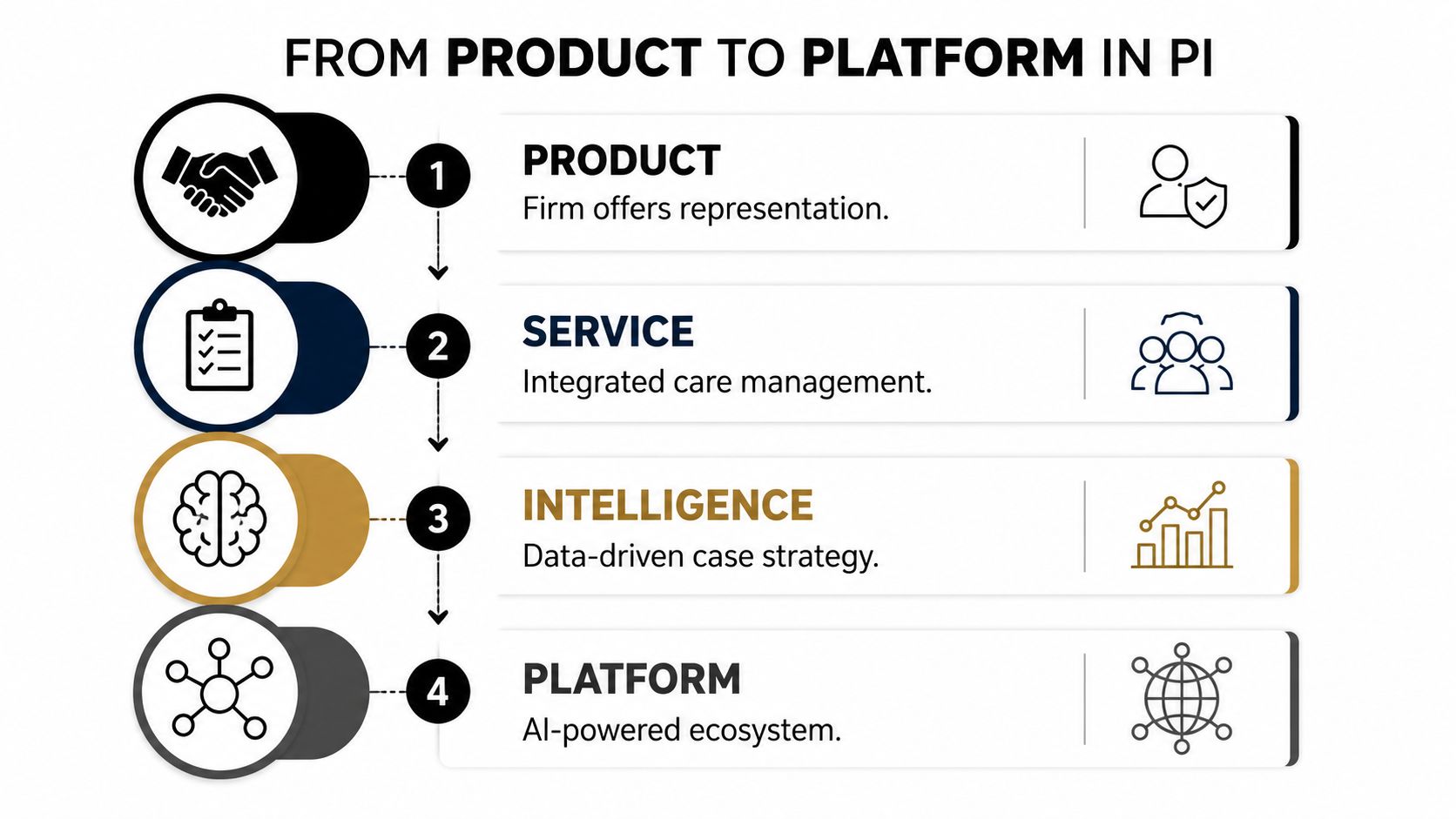
The hierarchy is worth keeping in your head when you evaluate tools.
- Product. The firm wins a matter.
- Service. The firm standardizes intake and file handling.
- Intelligence. The firm learns from each record set, demand, and outcome.
- Platform. The firm makes that intelligence reusable across cases and teams.
A lot of lawyers stop at automation because it feels efficient. It is efficient, but efficiency isn't the finish line. If the system doesn't preserve context, improve decision quality, and create a harder-to-copy workflow, your competitor can buy the same thing and catch up fast.
The firms that win don't just process documents faster. They build a case memory.
The Five Moats That Actually Matter in Personal Injury
McKinsey's 2024 AI research points to a small set of reinforcing choices that create durable moats, including privileged data, learning speed, capability reinvention, external partnerships, and trusted AI use. The key point is not that every firm should chase all five. It's that most PI firms should own only two or three, and master them. The research also shows that firms pulling ahead are making deliberate trade-offs instead of trying to build every advantage at once. McKinsey's AI advantage research gets that part right.
What a PI firm can realistically build
For a high-volume PI practice, the moat is privileged data. Every demand letter, chronology, provider response, and revised draft adds to a case-history corpus that gets more useful over time. That's not trivia. It's the raw material of faster judgment and better consistency.
Learning speed matters too, but only if the firm can update templates, prompts, QC rules, and review standards quickly. A team that ships the same sloppy process faster hasn't gained much. A team that learns from missed gaps and folds them into the next review cycle has.
Capability reinvention is the third practical moat. That's the ability to turn one workflow into another, for example, using structured record review to improve demand assembly, negotiation prep, and cross-examination notes. A firm that reinvents the same data across multiple tasks gets more value from each file than a firm that uses AI only to summarize PDFs.
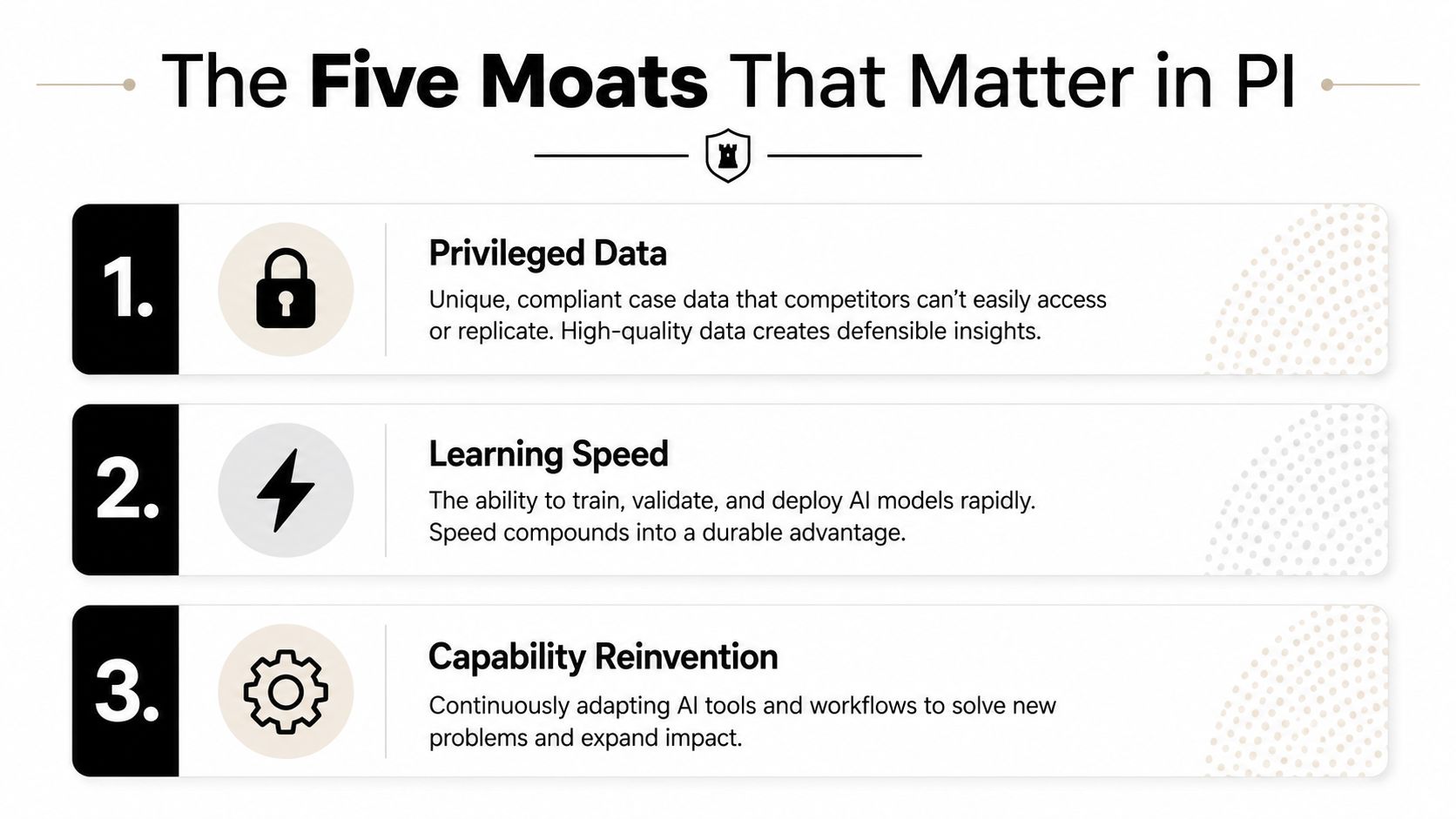
You do not need five moats. Most firms can't operationalize five moats without turning operations into theater.
- Solo practice. Privileged data, trusted AI use.
- Mid-size firm. Privileged data, learning speed, capability reinvention.
- High-volume firm. Privileged data, learning speed, capability reinvention, plus strong partnerships and governance.
The fragile position is saying, “We bought the same tool you did.” That's not a moat. It's a procurement choice. The durable position is saying, “Our workflow, data loop, and governance model make this technology hard to copy.”
How a Medical Records to Demand Workflow Actually Runs
The workflow starts the moment a file lands. A paralegal or case manager drags and drops the records, and the system begins pulling out the dates, diagnoses, treatments, providers, and symptom chronology that matter for the claim. The point is not to replace the attorney's judgment. The point is to remove the worst part of the slog so the attorney can spend time on liability, causation, and negotiation.
Here's the ownership shift in plain English.
| Workflow Step | Before (Attorney/Paralegal Hours) | After (AI Hours) | After (Human Review Hours) |
|---|---|---|---|
| Record intake and sorting | Heavy manual review | Minimal | Light QC |
| Date and provider extraction | Manual tagging | Automated extraction | Verification |
| Chronology building | Manual assembly | Automated structure | Attorney review |
| Demand draft assembly | Draft from scratch | Draft generation | Attorney rewrite and sign-off |
| Final strategy and negotiation prep | Human-led | Not applicable | Human-led |
The internal logic is simple. AI can do the extraction, ordering, and first-pass drafting. People still own coverage analysis, liability framing, treatment gap interpretation, and settlement posture. That's where judgment lives.
For a deeper walkthrough of the structure behind the file-to-demand process, the firm's own write-up on medical records summarization is worth reading before you shop for tools.
What changes and what stays human
A good workflow doesn't automate the whole case. It automates the parts that are repetitive, error-prone, and expensive to do manually. If the system can surface a chronology in minutes, the attorney can spend time asking better questions about causation and damages. If the draft demand starts from a structured overview, the paralegal isn't rebuilding the same narrative from scratch.
The goal isn't fewer lawyers in the loop. The goal is fewer hours wasted on work that doesn't require lawyer judgment.
Some firms waste money. They buy broad platforms that promise everything, then use them for none of the high-friction work that slows cases down. A narrow workflow built around records and demands beats a general-purpose stack almost every time.
A Realistic Case Scenario Where the Workflow Pays Off
A mid-size PI firm takes in a 900-page auto collision file. The injuries look routine at first glance, soft-tissue complaints, a concussion allegation, scattered follow-ups, and a messy treatment timeline. A paralegal has already skimmed it, but the file still feels ambiguous.
The AI review catches something the human skim missed. There's a treatment gap that affects the narrative, and the system also flags a prior similar claim tied to the same provider network. That context changes the conversation immediately. The attorney doesn't have to build the story from fragments. The attorney can frame the demand around continuity, credibility, and likely defense arguments before the other side raises them.
Practical rule: the first firm to see the gap usually controls the posture of the file.
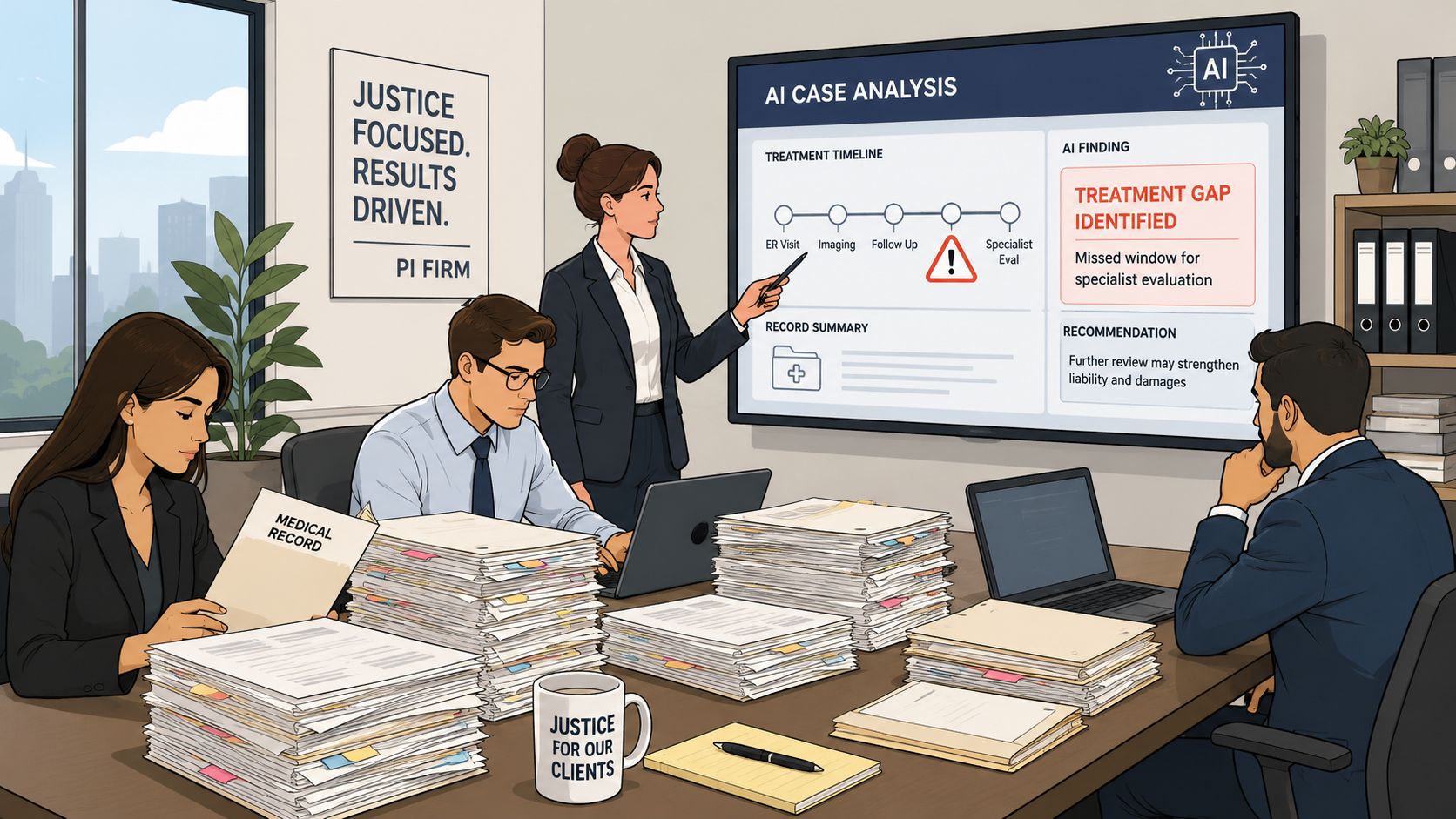
The payoff is not just speed. It's a strategic advantage. A cleaner chronology, a better demand narrative, and earlier spotting of weak points change how the attorney approaches settlement and how prepared they are for cross-examination. That kind of context is hard for opposing counsel to replicate because they don't own your intake, your review trail, or your internal learning loop.
Firms report eliminating 10+ hours of manual review and drafting per case, which boosts caseload capacity without sacrificing quality. That's the right kind of number to care about, because it ties directly to how many files the firm can move without adding headcount.
That's why one well-designed workflow can outperform a pile of generic tools. The firm isn't just processing documents faster. It's building a pattern library that makes each next file easier to handle.
Measuring ROI in Hours, Settlements, and Capacity
If you can't measure it, partners won't fund it for long. The cleanest ROI case for PI tech is built on three buckets, hours reclaimed, settlement posture, and capacity. Start there, and ignore vanity metrics like “documents processed” unless they tie back to those three.
Use the numbers that matter
The first calculation is time. If the workflow removes hours from review and drafting, multiply those hours by your blended internal cost. That gives you the labor savings per case. The second calculation is settlement value, which is harder to pin down but easier to observe in practice when demands go out earlier and with cleaner support. The third is capacity, because one firm can often absorb more cases without hiring if the manual backlog shrinks.
For a practical framework on how to evaluate software spend, the article on measuring AI solution ROI is useful because it pushes teams to tie adoption to cash, not hype.
| Metric | Per Case | Annual (120 Cases) | Dollar Impact |
|---|---|---|---|
| Manual hours reclaimed | 10+ hours | 1,200+ hours | Multiply by blended hourly cost |
| Review and drafting efficiency | Faster turnaround | More files processed | Capacity gain without immediate hiring |
| Settlement posture improvement | Case-specific | Case-specific | Use your actual demand and outcome data |
The dollar math is straightforward once your firm plugs in its own rates. The harder part is discipline. If the workflow saves time but the team still uses that time to rework the same messy process, you haven't gained anything.
Don't let the dashboard flatter you. Measure revenue impact, case throughput, and attorney time saved, then ignore everything else.
One more point. Capacity gains only count if the firm can absorb more work without breaking QC. If more volume means sloppier demands, you didn't buy advantage. You bought a faster way to create problems.
Compliance, HIPAA, and the Hidden Risks of Bad AI Adoption
A login screen doesn't make a tool safe for PHI. If the vendor can't give you a real compliance story, the firm is taking on risk, not gaining advantage. That means the basics matter, BAAs, data residency, model training opt-outs, audit logs, and retention policies.
The failure modes are predictable. If data leaks, if a shared model trains on your files, or if the firm can't reconstruct who saw what and when, the workflow becomes a liability. Advantage disappears the moment procurement and ops can't prove control.
The internal standards for HIPAA compliant document management should sit on the desk of whoever signs off on technology, not buried in a policy folder. If you handle protected health information, compliance has to be part of the workflow design, not a checkbox at the end.
What enterprise-grade adoption actually requires
The Ares platform is HIPAA compliant and designed with enterprise-grade privacy and security controls, making it suitable for sensitive PHI. That matters because compliance is not just a legal requirement, it's a moat. Firms that bolt consumer-grade AI onto sensitive work will struggle to clear enterprise procurement and internal risk review.
The risk list is short but serious.
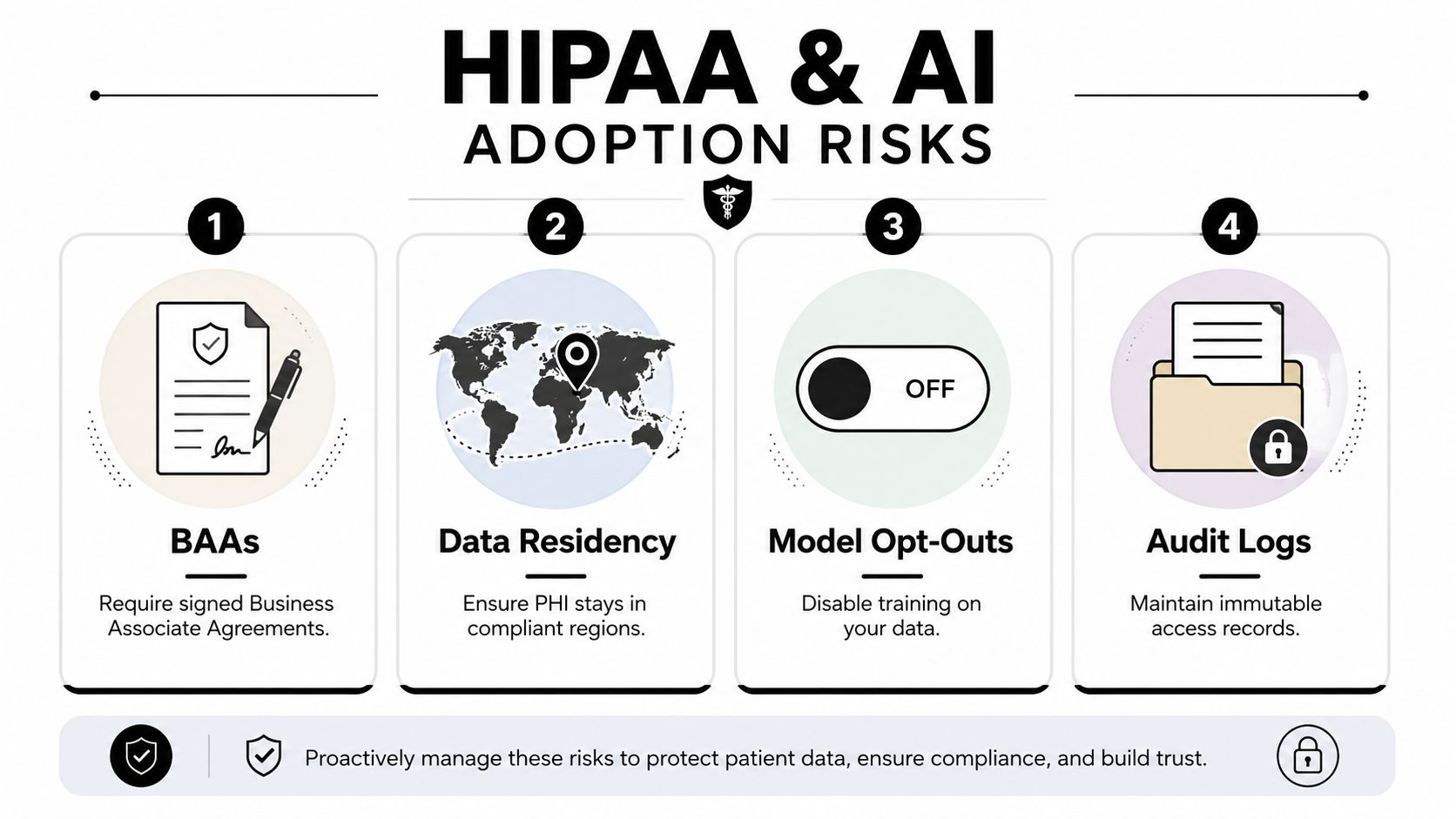
- BAAs. Require signed Business Associate Agreements.
- Data residency. Keep PHI in compliant regions.
- Model opt-outs. Disable training on your data.
- Audit logs. Maintain immutable access records.
If you need a plain-English parallel for how serious standards work in other regulated contexts, the discussion of laboratory testing standards is a helpful reminder that process control matters as much as output. In legal tech, the same principle applies. If the system can't be governed, it can't be trusted.
Your 30-60-90 Day Plan for a Real Advantage
Days 1 to 30, pick one workflow, one moat, and one outcome. Don't chase five tools. Pick medical records or demand drafting, decide whether the moat is privileged data or learning speed, and measure hours reclaimed. If you want the operating logic behind that discipline, the case for why automation is required is straightforward.
Days 31 to 60, run the new workflow on ten live cases in parallel with the old one. Log every miss, every correction, and every place the human still had to rebuild the file. Then tighten prompts, templates, and QC until the new process is cleaner than the old one.
Days 61 to 90, lock the process into intake and review, retire the manual steps, and tell clients what changed. The advantage is not the tool. It's the firm's willingness to redesign the work around it.
Ares automates medical record review and demand drafting for PI firms that want a tighter workflow and a stronger case narrative. If you're ready to build advantage around one hard workflow instead of buying another generic platform, visit Ares and see how the process fits your firm.