A new personal-injury file arrives before lunch. The client has signed, three providers still owe records, treatment dates don't line up, and the attorney wants to know whether the claim is ready for a demand. One employee starts calling providers and updating the client. Another opens the medical file, checks liability facts, and begins drafting. By midafternoon, both believe they own the missing billing records, while nobody has clearly accepted responsibility for deciding whether the file is demand-ready.
That is the practical problem behind case manager vs paralegal. The titles matter less than the handoffs, the review points, and the risks created when administrative coordination and substantive legal work blur together. A firm can hire both roles and still lose capacity if the same record is requested twice, a treatment gap isn't escalated, or a draft moves forward without attorney review.
When Intake Turns Into a Decision Point
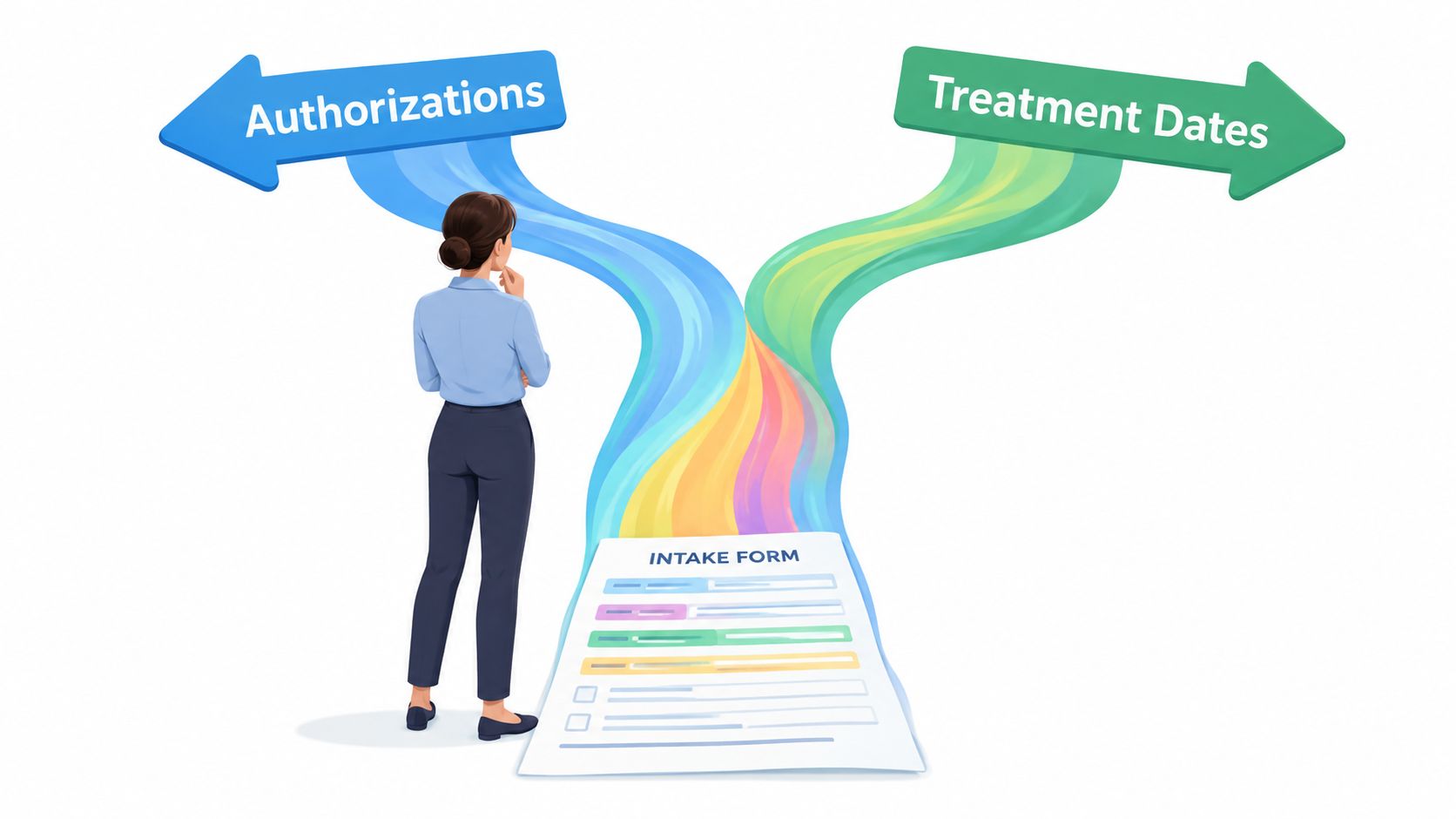
The first day of a soft-tissue claim shows the boundary clearly. A case manager can confirm the engagement, collect authorizations, contact the three providers, record the client's treatment dates, and keep the client informed about what happens next. The paralegal's attention belongs elsewhere, such as checking the accident facts, organizing liability evidence, identifying legal issues, and preparing the file for attorney analysis.
The overlap starts when someone asks for a “complete file.” Does that mean every medical record and bill has arrived? Does it mean the chronology has been checked against the source documents? Does it include a liability summary, insurance information, and a draft demand? Without a defined answer, both employees may perform partial work while the attorney remains the only person who knows what is missing.
The hidden handoff
A useful intake workflow assigns ownership in sequence:
- Case manager: Opens the file, confirms contact information, obtains authorizations, tracks providers, monitors treatment, and logs client communications.
- Paralegal: Reviews the organized materials, investigates facts, identifies legal issues, prepares substantive drafts, and supports attorney review.
- Attorney: Decides strategy, evaluates legal sufficiency, gives legal advice, approves demands, and controls pleadings or filings.
That sequence resembles the broader role of an intake specialist in a law firm, but intake ownership shouldn't end when the representation agreement is signed. The person who gathers information must also know the escalation rule for inconsistent dates, an unexplained treatment gap, a disputed provider bill, or a client account that conflicts with the records.
Practical rule: A handoff isn't complete when a folder changes hands. It's complete when the receiving role accepts a defined checklist and knows which unresolved items require attorney attention.
The comparison should therefore begin with workflow, not salary or job title. Ask which stage is congested, which errors are costly, and whether the firm has enough attorney time to supervise the work. A case manager may relieve a records and communication bottleneck. A paralegal may relieve a drafting, discovery, or deadline bottleneck. Hiring the wrong role can make both problems harder to see.
What the Labor Data Says About These Roles
The labor market treats these occupations differently, which helps explain why firms often recruit from different talent pools. The U.S. Bureau of Labor Statistics profile for paralegals and legal assistants reported approximately 404,900 paralegal and legal-assistant jobs in 2025. The median annual wage was $62,890, or $30.24 per hour, and about 75% of these workers were employed in legal services.
BLS also identifies an associate degree as the typical entry-level education for paralegals and lists no prior related work experience or formal on-the-job training as normally required. That doesn't mean every successful paralegal follows the same route. It does mean the occupation has a comparatively recognizable legal-support profile.
“Case manager” isn't one standardized BLS occupation. Many case-management jobs fall within broader social and human service categories. The same BLS-based data identifies 182,250 jobs in social assistance in 2025, while a commonly cited estimate places the broader group's national median wage at $45,930. That figure shouldn't be treated as a universal case-manager salary because healthcare, behavioral-health, disability, and community-service settings differ substantially.
| Metric | Paralegal | Case manager |
|---|---|---|
| Occupational profile | Discrete legal-support occupation | Broad, cross-sector coordination function |
| Main environment | Law firms and legal departments | Healthcare, social assistance, rehabilitation, community services, and law firms |
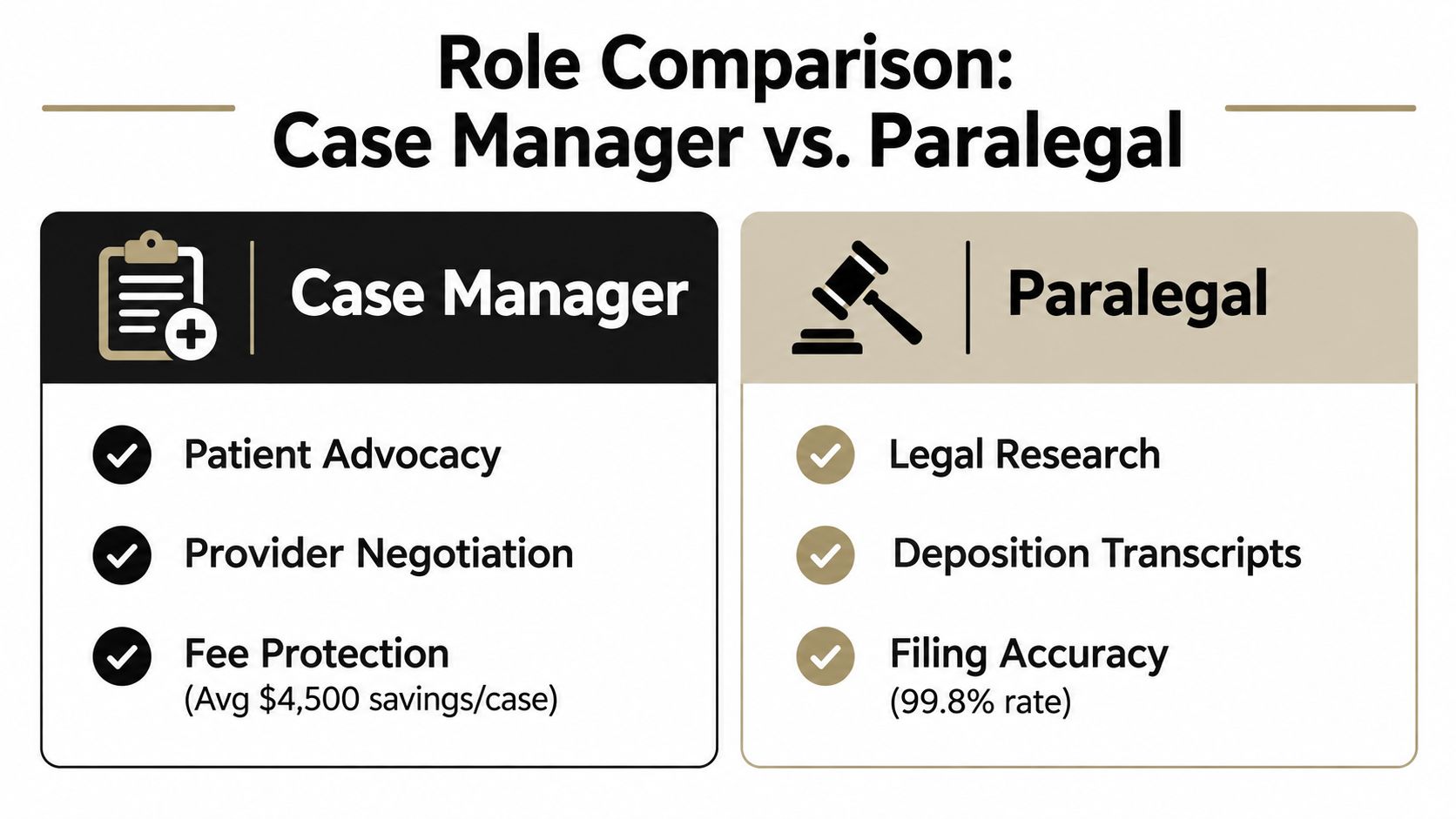
| Core contribution in a PI firm | Legal research, drafting, discovery, filings, and trial preparation under attorney supervision | Client, provider, records, billing, and pre-litigation coordination |
| Typical entry profile | Associate degree is the typical entry-level education | Backgrounds vary by sector and employer |
| U.S. labor reference | 404,900 jobs in 2025, with a $62,890 median annual wage | Often represented through broader social and human service classifications |
The compensation figures are useful for market planning, not for deciding who should perform a task. A case manager's value comes from keeping people, providers, documents, and follow-up aligned. A paralegal's value comes from producing reliable legal work under attorney supervision. They can collaborate closely, but the occupational systems show why they aren't interchangeable hires.
How the Claim Lifecycle Divides the Work
A personal-injury claim usually moves through recognizable operational stages. The case manager protects continuity during treatment and pre-litigation. The paralegal converts verified facts into legal work product when the file requires research, drafting, discovery, or litigation support.
Pre-litigation ownership
The case manager typically owns the operational rhythm before suit:
- Records and authorizations: Requests medical records, bills, employment information, and related documentation.
- Treatment monitoring: Tracks appointments, provider responses, gaps, and unresolved billing items.
- Client communication: Keeps the client informed and records questions that require attorney escalation.
- File readiness: Assembles a coherent package for review rather than just uploading disconnected documents.
The paralegal then works with the organized file. That may involve investigating liability, researching law, reviewing the chronology, organizing evidence, drafting a demand or other legal document, preparing exhibits, and supporting hearings or trial. The paralegal isn't the person who decides whether the client should accept a settlement or whether a legal position is sound. Those decisions remain with the attorney.
A practical claim lifecycle workflow should state exactly when responsibility changes. “Ready for demand” might require complete records and bills, a validated chronology, confirmed insurance information, an identified treatment gap review, and an attorney decision about unresolved causation or liability issues.
Measure the work separately
The metrics should reflect each role's actual risk:
- Case manager measures: Document-request cycle time, outstanding records or bills, treatment-gap identification, client-response time, and file-readiness rate.
- Paralegal measures: Deadline accuracy, drafting turnaround, discovery completeness, citation or filing-error rate, and trial-preparation readiness.
These measures prevent a common management mistake. A case manager shouldn't be judged by how quickly a demand is drafted, and a paralegal shouldn't be measured mainly by the volume of provider calls completed. Each role should be accountable for the point where its work can create delay or expose the firm to avoidable risk.
A clean division doesn't create distance between roles. It gives each person a clear definition of “done” and gives the attorney a reliable escalation path.
Responsibilities, Skills, and Output Formats Compared
The most useful comparison is the work product each employee leaves behind. A case manager creates operational visibility. A paralegal creates attorney-ready legal material. Both may touch the same medical file, but they should not take sole ownership of the same decision.
Case manager outputs
A strong case manager typically produces:
- Medical chronology: A dated working summary of treatment, providers, diagnoses, procedures, and unresolved gaps, with source documents available for verification.
- Provider log: Contact history, request status, authorization issues, and next follow-up date.
- Billing tracker: Outstanding bills, duplicate concerns, missing statements, and items requiring attorney or settlement review.
- Client status record: Clear updates, unanswered questions, and changes in treatment or symptoms.
- Pre-litigation readout: A concise account of what is complete, what is missing, and what the attorney must decide.
The skill profile centers on persistence, organization, empathy, communication, and disciplined follow-up. A case manager who records every call but fails to flag a contradictory treatment date hasn't completed the job. Coordination must include judgment about when a normal task has become an exception.
Paralegal outputs
A paralegal's work product is more directly connected to legal analysis and litigation preparation:
- Legal research: Authorities and issue summaries prepared for attorney review.
- Drafting: Demands, pleadings, discovery materials, correspondence, and memoranda within delegated authority.
- Evidence organization: Exhibits, witness information, discovery responses, and deposition materials.
- Deadline control: Calendaring and verification of procedural requirements.
- Trial preparation: Structured files that let the attorney locate and use admissible or strategically relevant material.
The paralegal must understand legal terminology, drafting standards, citation discipline, court procedures, and the limits of delegated work. Neither role may independently give legal advice, decide settlement strategy, or make an attorney's legal judgment appear final.
Digital workflows add another control point. Anyone handling PHI, client messages, or cloud-based files should understand client confidentiality in digital practice, including access discipline and careful transmission of sensitive information. Technology doesn't eliminate the need to define who can view, edit, approve, or send a document.
Real PI Scenarios That Decide the Hire
The right hire depends on the bottleneck, not the title used by a neighboring firm. A high-volume practice with orderly legal work but weak follow-up needs something different from a litigation team whose attorneys are buried in discovery.
When a case manager comes first
A solo attorney handling many automobile claims may spend too much time calling clients, requesting records, checking treatment status, and chasing bills. In that environment, a case manager can create capacity by standardizing file setup and making missing information visible.
The hire works when the attorney supplies scripts, escalation rules, and a definition of file readiness. It fails when the case manager is expected to answer legal questions, interpret causation, or promise settlement outcomes. The role should make the attorney's decisions easier, not make those decisions independently.
When a paralegal comes first
A litigation-focused firm may have responsive clients and complete records, yet lose evenings to discovery, pleadings, exhibit preparation, and deadline management. A paralegal is the better first hire when the legal work product is the constraint.
This person needs structured attorney review, reliable calendaring, and clear delegation. A paralegal who spends most of the day requesting records may be competent but poorly deployed. The firm should first remove routine coordination that doesn't require legal training.
When both roles make sense
Complex claims involving multiple providers, disputed treatment, extensive records, and a likely lawsuit can justify both roles. The case manager maintains the treatment and provider picture. The paralegal tests the facts against legal issues, prepares discovery or drafts, and supports litigation.
The risk is the handoff. Use a written responsibility matrix for intake, records retrieval, chronology validation, damages documentation, demand drafting, discovery, and trial preparation. For every stage, identify the responsible employee, the person who must be consulted, the attorney who approves the result, and the person who needs the final information.
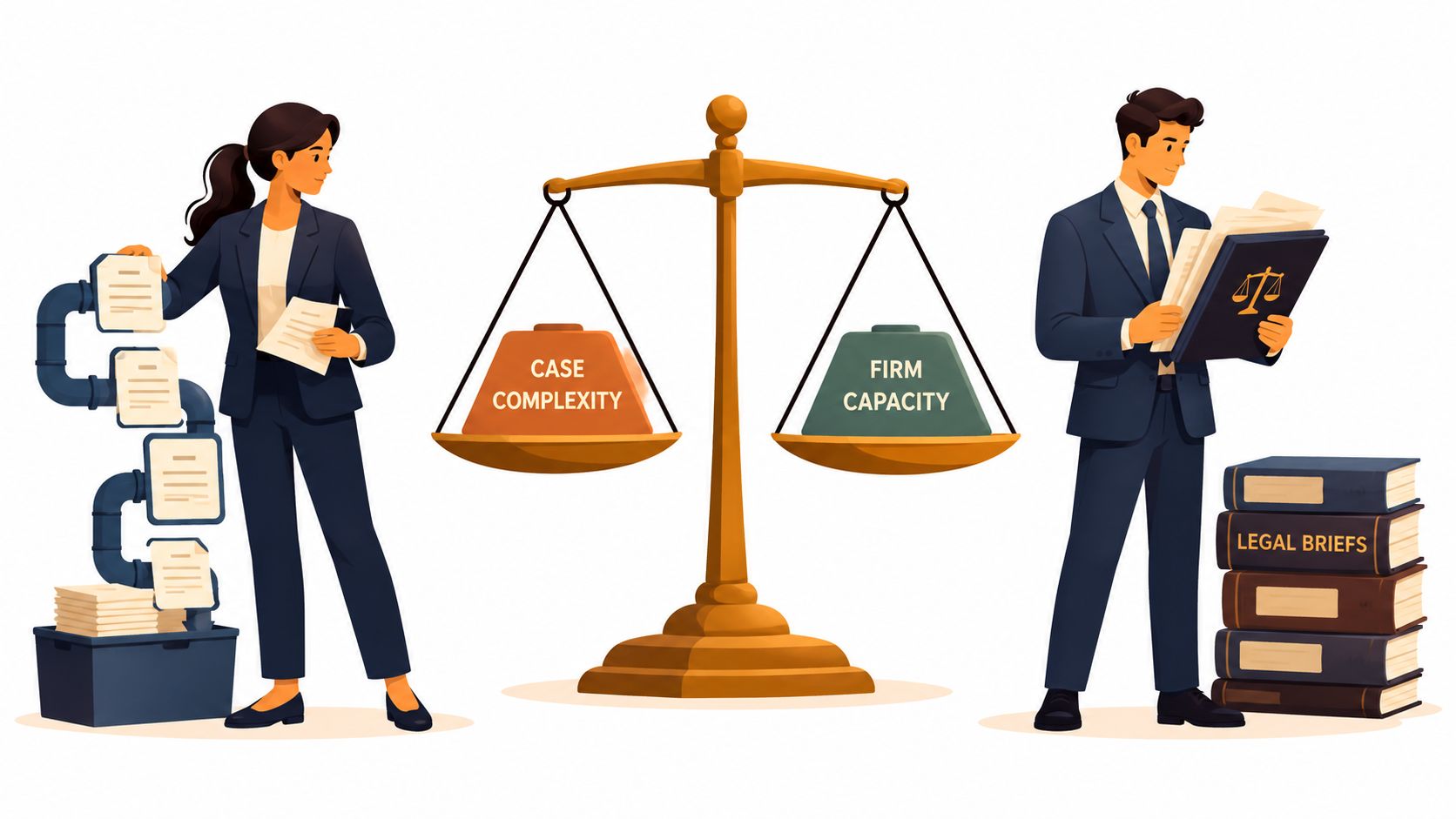
A cross-trained legal operations specialist can work in a smaller firm, but only with documented boundaries. Combining roles may reduce duplicate handoffs, yet it can also create overload. The choice should follow the firm's case mix, supervision capacity, billing model, and tolerance for missed deadlines or incomplete records.
How Legal AI Changes Role Boundaries
A case manager uses an AI tool to assemble a treatment timeline before calling a provider. The chronology looks complete until a duplicate bill and an unexplained treatment gap surface. AI moves where the effort happens, while accountability stays exactly where it was. A 2025 legal technology and AI adoption report found that 61.1% of surveyed legal professionals reported incorporating AI tools into their routines. Faster extraction therefore increases the value of source verification.
A tool can organize medical records, identify dates, extract diagnoses and treatments, group providers, and produce a draft chronology. It can also create a first demand draft from structured facts. These functions reduce repetitive review for both roles. They do not make the software responsible for accuracy, judgment, or the consequences of a missed fact, as explained in this guide to artificial intelligence for paralegals.

Keep the human controls visible
The case manager handles operational exceptions. That work includes confirming whether a provider was missed, escalating an unexplained treatment gap, checking that a bill belongs to the client, and asking about facts that extraction cannot resolve.
The paralegal validates legal work. That includes checking citations, comparing draft statements with source records, reviewing privilege and confidentiality concerns, verifying discovery material, and confirming attorney approval before a demand, pleading, or filing leaves the firm.
A practical governance checklist includes:
- Source verification: Compare extracted facts with the underlying records.
- Exception escalation: Route contradictions, missing records, and causation concerns to the appropriate human.
- Privacy review: Apply access and confidentiality controls to medical information.
- Attorney approval: Keep legal strategy, settlement advice, demands, and filings under attorney supervision.
- Performance tracking: Measure hours saved alongside errors caught, rework, missing records, and client-response quality.
Teams evaluating automation should prepare for handling edge cases automation misses, alongside routine throughput. Ares can process uploaded PI files, extract medical dates, diagnoses, treatments, providers, and symptom chronology, then produce organized medical overviews and demand drafts. A human reviewer still must challenge the output and document the attorney checkpoint. That control keeps technology from turning a small extraction error into a case-file problem.
Hiring Decision and Workflow Recommendations
Start with the failure that is costing the firm attention. If providers aren't answering, clients can't get updates, and bills remain scattered, hire or develop case-management capacity first. If attorneys are missing drafting time, discovery is disorganized, or trial preparation is consuming the week, prioritize a paralegal.
Make the choice operational
Use these decision rules:
- Choose a case manager first when pre-litigation coordination, records retrieval, client communication, and treatment tracking are the main constraints.
- Choose a paralegal first when legal research, drafting, discovery, filings, deadlines, and trial preparation are limiting attorney capacity.
- Choose both when the firm has meaningful volume in both operational coordination and litigation work, and can define the handoff.
- Choose a cross-trained operations specialist carefully when the firm is smaller and the work is predictable, but document which tasks require attorney review.
Don't copy another firm's job descriptions without mapping your own workflow. Interview candidates with file-based exercises. Ask a case-manager candidate to identify missing records and draft an escalation note. Ask a paralegal candidate to organize a fact pattern, flag unsupported assertions, and describe where attorney approval is required. Hiring teams can also use resources on how to reduce mis-hires with behavior data, provided the assessment measures the behaviors the role requires.
Build the controls before adding headcount
Create a RACI-style map for intake, authorizations, records, chronology validation, damages documentation, demand drafting, discovery, and trial preparation. Put an attorney checkpoint beside every task involving legal advice, settlement position, pleadings, filings, or strategic conclusions.
Then track a small set of role-specific indicators. For case managers, monitor outstanding records, unresolved bills, treatment gaps, response time, and file readiness. For paralegals, monitor deadline accuracy, drafting turnaround, discovery completeness, filing errors, and trial readiness. Review quality signals with capacity signals so speed doesn't conceal rework.
The practical answer to case manager vs paralegal isn't that one role is more valuable. A case manager protects flow and completeness. A paralegal protects the quality and reliability of legal work product. Firms improve when each person owns a defined result, escalates exceptions early, and hands over work in a format the next person can trust.
Ares helps PI firms organize uploaded medical records, extract dates, diagnoses, treatments, providers, and symptom chronology, and produce medical overviews and demand drafts for human review. If your firm is losing time at the records-to-demand handoff, visit Ares to evaluate a more repeatable workflow.