
At 9 p.m., a paralegal is still at her desk with banker boxes on the floor, an 800-page emergency-room packet open on one monitor, imaging records on another, and pharmacy printouts spread beside a demand-letter template. She isn't looking for one dramatic fact. She's searching for every date of service, provider, diagnosis, procedure, balance, gap in treatment, and statement that could affect causation or damages.
That work is necessary, but it doesn't have to begin with manual retyping. Automated data extraction uses OCR, natural language processing, and document-intelligence software to convert medical records, demand materials, bills, and related case documents into structured, searchable information. The attorney still makes legal judgments. The paralegal still verifies consequential facts. The software handles much of the repetitive capture and organization.
The distinction matters in personal injury practice. A scanned page is merely an image until OCR makes its characters searchable. A useful extraction system goes further, identifying what a date means, which provider performed a procedure, whether a diagnosis was negated, and where the supporting text appears in the source file.
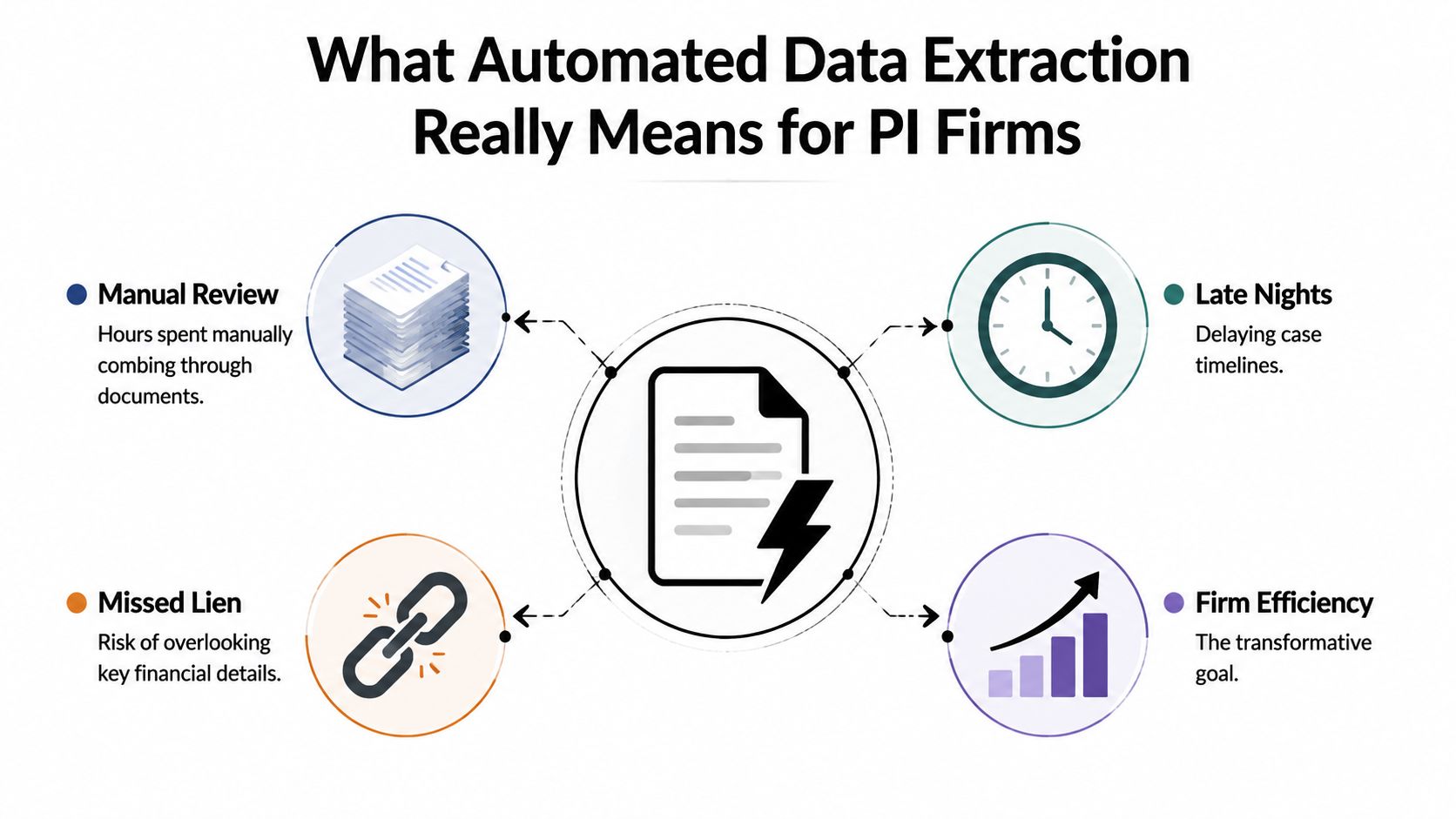
What Automated Data Extraction Really Means for PI Firms
Consider a rear-end collision file with hospital records, physician notes, physical-therapy logs, billing statements, lien correspondence, and a draft demand letter. A traditional workflow asks a paralegal to open each document, find relevant facts, copy them into a chronology or spreadsheet, and then reread the file while drafting the medical narrative. Every transfer creates another opportunity for a missed date, a duplicated charge, or a provider attached to the wrong visit.
Extraction means pulling specific values from those documents. In a PI matter, those values might include the date of an emergency visit, an injury code, the treating facility, a medication dosage, an imaging finding, a billed amount, or a lien balance. The source may be a typed PDF, a faxed page, an email attachment, or a narrative note with no convenient table.
Automation means the workflow runs consistently when new records arrive, rather than waiting for someone to prompt the system page by page. A connected intake process can classify incoming files, send them through extraction, map the results to the matter, and route uncertain fields to a reviewer.
Practical rule: OCR makes words searchable. Document intelligence tries to explain what those words mean in the context of the case.
That distinction is especially important for medical records. OCR may recognize “no acute fracture,” but a legal workflow needs to preserve the negation. It should not turn that phrase into a fracture finding. It also needs to distinguish the patient, the treating physician, the facility, and the author of a copied consultation note.
The business case has expanded beyond basic scanning. One industry estimate places the global OCR software market at US$14.8 billion in 2025, with a projection of US$56.3 billion by 2034 at a 14.2% CAGR, while data extraction represents 32.5% of market value, or about US$4.81 billion, according to MarketIntelo's OCR software market estimate. Another estimate values the market at US$10.62 billion in 2022 and projects US$32.90 billion by 2030, reflecting the movement from page digitization toward enterprise automation.
For a PI firm, the practical outputs are concrete: a searchable treatment chronology, a normalized medical-expense ledger, a provider index, a demand-package outline, and a review queue for questionable facts. Firms evaluating this workflow can also compare it with AI medical-record summarization to see where extraction ends and substantive case synthesis begins. A resource such as Ekipa AI's data extraction engine can help teams understand how a dedicated extraction layer fits into a broader document workflow.
How the Core Technologies Work Together
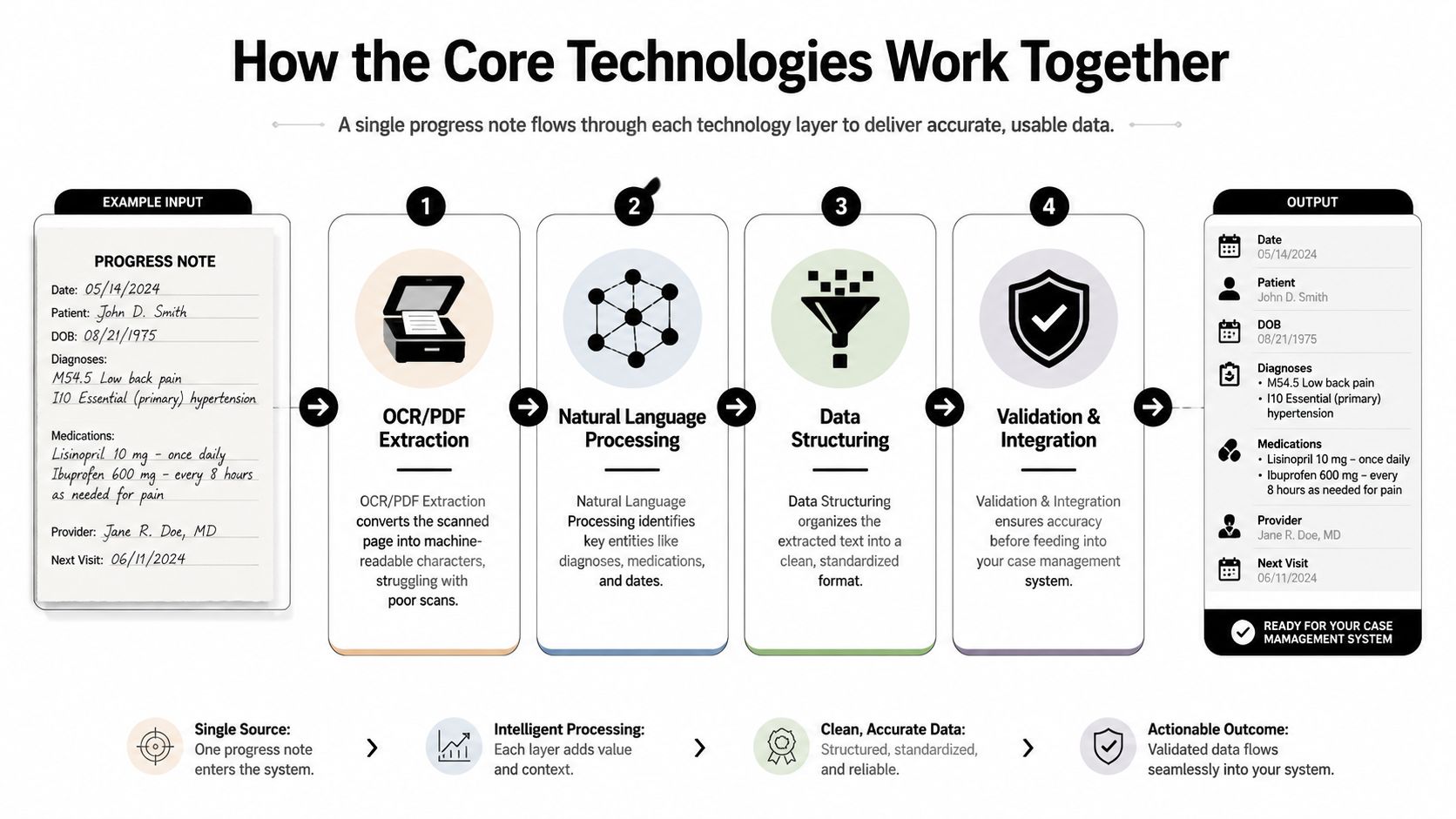
A progress note offers a useful example. The page might contain a visit date, a provider name, a diagnosis, a medication change, an imaging reference, and a follow-up instruction. No single technology reliably turns that page into a case-ready record. The system needs a pipeline in which each layer solves a different problem.
Layer one starts with the page itself
OCR or PDF text extraction converts a scanned image into machine-readable characters. If the note is a native PDF, the system may be able to access its text directly. If it's a fax, a scan, or a photograph, OCR must reconstruct the words from pixels.
That first step can fail before any legal reasoning begins. Faded fax lines may disappear, a handwritten addendum may produce incomplete text, and a skewed page can scramble columns. The output should therefore retain a connection to the original page, not replace it.
Layer two identifies the important entities
Named Entity Recognition, or NER, labels items such as patients, providers, facilities, dates, medications, diagnoses, procedure codes, and monetary amounts. In the progress note, NER might identify the physician, the visit date, “cervical strain,” a prescription, and a follow-up appointment.
NER doesn't automatically establish the relationship among those items. It may find two names but still need context to determine who treated the patient and who merely appears in a referral or copied history.
Layer three interprets relationships and language
Natural Language Processing, or NLP, connects the entities. It can help associate a diagnosis with a particular encounter, link a procedure to its provider, and distinguish a planned follow-up from a completed visit. It also needs to handle negation and time. “Denies radiculopathy” means something different from “reports radiculopathy,” while “return in four weeks” describes a future plan rather than a service already performed.
A 2025 study of AI-assisted evidence review reported that GPT-4o-based extraction achieved 74.4% sensitivity, 68.8% specificity, 69.1% precision, 97.1% variable-detection coverage, and 72.6% accuracy in a development dataset, as described in the Cambridge Research Synthesis Methods article. Those results illustrate both the promise and the need for review. Broad detection can coexist with errors in individual fields.
Layer four maps the results into the firm's system
Data mapping gives every extracted value a consistent destination. The date belongs in the treatment timeline. The provider belongs in the provider table. The bill belongs in the expense ledger. The note may receive categories such as emergency care, imaging, orthopedics, therapy, or pain management.
Validation should occur before the information reaches a demand package or case-management record. A legal-document review workflow, such as the one described in Ares's AI legal document review resource, is most useful when it preserves source references and makes uncertainty visible rather than presenting every output as settled fact.
Where the ROI Comes From
The strongest return comes from recovering attorney and paralegal capacity, not from replacing legal judgment. In a PI file, that means reducing repetitive searches through medical records, sorting, copying, and first-pass organization. The team can then spend more time on witness follow-up, provider development, lien resolution, settlement analysis, and mediation preparation.
A demand letter often depends on details scattered across emergency records, imaging reports, therapy notes, billing records, and provider correspondence. Automated extraction can bring those details into a reviewable structure, but the value depends on whether staff can verify each item against its source. Faster organization matters only when it produces a reliable starting point for legal work.
The economics should be measured alongside accuracy. A benchmark covering 370 real documents, 4,869 pages, 67 schemas, and 8 business domains measured value F1, long-record completeness, visual grounding, and per-page cost rather than field accuracy alone. Its top system reached 95.6% overall at 8.11 cents per page, while a lower-cost agent reached 89.5% overall at 3.12 cents per page, according to the published enterprise extraction benchmark.
Those figures are not a PI-firm promise. They define the tradeoff a firm should test on its own case files. A lower-cost workflow may fit records that receive heavier exception review. A higher-accuracy workflow may justify its cost when a missed diagnosis, procedure, bill, or treatment gap could affect litigation strategy.
A practical comparison
| Metric | Manual Workflow | Automated Extraction |
|---|---|---|
| Record intake | Staff open, sort, rename, and review documents individually | Files can be classified and routed through a repeatable intake process |
| Chronology creation | Dates and events are copied into a spreadsheet or case system | Dates and events are proposed in a structured timeline for review |
| Billing review | Charges and balances are located manually | Monetary fields can be captured and flagged for verification |
| Quality control | A second review depends on available staff time | Confidence thresholds and exception queues can focus human review |
| Demand preparation | The writer repeatedly searches source files for support | Structured facts and source references can support drafting and exhibits |
Calculate ROI from baseline measurements: review time, reviewer effort, correction volume, outsourced review spending, and the delay between receiving records and issuing a demand. A quick first pass is not a saving if staff later rebuild the chronology by hand.
A useful pilot asks whether the firm can move a file from intake to attorney-ready review sooner while preserving traceability. Measure faster case progression, fewer overlooked records, cleaner mediation exhibits, and more consistent handoffs between case managers and attorneys. Firms evaluating this workflow should compare extraction with AI medical-record summarization, then define where structured fact capture ends and substantive case synthesis begins.
HIPAA and Compliance Considerations
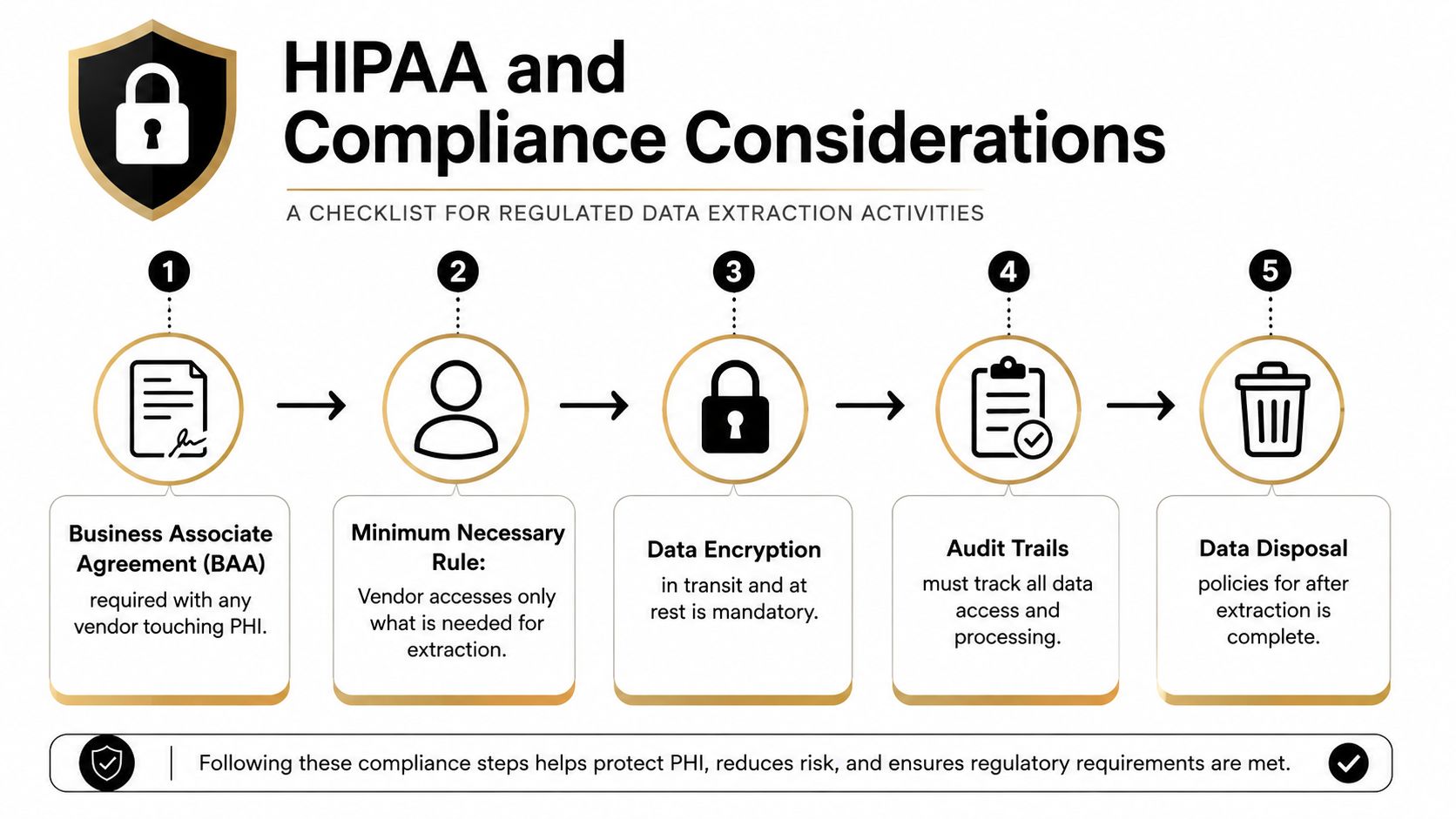
Medical-record extraction is a regulated data-handling activity, not an ordinary software purchase. When a PI firm sends protected health information, or PHI, to a third-party platform, the firm needs to understand the vendor's role, the data flow, the permissions, and the evidence it can produce during an audit or incident review.
A vendor that handles PHI for the firm may qualify as a Business Associate. The relationship generally requires a properly scoped Business Associate Agreement, or BAA, alongside the service contract. The BAA should address permitted uses, prohibited disclosures, subcontractors or subprocessors, breach reporting, safeguards, access obligations, and what happens to the data when the relationship ends.
Questions to answer before uploading records
- BAA coverage: Will the vendor sign a BAA that specifically covers the extraction service and relevant subprocessors?
- Model use: Will the vendor use case records or extracted content to train or improve a shared model?
- Retention: How long do source files, outputs, prompts, logs, backups, and deleted records remain available?
- Access control: Can the firm restrict access by role, matter, workspace, and administrative function?
- Traceability: Can the vendor show who accessed a file, what processing occurred, and when an output changed?
- Incident response: Does the vendor's notification process align with the firm's obligations and internal response plan?
Encryption in transit and at rest, controlled key management, least-privilege access, workforce training, retention rules, and tested incident-response procedures belong in the implementation file. The OCR layer, language model, storage layer, review interface, and export connector may all touch PHI, so reviewing only the visible application screen isn't enough.
Firms comparing communication and collaboration tools can use resources such as AONMeetings' Zoom HIPAA compliance analysis as a reminder that a product's general security reputation isn't the same as a matter-specific compliance determination. The firm still needs contract language, configuration controls, and documented procedures. Its internal review can also reference HIPAA-compliant document management guidance, provided the team treats that material as an operational starting point rather than a substitute for counsel.
Common Pitfalls and the Demo Trap
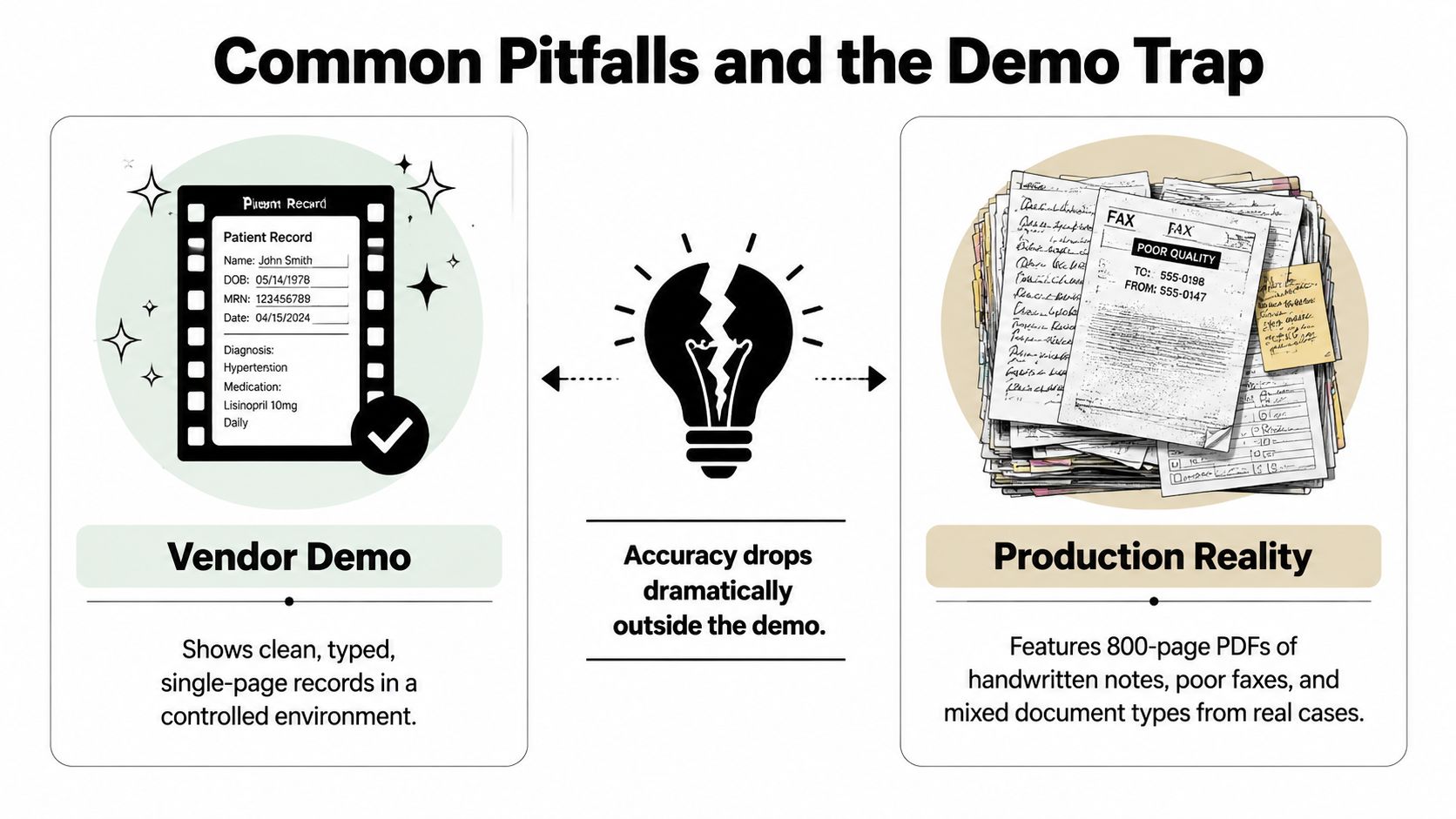
A vendor demo usually answers the easiest question, whether the system can read a clean document. A PI firm needs to answer a harder question, whether the system can preserve the meaning of a messy case file.
Real production packets may combine native PDFs, faxed pages, handwritten therapy notes, carbon-copy forms, duplicate records, bills, imaging reports, and correspondence. A system that performs well on a typed, single-page note may struggle when the same matter contains poor contrast, unusual layouts, overlapping stamps, or several patients and providers mentioned on one page.
Why field accuracy can mislead
Errors often occur in combinations. OCR can misread cursive. NER can label a physician's name as the patient or attach a facility to the wrong encounter. NLP can miss the significance of “no acute fracture.” Date normalization can place a dictated date, an encounter date, and a billing date into the same chronology without showing their differences.
A system may also extract a correct value but lose its provenance. That output is weaker when the reviewer can't see the page, the surrounding sentence, or the reason the software associated the fact with a particular visit.
The ExtractBench results make this complexity visible. Systems exceeded 85% value-F1 on simple invoices, but performance fell on multi-page contracts with extensive clause tables. Some vision-language models reached about 62% value-F1 in that setting because of list truncation, while a stronger extractor retained about 88%. The benchmark also reported that coding agents consistently exceeded 90% page-level grounding F1, as summarized in the enterprise-document benchmark coverage.
A defensible validation protocol
- Use actual matters: Give the vendor a representative packet, including clean pages, poor scans, duplicates, handwriting, and unusual layouts.
- Check end to end: Measure whether the final chronology, billing ledger, and source citations are usable, not merely whether isolated fields look correct.
- Test blind spots: Include negated findings, future appointments, conflicting dates, copied histories, and records with multiple providers.
- Review exceptions: Record how much time staff spend correcting outputs and whether the interface makes corrections auditable.
- Set acceptance rules: Require a fallback process for unsupported pages and a human sign-off before consequential facts enter a demand or filing.
A pilot can still mislead if the firm selects only friendly files. The difference between a convincing demonstration and a reliable production workflow is the quality of the test packet and the discipline of the review protocol.
A Real-World Walkthrough of a Case File
A rear-end collision file arrives as a 600-page medical packet. It contains EMS material, emergency-room notes, primary-care visits, orthopedic records, physical-therapy entries, pain-management notes, bills, and imaging reports. Before anyone drafts a demand, the paralegal must establish what the packet contains and whether the treatment story is complete.
The platform ingests the files and separates document types. OCR reads faxed pages, while native PDF text remains available where the file supports it. The extraction layer identifies providers, dates, diagnoses, procedures, medications, imaging findings, and charges, then proposes events for a chronological treatment timeline.
That timeline gives the reviewer a working map of the file. The emergency visit, first follow-up, orthopedic referral, therapy sessions, and pain-management treatment appear in one view. Gaps also become visible, such as an expected imaging report or a missing endpoint to therapy, so the reviewer can investigate specific questions instead of repeatedly scrolling through folders.
What the review queue catches
The paralegal's queue contains several entries that need human attention:
- A buried bill: A $14,200 pain-management bill appears on page 412, where a rapid manual review could overlook it.
- A missing MRI reference: The chronology mentions imaging, but the corresponding report is not readily identifiable in the packet.
- A therapy gap: Treatment entries appear without a clear discharge note.
- A causation issue: One note records that the patient denies radiculopathy, while later records describe symptoms requiring attorney analysis.
- A temporal distinction: “Symptoms resolved by 4/12” cannot support describing the condition as ongoing after that date without additional evidence.
Each flagged item links the proposed fact to its source page. The paralegal can verify the bill, check whether the MRI report sits elsewhere in the packet, and determine whether the therapy gap reflects missing records or an actual interruption. The causation question goes to the attorney, who can compare the conflicting symptom descriptions with the broader medical history.
From review to demand
After verification, the paralegal exports a structured medical overview, treatment chronology, billing ledger, and supporting citations. The demand writer can build the narrative from those materials without searching the entire packet for every date or amount. The attorney reviews the medical claims, revises the causation discussion, and approves the package.
Rather than replacing human judgment, the tool accelerates the path from scattered documents to a structured case review. The human gate remains necessary because a demand letter is an advocacy document, while extracted data is evidence for that document, subject to verification.
Choosing a Platform and Rolling It Out
Platform selection is a legal-operations project, not a feature-shopping exercise. A checklist can confirm OCR, NLP, exports, and an API. It cannot show whether the system preserves a diagnosis, keeps one claimant's medical records separate from another's, or gives a reviewer enough evidence to defend a correction involving HIPAA-protected PHI.
Begin with a representative matter packet. Include clean PDFs, poor scans, duplicate pages, handwritten notes, medical bills, demand correspondence, and unusual layouts. Ask the vendor to process that packet under the same conditions the firm will use in production. Require field-level confidence, source-page references, inferred information, extracted text, and review history in the output.
Evaluate the matter, not just the page
Page accuracy can hide a serious case-level failure. A system may read nearly every page correctly yet miss one diagnosis, duplicate a procedure, attach a date to the wrong encounter, or leave a bill out of the final ledger. Reviewers must compare source facts with the completed chronology, billing output, and demand-ready materials.
The benchmark evidence uses a broader framework, combining value F1, long-record completeness, visual grounding, and per-page cost instead of relying on one accuracy score. For a PI firm, the test becomes four practical questions:
- Did the system capture the right value?
- Did it preserve complete records across a long medical packet?
- Can a reviewer locate the source page and surrounding context?
- Does the processing cost fit the matter's economics?
Accuracy also includes the work required after extraction. A diagnosis that is technically present but difficult to trace, or a billing amount that lacks its supporting page, still creates review risk.
Put security into the acceptance criteria
Confirm that the platform supports a BAA, least-privilege access, encryption, retention controls, audit logs, and the firm's incident-response process. Ask how it handles failed pages, duplicate uploads, cross-matter isolation, exports, backups, deletion requests, and PHI in logs. If the vendor refuses a BAA or will not explain training-data reuse and AI-log retention, pause the review until the risk is resolved.
The firm also needs written operating measures. Define expected turnaround, acceptable error patterns, reviewer effort, escalation procedures, unsupported-file handling, and the method for correcting recurring extraction errors. A useful contract explains what happens when the system fails, not only what happens when it succeeds.
A controlled 90-day rollout
Days 1 to 30: Select one narrow use case, complete the security and BAA review, identify legal and operational owners, and record baseline measures for review time, correction effort, completeness, and source verification.
Days 31 to 60: Run a limited pilot with paralegal review. Double-check consequential facts, including diagnoses, dates, providers, procedures, balances, and statements that affect causation. Keep unsupported records on a manual fallback path.
Days 61 to 90: Refine intake rules, train staff, document quality controls, analyze exception patterns, and expand only after the attorney and operations owners approve the results. Require human sign-off before extracted information reaches a demand package, mediation exhibit, discovery response, or court filing.
The broader lesson is that raw extraction accuracy isn't the same as effective data quality. Recent enterprise guidance identifies a gap of about 3 to 5 percentage points between those measures because validation catches errors that extraction alone misses, as discussed in Box's enterprise content analysis. The same analysis identifies fragmented data and integration complexity as major barriers, with 25% citing fragmented data and 24% citing integration complexity. For a PI firm, standardizing ingestion, matter naming, permissions, validation, and handoffs may create more value than pursuing a marginal model improvement.
A platform such as Ares can support this workflow by extracting diagnoses, treatment timelines, provider details, and dates from uploaded medical records, then organizing them into case-ready outputs such as chronologies, billing ledgers, treatment timelines, and summaries. Every platform requires the same test: process the firm's own representative packet under its own controls before committing.
If your firm is ready to test automated data extraction against real medical records, Ares provides an AI-powered workflow for organizing medical facts and supporting demand-letter preparation. Visit Ares to review how a controlled, human-verified process can help your team move from document backlog to case-ready insight while keeping PHI protections in view.