The first sign that a personal injury firm has outgrown manual records review is usually not a software complaint. It's a stack of ER notes, imaging reports, PT records, and billing statements sitting on someone's desk while a demand letter waits behind it. The underlying cost is not just time, it's the delay in seeing the case clearly enough to argue it well.
That's where an AI legal assistant changes the work from document shuffling to case building. For PI teams, the value isn't abstract automation. It's the ability to turn a messy file into a chronology, spot treatment gaps early, and build a demand package that reflects the actual story in the records.
The End of Buried in Paperwork
A paralegal opens a new motor vehicle case and finds the usual surprise, a banker's box full of scans, duplicate pages, unreadable handwriting, and records from three providers that don't line up neatly. The attorney wants a chronology. The client wants movement. The adjuster is already asking for a demand package. In firms still doing this by hand, the day gets consumed before the case has even been interpreted.
That pressure is why AI has moved from curiosity to operational reality in legal work. A 2026 legal-industry statistics roundup reports that 83% of lawyers were using AI in June 2026 in Bloomberg Law's State of Practice survey of 760 practitioners, up from under 20% in 2023. The same source reports that AI users saw improved work quality (65%), better client responsiveness (63%), and increased work capacity (54%) legal-industry AI adoption statistics.
For PI firms, the point isn't that lawyers are suddenly tech fans. It's that the market has already crossed the threshold where manual-only handling is a competitive disadvantage. If one team can digest records quickly and another is still hunting for the relevant page in a PDF dump, the faster team gets to strategy sooner.
A practical way to think about adoption is to separate the tool from the workflow. A secure records-processing system, such as How to secure enterprise AI agents, is useful because it starts with consideration for legal operations, permissions, auditability, and case-specific access, not just a chat box.
Practical rule: if a new matter still requires hours of manual sorting before anyone can discuss liability, causation, or damages, the firm hasn't solved the front end of the case yet.
What an AI Legal Assistant Actually Does
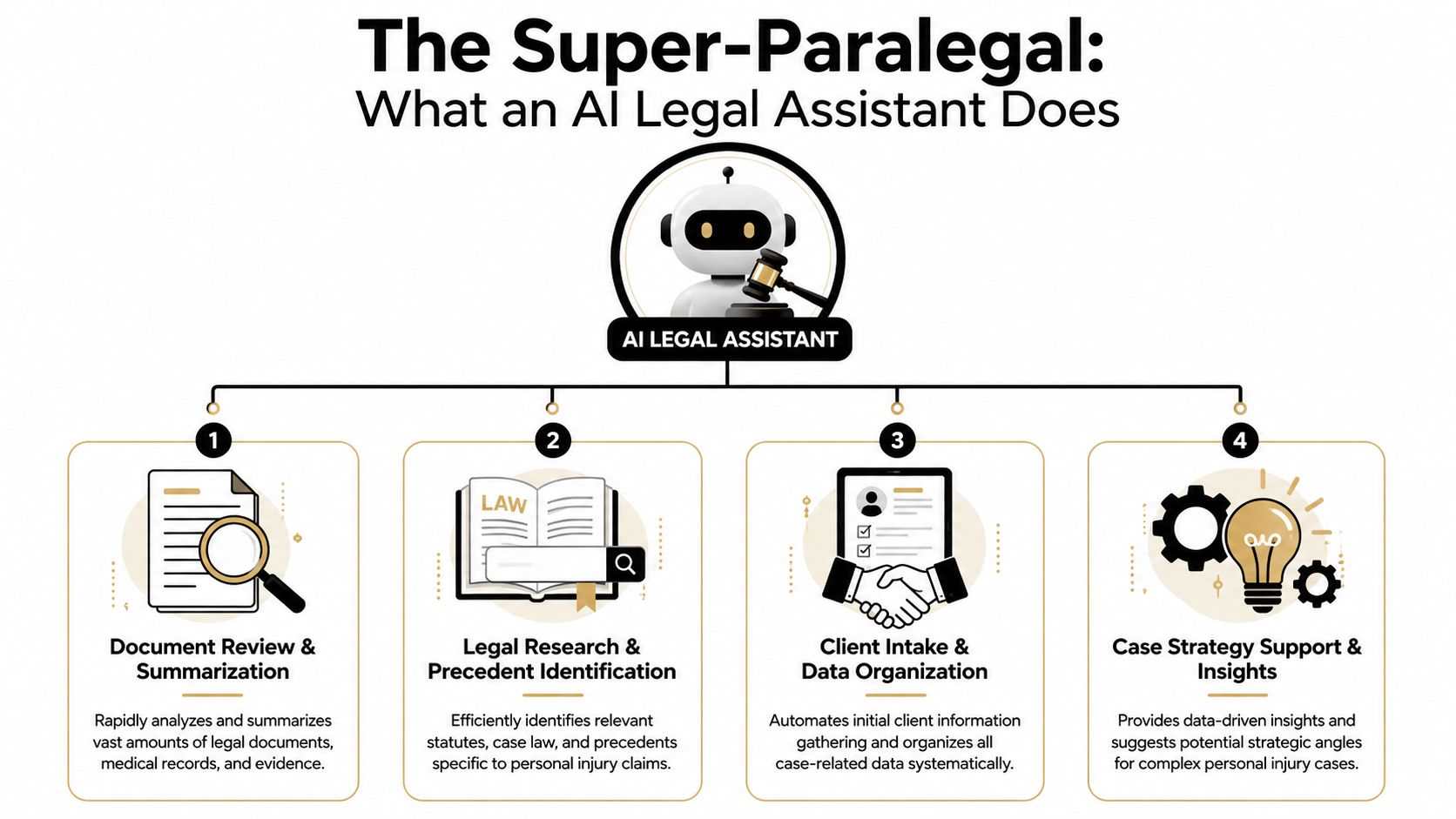
An AI legal assistant in PI practice is best understood as a super-paralegal for document-heavy work, not a replacement for legal judgment. It reads large files, extracts what matters, and organizes the material into formats attorneys can use. In practice, that means less time spent opening documents and more time spent evaluating what the records prove.
Document review and summarization
The highest-value PI tasks are the ones that are text-heavy and pattern-based. AI is useful when it has to summarize pleadings, extract clauses, review deposition transcripts, or build a chronology from scattered records NetDocuments on legal AI assistant workflows. In medical files, that same pattern recognition helps identify diagnoses, providers, treatment dates, and recurring complaints without making a human scroll page by page.
Chronology and narrative construction
A significant advantage shows up when the assistant turns fragments into a case story. A treatment note, an MRI report, and a PT discharge summary may live in different sections of the file, but the system can place them in order and surface the sequence that matters for causation and damages. That's useful because the attorney needs a coherent narrative, not just a pile of extracted facts.
Demand drafting from structured data
Once the records are organized, the first draft of a demand letter becomes much easier to assemble. The assistant can use the extracted chronology, treatment history, and issue flags to build a draft that reflects the file rather than a generic template. That doesn't eliminate attorney review, but it dramatically reduces the blank-page problem.
The best legal AI does not answer in the abstract. It answers from the firm's actual case file, then leaves a trace the lawyer can review.
For a PI-specific example of how this shows up in day-to-day operations, see Ares for personal injury lawyers.
How AI Transforms Your PI Practice Outcomes
The operational win is not “AI saves time.” It's that the saved time changes what the firm can do with a case. When records review happens faster, the attorney gets to liability analysis earlier, the paralegal gets out of transcription mode sooner, and the demand draft starts with more substance. That shift matters because PI files are won and lost on how well the team sees the case, not just how fast it types.
Stronger claims start with better file understanding
A good assistant doesn't just flatten the file into a summary. It helps the team see treatment progression, missing records, conflicting descriptions, and points where the story needs to be clarified. That's where claim quality improves. When the attorney can see the chronology clearly, the demand letter can connect mechanism of injury, treatment, and residual harm in a way that reads like a case narrative instead of an intake memo.
Faster drafting changes settlement leverage
Negotiation gets easier when the demand package is organized and defensible. Adjusters respond faster when the records are not a mess, when dates line up, and when the narrative is easy to follow. That doesn't guarantee a better offer, but it reduces the back-and-forth caused by incomplete or unclear submissions.
Process automation changes the economics
The market is already treating this as infrastructure. The AI legal assistant market is forecast to rise from USD 2.57 billion in 2025 to USD 18.0 billion by 2035, implying a 21.5% CAGR market projection. That kind of growth usually follows tools that move from novelty to daily operations, especially when firms can see the value in throughput, consistency, and better matter handling.
For a deeper operational lens on repetitive work elimination, it's worth comparing this with process automation benefits in other service environments. The legal lesson is the same, the more repeatable the task, the more valuable the automation.
Ares in Action Real World Scenarios
A multi-provider case is where a PI firm can feel the difference quickly. The file comes in with an ER visit, then orthopedic treatment, then physical therapy, and the records don't always speak the same language. One note says “improving,” another records persistent pain, and a third uses shorthand that gets missed in manual review. The assistant pulls those documents into a single chronology, so the attorney can see the sequence without chasing each provider separately.

That's where the file stops feeling like noise. The team can spot what changed between visits, where symptoms persisted, and where the paper trail is thin. In a PI setting, that kind of synthesis is useful because it helps the attorney decide what needs follow-up before the demand goes out.
A second scenario is the buried note. Somewhere in a 300-page file, a prior condition appears in a single line, and no one wants to find it during negotiations. A competent assistant flags it early, which lets the attorney address it proactively instead of discovering it when the adjuster raises it first. That's a real strategic shift, because surprise is expensive in settlement talks.
For a PI firm, the value of these outcomes is not academic. It's the difference between spending a morning finding the facts and spending that morning deciding how to use them.
Navigating Security HIPAA and Data Privacy
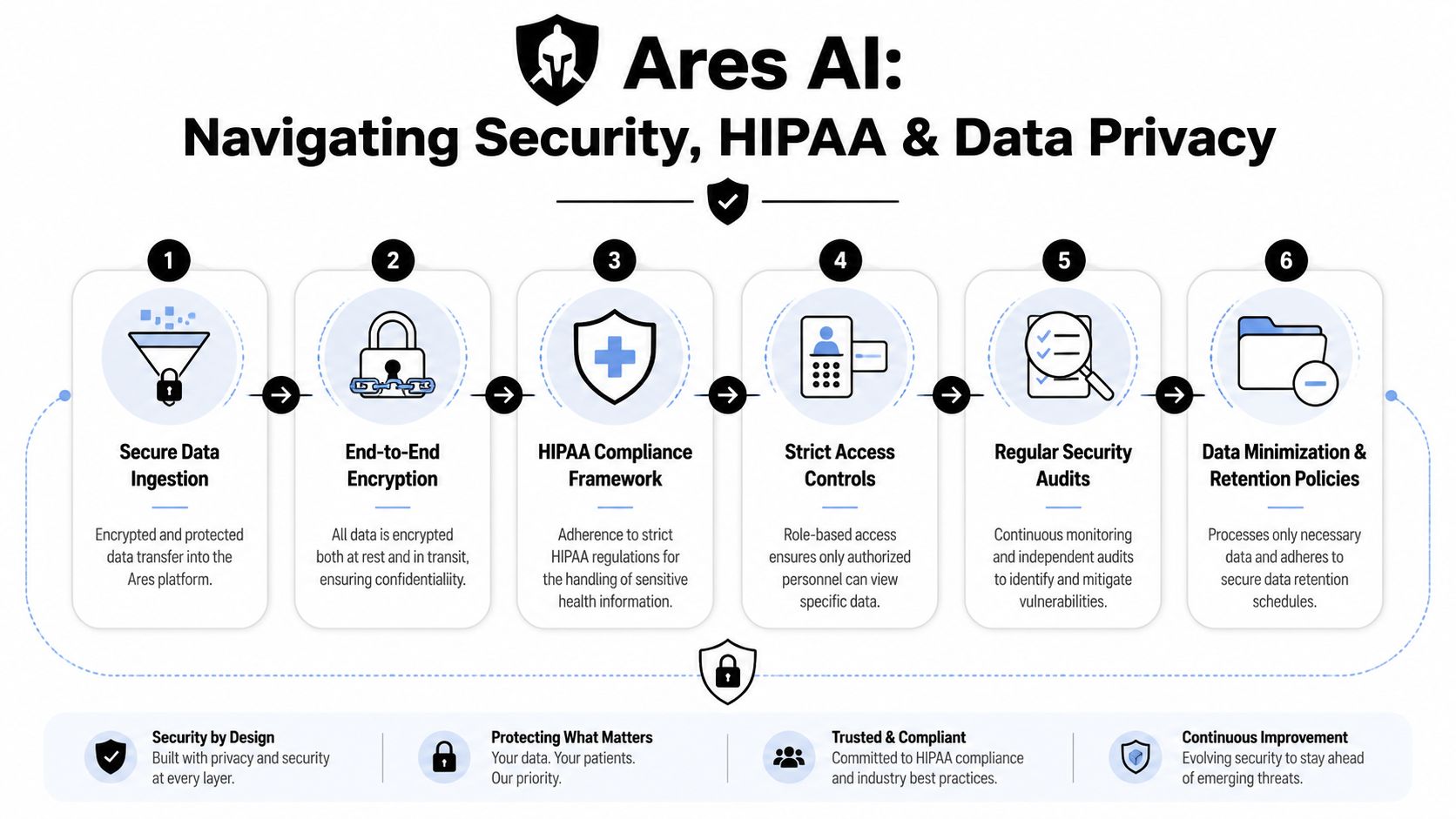
The first question every PI firm asks is the right one, what happens to PHI? That question matters more than feature lists, because medical records are the core input in most injury cases. A vendor that can't explain security, access control, and data handling in plain terms is not ready for a serious legal workflow.
Fiduciary-grade AI is about more than encryption
Thomson Reuters says legal-aid teams should choose fiduciary-grade AI grounded in authoritative, domain-specific content and continually tested by experts, and that buying decisions increasingly hinge on where data is processed, how PHI/PII is protected, and whether the system can support jurisdiction-specific reasoning Thomson Reuters on AI in legal aid. For PI firms, that means the vendor has to answer not just “is it secure,” but “what gets processed, who can see it, and how is it separated by matter.”
Grounding matters because legal risk is real
The safer architecture is retrieval-based, where the assistant pulls from allowed documents and generates output only from those sources. That approach reduces hallucination risk and gives the lawyer an audit trail of prompts, sources, and review actions. For a PI shop, that matters because the records themselves are the evidence base, and the output should always point back to the file.
Questions worth asking before you sign
A serious vendor review should include:
- Where is data processed? If the answer is vague, keep asking.
- How is PHI handled? The platform should explain its controls clearly.
- Can access be restricted by matter and role? PI teams need that separation.
- What gets logged? Prompts, sources, and reviewer actions should be trackable.
- What is the review workflow? The lawyer still has to validate the output.
A practical HIPAA-oriented workflow is outlined in HIPAA compliant document management, and it's worth reading alongside any vendor demo.
Implementing an AI Assistant in Your Firm
The firms that struggle with adoption usually treat it like a software installation. The firms that get value treat it like a workflow change. That difference shows up fast, because legal staff will not use a tool that slows them down, even if the demo looked impressive.
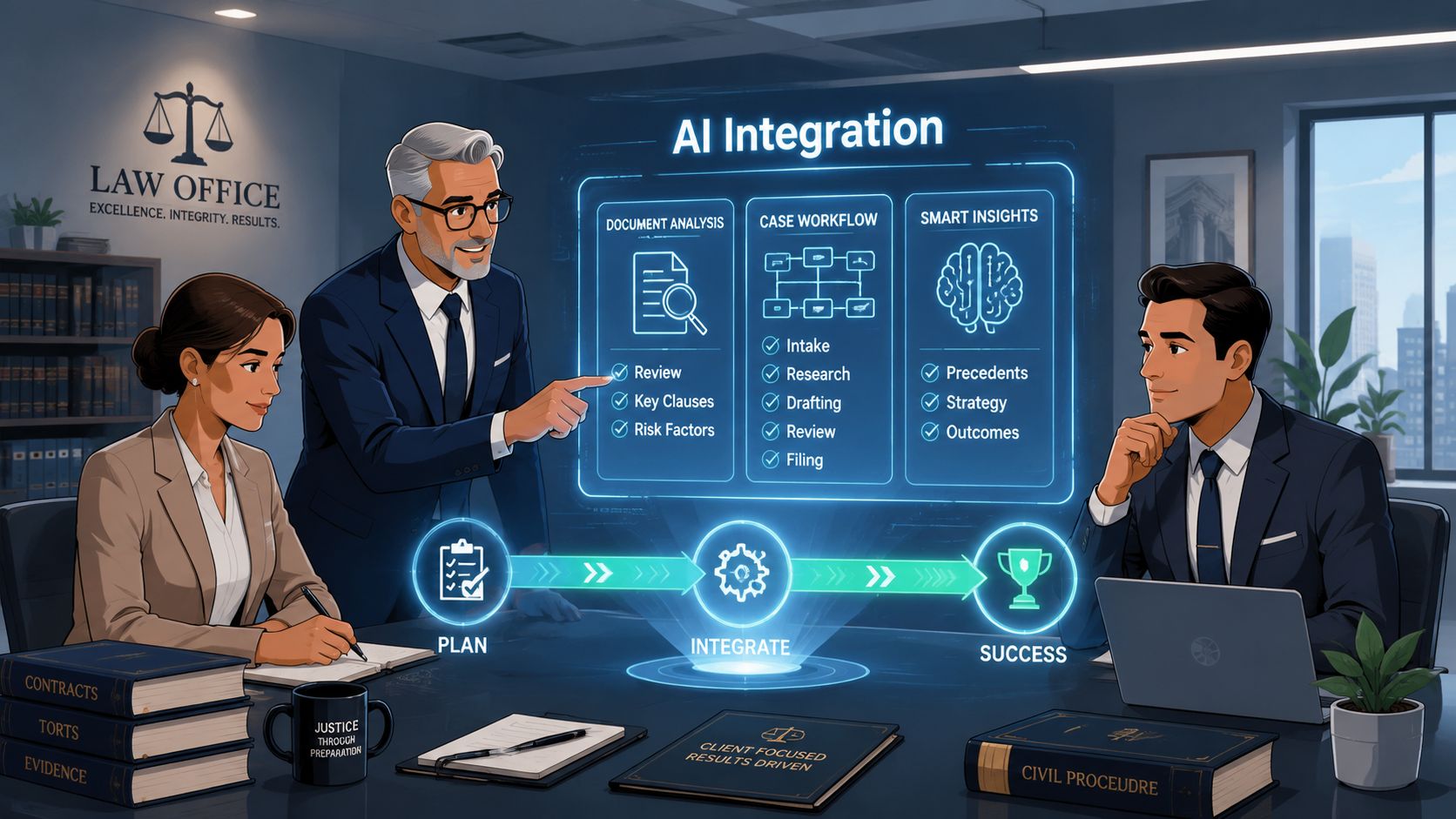
Start with a pilot that includes a few people who already handle records well and are willing to change habits. Keep the scope narrow, one case type or one practice group, and make the team work inside the actual matter flow instead of a test sandbox. That's how you learn whether the assistant fits your firm's actual pace.
A practical rollout usually depends on onboarding, training, and clear use rules. Stanford's legal-help research points to the practitioner assistance gap, where tools fail because they don't fit real workflows, especially in cases built from messy records and service-delivery steps Stanford research on AI in legal help. That's why a tool can look strong in a demo and still fail in a busy PI office.
A useful training plan is outlined in training and onboarding, and the core lesson is simple, people adopt what saves them effort immediately. If the assistant produces a cleaner chronology or a usable first draft on day one, the team is far more likely to keep using it.
The measurement should be practical, not theoretical. Track how long it takes from receiving a file to producing a demand draft, how much manual review work the paralegal still has to do, and whether the attorney is getting a better first pass on case facts. Use those signals to decide whether to expand.
One more point belongs here, the tool should fit where your team already works. A separate app that forces people to copy and paste records everywhere creates friction. Adoption sticks when the assistant becomes part of the file review and drafting routine, not another tab to manage.
Your Path to an AI-Powered Practice
An AI legal assistant won't replace a PI lawyer's judgment, and it shouldn't. The value is in clearing away the repetitive work that hides underlying issues, then giving the attorney a cleaner factual base for strategy, negotiation, and client communication. That means better use of staff time, better demand letters, and a firmer grip on the record before settlement talks begin.
The firms that benefit most will be the ones that treat AI as a case-building tool, not a novelty. They'll use it to sort records, build chronology, surface risks, and draft from the file instead of from memory. That shift makes the practice more consistent, and consistency is what lets a firm scale without sacrificing case quality.
If your team is still buried in paper or spending too much time assembling the same facts by hand, the next step is straightforward. Evaluate how a PI-focused assistant fits your intake, records review, and demand workflow, then test it on a live matter with real expectations. That's the fastest way to confirm if the tool improves the work.
A CTA for Ares.