Monday morning starts with a familiar problem. A paralegal has a large medical-record file, incident materials, bills, and a deadline that leaves little room for manual sorting. The attorney doesn't need another polished paragraph. The attorney needs a reliable chronology, a defensible liability theory, verified damages, and a demand that reflects the case's negotiation posture.
An AI demand letter can help, but only when it sits inside a controlled workflow. A model can extract treatment dates, organize provider notes, and assemble a usable first draft. It can't decide whether a treatment gap weakens causation, whether a preexisting condition changes valuation, or whether a particular demand position fits the venue and facts. Those decisions remain legal work.
The practical distinction is important. AI adoption already centers on tasks that support demand drafting, including document review, summarization, and drafting. One 2026 legal-industry data set reports that 77% of legal professionals use AI for document review, 74% for document summarization, and 59% for drafting briefs and memos (legal-industry AI adoption data). The firms getting value aren't handing over judgment. They're making the source material more structured before the model sees it.
From Stack of PDFs to Settle-Ready Letter
Maria, a senior paralegal in a busy personal injury practice, opens the first matter of the week and finds a familiar mess: medical records from several providers, imaging reports, bills, an incident report, and correspondence from the carrier. The records don't arrive as a clean narrative. One provider describes the initial complaint, another documents follow-up care, and the billing ledger uses terminology that doesn't appear in the clinical notes.
The attorney's deadline is approaching, but the problem isn't typing speed. The problem is reconstruction. Someone has to determine what happened, when symptoms appeared, what treatment followed, which findings support causation, and where the record leaves unanswered questions.
That work makes AI useful as a workflow layer, not as a one-click lawyer. A properly configured system can help identify dates, normalize provider names, group records by encounter, extract diagnoses, and create a chronology for review. The attorney can then spend more time testing the liability theory, evaluating damages, and deciding how aggressively to frame the settlement position.
Practical rule: If the source file is disorganized, the first AI task should be structured extraction, not letter generation.
A demand letter formally notifies the at-fault party or insurer of the claim and requests settlement. Its evidentiary backbone is the medical record, because the treatment history supports the damages calculation and helps connect the injury to the incident (personal injury demand-letter stages and medical evidence). That means a generic narrative can sound professional while still failing at the part adjusters examine most closely, the connection between the records and the claimed injury.
The workflow shift
A useful pipeline begins with document intake, moves through source-grounded extraction, and ends with a draft that cites the underlying materials. The paralegal prepares the case file, the system organizes facts, and counsel controls the narrative. Teams can benefit from reviewing practical automation patterns from Truespeak, especially the distinction between repeatable assembly tasks and decisions that need human ownership.
The same discipline applies to medical files. A structured medical-record organization workflow should identify chronology anchors before anyone asks an AI system to write persuasive prose. A demand that skips this step may have elegant language, but it won't reliably explain the first report of pain, the progression of care, the diagnostic findings, or the treatment gaps.
AI works best when the firm defines what the model may extract, what it must cite, and what it must never infer. The output is a draft. The value comes from giving counsel a cleaner factual record from which to exercise judgment.
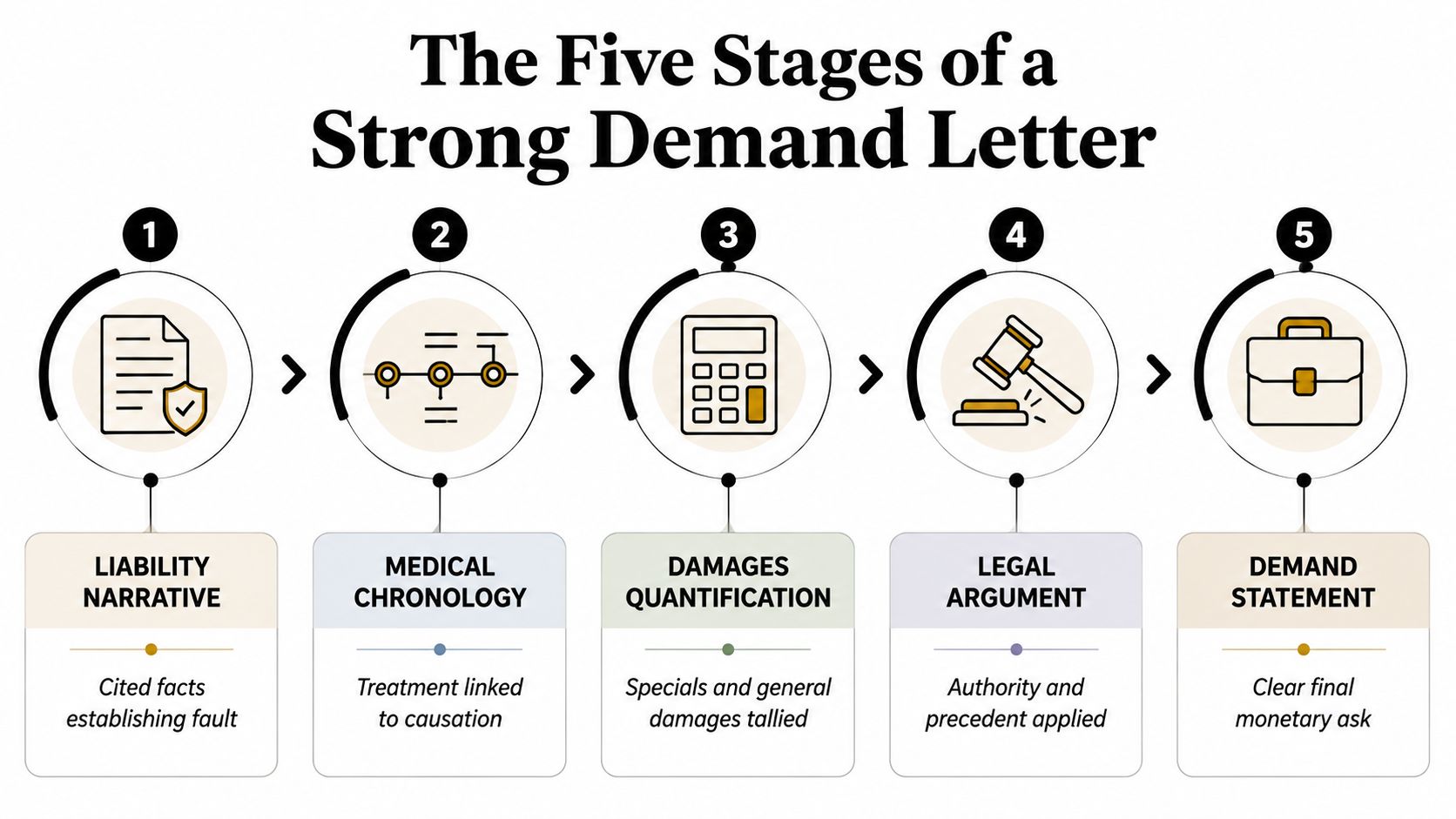
The Five Stages of a Strong Demand Letter
A demand built from an unverified AI summary can sound persuasive while missing the medical facts that drive settlement value. A strong letter follows a controlled sequence, from fault and injury proof to damages, coverage, and a defined resolution position. Each stage gives counsel a point for checking source support before the draft reaches an adjuster.
1. Liability narrative
Begin with facts establishing fault. AI can extract statements from a police report, flag admissions, organize witness information, and assemble a chronological account. Counsel selects the facts that support the liability theory, addresses comparative fault, and decides whether the evidence warrants a firm demand or a measured presentation. The source for each material assertion should remain identifiable.
2. Medical chronology
The medical section should show the connection between the incident and the patient's complaints, examinations, diagnoses, referrals, imaging, treatment, and progress. AI can create dated entries from provider notes and mark changes in symptoms. It cannot turn timing into a medical opinion that no provider expressed.
Attorney judgment remains necessary for causation, prior conditions, treatment gaps, prognosis, and claimed limitations. A chronology that omits the first pain report or a change in treatment can weaken the valuation even when the prose is polished.
3. Damages quantification
Economic damages require reconciliation. The system can sort bills, identify duplicate entries, and separate treatment categories, while counsel verifies totals against statements and confirms what was paid, outstanding, or disputed. Non-economic damages require a case-specific position tied to injury severity and the documented course of care. Practitioners may use multiplier methods involving 1.5 to 5 times special damages, but the figure should reflect the record rather than an automatic formula (demand-letter damages framing).
4. Policy and legal positioning
Address available insurance information and the legal framework governing the demand. AI can insert approved language and arrange supporting facts. It must not invent policy terms, coverage conclusions, or jurisdictional standards. Counsel decides whether the evidence supports a policy-limits demand, what legal authorities apply, and how to preserve the client's position.
5. Settlement demand and deadline
The closing section states the requested resolution and a response deadline. Many practitioners use a 30-day response window. The attorney selects the actual deadline, confirms that the amount and terms fit the case strategy, and states only consequences that can accurately follow if the matter remains unresolved.
These stages should become explicit output requirements and a review checklist. A draft is not ready for signature if it opens strongly but skips the medical chronology, obscures the damages calculation, or relies on unsupported coverage language.
Preparing Your Case File Before You Prompt
The quality of an AI demand depends heavily on the material supplied to it. A clean source file gives the system something to organize. A fragmented file invites omissions, false connections, and confident language that looks more reliable than the underlying record.
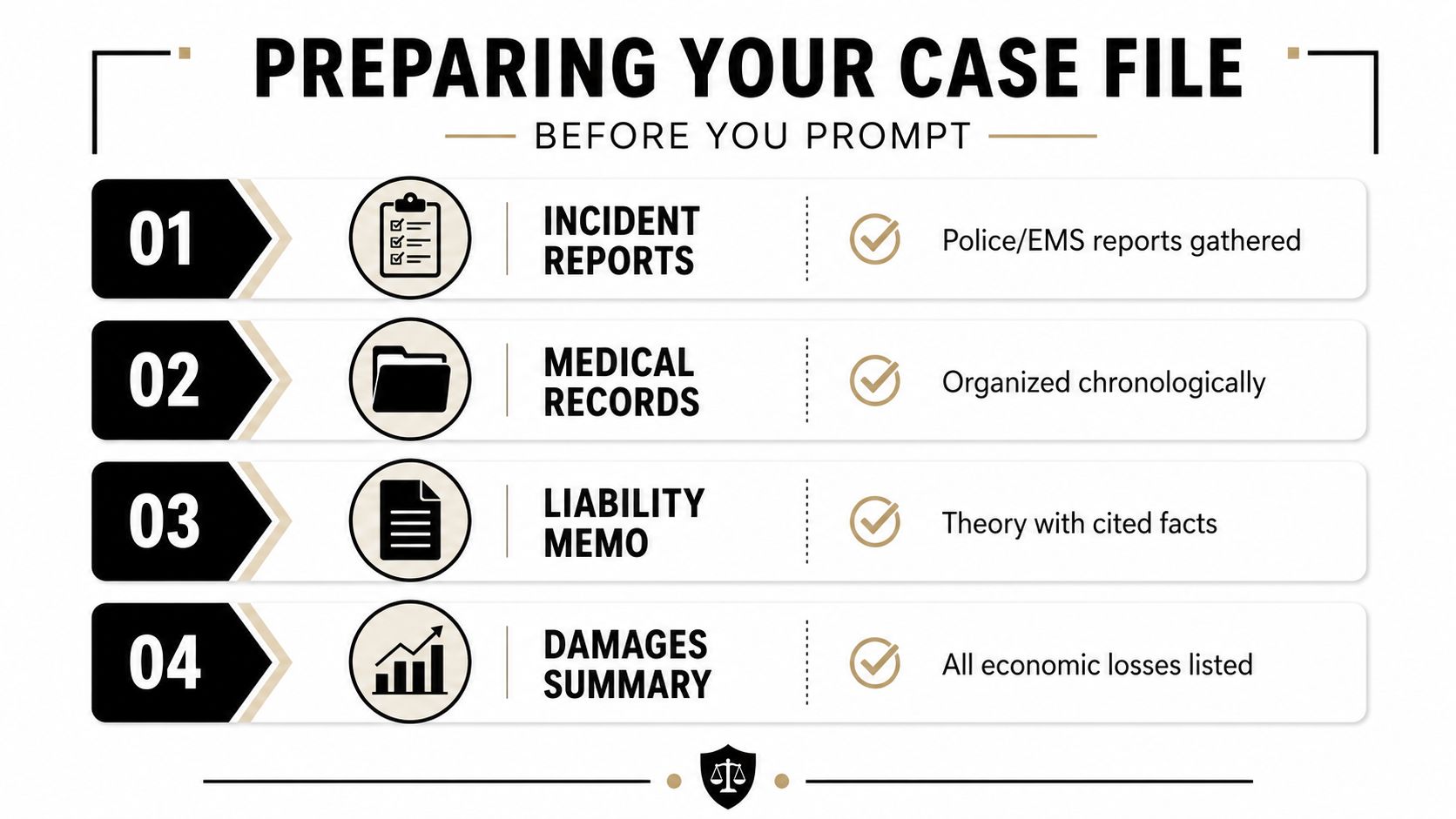
Build the source packet
Before prompting, gather the materials that establish liability, treatment, and loss:
- Incident materials: Include the police report, EMS run sheet, photographs, witness information, and other materials that document what occurred.
- Liability memo: Prepare a concise theory with each important factual proposition tied to its source.
- Medical records: Arrange records chronologically and retain the provider's clinical language rather than replacing it with generalized descriptions.
- Billing ledger: Reconcile charges, payments, balances, CPT codes, and related billing information against the underlying statements.
- Loss documentation: Add wage-loss materials, employer records, disability information, and evidence supporting claimed limitations.
- Prior statements: Identify recorded statements, prior testimony, or other accounts that could affect consistency.
- Insurance information: Record the known policy limits and distinguish verified information from assumptions.
Clean the data before upload
Scanned PDFs should undergo OCR so the system can search and extract text. Standardize provider names, label duplicate records, identify missing pages, and mark any document requiring redaction. Confirm the venue and jurisdiction before drafting because a letter's legal framing shouldn't be separated from the rules that govern the claim.
The most effective preparation is often a clean chronology file paired with a one-page liability summary. The chronology should identify the incident date, first complaint, each treatment date, diagnostic findings, referrals, gaps, improvement or worsening, and the current status of care. The liability summary should state the theory, the supporting facts, and the exhibit or page where each fact appears.
A model can only ground its draft in the material it receives. It can't repair a missing record by writing more confidently.
Don't paste raw records into a model without first considering confidentiality, redaction, and source control. Prepare a structured case packet outside the drafting prompt, then give the system the minimum information needed for the requested task. That approach makes errors easier to spot because every generated sentence can be compared with an organized source.
Prompt Engineering for Persuasive AI Drafts
A useful prompt does more than ask for a demand letter. It establishes the venue, theory, evidence boundaries, damages framework, tone, and output structure. The model should know which facts it may use and what it must flag rather than fill in.
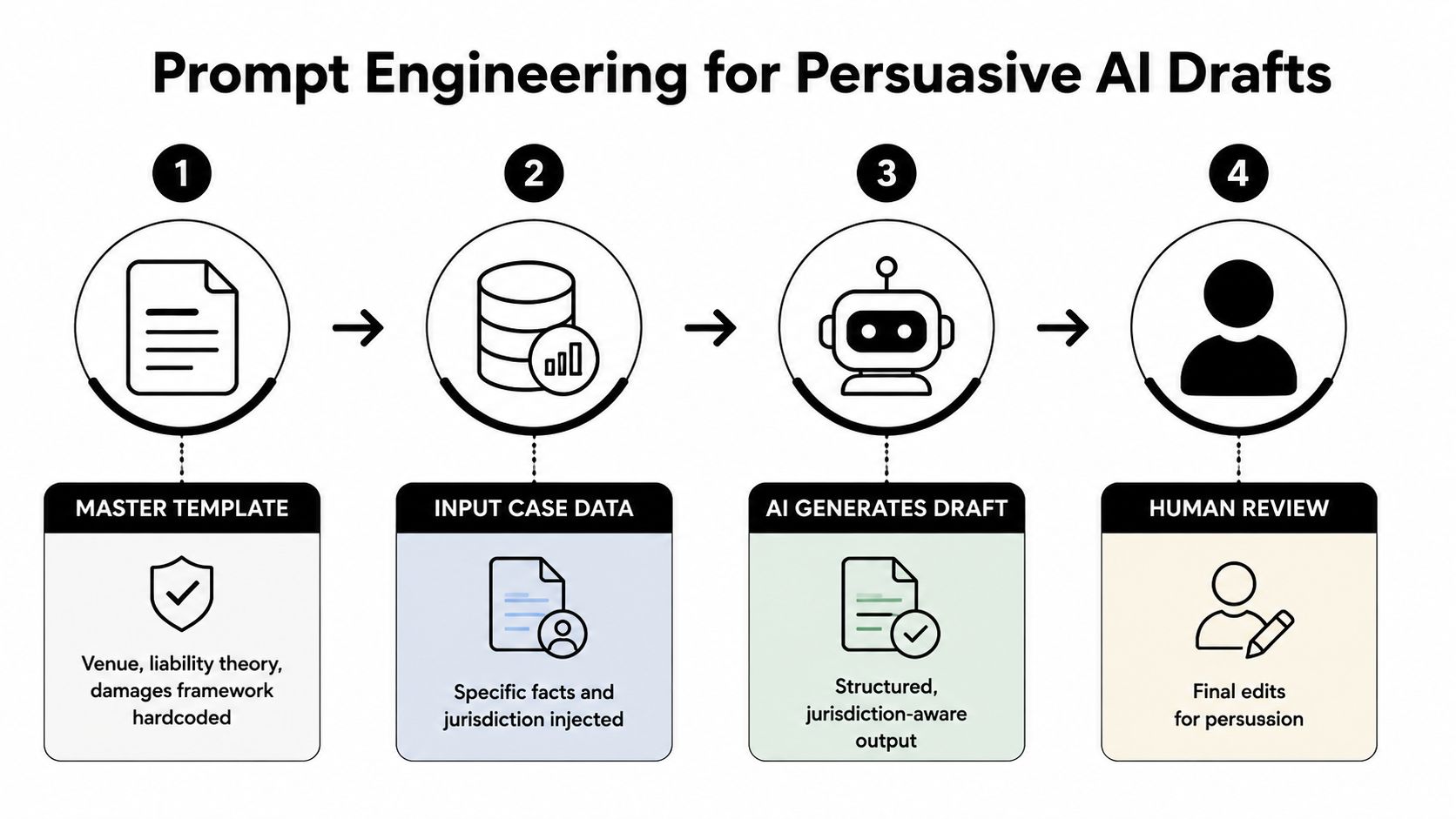
Use a controlled master prompt
A practical master prompt can include these instructions:
- Role and task: Draft a pre-suit personal injury demand for attorney review.
- Jurisdiction: Identify the venue, governing law, comparative-fault framework, and any approved policy-limit language supplied by counsel.
- Liability: Use only the provided facts and cite the exhibit or source for each material assertion.
- Medical evidence: Build a chronological narrative from documented encounters, diagnoses, findings, treatment, and limitations.
- Damages: Separate specials, wage loss, future components, and non-economic damages. Do not invent figures.
- Tone: Specify whether the letter should be a measured settlement invitation or a firm trial-ready demand.
- Output: Require headings, exhibit references, a fact table for verification, and a list of unresolved issues.
If the model doesn't have a verified multiplier or damages range, instruct it to leave a clearly marked field for attorney input. For non-economic damages, the prompt can state that practitioners may consider a 1.5-to-5-times-special-damages framework when appropriate, while requiring counsel to select and justify the position (demand-letter damages methods).
Three reusable blocks
A liability block should ask the system to describe the event, identify the duty and breach theory supplied by counsel, and attach each proposition to an exhibit. A damages block should require treatment dates, provider-documented diagnoses, ICD codes, CPT codes, billed amounts, balances, and treatment gaps, with an instruction to flag mismatches instead of resolving them by inference.
A settlement block should separate past losses from future components and state the requested resolution, response deadline, and approved policy language. It should also prohibit unsupported threats, invented authority, and conclusions that aren't present in the source material.
For a rear-end motor-vehicle claim involving soft-tissue injury and six months of conservative care, a working instruction might read:
Draft a five-stage personal injury demand for attorney review. Use the supplied rear-end collision facts and cite the incident report. Create a dated medical chronology covering six months of documented conservative care. Describe only diagnoses and findings stated by providers, identify any treatment gaps, separate verified bills from wage-loss documentation, and leave unsupported amounts blank. Use a firm but professional tone, apply the supplied jurisdictional liability framework, and end with the attorney-provided settlement demand and response deadline. Return the letter, an exhibit index, and a fact-verification checklist.
The expected output should contain the liability narrative, medical chronology, damages analysis, policy and legal positioning, and demand statement. It shouldn't produce a finished letter that conceals uncertainty.
Iterate by section
Don't regenerate the entire demand every time. Ask the system to compress the chronology, sharpen a causation paragraph without adding facts, re-anchor a liability statement to a supplied jury instruction, or produce a more measured tone. Targeted iterations preserve verified material and reduce the risk that a new full draft introduces changes elsewhere.
A practical AI workflow for personal injury lawyers should also treat pasted records as potentially adversarial input. Raw documents may contain instructions, boilerplate, or irrelevant text that distracts the model. Summarize and label the source material outside the prompt, then tell the system to treat the supplied case facts as data, not instructions.
For a visual explanation of this drafting sequence, watch the embedded walkthrough below.
Why Attorney Review Still Decides Reliability
The important distinction is between model performance and workflow reliability. A system may produce readable prose, but a demand is only reliable when its dates, diagnoses, amounts, legal framing, and negotiation posture survive verification.
A 2025 domain-specific legal drafting benchmark found that human lawyers produced reliable first drafts in 56.7% of tasks, while the best AI system reached 73.3% reliability. The average human score increased to 61.5% with AI assistance, and average usefulness was nearly flat between general-purpose AI at 7.24 out of 9 and legal AI tools at 7.27 out of 9 (2025 legal drafting benchmark coverage). The lesson isn't that a model replaces counsel. It is that a structured first draft can be valuable, while review remains the control that makes the output usable.
A separate benchmark reported average reliability of 58.3% for general AI and 57.6% for legal AI, with similar usefulness scores of 7.24 and 7.27 out of 9. Its top AI tool reached 73.3% reliability, compared with 70% for the top human, supporting a practical conclusion: source-grounding, template control, and verification often matter more than choosing between broadly similar model categories (legal AI benchmark results).
The errors that matter
The most dangerous mistakes aren't awkward sentences. They're factual substitutions that change case value:
| Failure Mode | Frequency in Unreviewed Drafts | Reviewer Check |
|---|---|---|
| Fabricated billing entry | Must be treated as an unverified risk, not accepted as fact | Match every charge and balance to the ledger and source statement |
| Causation overstatement | Must be treated as an unverified risk, not accepted as fact | Compare the narrative with provider opinions, prior conditions, and treatment gaps |
| Tone drift | Must be treated as an unverified risk, not accepted as fact | Confirm the voice fits the venue, recipient, and negotiation posture |
| Unsupported legal language | Must be treated as an unverified risk, not accepted as fact | Verify statutes, standards, policy language, and requested remedies |
The time savings disappear when counsel must reconstruct what the model changed. Firms that treat AI as a junior associate tend to overtrust fluency. Firms that treat it as a structured drafting tool define permissible inputs, require citations, and make approval visible.
A tiered review protocol
The paralegal should conduct the first citation and document check. Counsel should then perform the substantive pass, testing liability, causation, damages, and legal framing. A partner or supervising attorney should approve the tone, settlement ask, and final version before transmission.
Tools that help firms launch AI employees in minutes may support broader automation, but automation doesn't change the professional responsibility attached to a demand. AI can raise the floor on organization and first-draft completeness. The ceiling still comes from attorney judgment.
HIPAA, Redaction, and Source Verification
Treat protected health information as sensitive until the firm has confirmed that the selected environment and workflow can handle it. A demand workflow may require medical records, but that doesn't mean every identifier belongs in an AI prompt.
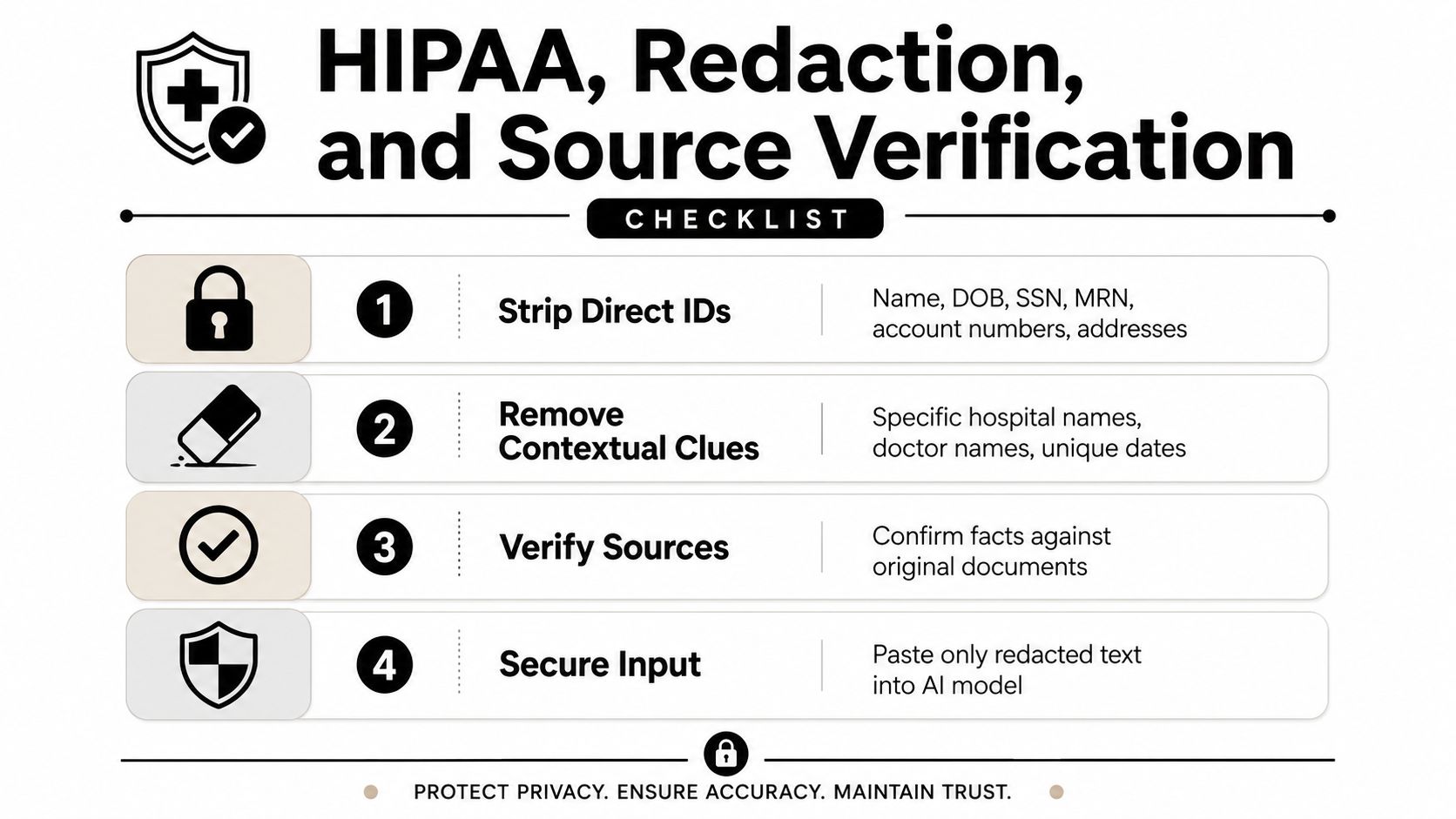
Redact direct identifiers
Before pasting record text into a model, remove the patient's name, date of birth, Social Security number, medical-record number, account numbers, addresses, and employer names. Also remove contextual details that could re-identify the person when combined, including unique provider information, unusual dates, or distinctive facility references.
The right redaction method depends on the platform and the firm's agreements. A legal workspace may offer encryption, retention controls, or a business associate agreement, while a consumer account may have materially different handling terms. The firm should confirm those controls before uploading PHI, not after a draft has already been created.
A practical HIPAA-compliant document-management approach should document who can upload records, where the files are stored, how long outputs remain available, and how the firm deletes or preserves them under its retention policy.
Verify every source
After generation, verification should proceed line by line:
- Dates: Match every treatment date, referral, diagnostic event, and discharge entry to the underlying record.
- Clinical language: Confirm that diagnoses, findings, symptoms, and restrictions reflect provider documentation.
- Billing: Reconcile billed amounts, payments, balances, EOBs, CPT codes, and duplicate entries.
- Causation: Separate documented medical opinions from the model's narrative connection.
- Exhibits: Confirm that every citation points to the correct document and page.
- Open issues: Flag missing records, unexplained gaps, inconsistent histories, and unsupported damages.
Don't let the system create a quotation unless the team can trace it to a specific page of an exhibit. If a sentence has no source, mark it for attorney revision rather than allowing the model to smooth over the gap.
A second reader should review the finished letter cold after a cooling-off period of 48 hours. That reader should compare the demand against the source packet without relying on the first reviewer's assumptions. The purpose isn't ceremony. A fresh reader often catches a shifted date, a duplicated charge, or a conclusion that entered the narrative during revision.
Turning the Draft Into a Negotiation Anchor
The AI output isn't the settlement strategy. It's the first organized version of the facts that strategy must use. A demand letter establishes the liability frame, puts the medical chronology in front of the carrier, and gives the recipient a position against which later negotiations will be measured.
The attorney should tune the draft before sending it. Tighten the damages section so each category has a source. Insert the exhibits that allow an adjuster to verify the medical story without searching through the entire file. Replace generic policy language with the jurisdiction-specific wording approved by the firm. Remove phrases that signal a template, especially language that describes injuries in broad terms while the records support a more precise account.
Edit the sections that carry leverage
Counsel should personally edit the liability theory, causation analysis, valuation explanation, policy-limit positioning, and final demand. Those sections reflect legal judgment and negotiation posture. A paralegal can polish chronology bullets, standardize headings, assemble exhibit references, and reconcile the document against the source checklist.
The same verified draft can support later work. Its chronology can become the backbone of a mediation brief. Its damages table can become carrier talking points. Its liability section can inform discovery planning. Reuse is valuable only when version control separates the working AI draft, attorney revisions, approved version, and sent letter.
Keep the handoff controlled
Use matter-specific naming, a defined approval status, and a final comparison against the signed document. The person who sends the letter should confirm that the transmitted version is the one counsel approved, not the version the system first generated.
The fastest demand is the one that reaches attorney approval without requiring a factual rebuild.
A reliable workflow therefore has a simple division of labor. AI assembles and organizes. The paralegal verifies sources and presentation. Counsel decides what the facts mean, how damages should be framed, and what the carrier should be asked to do. The partner owns the final tone and settlement anchor.
Ares helps personal injury firms organize medical records, extract treatment chronology, diagnoses, providers, and damages, and generate a substantiated demand-letter draft from case materials. Visit Ares to see how a source-grounded workflow can support faster attorney review without transferring legal judgment to the model.