Data standardization is the process of converting inconsistent, heterogeneous records into a uniform format so they can be reliably compared, analyzed, and acted on across systems. In a personal injury file, that usually means medical records from different providers arriving in dozens of formats, with different date styles, diagnosis labels, abbreviations, and billing codes.
You know the scene. A paralegal opens a new intake packet and finds one hospital report saying “MRI lumbar spine,” another saying “magnetic resonance imaging of lower back,” and a third using shorthand the rest of the team has never seen before. The records may all describe the same care, but until they're standardized, they read like separate languages.
The Medical Records Chaos Problem
A personal injury case rarely comes in as a tidy packet. It comes in fragments, maybe an ER note in one format, a radiology report in another, billing sheets from a third vendor, and follow-up visits scanned into a PDF that OCR barely recognized. The file is supposed to tell one medical story, but the details are scattered across formats that don't line up.
That's where data standardization earns its keep. It's the systematic process of turning inconsistent data into a common structure so people can search it, compare it, and use it without guessing what each provider meant. A practical way to think about it is translation, not cleanup. You're not changing the substance of the medical history, you're putting it into one shared language so the whole firm reads from the same playbook.
Why the same injury can look different on paper
One provider writes dates as MM/DD/YYYY, another spells them out, and a third drops the year into a header that OCR missed. One clinician writes “low back pain,” another uses “lumbar strain,” and a third abbreviates the same issue in a way that only staff inside that office would recognize. None of that is unusual, but it creates friction every time a lawyer or paralegal tries to build a chronology.
That friction matters because personal injury work depends on details connecting cleanly. If the same treatment appears under slightly different names, the review team has to decide whether they're looking at duplicates, separate events, or a missed continuation of care. Standardization reduces that guesswork by forcing the records into a format the firm can use.
Practical rule: if two documents describe the same event differently, the problem usually isn't the event, it's the formatting and terminology around it.
The historical reason this matters is bigger than legal work. Standardization became essential in trade and administration because fragmented measurement systems made comparison unreliable, and that same logic now applies to medical data, dates, names, and identifiers. The core lesson is the same across centuries, consistent rules are what make records interoperable across people and systems (historical context on fragmented measurement systems).
Core Techniques Behind Data Standardization
The most useful way to understand standardization is to break it into three layers. Each one solves a different problem, and firms often need all three working together before records feel usable.
Normalization makes formats line up
Normalization means bringing values into a consistent format. For a PI firm, that often means standardizing dates, names, provider labels, facility names, or units so they all follow one rule. A file where one note says January 15, 2024 and another says 01/15/2024 is still the same case file, but it's much easier to query when the firm chooses one standard representation.
A simple before-and-after example makes the difference obvious. Before normalization, an intake spreadsheet might list “Metro Gen. Hosp.,” “Metro General Hospital,” and “Metro Hospital” as separate providers. After normalization, all three can point to one canonical provider record, which means searches, reporting, and chronology building stop breaking apart on spelling alone.
Canonicalization chooses one preferred version
Canonicalization goes a step further. When multiple valid forms exist, the firm picks one preferred representation and maps everything else to it. That's useful for diagnosis descriptions, treatment labels, and provider names, especially when medical staff, billing staff, and intake staff all describe the same thing in different ways.
A claimant may say “my heart attack,” a doctor may write myocardial infarction, and a billing code may reference a coded clinical term. Canonicalization doesn't erase those variants, it gives the firm one version to use in summaries, sorting, and drafting.
Controlled vocabularies give the records a shared codebook
Medical coding systems matter. ICD-10, SNOMED CT, and CPT provide shared identifiers for diagnoses, clinical concepts, and procedures, which helps legal teams map free-text records into something searchable and consistent. In practice, that means one case file can treat “herniated disc” descriptions as the same underlying concept even when the source documents use different wording.
A useful implementation pattern is to build from messy intake data to structured fields that your team can trust. If you're mapping case documents, naming conventions matter too, and a practical guide like file naming conventions for legal teams can support the same consistency goal at the document level.
Standardization works best when the firm treats it as a layered system, not a single cleanup step.
For teams looking at healthcare data tooling in a broader sense, it can help to see how other operators are thinking about standardize healthcare data in 2026. The value isn't the buzzwords, it's the reminder that shared formats enable interoperability across systems.
The video below shows how standardization thinking fits into a larger data workflow.
Why Standardization Transforms Personal Injury Case Outcomes
A car crash file can look simple at intake and turn messy by review. One hospital writes “lumbar strain,” another says “back pain,” and a third notes a related complaint in a different format. Standardization gives the firm one way to read those records so the team can compare them without reworking the same facts every time.
The practical gain starts with speed, but it does not stop there. When medical records are standardized, review moves faster, summaries stay consistent, and attorneys can identify case themes without rereading the same file in several different ways. That changes how quickly a matter moves from intake to strategy, and it reduces the chance that a useful detail gets buried in provider-specific wording.
The biggest day-to-day benefit is searchability. A standardized timeline lets staff locate diagnoses, providers, treatments, and gaps across every record set without manually scanning each PDF for wording differences. That matters when a demand letter has to get the chronology right the first time, because a missed treatment gap or mislabeled provider can weaken the narrative before it reaches the adjuster.
Better review, cleaner narratives, stronger negotiation posture
Standardization also gives attorneys a steadier base for demand drafting. If treatment events, provider names, and symptom dates are structured the same way across cases, templates and AI tools can produce summaries that are easier to compare and review. That consistency helps lawyers spot treatment gaps, repeated complaints, and shifts in care more quickly, instead of sorting through multiple versions of the same fact pattern.
The value shows up again in the case theory itself. When the underlying data is unified, the narrative is easier to support. A chronology built from standardized records is less likely to contain accidental inconsistencies, which makes client meetings, negotiations, and internal case reviews more efficient. It also makes it easier to explain why a record matters, because everyone is working from the same labels and sequence.
For firms evaluating tools, it helps to compare systems that can ingest messy legal data and output something usable. A practical resource for that comparison is compare legal intake solutions, especially if you're deciding how much structure you need before documents hit the review queue.
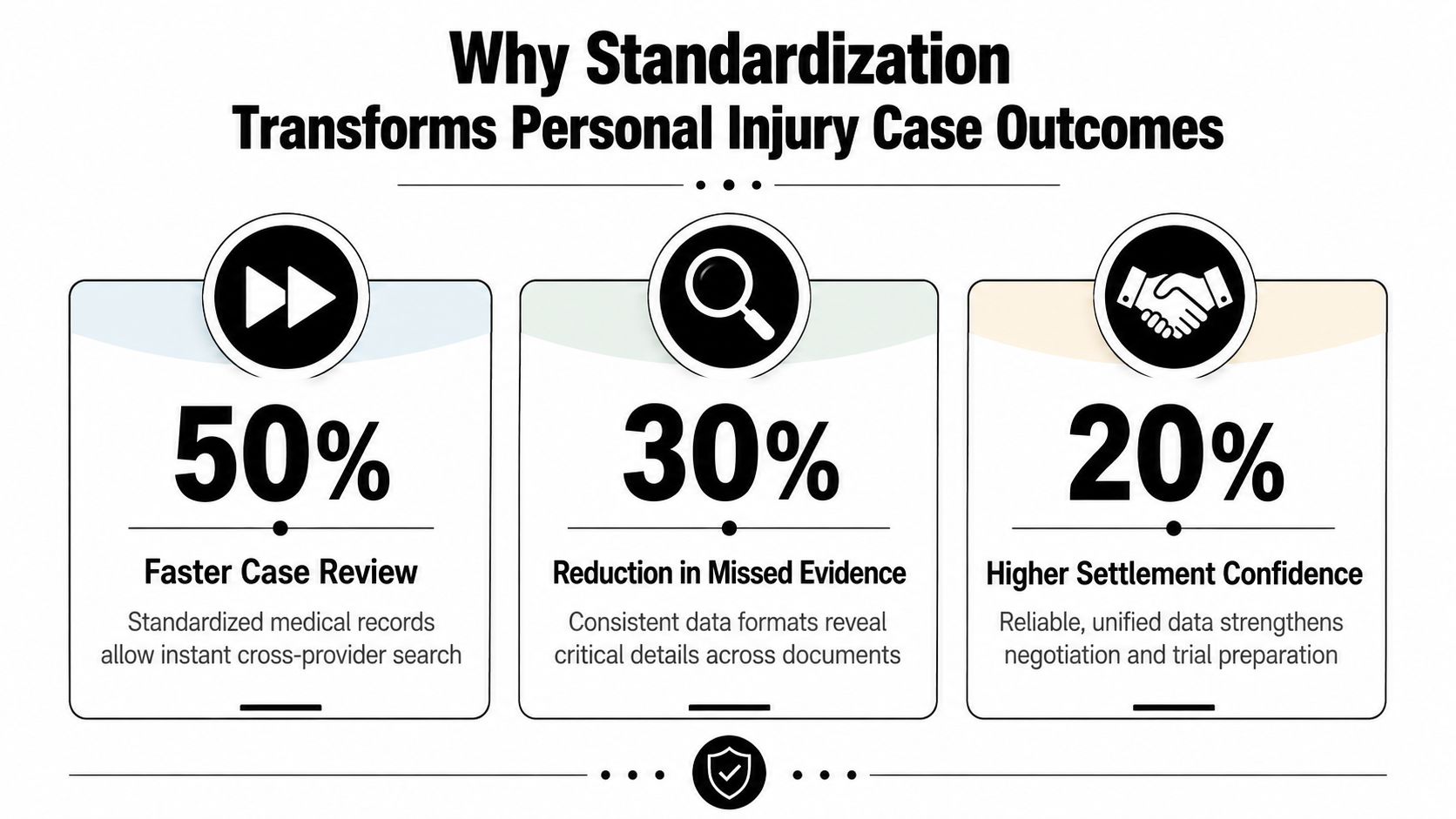
Standardized records do more than save reading time, they make the case theory easier to support, explain, and audit.
Standardized workflows also help firms handle sensitive PHI in a more predictable way. When data moves through consistent steps, staff can track what was received, transformed, reviewed, and exported with far less confusion. That predictability matters when multiple people touch the same file, because it reduces the chance that a record is misread, mislabeled, or passed along without a clear paper trail.
Common Misconceptions About Data Standardization
A lot of confusion around this topic starts with people using the same word to mean different things. In legal operations, that confusion wastes time because teams think they have standardized data when they have only cleaned it up or applied a statistical transform to a numeric field for a model.
Standardization, cleansing, and scaling are not the same
Data cleansing removes duplicates, typos, and obvious errors. Data standardization creates a uniform format so records can be compared across systems. In machine learning, standardization can also mean z-score scaling, which converts numeric values to mean 0 and standard deviation 1, but that is a statistical technique, not a records interoperability process.
That distinction matters for PI firms because the goal is usually operational, not mathematical. You want records that line up across providers, not a model-ready feature vector. If an article does not separate those meanings early, it leaves readers with the wrong mental model.
| Concept | Primary Goal | Example | Frequency |
|---|---|---|---|
| Data Standardization | Make records consistent across systems | Convert all dates to one format and map provider names to one label | Ongoing |
| Data Cleansing | Remove errors and duplicates | Fix misspellings and delete duplicate records | Ongoing |
| Feature Scaling | Adjust numeric values for statistical models | Convert variables to mean 0 and standard deviation 1 | Model-specific |
It is not a one-time project
Another myth says standardization gets finished once the first cleanup is done. Medical vocabularies change, provider formats change, and firm workflows change too. The rules need maintenance, especially when new records arrive from a hospital that changed its portal output or when a coding system shifts.
The governance work is where many teams underestimate the effort. Someone has to decide which label wins when two valid terms conflict, and someone has to update those decisions as the source systems evolve. For firms considering broader AI governance, the framework in 2026 AI compliance essentials is a useful companion read because it reinforces the need for documented rules and oversight.
A practical example comes from a case file that mixes provider names, injury descriptions, and treatment dates across multiple records. One spreadsheet may say “left knee pain,” another may say “knee contusion,” and a third may abbreviate the same condition in a way that only the original staff member understands. Standardization does not erase that history, it makes the different terms easier to reconcile before they reach a demand letter or a case summary.
Implementation Challenges and Governance Realities
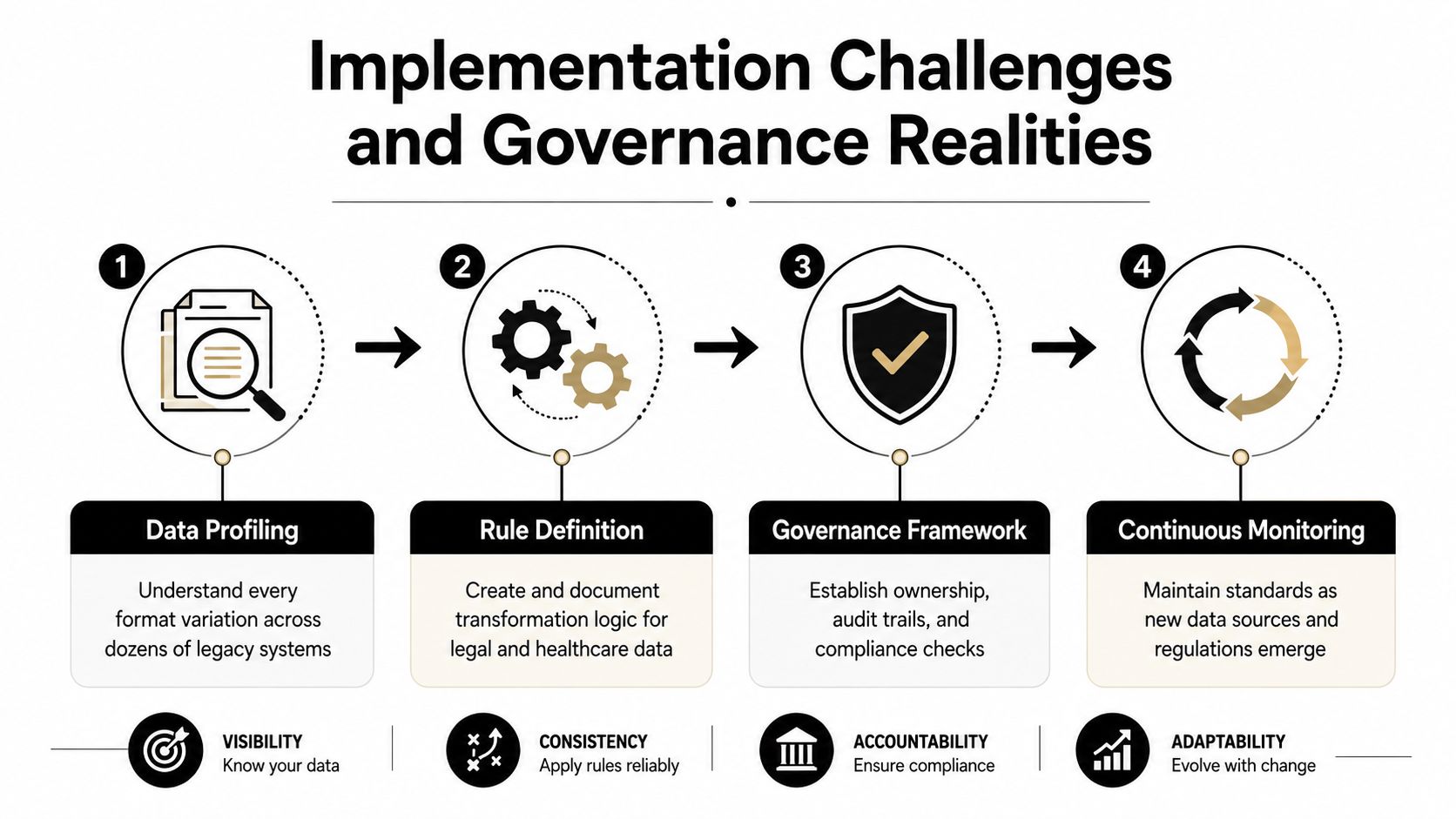
The difficult part of data standardization is usually not the idea itself. It is the day-to-day condition of source data, especially when legal teams work with medical records, bills, scans, faxed documents, and PDFs that were never built for clean downstream use. Every provider seems to use its own conventions, and those conventions rarely stay fixed for long.
A case file can arrive with one clinic's shorthand, a hospital's longer diagnosis text, and OCR errors layered on top. A scanner can blur a date, a fax can drop a line break, and a provider name can appear three different ways before anyone notices. Standardization has to account for that mess before the record can support a summary, chronology, or demand draft. A useful example of that workflow appears in this medical records summarization overview.
Profiling comes before policy
You cannot standardize what you have not mapped. Firms need to profile the source data first, looking at format variations, recurring abbreviations, provider naming patterns, and the places where OCR breaks down. Without that visibility, rules get built on assumptions instead of actual record behavior.
Rule definition is the next judgment call. If one clinic describes the same injury differently than a hospital, the team has to decide which phrase becomes canonical and how the alternates map to it. That is not just technical work. It is operational policy, and in a PI practice it affects how quickly a team can reconcile treatment history before drafting a demand letter.
Governance makes the system durable
A standardization program also needs ownership. If nobody is responsible for maintaining the rules, the system drifts the first time a major provider changes its format or a new coding practice appears in the records. Continuous monitoring matters because standards lose value when they are treated like a one-time cleanup project.
The most common failure mode is good logic that nobody revisits.
For teams building around automation and compliance, the governance discipline overlaps with AI oversight more than many firms expect. A practical reference on that topic is 2026 AI compliance essentials, because the same questions keep coming up, who owns the rules, how exceptions are handled, and how change is tracked.
How AI Platforms Leverage Standardization for Legal Workflows
Modern legal AI platforms only work well if they standardize the incoming records before they try to summarize anything. That's the hidden step most users never see. If the platform can't recognize that different provider labels, date formats, and diagnosis expressions refer to the same underlying facts, the output will be inconsistent.
In a PI workflow, this usually starts the moment a user uploads a case file. The system has to interpret that “Dr. Smith at Metro Hospital” and “Smith, J., Metro Gen. Hosp.” may refer to the same provider, that 01/15/2024 and January 15, 2024 are the same date, and that several descriptions of a herniated disc point to one clinical concept. Once that normalization happens, the platform can extract the chronology, providers, treatments, and key findings into a cleaner case view.
Why the downstream output gets better
That standardized layer is what supports faster review and cleaner drafting. It reduces the time spent reconciling wording differences, helps attorneys spot treatment gaps across multiple providers, and gives demand-letter templates a consistent factual backbone. The result isn't just speed, it's a more reliable record of what happened and when.
Ares is one example of this approach in practice. Its workflow ingests raw medical records, standardizes the case data, and produces structured summaries that can support demand drafting and medical overviews, which is exactly the kind of downstream use case standardization is meant to enable (medical records summarization workflow).
When the source data is standardized first, the summary reads like a legal work product, not a pile of unrelated documents.
That matters most in complex files with many providers. The platform can connect dates, diagnoses, treatments, and chronology across records only after the inputs are made comparable. Standardization is what lets the software behave like a legal operations tool instead of a document viewer.
Best Practices for Building a Standardization Strategy
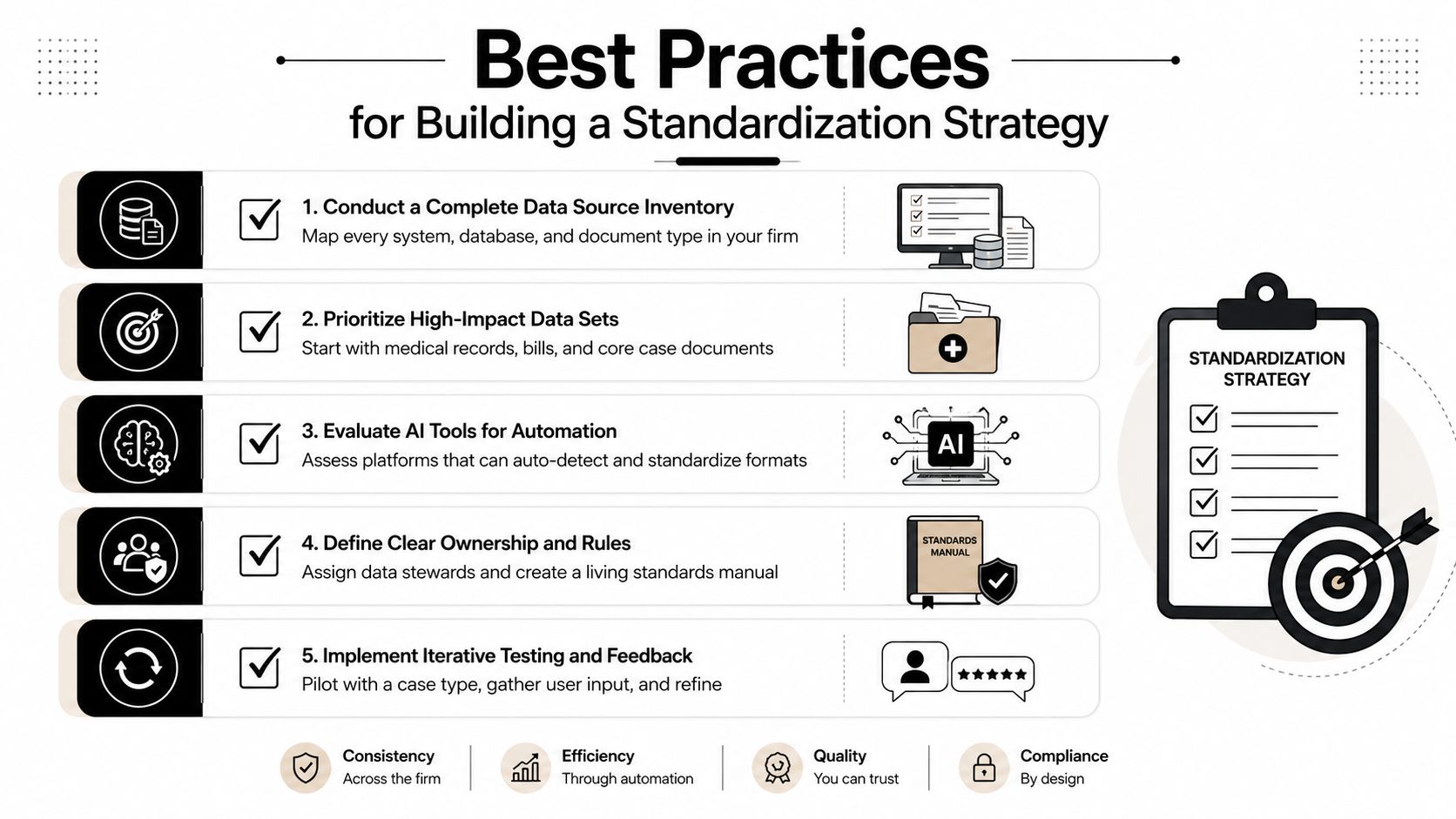
A strong standardization strategy starts with inventory. List every hospital, clinic, insurer, and document type your firm sees most often, then note how each one formats dates, names, diagnoses, and billing information. That map tells you where the friction really is.
From there, define a canonical vocabulary for the injuries, treatments, and provider names that appear most often in your practice areas. Don't try to standardize everything at once. Start with the records that shape chronology, liability analysis, and demand letters.
Build the process around ownership and feedback
Tooling matters too. If your system can't handle OCR, unstructured PDFs, and handwriting, manual cleanup will swallow the value before it reaches the attorney. A practical implementation guide like data vault implementation can help teams think about structure, access, and repeatability together.
- Conduct a complete data source inventory. Map every system, database, and document type in your firm.
- Prioritize high-impact data sets. Start with medical records, bills, and core case documents.
- Evaluate AI tools for automation. Look for platforms that can auto-detect and standardize formats.
- Define clear ownership and rules. Assign a data steward and keep the standards manual current.
- Implement iterative testing and feedback. Pilot with one case type, gather user feedback, and refine.
The best firms treat standardization as an operational advantage, not a back-office chore. As caseloads grow, the firm that can make messy records usable faster will have a real edge in drafting, negotiation, and case review.
If you're ready to turn inconsistent medical records into structured, case-ready workflows, visit Ares to see how the platform standardizes files, extracts key facts, and supports demand drafting for personal injury teams.