

If you're staring at a TV proposal that looks expensive, vaguely branded, and hard to measure, you're not alone. Most law firms get stuck on the same bad question, whether TV “works,” when the essential question is whether your case mix, intake team, and budget can support the right kind of TV buy.
The answer in 2026 isn't a sentimental yes or no. TV advertising for lawyers still has real weight, but only if you treat it like a channel-mix decision, not a vanity project. The firms that win are the ones that pick the right vehicle, police frequency, and demand attribution instead of hoping the phones ring.
Why TV Still Matters for Law Firms in 2026
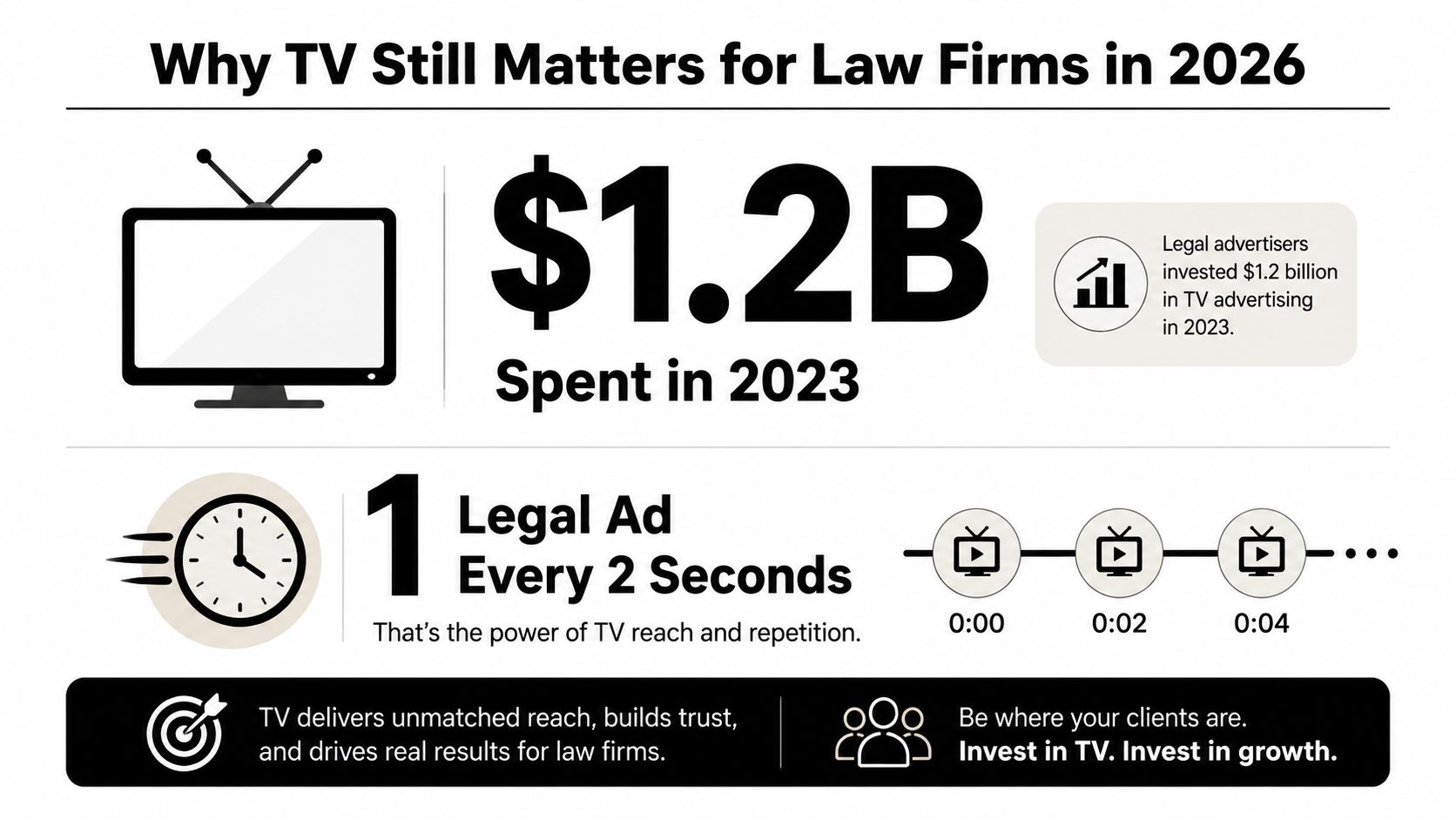
In 2023, U.S. legal TV ad spend was estimated at roughly $1.2 billion, which is the kind of number that tells you this channel isn't a sideshow, it's still one of the centerpieces of legal marketing (ATRA legal services advertising report). That same tracking also put TV ad volume at more than 16.4 million ads at its 2023 peak, with legal ads still running at a pace of about one every two seconds on U.S. television. If you're running personal injury or mass tort intake, that scale matters because it means your competitors are still buying attention in bulk.
Where TV still earns its keep
TV still works when the case value is high enough to justify broad reach and when the audience is large, skeptical, and slow to convert. Personal injury firms, mass tort firms, and other claimant-heavy practices still benefit from repeated exposure because television signals legitimacy fast. It's hard to overstate how much trust a polished spot can create before a prospect ever hits your website.
That's also why lawyer TV ad spend grew so aggressively in the earlier 2008 to 2015 period, rising from $531 million to a projected $892 million, a 68% increase documented by the U.S. Chamber Institute for Legal Reform (report). The same report said lawyer TV ad spending grew six times faster than all other television advertising during that stretch, which tells you this channel has long been structurally important, not a passing fad. For a useful production-oriented perspective on what strong TV spots need to look and feel like, insights for TV advertising teams are worth a read.
Where TV is a bad fit
TV is a poor fit when your intake capacity is thin, your case values are modest, or your niche audience is so narrow that broad reach becomes waste. A boutique firm chasing a tiny slice of a local market can burn money quickly if the spot is built for awareness but the back office can't handle response.
Practical rule: if one decent signed case doesn't pay for a meaningful chunk of the media, TV probably isn't your first lever.
Use your own marketing plan as the filter. If your overall strategy needs better intake infrastructure, start with the marketing plan for lawyers before you commit to airtime. The right TV buy should fit inside the firm's economics, not force the economics to catch up later.
Choosing Between Linear, Local Cable, and CTV
The wrong way to buy TV is to ask for “TV” and hope the vendor decides the rest. The right way is to separate the channel into three actual buying decisions, linear, local cable, and CTV/OTT, because each one behaves differently on reach, targeting, and attribution.
The quick comparison
| Vehicle | Targeting Precision | Typical Use Case | Main Trade-Off |
|---|---|---|---|
| Linear | Broadest | Fast awareness across a large market | Wasted impressions if your audience is narrow |
| Local Cable | Moderate | Local reinforcement and tighter market control | Still less precise than digital-style targeting |
| CTV/OTT | Highest | Geo-focused or audience-focused campaigns | Smaller scale, more fragmented buying |
Linear is still the blunt instrument. It buys mass reach, which is useful when you need your firm name in a market quickly and your intake team can handle a wave of calls. Local cable sits in the middle, often useful when you want regional presence without the entire blast radius of broadcast.
CTV/OTT is the most flexible of the three because it behaves more like digital video. It gives you a tighter way to aim by geography and audience, which matters when your firm cares about qualified leads more than raw exposure. Strategus frames attorney TV advertising as a choice between linear TV and OTT/CTV, and that framing is right, because the core issue is where your spend goes and what kind of caller comes out of it (Strategus overview).
How I'd think about the trade-off
If the case value is high and the market is large, start broad and use frequency control to avoid waste. If your territory is tight and you can define the audience cleanly, CTV/OTT deserves a bigger share of the plan. If you need both, blend them.
Buying bias that usually works: lean into CTV/OTT when you care most about case quality, keep linear in the mix when you need scale, and use local cable as the connective tissue between them.
For most PI firms, I'd default to a split that puts the largest share into the vehicle that matches your real intake capacity, not your vanity preference for “being everywhere.” If your front desk can only handle a controlled number of leads, precision beats sheer reach every time.
Writing Compliant Scripts That Still Convert
Bad legal commercials usually fail for one of two reasons. They're either too aggressive and trip compliance alarms, or they're so sanitized that nobody remembers them. The better scripts do both jobs at once, they create trust and stay inside the rules.
The structure that actually works
A solid 30-second PI spot needs five pieces, in this order, hook, problem, credibility, call to action, disclaimer. The hook should sound human, not theatrical. The problem should sound specific enough that a viewer self-identifies, without making promises you can't keep.
Credibility should come from the firm's actual posture, not inflated language. If you have a recognizable process, state it plainly. If you don't, don't pretend the script can invent one. The compliance side is not decorative, it's part of the persuasion.
A clean script often reads better because the disclaimer tells the viewer you're not bluffing. That's especially important in a market where people are already skeptical of lawyer commercials. The U.S. Chamber Institute for Legal Reform has argued that trial-lawyer ads feed public skepticism, and that makes restraint a conversion asset, not a weakness (trial-lawyer ad commentary).
A simple 30-second framework
- Hook: lead with the injury or disruption, not with the firm's name.
- Problem: show the practical consequence, missed work, bills, uncertainty.
- Credibility: mention the firm's process, responsiveness, or case focus.
- Call to action: tell the viewer exactly what to do next.
- Disclaimer: keep the language truthful and jurisdiction-appropriate.
A short annotated example helps. “After a serious crash, the bills don't wait.” That opens the door without promising an outcome. “If you're dealing with pain, missed work, or insurance pressure, call us.” That's direct, and it doesn't oversell. “We handle injury claims every day, and we'll explain your options.” That reads like a real firm, not a hype machine.
The firms that sound professional on TV usually are professional on TV. Clean disclaimers, no implied guarantees, and no inflated bravado make the whole commercial more believable.
Producing the Spot Without Burning the Budget
A smart TV spot starts to lose money the moment the firm underestimates production. I've seen partners compare a polished agency reel with a bargain freelancer quote and miss the point entirely. The cheapest option is only cheap if it still delivers a usable master, the right cutdowns, and enough polish to survive repeated airings.

Build the spot like a media asset, not a one-off video
Real attorneys can work on camera if they're comfortable, but don't force it. A good actor can outperform a stiff partner reading teleprompter copy, especially when the spot needs to survive repetition across broadcast and streaming placements. The production team should also think in deliverables, not just in one finished file.
That means shooting with distribution in mind. 4K gives you flexibility for CTV, while broadcast-safe HD still matters for linear delivery. You also want graphics, b-roll, and music licensing handled properly, because a legal ad that looks flimsy or sounds generic hurts credibility fast.
For firms that want a sense of what a full commercial production workflow can look like, the Commercial Video Production Italy page from Image Studio is a useful reference point, even if you're not producing in Italy. The value is in seeing how a production partner frames deliverables and creative scope.
What to demand before you approve final delivery
- Broadcast-safe master: no technical surprises at the station.
- Web cut: a version that works cleanly online.
- :15 and :06 edits: shorter cutdowns for testing and retargeting.
- Still frames: useful for landing pages and companion creative.
If a vendor can't hand over those assets without drama, you're dealing with a shop that's thinking like a video editor, not a media partner. That's a problem because TV buying is iterative, and the firm needs versions it can reuse.
The production red flags are easy to spot. Sloppy legal language, weak lighting, generic stock footage, and no plan for cutdowns all signal trouble. If the vendor doesn't ask how the spot will be measured, they're not really building for TV.
Buying Airtime, Negotiating CPMs, and Setting Frequency
Buying airtime should be disciplined and a little ruthless. Define the market, ask for proposals, compare what you are getting, and hold the buyer to a cost standard that matches the inventory in front of you. For legal media buyers, a useful working target is about a $6 CPM, and that benchmark comes from practical buying guidance used in the field (video guidance).
What to ask for in the proposal
Start with the DMA or market definition, then spell out the dayparts that matter for your audience. Do not let a vendor hide behind “mixed inventory” language. You need a clear answer on whether the buy is built for reach, frequency, or a mix of both.
Ask for a clean read on guaranteed versus non-guaranteed inventory. Guaranteed inventory gives you more certainty, and it often costs more. Non-guaranteed inventory can be efficient, but only if the buyer knows how to avoid junk placements and how to push for make-goods when delivery slips.
Frequency is where lazy buys get exposed
Practical rule: do not let viewers see more than two spots of the same ad in one program per day, because overexposure drives ad exhaustion.
That ceiling matters more than most buyers admit. A bloated schedule can make a campaign look active while hammering the same audience over and over. A tighter plan with controlled repetition usually gives you better response quality.
The same practical guidance recommends testing one creative for about two weeks before rotating to the next, which gives you enough time to see whether the spot is landing. That rhythm makes sense because legal viewers do not react on the same day, and you need a full response cycle before you judge the message. For a useful way to organize performance checks, review this dashboard analytics setup before you approve the next flight.
How to think about timing and market dynamics
Seasonal pressure matters. So does the wider media market. Political periods and other high-demand cycles can tighten inventory and make pricing less friendly, which means the same buy can look very different depending on when you place it. That is why you do not treat a media plan as a fixed document.
If the proposal looks good on paper, ask for the math behind it. Reach, frequency, and placement quality should all fit together. If they do not, the buyer is probably selling impressions, not outcomes.
Tracking Response and Proving ROI
TV becomes defendable when you stop treating response as a vibe and start treating it as a tracked event. “We got more calls this month” doesn't tell you what changed, because it mixes TV with everything else the firm is doing. The right setup isolates response so you can see whether airtime moved the needle.
The three instruments that matter
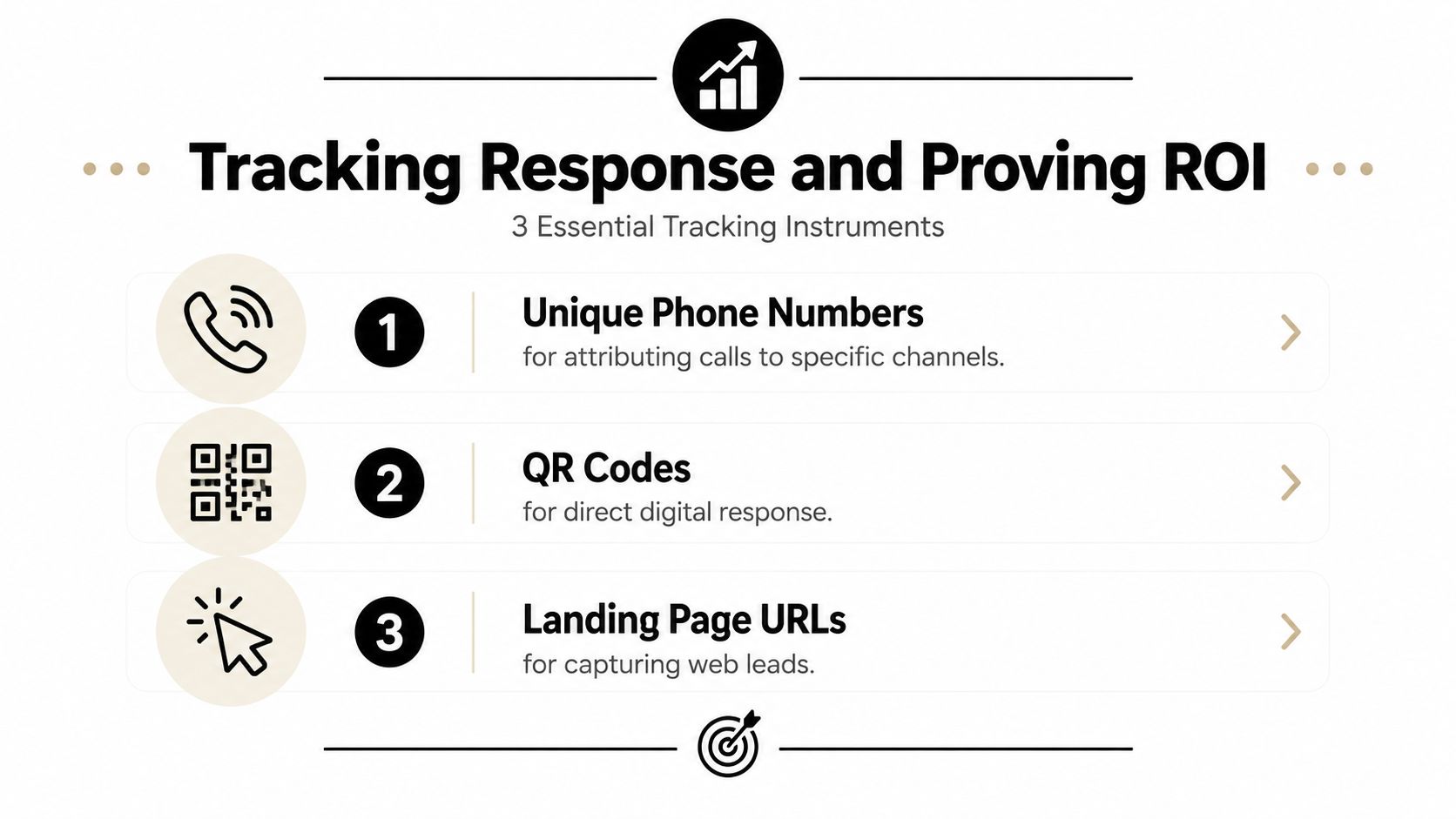
Use a unique call-tracking number for each flight. Build a dedicated landing page, such as a /TV page, so visitors who respond after seeing the ad land somewhere attributable. Train intake to ask a short source question so the team can capture how the caller heard about the firm.
That stack works because it separates channel response from overall brand demand. One legal-advertising analysis notes that a legal-services campaign with a $130,000 budget returned over $100,000 in profit, and another achieved $6.47 in legal fees per $1.00 spent (tracking analysis). Those aren't guarantees, but they do show what disciplined attribution can reveal when the campaign is working.
What a managing partner should look at every week
A simple dashboard is enough if it answers the right questions. How many calls came from the tracked number, how many web leads hit the TV page, and how many qualified matters got into intake? That's the whole point, because signed cases, not just inbound noise, pay the media bill.
For a more structured approach to reporting, dashboard analytics is the kind of internal discipline law firms need before they scale spend. If the numbers are buried in a marketing report no one reads, the campaign is already drifting.
Direct takeaway: TV ROI is a measurement problem first and a creative problem second.
The baseline matters too. Compare the flight period against a prior period with similar operating conditions so you can isolate lift instead of congratulating yourself for normal volume. If the numbers don't hold up under that comparison, you've learned something useful before you scale the buy.
Plugging TV Leads Into Intake and Case Triage
A TV campaign that produces calls but no good cases is just expensive noise. The front end can look strong, but if intake cannot separate viable matters from junk quickly, the media spend goes to the wrong audience. That is where most TV plans fail.

Intake has to be built for volume and triage
A TV-driven call stream should go into a staffed process with a short qualification script. Ask for the incident date, the venue, whether the caller has prior representation, and whether the claim may still be inside the statute of limitations. Those questions are basic, but they separate usable matters from dead ends fast.
Your intake team also needs a workflow that respects privacy and keeps information organized. If the firm is getting a rush of records, notes, and follow-up documents, the back office has to move them into case-ready form quickly. For firms trying to diagnose law firm pipeline problems, that handoff is where weak spots usually show up.
Where software fits into the process
An AI-assisted platform makes sense, not as a magic fix, but as a triage accelerator. If the system can turn incoming medical records and demand-letter drafts into organized work product, the firm spends less time drowning in clutter and more time deciding which TV-sourced leads deserve attention. That matters because the ROI math from the earlier section only works when the firm can process the matters it buys.
The internal process should be documented in one place. The law firm intake services guide is a useful reminder that intake is an operating system, not a phone-answering chore.
Hard truth: a TV campaign can't fix a broken intake desk.
If you want TV to be a real growth channel, connect the ad response to triage, then connect triage to case quality. That is how you learn whether the channel is producing files worth the spend, or just generating expensive calls that never become matters.
If you need a cleaner way to connect TV response to intake, case triage, and document review, Ares is built for that workflow. It helps PI firms turn incoming records and drafts into organized, case-ready work product so marketing spend does not get lost in the queue. Visit Ares to see how it can help your team move TV-generated leads from first call to qualified file faster.