
A patient calls your office after receiving a new diagnosis and says, “I just learned what went wrong.” The records show a procedure, several later appointments, and care from multiple providers. At first glance, the claim appears timely. Then intake identifies that the alleged negligent act occurred more than 30 months earlier, and the later visits were diagnostic reviews rather than treatment by the defendant. The apparent case may already be vulnerable to dismissal.
That scenario captures the operational difficulty behind the phrase statute limitations medical malpractice New York. The law has a baseline deadline, but fragmented medical care can make the accrual date difficult to identify. The difference between active treatment, a patient-requested examination, a second opinion, and care from another provider can determine whether a claim survives.
A defensible analysis starts with chronology, not the patient's discovery date. The firm must identify the alleged act, map every relevant encounter, determine whether a recognized exception applies, and preserve evidence before the deadline becomes a motion issue.
The Baseline 30-Month Rule and Strict Accrual
A patient may describe a delayed diagnosis as the moment the injury became apparent. New York generally treats that event differently. Under CPLR 214-a, a medical-malpractice action generally must be commenced within 2 years and 6 months, approximately 30 months, after the alleged negligent act, omission, or failure, as reflected in the New York Courts' statute-of-limitations timetable.
The critical point is that the ordinary clock is tied to the alleged malpractice, not automatically to the date the patient discovered its consequences. New York historically followed a strict time-of-the-act accrual rule. A patient's lack of awareness may explain why the claim wasn't investigated earlier, but delayed awareness alone generally doesn't move the accrual date.
Practical rule: Never enter the client's discovery date as the deadline trigger until the team has tested the claim against New York's occurrence-based framework and its limited exceptions.
Start with the alleged negligent event
Intake should identify the act or omission with as much precision as the records allow. In a surgical case, that may involve the procedure itself or a specific failure during postoperative care. In a medication case, it may involve a prescribing, dispensing, or monitoring decision. In a diagnostic case, the relevant event may be an interpretation, failure to order testing, or failure to act on a result.
The first review should produce a provisional timeline with separate fields for:
- Alleged act date: The date the negligent conduct allegedly occurred.
- Provider identity: The defendant whose conduct is being evaluated.
- Condition involved: The illness, injury, or condition connected to the claim.
- Later encounters: Every subsequent visit, test, referral, and treatment event.
- Filing status: Whether an action has already been commenced and against whom.
Here, a firm's broader medical-malpractice deadline analysis can help frame the inquiry, but no summary replaces a fact-specific review of the records.
Why discovery assumptions create risk
Jurisdictions that generally use discovery-based accrual may allow the limitations period to begin when a patient discovers, or reasonably should discover, the injury. New York's ordinary medical-malpractice rule is materially stricter. A patient who learns years later that an earlier treatment decision may have caused harm cannot assume that the later realization creates a new filing period.
The law does recognize targeted exceptions, including continuous treatment and specific discovery rules. Those exceptions must be proven from the facts. They aren't a general safety valve for every claim involving delayed symptoms, an overlooked diagnosis, or a patient who trusted the provider.
The operational consequence is straightforward. A firm should calculate the baseline date immediately, then investigate whether a documented exception changes it. Waiting to complete a perfect liability review before addressing limitations can consume the very time needed to preserve the claim.
Navigating the Continuous Treatment Doctrine
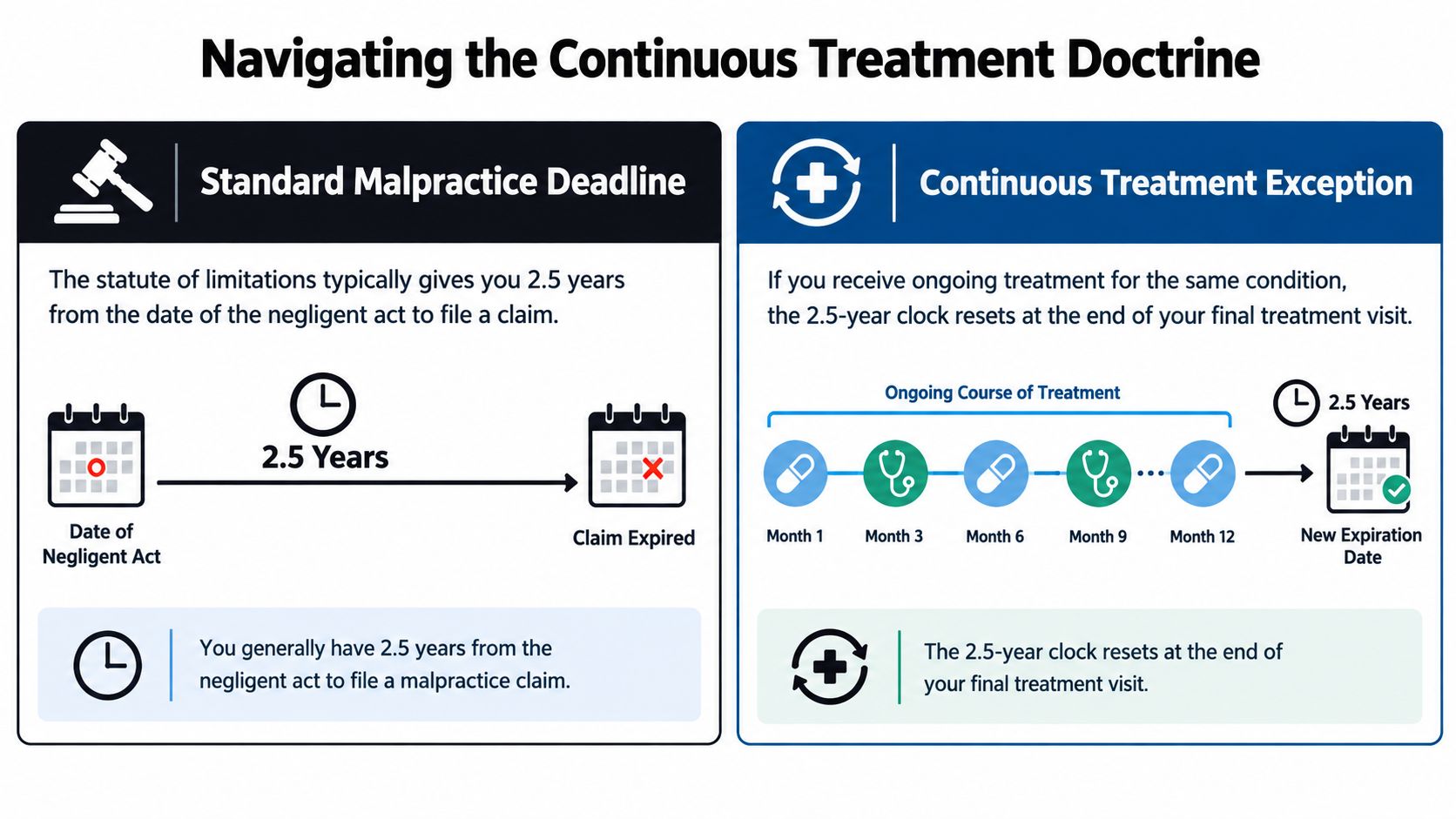
The continuous treatment doctrine is often the strongest argument for a later accrual date, and one of the easiest to apply too broadly. It can measure the limitations period from the end of an ongoing course of treatment when the defendant continued treating the same illness, injury, or condition underlying the alleged malpractice. It doesn't turn every later appointment with the same provider into an extension.
Separate treatment from observation
The intake question isn't just, “Did the patient return?” Ask what happened at each encounter and why. A later visit may support continuity when the provider is actively managing, correcting, or treating the same medical problem. The argument becomes weaker when the visit was limited to checking the patient's status, providing a second opinion, or reviewing a condition at the patient's request.
The New York Court of Appeals has emphasized that a patient-requested examination performed solely to assess the patient's condition doesn't qualify as continuous treatment. That limitation is discussed in the court's decision addressing patient-requested examinations and continuous treatment.
A useful encounter-by-encounter classification looks like this:
| Encounter type | Limitations significance |
|---|---|
| Active care for the same condition | May support continuous treatment |
| Corrective or ongoing management by the defendant | May support a later accrual date |
| Patient-requested condition check | Generally doesn't establish continuous treatment by itself |
| Second opinion from another provider | Usually requires separate analysis and doesn't automatically extend treatment by the defendant |
| Administrative contact or isolated scheduling event | Doesn't establish an ongoing course of treatment |
A decision framework for fragmented care
First, identify the defendant. Treatment by a different physician or facility may explain the patient's medical history, but it doesn't automatically create continuous treatment by the original defendant.
Second, identify the condition. The later care must concern the same illness, injury, or condition that generated the malpractice claim. A provider's treatment of an unrelated issue won't ordinarily preserve the earlier claim.
Third, identify the purpose of each visit. Records should show whether the provider was treating the problem, planning further care, monitoring a treatment course, or merely responding to a request for evaluation.
Fourth, assess continuity from the full record. Appointment notes, treatment plans, referrals, cancellation records, and the patient's account can matter. A later date should never be used as the accrual date merely because it is the last date appearing in the chart.
The doctrine developed as a targeted response to the unfairness of forcing a patient to sue while treatment for the same problem continued. A Hofstra Law Review account of New York's history identifies 1962 as the year the Court of Appeals first adopted the continuous-treatment rule. The policy supports ongoing care, not an unlimited extension through disconnected appointments.
A court may scrutinize the chronology closely once the defendant shows that treatment ended more than 30 months before filing. The plaintiff then needs evidence creating a triable issue on continuity. That makes the difference between “follow-up visit” and “continued treatment” a record question, not a label selected during intake.
Lavern's Law and Cancer Misdiagnosis Exceptions
Cancer misdiagnosis claims occupy a narrow place in New York's limitations framework. Lavern's Law allows certain cancer-related malpractice actions to be brought within 2 years and 6 months after the patient discovered, or reasonably should have discovered, both the alleged negligence and the resulting injury, subject to a 7-year outer limit measured from the malpractice. The rule is described in this analysis of New York's cancer misdiagnosis limitations exception.
That framework differs from the ordinary rule. A patient with a surgical injury, medication error, anesthesia claim, emergency-care error, or non-cancer misdiagnosis generally can't rely on a broad discovery rule just because the harm became clear later. The team must first classify the claim correctly, then determine whether the facts fit the statutory cancer exception.
Diagnosis date is not automatically discovery date
A later cancer diagnosis may be important, but it may not answer the limitations question by itself. The relevant inquiry can require evidence of when the patient learned, or reasonably should have learned, that an earlier failure likely caused the resulting injury.
That makes the following materials potentially significant:
- Pathology reports: These may establish when the malignancy was identified and how the diagnosis developed.
- Referral records: A referral can show when a specialist became involved and what concern prompted the referral.
- Disclosure conversations: Notes may reveal when a provider discussed a missed finding or possible earlier error.
- Second-opinion records: These may document when the patient first received an explanation connecting the earlier care to the injury.
- Oncology records: Treatment planning and specialist assessments can clarify what the patient knew and when.
The distinction matters because a record stating “cancer diagnosed” doesn't necessarily establish when the patient discovered both the alleged negligence and the resulting injury. Intake should preserve the surrounding records instead of extracting only the diagnosis date.
Compare the claim categories carefully
A missed cancer diagnosis may fit Lavern's Law if the statutory requirements are met. A missed fracture, delayed infection diagnosis, medication error, or surgical complication generally remains subject to the occurrence-based framework unless another recognized exception applies. Treating all delayed diagnoses alike creates a serious risk of using the wrong trigger date.
The 7-year outer limit also matters. Even when the discovery analysis favors the patient, the outer cap limits how far the claim can proceed from the malpractice date. The team should calculate both dates and docket the earlier operative deadline after confirming the facts.
For firms, cancer cases demand issue-spotting across records rather than a single-date search. The chronology should show the alleged missed opportunity, the later diagnostic milestones, the first meaningful disclosure or causal explanation, and the records supporting each conclusion. A clean timeline won't resolve the legal issue by itself, but it gives counsel the evidence needed to evaluate discovery rather than speculate about it.
Foreign Objects and Statutory Tolling Provisions
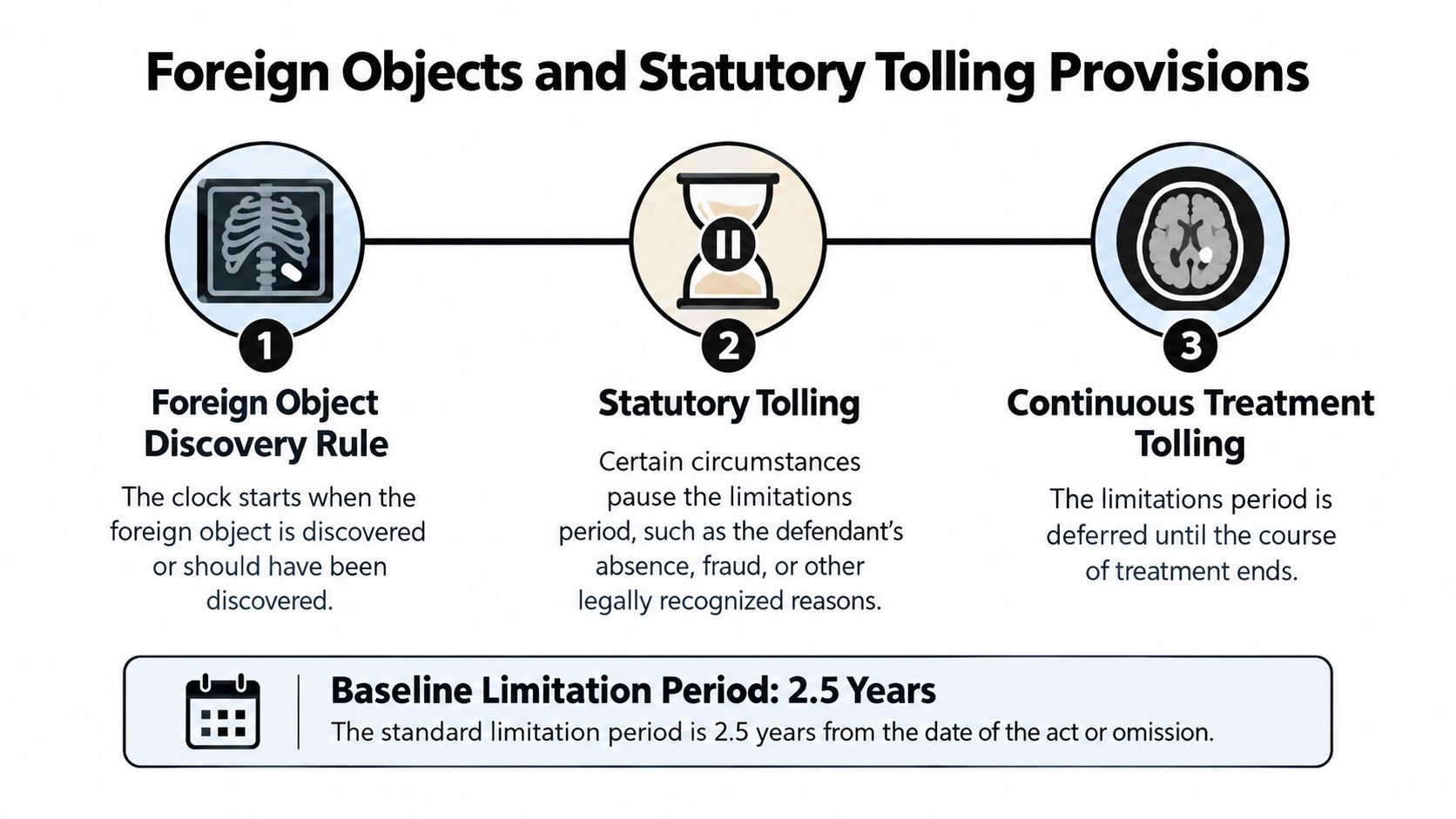
Foreign-object claims operate under a separate discovery-based exception. When an unintended object is left in a patient's body, the limitations analysis can turn on when the object was discovered, rather than applying only the ordinary act-based calculation. The exception is targeted, and intentionally implanted devices are excluded, so the physical presence of an object isn't enough by itself.
The historical development is useful because it explains why New York treats this category differently. The Hofstra Law Review history identifies 1969 as the year the Court of Appeals recognized the foreign-object discovery rule. The rule addresses the distinctive problem of an undisclosed object retained after treatment, not every case in which a medical device later causes symptoms.
Build the exception analysis from the operative record
A surgical claim involving a possible retained object should prompt an immediate records request for the operative report, nursing documentation, imaging, removal procedure, and pathology materials. The team needs to establish what was left, whether it was unintended, when it was discovered, and which provider or facility may be responsible.
Don't describe an implanted device as a foreign object without analyzing its purpose and placement. A device deliberately placed as part of treatment may fall outside the exception even if it later becomes problematic. That classification can change the deadline analysis completely.
Examine disability and capacity issues separately
Minority and legal incapacity can raise additional tolling questions. Those issues shouldn't be folded casually into continuous treatment or discovery analysis. Intake should record the patient's age at the relevant time, any facts bearing on legal incapacity, who managed the patient's affairs, and whether a representative acted on the patient's behalf.
The practical lesson is that exceptions don't form one universal extension. Each has its own factual trigger and limits. A foreign-object argument depends on the nature and discovery of the object. A disability argument depends on the patient's legal status and applicable tolling rules. Continuous treatment depends on the defendant's ongoing care for the same condition.
Record-gathering principle: When an exception is possible, preserve the document that proves the trigger, not merely the document that suggests it.
The baseline calculation should remain on the docket while the exception is investigated. A tentative tolling theory is not a substitute for preserving the earliest defensible filing date.
Procedural Steps to Preserve and Document Claims
A timely theory can still fail if the firm doesn't execute the preservation plan. The first task is to identify every potential defendant and determine whether any provider is a governmental or municipal entity. Public-healthcare claims may require an additional notice process before suit, and that requirement can create an earlier operational deadline than the ordinary malpractice calculation.
The team should treat notice analysis as a threshold task, not a later litigation detail. Confirm the entity's legal identity, obtain the relevant claim procedure, and have counsel verify the applicable notice deadline. Never assume that a hospital's name on a bill or discharge summary identifies the correct legal defendant.
Use a deadline-preservation workflow
Secure complete records. Request provider charts, operative reports, nursing notes, imaging, laboratory results, referrals, billing records, and correspondence. The request should cover the alleged event and every later encounter relevant to continuity.
Preserve physical and electronic evidence. Identify imaging files, removed materials, devices, photographs, portal messages, and communications. A later summary may omit the detail needed to prove when treatment ended or what a visit was intended to accomplish.
Analyze notice obligations. Determine whether the claim involves a governmental or municipal provider. Confirm the proper recipient, service method, and deadline with counsel, then preserve proof of service.
Docket multiple dates. Calendar the baseline act date, every potential last-treatment date, discovery dates for applicable exceptions, notice deadlines, and a conservative internal escalation date. A single calendar entry hides unresolved assumptions.
Commence before the operative deadline. Filing strategy should account for service, defendant identity, and amendment issues. Last-minute filing leaves little room to correct a misidentified entity or incomplete chronology.
Make the chronology litigation-ready
Manual date entry often collapses several different events into one. A record may list a visit date, a test date, a result date, and a later discussion date. Those events have different legal significance. The chronology should preserve them separately and identify the provider, condition, purpose, and source record for each event.
Once a defendant demonstrates that treatment ended more than 30 months before filing, the plaintiff must produce evidence creating a triable issue on continuity. The New York appellate decision addressing that burden highlights why a chronology separating active treatment from diagnostic follow-up can materially affect the limitations analysis.
Litigation reality: A chronology built only for the demand package may be too vague for a statute motion. Capture the reasoning behind each date while the records are being reviewed.
Statute Evaluation Checklist for Intake Teams
A caller may describe “ongoing treatment” because they saw the same physician repeatedly. That phrase is a starting point, not a legal conclusion. The intake specialist should turn the narrative into discrete events and ask what the provider did at each encounter.
Ask questions that expose the timeline
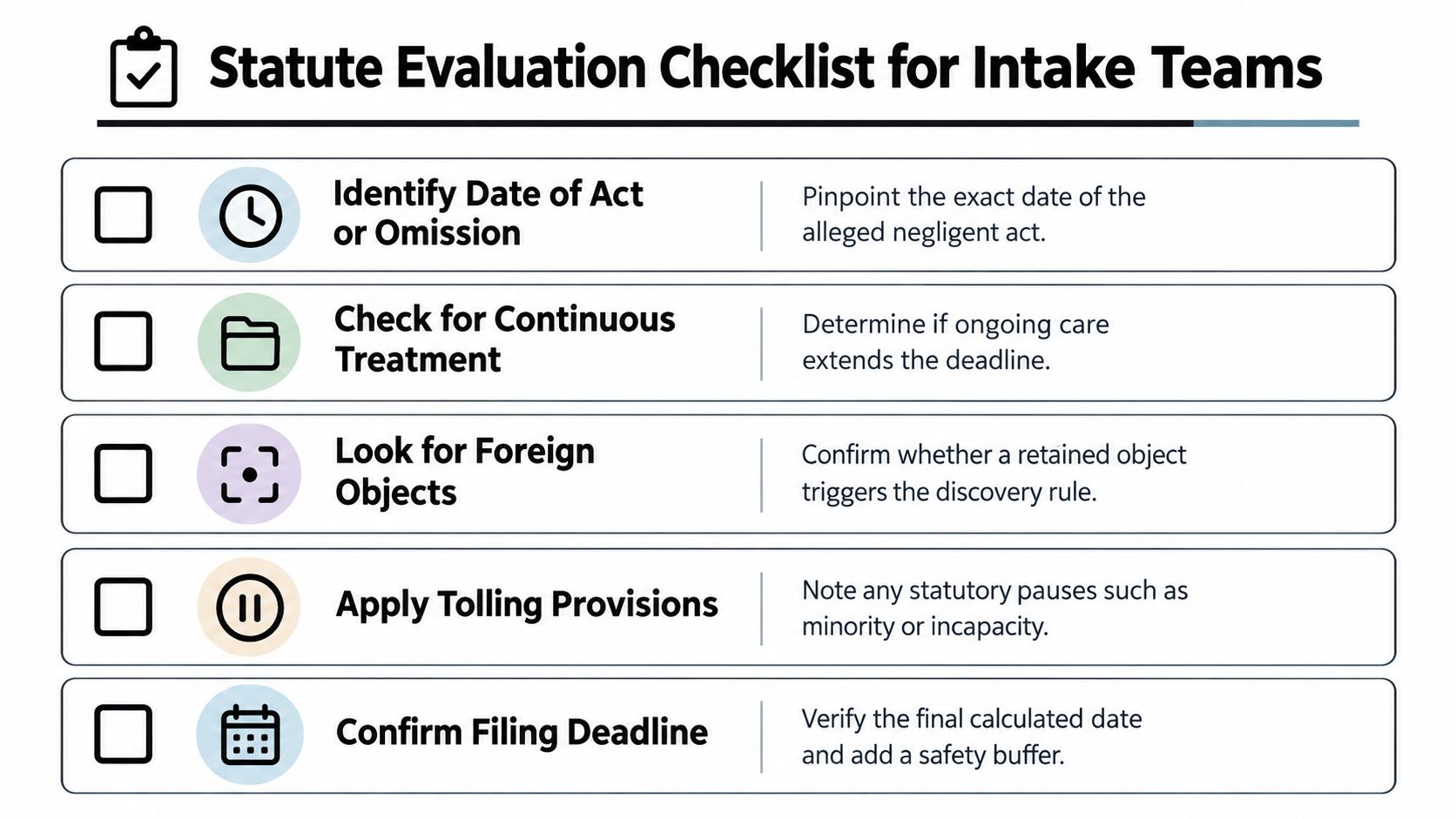
- Pinpoint the alleged act: What did the patient believe went wrong, and on what date did the relevant procedure, decision, omission, or failure occur?
- Identify every provider: Which physician, hospital, clinic, laboratory, or imaging facility participated? Don't treat the entire care network as one defendant.
- Describe each follow-up: Was the provider treating the same condition, adjusting care, planning a procedure, or checking the patient's status?
- Locate the final active treatment: What was the last encounter at which the defendant managed the condition?
- Test the exceptions: Was an unintended object discovered? Does the claim involve a qualifying cancer misdiagnosis? Are minority or incapacity issues present?
- Gather trigger records: Request operative notes, pathology, imaging, referrals, oncology records, and disclosure documentation when they may establish the relevant date.
- Confirm procedural status: Has a notice been served, an action commenced, or a prior attorney contacted the provider?
A paralegal reviewing a fragmented chart should flag gaps rather than fill them with assumptions. A blank interval may reflect discontinued care, a referral to another provider, a missed appointment, or an undocumented treatment plan. Each possibility has a different significance.
The team also should separate patient statements from record-supported dates. The client may remember when a doctor acknowledged an error, while the chart may show an earlier result, referral, or discussion. Preserve both, then have counsel assess which facts establish discovery or continuity.
Use a structured intake record that includes the date, provider, condition, encounter purpose, treatment status, and supporting document. A dedicated intake specialist workflow for law firms can help standardize the first review, but the attorney still must decide which facts support a legal exception.
The final intake product should state the earliest plausible deadline, the later dates that might support an exception, the evidence still missing, and the action required immediately. It shouldn't merely say “statute issue to be reviewed.”
Leveraging AI for Accurate Medical Chronologies
A firm handling fragmented medical care can't safely rely on memory, scattered notes, and a spreadsheet assembled at the end of intake. The records may contain duplicate dates, inconsistent provider names, delayed result entries, and follow-up visits that look similar but served different purposes. A missed distinction can turn a plausible continuous-treatment argument into an unsupported assertion.
AI-assisted review can organize that material before counsel makes the limitations decision. A platform can extract dates, providers, diagnoses, treatment events, referrals, and symptom changes, then present them in a chronology that the legal team can verify against source records. Used correctly, that process supports analysis. It doesn't replace attorney judgment about accrual, continuity, discovery, or tolling.
Design the workflow around verification
The useful output isn't a single “deadline” generated without explanation. It should show:
- The alleged event: What occurred and where the date came from.
- The treatment sequence: Which provider treated which condition and when.
- The encounter purpose: Whether the visit appears therapeutic, corrective, diagnostic, or administrative.
- The possible endpoint: Why a particular visit may represent the end of active treatment.
- The unresolved gaps: Which records or facts could change the conclusion.
- The source trail: The note, report, or record supporting each material date.
That structure makes the chronology more valuable for summary-judgment preparation and expert review. It also forces the team to confront uncertainty instead of hiding it behind a manually selected last visit.
Ares is one option for processing medical records into organized chronologies and extracting dates, diagnoses, treatment events, providers, and symptom history. The firm should still audit material entries, compare the output with the underlying records, and document the attorney's final limitations analysis.
Manual review remains necessary for legal classification, but manual transcription of every date is a poor control in high-volume practice. The safer approach combines automated extraction with human verification, source citations, and a deadline docket that preserves both the baseline calculation and any exception theory.
The strategic benefit extends beyond timeliness. A chronology that distinguishes active treatment from diagnostic review can sharpen liability analysis, expose missing records, improve expert preparation, and give the demand narrative a defensible sequence. The same timeline that protects against a limitations error can also explain causation and damages more clearly.
Ares helps personal injury firms turn hospital records, operative reports, nursing notes, and discharge summaries into organized, case-ready chronologies that support deadline analysis in fragmented-care claims. Upload the records, verify the extracted treatment sequence and source details, and visit Ares to build a repeatable review workflow for New York medical-malpractice intake.