

You open the plaintiff's chart expecting a timeline. Instead, you find a filing system. The emergency department note sits under physician documentation, the CT report is filed with radiology, the orthopedic assessment appears in an outpatient section, and physical therapy records follow their own sequence. The same accident date may appear repeatedly, with different descriptions of symptoms, mechanism, and treatment.
That's the central difficulty with a source oriented medical record. The chart may be complete, but the injury narrative isn't assembled for you. As a personal injury paralegal, I've learned that the fastest review isn't a frantic page-by-page read. It's a disciplined extraction process that separates source, date, provider, finding, and symptom progression before you attempt to write the story.
The Moment You Open a 600-Page Chart
The attorney has a demand deadline approaching. On the desk sits a printed chart with colored tabs projecting from the edges, or a PDF open beside a blank chronology. The table of contents looks organized until the review begins. Emergency department notes are grouped together. Radiology reports are elsewhere. Orthopedic follow-ups appear under an ambulatory provider section, while therapy documentation is buried near the end.
The first emergency note describes neck pain. The imaging section contains a report that uses different terminology. The orthopedic provider later records restricted motion and a more specific diagnosis. A therapy note mentions a functional limitation that never appears in the physician's narrative. None of these entries is necessarily wrong. They weren't written to form one legal narrative.
Practical rule: Don't form a causation opinion from the first section you open.
A source-oriented chart is designed for retrieval by department or provider stream, not for personal injury analysis. The model has historical value because it separated documentation into specialty-specific streams and made paper charts workable across multiple providers, as described in this review of medical record organization. That same separation creates the review burden.
Before reading, create a one-page source index. List the emergency department, imaging, surgery, orthopedics, primary care, nursing, therapy, pharmacy, ambulance, and any other sections present. Then record the earliest and latest date visible in each section. This simple step shows where the injury story may begin, where treatment changes, and which sources need cross-checking.
The objective isn't to read every page twice. It's to turn scattered entries into a defensible chronology, identify conflicts before the defense does, and preserve the source behind every important fact. A practical medical record organization workflow starts with that same principle: organize the chart before interpreting it.
What a Source Oriented Medical Record Actually Is
Think of a source-oriented medical record as a filing cabinet. Each drawer belongs to a department or provider type, and documents within that drawer are generally arranged by time. The radiology drawer contains imaging reports, the therapy drawer contains rehabilitation notes, and the physician drawer contains provider assessments. The drawers sit beside one another, but they don't automatically connect the clinical facts inside them.
Formally, a Source-Oriented Medical Record, or SOMR, organizes information by the source of documentation rather than by the patient's problem. Source and time operate together. A reviewer can usually find the latest note from a particular department quickly, then read that department's entries in chronological order. The JoVE explanation of source-oriented records describes this structure and its retrieval advantage.
Common sections include:
- Emergency department: Triage, presenting complaints, initial examination, treatment, and disposition.
- History and physical: Admission history, examination, relevant medical background, and initial assessment.
- Operative reports: Procedures performed, findings, complications, and postoperative instructions.
- Radiology and imaging: X-ray, CT, MRI, ultrasound, and other interpretive reports.
- Pathology: Tissue examination and diagnostic findings where applicable.
- Nursing notes: Observations, reported symptoms, care provided, and response.
- Consults: Opinions from specialists who evaluate the patient.
- Therapy and rehabilitation: Functional performance, tolerance, goals, restrictions, and progress.
- Outpatient follow-ups: Continuing assessments, referrals, medication changes, and work status.
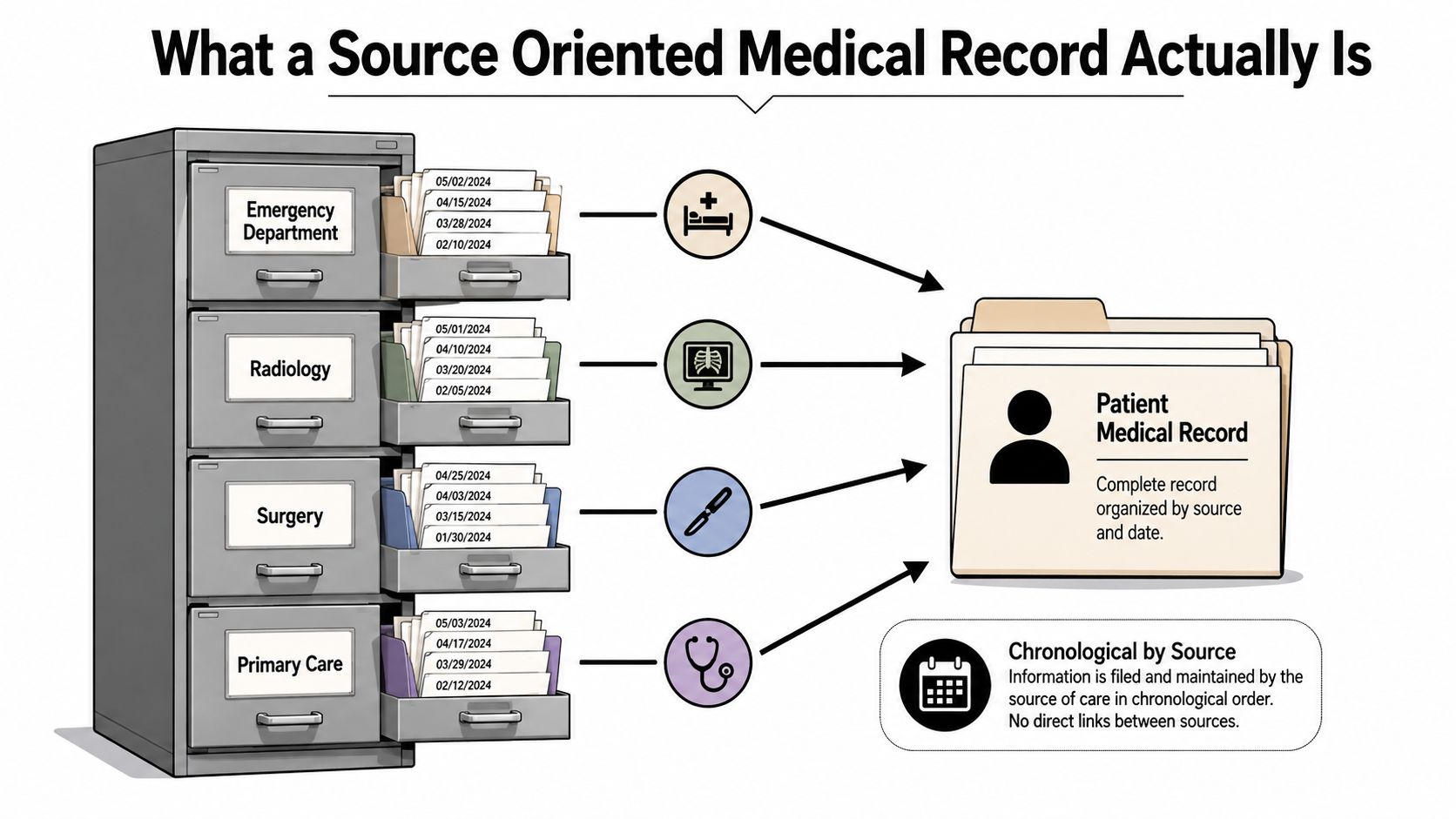
Each source also has its own shorthand and priorities. An emergency clinician may document acute complaints and rule-out testing. A radiologist focuses on image interpretation. An orthopedic provider may emphasize range of motion, neurologic findings, and treatment options. A therapist records what the patient can do, how symptoms affect activity, and whether function improves with treatment.
That difference matters in litigation. SOMR is a documentation model, not a legal chronology or a case narrative. It can show who documented a fact and where that fact originated, but counsel must connect the entries carefully. The record's organization explains both its greatest strength, source accountability, and its most important weakness, fragmented clinical context.
How SOMR Compares to Problem-Oriented and Chronological Records
For PI review, the useful question isn't which record format is universally superior. The useful question is what each format lets you find quickly, what it hides, and how much reconstruction the reviewer must perform.
A problem-oriented medical record, or POMR, organizes documentation around numbered patient problems and commonly uses SOAP entries. A chronological record emphasizes sequence, often placing the most recent documentation first or presenting encounters in date order. SOMR preserves each department's documentation stream, which helps establish source and note lineage but separates facts that belong to the same injury.
| Criterion | SOMR | POMR | Chronological |
|---|---|---|---|
| Locate entries tied to a body part or diagnosis | Requires searching multiple source sections | Usually efficient if the problem list is complete | Efficient when entries are consistently indexed |
| Reconstruct clinical decisions | Requires cross-source synthesis | Strong when each decision is linked to a problem | Shows sequence, but context may be thin |
| Defensibility when one section is read alone | Strong for source attribution, weaker for overall narrative | Strong for defined problems, dependent on accurate problem assignment | Strong for sequence, weaker for discipline-specific detail |
SOMR works well when the task is narrow. If you need to verify a radiology impression, identify the provider who wrote a consultation, or locate therapy's functional observations, the dedicated source section is useful. The problem begins when the legal question spans sources, such as whether symptoms persisted, whether a diagnosis developed over time, or whether treatment followed a continuous path.
POMR can make longitudinal problem tracking easier, but it has its own limits. A stale or incomplete problem list can exclude relevant facts, and a provider treating several unrelated conditions may not consistently assign every entry to the right problem. Chronological organization gives a reviewer speed during recent-event review, yet it may not preserve the full clinical reasoning of each specialty.
A clean date order doesn't automatically create a clean causation analysis.
For attorneys, the practical answer is not to replace the chart's format. It's to extract the chart into a litigation-ready format. A detailed medical record chronology approach helps convert source-based entries into the sequence needed for liability, causation, damages, and witness preparation.
Why Source-Based Fragmentation Is the Real PI Review Problem
The risk isn't that SOMR lacks information. The risk is that relevant information sits in separate departmental compartments, and no single entry explains how all of it fits together. A physician note may mention persistent pain without detailing the functional limitation recorded by therapy. A radiology report may contain the most important objective finding, while the treating provider's note only says that imaging was reviewed.
That structure forces the reviewer to reconstruct three things manually: causation, treatment continuity, and symptom evolution. The process becomes harder when entries repeat the same history with small differences, use department-specific abbreviations, or record different dates for the same encounter. A missed specialist note can obscure a pre-existing condition. A missed imaging report can make a later diagnosis appear unsupported. A gap in therapy can be mistaken for recovery when it may reflect authorization, referral, transportation, or an undocumented change in care.
The verified descriptions of SOMR consistently identify this fragmentation trade-off. Source separation improves retrieval within a department, but it makes cross-specialty synthesis harder when the patient's care involves overlapping conditions or pathways, as explained in this source-oriented medical record overview.
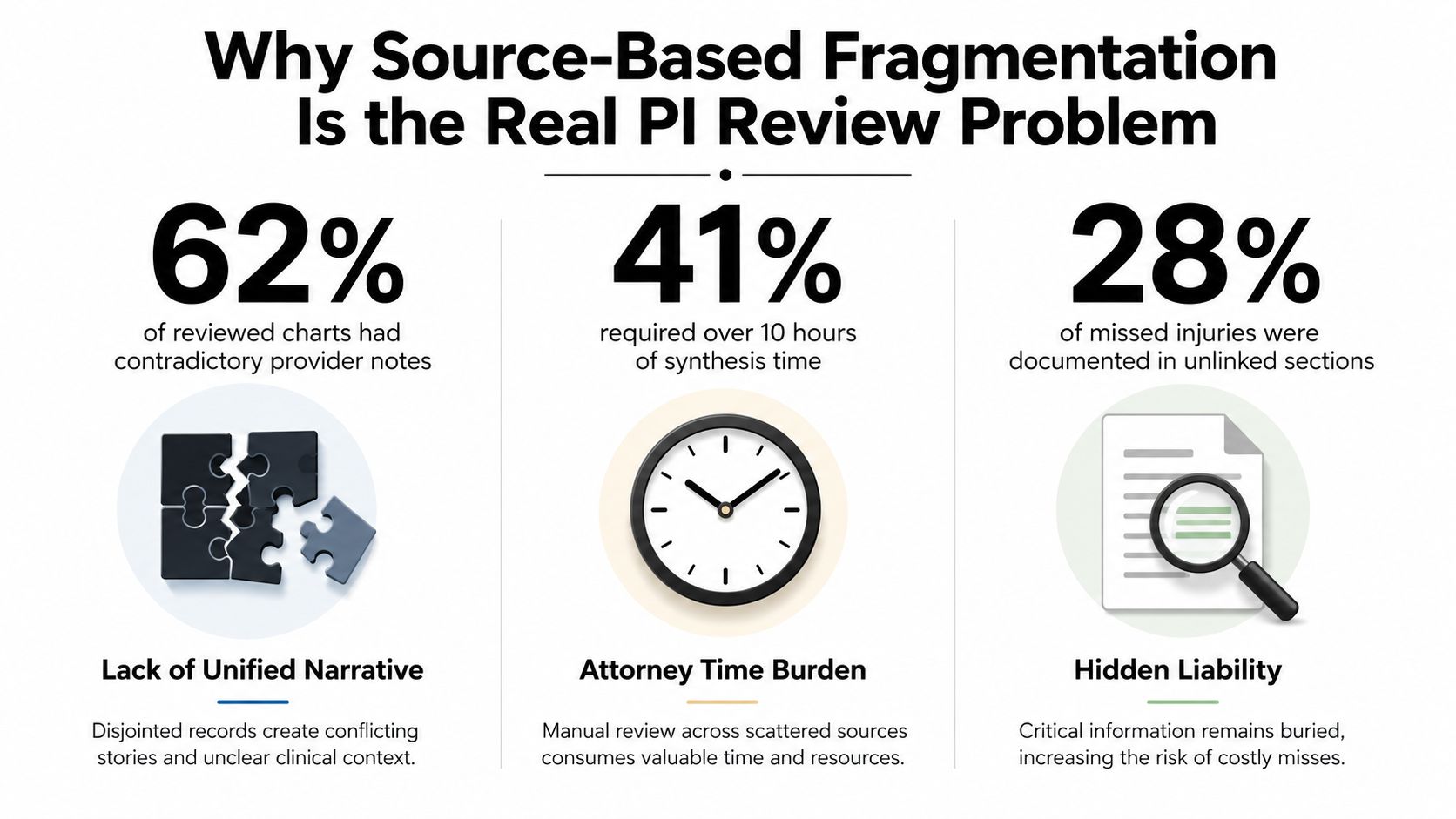
In a demand review, that fragmentation can weaken the presentation even when the underlying treatment supports the claim. The demand may omit the first documented complaint, fail to connect a later diagnosis to earlier symptoms, or overlook a provider statement that limits an alternative explanation. Insurers can then characterize the chronology as incomplete or inconsistent.
The answer isn't to treat every discrepancy as proof of fraud or negligence. Treat it as a verification issue. Preserve the exact source, identify whether the difference is a patient history, objective finding, diagnosis, or provider interpretation, and state what the chart establishes without overstating what it doesn't.
A Step-by-Step Extraction Workflow for SOMR Review
Start with structure, not conclusions. The following workflow keeps the source trail visible while producing the chronology an attorney can use.
Build the source map first
Create an index with one row for every section. Include emergency care, ambulance records, radiology, surgery, orthopedics, primary care, therapy, nursing, pharmacy, consultations, and billing if those materials are included. Record the provider or facility associated with each section and note whether the section appears complete.
This prevents a common failure, reading the chart in the order the PDF presents it and assuming that order reflects the patient's experience.
Harvest dates and providers
Next, collect the date, time when available, provider, facility, document type, and page reference for every clinically meaningful entry. Keep duplicate dates rather than deleting them. Multiple entries on one date may show different observations, and apparent conflicts often become understandable once you separate triage, imaging, treatment, and discharge documentation.
A medical record chart review template can provide a repeatable place to capture these fields.
Sort diagnoses, procedures, and imaging findings by source
Create separate buckets for diagnoses, procedures, imaging, referrals, and restrictions. Label each item with the originating source. Don't attribute a radiologist's impression to the treating physician unless the physician independently adopts it. Likewise, don't treat a billing diagnosis as equivalent to a narrative clinical assessment without checking the underlying note.
Track symptoms beside objective findings
For every encounter, place the patient's reported symptoms next to the provider's objective findings. Record body part, side, intensity when documented, range of motion, neurologic complaints, tenderness, weakness, functional limitation, and changes from the prior entry.
The contrast often matters. A patient may report continuing pain while an examination shows improvement, or therapy may document limited function that does not appear in a brief follow-up note. Those are not automatically contradictions. They are different evidence points that require context.
Verify continuity before finalizing
Cross-reference medications, referrals, work status, restrictions, procedures, and follow-up instructions. Then run a final check:
- Date verification: Confirm encounter dates against the document metadata and source section.
- Provider verification: Distinguish the ordering provider, performing provider, interpreting provider, and referring provider.
- Diagnosis verification: Identify when a diagnosis was first reported, first assessed, and later confirmed or revised.
- Gap review: Mark unexplained treatment pauses, missed appointments, delayed referrals, and absent results.
- Conflict review: Compare mechanism, prior history, symptoms, examination, imaging, and functional status across sources.
- Page preservation: Keep the page citation for every fact that will appear in a demand, pleading, or deposition outline.
The final chronology should let another reviewer move from summary to source without guessing where a statement came from.
Reading a Real Case Across Multiple Source Sections
Consider a motor vehicle collision followed by a soft-tissue neck injury. The example below shows why no single section carries the full narrative.
The emergency department records the initial neck complaint and a negative CT. It may document pain and discharge instructions without fully developing the mechanism or explaining how symptoms changed after discharge. Two weeks later, the orthopedic note records restricted range of motion and provides the first formal whiplash diagnosis. That note adds clinical interpretation, but it may not repeat every detail from the emergency encounter.
The MRI report then contributes an objective finding, a disc herniation, that wasn't visible in the earlier CT record. Physical therapy documents function over the treatment course, including restrictions and the patient's reports of pain during activity. A primary care follow-up later records radiculopathy symptoms and connects the ongoing course to a surgical recommendation. Each section supplies a different layer.
| Source Section | Date Range | Key Findings | Symptom Documentation |
|---|---|---|---|
| Emergency department | Collision date and initial visit | Neck complaint, examination, CT result, discharge plan | Initial pain and acute complaints |
| Orthopedics | Follow-up after emergency care | Restricted motion, formal whiplash assessment, treatment plan | Ongoing neck pain and examination-related limitations |
| MRI facility | Imaging appointment and report | Disc finding and radiologist's impression | Symptoms may appear in the indication, not the full clinical history |
| Physical therapy | Treatment course | Functional testing, exercises, tolerance, restrictions | Activity-related pain, limitations, and progress |
| Primary care | Later follow-up | Radiculopathy assessment and surgical referral or recommendation | Evolution from local neck pain to radiating symptoms |
The extraction move at each stop is consistent, but the emphasis changes. From the emergency section, capture the first complaint, mechanism details, examination, imaging ordered, result, and discharge instructions. From orthopedics, capture the provider's diagnosis, objective restrictions, prior-history discussion, and next treatment decision. From MRI, preserve the report's exact finding and date. From therapy, record function and work impact. From primary care, identify when the symptom pattern changed and what decision followed.
The final narrative should not say that “the chart shows neck pain.” It should show when the complaint began, how providers described it, what objective findings emerged, how function changed, and which source supports each step.
Common Pitfalls When Reviewing Source Oriented Records
The first mistake is treating the chart as one cohesive document. It isn't. Each section has a different purpose, author, workflow, and threshold for detail.
Mistakes that distort the narrative
Reading the PDF in page order: PDF order reflects compilation, not necessarily the sequence of care. Build a chronology before deciding what happened.
Accepting the first diagnosis: The first diagnosis may be provisional, symptom-based, or limited by the setting. Check imaging, specialist assessments, operative reports, and later revisions.
Ignoring ambulance and triage material: The first account of mechanism and symptoms may appear before the main emergency department note. Those entries can establish what was reported closest to the event.
Missing consultant notes: A consultant's assessment may be filed separately from the treating team's progress notes. Search every specialty section before concluding that no opinion exists.
Treating every pain visit as index-injury treatment: Pain management documentation may address several conditions. Confirm the body part, diagnosis, history, and treatment purpose before including it in the injury sequence.
Assuming a gap proves improvement: A missing entry proves only that the reviewed material contains no documentation for that interval. Look for referrals, authorization records, work notes, later histories, and outside-provider records.
A better review posture
Radiology should be reviewed as its own source, not merely as a sentence copied into a physician note. Therapy should be read for function, not just treatment attendance. Primary care should be checked for prior complaints and intervening conditions that may affect causation.
Verification standard: Every material conclusion should answer three questions, who documented it, when, and what kind of fact is it?
The consequences of small omissions compound. If the chronology misses an early complaint, the defense may argue delayed onset. If it misses a treatment gap, the defense may argue noncompliance. If it misses a prior symptom in a specialist note, the causation analysis may look incomplete. A careful reviewer doesn't hide these issues. The reviewer identifies them, explains them, and preserves the supporting source.
Putting the Framework to Work on Your Next Case
A repeatable SOMR workflow can be reduced to four passes:
- Triage pass: Build the source map, identify the injury date, list providers, and locate likely gaps.
- Source pass: Extract dates, diagnoses, procedures, findings, symptoms, restrictions, and page citations within each section.
- Reconstruction pass: Merge the entries into a true chronology and compare subjective complaints with objective findings.
- Liability pass: Flag conflicts, prior conditions, delayed diagnoses, treatment gaps, missing follow-ups, and unresolved questions.
Each pass produces a case deliverable. The triage sheet supports the initial liability theory. The source pass supports the damages model. The reconstructed chronology supports the demand letter. The gap and conflict analysis supports deposition preparation and discovery requests.
AI-assisted review can speed the mechanical work of locating providers, dates, diagnoses, treatments, and source references across large records. Ares is one option that turns uploaded medical records into organized chronologies, treatment timelines, billing ledgers, and source-cited answers for cross-checking treatment details. Human judgment still controls causation, the meaning of a gap, the weight of conflicting histories, and the strategy presented to the insurer or jury.
Standardize the process before the next deadline arrives. When every reviewer starts with a source map and ends with verified cross-source synthesis, fragmented charts become manageable evidence rather than an obstacle.
If your team spends too much time reconstructing scattered records, visit Ares to organize medical chronologies, treatment details, and source-level findings from uploaded case files. Use it to support the manual review process, verify key dates and diagnoses, and build a clearer foundation for demands and litigation strategy.